
Judge, 1883-11-10 · page 2 of 16
Judge — November 10, 1883 — page 2: what you’re looking at
What you’re looking at
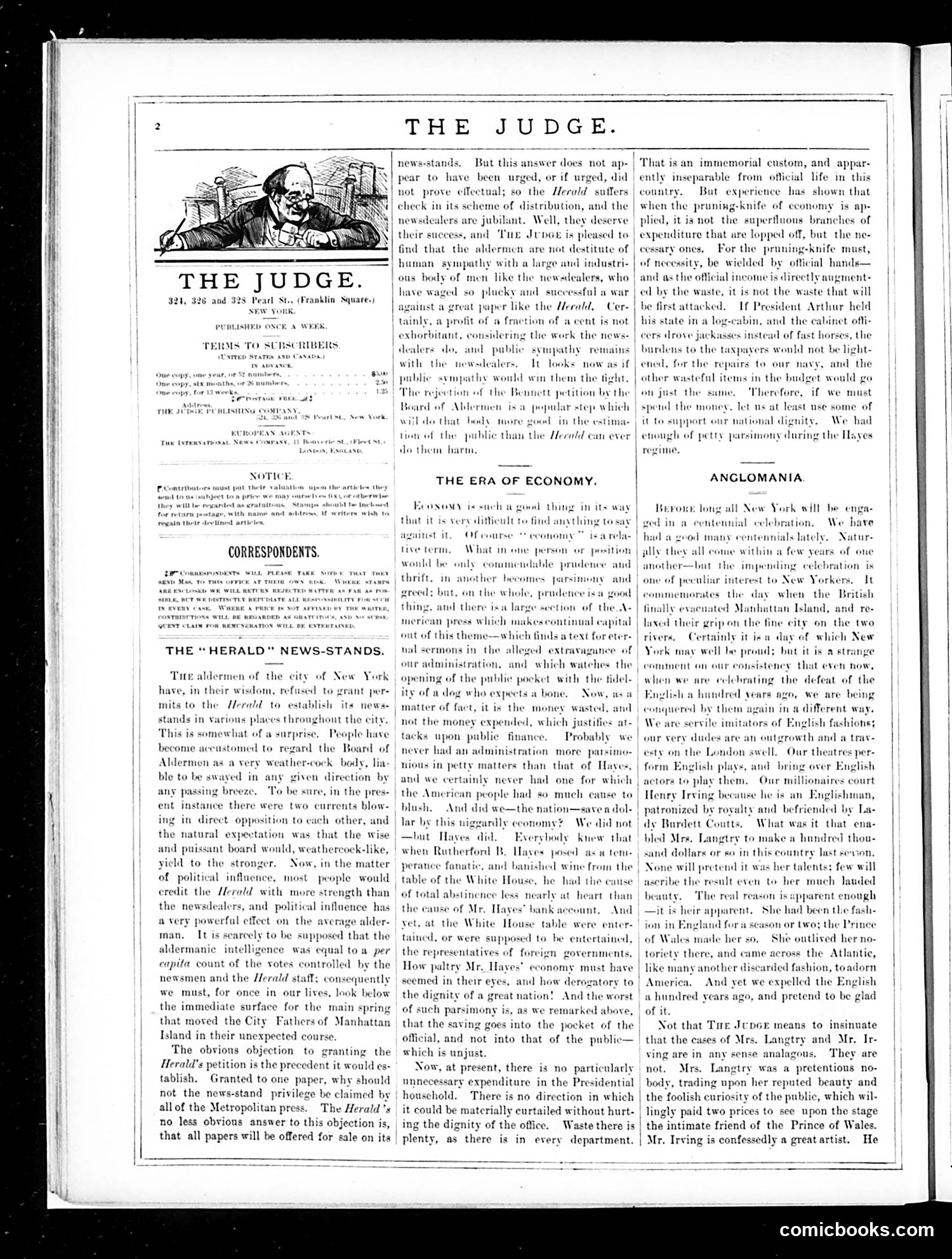
The cartoon depicts a dispute between New York's Board of Aldermen and the *Herald* newspaper over establishing news-stands throughout the city. The Aldermen refused permits, which *Judge* satirizes as hypocritical—they claim to oppose precedent-setting, yet the real reason appears to be political pressure from news-dealers threatened by competition. *Judge* mocks the Aldermen as weathervanes, easily swayed by influence. The magazine defends the *Herald's* petition while grudgingly acknowledging public sympathy favors the news-dealers. The underlying criticism targets corrupt municipal government: aldermen prioritize political pressure over logical governance, claiming principle while serving special interests. This reflects broader Progressive-era concerns about urban political machines. The second article satirizes government "economy" measures, contrasting President Hayes's publicized temperance with his actual financial dealings—another jab at hypocrisy masquerading as virtue.
📄 Transcribed text from this page (OCR, searchable)
Machine-transcribed from the original scan — historical spelling and the odd misread are preserved.
THE JUDGE. | their suce N THE JUDGE. 324, 326 and 328 Pearl St NEW YORK Franklin Square.) PUBLISHED ONCE A WEEK. TERMS TO SUBSCRIBERS. fk aE E Pe MLISIING CoMAsy EAN AGENTS THE *“ HERALD" NEWS-STANDS. Tue aldermen of th have, city of New in their wisdom, refused to Herald to. establish stands in various places throug! York rant pers mits to the news out the eity, This is somewhat of a surprise. People have and the Board of ther-cock body, lia riven direction by be su becom med to. re Aldermen as a very we ble to be wayed in any any passing breeze, ent inst e, in the pres- e the e two currents blow- ing in direct opposition to cach other the natural expectation was th and it the wise cathercock-like, w, in the matter and puissant board would yield to the stron of political influence, most people would credit the Herald with more strength than the newsdealers, and political influence has a very powerful effect on th ler- It is that the aldermani toa per ed by the newsmen and the Herald staff; consequently must, for once in our lives, look be the immediate surface for the main spring that moved the City of Manhattan Island in their unexpected course, The obvions objection to granting the Herald's petition is the precedent it would es- tablish. Granted to one paper, why should not the news-stand privilege be claimed by allof the Metropolitan press. The Herald's no less obvious answer to this objection is, that all papers will be offered for sale on its man. arcely to be intel capita count of the votes controll we Fathe 7 But this answer does not ap- | That isan immemorial custom, and appar- to have been urg {not prove elfectual; so t d, or if urged, did e Herald suffers tribution, and the . Well, they deserve ‘Te Junot is pleased to | find that the aldermen are not destitute of | human check in its scheme of ¢ ympathy with a large and industri- {men like the rs, who ed so plucky and. snecessful a war ainst a great paper like the Herald. Ce tainly, a profit of a fraction of a cent is not exhorbitant, consideri ous body new have wa he work the new dealers do, and public sympathy remains with the lealers. It looks) now as if public sympathy wonld win them the fight, v af the Bennett petition by the Board of Aldermen isa popular step which wilde that bods more i new al in the public than the Herald can ever do them harm, THE ERA OF ECONOMY. Eeosowy is sucha thing in its w pat it is very dittieult ‘find anything tos hist it eurse “ eeonomy i What in one per would be only commendat thrift. tive term, nor position e prudence and in ther becomes my and greed: bu thin mn the whole, and there isa lar whieh mak out of this theme—wh. nal set merican pr finds a text for eter- mons in the all vance of our nistration, opening of the publ ind whieh wateh pocket with the tidel- Now, money was! ity of a dog who expects a bone. matter of fact, itis the not the money expen¢ whieh justif P W administration more ] nious in petty matters than that of Hayes, and we certainly never had one for which the American people blush, And did we- lar by this niggurdly e« We did not Hayes did. Knew that when Rutherford B. Hayes posed. asa tem- perance fanatic, and banished wine from the table of the White House, he had tt of total abstinence less nearly a the cause of Mr. Hayes” bank acc at the White [He ble were tained, or were supp tacks upon public fi never hac ad so much cause to he nation—save adol- OMY F —hut Sveryvbody untse heart than And enter- unt, <i to be entertained, the representative foreign governments, How paltry Mr, Hayes? seemed in their ey economy must have and how derogatory to the dignity of a great nation! And the worst of such parsimony is that the savi 8 We remarked above, goes into the pocket of the official, and not into that of the public— which is unjust at present, there is no particularly unnecessary expenditure in the Presidential household. There is no direction in which it could be materially curtailed without hurt- ing the dignity of the office. Waste there is plenty, as there is in every department. | Mr. Irving is confessedly a great artist. | oth ently inseparable from official life in this But has shown that when the pruning-knife of economy is ap- plied, it is not the superfluous branches of expenditure that are lopped off, but the ne- cessary ones. For the pruning-knife must, f necessity, be wielded by official hands— nd as the official ine country, experience mie is directly augment: ed by the waste, it is not the waste that will irstattacked. If President Arthur held his state in al bin, and the cabinet offi- Trove jackasses instead of fast hors burdens to the taxpayers would not be] cer ened, for the repairs to our navy, and the r wasteful items in the buc on just the Therefo spend the money, let it to support our mati ret would go ve, if we must We had of petty parsimony during the Hayes ANGLOMANIA. Kowill he enga- We have Natur- ally they all come within a few years of one tion. Timany contennials latel another—but the impending celebration is one of peculiar interest to New Yorkers. It ommemorates. the the British finally evacuated Manhattan Island, and re- laxed their grip on the fine city on the two ainly it isa day of which New well he proud: but it is a strange day when rivers, York comme our eonsisteney that even now, when we are celebrating the defeat of the English a hundred veara ago, we are being conquered by them again ina different way. We ‘ors of English fashionsy owth and a trav- Our th ud bring over servile imit ry dude esty on the Le form English pla actore to play them. Henry Irving be« nglishman, patronized by royalty and befriended by La- dy Burdett Coutts. What was it that’ ena- bled Mrs, Langtry to make a hundred thou- sand dollars or 0 in this country last sewon, None will pretend it was her talents ascribe the result even to her much The real —it is heir apparen ure an outy on awell. atres per- “nglish Our millionaires court ase he is an beanty. nis ay She had been the on or two; the Prince uitlived her no- the Atlantic, shion, toadorn marent er ion in England fora of Wales mad toriety ther like many another discarded And yet we expelled the English a hundred years ago, and pretend to be glad of it. Not that Ti her se JvpGE means to insinuate Langtry and Mr. Ir- ving are in gous. They are Mrs. Langtry was a pretentious no- body, trading upon her reputed beauty and the foolish curiosity of the public, which wil- lingly paid two prices to see upon the stage the intimate friend of the Prince of Wales. He not. comicbooks.com