
A complete issue · 16 pages · 1883
Judge — October 27, 1883
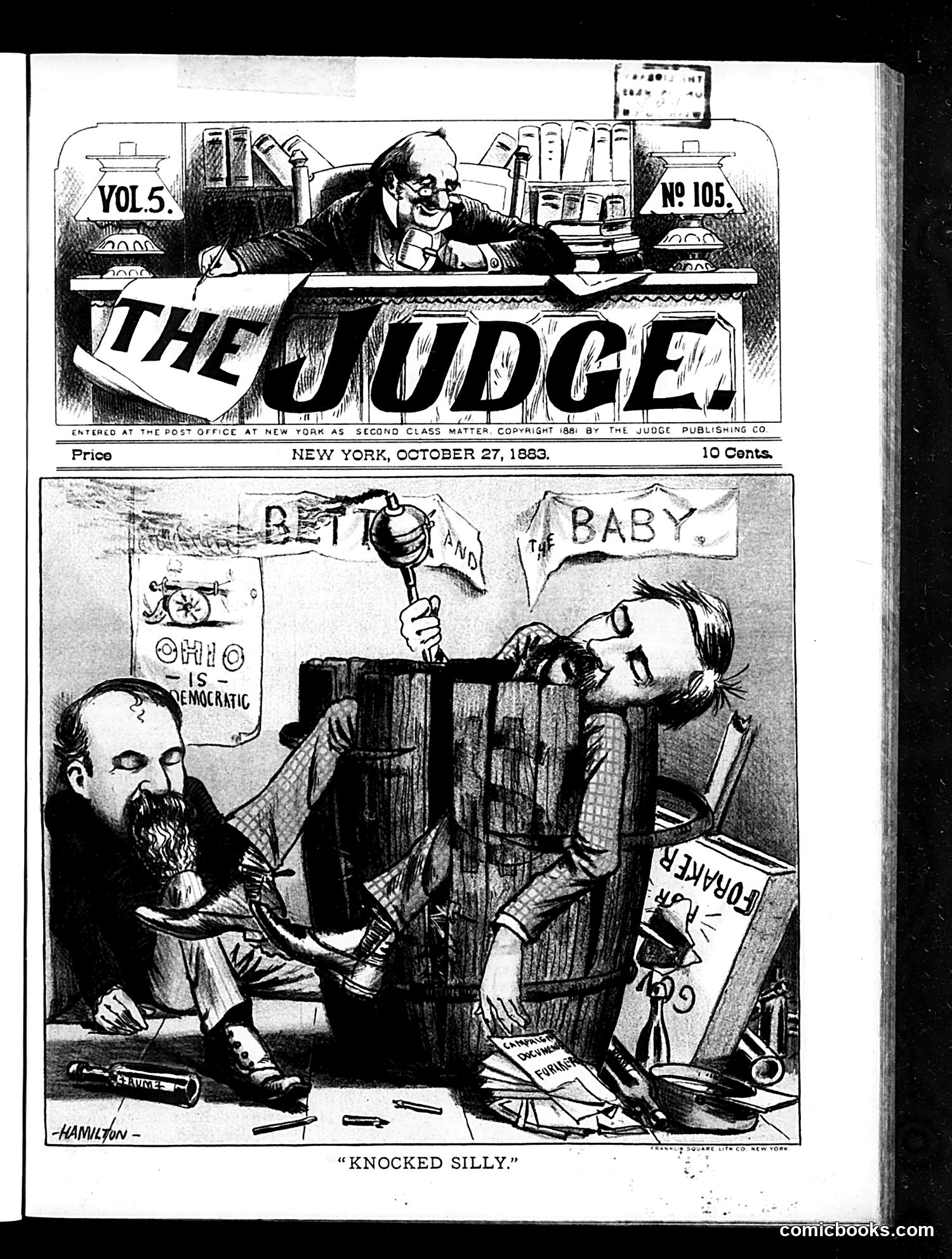
This political cartoon by Hamilton satirizes the 1883 Ohio gubernatorial race. The bearded figure on the left appears to represent a Democratic politician, depicted as a cradle-rocking baby with a rattle labeled "BABY" and text reading "OHIO IS DEMOCRATIC." The figure on the right, wielding a mallet, represents the Republican opposition, literally "knocking silly" the Democrat's claims about Ohio's Democratic allegiance. The scattered papers and tools suggest the destruction of political arguments. The satire mocks Democratic confidence about controlling Ohio—a crucial swing state—suggesting Republicans would decisively defeat Democratic pretensions through electoral force. This reflects the intense partisan battles of the Gilded Age, when control of states like Ohio determined national political power.
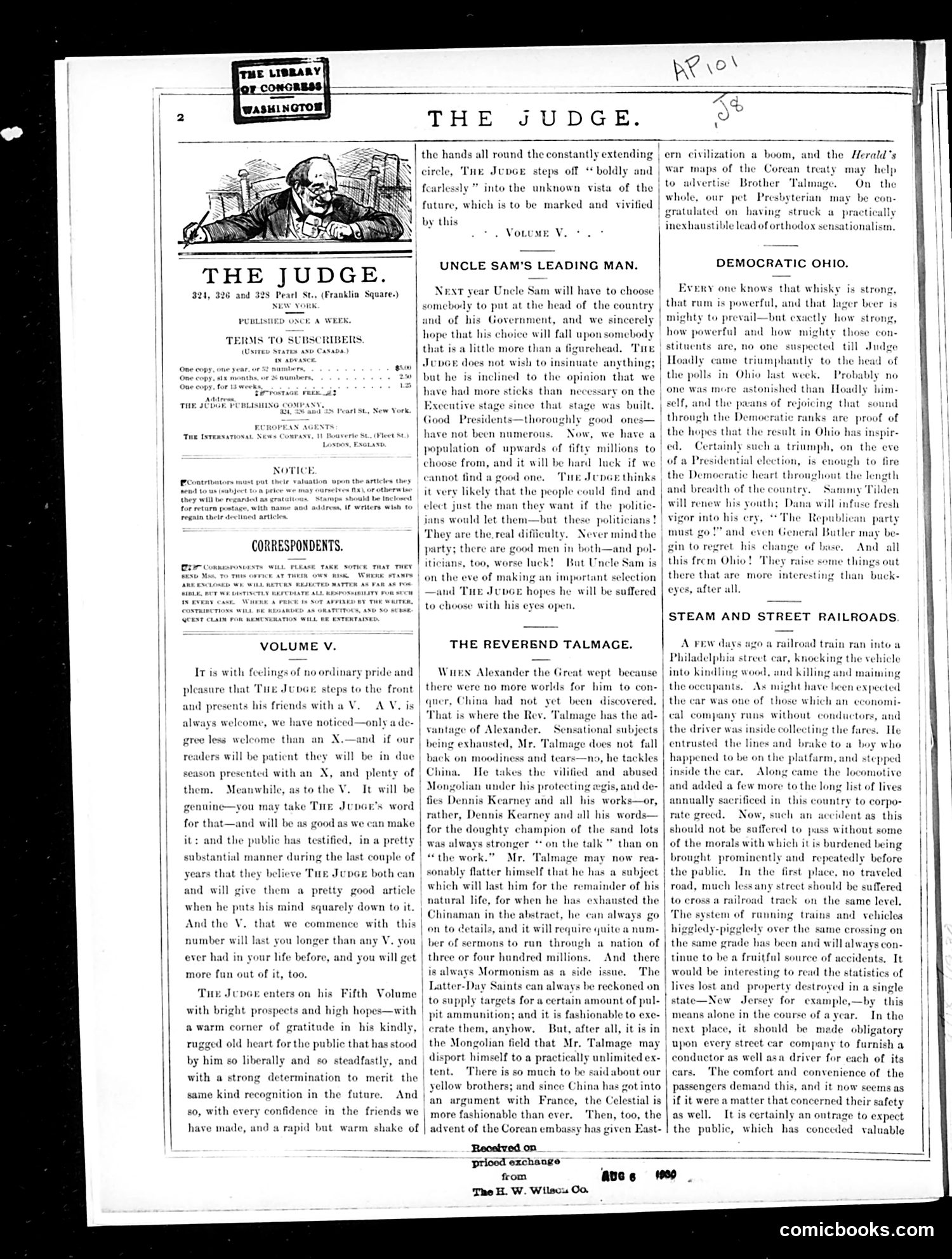
This is the introduction to *Judge* magazine's fifth volume. The main editorial cartoon depicts the magazine's mascot personifying *The Judge* himself, stepping boldly into the future. **Key content:** 1. **"Uncle Sam's Leading Man"**: Commentary on the upcoming presidential election. *Judge* argues that while Americans *could* elect the right candidate if left alone, corrupt politicians manipulate the process. The piece advocates for a genuine leader rather than a "figurehead." 2. **"The Reverend Talmage"**: Satirizes evangelist Thomas De Witt Talmage, known for sensational sermons. The piece jokes that unlike Alexander the Great (who conquered all known worlds), Talmage has infinite sermon material—particularly in attacking Chinese immigrants and Mormonism, allowing endless moral crusades. The magazine positions itself as a voice of political and social criticism, using humor to mock both political corruption and religious sensationalism.
This page contains three distinct opinion pieces rather than visual cartoons: **"When Doctors Disagree"** criticizes the medical profession's rigid etiquette. It satirizes the bitter rivalry between allopathic (conventional) and homeopathic doctors, mocking that patients suffer when doctors refuse professional consultation with rival practitioners. The piece advocates "common sense" over professional rules—a jab at medical establishment inflexibility. **"Mr. Colville's Supers"** addresses a theater accident involving injured supernumeraries (extras). Judge had previously criticized theater manager Colville's handling of the incident; Colville responded angrily in another publication. Judge defends its criticism, sarcastically noting Colville's sensitivity while asserting the magazine's right to comment on public safety matters. **"The Plancus Ring" and related verses** appear to be satirical poetry about political corruption or electoral manipulation, though specific references are unclear without additional context. The page demonstrates Judge's role as social and professional critic, targeting institutional hypocrisy and negligence.
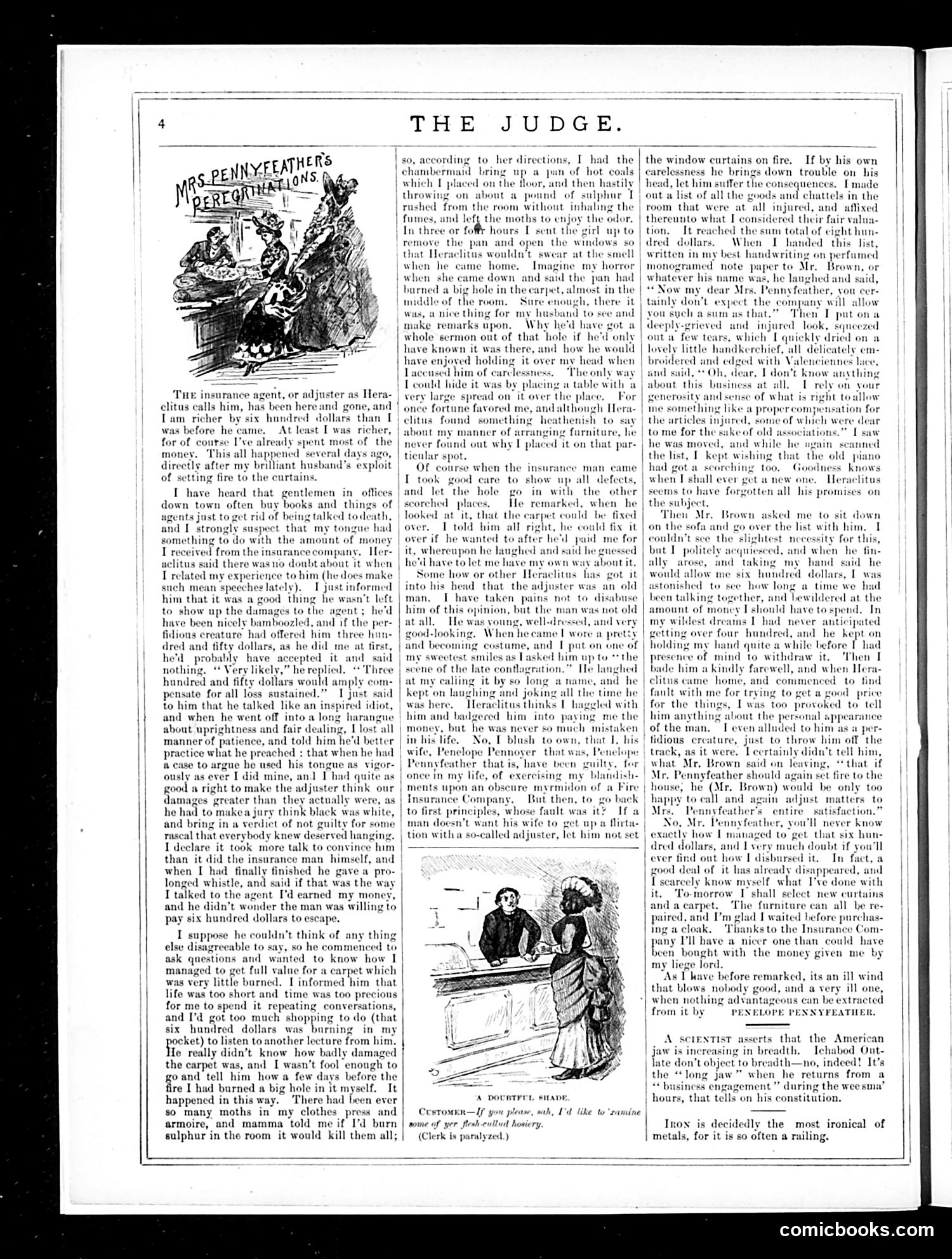
This page satirizes a woman's successful insurance claim following a fire. The central figure is **Mrs. Pennyfeather**, who narrates how she manipulated an insurance adjuster into paying $600 for carpet damage. **The satire's targets:** - **Insurance fraud**: Mrs. Pennyfeather deliberately hid a pre-existing burn hole she'd made with sulphur (used to kill moths in her wardrobe) and claimed the fire caused all damage - **Female verbosity**: The piece jokes that her relentless talking—her "tongue"—wore down the adjuster, making him pay just to escape her conversation - **Marital dynamics**: Her husband Heraclitus is portrayed as pompous and oblivious; she outsmarts both him and the insurance agent **The humor works on multiple levels**: the woman's clever dishonesty, her awareness of how her talkativeness is weaponized, and the adjuster's defeat by conversation rather than evidence. The illustration shows the adjustor examining the carpet while Mrs. Pennyfeather stands nearby—visually capturing the moment of deception. This reflects Victorian anxieties about insurance fraud and satirizes both insurance companies' vulnerability and women's cunning domesticity.
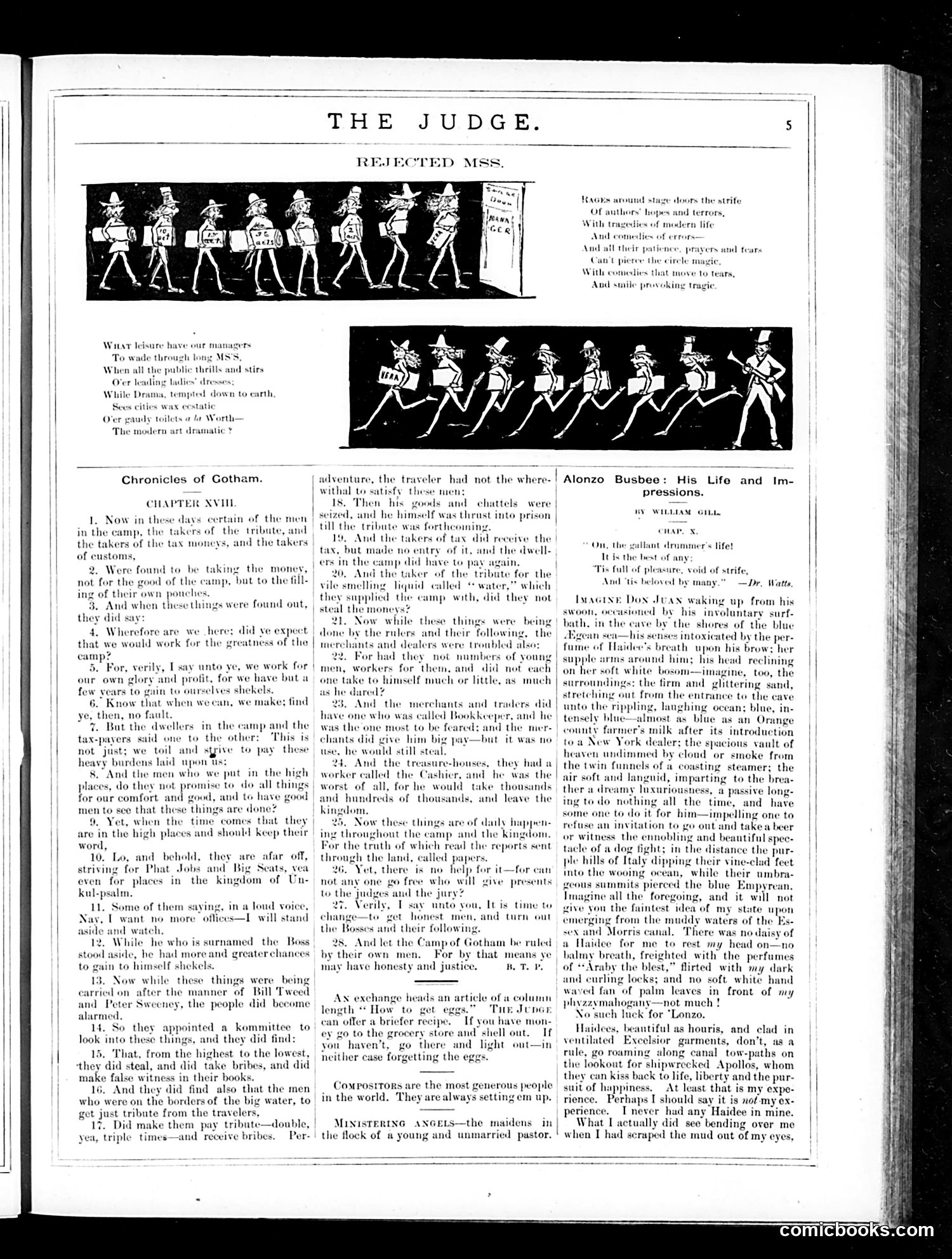
This page satirizes **political corruption in New York City government**, likely during the Tammany Hall era (references to "Bill Tweed" appear in the OCR text). The main content is "Chronicles of Gotham," a biblical-style parody describing how officials in a camp (the city) systematically steal tax money and bribes for personal profit rather than public good. The passage mocks: - **Tax collectors and customs officials** who embezzle funds while claiming they work "for our own glory and profit" - **Corrupt judges and bureaucrats** who steal at every level - **Merchants complaining** they must pay triple tribute to dishonest border officials The satire uses mock-serious religious language ("And the takers did receive...") to expose how pervasive corruption had become—from highest officials down to customs agents at ports. The accompanying illustrations show skeletal or ghostly figures, likely representing the corrupt officials as moral corpses. The joke is that such systematic theft is treated almost matter-of-factly, as if it's simply how government operates.
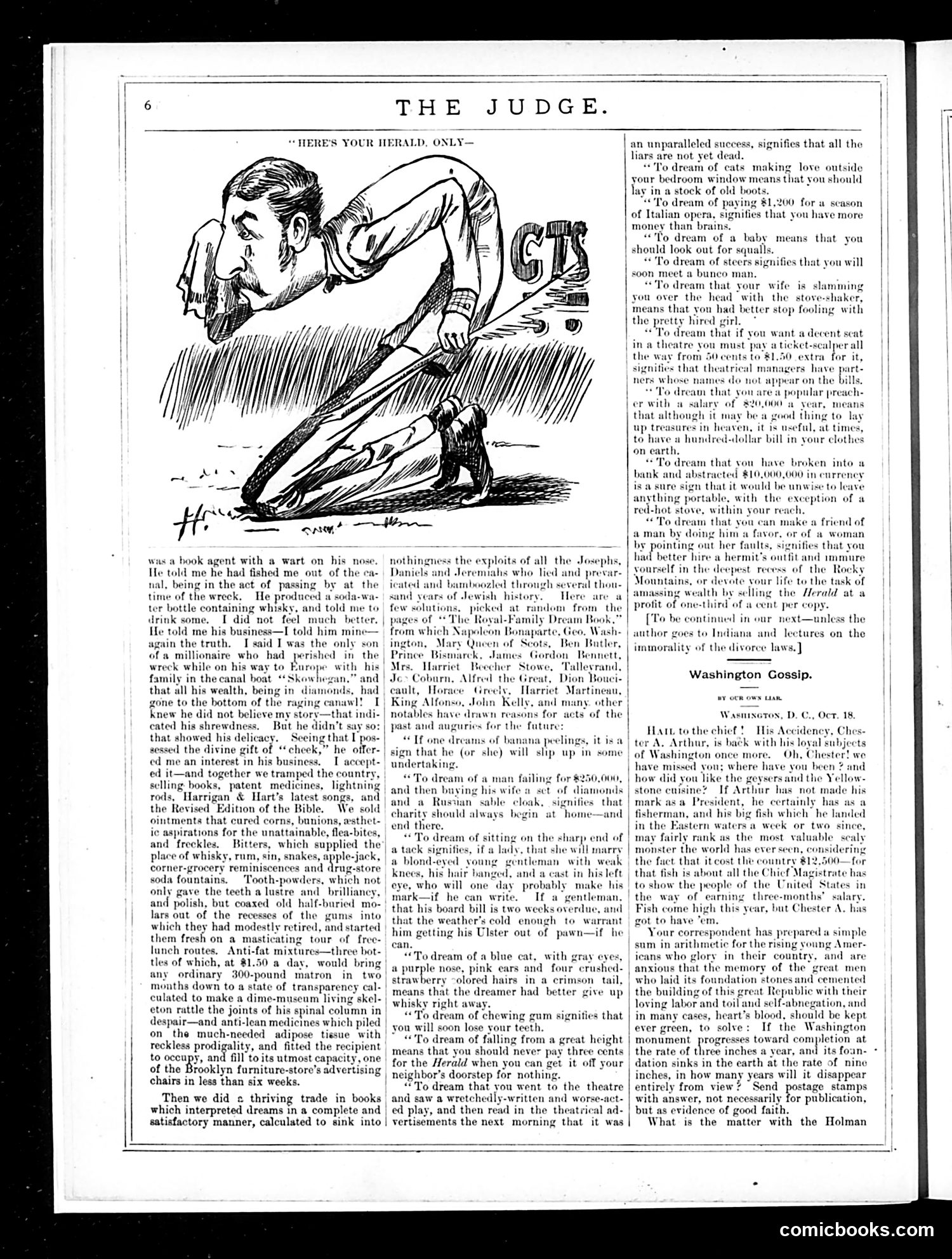
This page satirizes con artists and dream-interpretation scams popular in the late 19th century. The cartoon depicts a disheveled man with a wart being offered a "herald" (newspaper) — likely mocking fraudulent dream books that were widely sold. The text describes two swindlers who traverse America selling bogus products: fake medicines (tooth powders, weight-loss pills), lightning rods, and especially dream-interpretation books. These books claimed to decode dreams' meanings — a profitable fraud targeting credulous customers. The satirical "dream definitions" ridicule the entire enterprise. Examples include absurd predictions (dreaming of a blue cat with strawberry hairs means quit drinking) and cynical jokes (dreaming of the Herald newspaper itself becomes self-referential mockery). The satire targets both the con men exploiting people's superstitions and the gullible public believing in such nonsense. Judge magazine frequently attacked fraudulent schemes and patent medicines that plagued American consumers during this era.
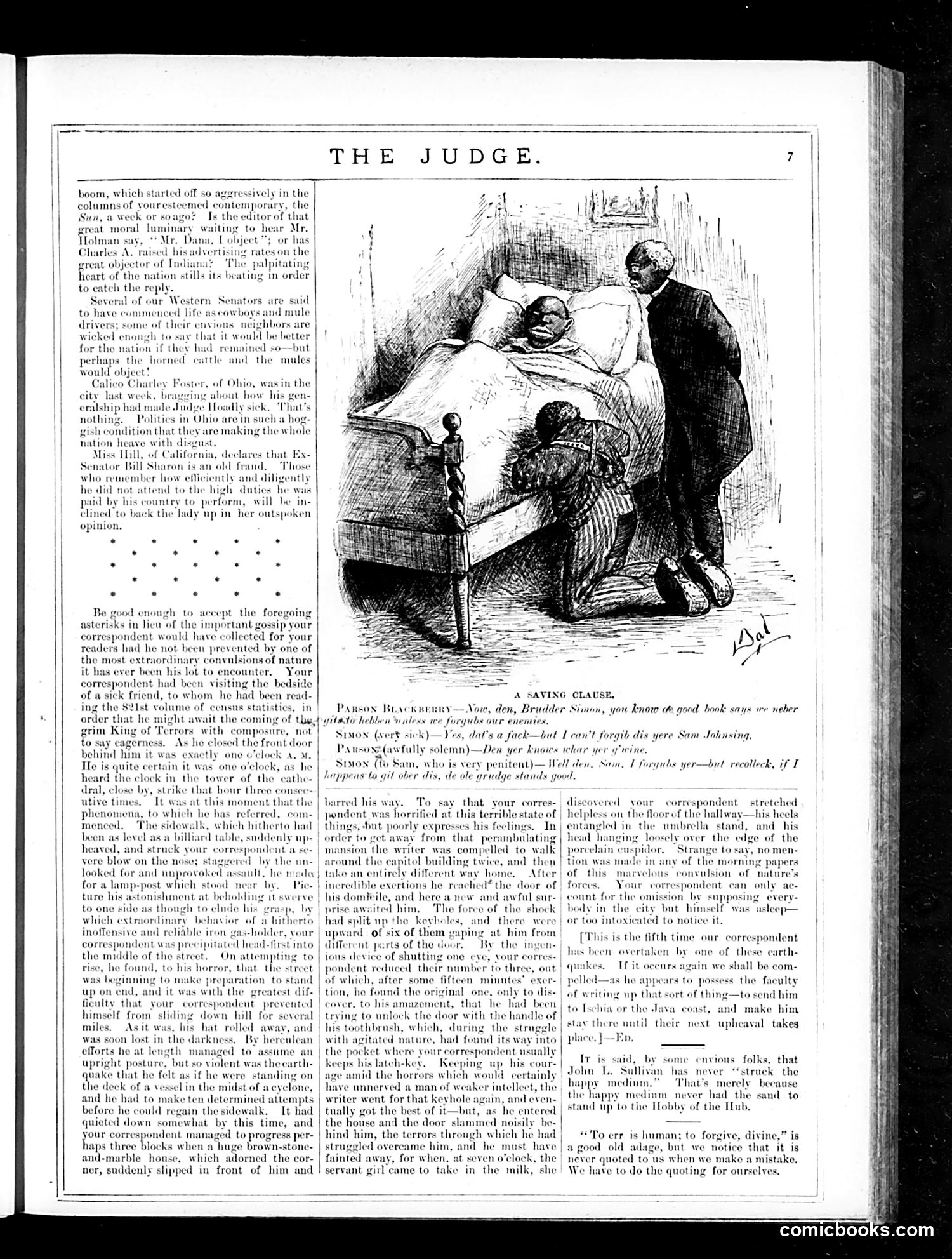
This page features a satirical dialogue cartoon titled "A Saving Clause," depicting two Black men—Parson Blackberry and Simon—in conversation. The parson quotes scripture about not bearing grudges against enemies, while Simon responds with a loophole: "Yes, dat's a fact—but I can't forgit dis yere Sam Johnson." **The Satire:** This mocks post-Reconstruction racial hypocrisy. The joke hinges on the tension between Christian morality (forgiveness) and the practical impossibility of overcoming real grievances. By having the characters acknowledge this contradiction themselves, Judge satirizes both the inadequacy of moral platitudes for addressing genuine injustices and, implicitly, white society's expectation that Black Americans simply "forgive" without addressing systemic wrongs. The accompanying text describes an earthquake, likely a separate humorous piece about a reporter's misadventures. **Note:** The caricature style and dialect reflect deeply problematic 19th-century racial stereotyping standard in period publications.
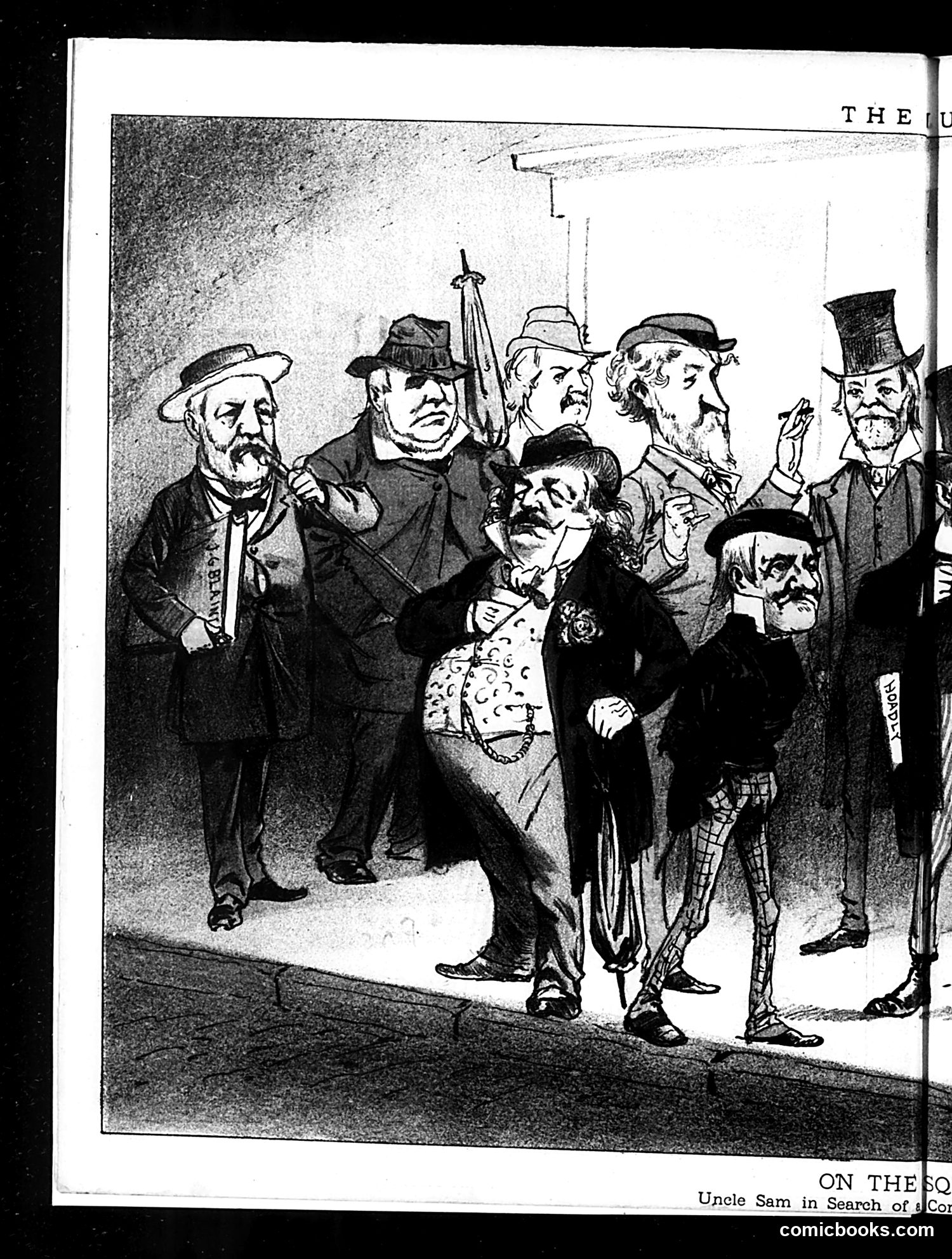
The OCR text is too corrupted to read clearly, so I'm relying on the image alone. This appears to be a political cartoon from *Judge* magazine showing "Uncle Sam in Search of" something (caption cut off). Uncle Sam, identifiable by his distinctive tall hat and goatee, stands among a group of caricatured men in formal dress—likely representing various political or national figures. The exaggerated facial features and body language suggest satire of prominent politicians or diplomats of the era. Without the complete caption and given the OCR failure, I cannot confidently identify the specific figures depicted or the exact satirical point. The composition suggests commentary on American foreign policy or diplomatic negotiations, but the precise historical context remains unclear from the visible image alone.
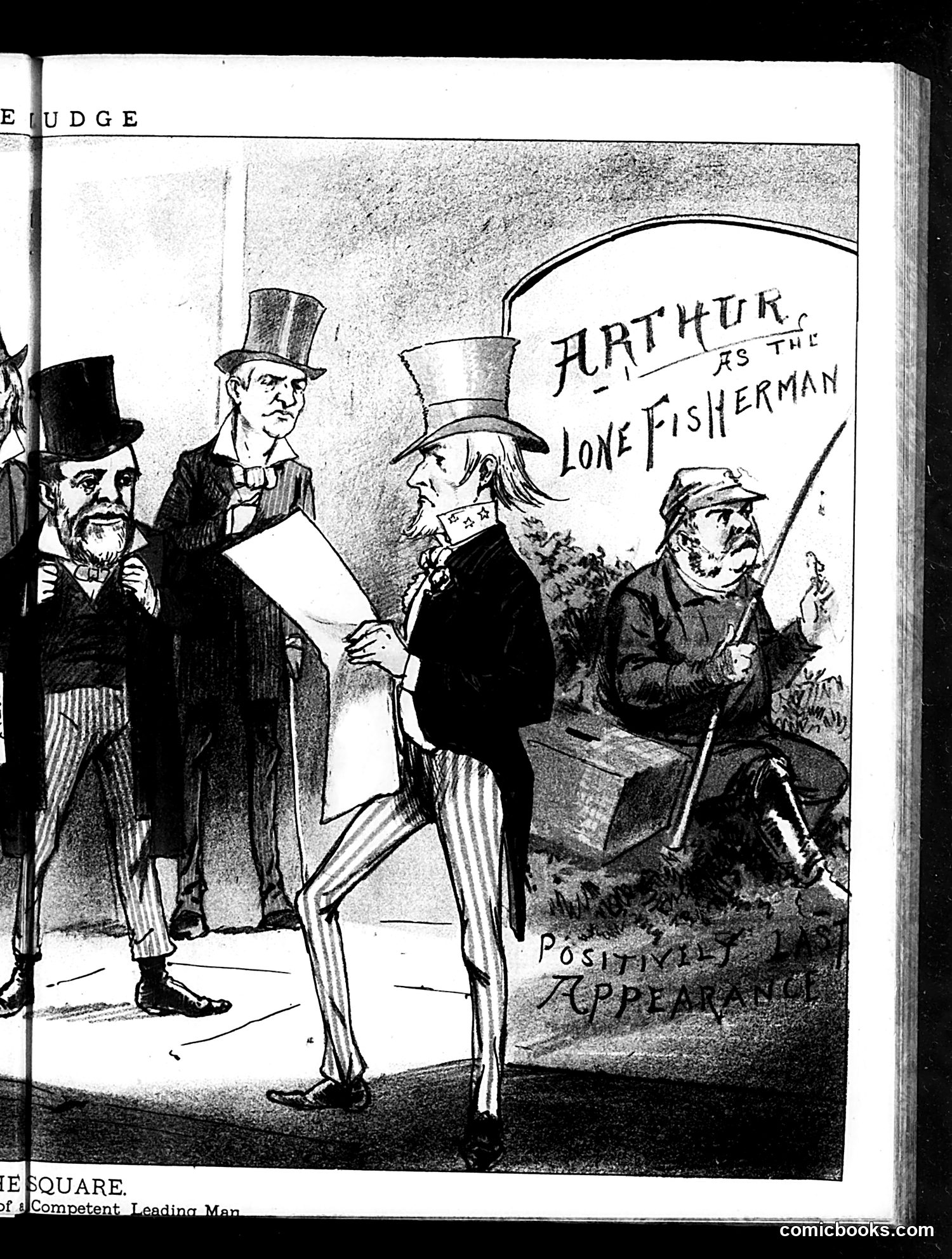
This **Judge** magazine cartoon satirizes Arthur as "the Lone Fisherman" with a caption reading "Positive Appeal." The image depicts what appears to be political figures in formal dress (top hats) observing a solitary fisherman. The phrase "Lone Fisherman" and "Positive Appeal" suggest this criticizes a political figure—likely Arthur (possibly Chester Arthur, U.S. President 1881-1885)—for operating independently or without broad political support, despite claims of popular appeal. The well-dressed observers on the left appear to represent the political establishment, contrasting with the isolated fisherman figure. The satire likely mocks the gap between claimed popularity and actual political isolation or lack of substantive backing among party leadership or the electorate.
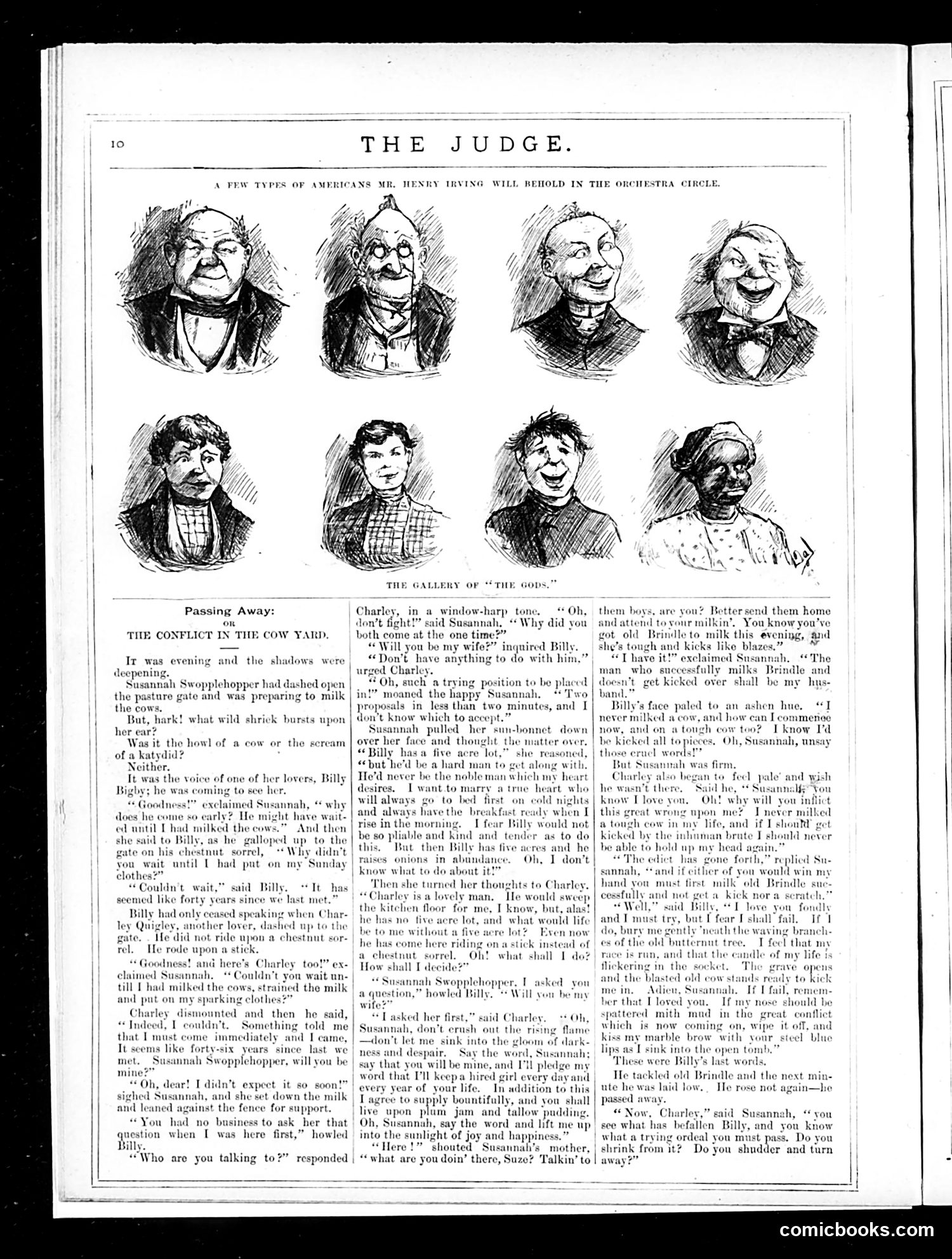
This is a humorous domestic satire depicting a rural love triangle. Susannah Swopplehopper, a farm girl, is courted by two rivals: Billy, who arrives on horseback, and Charley, who rides a stick (suggesting he's poorer or ridiculous). Both simultaneously propose marriage. Susannah's dilemma satirizes romantic indecision: Charley is "lovely" and kind, but Billy has "five acres and onions in abundance"—meaning wealth matters. The joke escalates when she declares the winner must first milk her cow "Brindl." Billy, unfamiliar with farm work, panics at the prospect of being kicked, leading to mock-heroic despair about his potential death. The satire mocks rural courtship conventions, mercenary marriage calculations, and the absurdity of masculine posturing over farm labor. The exaggerated melodrama of Billy's fear parodies romantic literature of the era.
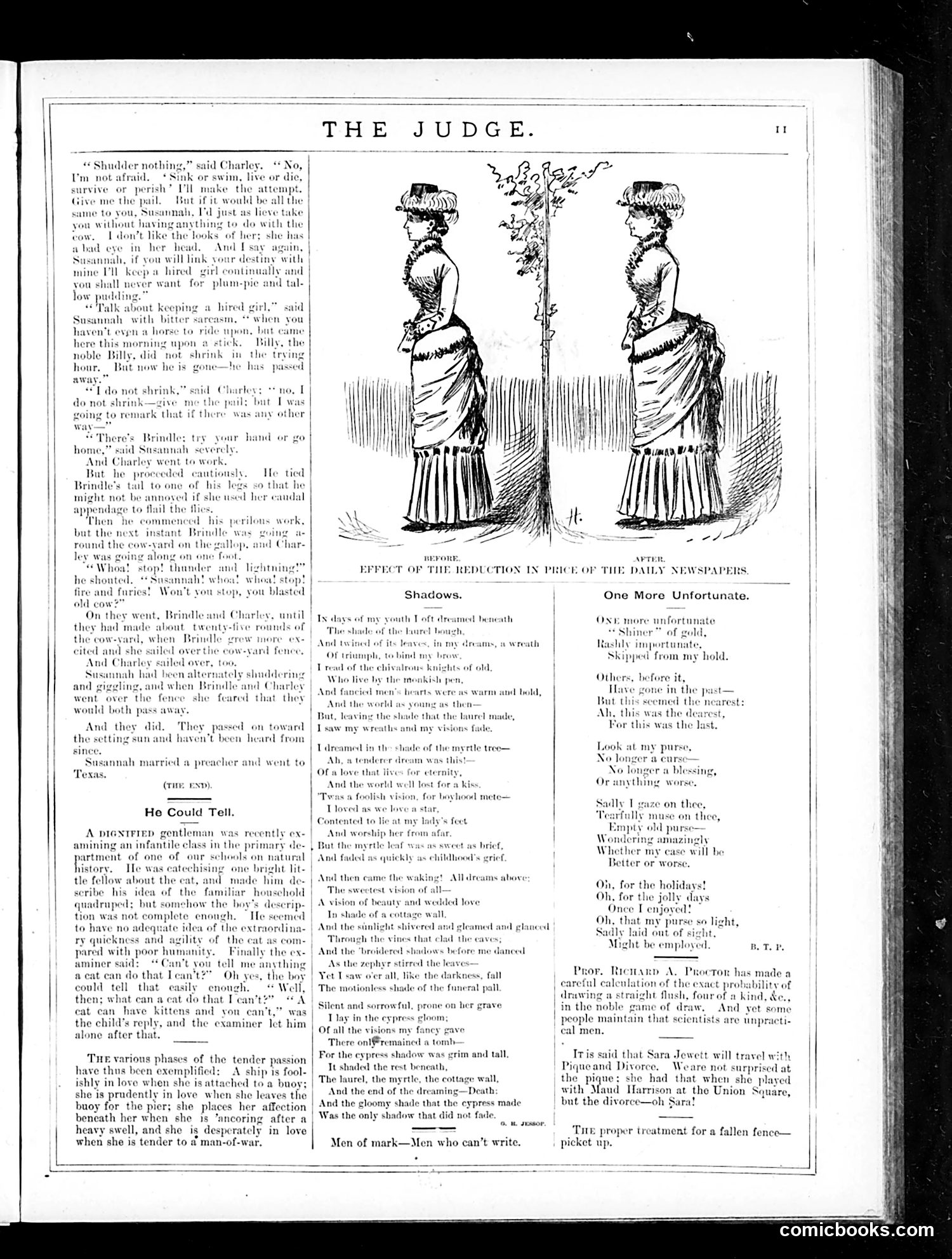
This page contains two main sections: **Top Illustration:** A satirical cartoon showing two identical women standing in a field, captioned "Effect of the Reduction in Price of the Daily Newspapers." The joke appears to be that cheaper newspapers have made women look identical—suggesting mass-produced, uniform thinking or appearance resulting from wider newspaper circulation and standardized content. **Text Stories:** The page includes three narrative pieces: 1. **"He Could Tell"**—a humorous anecdote about a schoolboy who, when asked what cats can do that humans cannot, answers: "cat can have kittens and you can't." 2. **"Shadows"** and **"One More Unfortunate"**—melancholic poems reflecting on lost youth, romantic disillusionment, and the fading of youthful dreams. 3. **Brief notices** at bottom, including a joke about probability and card games. The overall tone mixes light satire with sentimental Victorian-era romanticism typical of Judge's editorial mix.
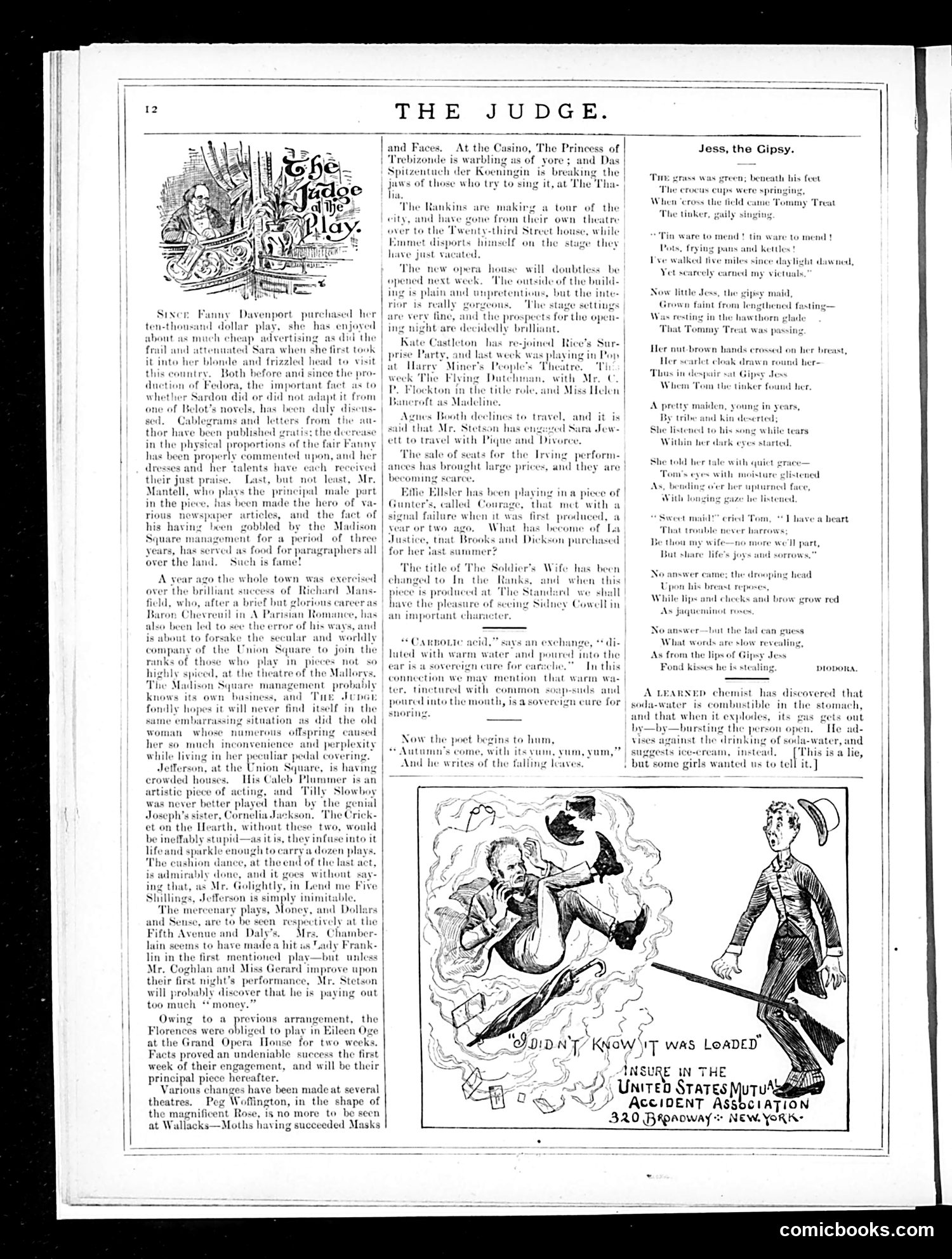
This page contains theater reviews and a prominent insurance advertisement cartoon. The main illustration shows a man and woman in clouds with a gun, captioned "I Didn't Know It Was Loaded"—advertising the United States Mutual Accident Association (320 Broadway, New York). The cartoon plays on a common legal excuse for accidental shooting deaths in the era. By pairing this phrase with insurance imagery, it darkly suggests that accidental firearm deaths were common enough to warrant accident insurance—a satirical commentary on 19th-century gun safety (or lack thereof) and the growing insurance industry capitalizing on such risks. The surrounding text discusses contemporary theatrical productions, performers, and companies—typical Judge content mixing entertainment gossip with social commentary. The page reflects Judge's role as a satirical publication addressing both high culture (theater) and serious social issues (preventable deaths) through humor.
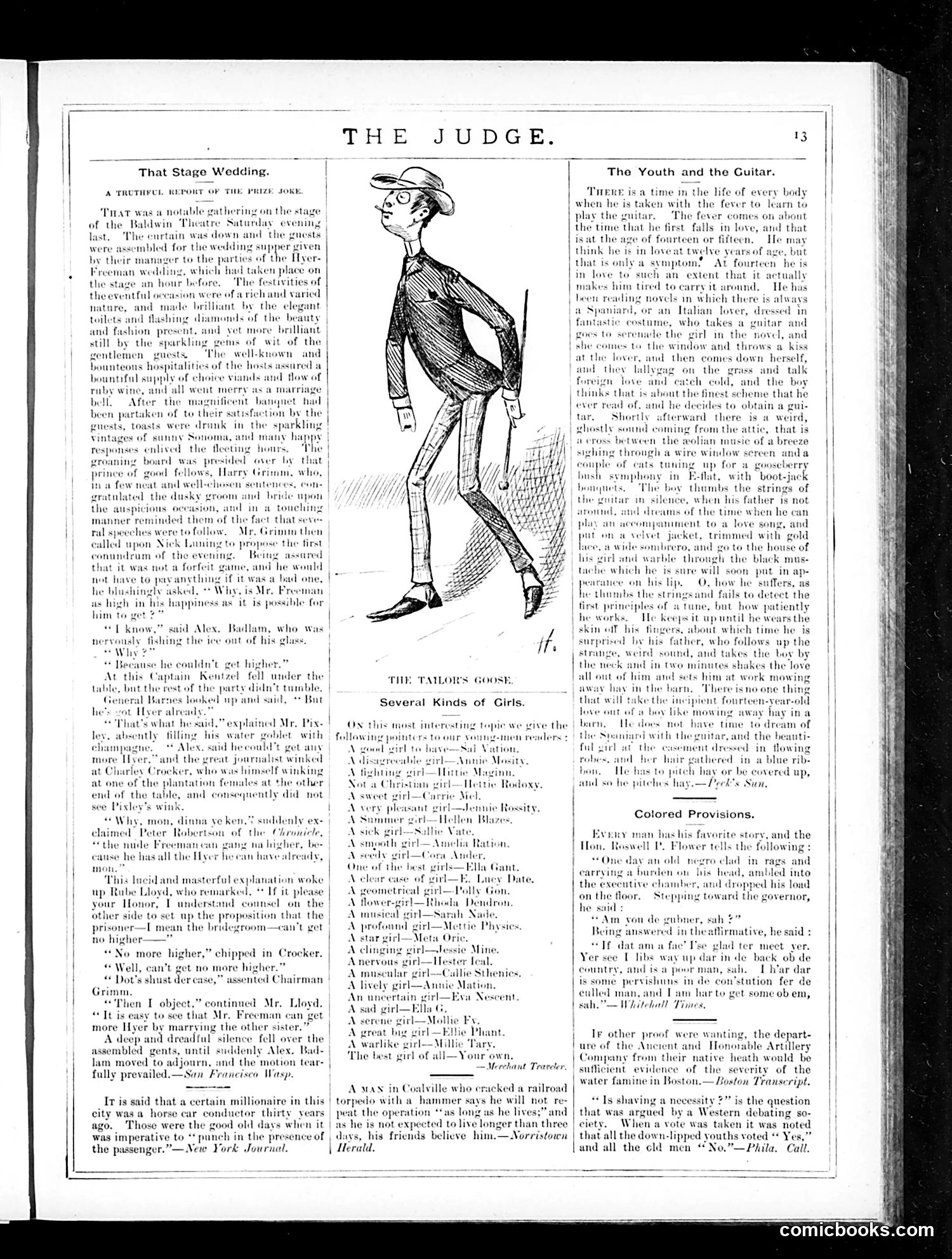
This page from *Judge* magazine contains three satirical pieces: **"That Stage Wedding"** recounts a humorous anecdote from a San Francisco society wedding at the Baldwin Theatre. The joke turns on wordplay: when asked why the groom couldn't get "higher," various guests offer increasingly contrived puns about "Hyer" (apparently a family name), culminating in the suggestion he could marry the bride's sister. It's genteel Victorian humor playing on double meanings. **"The Tailors Goose"** is a pun-based list of girl archetypes, using names that sound like common words (e.g., "Annie Mosity" = animosity, "Dolly Gone" = dialogue). This type of wordplay humor was popular Victorian-era entertainment. **"The Youth and the Guitar"** is a satirical sketch about adolescent romance, depicting the clichéd fantasy of a young man serenading his love with a guitar while reading romantic novels—mocking sentimental literary conventions popular with teenagers. The illustrated cartoon shows a man in formal attire, likely the "tailors goose" reference (a foolish man).
This page from Judge contains several brief satirical pieces typical of the magazine's humor: **"Closet Courtship"** depicts a Scottish minister (Rev. Dr. Wightman) repeatedly summoned from his study by his housekeeper Mary with various pretexts (fire needs tending, breakfast preparations). The satire mocks courtship conducted under the guise of domestic duties—a "closet" romance hidden behind household tasks. **"He Takes the Odds"** features a dialogue between two Black characters debating watermelon and cholera, using heavy dialect. This reflects the period's crude racial stereotyping common in 19th-century American humor publications. **"Not That Far"** jokes about a man's unlucky mining investment and a careless fellow whose revolver accidentally killed a president—likely satirizing recent political violence or financial schemes. The remaining anecdotes mock various social types: the nomination-seeking politician, sibling rivalry over chickens, Toledo's musical enthusiast, and women's unsuitability for business. The page is primarily textual humor with extensive advertising for pianos, fire extinguishers, and patent medicines below.
This is a humorous dialogue between a managing editor and a religious editor at a magazine. The joke centers on the managing editor's attempt to extract gossip about a beautiful blonde woman the religious editor encountered at a camp meeting. The religious editor, initially reluctant, is gradually plied with alcohol (a "demijohn" of liquor) by the managing editor, who offers toasts and refreshment while pressing for details about the mysterious woman. The satire mocks the hypocrisy of a "religious" editor—someone who should maintain moral standards—being seduced into gossip and drinking through flattery and social pressure. The punchline (implied by the title) suggests the religious editor's "bitter revenge" is withholding information about the woman, frustrating the managing editor's curiosity despite his manipulation tactics. The page is primarily advertisements; the cartoon illustrates workplace office culture and editorial office dynamics of the era.
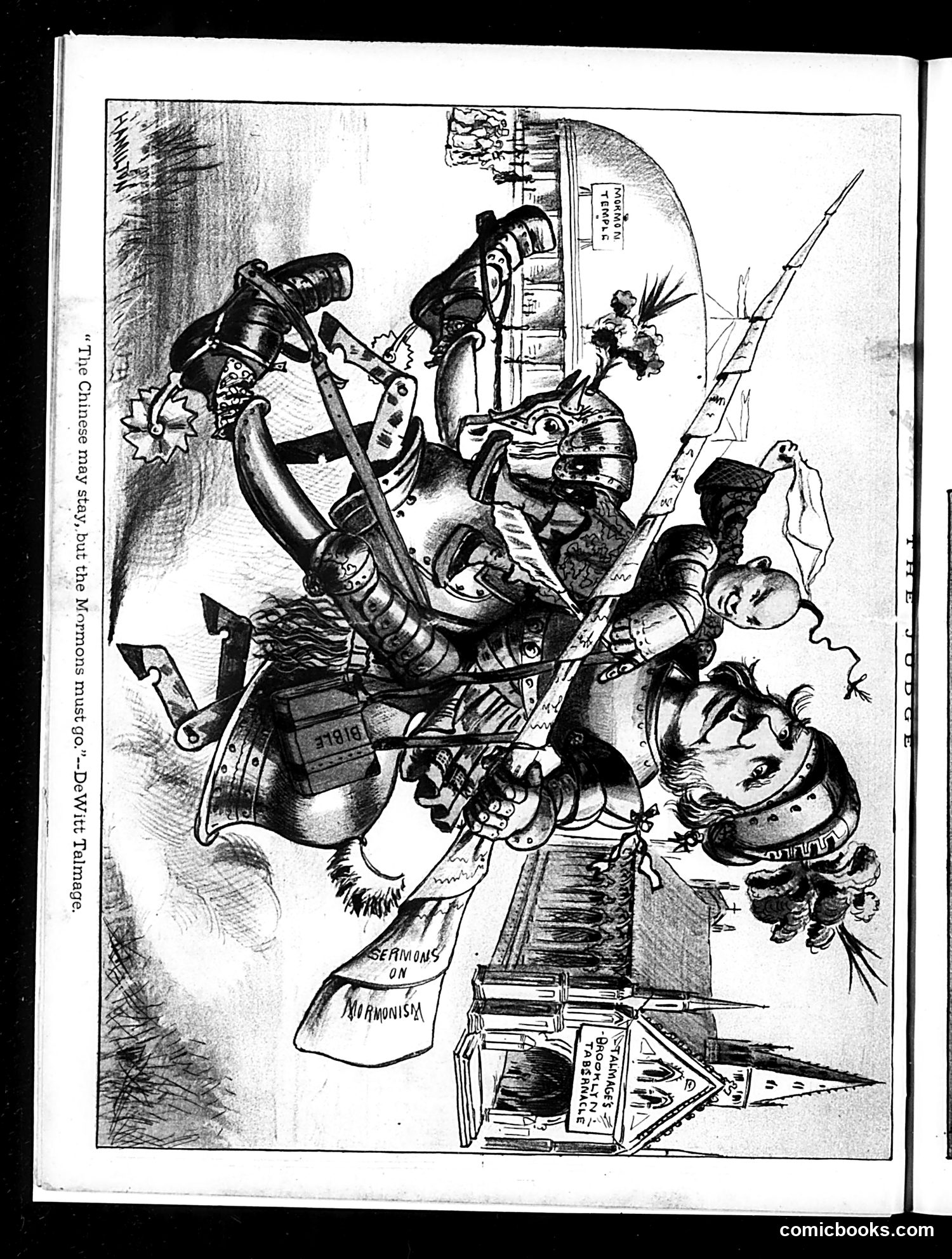
The OCR text is too corrupted to read clearly, but the image itself shows a political cartoon satirizing **Chinese immigration and anti-Chinese sentiment** in America. The cartoon depicts caricatured Chinese figures (identifiable by period stereotypical features) being attacked or thrown out by American figures wielding weapons and tools. Visible text includes "SERMONS ON NIIHIMINISM" [sic] and references to "CHINESE" exclusion rhetoric. This likely comments on the **Chinese Exclusion Act era** (1882 onwards), when anti-Chinese violence and political campaigns were common in America. The satire appears to criticize either the violence against Chinese immigrants or—less likely—the immigrants themselves, depending on Judge magazine's editorial stance at that moment. Without clearer OCR text or a visible date, the specific year and exact satirical target remain unclear, though the theme reflects late 19th-century American xenophobia and labor tensions.