
Judge, 1883-10-27 · page 3 of 16
Judge — October 27, 1883 — page 3: what you’re looking at
What you’re looking at
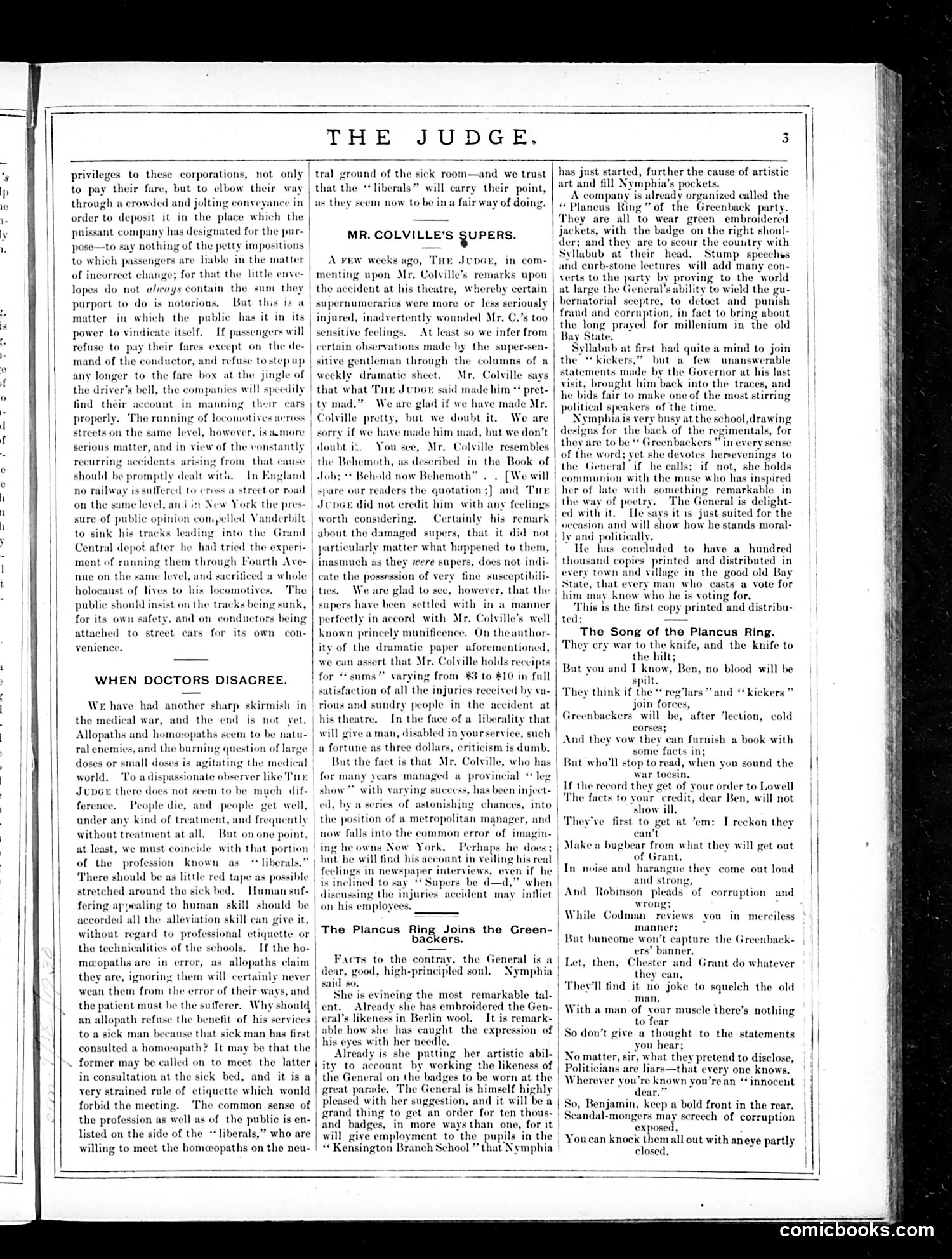
This page contains three distinct opinion pieces rather than visual cartoons: **"When Doctors Disagree"** criticizes the medical profession's rigid etiquette. It satirizes the bitter rivalry between allopathic (conventional) and homeopathic doctors, mocking that patients suffer when doctors refuse professional consultation with rival practitioners. The piece advocates "common sense" over professional rules—a jab at medical establishment inflexibility. **"Mr. Colville's Supers"** addresses a theater accident involving injured supernumeraries (extras). Judge had previously criticized theater manager Colville's handling of the incident; Colville responded angrily in another publication. Judge defends its criticism, sarcastically noting Colville's sensitivity while asserting the magazine's right to comment on public safety matters. **"The Plancus Ring" and related verses** appear to be satirical poetry about political corruption or electoral manipulation, though specific references are unclear without additional context. The page demonstrates Judge's role as social and professional critic, targeting institutional hypocrisy and negligence.
📄 Transcribed text from this page (OCR, searchable)
Machine-transcribed from the original scan — historical spelling and the odd misread are preserved.
THE JUDGE. privileges to these corporations, not only to pay their fare, but to elbow their way through a crowded and jolting conveyance in | order to deposit it in the place which the puissant company has designated for the pur- | pose say nothing of the petty impositions to which passengers are liable in the matter of incorrect change; for that the little enve- lopes do not always contain the sum they purport to do is notorions. But this is matter in which the public has it in its | power to vindicate itself. If passengers will refuse to pay their fares except on the de- mand of the conductor, and refuse to step up any longer to the fare the driver's hell, the companies will speedily find their account: in manni properly. ‘The running of locon streets on the same level, however, is amore serious matter, and in view of the vonstantly recurring accidents arising from th: should be promptly dealt with. In I no railway is suffered to cross a street or road on the sate level, and in New York the pi sure of public opinion conpelled Vanderbilt to sink his tracks leading into the Grand Central depot after he had tried the exper ment of running them through Fourth Ave- nue on the same level, and sacrificed a whol holocaust of lives to his locomotives. The public should insist on the tracks being sunk, for its own safety, and on attached to street cars fi venience. nductors being its own con- WHEN DOCTORS DISAGREE. We have had another sharp skirmish in the medical war, and the end is not vet. Allopaths and homo-opaths scem to be natu- ral cnemies, and the burning question of large doses or small doses is agitating the medical world. To adispassionate observer like Tue JUDGE there does not seem to be much dif- ference. People die, and people get well, under any kind of treatment, and frequently without treatment at all. But on one point, at least, we must coineide with that portion of the profession known as * liberals.” ‘There should be as little red tape as possible stretched around the sick bed. Human suf- fering appealing to human. skill should be accorded all the alleviation skill can give it, without regard to professional etiquette or the technicalities of the schools. If the ho- mopaths are in error, as allopaths claim they are, ignoring them will certainly never wean them from the error of their ways, and the patient must be the sufferer. Why should an allopath refuse the benefit of his services to a sick man because that sick man has first consulted a hom@opath? It may be that the former may be called on to meet the latter in consultation at the sick bed, and it is a very strained rule of etiquette which would forbid the meeting. The common sense of the profession as well as of the public is en- listed on the side of the * liberals,” who a willing to meet the homeopaths on the neu- tral ground of the sick room—and we trust | that the “liberals” will carry their point, us they seem now to be ina fair way of doing. MR. COLVILLE’S QUPeRs. A Pew weeks ago, THe JepGE, in com- | menting upon Mr, Colville’s remarks upon the accident at his theatre, whereby certain supernumeraries were more or less seriously injured, inadvertently wounded Mr. C.’s too sensitive feelings. At least so we infer from certain observations made by the super-sen- sitive gentleman through the columns of a | weekly dramatic sheet. Mr, Colville says that what THe Juper: said made him “ pret- ty mad.” W. ud if we have made Mr, Colville pretty, but we doubt it, We are | sorry if we have made him mad, but we don’t doubt ik, You see, Mr. Colville resembles the Behemoth, as described in the Book of Job: Behold now Behemoth” . . [We will spare our readers the quotation :] and Tie Jvper did not credit him with any feelings worth considering. Certainly his remark about the damaged supers, that it ¢ particularly matter what happened to them, inasmuch us they were supers, does not indi- cate the possession of very tine susceptibi thes We are glad to see, however, that the supers have been settled with in a manner perfeetly in accord with Mr. Colville’s well known princely munificence. On theauthor- ity of the dramatic paper aforementioned, we can assert that Mr. Colville holds receipts for “sums” varying from 83 to $10 in full satisfaction of all the injuries received by va- rious and sundry people in the accident at his theatre. In the face of a liberality that will give aman, disabled in your service, such a fortune as three dollars, criticism is dumb. But the fact is that Mr. Colville, who has for many years managed a provincial “leg show * with varying success, has been inject- ca, by a series of astonishing chances, into the position of a metropolitan manager, and now falls into the common error of in ing he owns New York. Perhaps he di but he will find his account in veiling his r feelings in newspaper interviews, even if he is inclined to say “Supers be d—d,” when discussing the injuries accident may inflict on his employees. The Plancus Ring Joins the Green- backers. Facts to the contray, the General is a dear, good, high-principled soul. Nymphia id She is evincing the most remarkable tal- ent. Already she has embroidered the Gen- eral’s likeness in Berlin wool. It is remark- able how she has caught the expression of his eyes with her needle. Already is she putting her artistic abil- ity to account by working the likeness of the General on the badges to be worn at the great parade. The General is himself highly pleased with her suggestion, and it will be a grand thing to get an order for ten thous- and badges, in more ways than one, for it will give employment to the pupils in the “Kensington Branch School ” that Nymphia has just started, further the cause of artistic art and fill Nymphia’s pockets, ‘A company is already organized called the * Plancus Ring” of the Greenback party. |'They are all to wear green embroidered jackets, with the badge on the right shoul- der; and they are to scour the country with Syllabub at their head. Stump speeches nd curb-stone lectures will add many con- verts to the party by proving to the ‘world at large the General's ability to wield the gu- bernatorial sceptre, to detect and punish fraud and corruption, in fact to bring about the long prayed for millenium in the old Bay State. Syllabub at first had quite a mind to join the * kickers,” but a few unanswerable statements made by the Governor at his last visit, brought him back into the traces, and he bids fair to make one of the most stirring political speakers of the time. Nymphia is very busy at the school drawing designs for the back of the regimentals, for they are to be “* Greenbackers ” in every sense of the word; yet she devotes hemevenings to the General if he calls; if not, she holds communion with the muse who has inspired her of late with something remarkable in the way of poetry. The General is delight- ed with it. He Says it is just suited for the jon and will show how he stands moral- ly and politically. He has concluded to have a hundred thousand copies printed and distributed in every town and village in the good old Bay State, that every man who. casts a vote for him may know who he is voting for. This is the first copy printed and distribu- ted: —— The Song of the Plancus Ring. They ery war to the knife, and the knife to the hilt; But you und I know, Ben, no blood will be spilt They think if the *reg’lars "and ‘kickers ” in forces, Greenbackers will be, after ‘lection, cold corses; And they vow they can furnish a book with some facts in; But who'll stop to read, when you sound the tocsin. If the record they get of your order to Lowell ‘The facts to vour credit, dear Ben, will not show ill. They've first to get at ’em: can’t Make a bugbear from what they will get out of Grant. In noise and harangue they come out loud and strong And Robinson pleads of corruption and wrong; While Codman reviews you in’ merciless manner: But buncome won't capture the Greenback- ers’ banner. t, then, Chester and Grant do whatever they can, They'll find it no joke to squelch the old man, With a man of your muscle there's nothing tof So don’t give a thought to the statements you hear; No matter, sir, what they pretend to disclose, Politicians are liars—that every one knows. Wherever you're known you’re an ‘innocent dear.” So, Benjamin, keep a bold front in the rear. Scandal-mongers may screech of corruption exposed, Youcan knoe them all out with aneye partly closed. . I reckon they comicbooks.com