
A complete issue · 17 pages · 1883
Judge — October 20, 1883
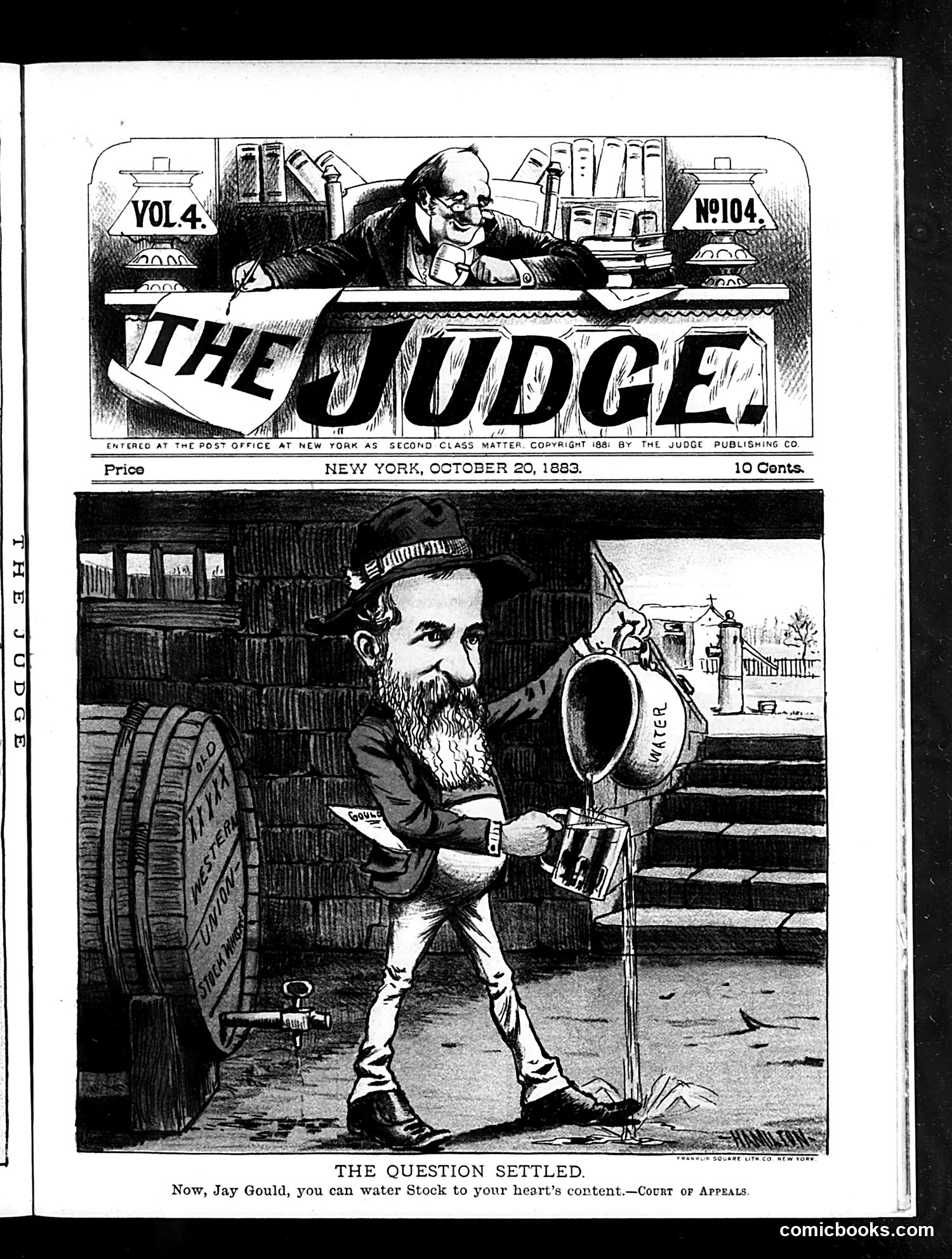
This political cartoon satirizes a legal dispute involving **Jay Gould**, the wealthy railroad magnate and financier. The caption "The Question Settled" and accompanying text "Now, Jay Gould, you can water Stock to your heart's content.—Court of Appeals" references the practice of "watering stock"—artificially inflating a company's shares beyond actual value. The caricatured figure, depicted with an exaggerated beard and holding a watering can labeled "WATER," is shown literally watering a barrel, suggesting the Court of Appeals had ruled in Gould's favor regarding questionable stock practices. The cartoon mocks both Gould's financial manipulations and the court's apparent sanction of such deceptive business practices—a common target of Gilded Age satire criticizing wealthy industrialists and judicial corruption.
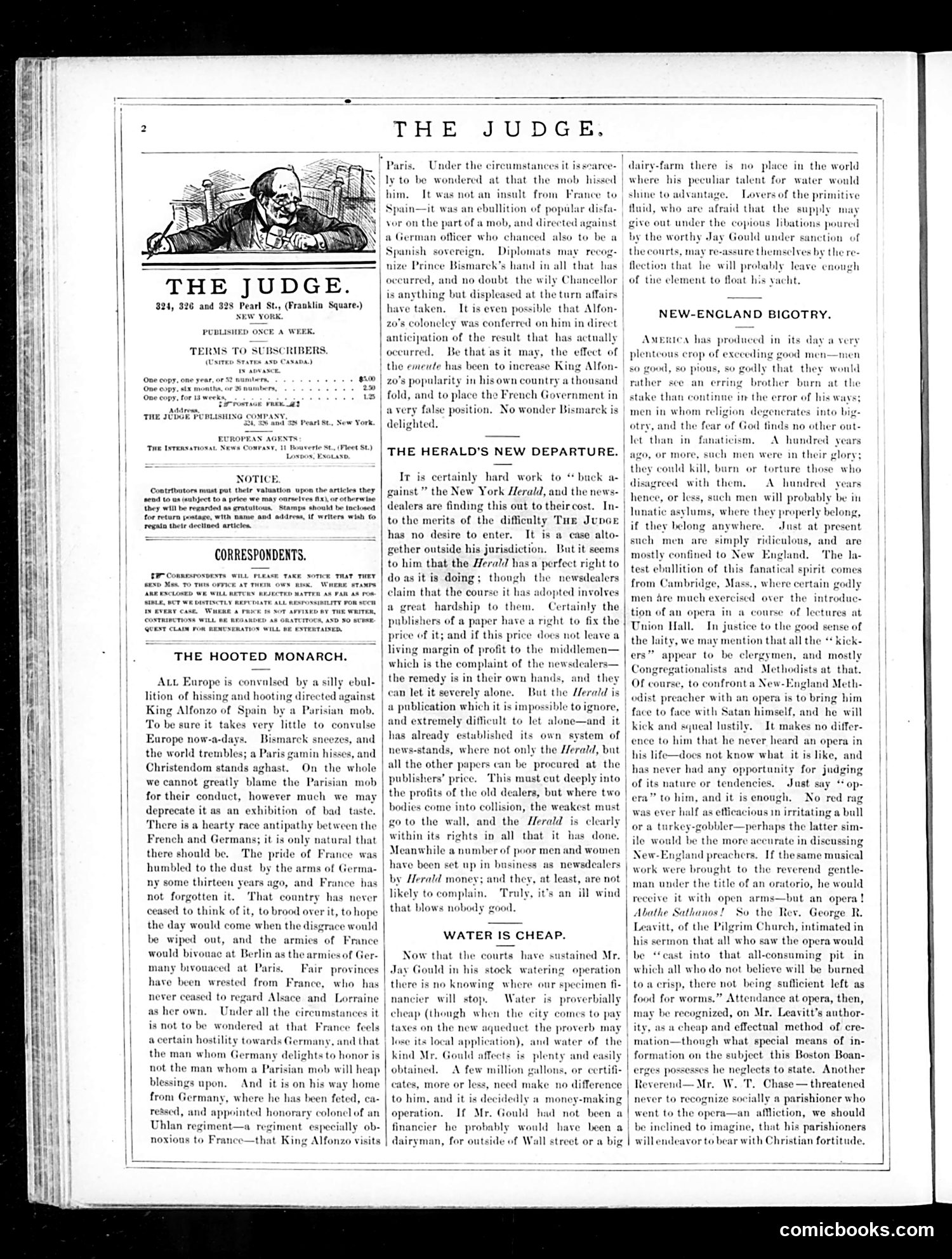
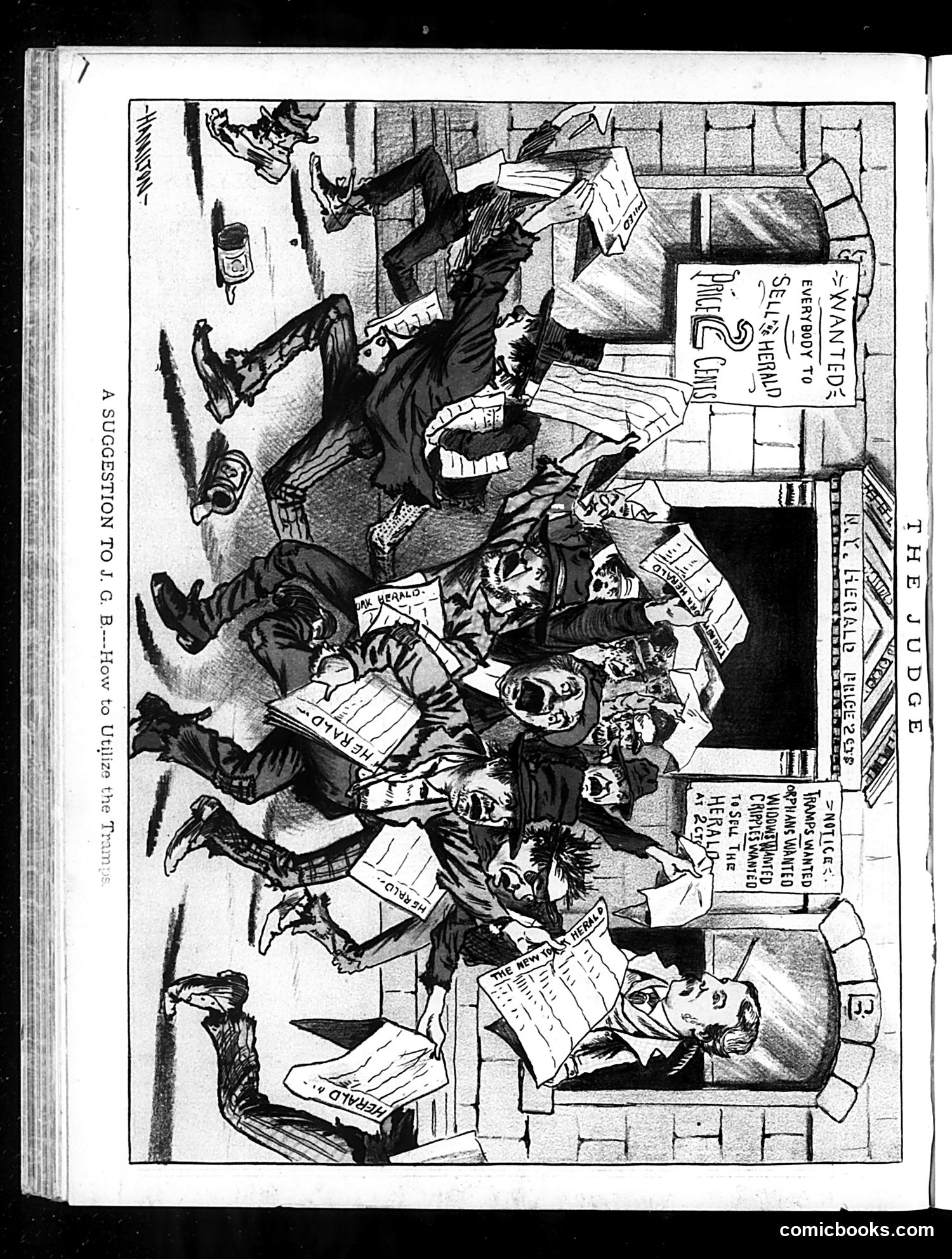
**The Hooted Monarch** cartoon addresses King Alfonso XII of Spain's unpopularity in France. A Parisian mob recently hissed him—an insult Judge attributes to Franco-German tensions rather than anti-Spanish sentiment. The article suggests Prussian Chancellor Bismarck deliberately orchestrated Alfonso's German honors to provoke France, exploiting existing hostility stemming from France's 1870 defeat and loss of Alsace-Lorraine. The satire mocks Bismarck's manipulation of European diplomacy. **The Herald's New Departure** section defends the New York Herald's right to set its own newspaper prices and establish direct distribution, despite newsdealer complaints about lost profits. Judge acknowledges the dealers' hardship but argues that when economic forces collide, "the weakest must go to the wall"—endorsing the Herald's competitive advantage and modern business practices over traditional middlemen. Both pieces champion aggressive modernization against established opposition.
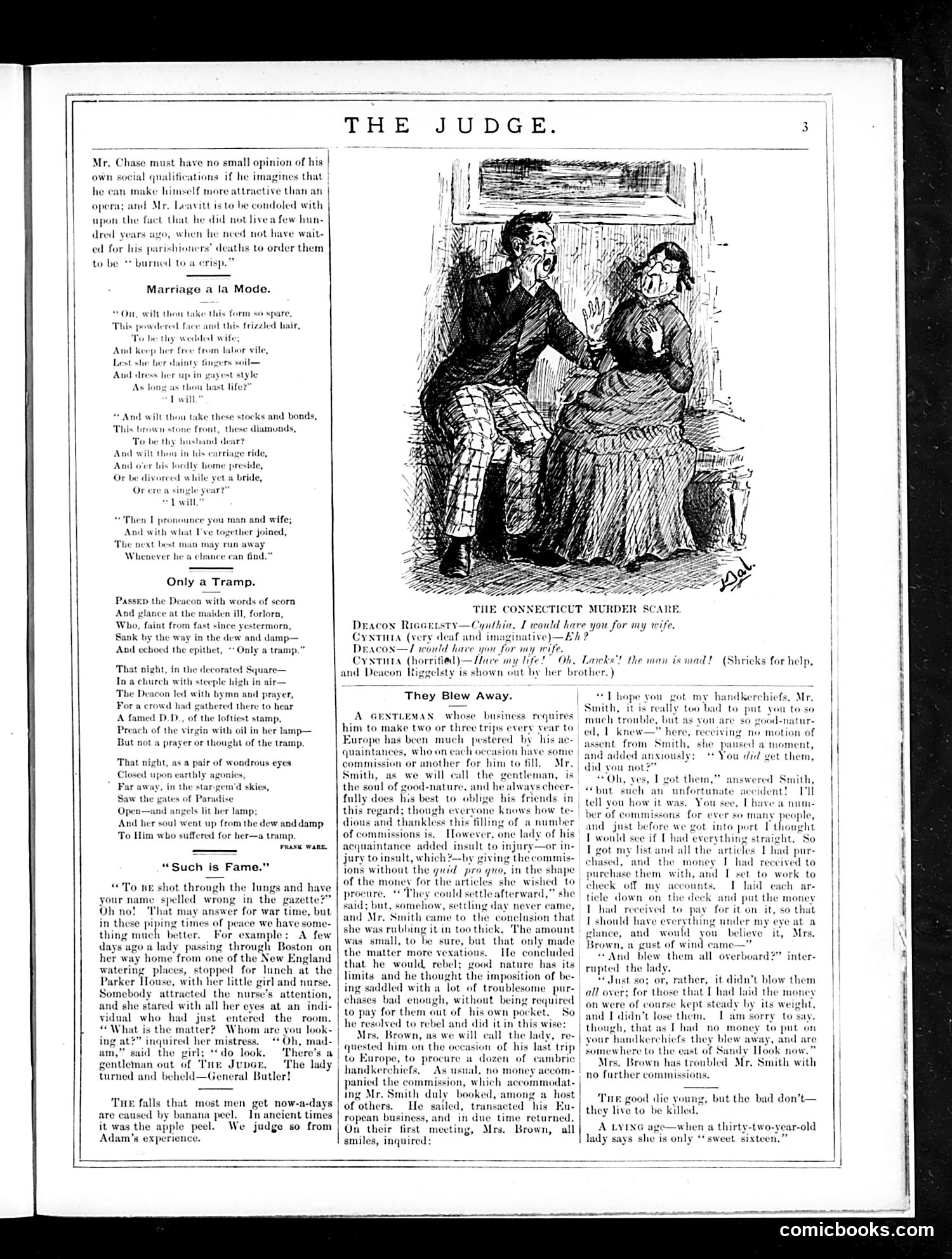
This page from Judge magazine contains multiple satirical pieces. The main illustration depicts "The Connecticut Murder Scare"—a violent domestic dispute where a deaf woman (Cynthia) misunderstands her suitor Deacon Riggletsby's marriage proposal, thinking he threatens her life. Her brother must rescue her as she screams for help. Other pieces mock contemporary social absurdities: "Marriage à la Mode" satirizes mercenary marriages where women trade romantic ideals for wealth (stocks, bonds, brown stone houses). "Only a Tramp" contrasts society's indifference to an actual virtuous poor man with their reverence for church respectability. "They Blew Away" ridicules a woman who repeatedly commissions favors from a traveling businessman without payment, exploiting his good nature until he rebels. The humor targets hypocrisy, materialism, and social pretension through exaggerated scenarios showing the gap between Victorian ideals and actual human behavior.
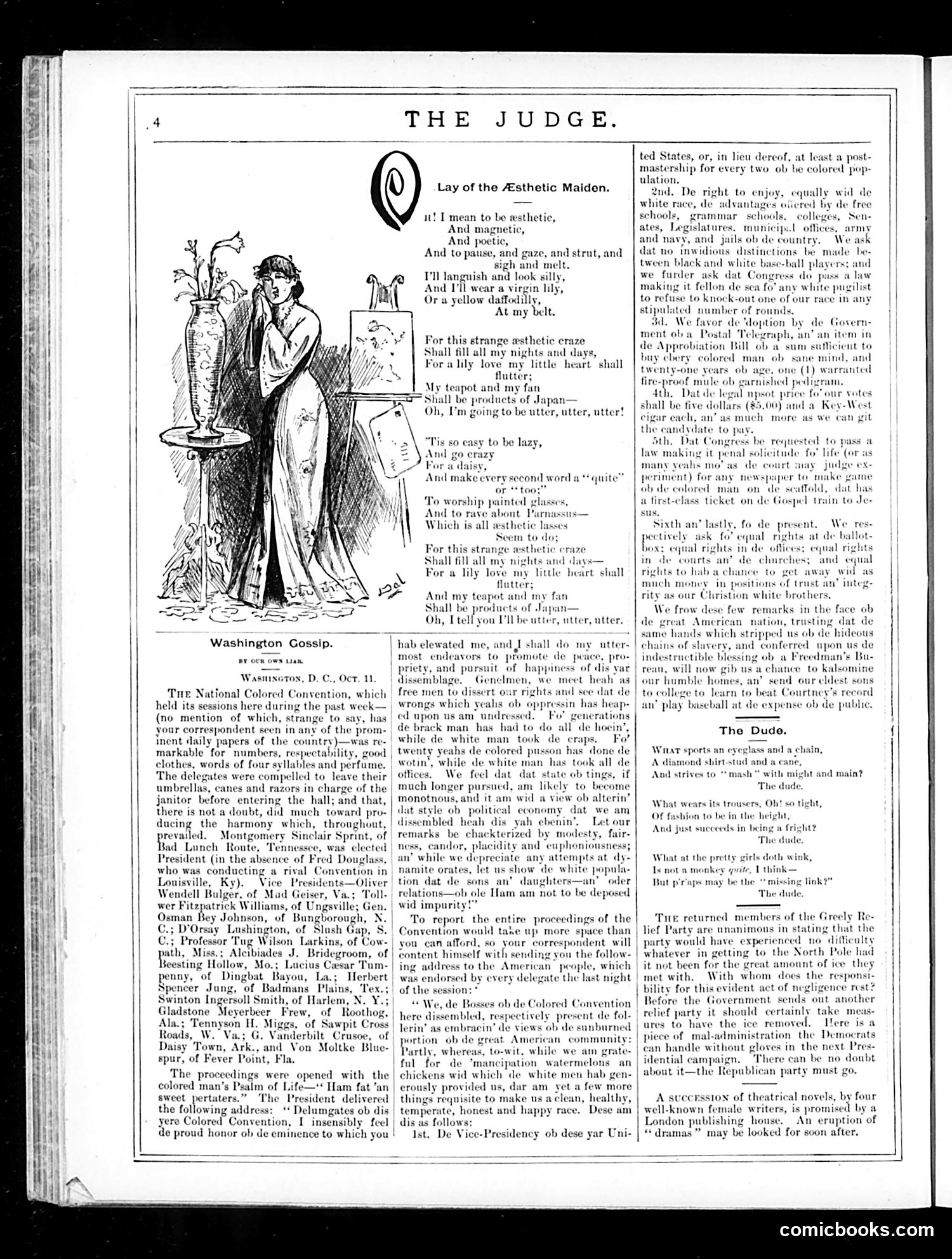
This page contains two distinct satirical pieces from *Judge* magazine. **"Lay of the Aesthetic Maiden"** mocks the "Aesthetic Movement"—a late 19th-century artistic trend emphasizing beauty and artistic sensibility over practicality. The illustrated young woman embodies this affectation: she poses dramatically with lilies and daffodils, speaks in flowery language about languishing and wearing virgin lilies, and worships "painted glass" and Japanese teapots. The satire suggests such aestheticism is pretentious, lazy, and disconnected from real life. **The second section** appears to be a political speech or petition from African American delegates at a "Colored Convention," demanding equal rights—including voting rights, government positions, and educational opportunities. The satirical tone (rendered in dialect) and the contrast with the aesthetic maiden above suggests *Judge's* political stance: mocking genuine civil rights demands by pairing them with frivolous aesthetic posturing, implying both lack equal seriousness. The page reflects *Judge's* conservative editorial perspective on Reconstruction-era racial politics.
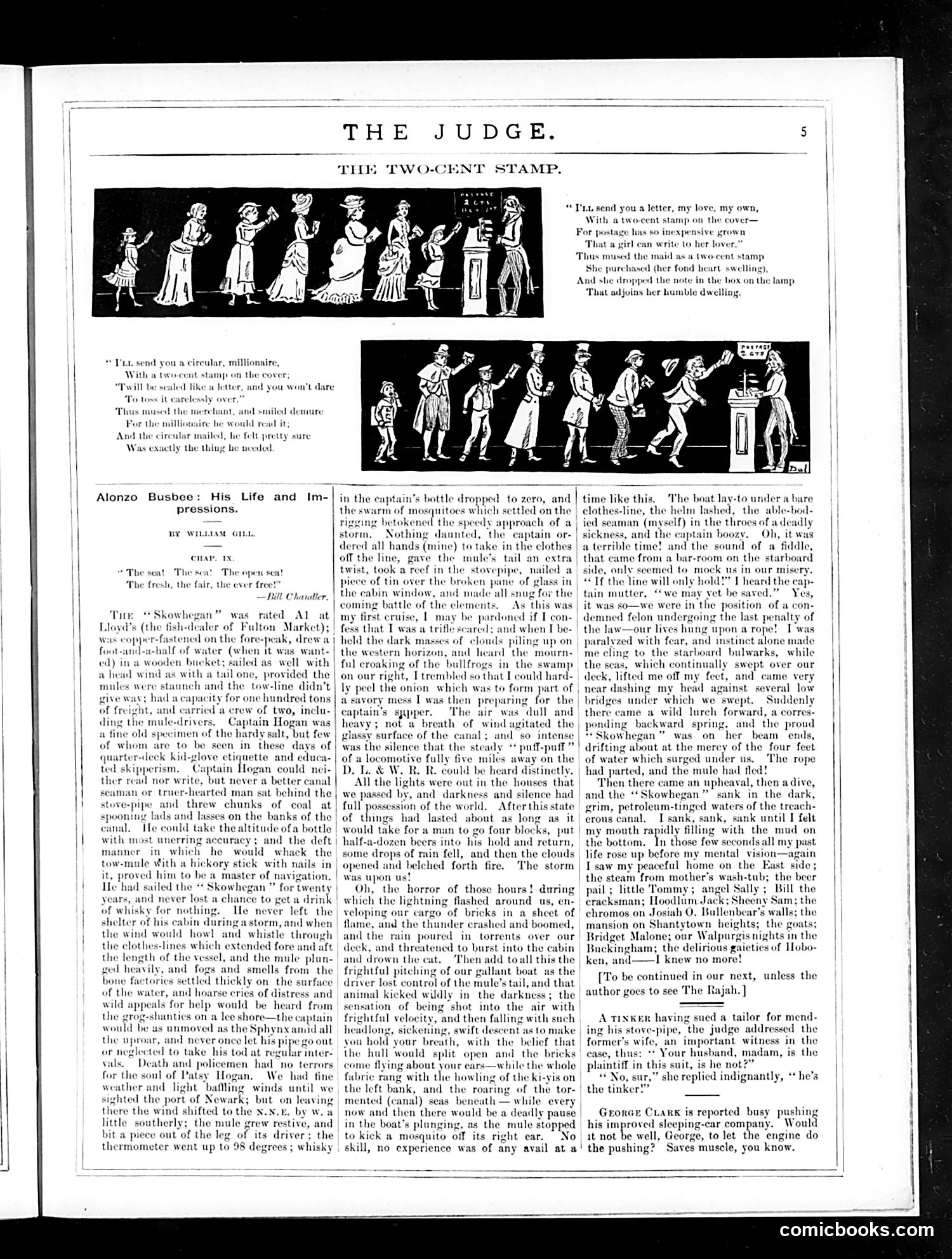
This page contains two separate items: **Top section ("The Two-Cent Stamp"):** A lighthearted verse-and-illustration about the newly introduced two-cent postage stamp. The satire mocks the stamp's purpose—allowing people to send letters more cheaply—by showing a young woman excitedly purchasing stamps to write to her lover, now that postage has become "inexpensive." The joke is gentle: the reduced cost makes romantic correspondence more affordable for ordinary people. **Main article ("Alonzo Busbee"):** A lengthy sea adventure story by William Gill about a canal boat captain and his vessel, the "Skowhegan." This appears to be straightforward nautical fiction rather than political satire, documenting the captain's experiences navigating storms and mule-powered canal transport. The two-cent stamp reference dates this to the 1880s, when that denomination was introduced.
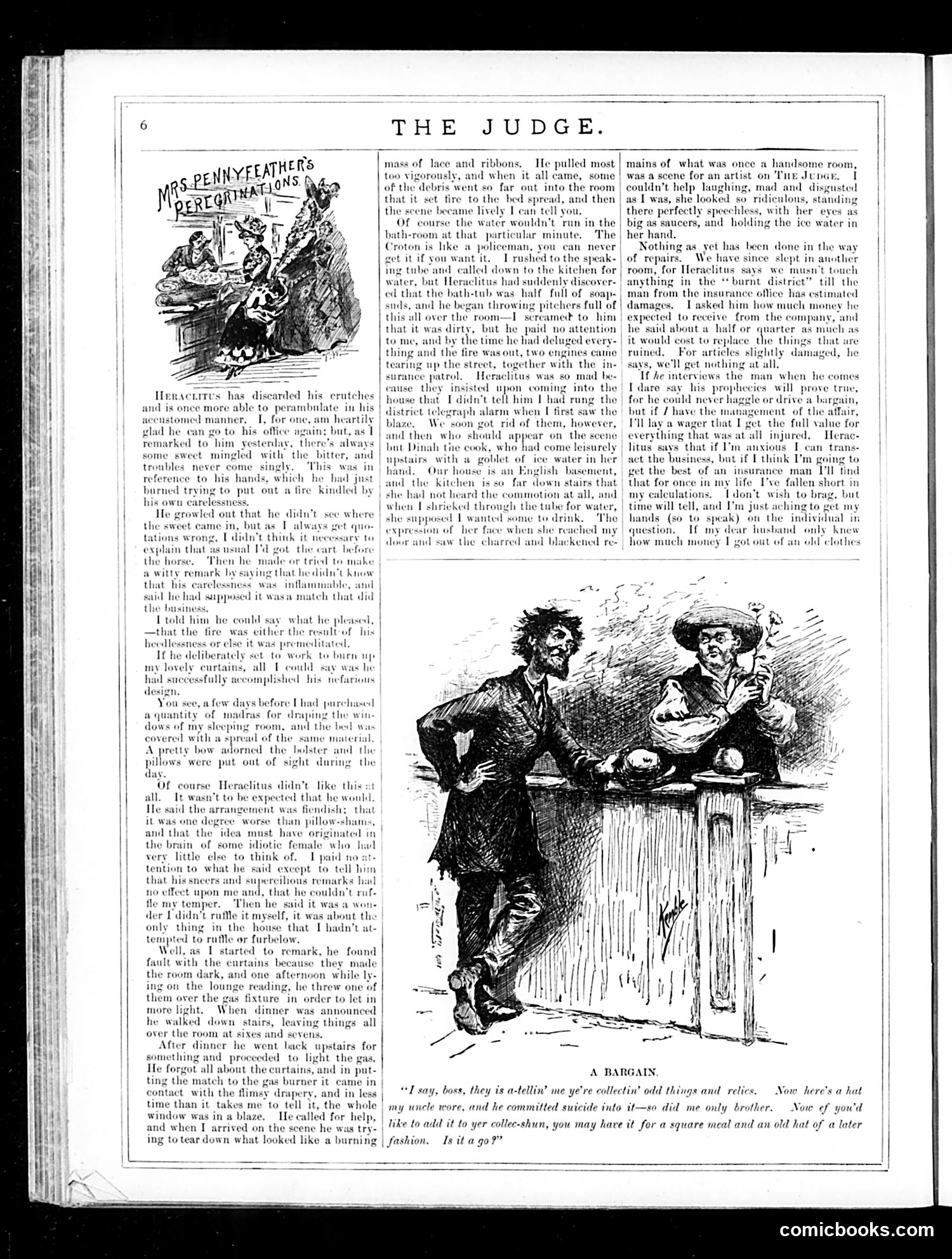
This page presents a domestic humor story about a housewife dealing with property damage caused by her husband Heraclitus's carelessness. The narrative describes a fire started by his negligence that damages their bedroom and furnishings. The cartoon at bottom, titled "A Bargain," depicts two working-class men negotiating the sale of secondhand goods—likely items from the fire damage described above. One character offers to sell damaged items "on the cheap" to his companion, joking about passing off burned merchandise as bargains. The satire targets both middle-class domestic mishaps and the petty economics of working-class life—the desperation to recover value from disaster through shrewd (if dishonest) dealing. The humor relies on the contrast between the elaborate upper-middle-class household drama in the text and the crude bartering of its ruined remnants by lower-class characters in the illustration.
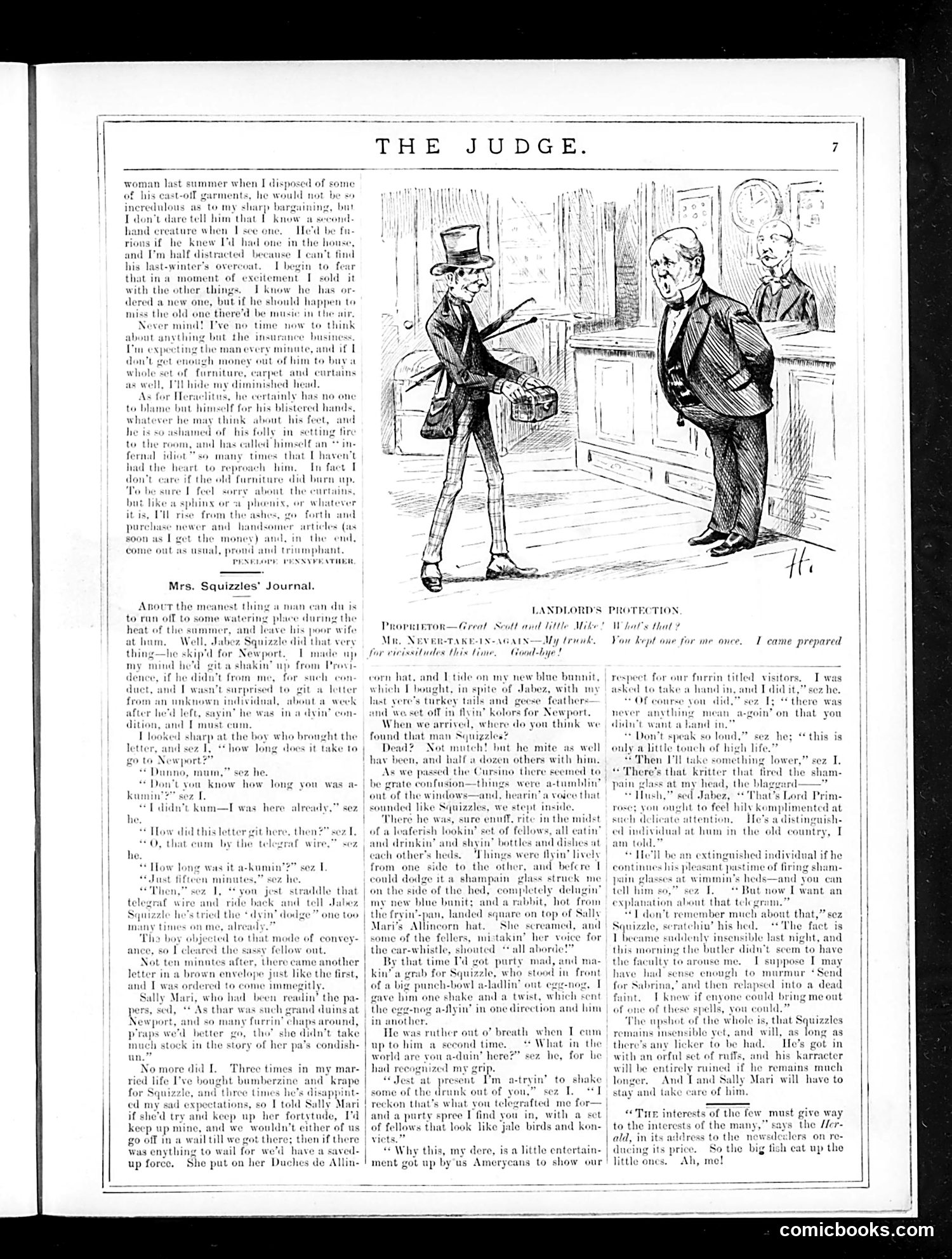
This page from *Judge* magazine features "Mrs. Squizzles' Journal," a humorous domestic narrative illustrated by a cartoon labeled "Landlord's Protection." **The Main Story:** A wife (Mrs. Squizzles) discovers her husband Jabez has fled to Newport for the summer, leaving her at home. She receives multiple urgent telegrams demanding her immediate presence, each supposedly from a dying man. Suspicious, she investigates and finds Jabez at a rowdy establishment—not dying, but carousing with other men, eating, drinking, and throwing dishes. She physically drags him out by grabbing his collar. **The Satire:** The joke targets husbands who abandon their wives in summer heat while claiming emergencies, and the absurd deceptions men employ. The cartoon caption references "landlord's protection," likely mocking how landlords might protect property (or themselves) from such chaos. **Social Context:** This reflects Victorian/Gilded Age gender dynamics—wives' domestic confinement versus husbands' leisure freedom—presented through gentle domestic comedy typical of *Judge's* satirical approach.
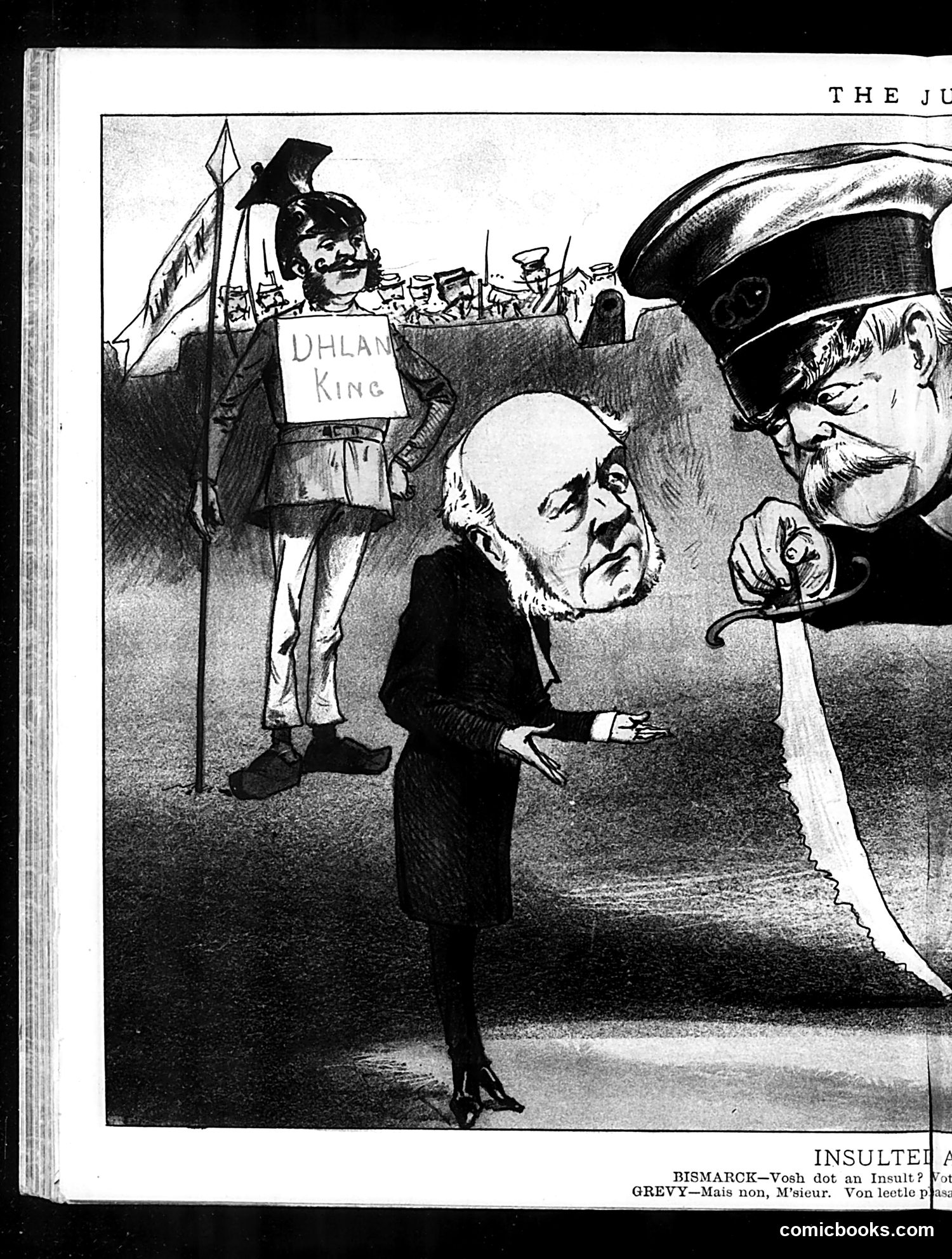
This is a satirical cartoon from *Judge* magazine depicting a confrontation between Otto von Bismarck (the bald, elderly figure in the center) and a German military officer (right). In the background, a figure holds a sign reading "Uhland King," apparently representing or mocking some form of German leadership or nationalist movement. The satire appears to mock Bismarck's response to challenges to his political authority. The caption fragment "Vosh dot an Insult?" suggests Bismarck's indignant reaction to being questioned or challenged. The "Uhland King" reference likely alludes to a specific German political figure or movement the American magazine's readers would recognize as contemporary competition or threat to Bismarck's dominance. The cartoon satirizes both German militarism and Bismarck's defensive posturing regarding his political position and legacy.
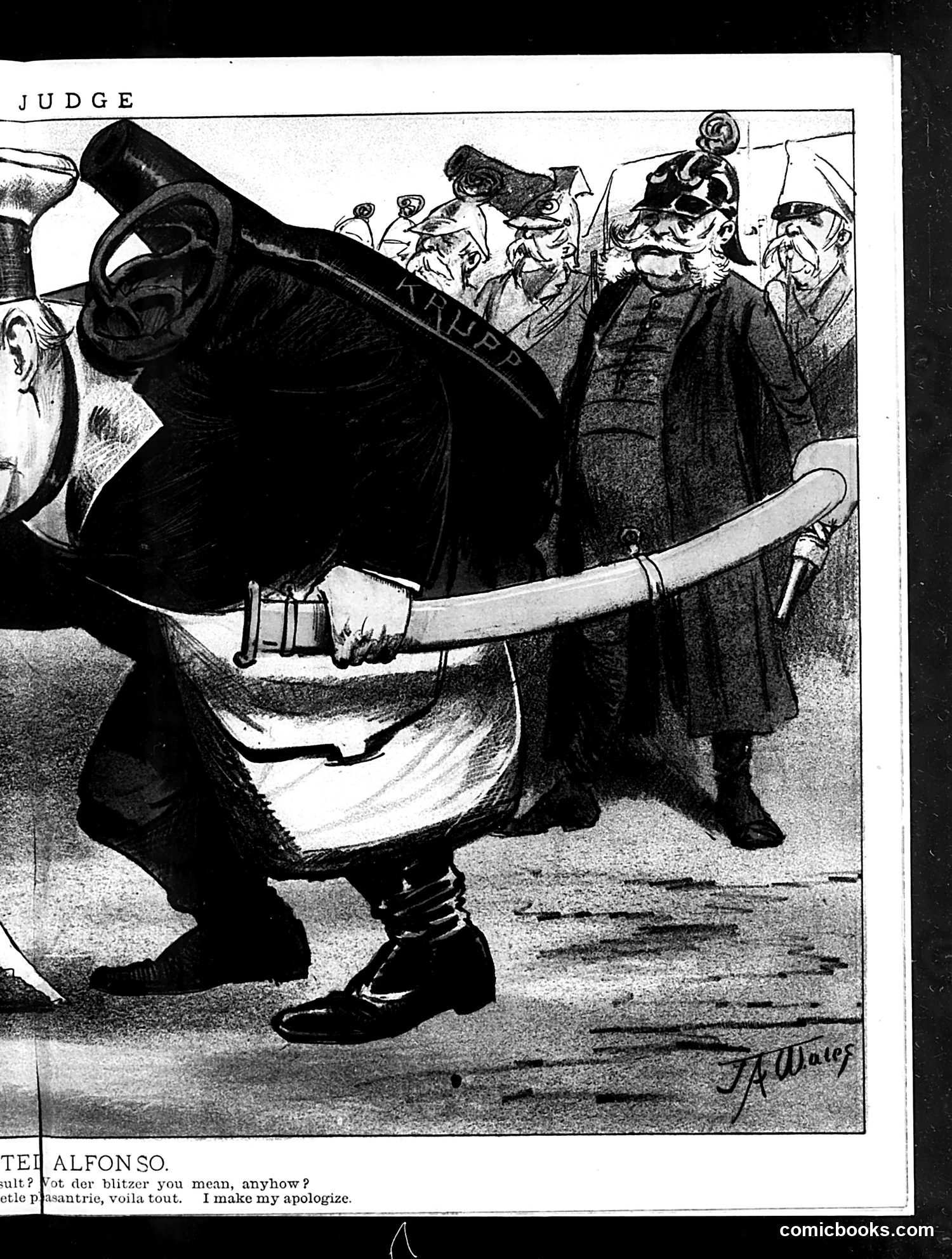
This political cartoon depicts **King Alfonso XIII of Spain** (identified by the caption "ALFONSO") as a grotesque, heavily caricatured figure. The exaggerated facial features and dark, menacing silhouette suggest hostile satirical intent. The partially visible dialogue mentions "peasantry" and an apology ("I make my apologize"), implying the cartoon comments on Spanish class relations or a specific royal scandal or policy affecting common people. A group of officials or observers stands in the background, witnessing the scene. The cartoon's style and presentation suggest this critiques Alfonso's governance or conduct during his reign (1886-1931), likely during a period of Spanish social unrest or controversial royal action. Without the full caption or date, the specific incident remains unclear.
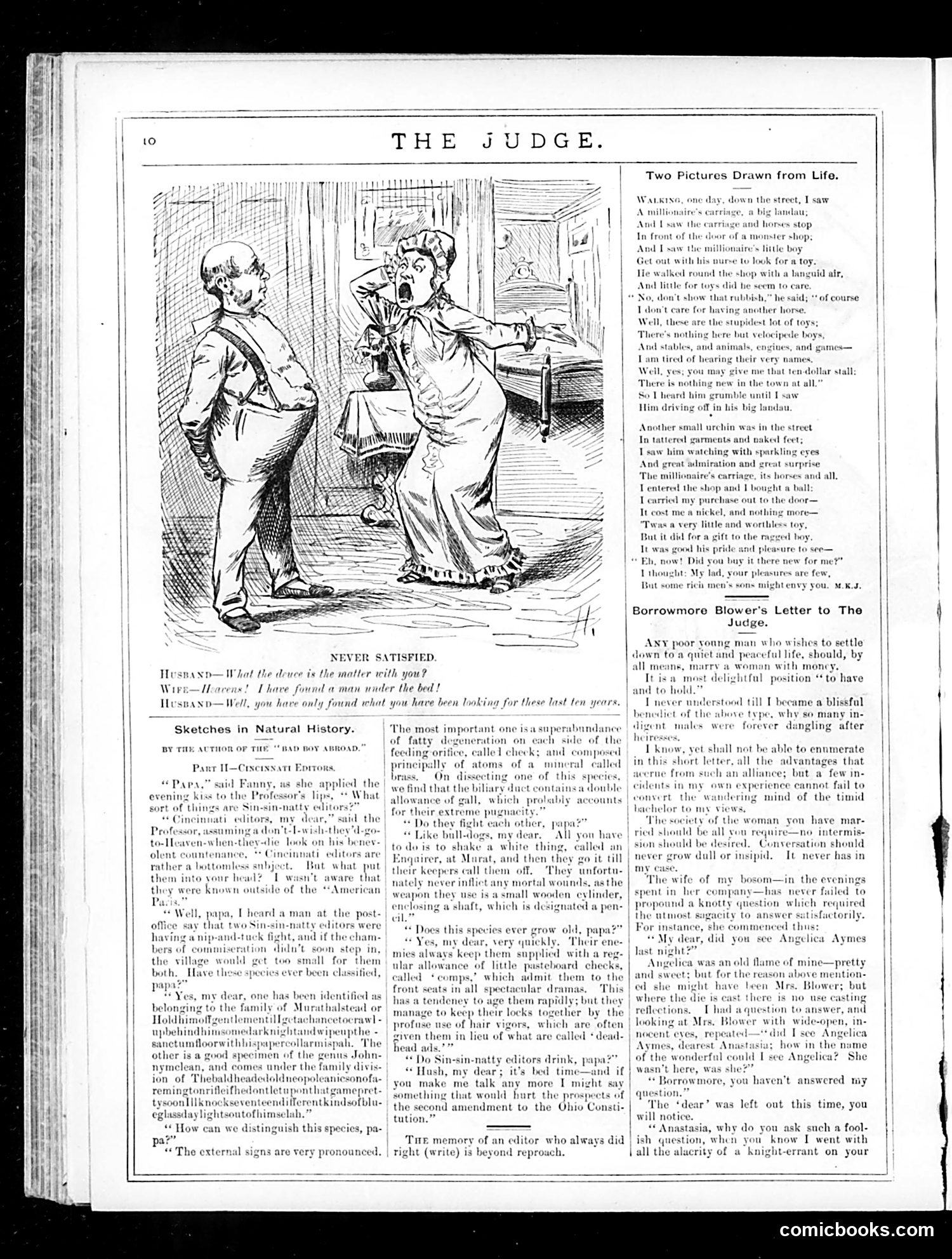
This cartoon depicts a domestic argument between a husband and wife. The husband has discovered a man hiding under the bed, confronting his wife with the discovery. The wife's response—that he's "only found what you have been looking for these last ten years"—suggests a marital complaint: the husband has long suspected infidelity or impropriety. The satire critiques marriage dynamics of the era, particularly the husband's hypocrisy. His shock at finding evidence of what he apparently suspected all along exposes the gap between marital suspicion and actual proof. The cartoon ridicules both the husband's apparent blindness and the wife's pointed retort, suggesting mutual dissatisfaction in the relationship. The accompanying text pieces ("Two Pictures Drawn from Life" and "Borrowmore Blower's Letter to The Judge") develop similar domestic themes—wealth's inability to purchase happiness, class differences in childhood joy, and marriage's complications—reinforcing *Judge* magazine's recurring satirical focus on American domestic life and social pretension.
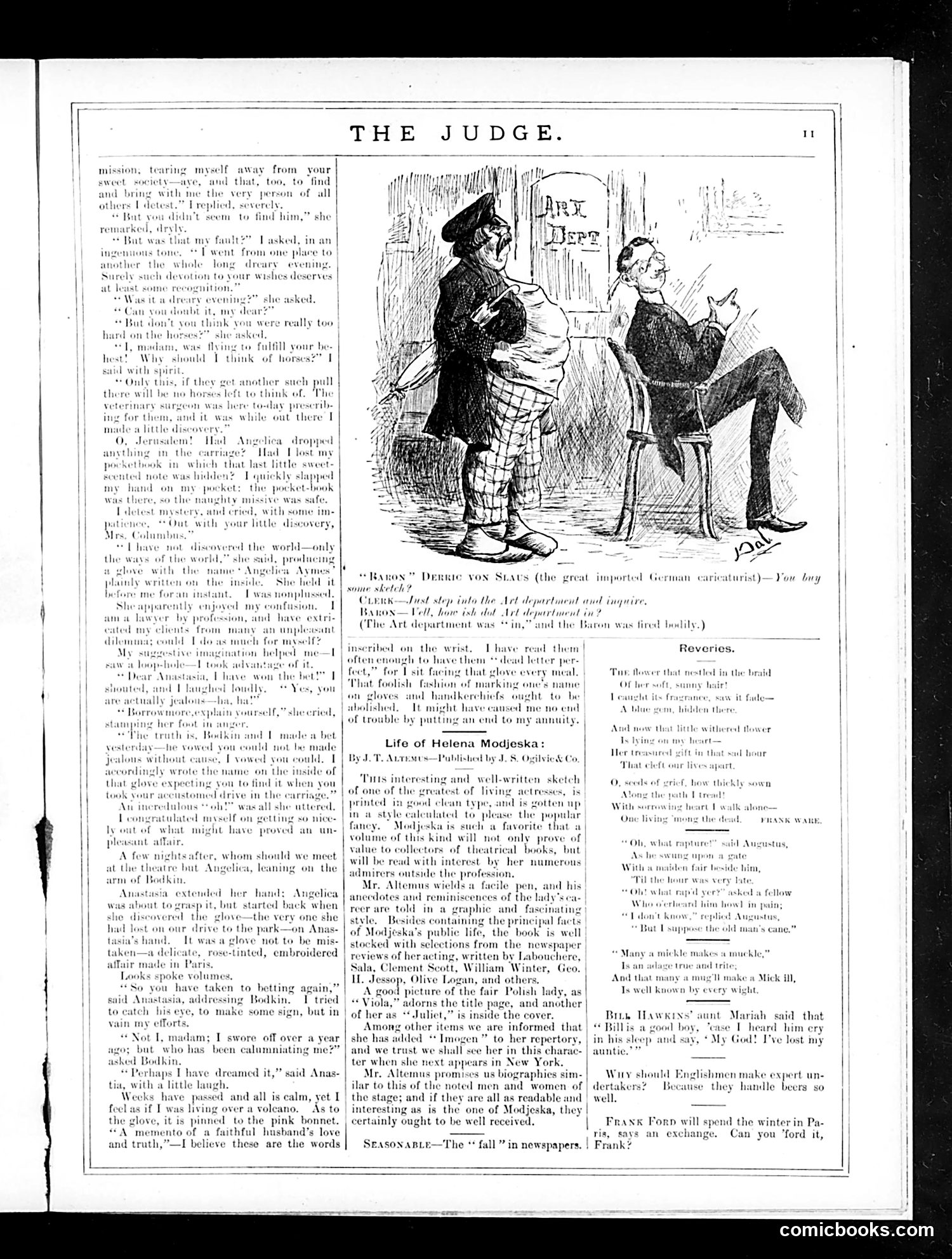
This page from Judge magazine contains multiple satirical pieces typical of the publication's format. **Main Cartoon**: The illustration shows "Baron" Derric von Stau (identified as "the great imported German caricaturist") visiting Judge's art department. The satire mocks the pretentious German artist—the misspelled "Vell, how ish dot Art department" parodies a German accent, while the joke suggests the art department's poor quality or the artist's inflated reputation. This reflects American humor about European affectations and artistic pretension. **Text Content**: The page includes serialized fiction excerpts and book reviews, including a review of "Life of Helena Modjeska" (a celebrated Polish actress), and lighter pieces like "Reveries" poetry and miscellaneous social humor. The overall satire targets social pretension, artistic vanity, and the folly of wealthy individuals—common Judge themes mocking the Gilded Age elite.
This page from **Judge** magazine focuses on **theater reviews and a letters section**. The main content includes: **Theater Coverage:** Reviews of New York productions at various playhouses (Daly's, Wallack's, the Fourteenth Street Theatre, etc.). The writer discusses contemporary actors and plays with the typical critical tone of period theater journalism—commenting on performances, staging, and audience reception. **The Cartoon:** The decorative header illustration titled "The Judge at Play" appears to be a generic theatrical vignette, likely just ornamental framing rather than political satire. **"Answers to Correspondents":** A letters column where the magazine's editors respond to reader submissions about poetry, stories, and other matters—rejecting some work as unsuitable, offering editorial advice, and making humorous remarks about submissions. The page reflects **Gilded Age theatrical culture** and the magazine's role as social commentary on entertainment and public taste. The tone is witty and somewhat condescending toward readers and aspiring writers.
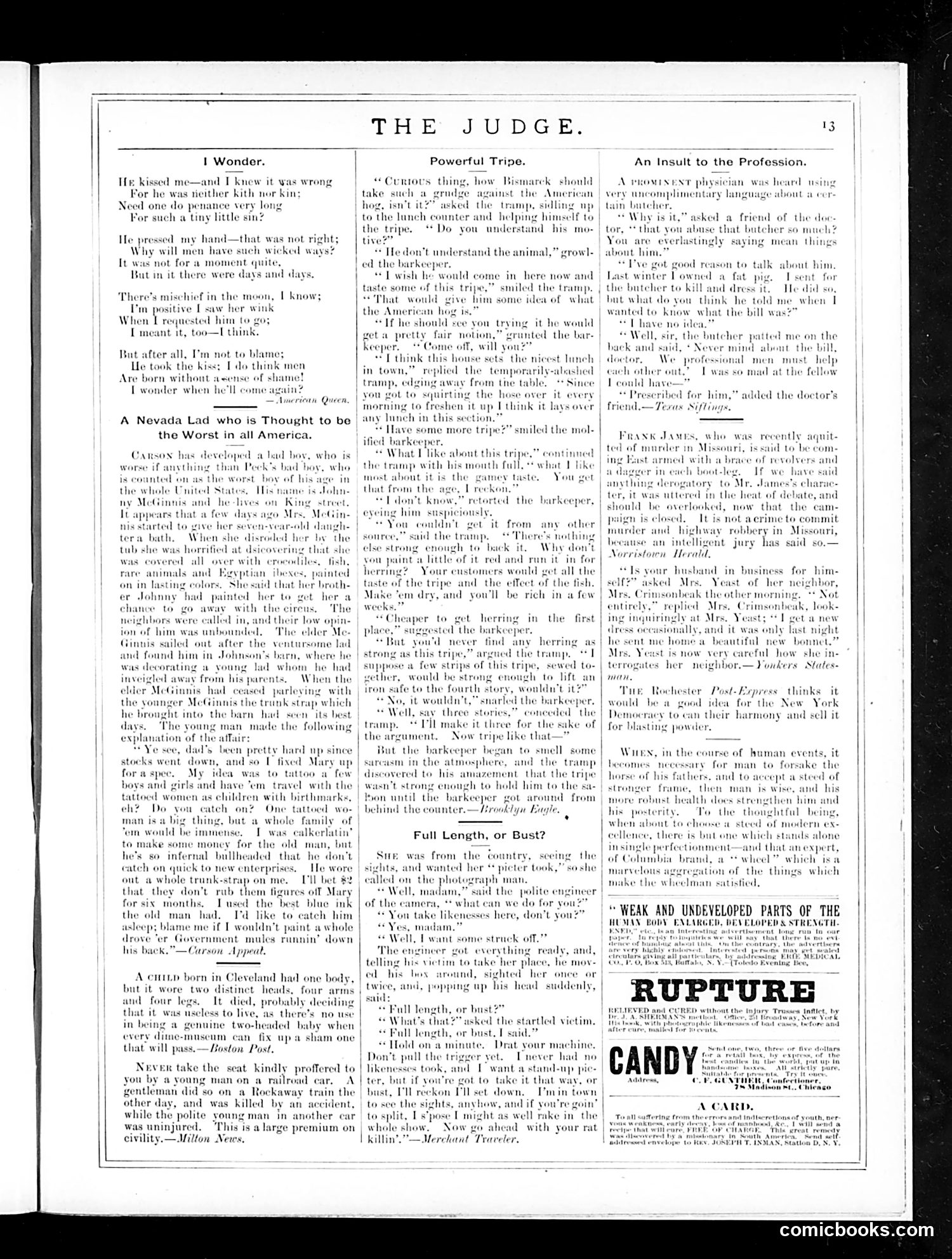
This page from *Judge* contains three satirical pieces typical of late 19th-century American humor: **"I Wonder"** and **"A Nevada Lad"** are romantic/scandal anecdotes mocking seduction and moral hypocrisy—common Judge themes ridiculing social pretense. **"Powerful Tripe"** satirizes a tramp and barkeeper debating whether to sell horse tripe as food, with the tramp suggesting they paint it red to fool customers. This targets food-industry deception and the sale of poor-quality meat to working-class consumers—a genuine Progressive-era concern. **"Full Length or Bust?"** jokes about a traveling circus performer with two heads (referencing actual sideshow attractions of that era) negotiating a photograph pose. The advertisements below (Rupture, Candy, medical notices) are typical period ads. The page reflects Judge's formula: crude jokes about gender relations, crime/vice, and working-class life, paired with social commentary on fraud and exploitation. The humor is unsophisticated by modern standards but reflects contemporary anxieties about urban deception and consumer fraud.
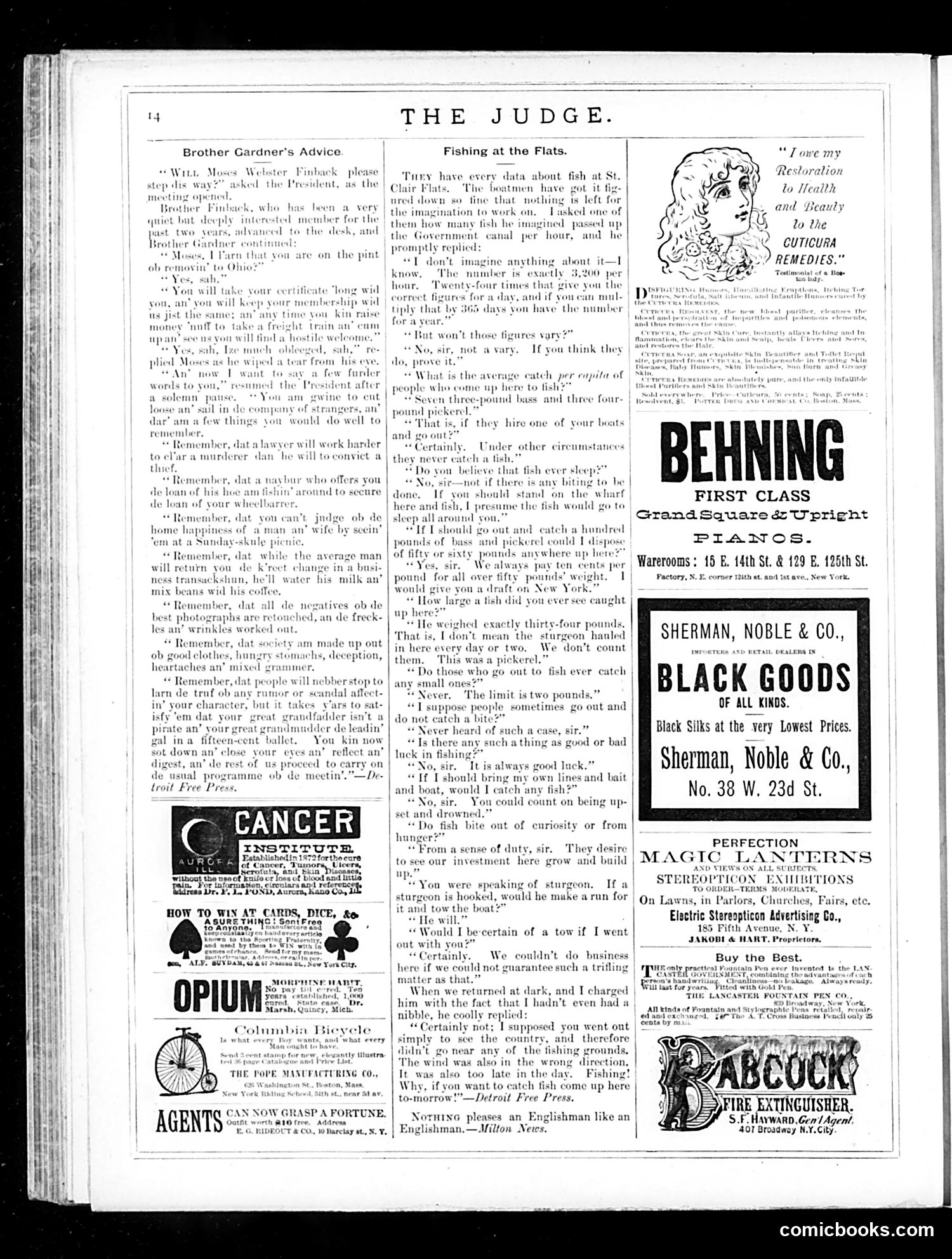
This page contains a humorous dialogue between a fisherman and a government official about fishing productivity at "the Flats." The satire mocks bureaucratic absurdity: when asked how many fish are caught, the official produces exact statistics (3,200 per hour), which he multiplies mechanically to claim yearly totals—despite admitting nobody actually catches fish there. The joke targets government inefficiency and the era's faith in statistics divorced from reality. The official's confident recitation of meaningless numbers, contrasted with the fisherman's practical observation that "they never catch a fish," satirizes how institutions prioritize data over actual results. The accompanying column, "Brother Gardner's Advice," offers practical counsel to someone moving to Ohio, maintaining the magazine's mix of satire and gentle humor. The page is primarily text-based editorial content with period advertisements below.
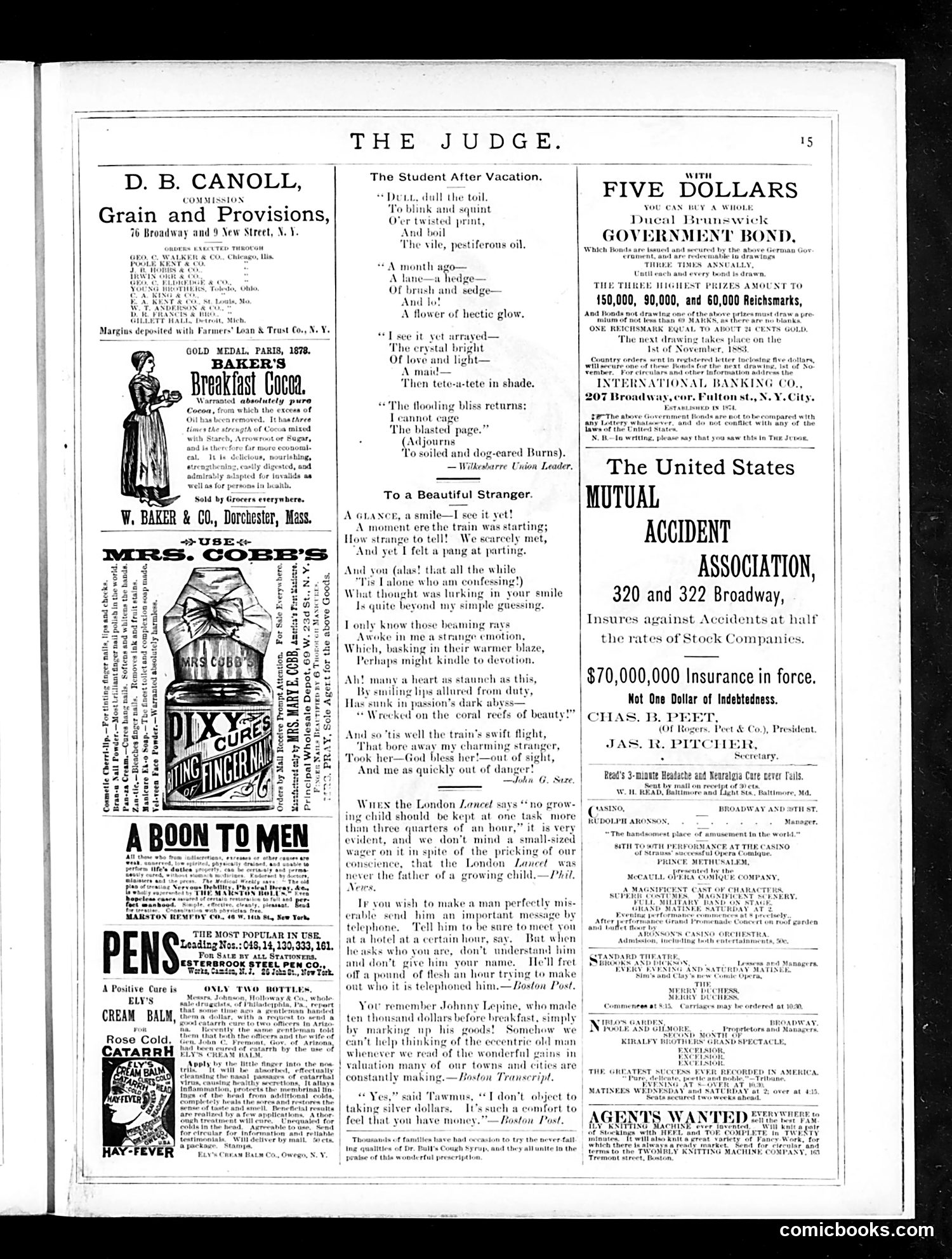
This is primarily an **advertising page** from Judge magazine, not a political cartoon. The page contains multiple commercial advertisements (grain provisions, insurance bonds, pens, medical remedies) interspersed with brief humorous poems and social commentary. The literary pieces include "The Student After Vacation" (about academic lethargy), "To a Beautiful Stranger" (a romantic poem about meeting someone on a train), and several short satirical observations. One notably mocks the *London Lancet* medical journal's advice about child education. Another jokes about the annoyance of anonymous telephone calls. The content reflects **late 19th-century American concerns**: workplace exhaustion, romantic encounters, parenting theories, and the new technology of the telephone as a social irritant. The page demonstrates Judge's format: mixing paid advertisements with light satirical verse to entertain middle-class readers while generating revenue.
This appears to be a title page or section divider from *Judge* magazine, showing only "THE JUDGE" text on the left margin against an otherwise blank white page. Without visible cartoon imagery, advertisements, or substantive content, I cannot identify specific figures, political references, or satirical points. To provide meaningful analysis of the satire or social commentary, I would need a page containing actual cartoon illustrations or article text. This particular image shows only the magazine's masthead or section heading, which is insufficient for explaining the satirical content or historical context to a modern reader.