
Judge, 1883-10-20 · page 2 of 17
Judge — October 20, 1883 — page 2: what you’re looking at
What you’re looking at
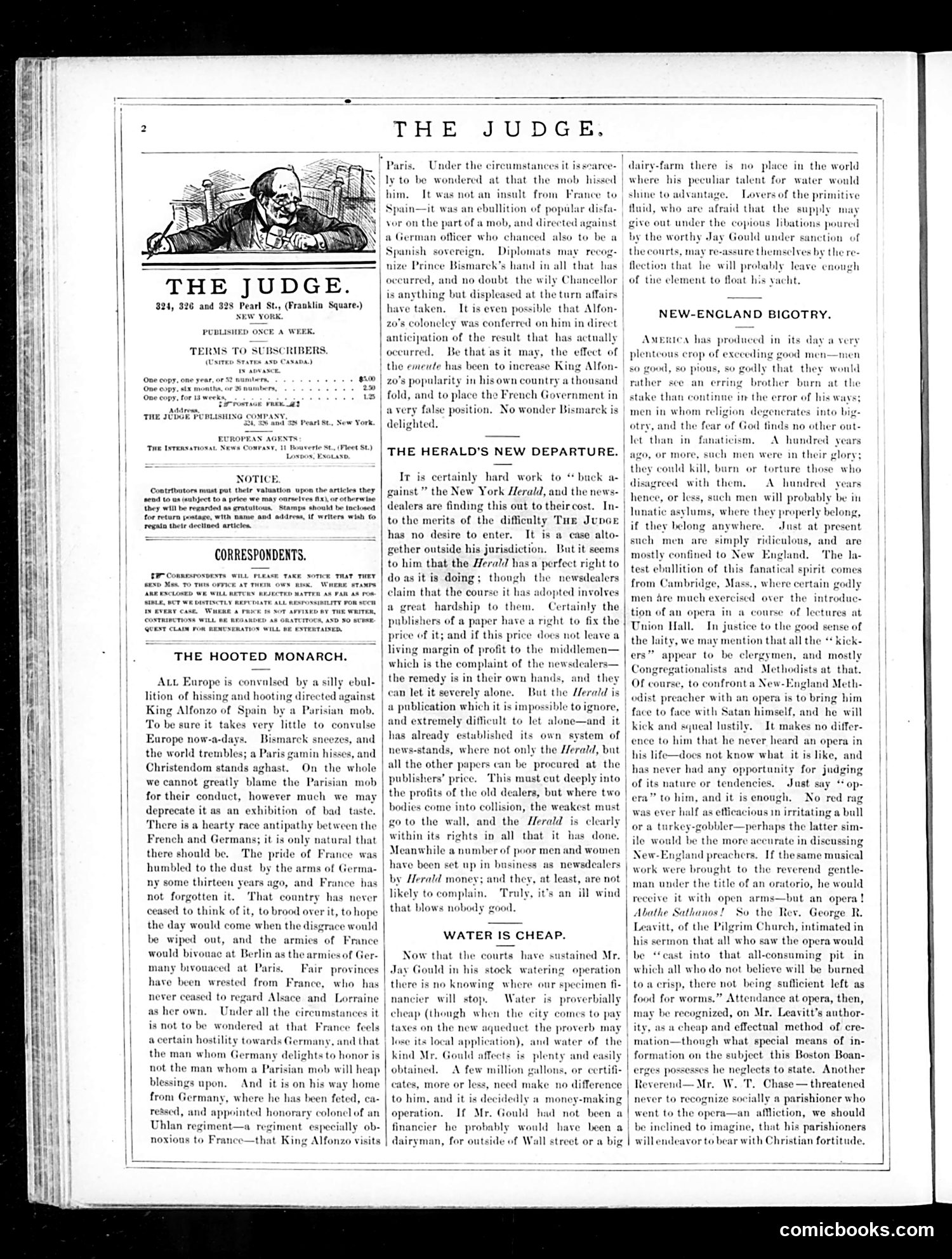
**The Hooted Monarch** cartoon addresses King Alfonso XII of Spain's unpopularity in France. A Parisian mob recently hissed him—an insult Judge attributes to Franco-German tensions rather than anti-Spanish sentiment. The article suggests Prussian Chancellor Bismarck deliberately orchestrated Alfonso's German honors to provoke France, exploiting existing hostility stemming from France's 1870 defeat and loss of Alsace-Lorraine. The satire mocks Bismarck's manipulation of European diplomacy. **The Herald's New Departure** section defends the New York Herald's right to set its own newspaper prices and establish direct distribution, despite newsdealer complaints about lost profits. Judge acknowledges the dealers' hardship but argues that when economic forces collide, "the weakest must go to the wall"—endorsing the Herald's competitive advantage and modern business practices over traditional middlemen. Both pieces champion aggressive modernization against established opposition.
📄 Transcribed text from this page (OCR, searchable)
Machine-transcribed from the original scan — historical spelling and the odd misread are preserved.
SS SEAS THE JUDGE. — | Paris. Under the circumstances it is THE JUDGE. 824, 326 and 328 Pearl St., (Franklin Square.) TERMS TO SUBSCRIBERS. Peart 8t., New York. ENTS Rouverte St., (Fleet St.) Loxpos, EStaxe, ‘Tne Isrensanionst, News Comrasy NOTICE. Contributors must pat thetr valuation send to 8 (aubject to a price we m they will be rezanted for return regain their declined articles. CORRESPONDENTS. rope is convulsed lition of hissing and hooting directed King Alfonzo of Spain by a Parisian mob. be sure it takes very little to convulse | Europe now-a-d Bismarck sneezes, and the world trembles; a Paris gamin hisses, and Christendom stands aghast. for their conduct, however much we ma: deprecate it as an exhibition of bad t There is a hearty race antipathy between the French and Germans; it is only there should be. The pride of France was humbled to the dust by the arms of ( ny some thirteen years ago, and F not forgotten it. ‘That country has 1 ceased to think of it, to brood ov the day would come when the di be wiped out, and the armies of would bivonac at Berlin as the armies of Ger- many bivouaced at Paris, Fair provinces have been wrested from France, who never ceased to regard A and Lorraine as her own. rit, tohope Under all the circumstances it is not to be wondered at that France feels acertain hostility towards Germany, the man whom nd that ts to honor is not the man whom a Parisian mob will heap blessings upon. many del And it is on his way home from Germany, where he has been feted ed, and appointed honorary colonel o Uhlan regiment—a regiment especially On the whole | we cannot greatly blame the Parisian mob | ly to be wondered at that the mob his him. It was not an insult from France t Spain—it was an ebullition of popular di vor on the part of a mob, and directed against a German officer who chanced also to be a Diplomats may recog: nize Prince Bismarek’s hand in all that has occurred, and no doubt the wily Chancellor Spanish sovereign. is anything but displeased at the turn affairs | have taken. It is even possible that Alfon- s coloneley was conferred on him in direct | anticipation of the result that has actually Be that as it may, the effect of King Alfon- o's popularity in his own country a thousand | fold, and to place tho French Government in | avery false position, No wonder Bismarck is delighted. occurred, the emeute has been to incre THE HERALD’S NEW DEPARTURE. Ir is certainly hard work to “buck 4 gainst ” the New York Herald, and the news- dealers are finding this out to theircost. In- | to the merits of the difficulty Tue Jupce has no desire to enter. It is a case alto- gether outside his jurisdiction. But it seems to him that the Herald has a perfect right to do as it is doing; though the newsdealers claim that the course it has adopted involves a great hardship to them. publishers of a paper have a right to fix the | ; and if this price does not leave living margin of profit to the middlemen— | which is the complaint of the newsdeale: the remedy is in their own hands, and thi can let it severel But the Herald is a publication wh. ble to ignore, and extremely difficult to let alone—and it has alrea blished its own system of new ands, where not only the Herald, but all the other papers can be procured at the publishers’ ps his must cut deeply into the profits of the old dealers, but where two bodies come into collision, the weakest must goto the wall, and the “Herald is clearly within its s in all that it has done, Meanwhile a number of poor men and women up in business as newsdealers Herald money; and they, at least, are not likely tocomplain. Truly, it’s an ill wind that blows nobody good. have been s t WATER IS CHEAP. Now that the courts have ained Mr. | Jay Gould in his stock watering operation there is no knowing where our specimen fi- nancier will stop. Water is proverbially cheap (though when the city comes to p: taxes on the new aqueduct the proverb m: lose its local application), and water of the kind Mr, ¢ obtaine cates, more or less, need make no difference to him, and it is decidedly a money- ing operation. If Mr. Gould had not been financier he probably would have been a Certainly the | | urm there is no place in the world where his peculiar talent for water would shine to advantage. Lovers of the primitive fluid, who are afraid that the supply may give out under the copious libations poured by the worthy Jay Gould under sanction of the courts, may reassure themselves by the flection that he will probably leave enoug of tne element to float his vacht. NEW-ENGLAND BIGOTRY. America has produced in its day a very plenteou: fa men—men so good, they wonld rather sce an erring brother burn the stake than continu men in whom reli in the error of his ways; otry, and the fear of God finds no other out- let than in fanaticism, A hundred y or more, such men were in their they could kill, burn or torture those agreed with them, A hundred years Thong, St eas, wich mel il probably be in lunatic asylums, where they properly belong, r Just at pre such men are simply ridiculous, and mostly confined to New England. ‘The I test ebullition of this fanatical spirit comes from Cambridge, Mass., where certain men dre much exercised over the introdu | tion of an opera in a course of lectures Union Hall. In justice to tl nd sense | the laity, we may me tion t utall the jould affects is plenty and easily | A few million gallons, or certifi- | e ers” appear to be clergymen, and mostly Congre nd “Methodis ts at that. Of course, to confront a New-England Meth- odist preacher with an opera is to bring him face to face with Satan himself, and he will kick and squeal lustily. It makes no differ- ence to him that he never heard an opera in his li locs not know what it is like, has never had any opportunity for judging of its natu ionalists ror tendencies. Just say ‘* op- era” to him, and it is enough. No red rag was ever half as efficacious in irritating a bull key-gobbler—perhups the latter sim- Jd be the mor > in discussing and preachers. If thesame musical work were brought to the reverend gentle- n under the title of an oratorio, he qronld: ve it with open arms—but an op Abathe Sathanos! So the Rev. George R. itt, of the Pilgrim Church, intimated in st into that all-consuming pit in which all who do not believe will be burned to acrisp, there not being sufficient left as food for worms.” Attendance at opera, then, may be recognized, on Mr, Leavitt’s author- ity, asa cheap and effectual method of cre- mation—though what special means of in- formation on the sub, this Boston Boan- shen ts to state. Another Reverend— Mr. W. T. Chase — threatened never to recognize socially a parishioner who went to the opera—an affliction, we should F be inclined to im: , that his parishioners dairyman, for outside of Wall street or a big | will endeavor to bear with Christian fortitud | comicbooks.com