
A complete issue · 16 pages · 1883
Judge — July 7, 1883
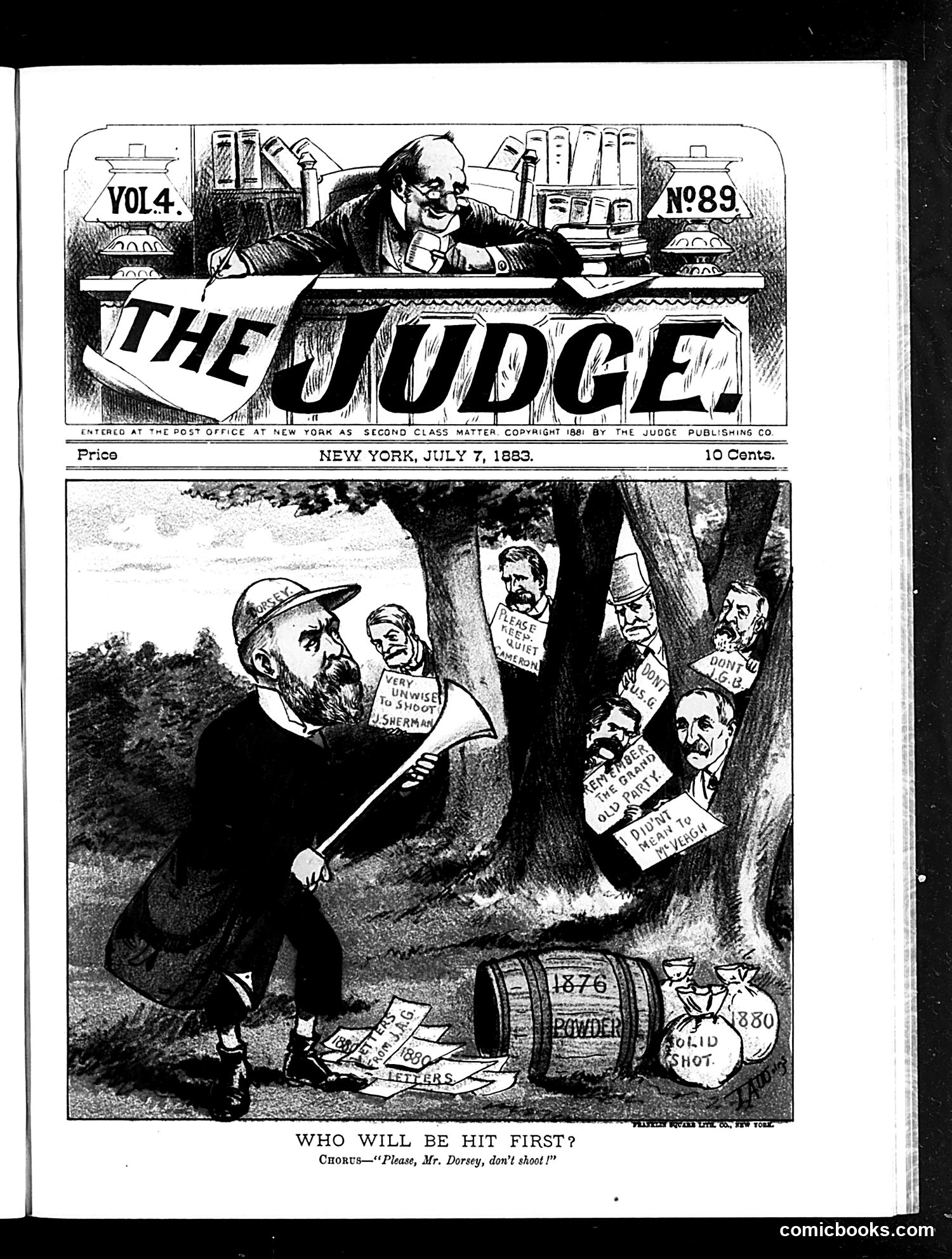
This political cartoon satirizes violence in American politics during the Gilded Age. A bearded man (likely representing a political figure or the concept of political violence) prepares to shoot at several effigies hanging from a tree, labeled with names of political figures and dates (1876, 1880). The caption "Who Will Be Hit First?" and chorus "Please, Mr. Dorsey, don't shoot!" suggest anxiety about political assassination or violence. The hanging effigies represent past targets of political violence or assassination attempts. Powder barrels and ammunition at the base emphasize the explosive threat. This appears to critique ongoing political instability and the threat of violence as a political tool during this turbulent period of American history.
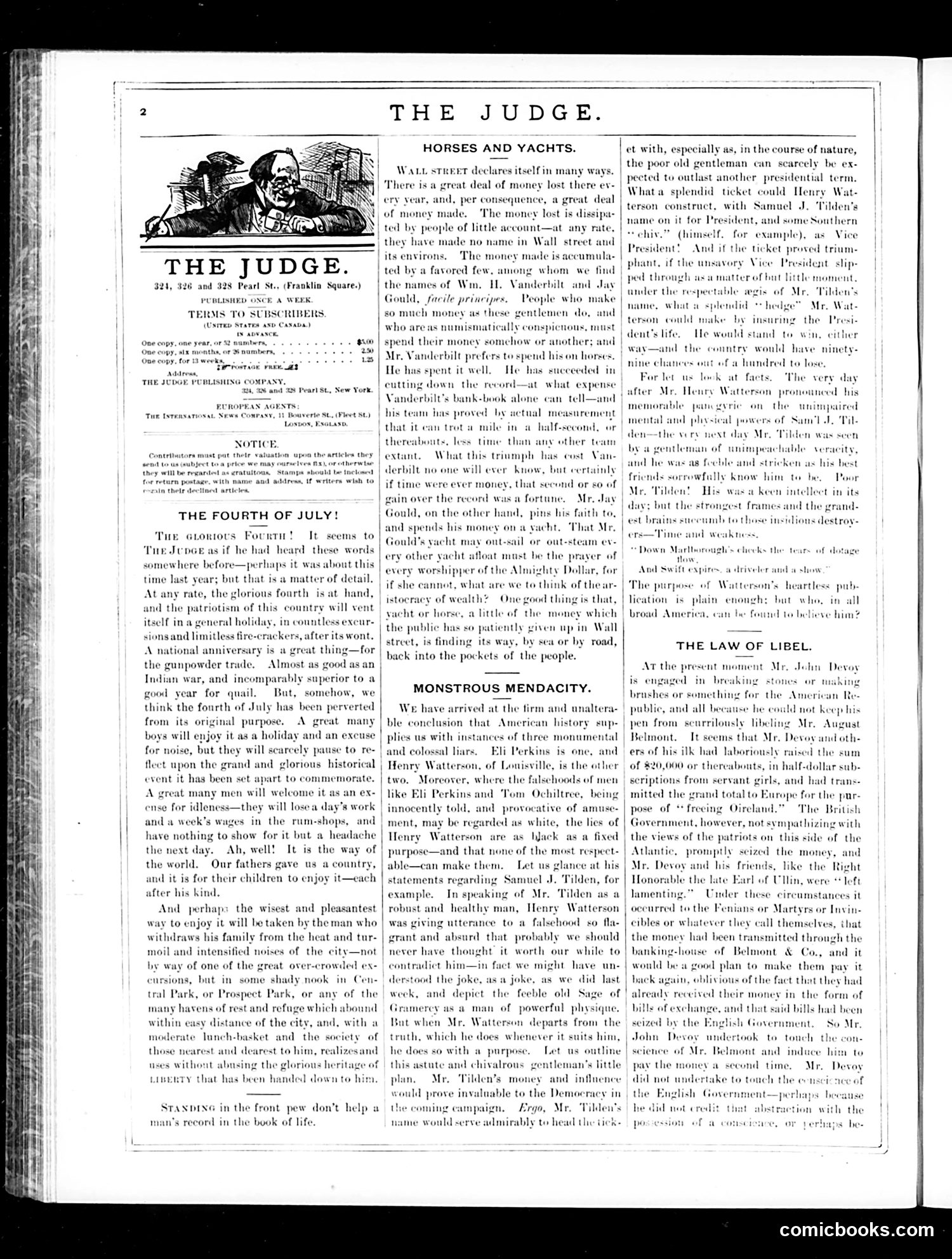
This page satirizes the wealth and spending habits of Gilded Age robber barons, particularly **William H. Vanderbilt** and **Jay Gould**. The main article criticizes how these men accumulate vast fortunes on Wall Street, then dissipate or hoard the money rather than returning it to the public. Vanderbilt's preference for spending on horses and Gould's investment in yachts exemplify this wasteful conspicuous consumption. The piece also attacks **Henry Watterson** (a Louisville newspaper editor) for spreading false stories about political figures like **Samuel J. Tilden**, comparing his deliberate lies unfavorably to the innocent falsehoods of other notorious exaggerators like "Eli Perkins" and "Tom Ochiltree." The satirical point: the wealthy elite either squander money on personal luxuries or lie to protect their interests—neither serves the public good. The tone is mocking indignation at Gilded Age excess and media dishonesty.
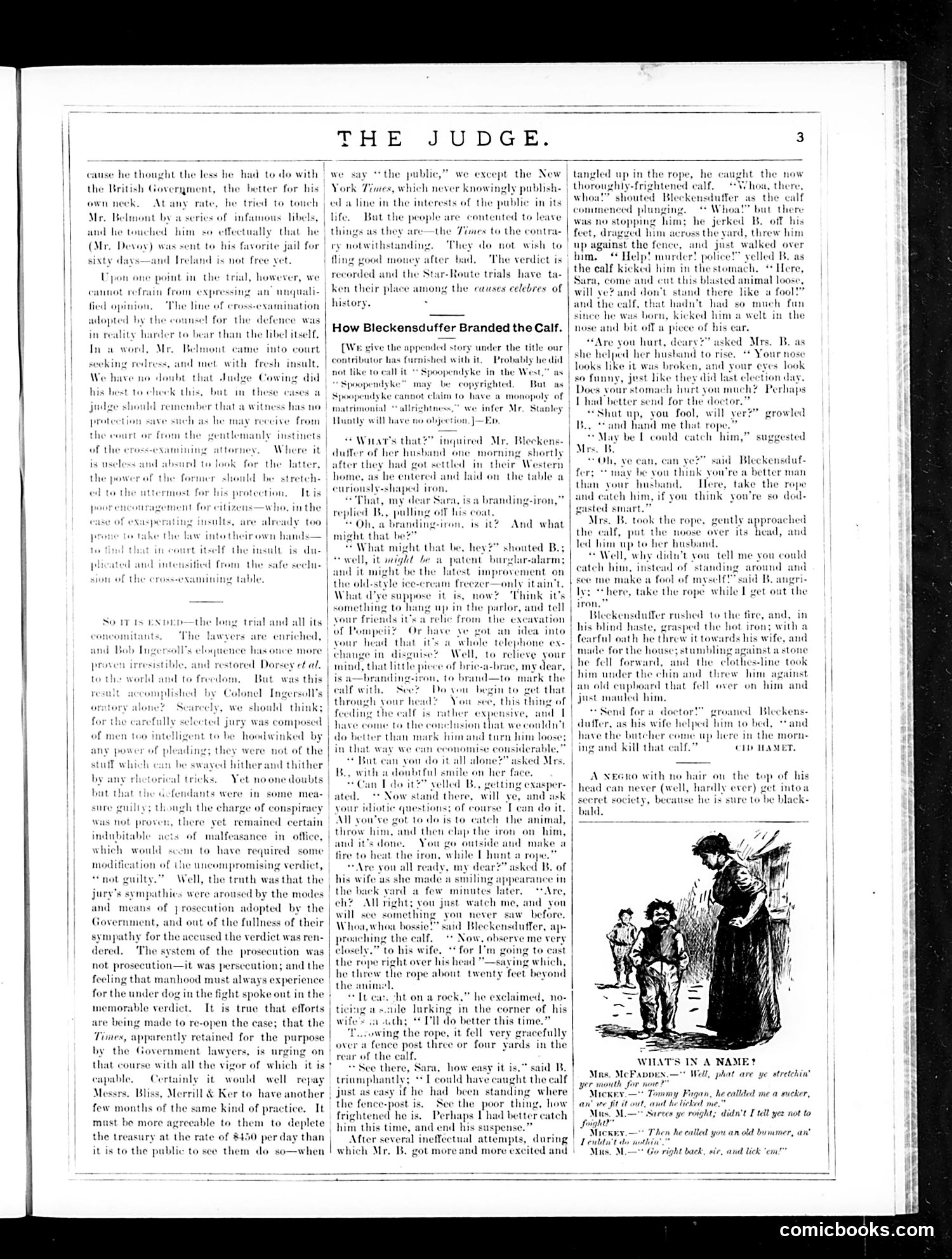
This page from *Judge* contains a humorous domestic story illustrated with a comic scene. The narrative describes a comedic mishap: Mr. Bleckensduffer shows his wife a branding iron, which she misunderstands as decorative. When a calf escapes nearby, she suggests he use it to catch the animal. After various comic struggles, Bleckensduffer grabs the hot iron by mistake and throws it toward his wife in pain. The satire appears to mock masculine pride and marital dynamics—the husband's wounded dignity ("you're a better man than your husband") contrasts with the wife's practical problem-solving. The slapstick conclusion targeting domestic conflict was typical *Judge* fare: working-class humor emphasizing bumbling husbands, exasperated wives, and physical comedy. The illustration shows the chaotic scene with the calf, rope, and frantic action.
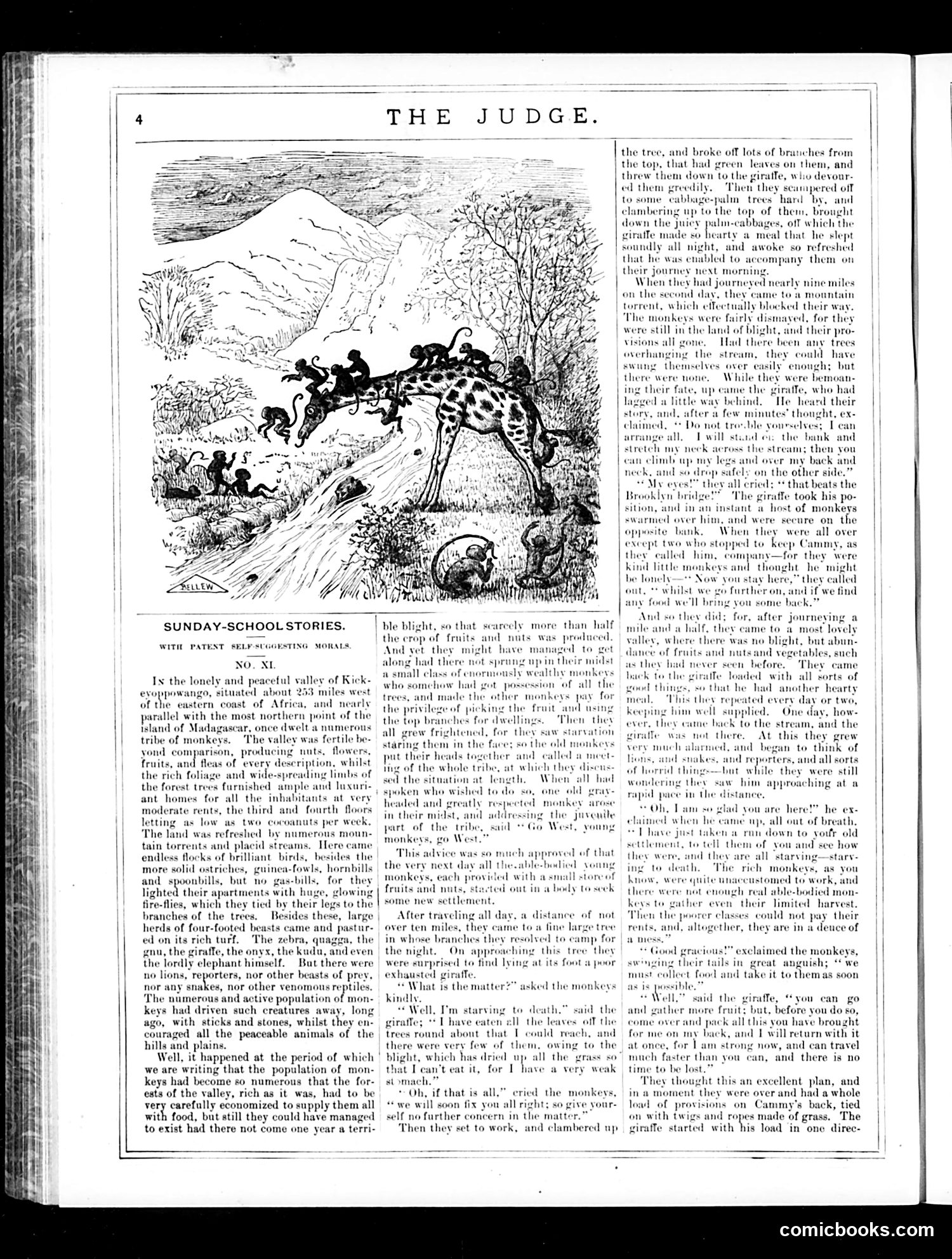
This is a moral fable disguised as children's literature. A tribe of monkeys faces starvation when "blight" destroys their food supply, and wealth inequality emerges—"a small class of enormously wealthy monkeys" hoard resources while others starve. The story advocates collective problem-solving: the monkeys work together, using a giraffe as a bridge to cross a dangerous stream and find fertile land. Two monkeys stay behind to care for a sick companion, emphasizing compassion. The satire targets both **extreme poverty and selfishness**: the moral isn't anti-wealth but anti-hoarding during crisis. The "patent self-suggesting morals" subtitle suggests Judge is mocking simplistic Sunday-school lessons that oversimplify social problems. This likely reflects **Gilded Age anxieties** about labor unrest, resource scarcity, and whether wealthy elites would cooperate with working classes during hardship—or whether mutual aid and community values could solve societal problems.
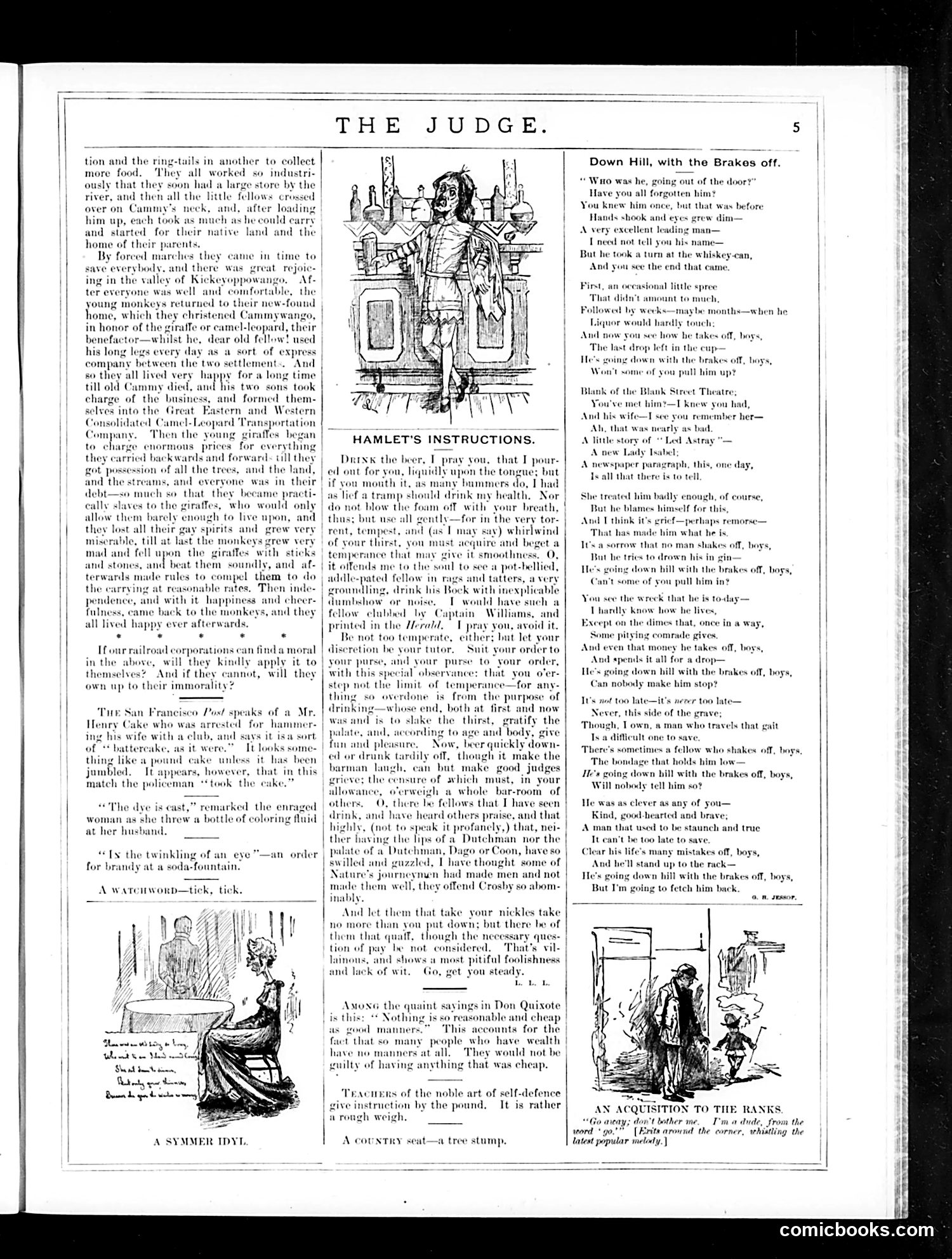
This page contains several satirical pieces typical of late 19th-century American humor: **"Hamlet's Instructions"** parodies Shakespeare by presenting Hamlet's famous advice about moderation as instructions for drinking beer, not restraint. The satire mocks both theatrical pretension and alcohol culture. **"Down Hill, with the Brakes off"** appears to be a cautionary verse about moral or financial decline, using railroad imagery (brakes, downhill) as metaphor. It likely references a specific scandal or public figure's fall from grace, though the OCR makes the exact subject unclear. **"A Summer Idyl"** and **"A Symmetry Idyl"** contain social commentary about courtship and relationships, with typical Victorian-era romantic satire. The illustrations show period-appropriate characters in domestic or street scenes. Without clearer OCR, specific political figures cannot be confidently identified, but the overall tone reflects Judge's characteristic mockery of excess, hypocrisy, and social pretension.
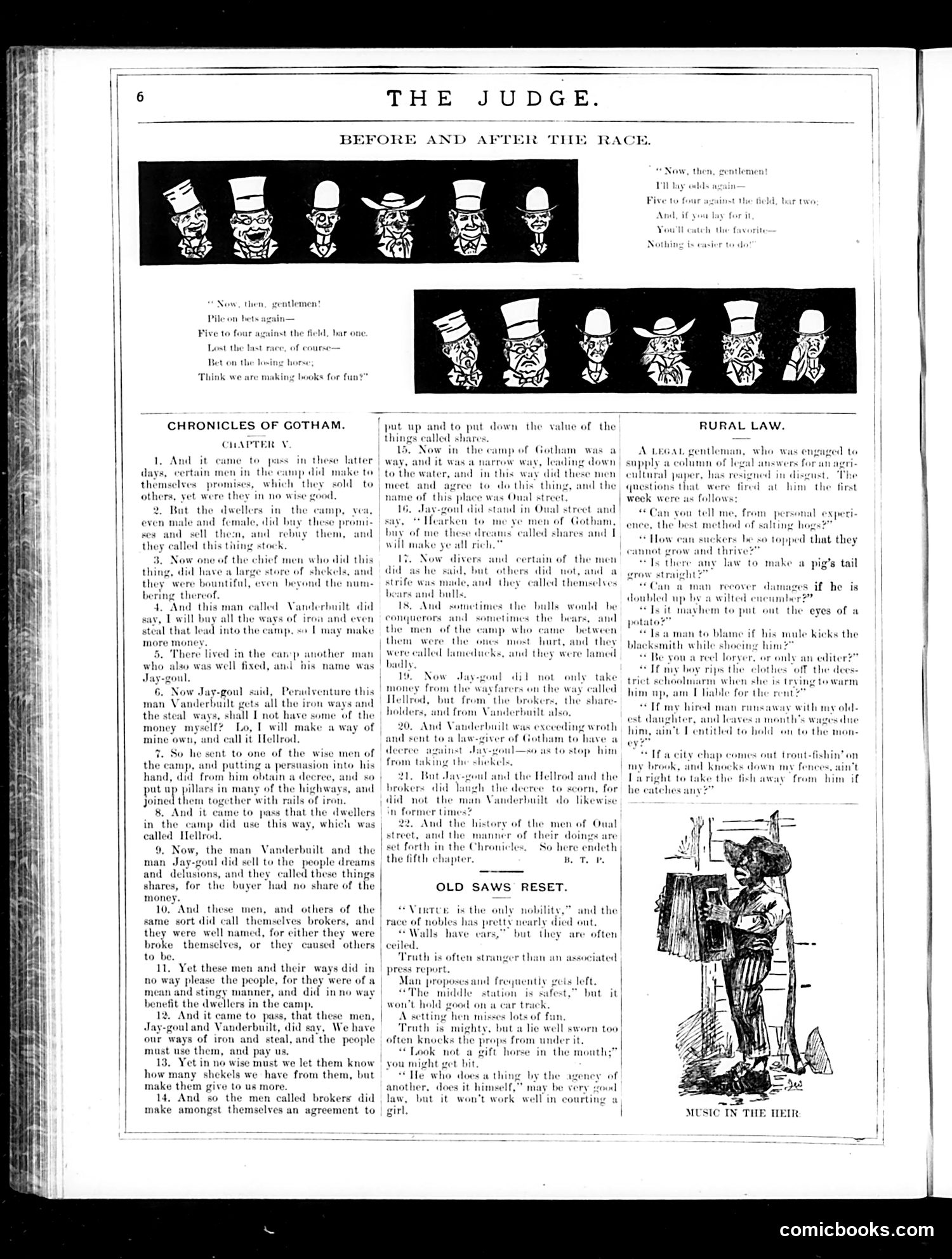
This page satirizes **Gilded Age railroad monopolies and stock market manipulation**, likely referencing real figures **Jay Gould and Cornelius Vanderbilt**. The "Chronicles of Gotham" biblical parody describes how wealthy men (Vanderbilt and "Jay-goul") create worthless stock shares ("dreams") they sell to gullible citizens. These "brokers" become wealthy through deception while ordinary people—called "lame ducks"—lose money. When Vanderbilt seeks legal action against Gould, it fails because Vanderbilt himself used identical tactics. The top cartoon panels show six caricatured faces before and after "the race"—likely depicting wealthy speculators whose expressions change following market crashes or failed schemes. The satire's point: **wealthy railroad barons enriched themselves through fraudulent stock schemes with no real consequences**, creating a rigged financial system that harmed ordinary citizens while the powerful remained unpunished. This reflects genuine Progressive-era criticism of unregulated capitalism and monopolistic practices.
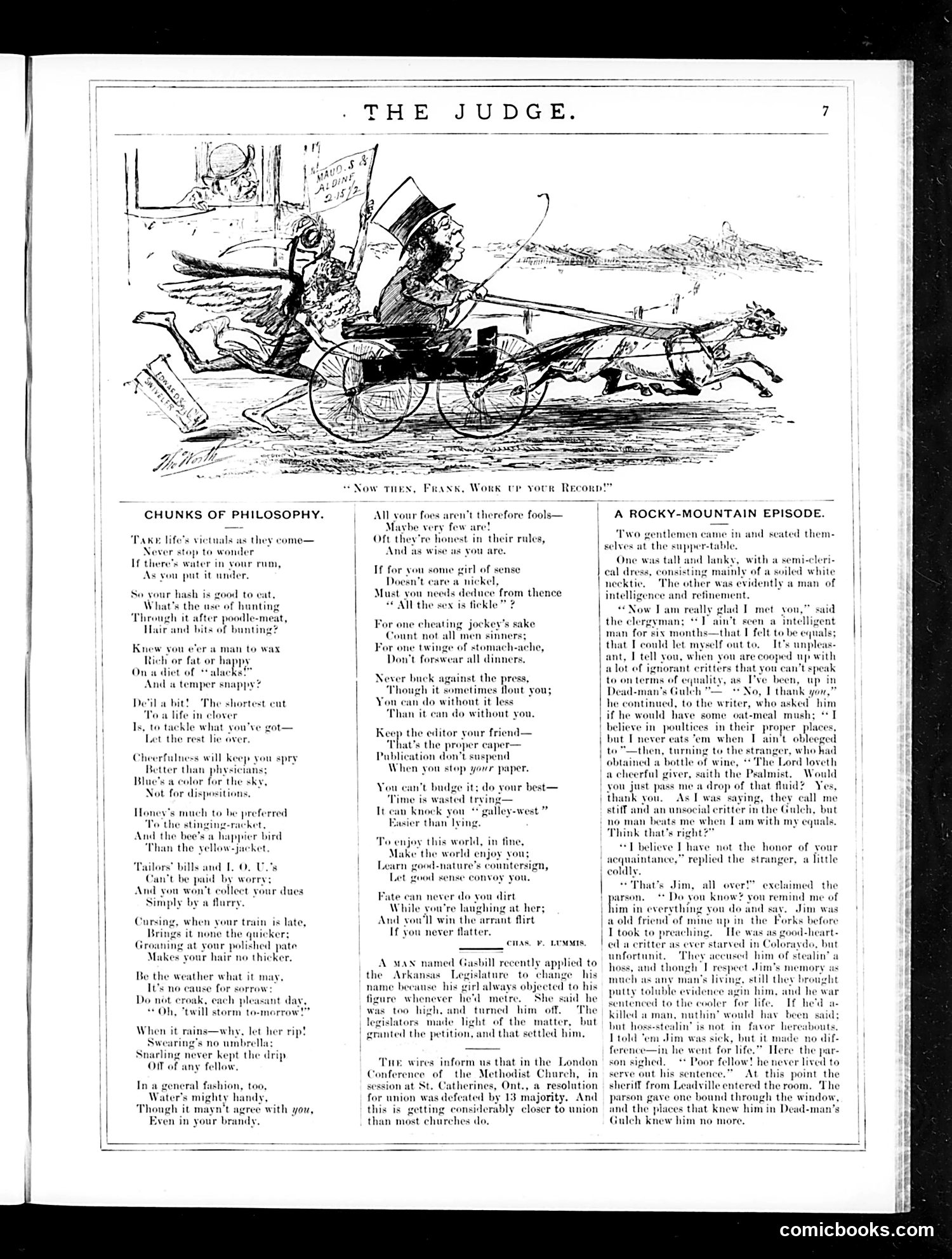
The main cartoon depicts a man in a top hat being pulled in a cart by another figure, with the caption suggesting pressure to produce results or improve performance—likely a political commentary on a public figure needing to demonstrate achievement. The page consists primarily of two text sections: "Chunks of Philosophy," a collection of humorous aphorisms about accepting life's difficulties without complaint, and "A Rocky-Mountain Episode," a tall tale about two frontier gentlemen meeting in a saloon. The Rocky-Mountain story concludes with an absurdist punchline where a parson suddenly flees through a window. The philosophical verses and frontier anecdote represent *Judge* magazine's typical blend of satirical humor and vernacular American storytelling. Without identifying specific historical figures, the page appears to mock both philosophical resignation to hardship and frontier lawlessness through exaggeration and absurdist comedy.
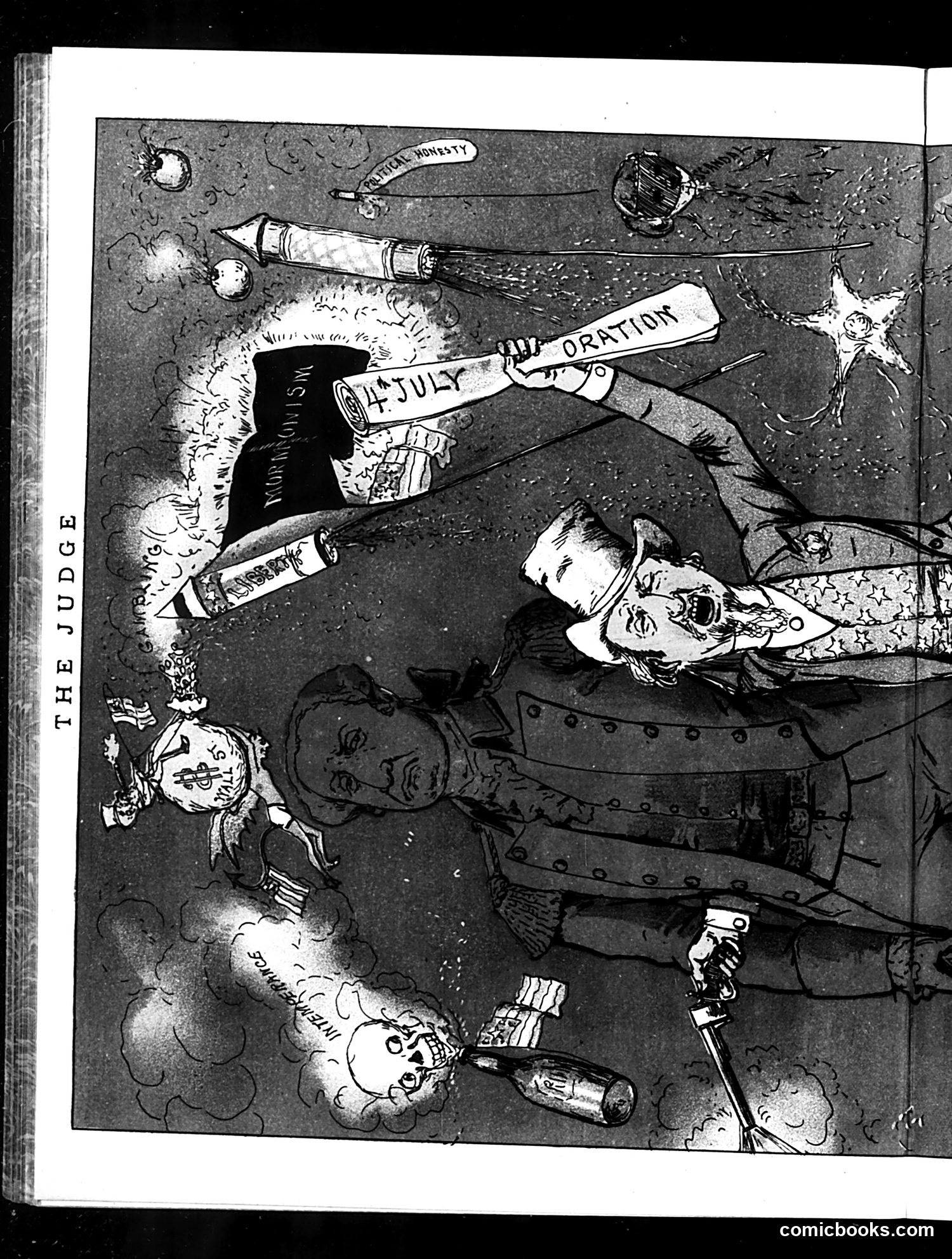
This appears to be a satirical cartoon titled "The Judge," showing a stern judicial figure presiding over a chaotic Fourth of July celebration. The central figure holds a scroll marked "4TH JULY ORATION" and a gavel labeled "HONESTY," suggesting judicial oversight of Independence Day proceedings. The cartoon depicts various fireworks, explosions, and celebratory chaos surrounding the judge, with what appears to be caricatured political or social figures. The satire likely critiques either the quality of Fourth of July speeches, the dishonesty of political figures during patriotic occasions, or the gap between idealistic Fourth of July rhetoric and actual conduct. Without clearer identification of specific figures or publication date, the precise political targets remain unclear, though the imagery suggests commentary on patriotic hypocrisy or judicial judgment of public morality.
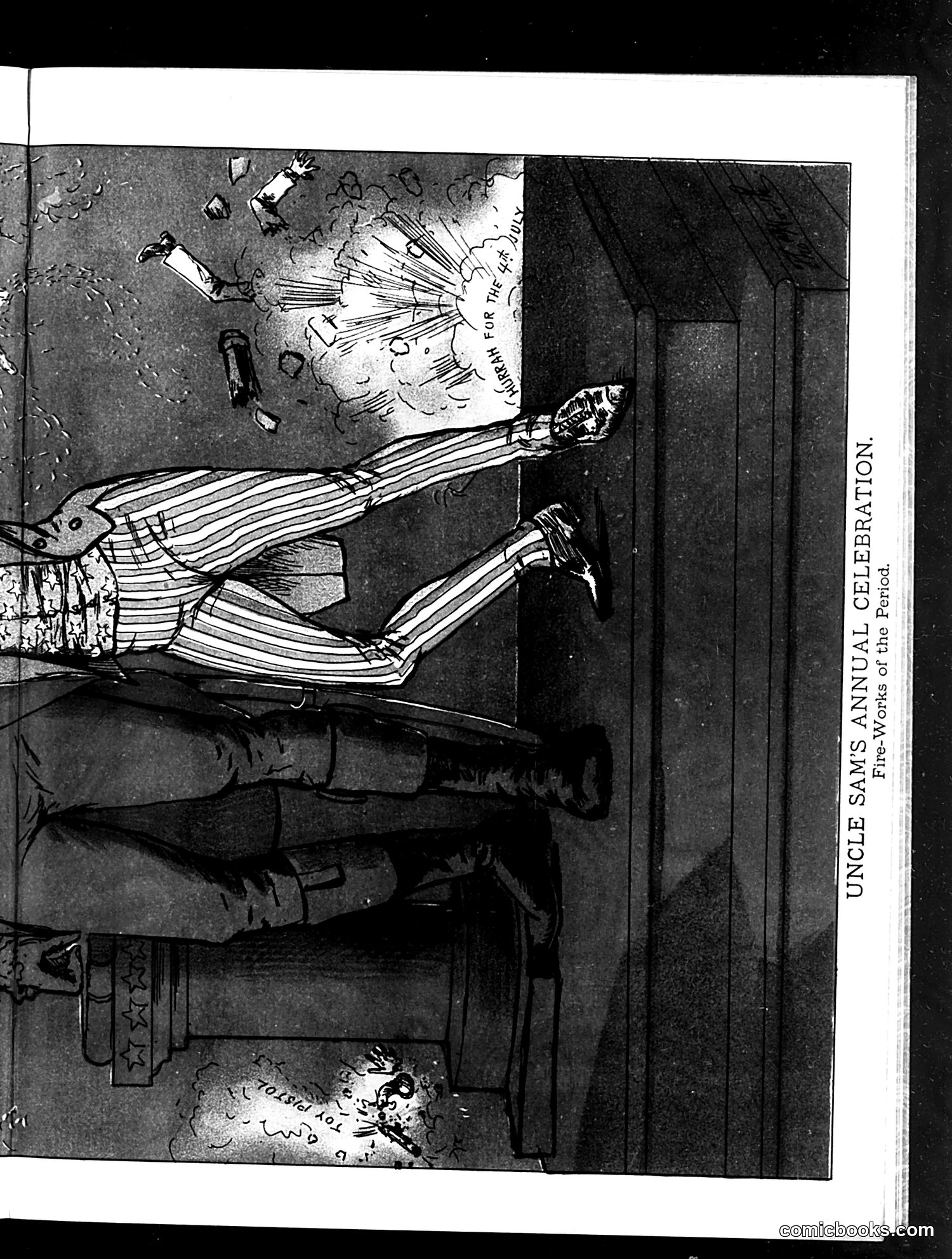
This political cartoon depicts **Uncle Sam** (identifiable by his striped pants and characteristic appearance) celebrating or commemorating something, with explosions and chaos erupting above him. The caption references "First-Weeds of the Period," suggesting this satirizes an annual American observance or tradition. The violent imagery—with figures scattered and explosions—likely critiques how Americans "celebrate" or engage with a particular national practice, possibly relating to Independence Day fireworks or another patriotic observance. The cartoon's tone is sardonic, suggesting the celebration causes harm or chaos despite its patriotic intent. Without clearer OCR or specific dating, the exact target remains somewhat unclear, but the satire appears to mock the violent or destructive nature of American celebratory traditions and their disconnect from their stated purposes.
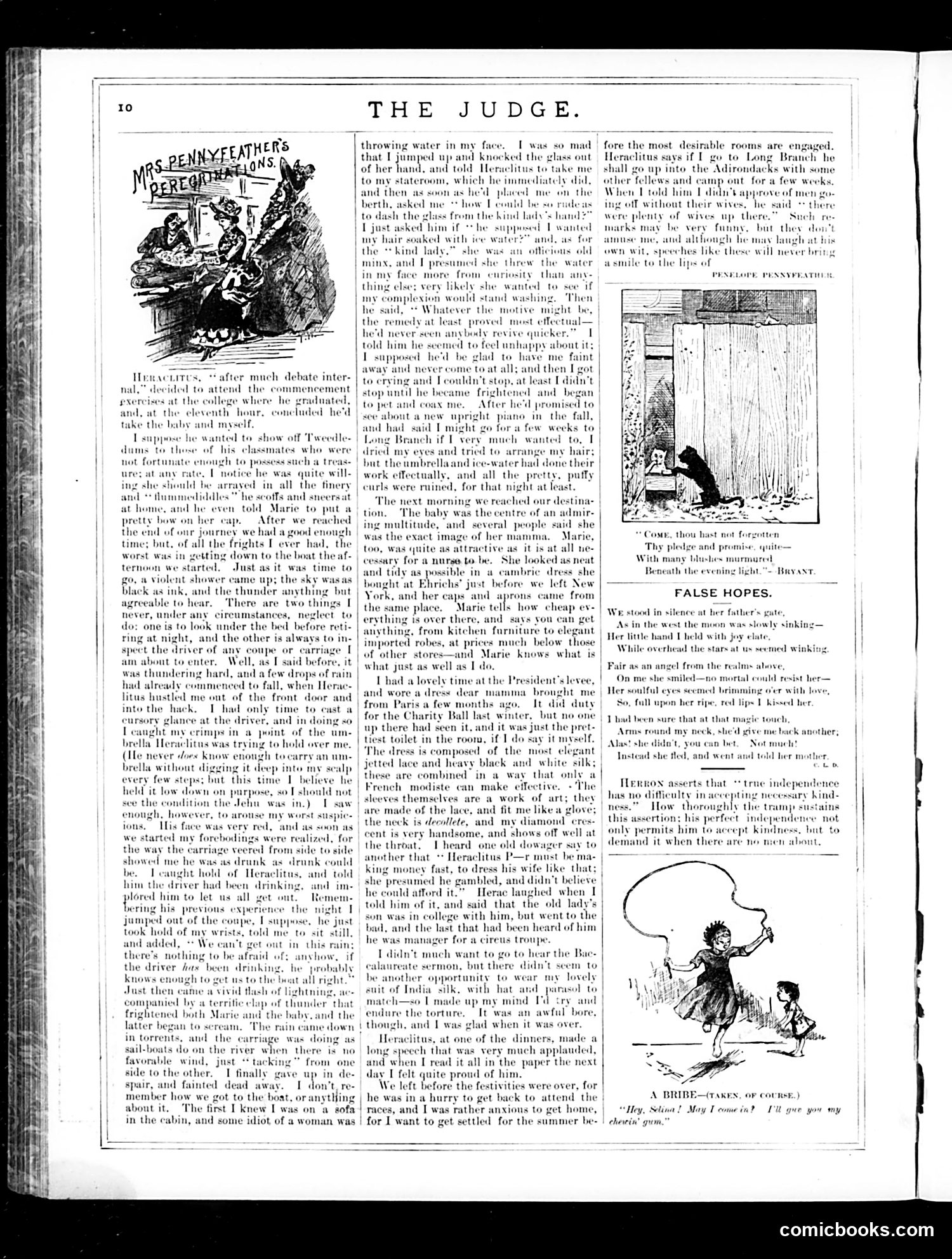
This page contains personal correspondence letters to the magazine's editor, not political cartoons. The main content is **"Mrs. Pennyfeather's Peregrinations,"** a serialized humorous narrative about a woman's social adventures. The visible story segment describes a comedic incident where the narrator was accidentally splashed with water by an officious older woman, then discusses attending social events—a President's levee and charity ball—where she wore an elegant imported Paris dress with black and white silk lace. The humor derives from domestic mishaps, social pretensions, and the narrator's observations about fashion, servants, and her husband Heraclitus's behavior. The two small illustrations show sentimental Victorian scenes: one captioned "Come, thou hast not forgotten" (a domestic moment), and another labeled "A BRIDE—TAKES OF COURSE" showing a bride and groom. This represents **typical Judge content**: lighthearted social satire targeting middle and upper-class domestic life and etiquette, rather than hard political commentary.
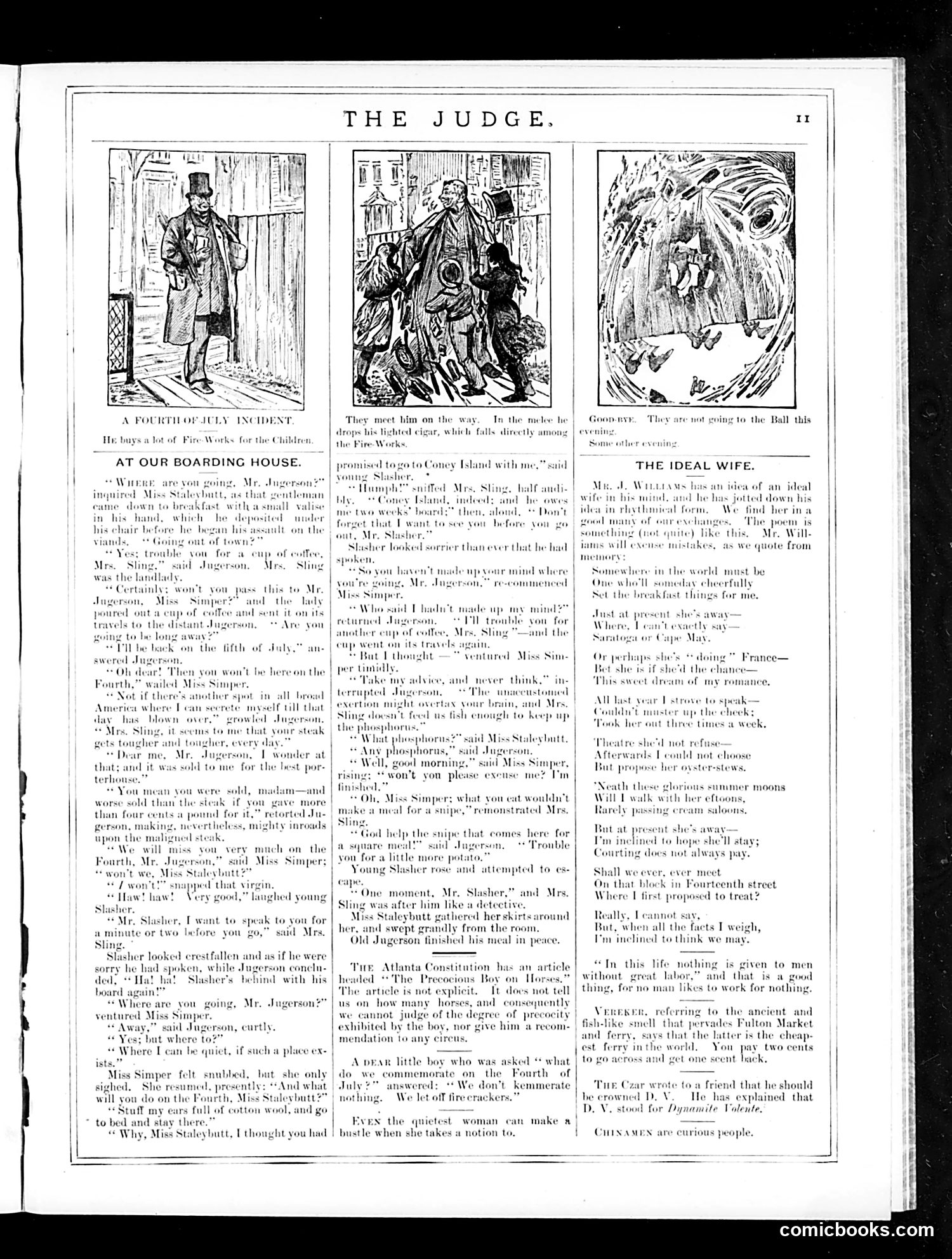
This page contains humorous domestic fiction pieces typical of Judge magazine's social satire. **"A Fourth of July Incident"** depicts boarding house life, where penny-pinching Mr. Jugerson buys fireworks for children but quarrels with fellow boarders over trivial expenses (four-cent steaks, coffee). The incident culminates when someone drops a lit cigar into the fireworks—a comedic climax suggesting chaotic consequences. **"The Ideal Wife"** is a poem-prose piece mocking romantic idealization. A man dreams of his absent wife as she "does" Cape May or France, while she's actually just away. The satire suggests husbands romanticize absent spouses while reality is mundane. The poem's refrain—"courting does not always pay"—undercuts sentimental marriage expectations. Both pieces satirize American middle-class boarding house culture and domestic relationships, using everyday frustrations and petty conflicts for humor. The cartoons (illustrations visible but unclear in detail) likely visualize these domestic comedies for readers seeking entertainment through exaggerated social observation.
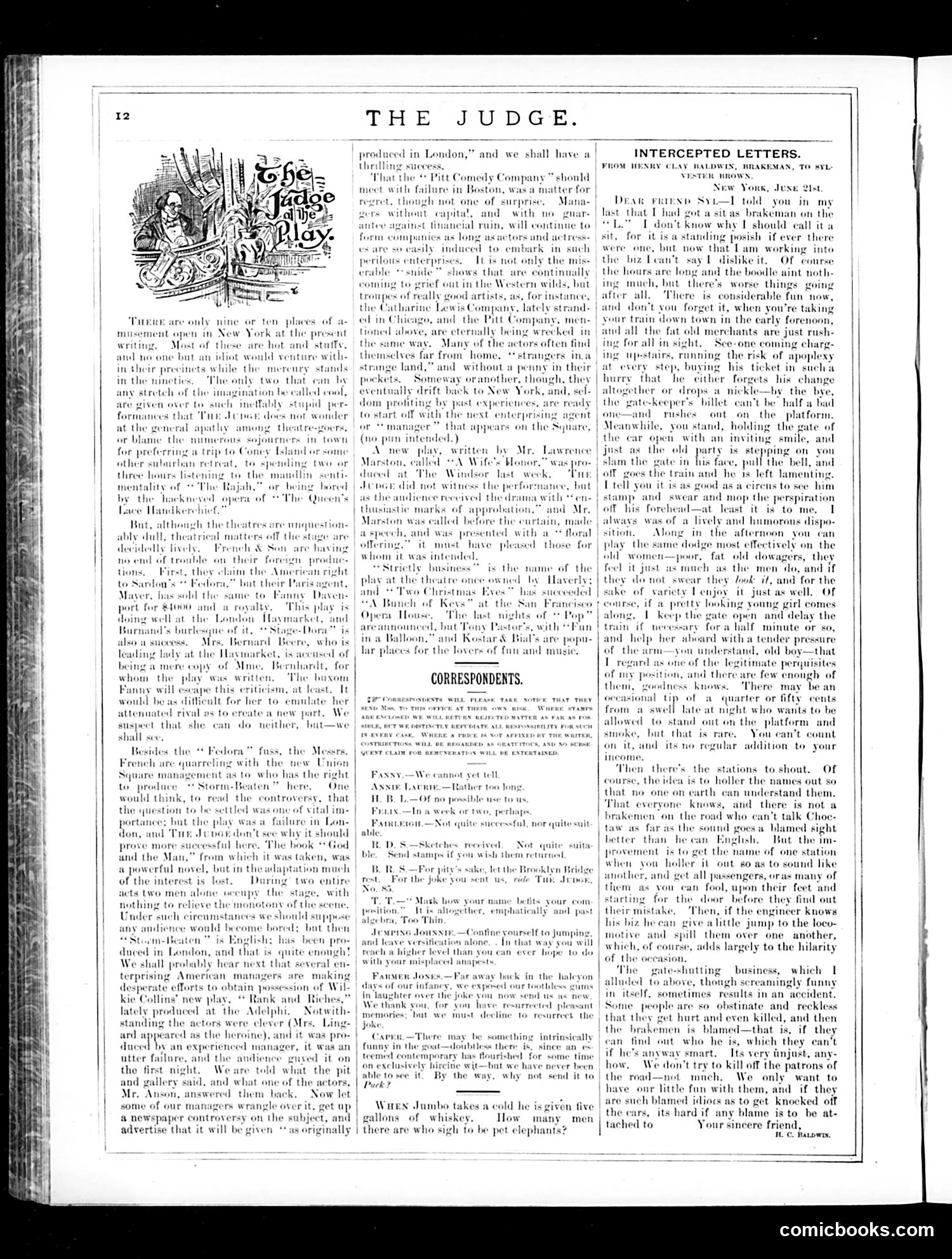
This page contains theatrical gossip and satirical commentary typical of Judge magazine's entertainment coverage. **Main Content:** The left column discusses the precarious state of New York theaters, mentioning failed theatrical companies (the Pitt Comedy Company, Catharine Lewis Company) and noting that only 9-10 playhouses operate in the city. It critiques theater managers and struggling actors who repeatedly attempt new ventures despite consistent failures, describing them as naive and perpetually broke. **"Intercepted Letters" Section:** This satirical column presents a fake letter from a railroad brakeman named Henry Clay Baldwin to a friend "Sylvester Brown," describing the cruel amusement he derives from closing train car doors on late passengers—trapping elderly merchants and others trying to board. The humor relies on readers finding entertainment in this petty cruelty. **Social Context:** The satire targets both theatrical industry instability and working-class indifference to public inconvenience. The "intercepted letters" feature appears designed to mock ordinary workers' perspectives through exaggeration.
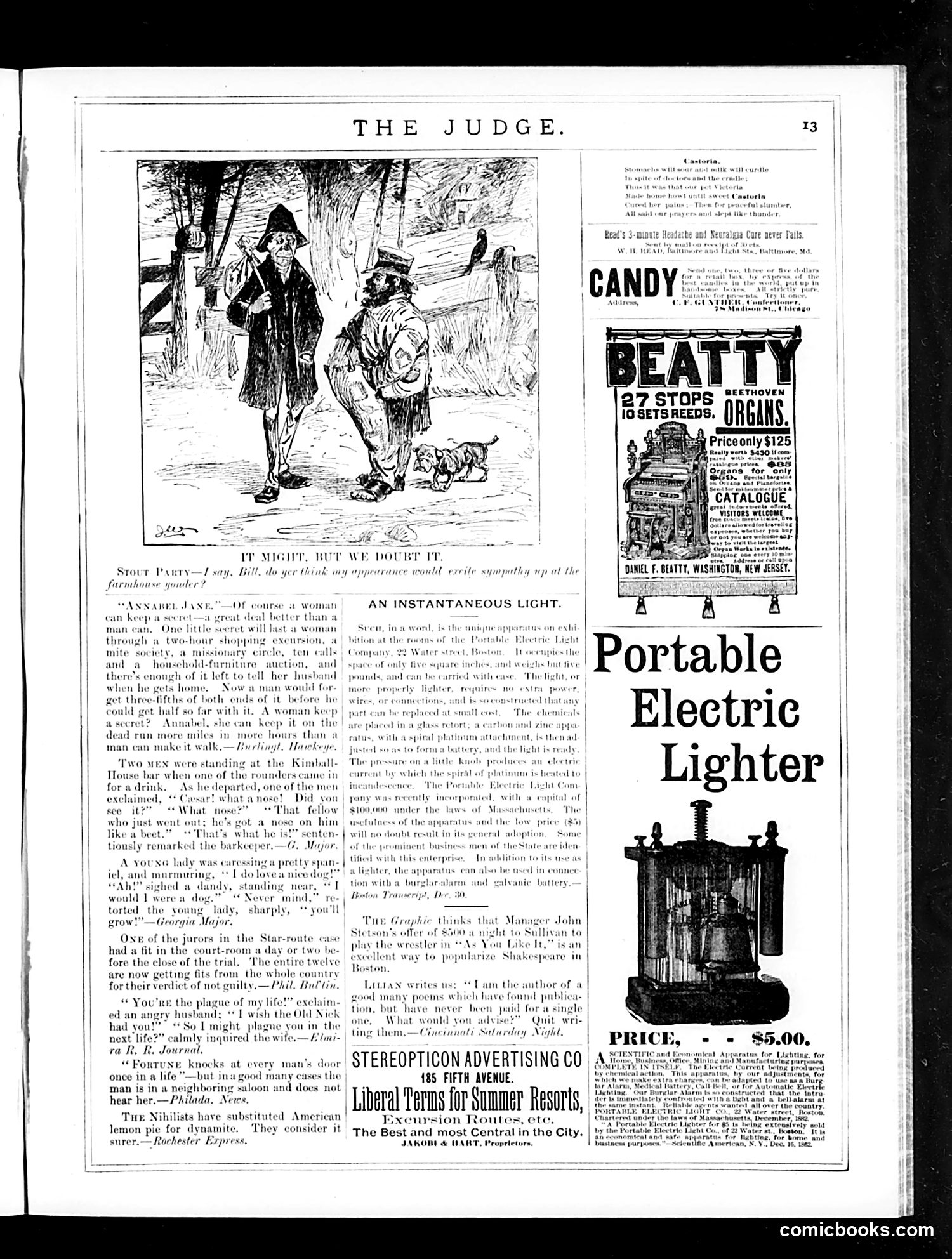
The main cartoon depicts a well-dressed woman and a working-class man with a small dog, illustrating a joke about women's ability to keep secrets. The text beneath jokes that while women are "great deal better than a man" at keeping secrets in general, they cannot keep a secret "on the dead run more miles in more hours" — the implication being that women will inevitably gossip about juicy information. This reflects late-19th-century gender stereotypes portraying women as inherently talkative and unreliable with confidential information. The cartoon mocks Victorian assumptions about feminine nature through exaggerated contrast: women are simultaneously praised and condemned for their chattiness. The page also contains miscellaneous short humorous anecdotes and advertisements (for electric lighters and organs), typical of Judge's satirical format combining social commentary with advertising.
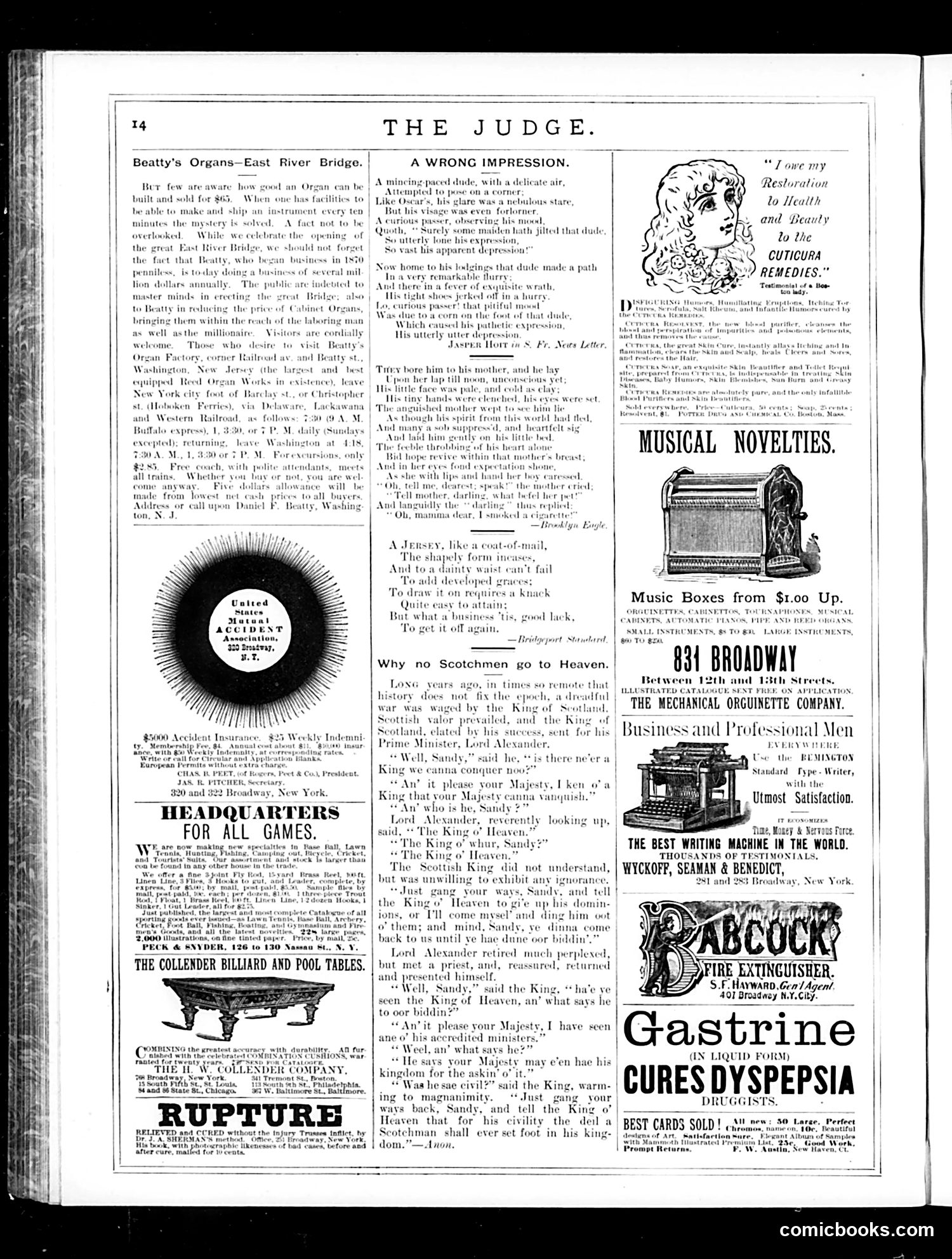
This page features a humorous dialect poem poking fun at Scottish pride and stubbornness. The narrative describes a conversation between the King of Scotland and Lord Alexander, his minister, set in a remote historical period. **The Joke:** After Scotland's military victories, Lord Alexander boasts to the King that there's no kingdom Scotland cannot conquer—except Heaven itself. When the King jokingly offers to add Heaven to his conquests, Alexander takes the challenge seriously and attempts to negotiate with God, demanding Scotland's admission to Heaven as payment for the King's civility. **The Satire:** The piece mocks Scottish national pride, portraying Scots as so arrogantly confident in their martial abilities and so stubbornly independent that they'd literally argue with divine authority. The punchline—that no Scotsman will ever enter Heaven because of this defiant audacity—works as ethnic humor typical of 19th-century Judge magazine, relying on stereotypes of Scots as proud, argumentative, and ungovernable. The dialect spelling reinforces the caricature throughout.
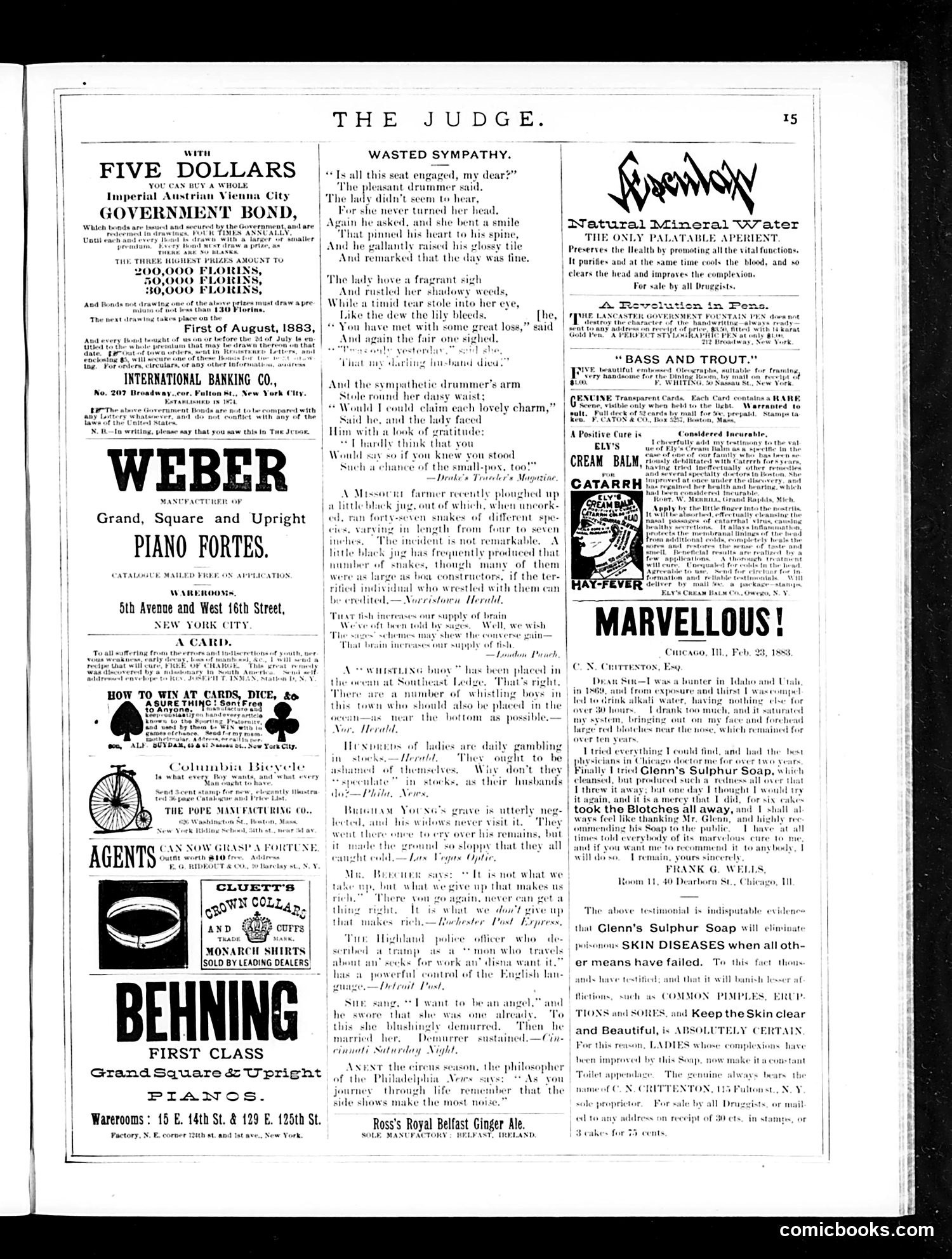
This page is primarily **advertisements** for pianos, mineral water, ginger ale, and patent medicines, with one satirical poem titled "Wasted Sympathy." The poem mocks sentimentality and romantic deception. It depicts a traveling drummer (salesman) exploiting a woman's emotional vulnerability by feigning sympathy for her "lost" husband. He strategically comforts her—"stole round her daisy waist"—while she mistakes his advances for genuine concern. The final reveal suggests his sympathy is performative; he's simply a seducer using practiced manipulation. The satire targets **19th-century commercial culture**: the opportunistic traveling salesman and women's susceptibility to flattery. It also mildly critiques female gullibility, though the drummer emerges as the primary villain. The page reflects Judge's typical format—mixing social commentary with commercial notices—common to satirical magazines of this era.
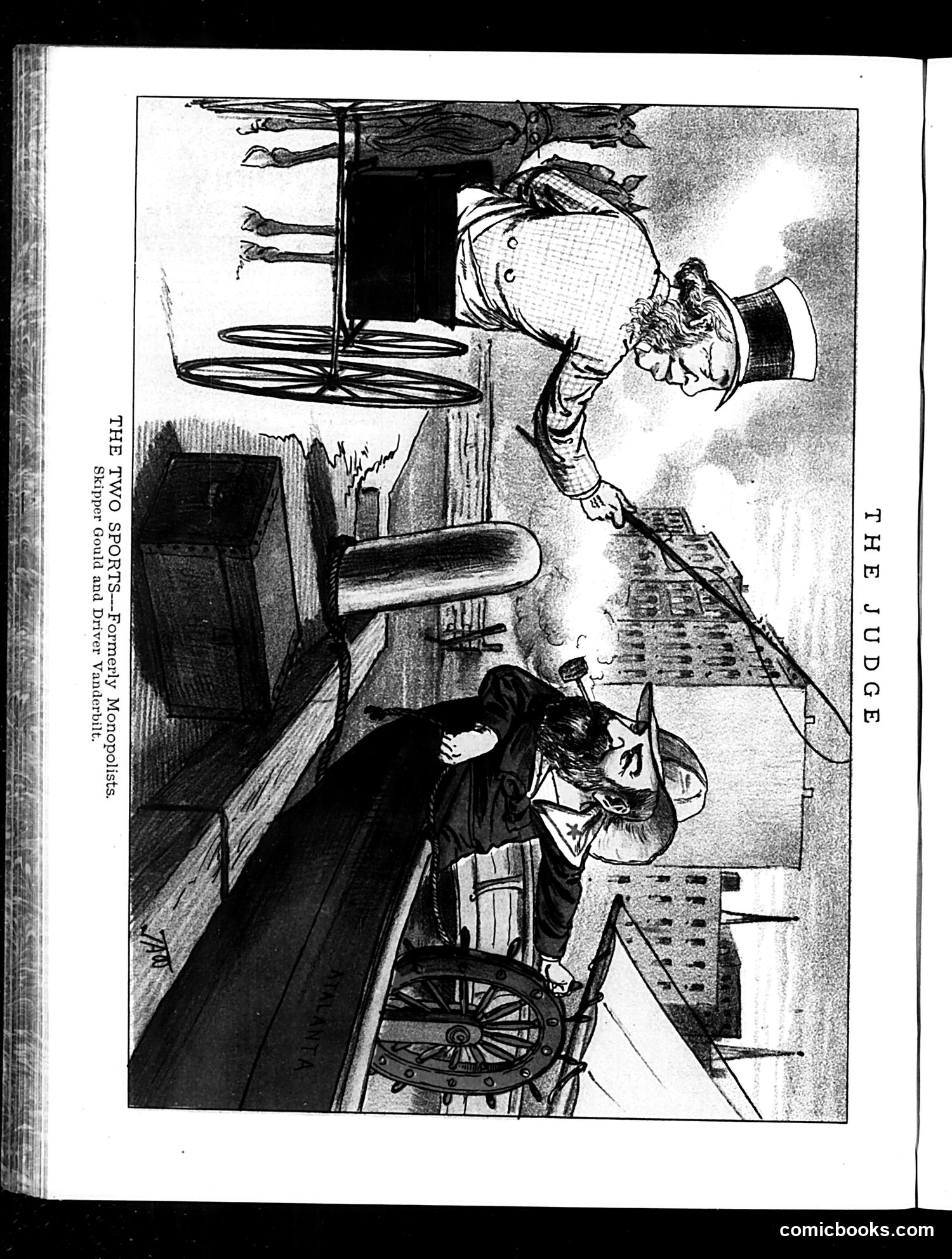
This page contains a single political cartoon titled "THE JUDGE" showing two figures in what appears to be an interior domestic scene. A man in formal dress (top hat and coat) leans through a window or doorway, while below, a woman in dark clothing sits at what looks like a spinning wheel or similar domestic device. The OCR text is largely corrupted and unreadable, preventing clear identification of the specific political figures or social commentary intended. Without legible caption text or clearer context, the exact satirical point—whether it addresses gender roles, labor, politics, or social relationships—cannot be reliably determined from the image alone. To properly explain this cartoon's meaning would require either clearer text or additional historical context about the Judge magazine issue's date and content.