
Judge, 1883-07-07 · page 2 of 16
Judge — July 7, 1883 — page 2: what you’re looking at
What you’re looking at
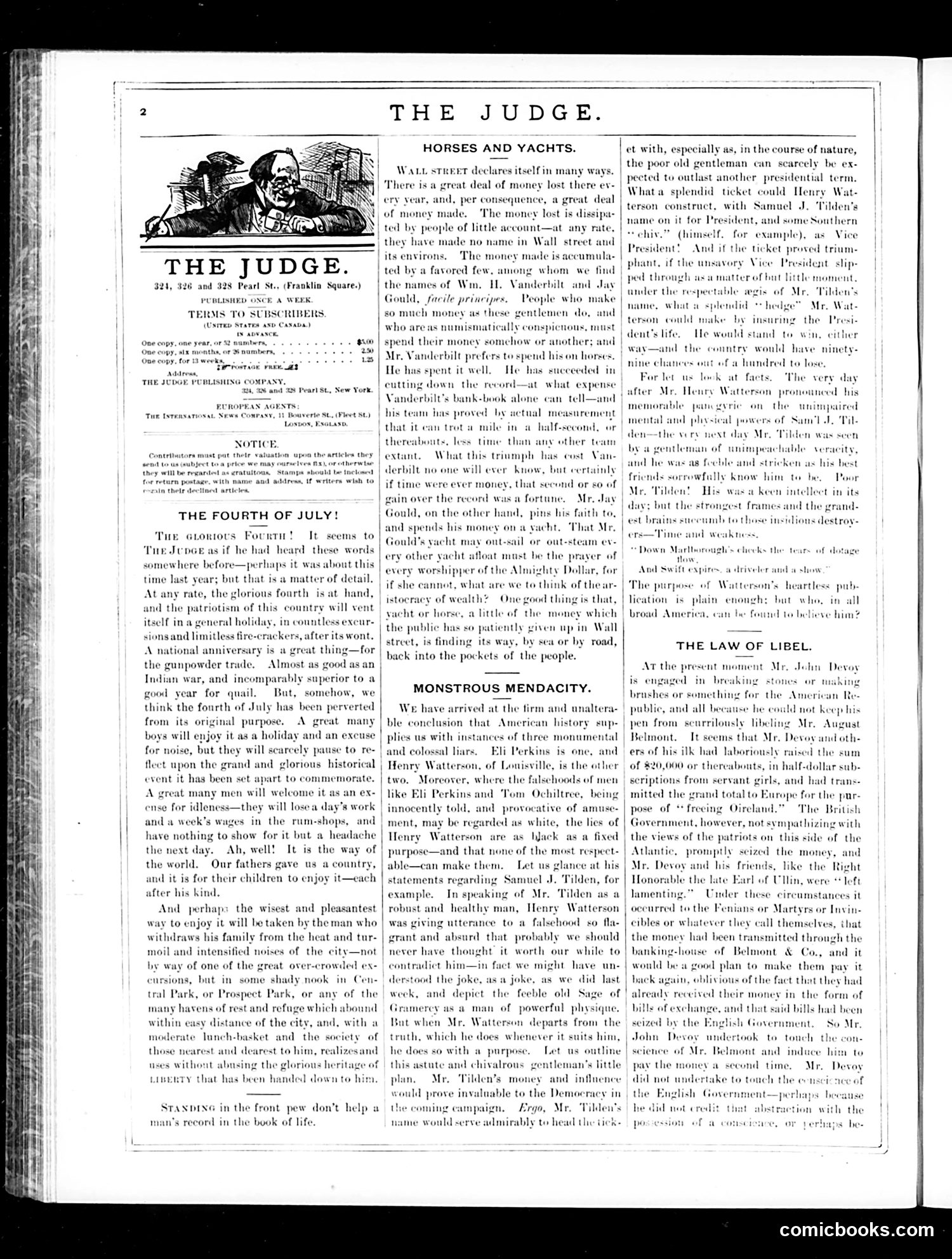
This page satirizes the wealth and spending habits of Gilded Age robber barons, particularly **William H. Vanderbilt** and **Jay Gould**. The main article criticizes how these men accumulate vast fortunes on Wall Street, then dissipate or hoard the money rather than returning it to the public. Vanderbilt's preference for spending on horses and Gould's investment in yachts exemplify this wasteful conspicuous consumption. The piece also attacks **Henry Watterson** (a Louisville newspaper editor) for spreading false stories about political figures like **Samuel J. Tilden**, comparing his deliberate lies unfavorably to the innocent falsehoods of other notorious exaggerators like "Eli Perkins" and "Tom Ochiltree." The satirical point: the wealthy elite either squander money on personal luxuries or lie to protect their interests—neither serves the public good. The tone is mocking indignation at Gilded Age excess and media dishonesty.
📄 Transcribed text from this page (OCR, searchable)
Machine-transcribed from the original scan — historical spelling and the odd misread are preserved.
THE JUDGE. HORSES AND YACHTS. Watt street declares itself in many ways. There is a great deal of money lost there ev- F ni of money made. ted by pe they have The money lost is dissipa- ple of little account—at any rate, Jeno name in Wall street aud The money made is accumula- a favored few, among whom we find THE JUDGE. | 324, $26 and 328 Pearl St., (Franklin Square.) mes of Wm. H. Vanderbilt: and Jay PUDLISHED ONCE A WEEK | Gould, facile principes. People who make TERMS TO SUBSCRUB so much money ats these gentlemen do, and spe as numismatically co + t2 | Mr. Vanderbilt prefers to spend his on horses. | He has spent it well, He cuttin rd—at what expense Vanderbilt’s bank-book alone ean tell—and proved by aetual nr | that it ean trot a mile ina half. there loss time than any oth | extant. What this triumy derbilt 1 hu ver money, th 1 their money somchow has succeeded in AN’ ¥ ow e nd'a0 Peart St, Sew York nthe t RUROPEAN AGENTS Tue Ierensarion at, News Compasy, Ht Rouverte St, (Fleet St) Lospox, ESGLaso, his team it urement cond, or NOTIC Contribatore must pat thetr © send to usa ro team t Vane wy but certainty uation upon has one will ev if time we t second or £0 of fortune. Mr. pins his fa wyacht. That Mr. | ord was gain over the re THE FOURTH OF JULY! Gould, on the other hane a ‘ Ney On Tie GLortovs Fourti! Tue Jepee as if he hy somewhere before—perl It 1 heard these words ps it was about this time last year; but that is a matter of detail. At any rate, the glorious fourth is at hand, and the patriotism of this country will vent itself in: I holiday, in jess fire-crackers, after A national anniversary is a great thing—for the gunpowder trac Almost Indian war, and incomparably superior to a | good year for quail. But, think the fourth of July has been perverted from its original purpose, seems to | y out-sail or out-steam ev- other 3 t must be the prayer of sry worshipper of the Almighty Dollar, for to think of the ar- ? vod thing is that, | yacht or ho: little of the money which the public has so patiently given up in Wall treet, is finding its way, by sea or by road, back into the pockets of the people. if she cannot, what are w On istocracy of wealt excur- its wont — | MONSTROUS MENDACITY. We have arrived ble « | plies us with in | and Hen somehow, we tthe firm and unalt nelusion that American history a up f three monumental . Eli Perkins is one, and terson, of Louisville, is the other two. Moreover, where the falsehoods of men like Eli Perkins and ‘Tom Ochiltree, being innocently told, and provocative of ment, may be regarded as white, the lies of | Henry Watterson are as Wack as a fixed purpose—and that none of the most r Let us ny boys will enjoy it as a holiday a for noise, but they will scarcely pau fleet upon the gi event it has be sUnces to re. nd and glorious historical sal Via W. a t apart to commemorate. y men will welcome it as they will losea ¢ and a we sin the rum-shop have nothing to show for it but a | the next day. Ah, well! It is the way of the world. Our fathers gave us a country, and it is for their children to enjoy it—each after his hind. neX= ‘3 work muse- and che | ance at hy arding Samuel J. Tilden, for | example. In speaking of Mr. Tilden robust and healthy r | was able—can ma hem. statements re; a , Henry Watterson ing utterance to a. falseh grant and absurd that probably we should | never have thonght —in fi And perhaps the wisest and pleasantest way to enjoy it will be taken by theman who withdraws his family from the heat and tur | moil and intensified noises of the y of one of the vd so fla- rity—not it worth our while to | by w at ove owded x= | ¢ shady nook in Cen- t Park, or any of the nd re ntradiet hi 1 the dd depict the we might have un- a jok we did last | feeble old Sage of | merey as a man of powerful physique. when Mr, Watterson departs from the truth, which he does whenever it suits hir » with a purpose. stute and chivalrous. gc Mr, Tilden’s mi would prove invaluable Me wee many havens of re within ¢ which abound y distance of the city, and, with a lunch-basket and the society of On| rest to him, reali ee the Linenty that has been h those nearest and « Let us outli uses without abusin lorious herita Jeman’s lit nded down to h plan, and influence » the Democracy in Ergo, Mr. ‘Vildeu’s mirably to head the tick STANDING in the front pew don’t help a the comit eam pai man’s record in the book of i | et with, per consequence, a great deal | specially as, in the course of nature, the poor old gentleman can scarcely be ex- pected to outlast another presidential term. Whata splendid ticket could Henry Ws terson construct, with Samuel J. ‘Tilder name on it for Pre tl sehiv” (hin for example), as Vi President! And if the ticket proved trium- phant, if the unsavory Vice President slip- ped through lent, and some S« rn ama atterof but littl: moment. sof Mr. Tilden’ hedge Mr. Wat- ke by insuring the [re He would stand te win, either way—and the under the res what a mame, country would have ninety- nine chances out of a hundred to lose, For let us look at facts. ‘The very day after Mr. Henry Watterson pronotneed his memorable pancgvric on the mental and physieal powers of Su den—the vers next day Mr. Tilden was seen by a gentlem: he w of unimpeachable as feeble and wrrowfally know him to be 1 te keen intellec strongest frames and the est brains sueer veracity, ken as friends dur.. Ti day; but th tin its oth —Time and weak ness, Down Mar How And Swift expires ough’s cli a driveler and a show of Wal ain eno: ersan's: heartless | : but lic broad America, can is | who, in rd to believe him? THE LAW OF LIBEL. Mr, John nes ort < or something we Amerie: Tall because he could not kee pen from scurrilously libeling Mr. August Belmont. It seems that Mr. Devoy and oth- ers of his ilk had laboriously raised of 20,000 or th AT the present 1 public, sum bouts, in half-dollar sub- scriptions from servant girls, and had trans. mitted the grand total to Europe for the pur- f ‘freeing Oireland, q British - however, not sympathizing with the views of the patriots on this si the Atlantic, promptly seized the money Mr. Devoy and like the Right Honorable the late Earl of Ulin, were “1 lamenting.” Under these cireumstances it oceurred to the Fenians or Martyrs or Invin- r they call themselves, that the money had been transmitted through the banking-house of Belmont & Co., and it would bea good plan to make them pay it hack ag Hivious of the fact that they had already received their money in the fi id bills + and frie cibles or whi m of been seized by t rument, So Mr, John Devey unde to touch t science of Mr. Belmont and indu pay the did not undertake the English Gover oney a second time. Mr. ‘o touch the « he did we to with the perhaps be- comicbooks.com