
A complete issue · 16 pages · 1883
Judge — June 30, 1883
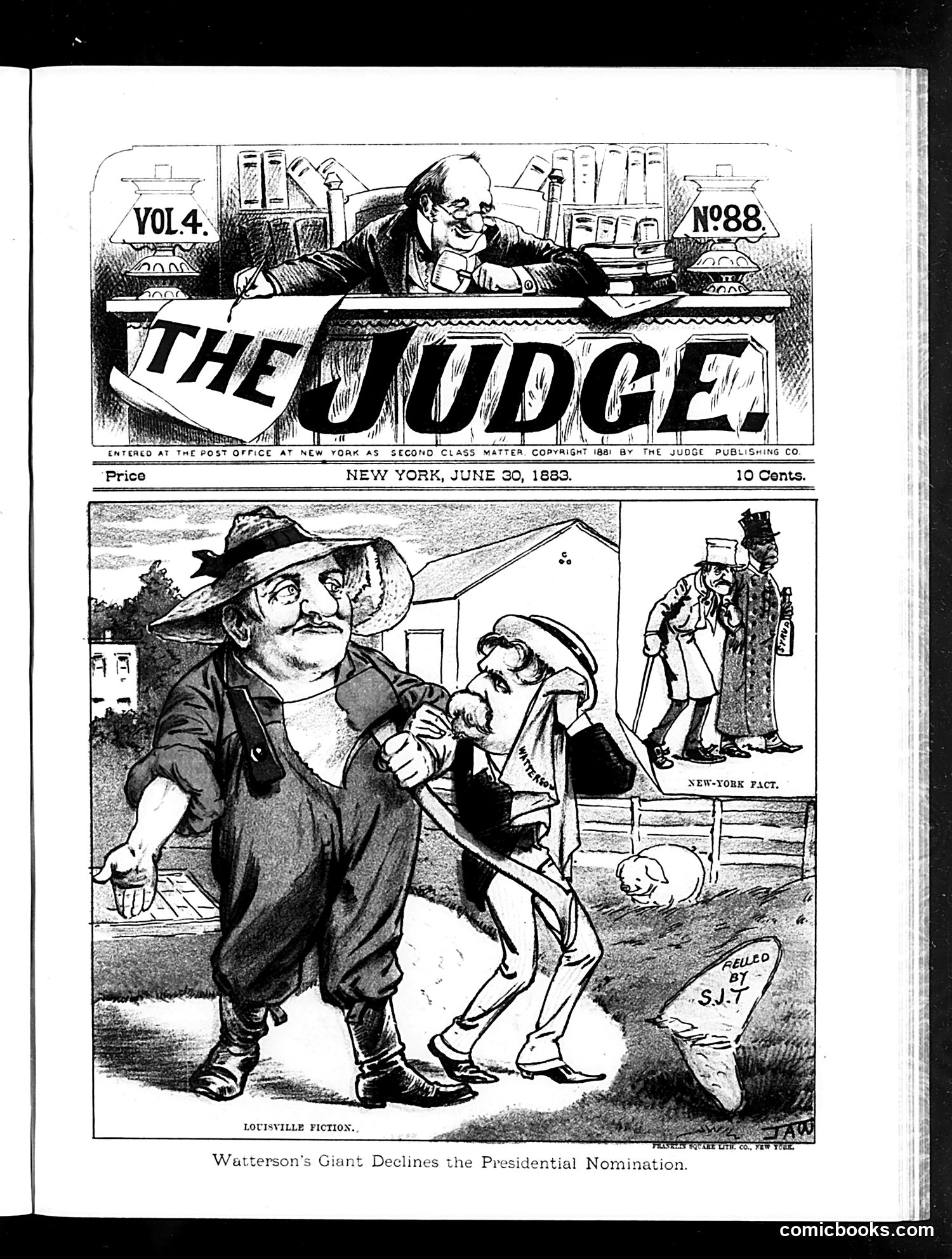
This **Judge** magazine cover from June 30, 1883 satirizes a political figure's rejection of a presidential nomination. The main cartoon, titled "Louisville Fiction," depicts a large man in a wide hat being physically restrained by a smaller figure while declining nomination. The title references "Watterson's Giant"—likely James B. Watterson or a political figure associated with Louisville—humorously suggesting his refusal was theatrical or exaggerated ("fiction"). The smaller figure's struggle to hold back the larger one plays on the ironic contrast between the nominee's professed unwillingness and apparent power/influence. The inset shows formal political figures, contextualizing this as a genuine nomination event being ridiculed as performative.
This page from *Judge* satirical magazine contains three separate pieces about American political figures, likely from the 1880s. **"Samuel J. Tilden"** praises the Democratic politician's vigor and vitality, suggesting—somewhat ironically—that despite his age, he remains physically active and robust as a farmer. The piece celebrates his continued energy. **"Blaine's Hermitage"** attacks Republican James G. Blaine, suggesting he harbors grievances and resentments that isolate him. The satire implies Blaine is brooding over past controversies and political defeats, unable to move forward. **"The Dance"** criticizes Puritanical moralists—"Pharisees"—in San Francisco who attempted to ban dancing as immoral. The author ridicules their prudishness, arguing that dancing between young couples is innocent and artistic, not sinful. The piece defends recreational freedom against religious zealotry. Overall, the page reflects *Judge's* progressive satirical stance: supporting Democratic figures, attacking Republican grievances, and mocking conservative moral restrictions on public behavior.
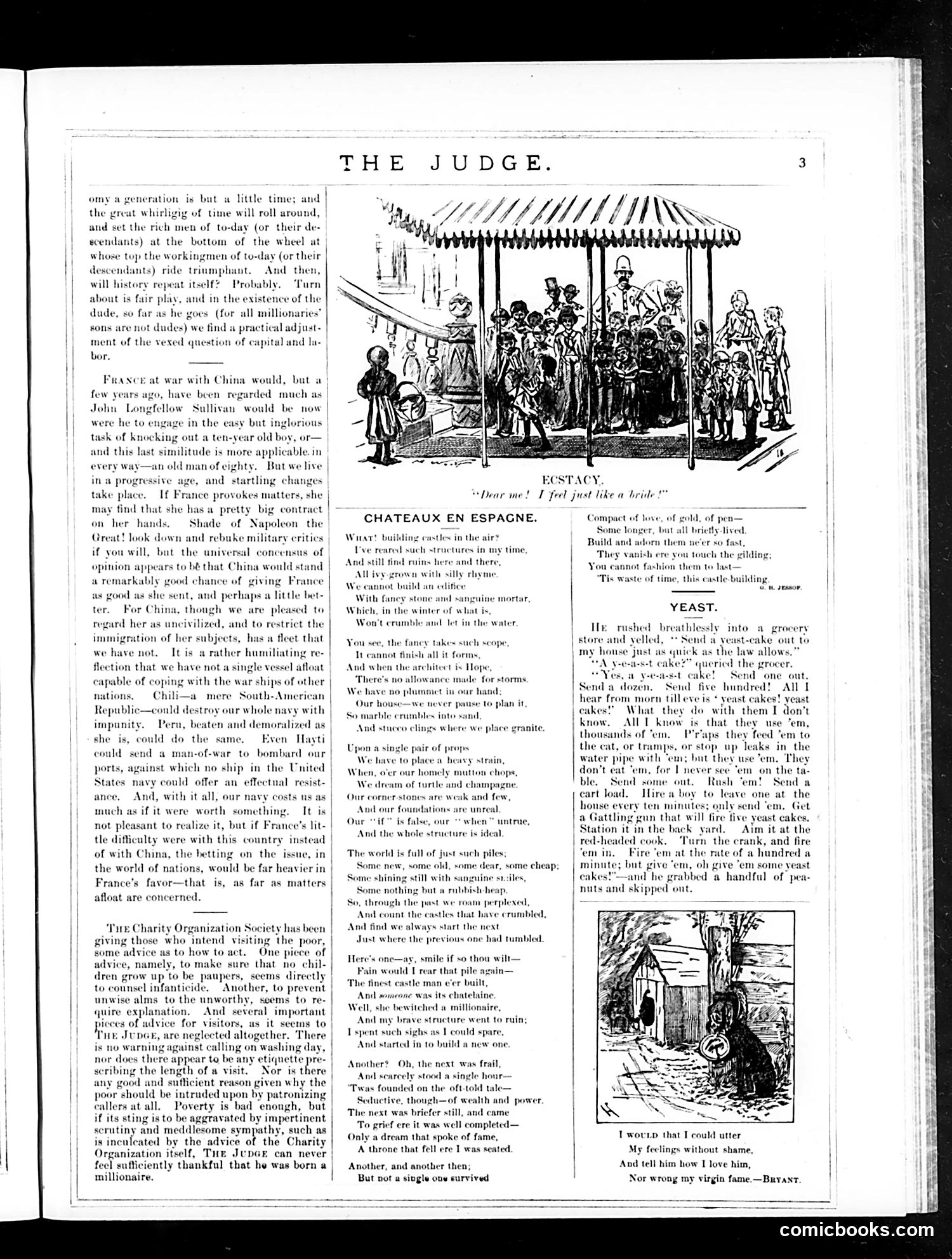
This page contains two main pieces: **"Ecstasy" (top cartoon):** A crowded scene showing what appears to be a public gathering or market, with the caption "Dear me! I feel just like a bride!" The satire likely mocks romantic notions or sentimental reactions to ordinary situations. **"Chateaux en Espagne" (poetry section):** A philosophical poem about building castles in the air—constructing grand plans that inevitably crumble. The text warns against fanciful, impractical schemes: "We cannot build an edifice / With fancy stone and sanguine mortar.../ Won't crumble and let in the water." This is metaphorical social commentary about unrealistic hopes and poorly-founded ambitions. **"Yeast" (bottom section):** A satirical anecdote mocking absurdly complex or inefficient methods—a grocer uses elaborate procedures to serve simple yeast cakes. The humor targets overcomplicated systems and pretentiousness. The page broadly satirizes human folly: romantic delusion, impractical idealism, and needless complexity in everyday life.
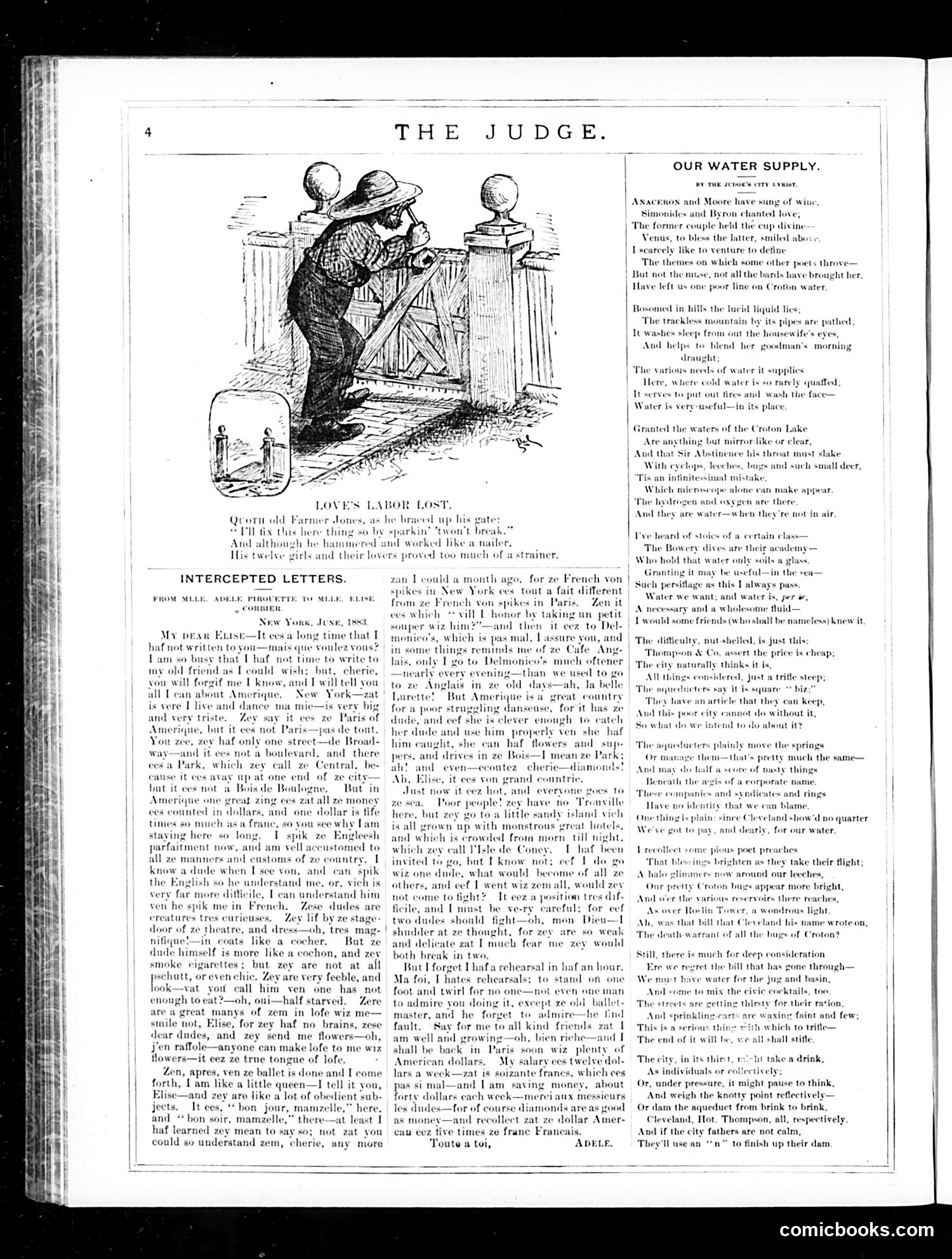
This page satirizes New York City's water supply quality and management around the 1880s. The main cartoon, "Love's Labor Lost," depicts an old farmer struggling to fix a leaky pipe—likely representing city officials' inability to maintain the Croton water system (New York's primary water source at the time). The accompanying poem "Our Water Supply" mocks the Croton Lake water as murky and contaminated ("anything but mirrorlike or clear"), forcing residents to consume questionable water containing unwanted particles. References to the water's poor quality ("eyecloths, leeches, bugs") suggest chronic contamination problems. The page also includes a satirical "Intercepted Letter" from a French woman describing American city life, which provides comedic social commentary but appears unrelated to the water theme. Together, these pieces ridicule both the inadequate infrastructure and the city's apparent indifference to providing safe drinking water—a genuine public health concern of the Gilded Age.
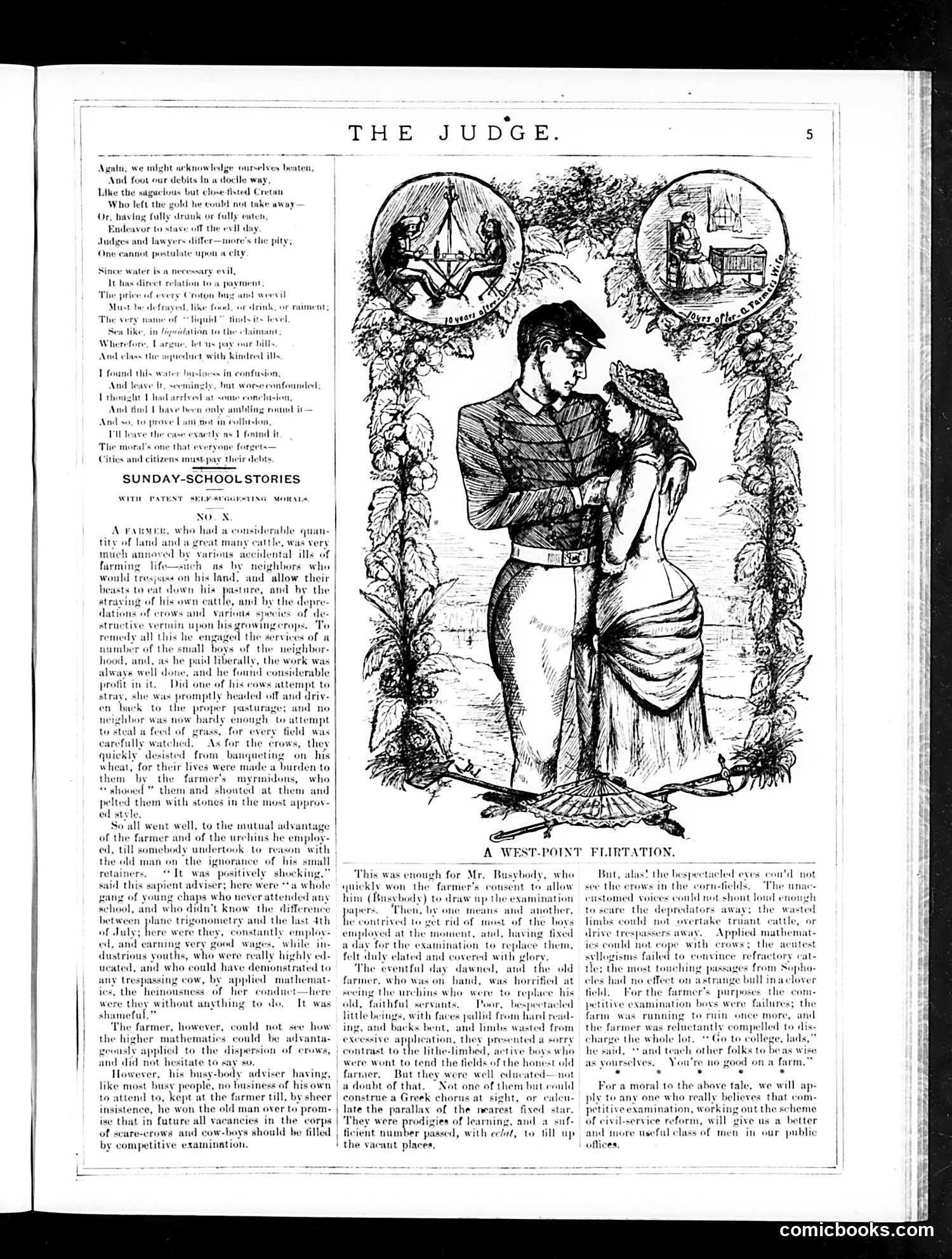
This page contains two distinct pieces. The main illustration, "A West-Point Flirtation," depicts a young woman in Victorian dress, likely satirizing romantic entanglements involving U.S. Military Academy cadets—a recurring social comedy topic in Judge. The "Sunday-School Stories" section presents a moral fable mocking educational reformers. A practical farmer manages his land efficiently by employing street urchins as scarecrows and farmhands. A busybody reformer pressures him to hire only competitively examined candidates instead, arguing mathematical education proves superior. The reform backfires: the educated boys cannot physically perform the work despite their knowledge. Their frames are too weak; their learning useless for practical labor. The satire targets Progressive-era civil-service reform advocates who believed standardized testing and academic credentials should determine hiring across all sectors—including manual labor. Judge's conservative position: theoretical education cannot replace practical experience or physical capability for working-class employment.
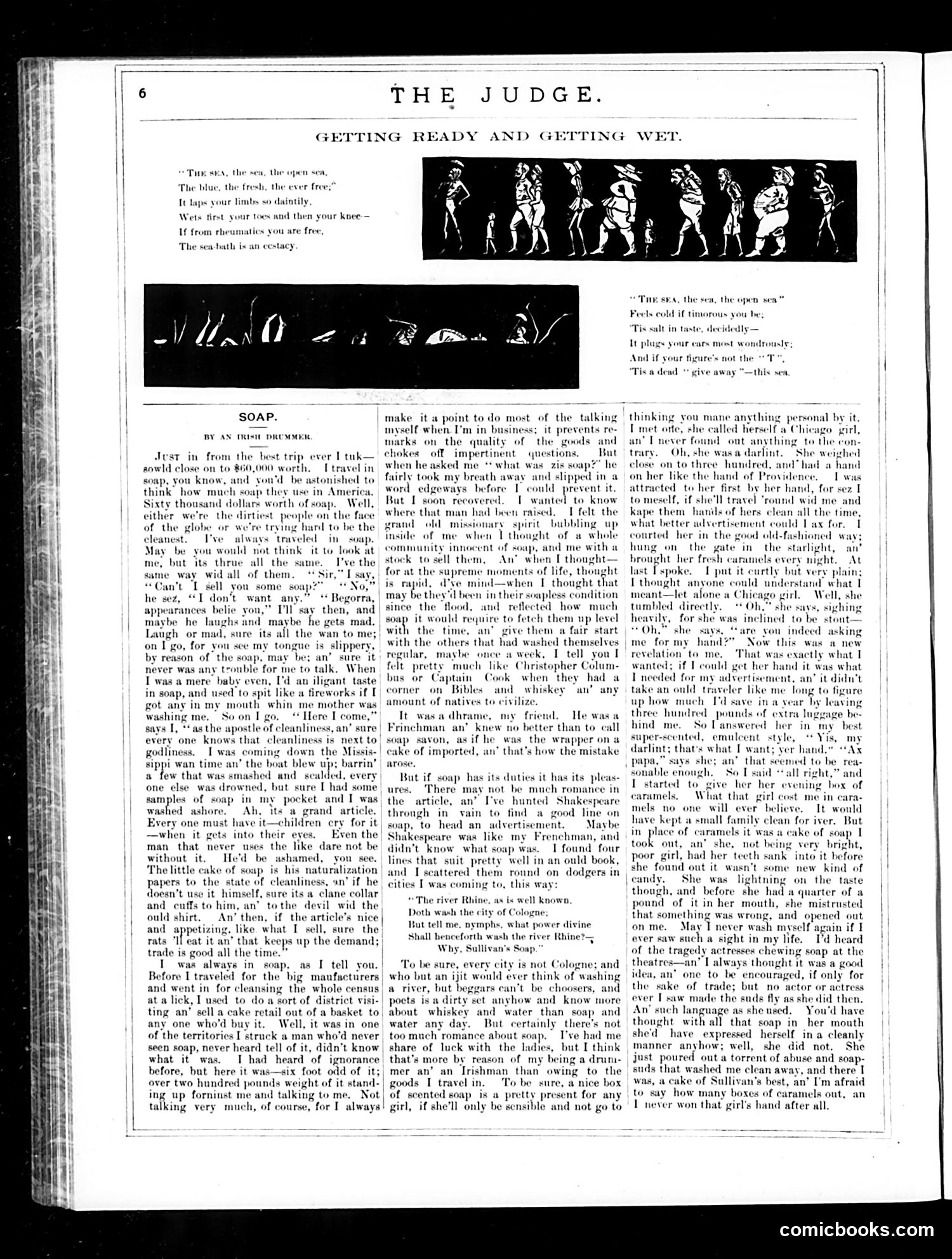
This page from Judge contains two distinct elements: **The Poetry/Verse Section** (top): Patriotic verses celebrating the sea and swimming—likely promoting bathing and water sports as healthful activities popular in the Gilded Age. **"Soap" (main article)**: A humorous monologue by an Irish soap salesman (indicated by dialect: "thrue," "zis") describing his encounter with an ignorant European customer—a Frenchman who didn't know what soap was. The joke satirizes: - European "backwardness" versus American commercial progress - The salesman's missionary zeal in "civilizing" the uncivilized through commercial products - Irish immigrant experiences in American sales/business - Contemporary attitudes viewing soap as a marker of civilization itself The salesman compares himself to Columbus and Captain Cook, suggesting consumer goods—not exploration or religion—represent modern "civilization." This reflects late 19th-century American attitudes about commerce, cleanliness, and cultural superiority. The piece is essentially comedic advertising disguised as social commentary.
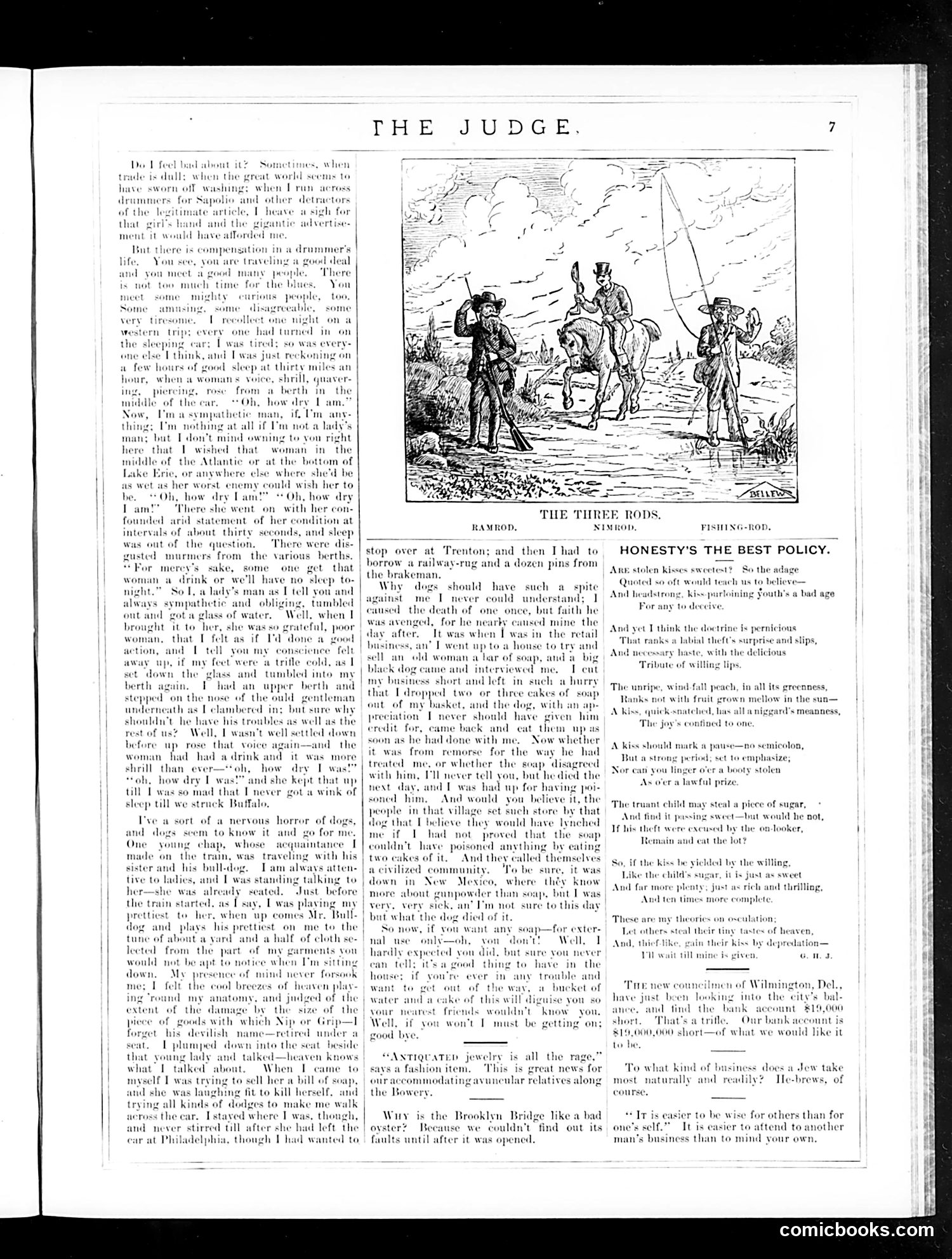
This page contains two distinct pieces of satirical writing from Judge magazine. **"The Three Rods"** (illustrated) appears to depict a humorous anecdote about traveling salesmen or similar figures on a rural road—likely satirizing commercial travelers' tales and exaggerations. **"Honesty's the Best Policy"** is the main narrative, a lengthy rambling monologue by a character recounting various misadventures involving soap sales, a poisoned dog in New Mexico, and romantic entanglements on trains. The piece satirizes the unreliability of traveling salesmen's stories and their dubious morality. The narrator admits to various deceptions and absurd situations—notably attempting to frame a woman for poisoning a dog with soap cakes—suggesting social hypocrisy disguised as "honesty." The humor derives from the protagonist's obliviousness to his own dishonesty while claiming moral high ground, and from the increasingly absurd complications of his schemes. This reflects late-19th-century American skepticism toward commercial culture and traveling salesmen as figures of dubious character.
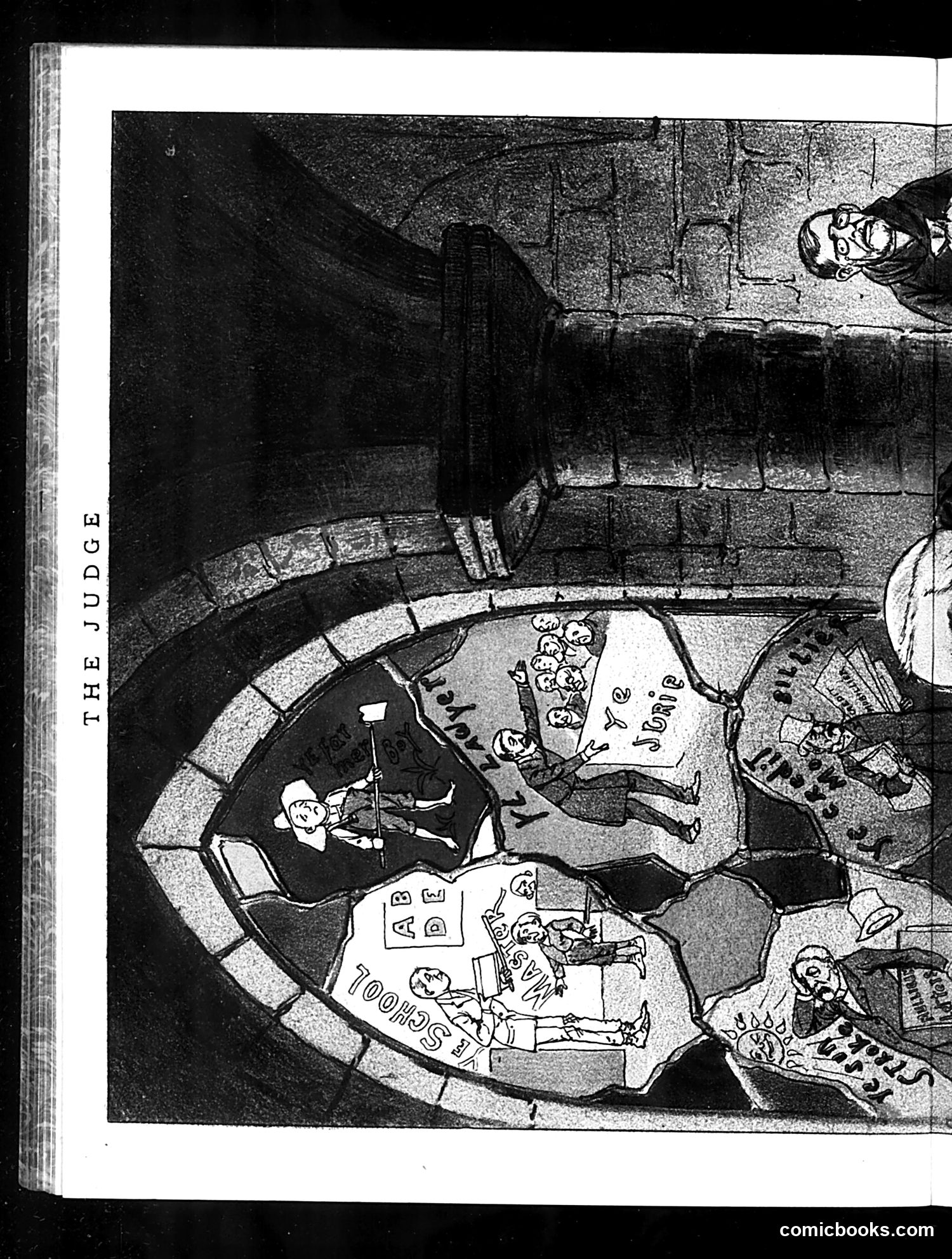
This appears to be a courtroom scene titled "THE JUDGE," showing a judicial proceeding from an overhead perspective. The cartoon depicts a judge presiding over what seems to be a trial, with multiple figures arranged in the courtroom—likely including plaintiffs, defendants, lawyers, and spectators. Without clearer legibility of specific text labels or facial features in this rotated image, I cannot definitively identify which political figures or events this satirizes. The style suggests early-to-mid 20th century American satire, typical of *Judge* magazine's content critiquing legal proceedings, judicial corruption, or contemporary political trials. To accurately explain the specific satire and identify the figures involved, clearer text or higher image resolution would be necessary.
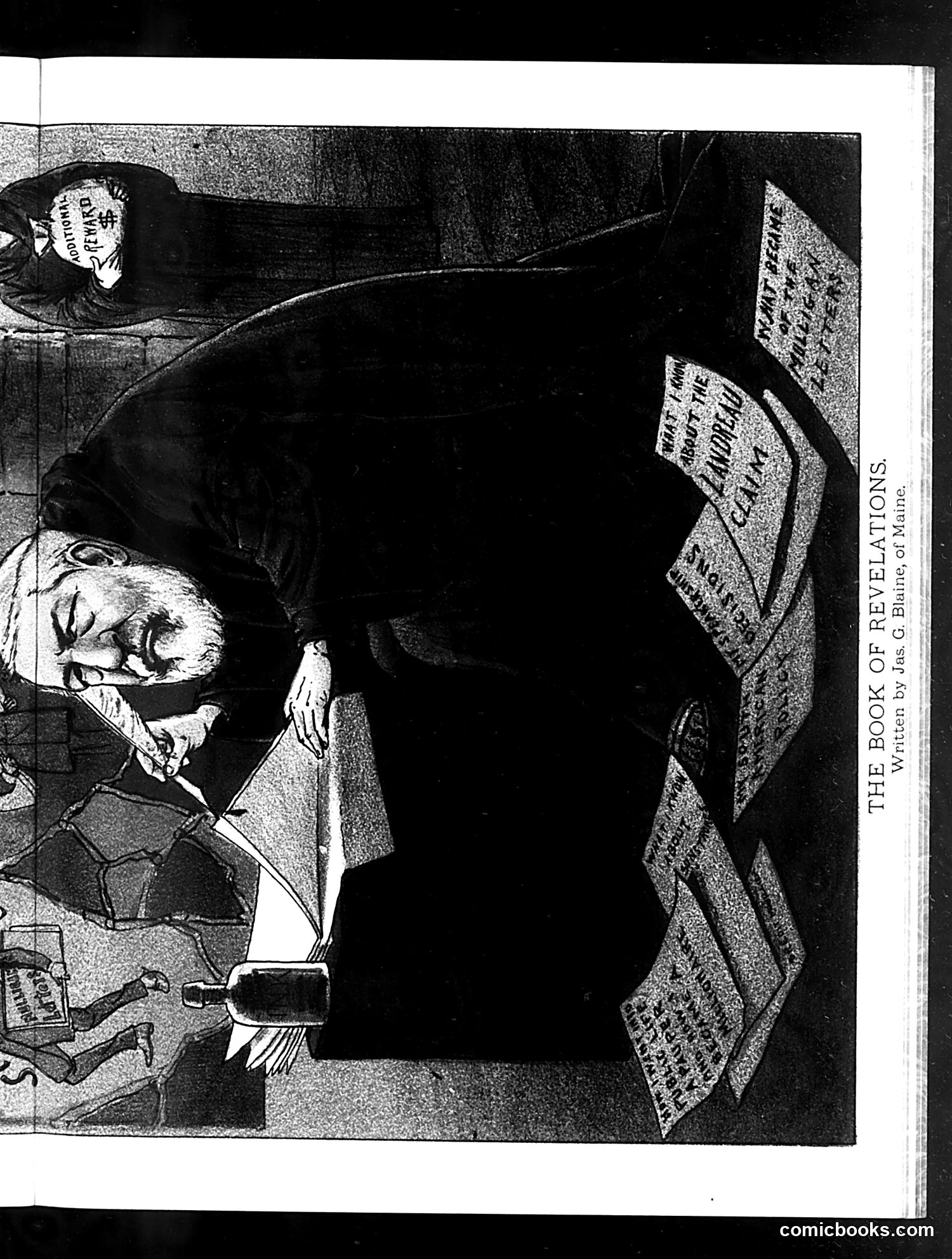
This appears to be a political cartoon from Judge magazine, written by Jas. G. Blaine of Maine. The illustration depicts a figure in dark clothing examining or reading documents/papers displayed on what appears to be a wall or board. The OCR text is heavily corrupted and largely illegible, making precise interpretation difficult. However, the title "The Book of Revelations" suggests the cartoon satirizes expose or scandal-revealing documents. Without clearer text, I cannot definitively identify the specific political figure, event, or scandal being referenced. The cartoon likely comments on a Maine politician's revelations or public disclosures, but the specific historical context remains unclear from this reproduction.
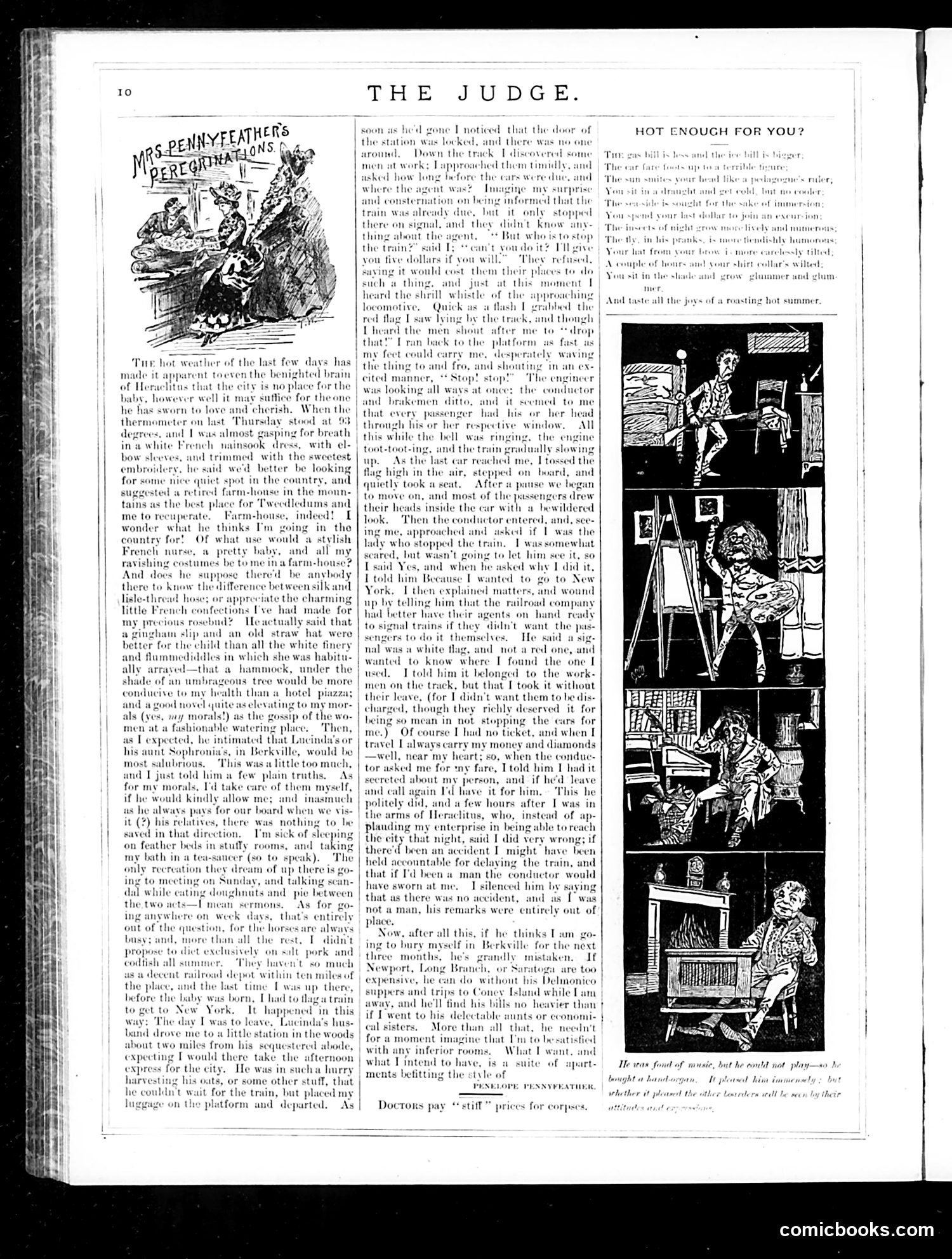
This page contains two distinct pieces: **Left side**: "Mrs. Pennyfeather's Performances" - A comic narrative (with accompanying illustration) satirizing a wealthy, self-absorbed woman. She refuses her husband's sensible suggestion to escape summer heat at a farmhouse, dismissing rural life as incompatible with her expensive wardrobe and fashionable pretenses. The satire targets upper-class women's vanity and impracticality. **Right side**: "Hot Enough for You?" - A story illustrated with woodcut panels about a woman who stops a train by waving a signal flag to catch a ride to New York. She then deceives the conductor about having fare money. The satire appears to mock both female audacity/dishonesty and social climbing—she claims to have "diamonds near her heart" while brazenly avoiding payment. Both pieces ridicule privileged women's behavior: one through vanity, the other through deceit. The tone is condescending humor typical of late-19th-century Judge magazine's satirical approach to gender and class.
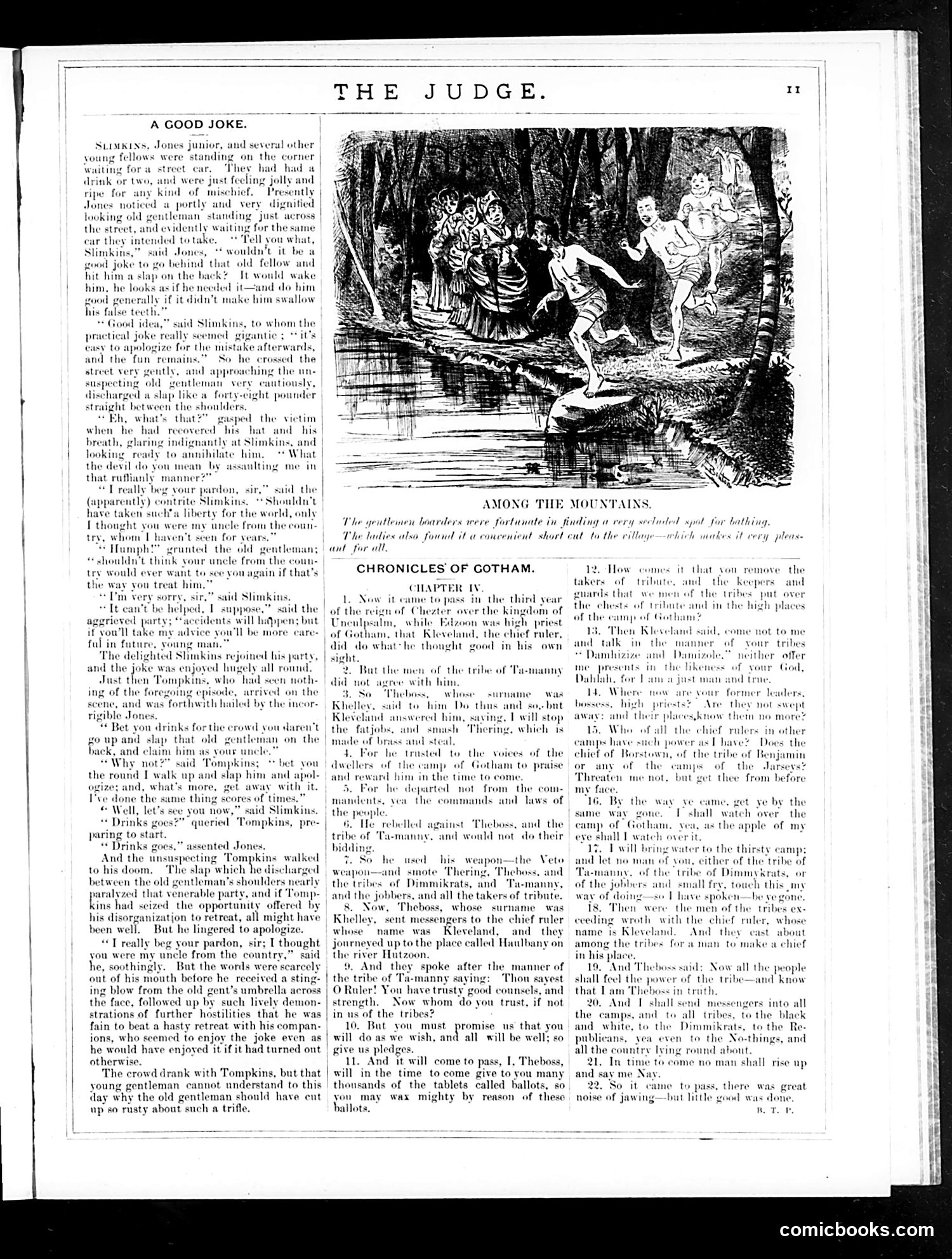
This page contains two distinct pieces from Judge magazine: **"A Good Joke"** (left column): A satirical story mocking young men's behavior. Drunk youths slap an elderly gentleman, then claim it was a mistake. When they dare friend Tompkins to repeat the prank, he does—but the "dignified" man turns out to be combative, vigorously defending himself with his cane and umbrella. The joke's irony: Tompkins expected an easy mark but found a formidable opponent. The satire targets youthful arrogance and bullying masquerading as humor. **"Chronicles of Gotham"** (right): A biblical-style parody mocking New York City politics, specifically **Tammany Hall** (the corrupt Democratic political machine). "Tammany" appears repeatedly as a tribe; "Kleveland" (likely Grover Cleveland) is the ruler. The passage satirizes how Tammany politicians promise voters ("ballots") rewards in exchange for political support and compliance. It's commentary on machine politics' transactional nature and manipulation of the electorate.
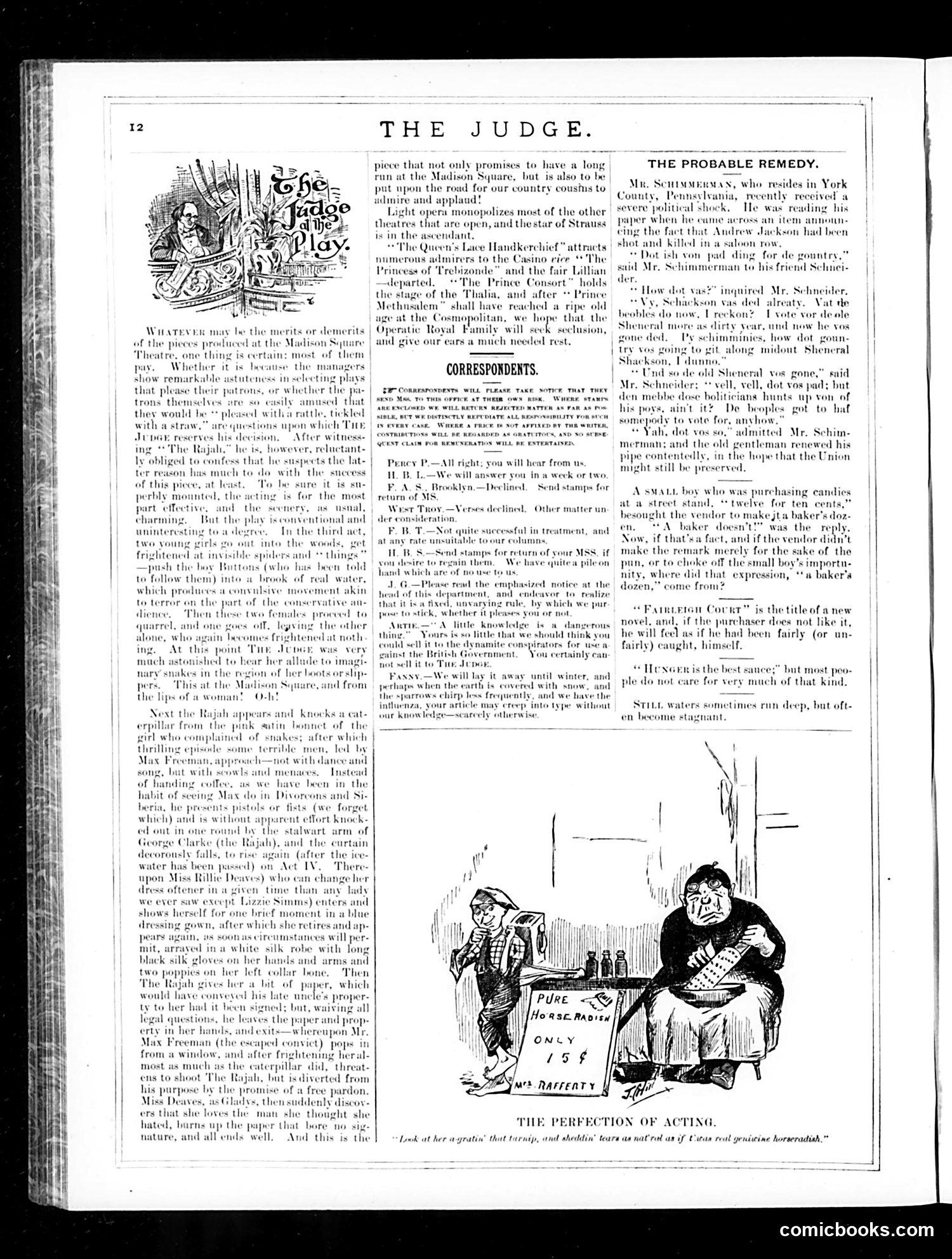
This page contains two distinct pieces of satirical content: **"The Probable Remedy"** (top right) depicts a conversation between two German-immigrant characters—Mr. Schimmerman and Mr. Schneider—discussing American politics. The satire mocks their thick German accents (rendered phonetically: "vat," "dot," "vos") while they debate a solution to political corruption. One suggests that since Andrew Jackson was "shot and killed in a saloon row," perhaps politicians should meet the same fate. The joke satirizes both immigrant speech patterns and naive approaches to solving political problems through violence rather than reform. **"The Perfection of Acting"** (bottom) shows a disheveled woman at a table labeled "Pure Horse Radish Only—5¢" attempting to sell condiments. The caption quotes her: "Look at her grace! that bravure, and shallor! bare as on any of those old operetta heroines!" This mocks theatrical overacting—suggesting that even a street vendor hawking cheap horseradish performs with exaggerated operatic dramatics, satirizing the melodramatic excesses of contemporary theater.
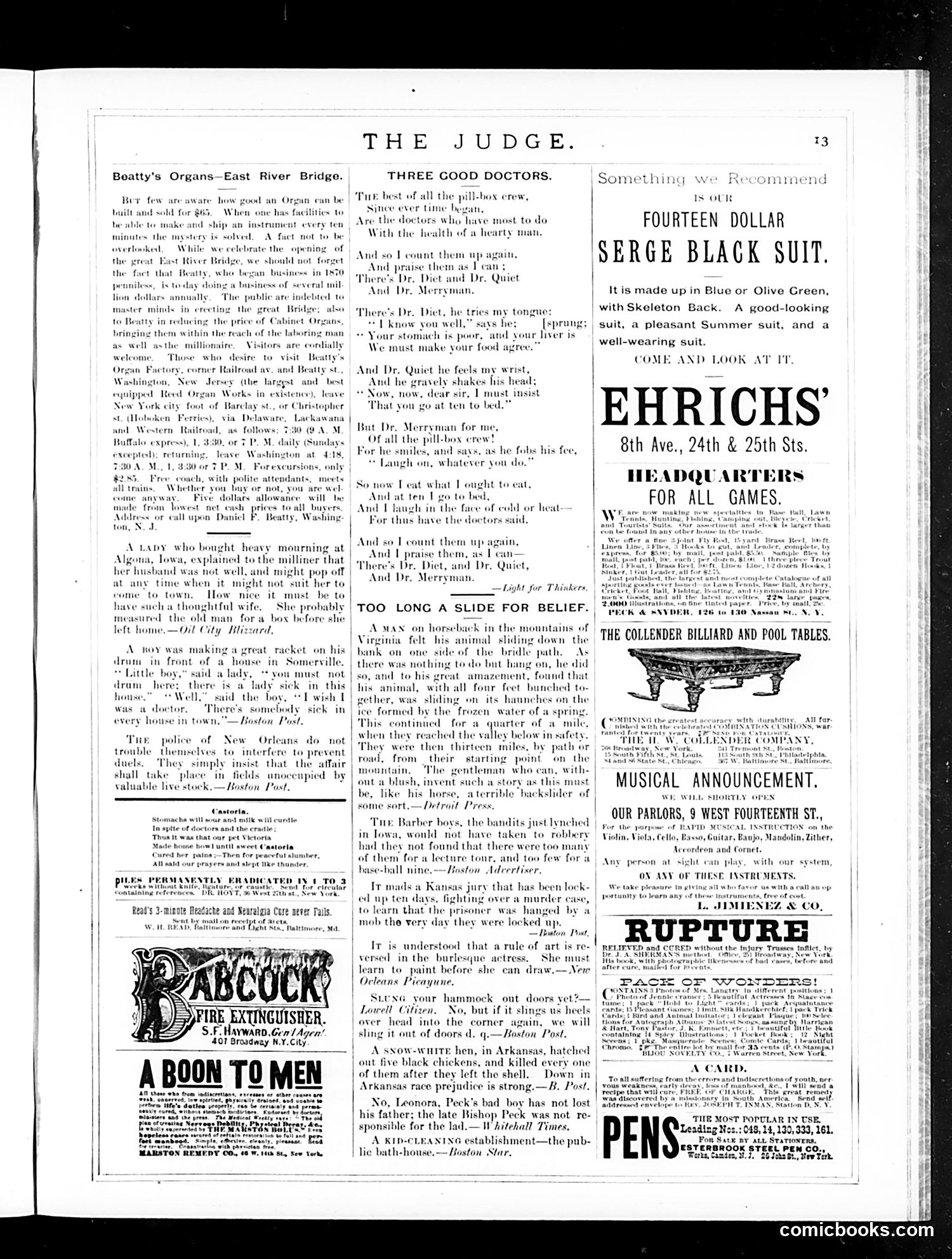
This page consists primarily of **advertisements and humor columns** rather than political cartoons. The main content includes: **"Three Good Doctors"** — a humorous poem praising three fictional physicians: Dr. Diet, Dr. Quiet, and Dr. Merryman, presented as remedies for poor health. The satire mocks medical pretension by suggesting common sense (diet, rest, good humor) outperforms actual doctors. **"Too Long a Slide for Relief"** — an anecdote about a man on horseback whose animal unexpectedly slides down a frozen mountainside on its haunches for a quarter-mile, arriving safely. The joke plays on the absurdity of accidental survival. The page also features **commercial advertisements** for Beatty's organs, the Babcock Fire Extinguisher, billiard tables, and various other products—typical of Judge's revenue model. The humor throughout is **light, domestic, and non-political**, focusing on everyday absurdities and medical/domestic satirical observations rather than contemporary political events.
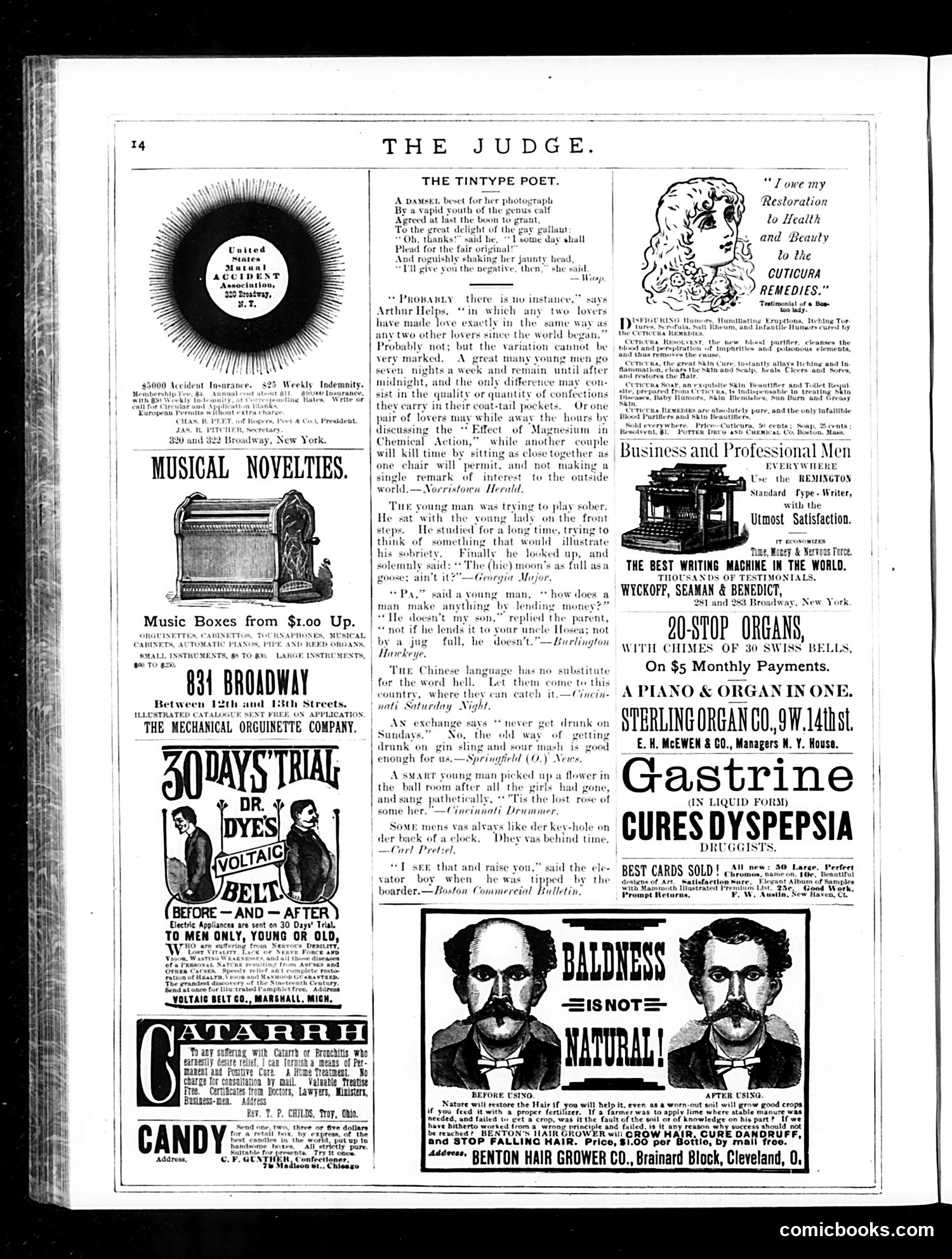
This page is primarily **advertisements** interspersed with short humorous anecdotes under the heading "THE TINTYPE POET." The central cartoon—a circular tintype photograph with radiating lines—illustrates the opening poem about a "vapid youth" attempting to court a young woman by offering her a tintype portrait. The satire mocks sentimental courtship rituals and photography trends of the era. The surrounding text consists of brief, unrelated jokes about romantic/social situations: young men trying to impress women, misunderstandings about money and lending, drunk behavior, and wordplay. These represent typical *Judge* magazine humor—lighthearted observations on courtship, class relations, and male foolishness. The bulk of the page advertises period products: music boxes, typewriters, organs, patent medicines (Gastrine for dyspepsia, Benton Hair Grower), and candy. The baldness advertisement with "before/after" images was common patent-medicine marketing. The overall purpose is entertainment and revenue through advertising.
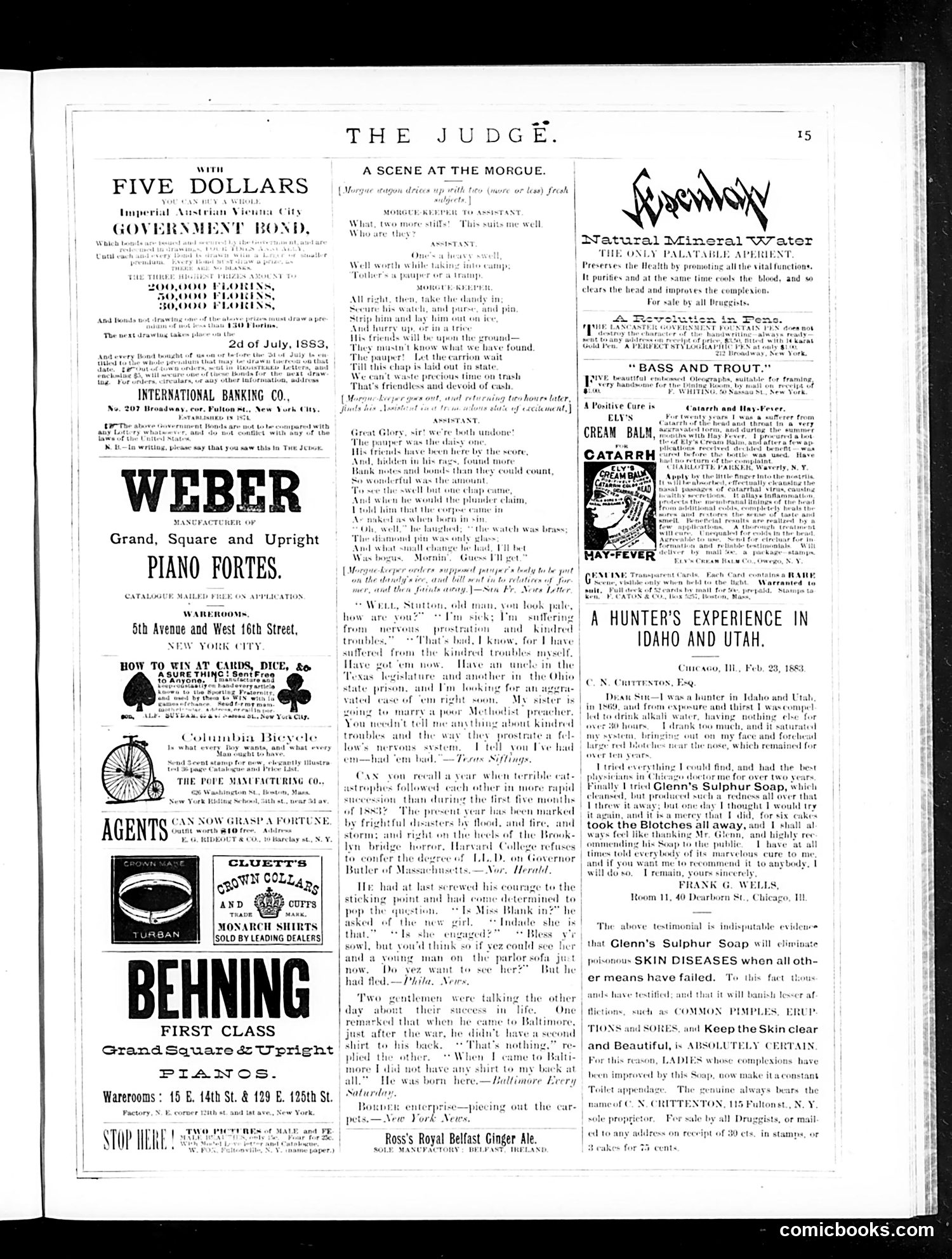
This page is primarily **advertisements and filler content** rather than political satire. The main textual feature is "A Scene at the Morgue," a dialogue-based sketch (not a visual cartoon) satirizing class discrimination in death care. ## The "Scene at the Morgue" Satire The sketch depicts morgue attendants discussing corpses with callous indifference to the dead's dignity, prioritizing only wealth. The satire targets **class prejudice**: a well-dressed corpse receives respectful treatment ("laid out in state"), while a poor person is stripped of valuables and dismissed as "friendless and devoid of cash." The dialogue mocks the hypocrisy and cruelty of treating death itself as a commercial transaction where human worth is measured purely by possessions and social status. ## Surrounding Content The page is dominated by **period advertisements** for pianos, banking services, patent medicines (Glenn's Sulphur Soap, Ely's Cream Balm), and ginger ale—typical of Judge's revenue model. These ads reflect late 19th-century consumer culture and pseudoscientific medical claims.
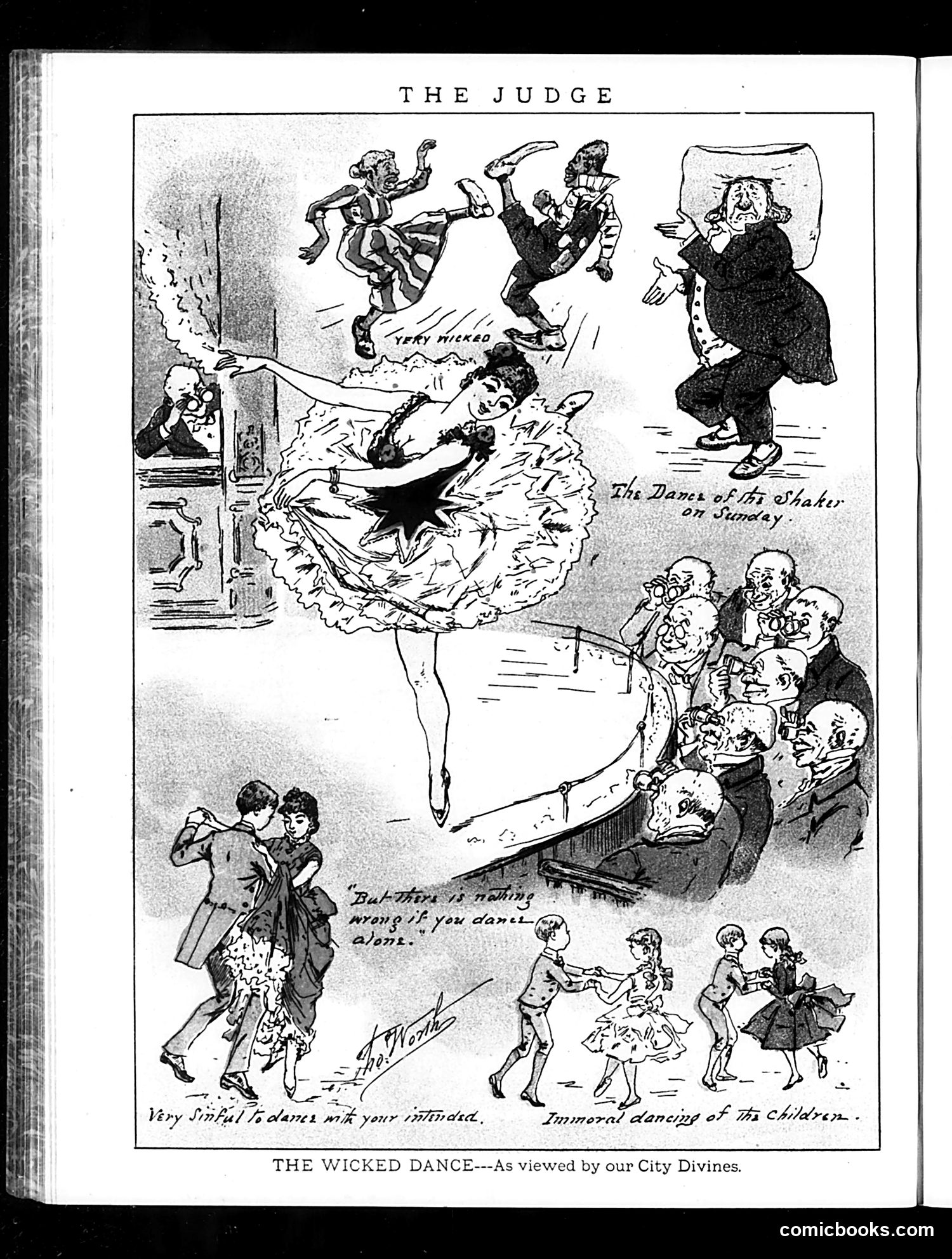
This satirical cartoon mocks religious leaders ("City Divines"—clergy) for their moral panic about modern dancing. The central image shows a dancer performing what appears to be a scandalous high-kick or can-can style dance, while shocked onlookers (representing clergy and moral authorities) react with horror from a theater box. The surrounding vignettes exaggerate the clergy's fears: children dancing "immorally," adults dancing inappropriately, and a couple dancing together in public. The satire suggests these religious figures are overreacting to ordinary social dancing and seeing wickedness everywhere. This reflects early 20th-century debates about changing social mores, particularly jazz-age dancing that conservatives viewed as sinful. Judge ridicules the clergy's outdated moral standards and their disconnect from modern urban culture.