
A complete issue · 16 pages · 1883
Judge — June 23, 1883
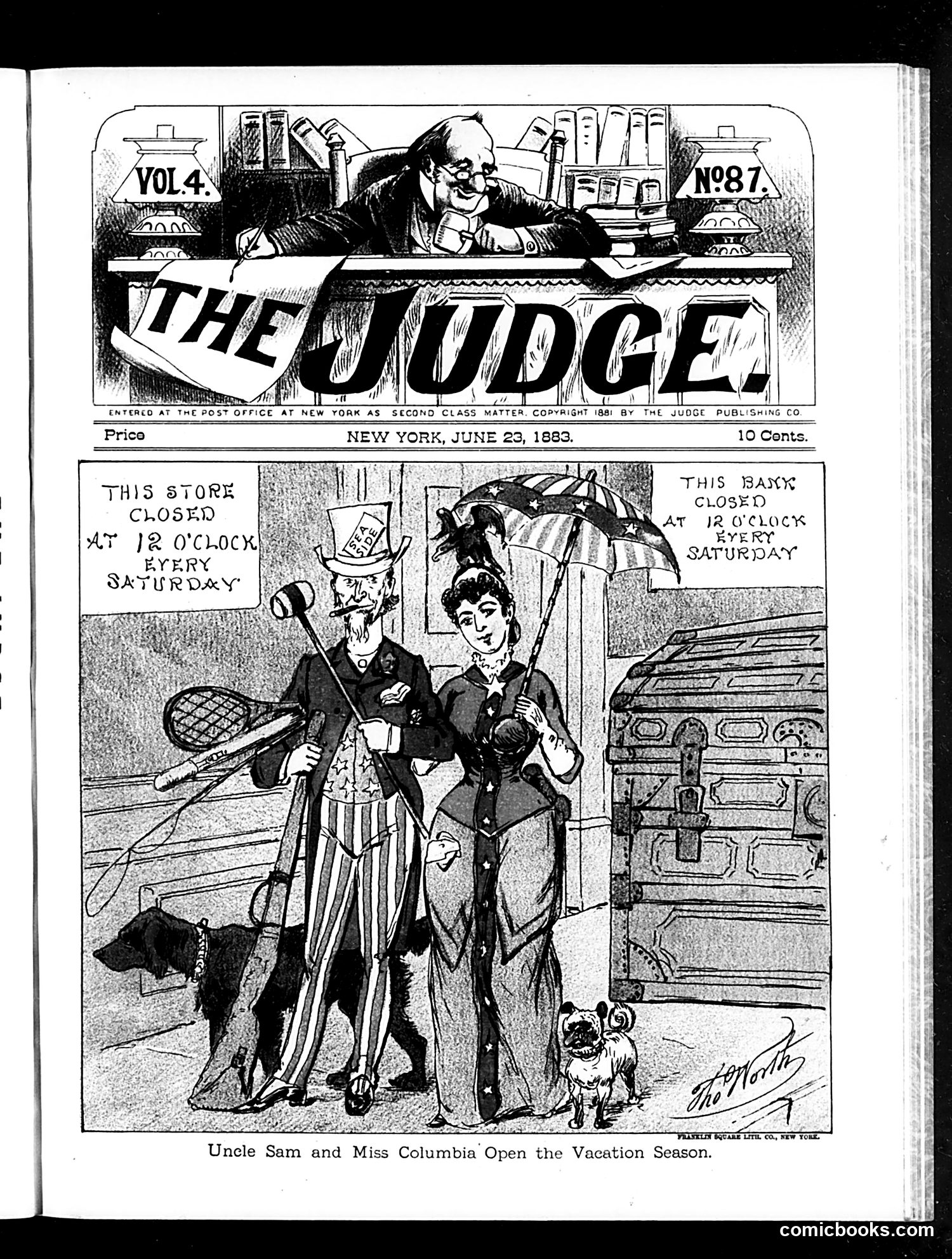
**Main Cartoon: "Uncle Sam and Miss Columbia Open the Vacation Season"** The illustration depicts two figures—Uncle Sam (identifiable by his characteristic top hat) and Miss Columbia (female personification of America)—preparing for vacation. They carry sporting equipment (tennis racket, umbrella) and are accompanied by dogs, standing before a bank and store, both marked as closed on Saturdays at noon. **The Satire:** This cartoon likely satirizes the growing American leisure culture and the establishment of Saturday half-days off—then a relatively new labor practice. The juxtaposition of bank/store closures with affluent figures enjoying recreation suggests commentary on commercialization of leisure time and class distinctions in access to vacation. The cartoon presents this vacation season as a national phenomenon worthy of personified national figures' participation.
This page contains **political commentary on Republican party troubles**, specifically targeting the nomination of **James B. Foraker as Ohio's Republican gubernatorial candidate**. The text criticizes this choice as strategically weak—Foraker is described as an unknown lawyer and soldier with no particular distinction, nominated at a critical moment when the party desperately needs its strongest candidate. The satire suggests Republicans are so fractured (split between "Stalwarts" and "Half-breeds") that they've settled on a mediocrity. A secondary section discusses **extradition of Irish nationalist Patrick Tynan**, a contemporary controversy where Britain pressured the U.S. government to return the alleged dynamite conspirator. Judge argues his apparent death resolves an awkward diplomatic dilemma: extraditing him would anger Irish-American voters, while refusing would antagonize Britain. The cartoon's accompanying illustration (showing a judge's profile) reinforces the legal/judicial theme of these political debates.
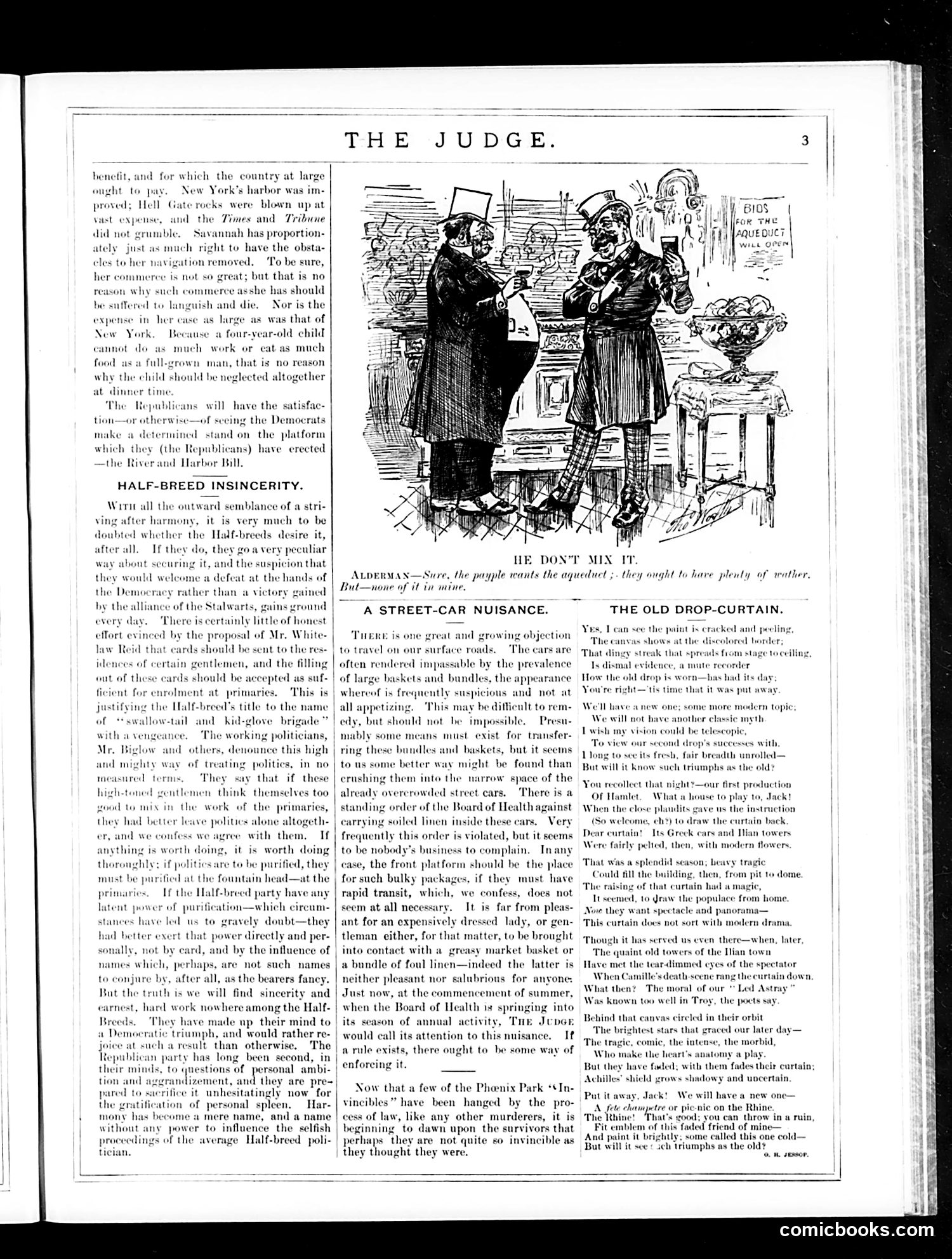
This page contains political commentary on Republican "Half-Breed" faction insincerity and a complaint about street-car crowding. **"Half-Breed Insincerity"** attacks moderate Republicans who claim to want party harmony but allegedly prefer Democratic victory to genuine unity. The term "Half-breed" referred to Republicans who opposed the spoils system, yet the article sarcastically suggests they use personal ambition rather than principle to guide their politics. The piece criticizes their refusal to participate in grassroots primary elections while lecturing others about party purification—exposing what the author sees as hypocritical elitism. **"A Street-Car Nuisance"** satirizes overcrowded public transportation cluttered with market baskets and soiled laundry bundles, making conditions unpleasant for well-dressed passengers. The Board of Health supposedly issued orders against this practice, but enforcement remains nonexistent. The cartoon illustration (captioned "He Don't Mix It") depicts two well-dressed gentlemen keeping their distance, humorously illustrating the separation theme of both articles—factional Republican division and class-based discomfort on transit.
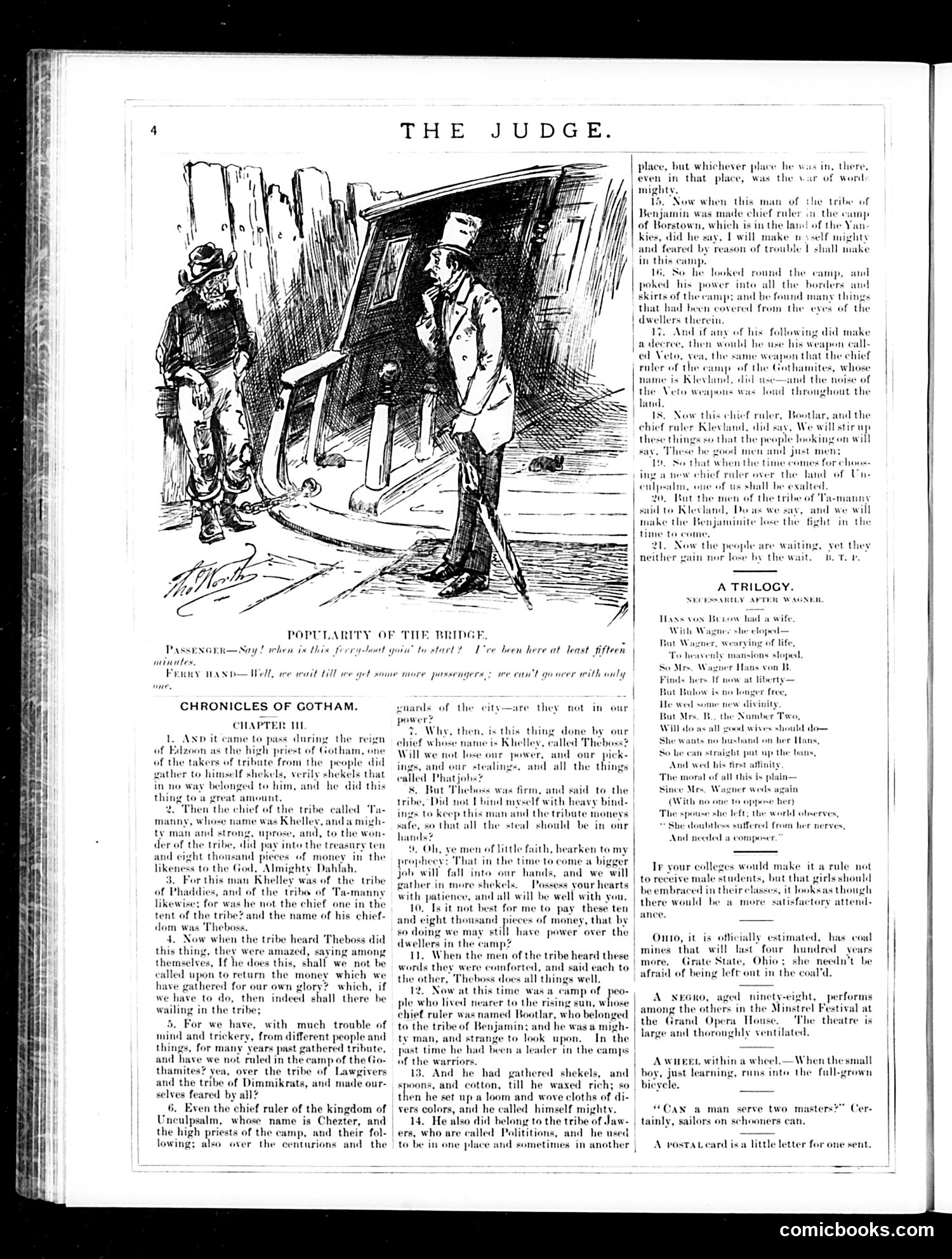
This page from *Judge* presents a biblical parody mocking New York City political corruption, likely from the 1880s-90s Tammany Hall era. The main cartoon, "Popularity of the Bridge," depicts a transit worker and passenger—likely commentary on public infrastructure projects serving political machines. The text "Chronicles of Gotham" uses Old Testament language to satirize local corruption: "Khelley" (likely Boss Kelly or similar Tammany figure) extorts tribute from citizens while "Theboss" rules the tribe. References to "Ta-manny" explicitly invoke Tammany Hall, the Democratic political organization notorious for graft. The satire mocks how political bosses gathered public funds, distributed patronage, and maintained power through intimidation and alliances with other corrupt factions ("tribe of Law," "tribe of Dimmikrats"). "Bootlar" and "Chezter" appear to be rival political figures competing for influence. The satire suggests these bosses enriched themselves while common citizens gained nothing—a familiar critique of urban machine politics and their predatory relationship with working people.
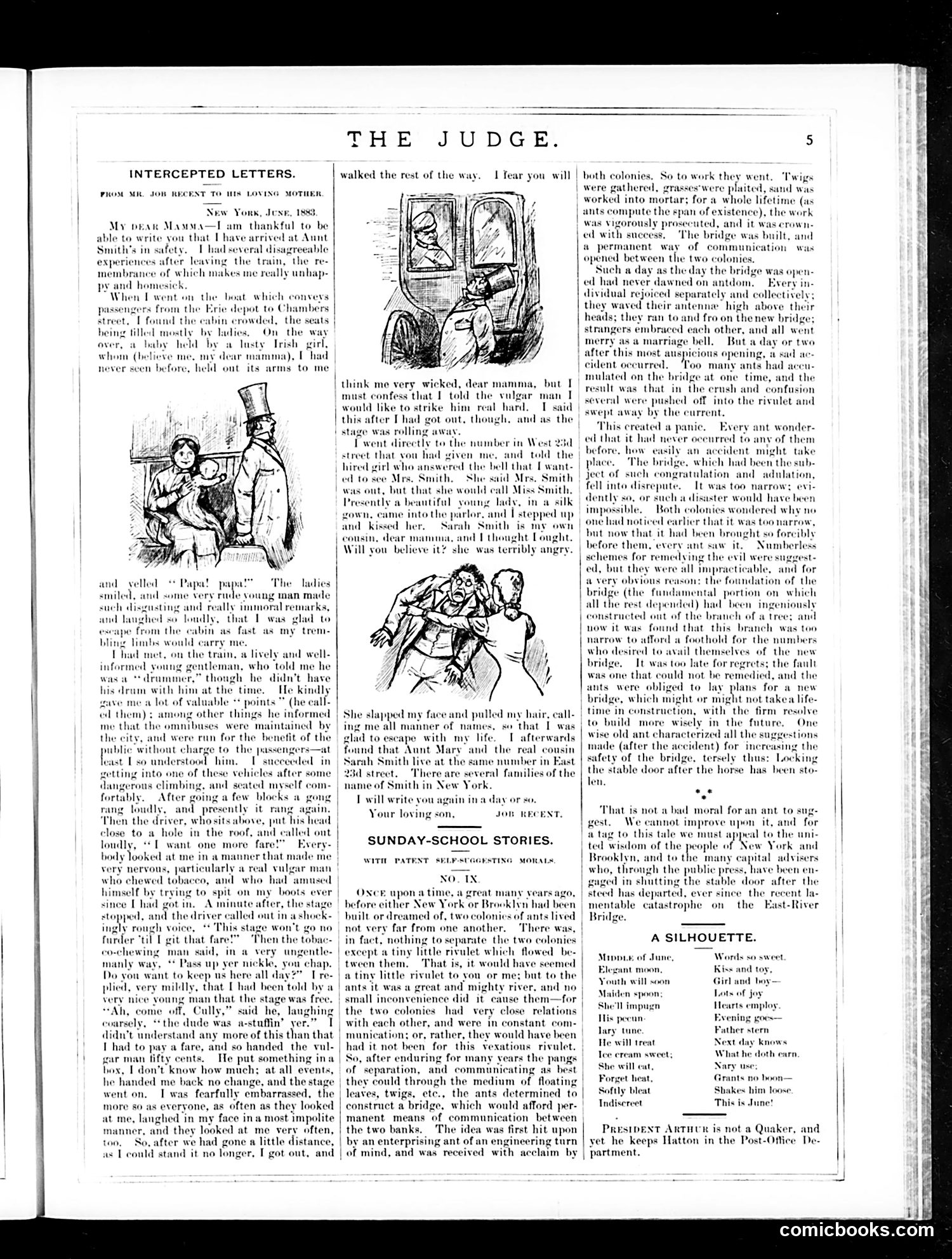
This page contains two distinct pieces of satirical content: **"Intercepted Letters"** is a humorous travel narrative mocking a naive young woman's first visit to New York City. She describes comic misadventures: a stranger's baby mistaking her for "Papa," crude remarks from passengers, and her bewilderment with streetcar etiquette. The satire targets upper-class provincial innocence encountering urban vulgarity—she's scandalized by a tobacco-chewing conductor and confused by the fare system, representing the clash between genteel manners and working-class city life. **"Sunday-School Stories"** (visible below) appears to be a separate instructional piece about ants constructing a bridge, likely using animal behavior as moral instruction—a common Victorian pedagogical device. The cartoons accompanying these texts use exaggerated facial expressions and body language typical of 1880s Judge illustrations to emphasize the comedy of social discomfort and class difference.
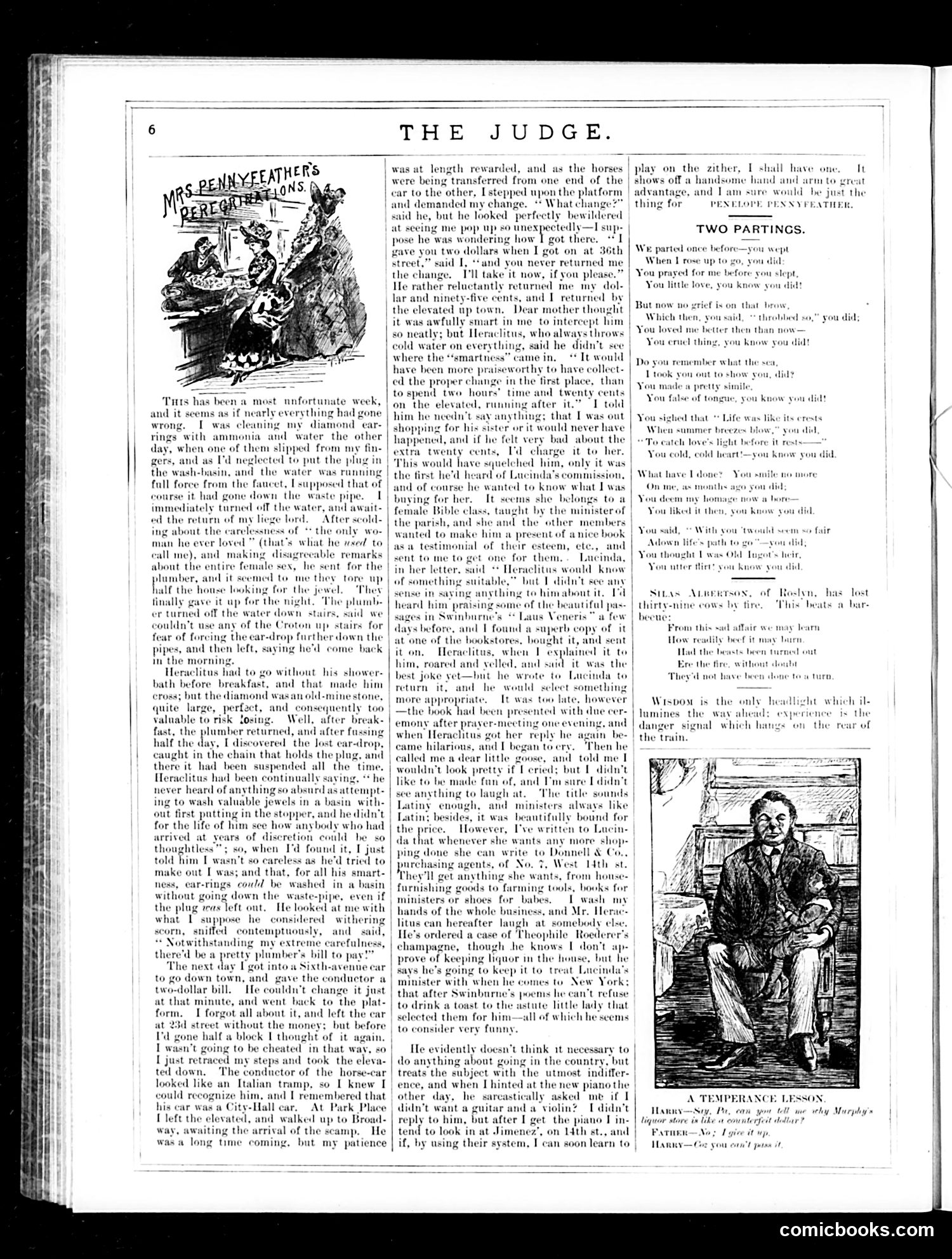
This page from *Judge* magazine contains personal anecdotes rather than political cartoons. The illustrated header "Mrs. Pennyfeather's Experiences" introduces humorous domestic stories typical of the era's satirical magazines. The main narratives satirize middle-class anxieties: a woman loses her diamond ring down a drain and must deal with an unhelpful plumber; she later confronts a streetcar conductor who shortchanged her; and she receives an inappropriate gift book ("Laus Veneris"—about Venus/sensuality) from a relative, creating social embarrassment. The satire targets Victorian propriety and class pretensions. The humor derives from the narrator's determination to recover money (a few cents) and her mortification over receiving risqué literature. Her father's dismissal of her resourcefulness adds commentary on gender attitudes of the period. The page reflects turn-of-the-century American middle-class concerns: consumer transactions, domestic mishaps, and proper behavior—presented for genteel readers' amusement.
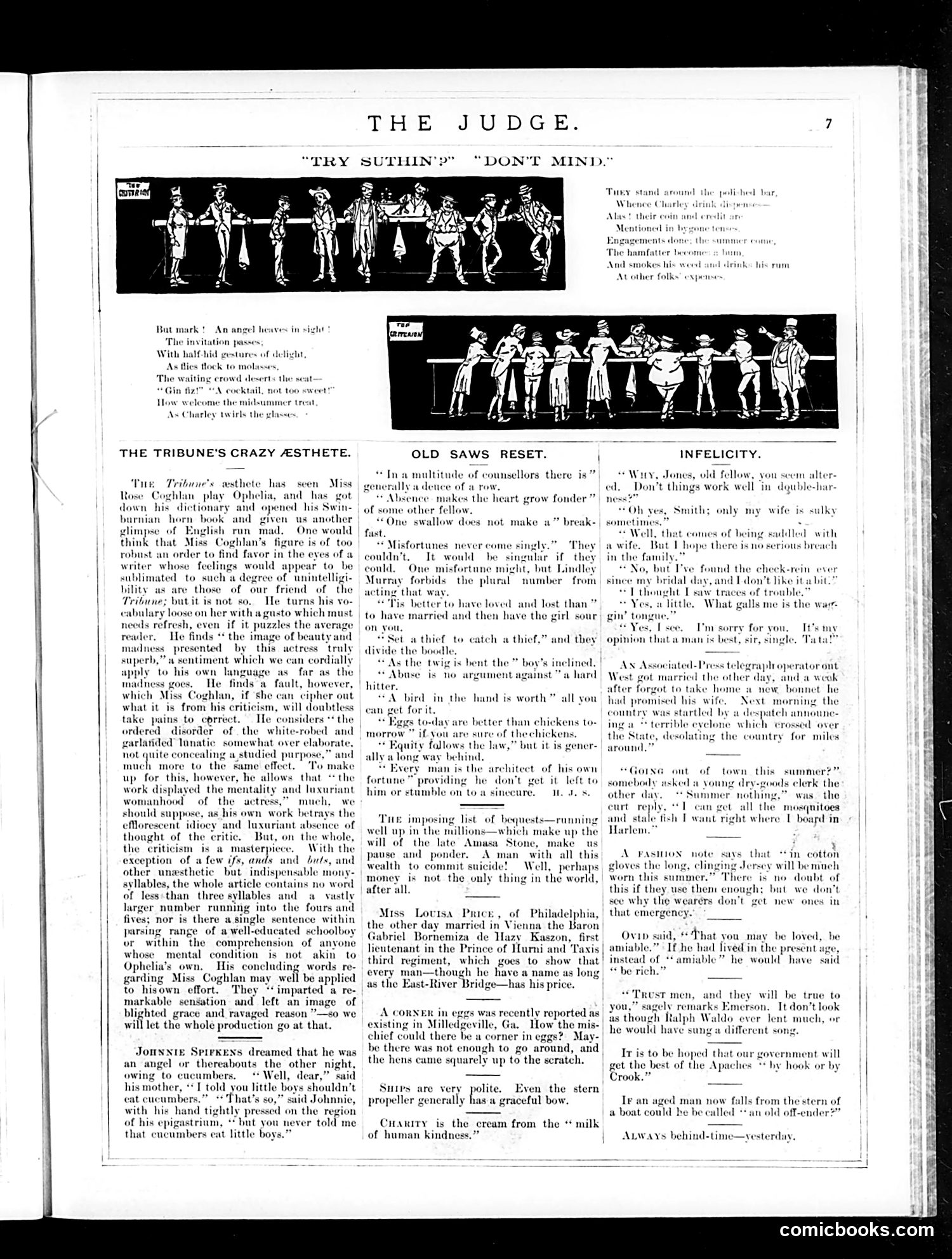
This page contains several satirical pieces typical of the era: **"The Tribune's Crazy Aesthete"** mocks the Chicago Tribune's art critic for using absurdly pretentious vocabulary (every word over three syllables) to review actress Rose Coghlan's performance as Ophelia. The satire ridicules affected literary criticism that obscures rather than clarifies meaning—the critic's own writing is incomprehensible to average readers, despite praising the actress's "blighted grace and ravaged reason." **"Old Saws Reset"** humorously deconstructs familiar proverbs through literal logic: "misfortunes never come singly" couldn't grammatically work otherwise; "set a thief to catch a thief" means thieves divide stolen goods. **"Infelicity"** and other brief humor items use wordplay and domestic comedy typical of period magazines. The cartoons at top show social gatherings with figures in formal dress, illustrating the text's satirical themes about society and pretension. Overall, the page exemplifies Judge's focus on lampooning American intellectual and social affectations of the era.
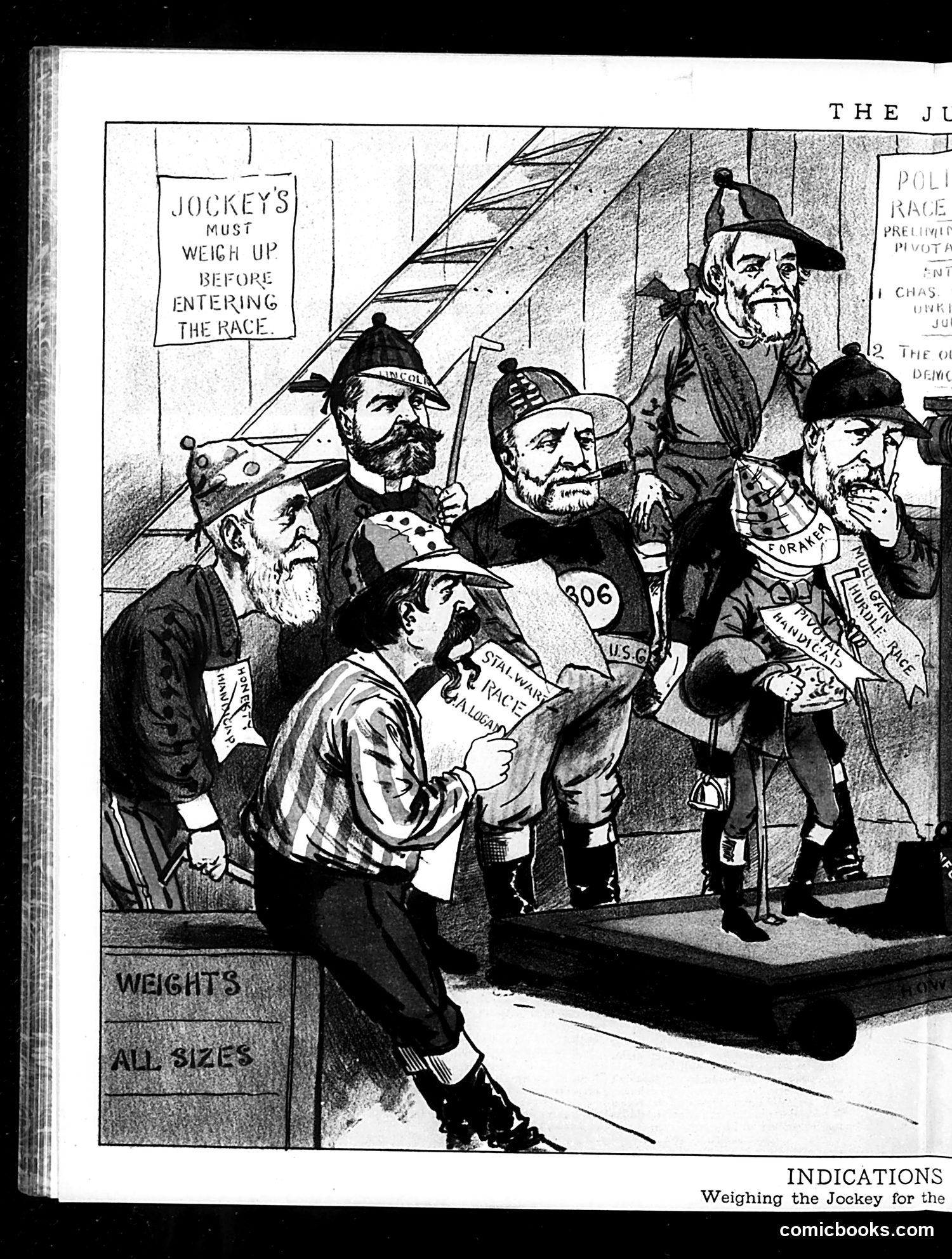
This political cartoon satirizes electoral processes through a horse-racing metaphor. The caption "Weighing the Jockey for the Race" and the sign "JOCKEYS MUST WEIGH UP BEFORE ENTERING THE RACE" suggest an upcoming election. The figures appear to be politicians or political candidates being "weighed" like jockeys before a race—a common satirical comparison of elections to sporting competitions. The various men display badges, labels, and attire suggesting different political affiliations or interests (one appears marked "U.S.G." and others wear different insignia). The joke likely critiques how candidates are evaluated or screened before political contests, with the implication that politicians should be formally "weighed" or assessed for qualification. The "WEIGHTS ALL SIZES" sign reinforces this racing-sport metaphor, suggesting candidates of various stature compete equally. Without specific dates or identifying labels visible, the exact election referenced remains unclear.
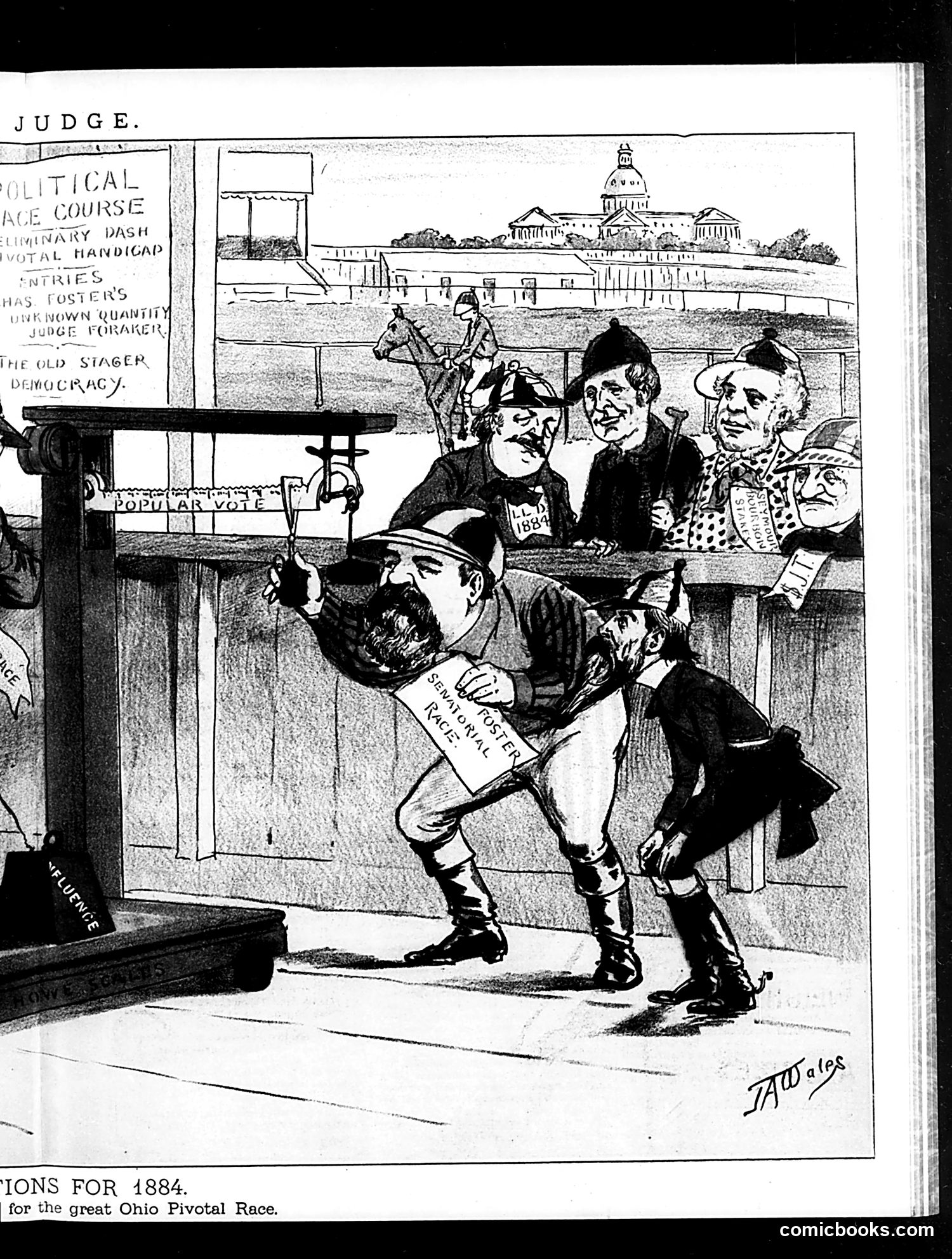
This cartoon satirizes the 1884 Ohio presidential election, described as a "great Ohio Pivotal Race." The image depicts a horse race at the Capitol, where political candidates are jockeys competing for the presidency. The OCR text references "Judge Foraker" and mentions "The Old Stager" and "Democracy" among the competing entries. The cartoon uses horse-racing metaphor to mock the electoral competition, suggesting candidates are essentially racing animals rather than serious statesmen. Key figures appear to be caricatured Ohio politicians, though specific identifications are unclear from the image alone. The Capitol backdrop emphasizes this is about national politics. The satire criticizes the reduction of presidential campaigns to mere sporting spectacle—treating the election as entertainment rather than serious governance. The tone suggests *Judge* magazine viewed the 1884 race cynically, mocking both candidates and voters.
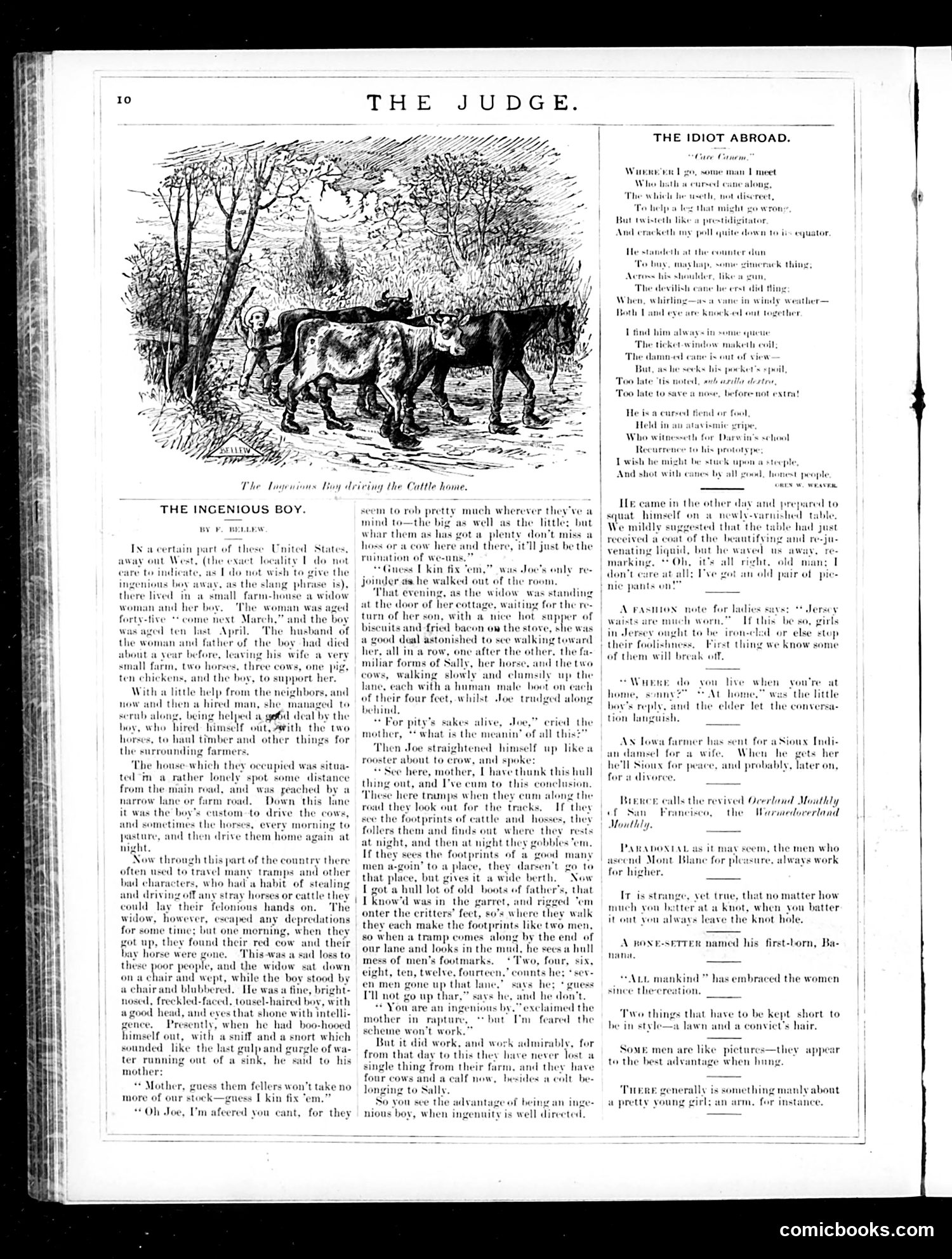
This page contains two distinct pieces of satirical content: **"The Ingenious Boy"** (main story with illustration): A sentimental narrative about a poor rural widow's clever son who outwits cattle thieves. When thieves steal livestock by following animal footprints, the boy attaches old boots to the cattle's feet, making them appear to be men walking. The thieves, seeing what looks like a large group of men, abandon their robbery plans. The satire appears aimed at celebrating rural ingenuity and common-sense problem-solving over formal education or law enforcement—a romantic notion of American frontier resourcefulness. **"The Idiot Abroad"** (right column, verse): A poem mocking a foolish traveler who misunderstands foreign customs and technology. References include confusion with a train window, mishandling of luggage, and general bewilderment abroad. This satirizes the "ugly American" tourist stereotype—the ignorant traveler embarrassing himself through cultural incomprehension. Both pieces reflect late-19th-century Judge magazine's satirical targets: rural virtue versus urban pretension, and American ignorance of the wider world.
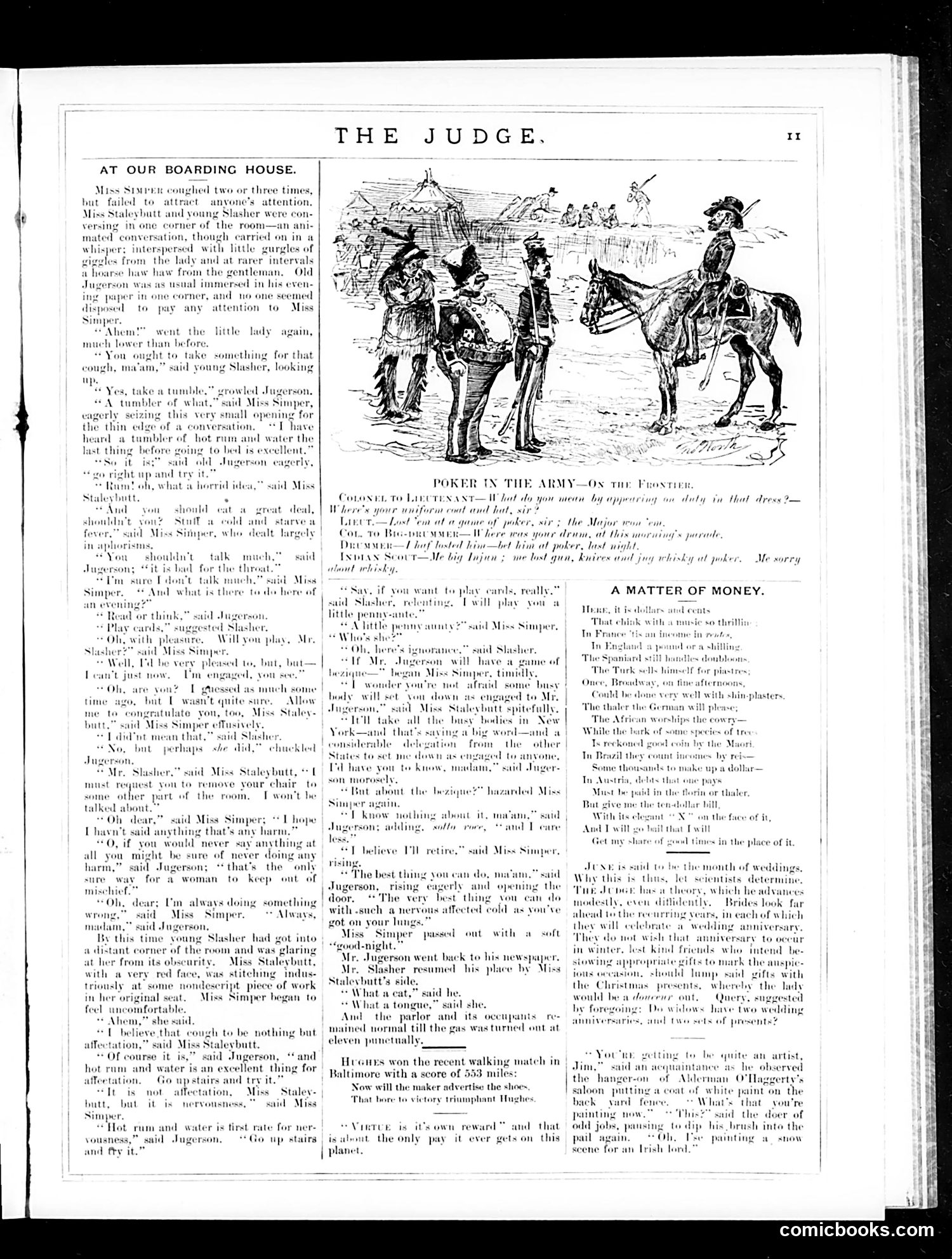
This page from *Judge* contains two main satirical pieces: **"At Our Boarding House"** (left column and continuation): A domestic comedy sketch mocking Victorian propriety. Miss Simper repeatedly coughs to gain attention while others ignore her; young gentlemen discuss card games and "penny-ante" poker. The satire targets the artificial social conventions of boarding-house life and the obsessive etiquette that governs such spaces—characters debate whether hot rum is medicinal or merely affected behavior. The humor lies in exposing how rigid social rules create absurd situations. **"Poker in the Army—On the Frontier"** (illustration and caption): A military scene where a Native American scout has lost his uniform, gun, and knife in a poker game. The satire mocks both military discipline (an officer questioning the soldier's appearance) and the prevalence of gambling among soldiers, even in remote frontier posts. The broken English suggests crude ethnic stereotyping common to the era. Both pieces satirize American social hypocrisy and moral contradictions—whether among the genteel or military classes.
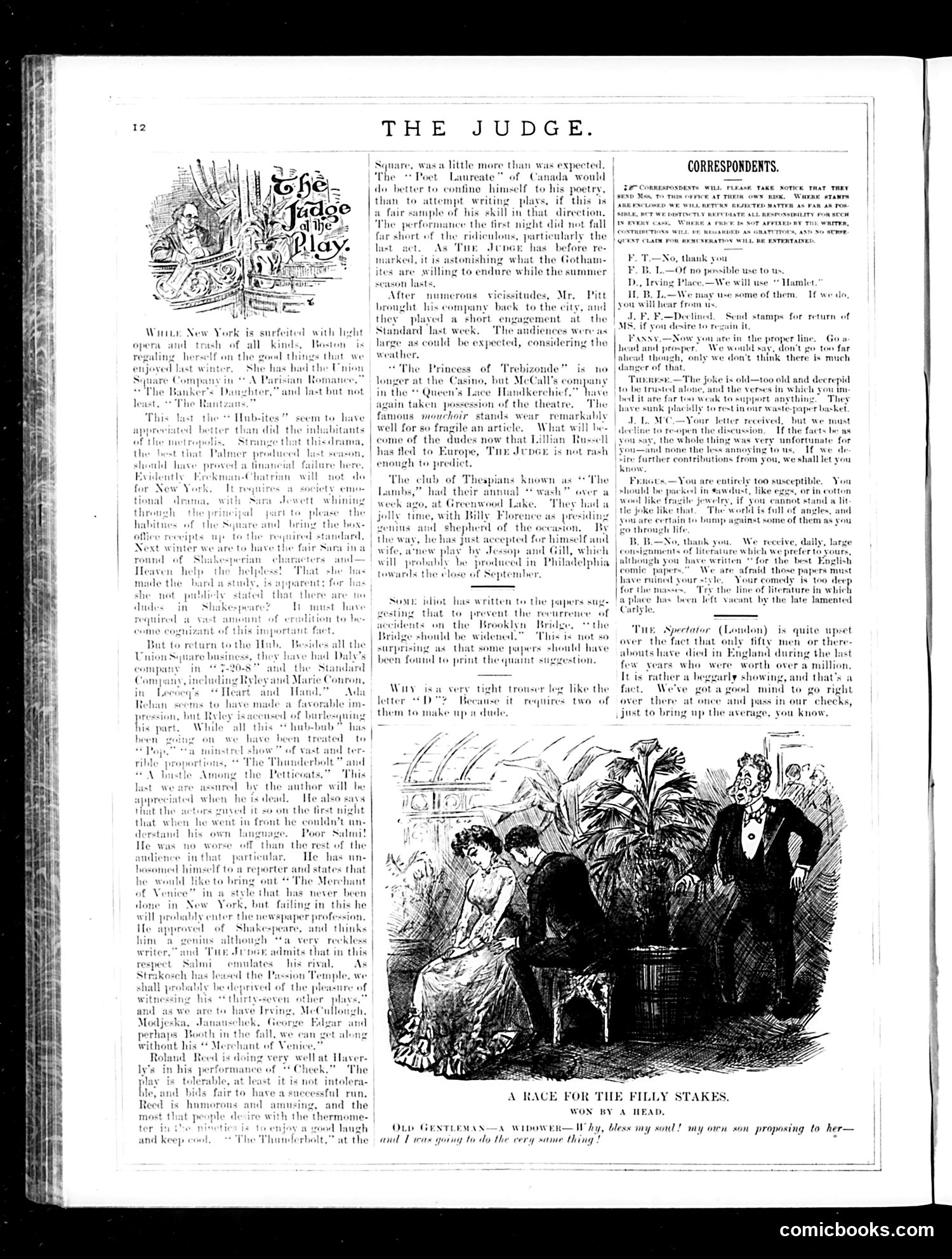
This cartoon satirizes courtship competition among wealthy older men. The illustration shows two gentlemen—one labeled "Old Gentleman—A Widower"—who have apparently both proposed to the same woman (a "filly," period slang for an attractive young woman). The joke is that one has beaten the other "by a head" to marriage, like racehorses competing for a trophy. The humor targets the absurdity of wealthy widowers and bachelors treating romantic pursuit like sport or gambling—competing for desirable young women as prizes. The gentlemen's surprised recognition of each other suggests both had identical intentions toward the same woman, reducing courtship to mercenary competition. This reflects Gilded Age social anxieties about marriage as transactional rather than romantic, particularly older men's pursuit of younger women for status or companionship.
This page is primarily **text-based content** rather than a political cartoon. It contains humorous anecdotes and brief satirical pieces typical of Judge magazine's format. The visible content includes: - **"Pulpit Slips of the Tongue"** section featuring stories about clerical mishaps and confused sermons - Multiple short humorous vignettes about everyday life (a girl hiding money in stockings, a man paying for a locomotive trip) - An anecdote about **Kate Kase throwing water at Judge Mallory** in Milwaukee—appearing to satirize judicial proceedings or court behavior - Advertisement for **Beatty's Organs** (musical instruments sold for $65) - Advertisement for **Dabcock Fire Extinguishers** The satire targets **minor social absurdities**: pompous clergymen, awkward domestic situations, and small-town behavior. Without identifying specific political figures or major events on this page, the humor relies on gentle mockery of everyday pretension and human folly rather than partisan critique.
This page is primarily **advertising** with one notable literary contribution. The main content is Eugene Field's humorous poem **"The Soaped Swimmer,"** which tells a whimsical story of a boy who went swimming, ate soap cake, and experienced comic digestive consequences—a lighthearted morality tale typical of late-19th-century children's verse. The accompanying illustration shows a young girl's face, presumably the character referenced in the poem. The rest of the page consists of period advertisements for consumer goods and services: music boxes, typewriters, pianos, organs, patent medicines (Gastrine for dyspepsia, Cuticura remedies), candy, and fabric goods from Le Botillier Brothers. **There are no political cartoons or satirical commentary visible.** This appears to be a standard magazine page mixing light literary content with commercial advertising—typical of *Judge's* format during this era, where satirical articles alternated with paid advertisements and entertainment pieces.
This page features a humorous story-cartoon titled "He Was a Singer," which satirizes urban noise complaints and inconsiderate neighbors in late 19th-century America. **The Setup:** A resident of a tenement building on an unnamed street begins singing loudly at midnight, disturbing neighbors. His rendition—a sentimental ballad about his love in Savannah—is so terrible that angry residents emerge armed, attempting to "pulverize the midnight intruder." **The Joke:** Rather than stopping, the singer persists, promising to continue his "repertoire" and threatening further performances. A policeman eventually arrives and arrests him, but even while being taken away, the singer refuses to cease, declaring he'll "sing all the way up to the workhouse." **The Satire:** The cartoon mocks both the oblivious nuisance of amateur singers performing at all hours and the urban tension between tenement dwellers sharing close quarters. It reflects period anxieties about crowded city living and the lack of privacy or peace in working-class neighborhoods. The remainder of the page consists of period advertisements for pianos, banking services, and patent medicines.
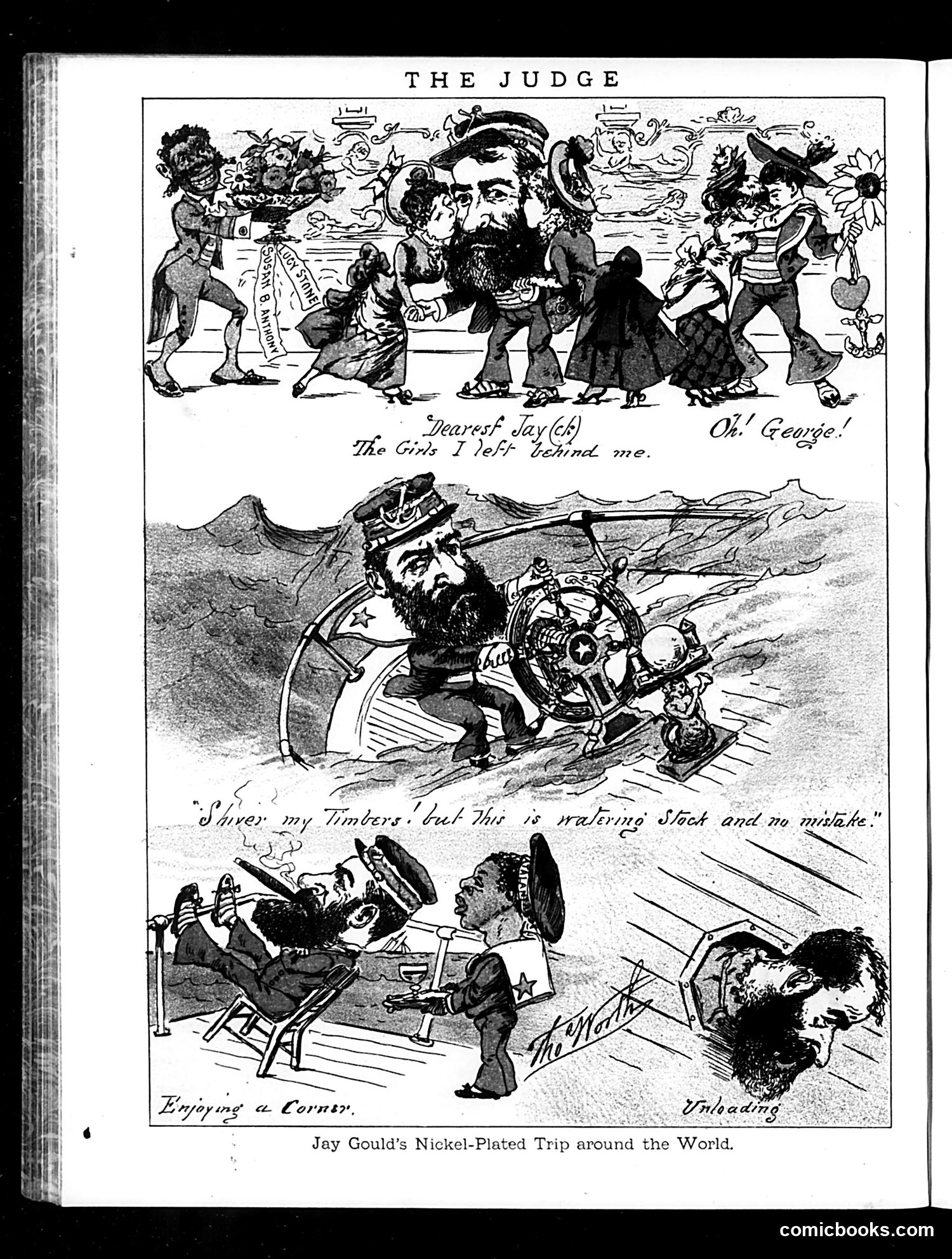
This is a satirical three-panel cartoon about **Jay Gould**, the wealthy American railroad magnate and financier. The title's "nickel-plated" is a pun—suggesting his trip is merely superficially glamorous despite his vast wealth. The top panel shows Gould surrounded by admirers and children ("The Girls I left behind me"). The middle panel depicts him commanding a ship, claiming to "shiver my timbers" while protecting his "watering stock" (a reference to the financial practice of inflating company value). The bottom panels show him "enjoying a corner" and "unloading"—likely mocking his business dealings and exploitative practices. The satire targets Gould's reputation as a ruthless businessman and robber baron, suggesting his world travels are mere vanity while his real interest remains financial manipulation and profit extraction.