
A complete issue · 16 pages · 1883
Judge — May 5, 1883
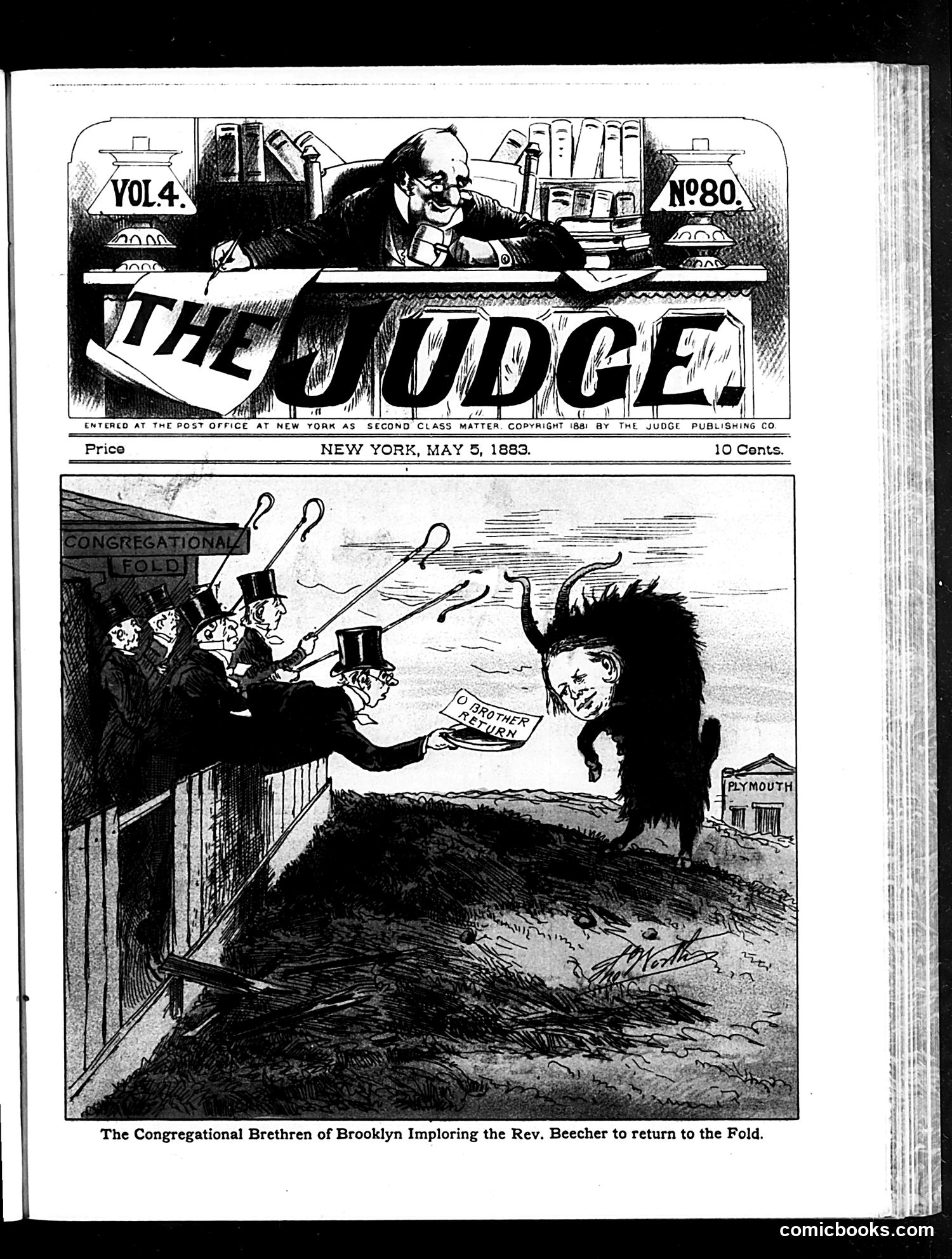
This 1893 cartoon satirizes Rev. Henry Ward Beecher, a prominent Brooklyn minister. The caption reads: "The Congregational Brethren of Brooklyn Imploring the Rev. Beecher to return to the Fold." The cartoon depicts clergymen (shown with top hats and shepherd's crooks, emphasizing their pastoral role) attempting to lure back a demonic or devilish figure representing Beecher. The "Congregational Fold" sign references his church affiliation. The satire mocks Beecher's departing from or controversial relationship with his congregation. The grotesque depiction suggests the magazine viewed his actions or positions as morally troubling. Beecher was historically controversial—this likely references his involvement in a sensational adultery scandal of the 1870s that damaged his reputation despite his acquittal.
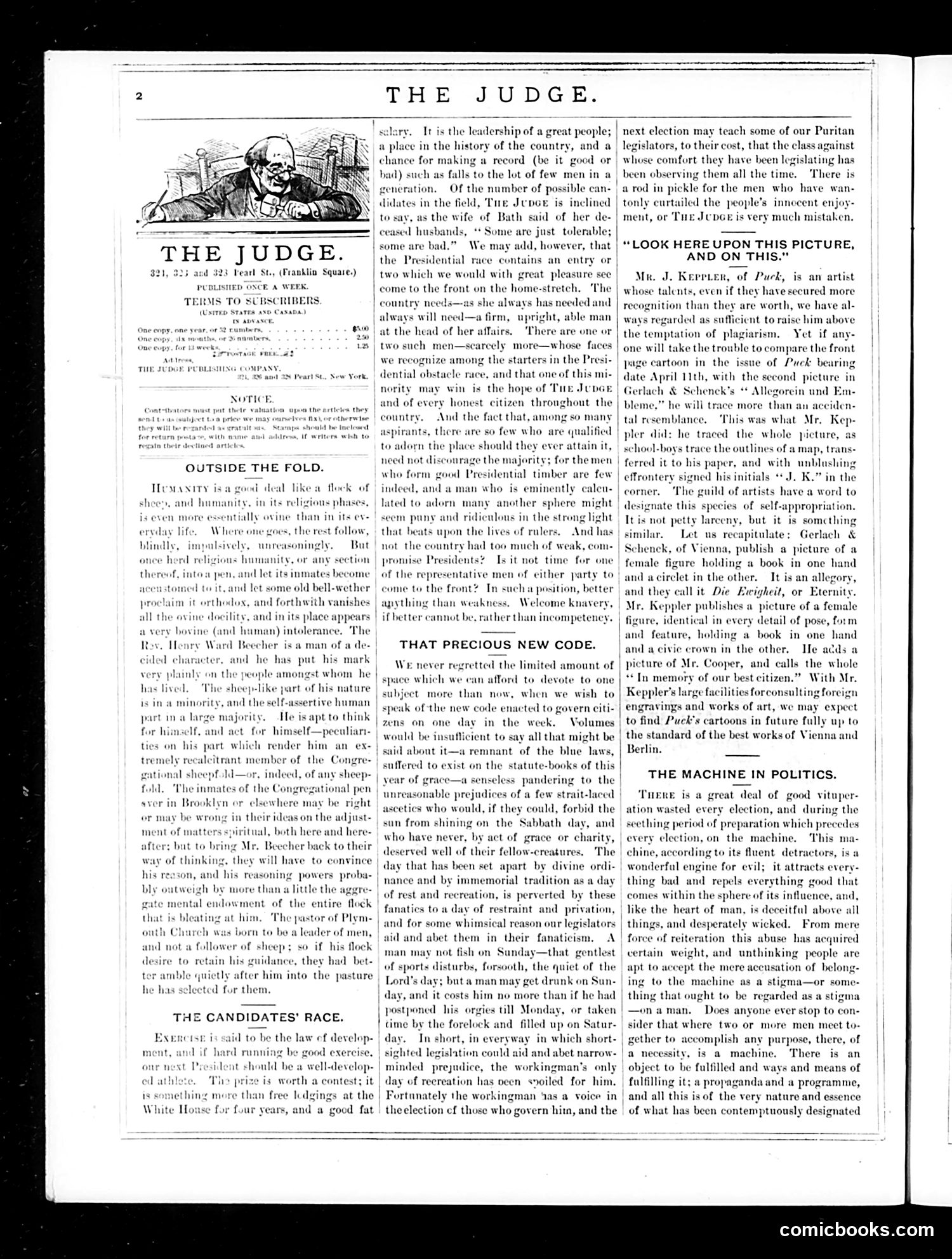
This page from *Judge* magazine contains three editorial essays addressing contemporary political concerns: **"Outside the Fold"** uses a sheep metaphor to praise Rev. Henry Ward Beecher as a strong independent leader who doesn't blindly follow the crowd—contrasting him with the "herd mentality" of ordinary people. **"The Candidates' Race"** discusses the upcoming Presidential election, arguing that while many candidates exist, few are truly qualified for the office. The writer expresses hope that strong, capable men will emerge as frontrunners. **"That Precious New Code"** criticizes legislative overreach, complaining that lawmakers create excessive volumes of laws. The writer advocates for simpler legislation, mentioning outdated "blue laws" that should be eliminated. The page reflects late 19th-century concerns about leadership quality, legislative efficiency, and political reform. Without seeing specific dates or illustrations clearly, the exact election year remains unclear, but the tone suggests concern about finding worthy presidential candidates.
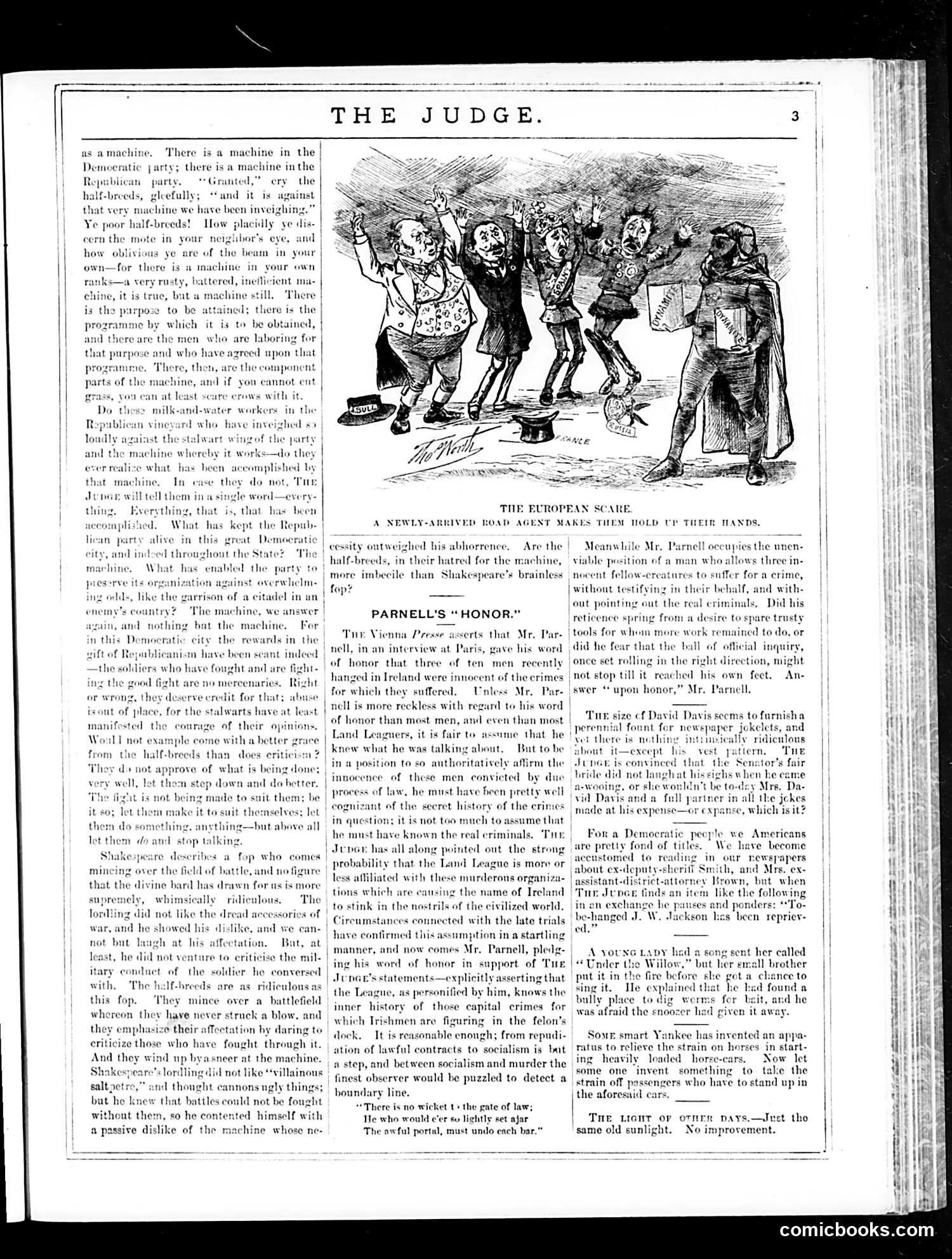
This page contains political commentary on two separate topics: **"The Machine" (main text):** Critiques Republican "half-breeds" (moderate Republicans who opposed the party machine) for hypocritically denouncing political machines while benefiting from their own party's organizational apparatus. The author argues both Democratic and Republican parties operate via machine politics, and that the Republican machine—despite being "rusty" and "inefficient"—has accomplished significant goals. **"The European Scare" (cartoon):** The illustration shows a road agent (bandit) frightening travelers into surrendering their valuables. This appears to satirize public fear of European radicalism or anarchism—a contemporary American anxiety. The caption suggests recent arrivals from Europe are perceived as threatening. **"Parnell's Honor" (sidebar):** References Charles Stewart Parnell, Irish nationalist leader. It questions his credibility regarding claims that ten Irishmen convicted of crimes were innocent, suggesting either his knowledge or his honor is suspect. The page reflects late-19th-century American partisan politics and anxieties about immigration and radicalism.
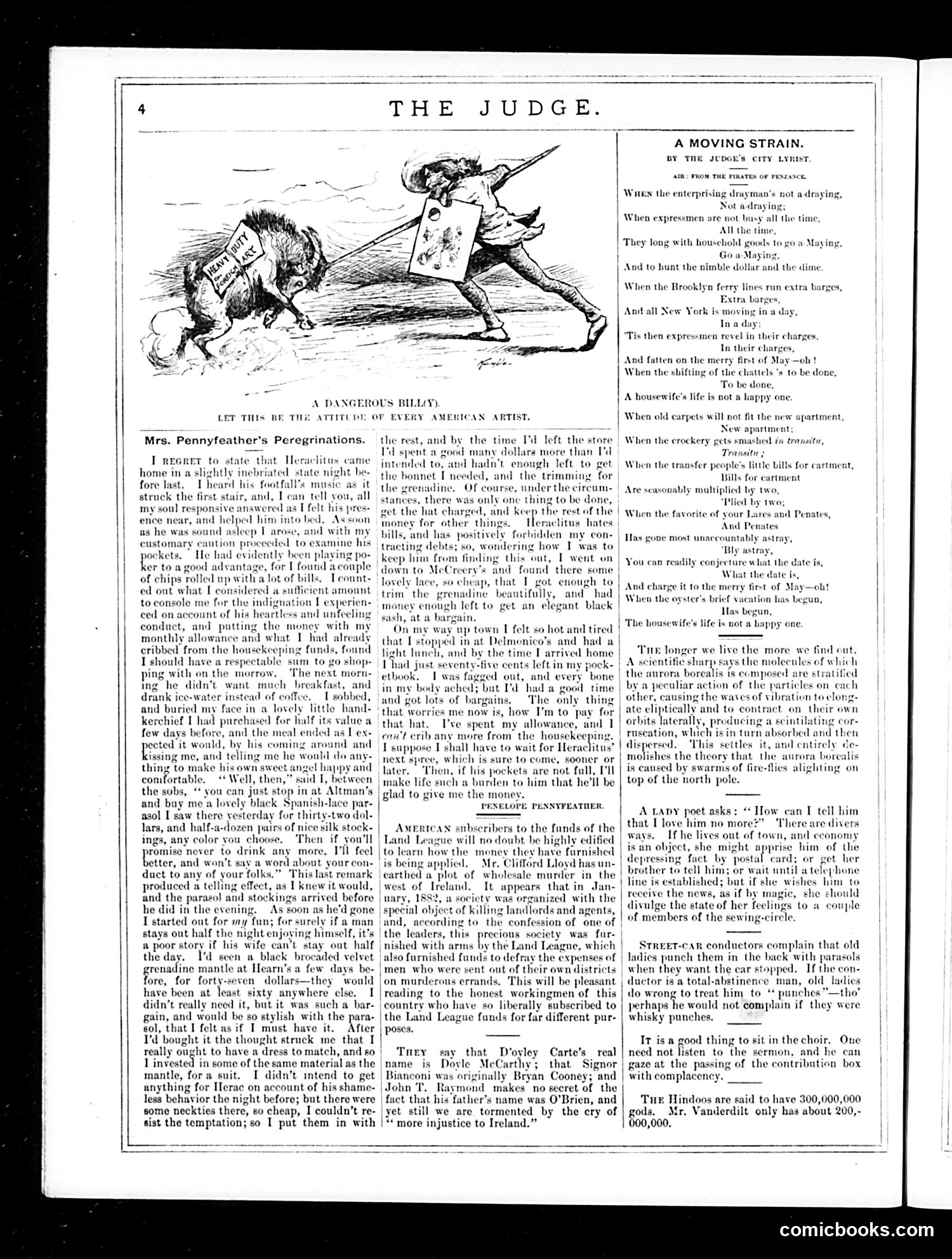
This is a satirical domestic narrative mocking wealthy wives' spending habits. The unnamed husband "Heraclitus" returns home drunk, and his wife discovers gambling winnings. Rather than express concern, she systematically pilfers his money for shopping. The satire targets the contradiction between Victorian wifely obedience and actual financial manipulation: she lectures him about drinking while stealing from housekeeping funds, then goes on an extravagant shopping spree (silk stockings, parasols, grenadine dresses, bonnets) that exceeds her allowance. She strategically charges items, manipulates her husband's guilt, and plans future financial coercion through emotional abuse ("make life such a burden"). Judge ridicules both: the husband's weakness and the wife's calculated domesticity-as-cover for fiscal irresponsibility. The humor lies in exposing the gap between idealized Victorian marriage and actual household power dynamics—where wives weaponize emotional leverage to fund consumption. The cartoon above (showing a woman beating a man) reinforces the theme of female domestic dominance.
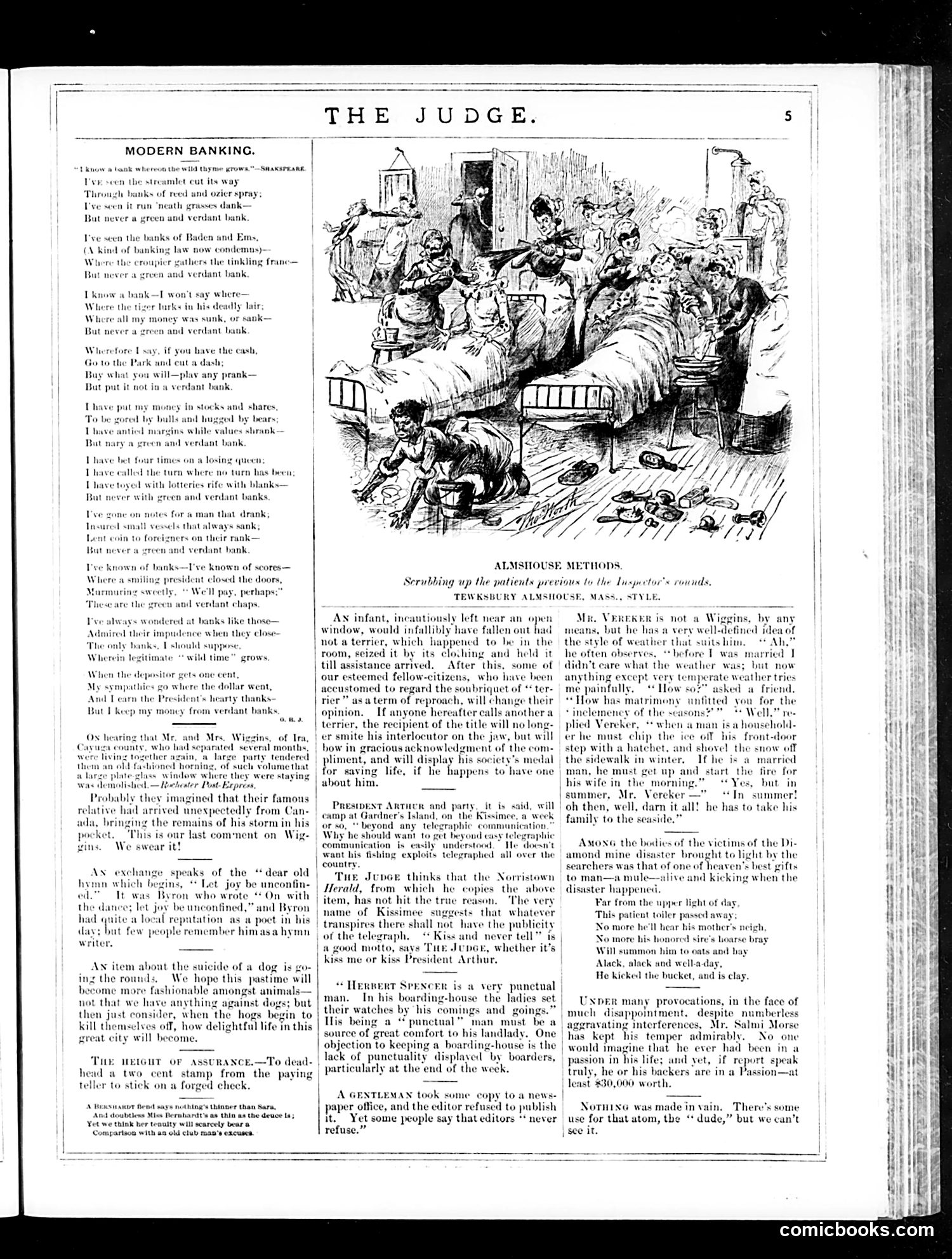
This page satirizes late 19th-century banking failures and financial instability. The long poem mockingly lists various types of banks the speaker has experienced—gambling establishments (Baden), banks where money mysteriously vanishes ("sunk, or sank"), and banks whose presidents abscond, "Murmuring sweetly, We'll pay, perhaps." The satire targets the era's widespread bank collapses and the public's lost confidence in financial institutions. The accompanying illustration depicts chaotic "Almshouse Methods" at Tewksbury Almshouse (Massachusetts), showing overcrowded, squalid conditions—likely satirizing how bank failures impoverished citizens and overwhelmed poorhouses. Side items mock contemporary figures: President Arthur's fishing trip (interpreted as dodging scrutiny), Herbert Spencer's punctuality, and a dog's heroism. The tone throughout is cynical about institutional reliability—whether banks or government.
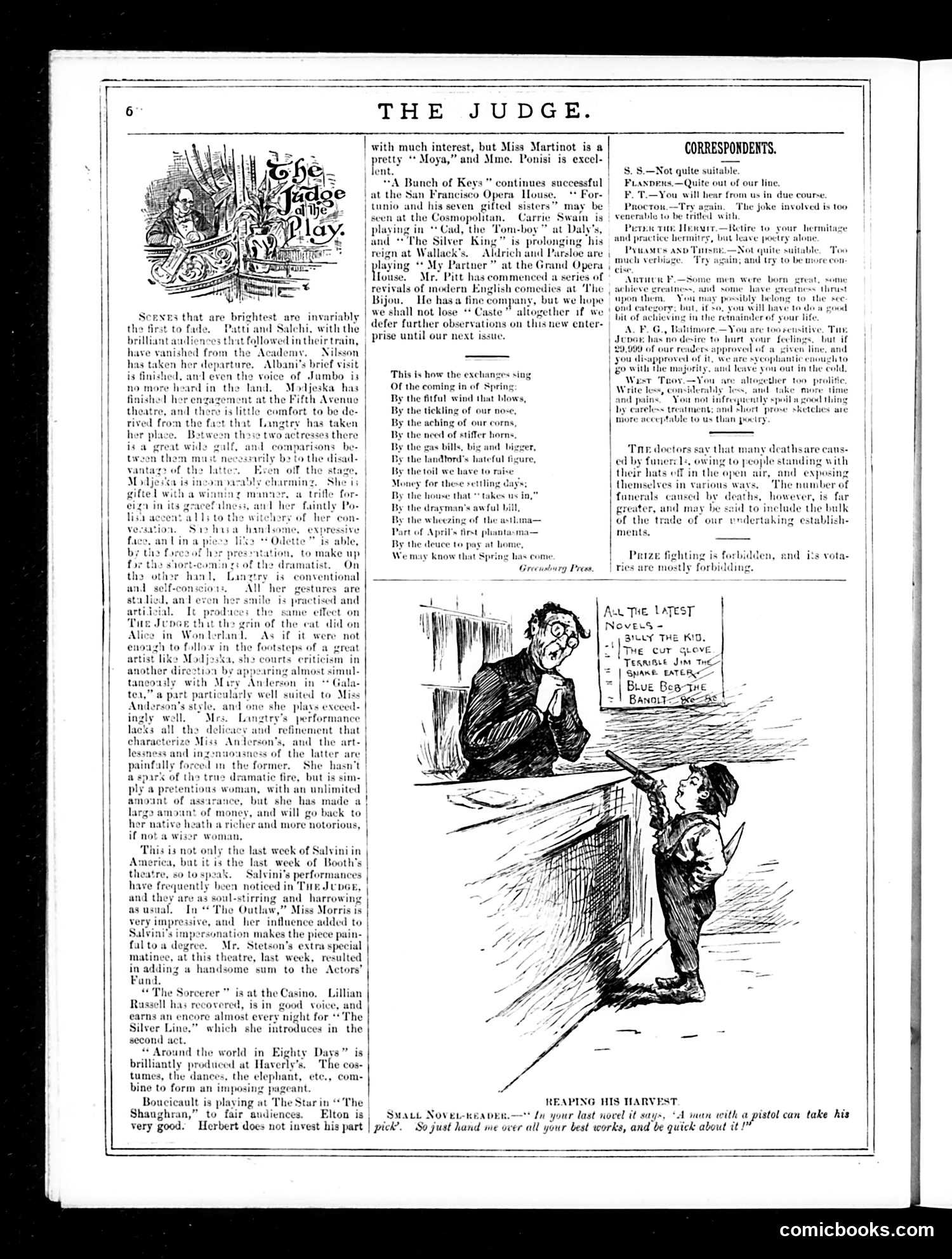
This page from *Judge* magazine contains theater reviews and two cartoons mocking popular culture. ## Main Content: Theater Reviews The bulk of the page reviews contemporary performers—Patti, Albani, Modjeska, Lillie Langtry, and Salvini—who were major theatrical stars of the era. The critic praises some (Modjeska's "incomparably gifted" acting) while dismissing others (Langtry as "pretentious," lacking "true dramatic fire"). ## Cartoons **"Reaping His Harvest"** (bottom): Depicts a publisher or editor confronting a struggling author, demanding rights to his works in exchange for publication. The joke satirizes exploitative publishing practices—the publisher essentially strong-arms the desperate writer. **Upper cartoon** (partially visible): Lists "latest novels" in mocking titles—"Silly the Kid," "Terrible Jem the Squawk Eater," "Blue Bead the Bandit"—likely satirizing sensationalist dime novels and pulp fiction popular with working-class readers, which literary elites considered lowbrow trash. The page reflects *Judge's* stance as a publication for educated, cultured readers who could appreciate theatrical sophistication while mocking both commercial exploitation and mass-market entertainment.
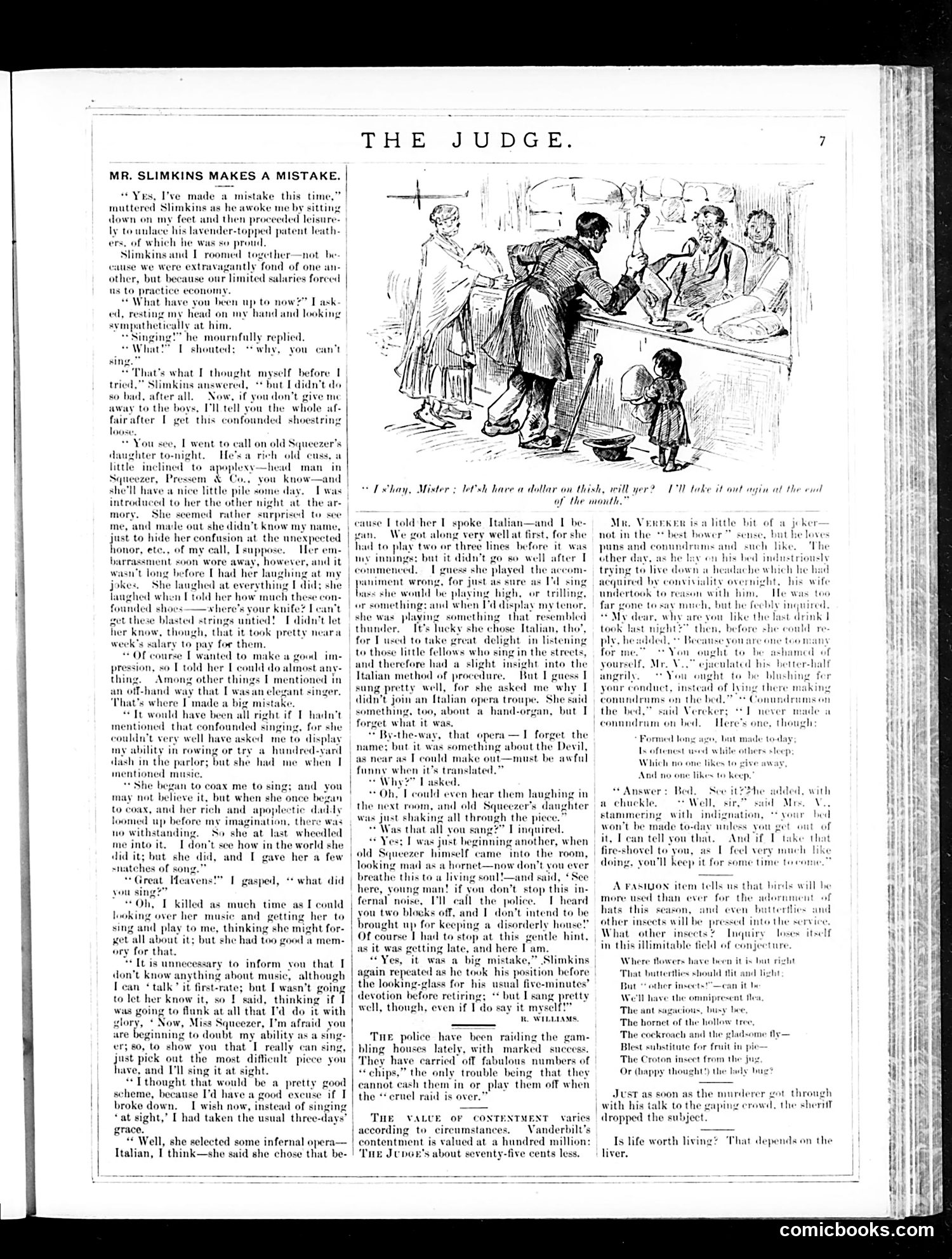
This page contains a humorous short story (not a political cartoon) from *Judge* magazine, likely from the late 19th century. The narrative follows Mr. Slimkins, a poor boarder who makes a social blunder while courting a wealthy woman. **The setup:** Slimkins and a roommate practice economy. Slimkins meets a rich heiress and, to impress her, claims musical talent he doesn't possess and pretends to speak Italian. **The mistake:** When asked to sing Italian opera at sight, he performs so badly that neighbors complain to police about the "infernal noise." Her father appears furious, threatening to call authorities over the "disorderly house." **The satire targets:** Social climbing through false pretenses, the desperation of poor men chasing wealthy women, and the embarrassment of exposed fraudulence. The humor lies in Slimkins's self-inflicted humiliation—his lies backfire spectacularly. This reflects Victorian-era anxieties about class mobility and masculine dignity.
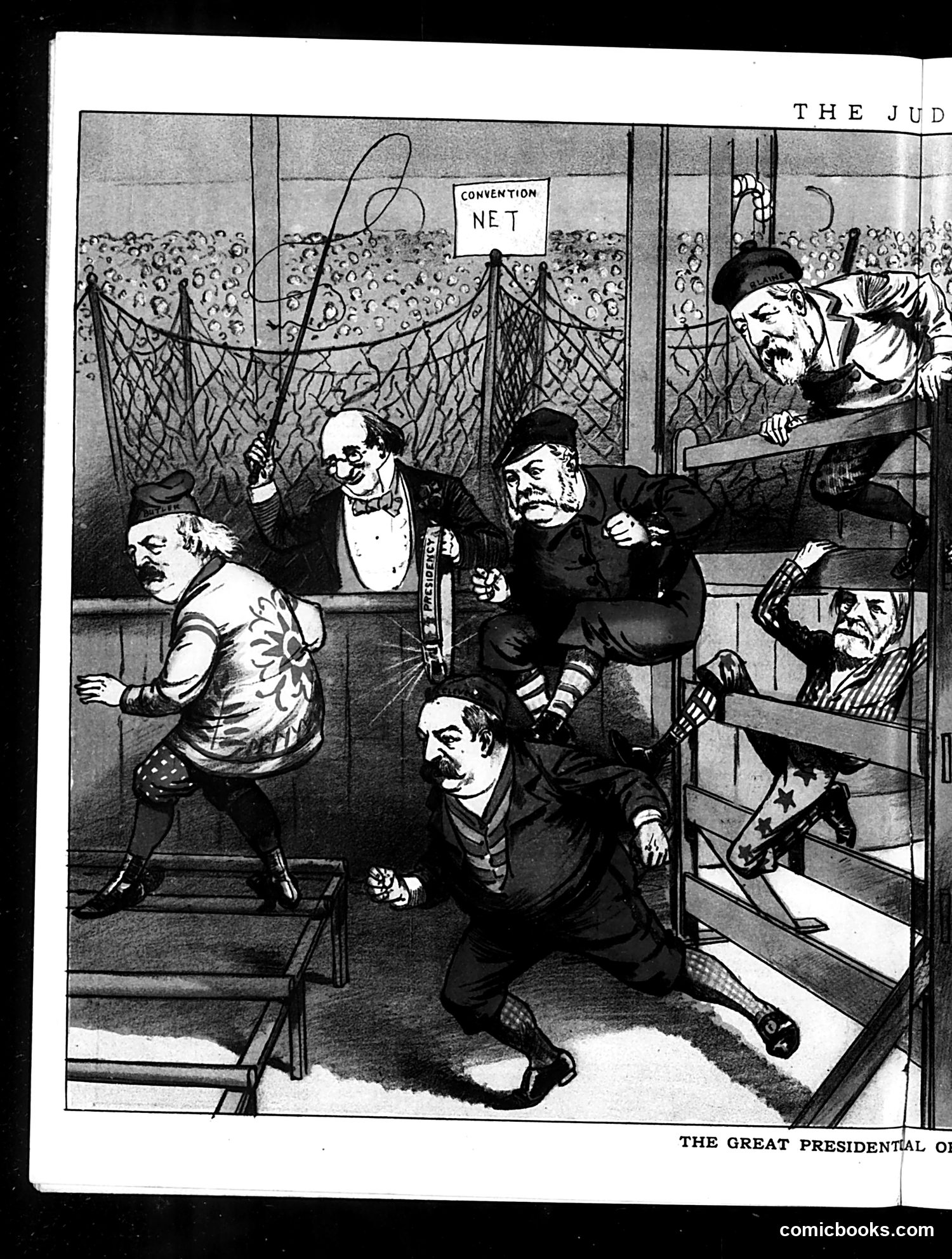
This appears to be a satirical cartoon from *Judge* magazine depicting "The Great Presidential" event (title cut off). The scene shows a convention or gathering with a large crowd visible in the background behind a "Convention Net." Several caricatured male figures—depicted with exaggerated facial features typical of late 19th/early 20th-century political caricature—are shown in dynamic poses around what appears to be a fishing net or trap. The imagery suggests they are "catching" or competing for something, likely referencing presidential ambitions or political maneuvering. Without the complete title or date, I cannot identify the specific figures or presidential race being satirized. The net metaphor suggests the cartoon critiques politicians as being "trapped" or competing through questionable means during a convention process.
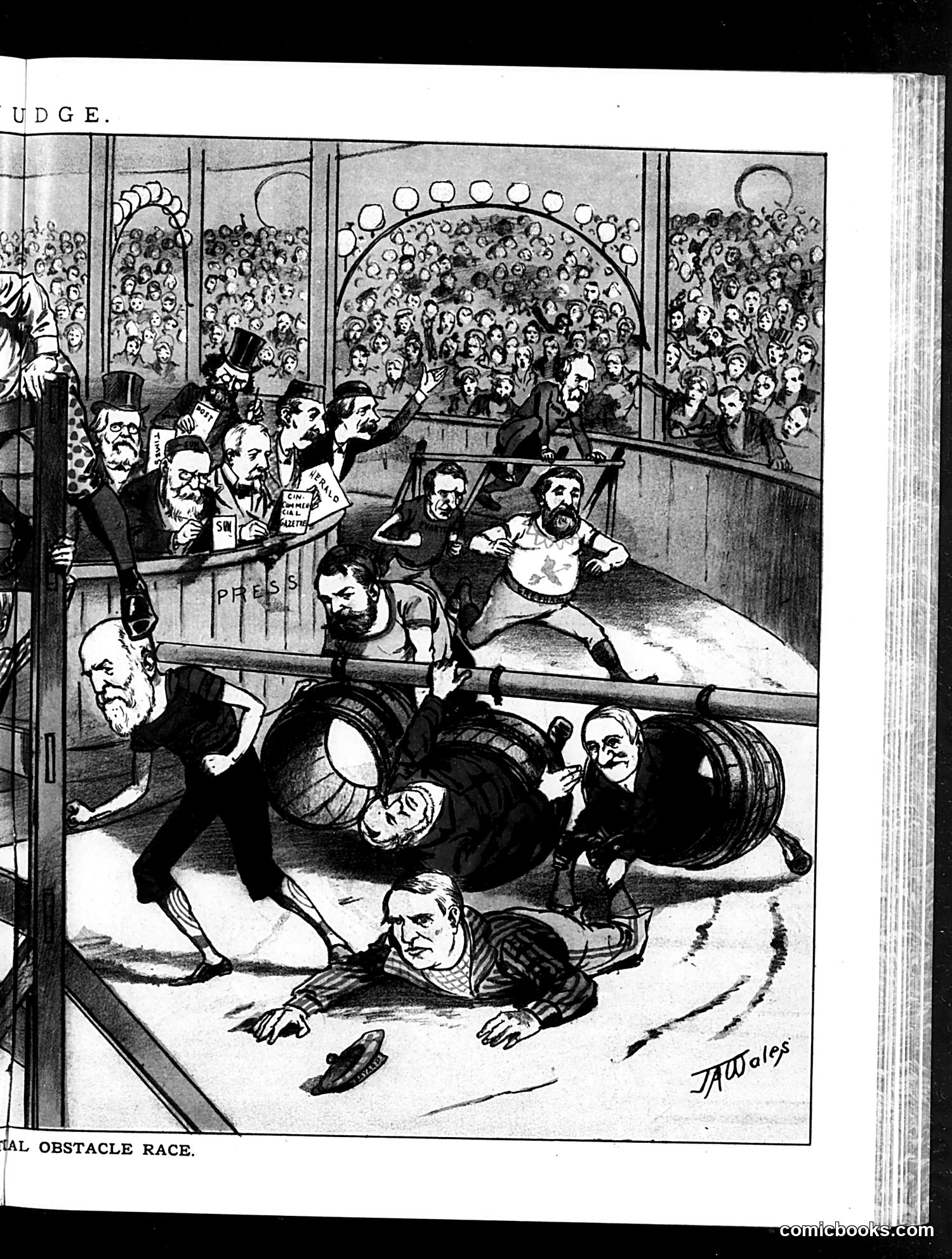
This Judge magazine cartoon satirizes political competition as a chaotic obstacle course. Exaggerated caricatures of politicians crawl, tumble, and struggle through barrels and barriers in an arena packed with spectators—representing the American voting public watching the political "spectacle." The title "Political Obstacle Race" suggests that winning political office requires navigating absurd, undignified challenges rather than demonstrating genuine competence or character. The cartoon mocks how politicians compromise their dignity and integrity to gain power, while the masses passively consume the performance. Without visible date or specific named figures, the satire's precise political targets remain unclear, but the work exemplifies Judge's cynical view of American democracy as entertainment rather than serious governance.
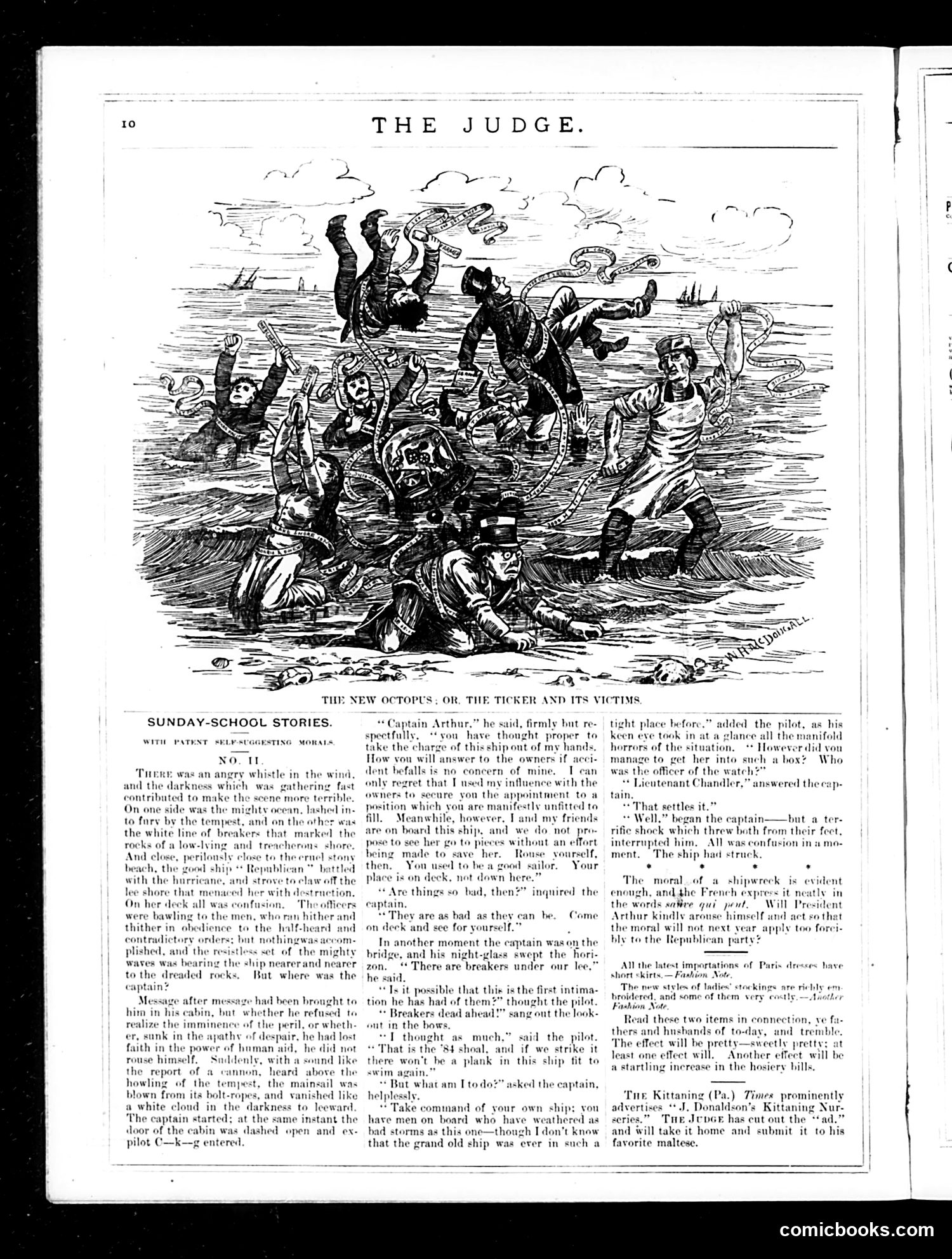
This page presents a "Sunday-School Story" satirizing President Chester Arthur's appointment practices. The large illustration depicts the ship *Republican* wrecking on rocks—a metaphor for the nation's peril under Arthur's leadership. **The Satire:** A subordinate officer confronts Captain Arthur, stating he used his influence to secure Arthur's appointment despite Arthur being "manifestly unfit" for command. When disaster strikes (the ship hits breakers), Arthur is found drunk in his cabin, oblivious to the crisis. The moral: Arthur received his presidency through political patronage rather than merit, and his incompetence endangers the nation. **Context:** This reflects 1880s criticism of the spoils system—where political appointments went to cronies rather than qualified candidates. Arthur, a former customs official appointed through patronage, faced accusations of unfitness for the presidency. The cartoon's title references the ship's name as symbolic: the Republican party itself is imperiled by poor leadership.
This page is primarily **advertising**—a collection of commercial notices and product advertisements typical of late 19th-century American magazines. The prominent ads include: - Government bonds and banking services - Weber and Behning pianos - Baker's chocolates - Babcock fire extinguishers - Various other consumer goods The page includes several brief **humorous snippets and anecdotes** in the Judge style, such as a story about a prisoner's lawyer defending someone who used self-defense, a poem about a poet who wants to chain a muse, and jokes about Irish characters and Boston society conventions. These joke items exemplify Judge's satirical voice—mocking pretension, social hypocrisy, and contemporary quirks. The actual satirical *cartoon* content is minimal or unclear in this reproduction. The page functions more as a revenue-generating vehicle for paid advertisements than as editorial satire.
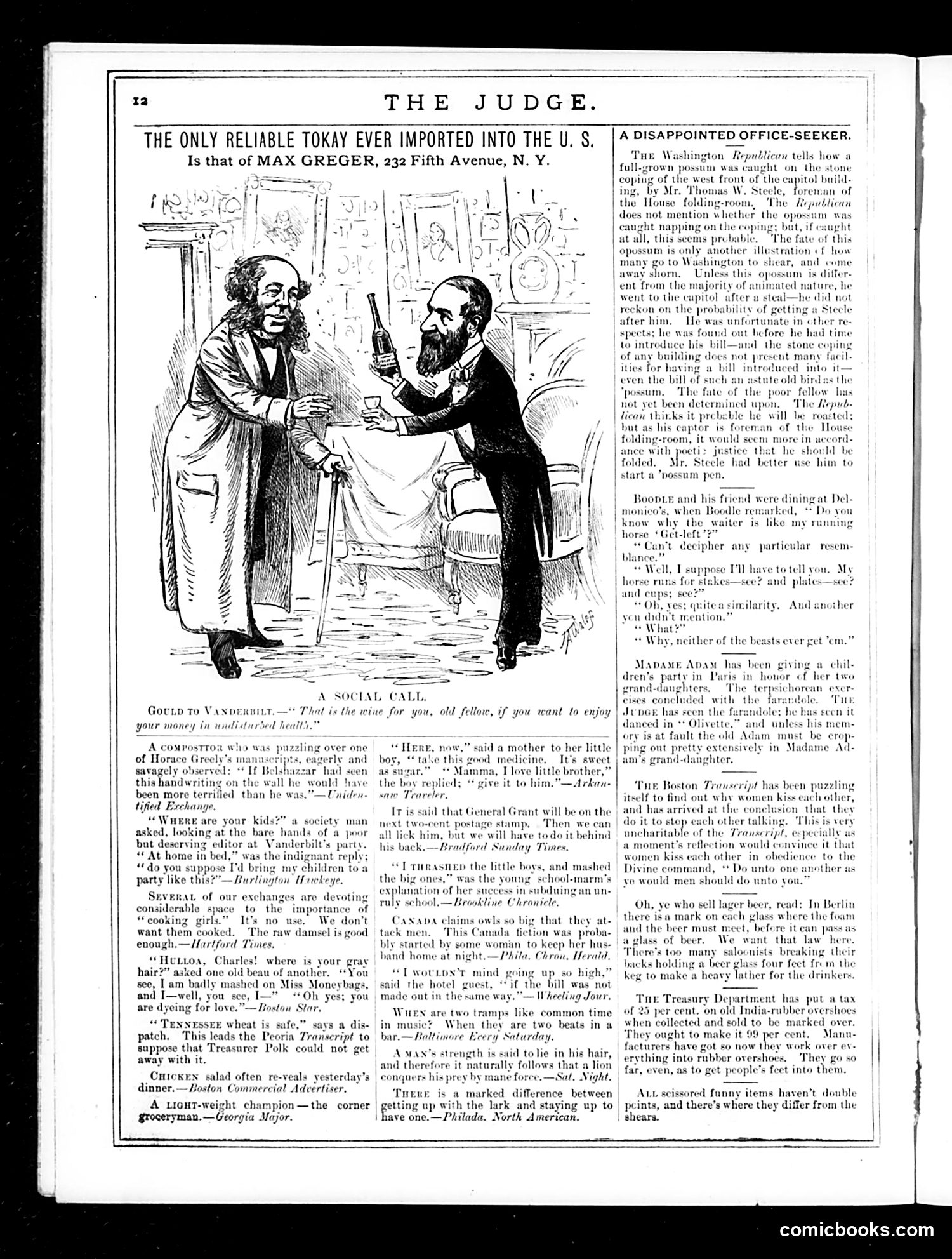
This page from *Judge* magazine (a leading American satirical publication) contains multiple short humor items typical of the era. **Main Cartoon:** "Gold to Vanderbilt" depicts two men in conversation about wine—one appears to be a merchant or seller (Max Greger, referenced in the advertisement header) discussing Tokay wine with a well-dressed gentleman, likely representing wealth/high society. **Satirical Content:** The scattered anecdotes mock various social types: society men, office-seekers (the "Disappointed Office-Seeker" section), domestic life, and government inefficiency. One item references General Grant, suggesting Civil War-era or Reconstruction-period dating. **Key Joke:** An office-seeker hopes to meet General Grant at the Capitol but instead finds a possum and gets caught. The satire targets the frustrations of political patronage and the absurdity of Washington bureaucracy. **Overall Tone:** The page satirizes American social pretensions, political corruption, and domestic absurdities through brief, caustic witticisms—typical of *Judge's* format as a humor magazine for educated readers.
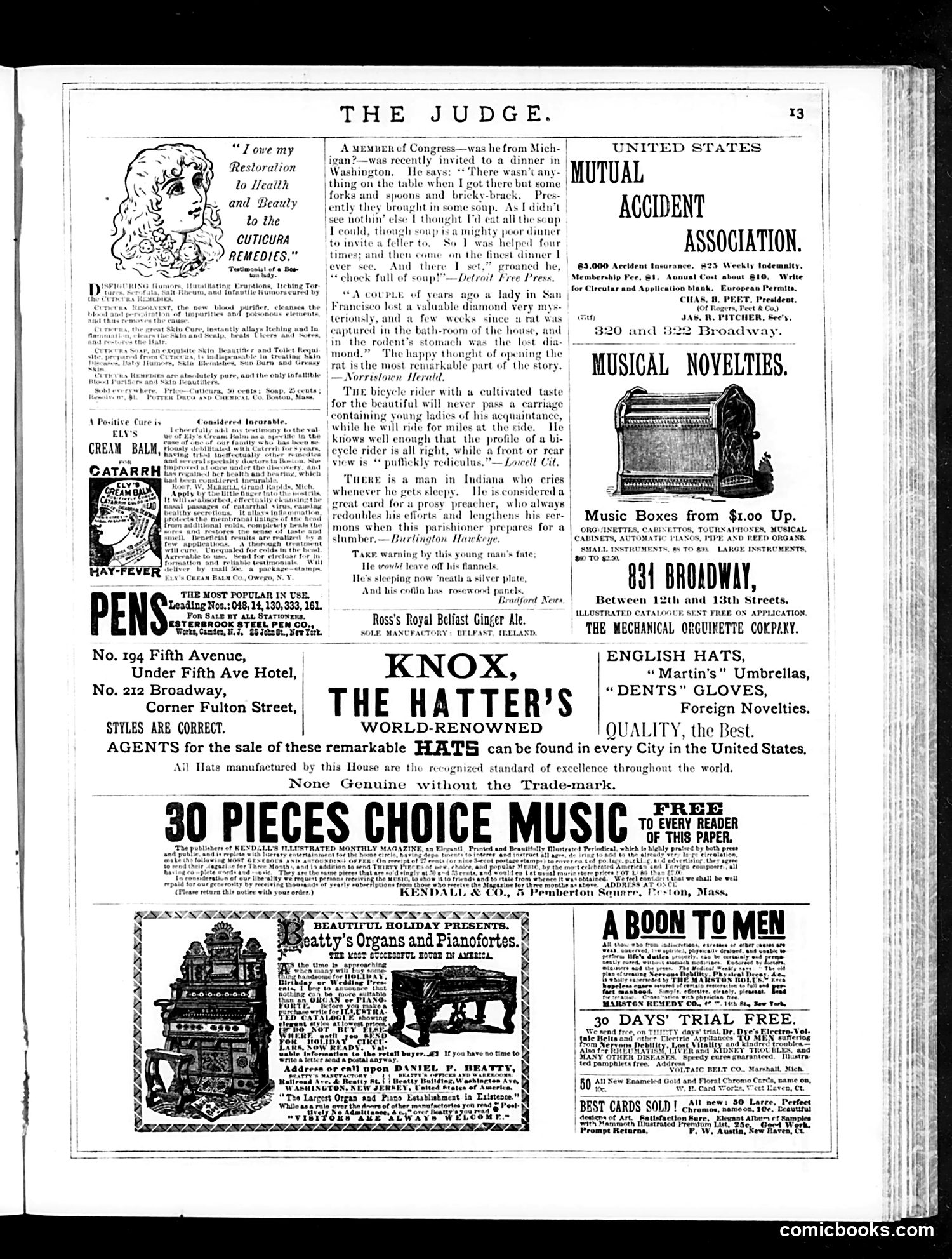
This is primarily an **advertising page** with minimal editorial content. The small cartoons/anecdotes in the upper left are brief humor pieces typical of Judge magazine's satirical style: 1. **Congressional Dinner Joke**: A Michigan congressman complains that a Washington dinner served only soup—a subtle jab at either the meagerness of the meal or perhaps a congressman's lack of sophistication in recognizing proper dining etiquette. 2. **Lost Diamond Story**: A humorous tale about a lady whose valuable diamond, mysteriously lost, is later found in a rat's stomach in her bathroom—basic absurdist humor playing on the unexpected and ridiculous. 3. **Indiana Man Who Cries**: A brief mention of a man who weeps when sleeping, apparently making his sermons more effective—light social satire. These are filler jokes with no clear political dimension. The page is dominated by **product advertisements** for hats (Knox), music boxes, organs, remedies (Cuticura, Ely's Cream Balm), and the Mutual Accident Association. This was standard Judge content: satirical humor mixed with commercial advertising.
This page features "A Starting Domestic Revolution," a satirical piece about household management reform. The main cartoon illustrates the "Most Wonderful Discoveries of Modern Times" — various domestic labor-saving devices and practices meant to ease housework. The four sections below show a pointing hand icon (a common period feature for emphasis) introducing topics like: - Judge Turgee's comment (unclear which figure) - "Emmy's Progress" — appearing to mock or celebrate new household inventions - "It Wickedly Witness" — referencing domestic service issues - "The Servant Suffrage" — likely satirizing women's labor or suffrage movements The satire targets turn-of-century debates about modernizing domestic work and women's roles, probably mocking both progressive reforms and resistance to them. Without clearer image resolution, specific figure identification remains uncertain.
This page is heavily obscured and contains severely corrupted OCR text that is largely illegible. While the header identifies this as from **Judge**, a prominent American satirical magazine, the actual content cannot be reliably deciphered from the provided text. Visually, the page appears to contain **multiple cartoon panels and satirical illustrations** typical of Judge's format, along with accompanying text. There are references to what appear to be **political or social commentary**, but specific figures, dates, events, and the particular satirical points cannot be accurately identified from this corrupted reproduction. To properly analyze the cartoons' meaning, context, and targets, a clearer image or legible text would be necessary. Without readable source material, any interpretation would be speculation rather than evidence-based analysis.
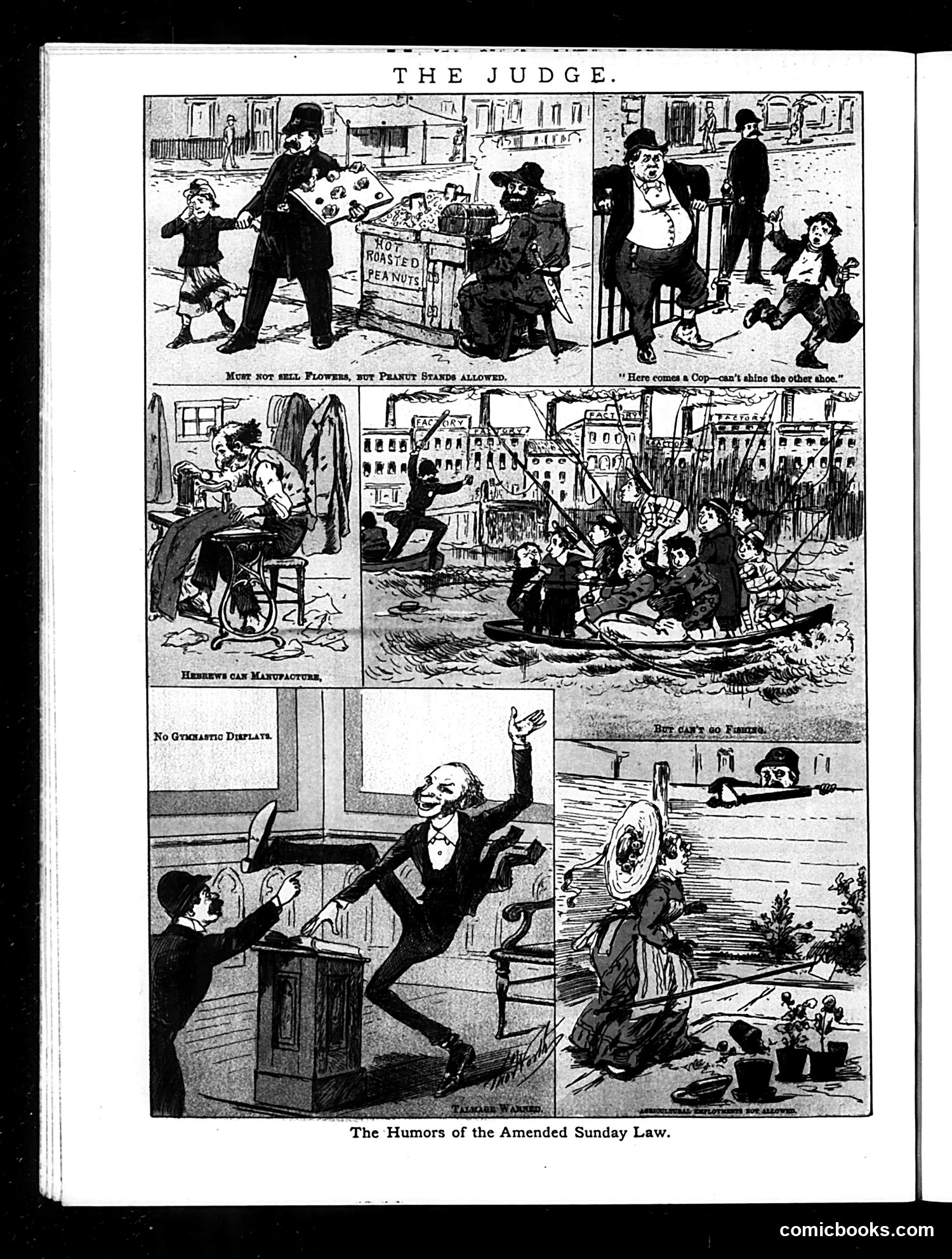
This satirical comic strip mocks enforcement of Sunday closing laws (prohibitions on commercial activity on Sundays). The panels depict absurd consequences: 1. **Street vendors** are prevented from selling roasted peanuts and flowers 2. **A policeman** enforces these restrictions while children play 3. **Indoor manufacturing** continues unchecked despite Sunday restrictions 4. **Boating and fishing** are allowed, creating inconsistent enforcement 5. **A judge** is depicted as the enforcer, shown in exaggerated physical comedy The cartoon's point: the "amended" Sunday law is ridiculously inconsistent—banning harmless street commerce while permitting recreational activities. It satirizes selective or illogical law enforcement and suggests the regulations are absurd when applied practically. The title indicates this addresses actual legislative changes to Sunday closing laws in the period.