
A complete issue · 16 pages · 1883
Judge — March 24, 1883
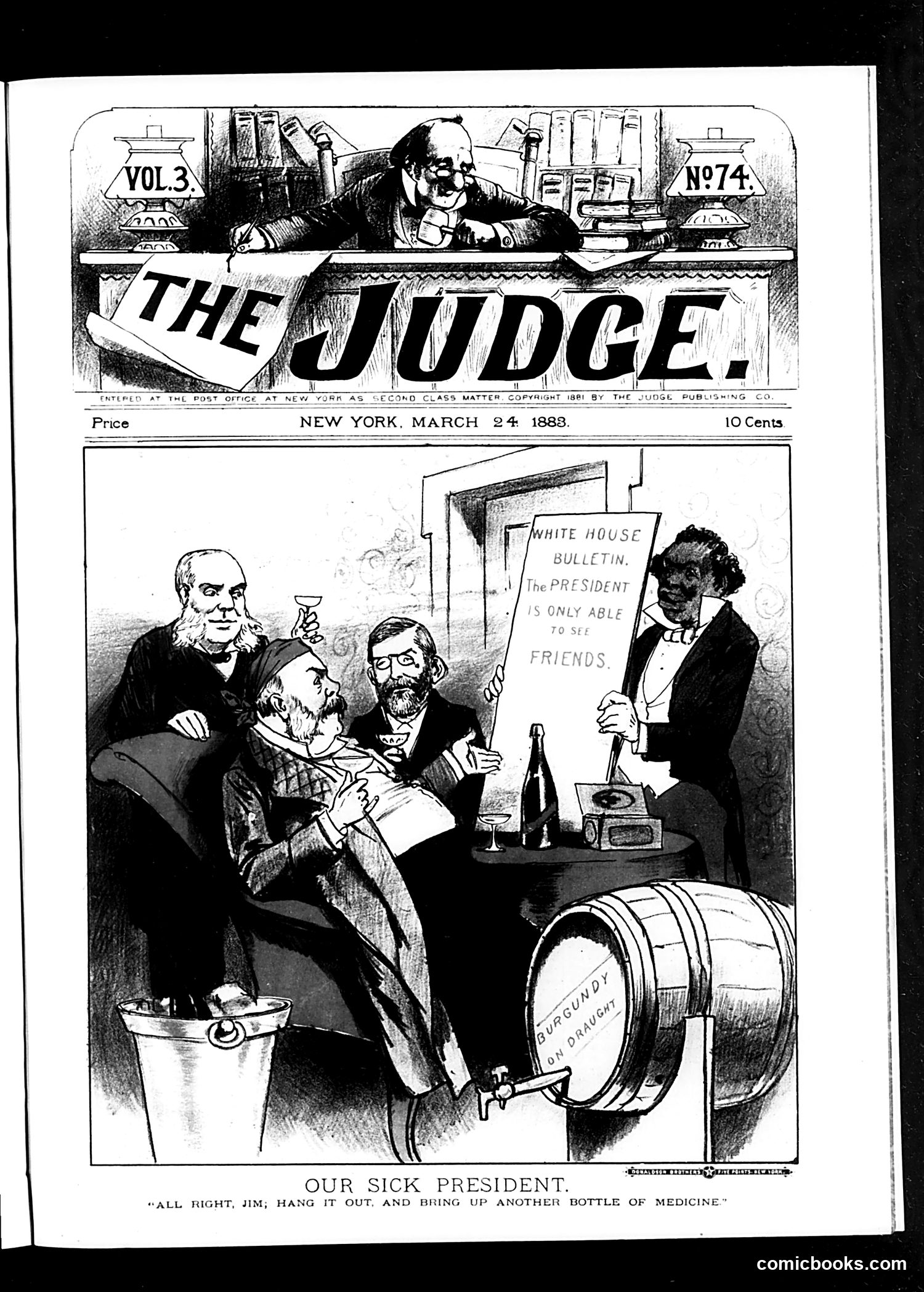
This political cartoon satirizes President Chester Arthur's illness. The caption "All right, Jim, hang it out, and bring up another bottle of medicine" suggests Arthur's advisors are treating his ailment with alcohol rather than legitimate medical care. The men gathered around appear to be political cronies or appointees. The "White House Bulletin" posted on the wall states "the President is only able to see friends"—likely mocking how his illness was being used to limit access or control his schedule. The barrel labeled "Burgundy" and bottles on the table reinforce the joke that excessive drinking, presented as "medicine," is the prescribed treatment. This reflects contemporary skepticism about both Arthur's health and his inner circle's influence during his presidency.
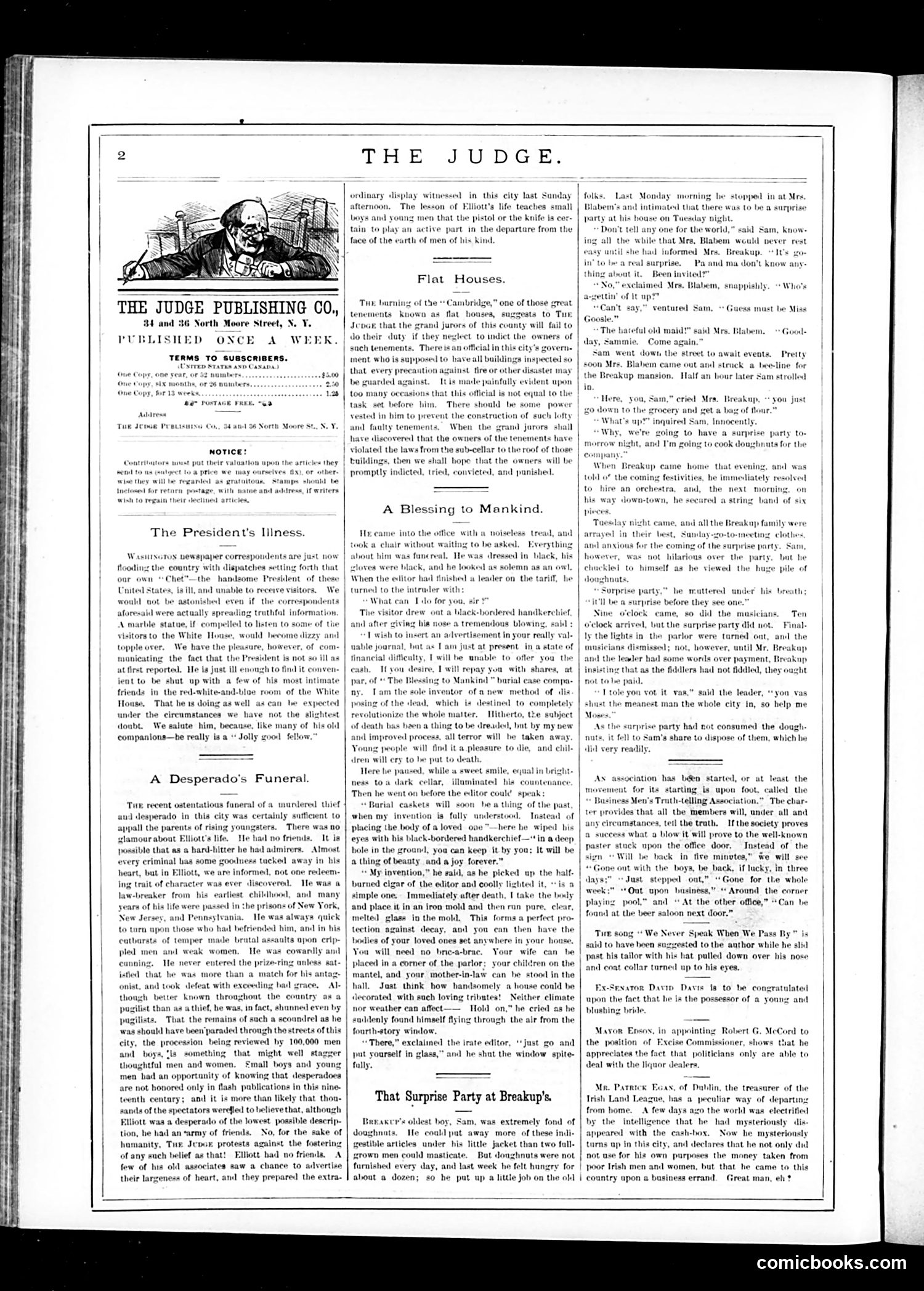
This page from *Judge* magazine contains three satirical pieces about contemporary (late 19th-century) issues: **"The President's Illness"**: A lighthearted defense of the sitting president against harsh press coverage during his illness, sarcastically noting he's a "jolly good fellow" despite critics' demands for constant updates. **"A Desperado's Funeral"**: Sharp social criticism of the lavish funeral given to a criminal named Elliott (likely a notorious NYC criminal). The satire argues that glorifying such a criminal's death—with crowds and ceremony—sends dangerous messages to young people about crime and violence. The piece advocates for law enforcement to actually prosecute tenement owners and improve housing conditions rather than celebrating criminal deaths. **"Flat Houses"**: Commentary on dangerous urban housing ("flat houses"/tenements), calling for officials and grand juries to enforce building codes and hold negligent landlords accountable for fire hazards and poor conditions. The overall thrust: *Judge* criticizes both sensationalist press coverage and social negligence regarding public safety and housing standards.
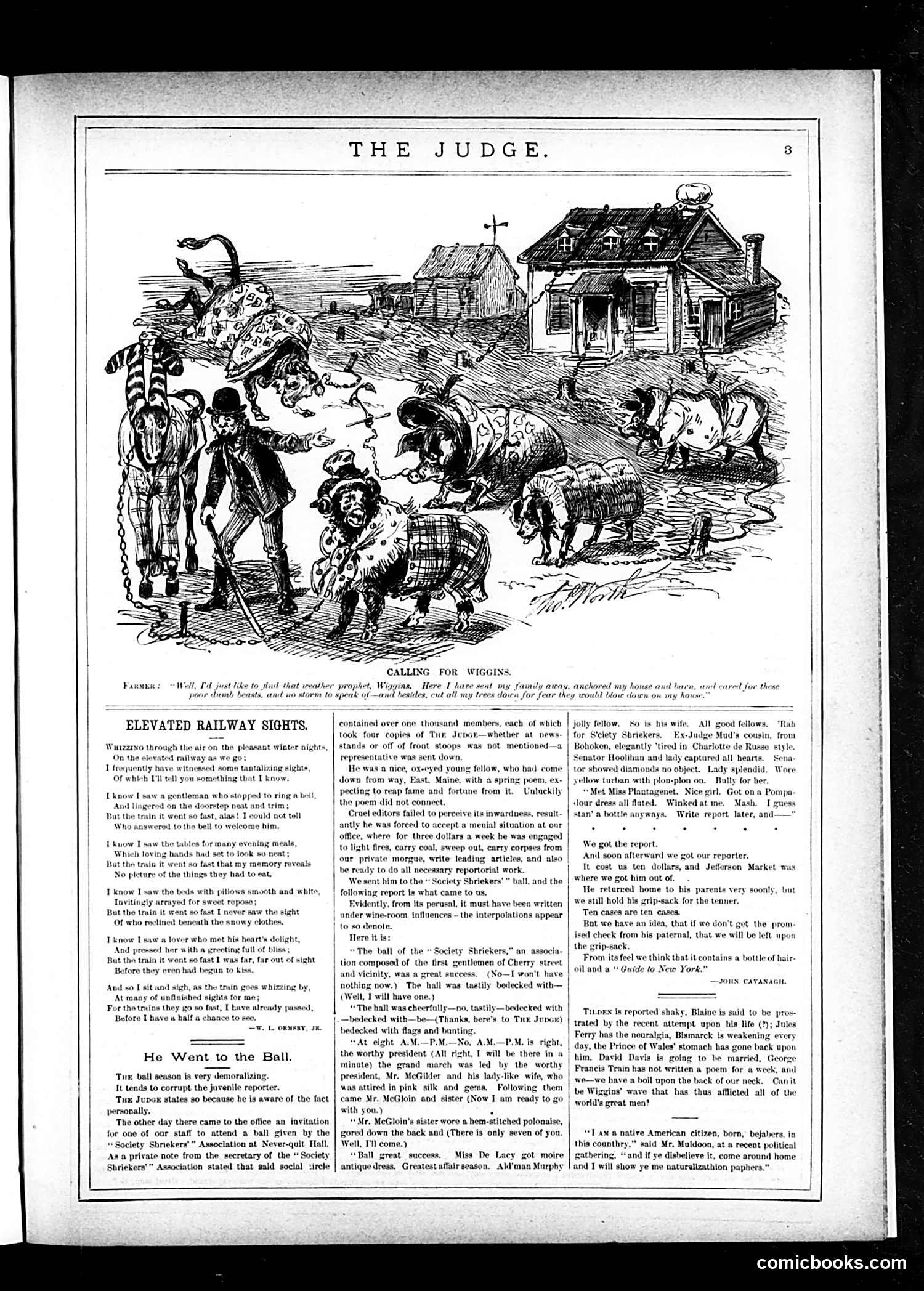
This page contains two satirical pieces from the late 19th century: **"Elevated Railway Sights"** mocks the then-new elevated trains in New York City. The poet humorously complains that while riding the "el," he glimpses domestic scenes—families dining, lovers embracing, beds with sleeping figures—but the train moves so fast he never sees complete moments. It's gentle satire on the intrusive nature of this new technology invading people's privacy. **"He Went to the Ball"** ridicules a naive young reporter from Maine sent to cover a "Society Shriekers" Association ball. The increasingly incoherent article—with drunken interpolations in brackets—reveals the reporter getting intoxicated while supposedly working. The satire targets both the pretensions of society balls and the incompetence/corruption of newspaper reporters, a common Judge theme. Names like "McGloin" and "Alderman Murphy" appear to be fictional stand-ins for society figures.
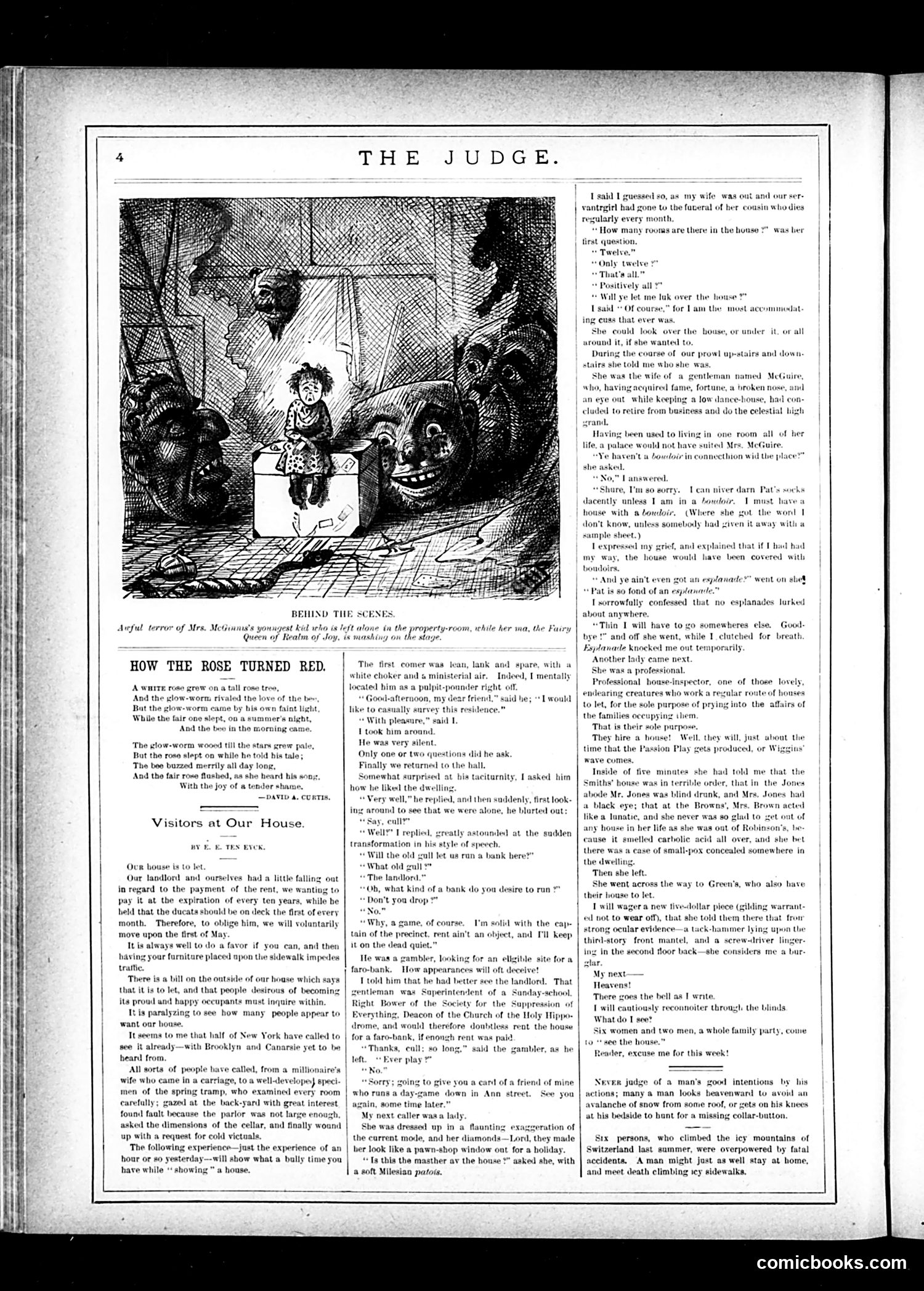
This page contains three pieces of light satirical humor typical of Judge magazine's approach to everyday American life: **"How the Rose Turned Red"** is a whimsical poem illustrated with a nature fable—a glow-worm courts a white rose, and the rose blushes red from his attention. It's gentle romantic humor with no political intent. **"Visitors at Our House"** is the main satirical piece. The author describes showing a rented house to prospective tenants, encountering increasingly absurd characters: a stern minister, a gambling banker seeking a faro bank location, and an Irish immigrant woman obsessed with having a proper *boudoir*. The satire mocks social pretension (the woman's malapropisms and class aspirations) and immigrant stereotypes common to the era. The humor relies on caricature and dialect comedy popular in 1880s-90s publications. **"Behind the Scenes"** references theatrical life, likely satirizing backstage chaos or family disruptions related to performance. The content reflects period attitudes toward immigrants and class differences without addressing specific political events.
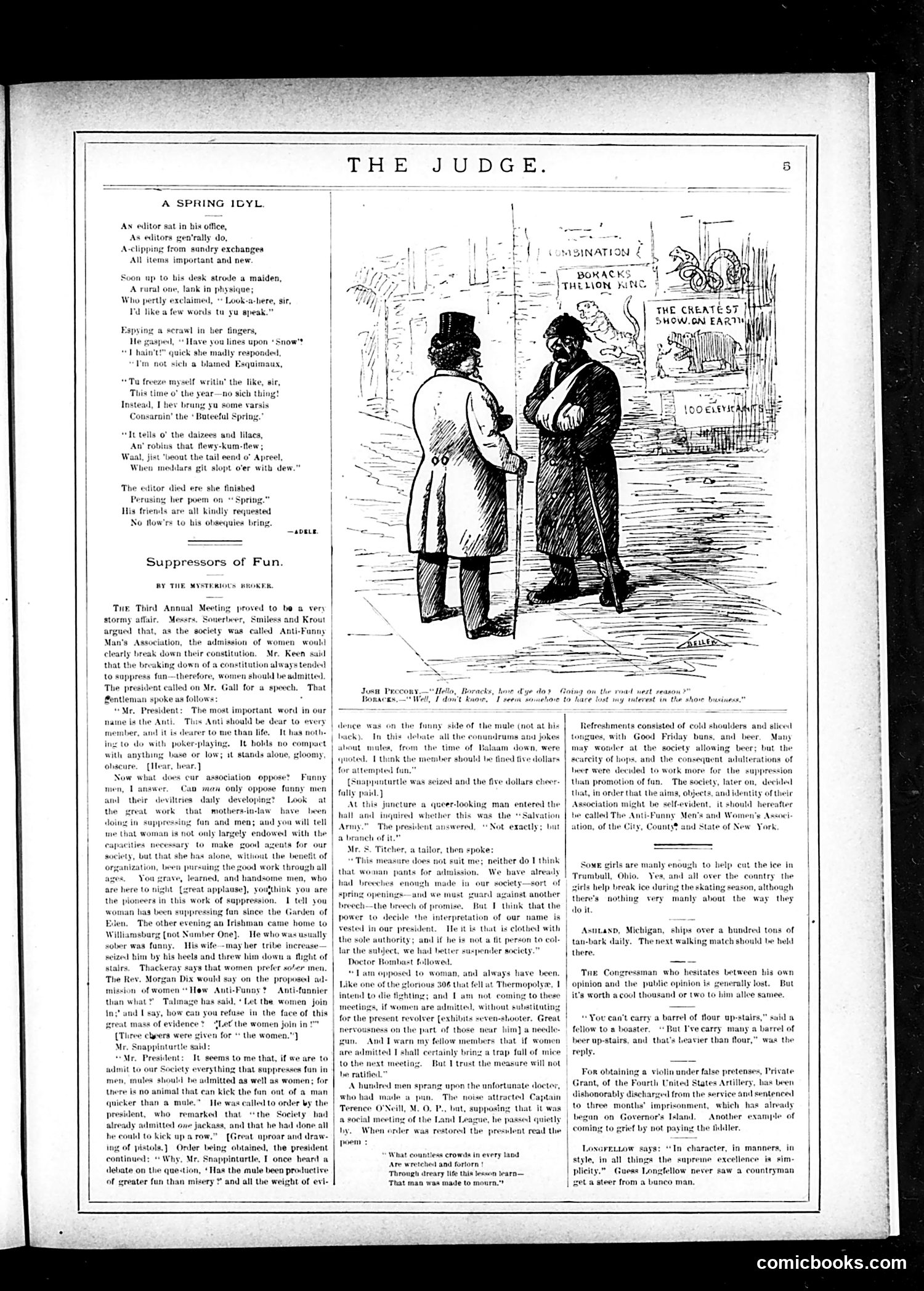
This page satirizes an anti-fun society debating whether to admit women members. The cartoon depicts the society's absurd premise: that women are *already* the primary suppressors of enjoyment (mothers-in-law, wives who dislike drunk husbands), so admitting them would formalize their role. The speakers argue comically that women have "suppressed fun since the Garden of Eden" and cite examples like wives throwing drunken husbands downstairs. One member (Snappmturtle) opposes admission, fined five dollars for his "attempted fun." The "Spring Idyl" poem above mocks sentimental rural poetry—a country girl submits clumsy verses about spring flowers to an editor, who finds it unbearably bad. Together, these pieces mock Victorian prudishness and anti-pleasure crusades while satirizing both sentimental literature and the comic premise that organized fun-suppression is somehow a legitimate social institution.
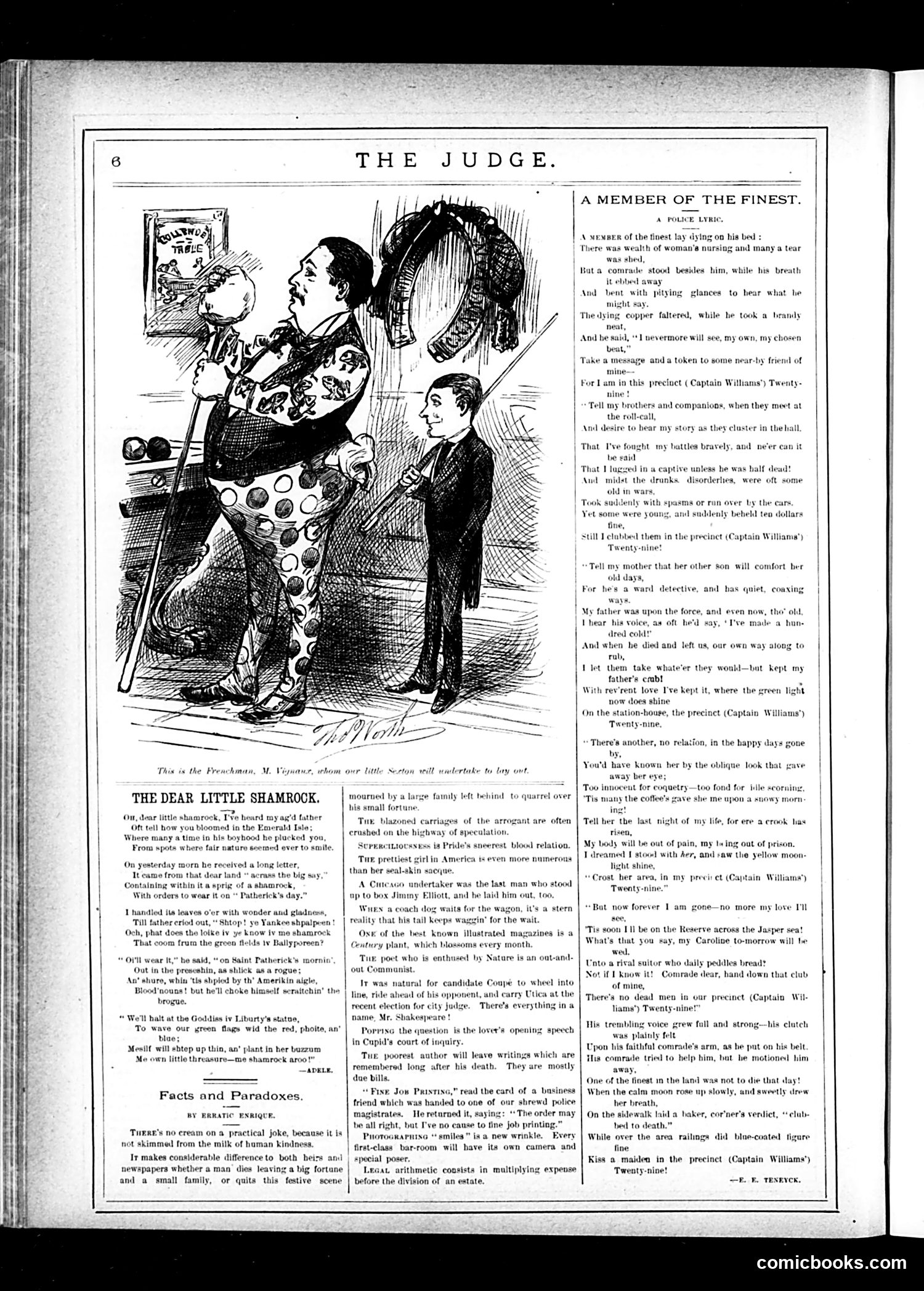
**Main Cartoon ("A Member of the Finest")**: A dying Irish-American police officer delivers a deathbed speech to a younger officer. The satire mocks sentimental "heroic cop" narratives—the dying man boasts of fighting criminals in "Captain Williams' Twenty-nine" precinct, yet admits most were drunk, disorderly, or young. The exaggerated Irish dialect and melodramatic tone suggest Judge is ridiculing both police self-aggrandizement and Irish-immigrant culture simultaneously. **Second Piece ("The Dear Little Shamrock")**: An Irish immigrant receives a shamrock from home on St. Patrick's Day. The heavy brogue dialect and immigrant perspective parody Irish-American sentimentality while poking fun at their outsider status ("Yankee shpalpeen"). **"Facts and Paradoxes"**: Brief satirical quips about practical jokes, inheritance disputes, undertakers, and urban life—typical Judge filler content mocking contemporary society. The page reveals late-19th/early-20th-century American attitudes toward Irish immigrants: simultaneously contemptuous of their dialect and culture, yet fascinated by their stories.
This page contains satirical commentary on Solon, the ancient Athenian lawgiver, presented as a cautionary historical figure. The left column contains humorous poems about various men, while the right side discusses Solon's legislative approach. **The Satire's Point:** The piece mocks overly rigid or elaborate legal systems by comparing them to Solon's ancient laws—suggesting they become impractical and comical. Specific examples cited include absurd regulations about widows' behavior, restrictions on young men, and a law requiring dogs that bit people to wear signs around their necks. **Political/Social Context:** This likely satirizes contemporary American legislation the 1880s-90s, critiquing lawmakers who create unnecessarily complex or moralistic laws. The humor derives from likening modern legislators to an ancient figure whose well-intentioned but impractical rules ultimately failed. **The Joke:** Solon tried so hard to regulate society through law that his rules became ridiculous—much like contemporary politicians, the piece suggests. The poems on the left appear to be unrelated lighter fare, typical of Judge's mixed content.
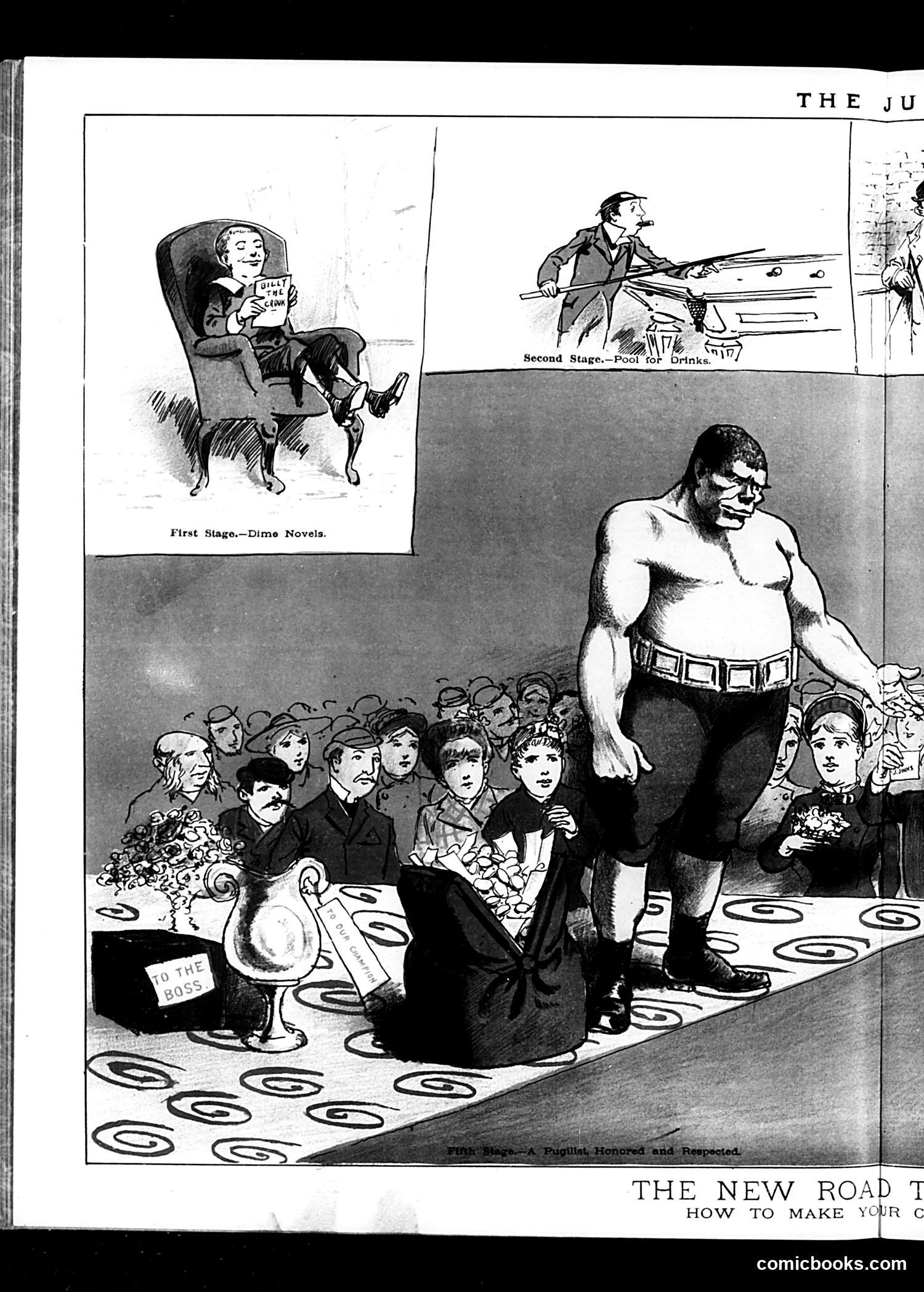
This three-panel satirical sequence depicts social climbing through entertainment. The **First Stage** shows a person enjoying cheap "Dime Novels" (popular pulp fiction). The **Second Stage** depicts someone at a billiard/pool hall, suggesting descent into vice. The **Third Stage** shows a muscular prize-fighter or boxer performing before an audience of well-dressed spectators labeled "TO THE BOSS," implying corrupt patronage. The satire critiques how working-class entertainment (dime novels, gambling, boxing) were seen as stepping stones to success—but only through questionable means tied to powerful patrons. The title "How to Make Your O[wn]..." appears cut off, but the sequence mocks the notion that there's a legitimate "new road" to prosperity for the poor beyond servitude to the wealthy.
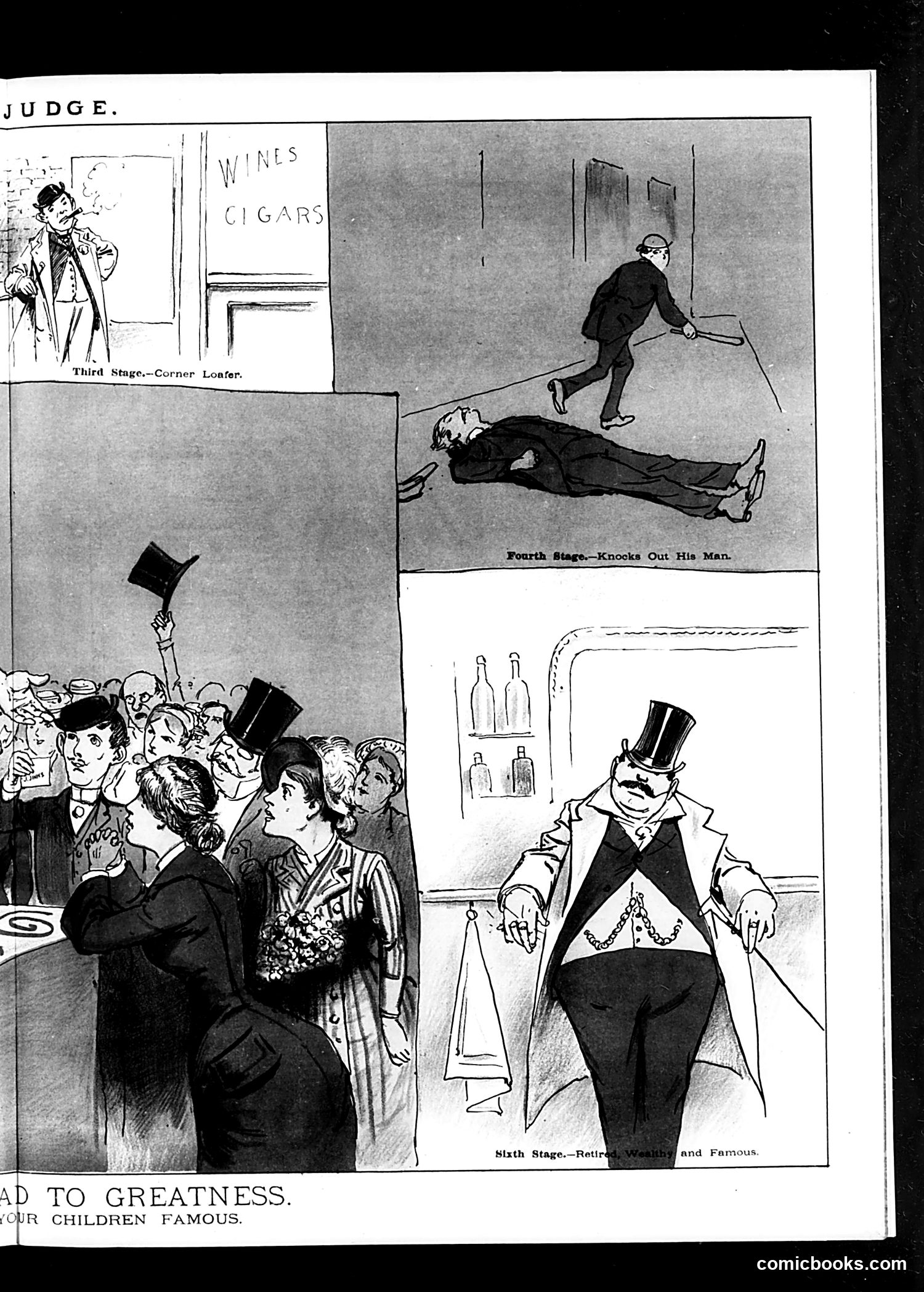
This multi-panel satirical cartoon traces the stages of becoming a successful public figure, likely a businessman or entrepreneur. The narrative progresses from: 1. **Third Stage—Corner Loafer**: A shabby man loitering outside a shop selling wines and cigars 2. **Fourth Stage—Knocks Out His Man**: A brawling figure defeating an opponent 3. **Sixth Stage—Retire, Wealthy and Famous**: A portly, well-dressed gentleman in top hat, relaxed in a luxurious setting with bottles visible (suggesting alcohol/wealth) The satire mocks the path to American success, suggesting it involves loitering, violence, and ultimately conspicuous consumption of luxury goods. The bottom text promises "Road to Greatness" and "Your Children Famous," likely ironically commenting on the questionable morality of this success narrative. The cartoon critiques how American wealth and status are achieved through dubious means.
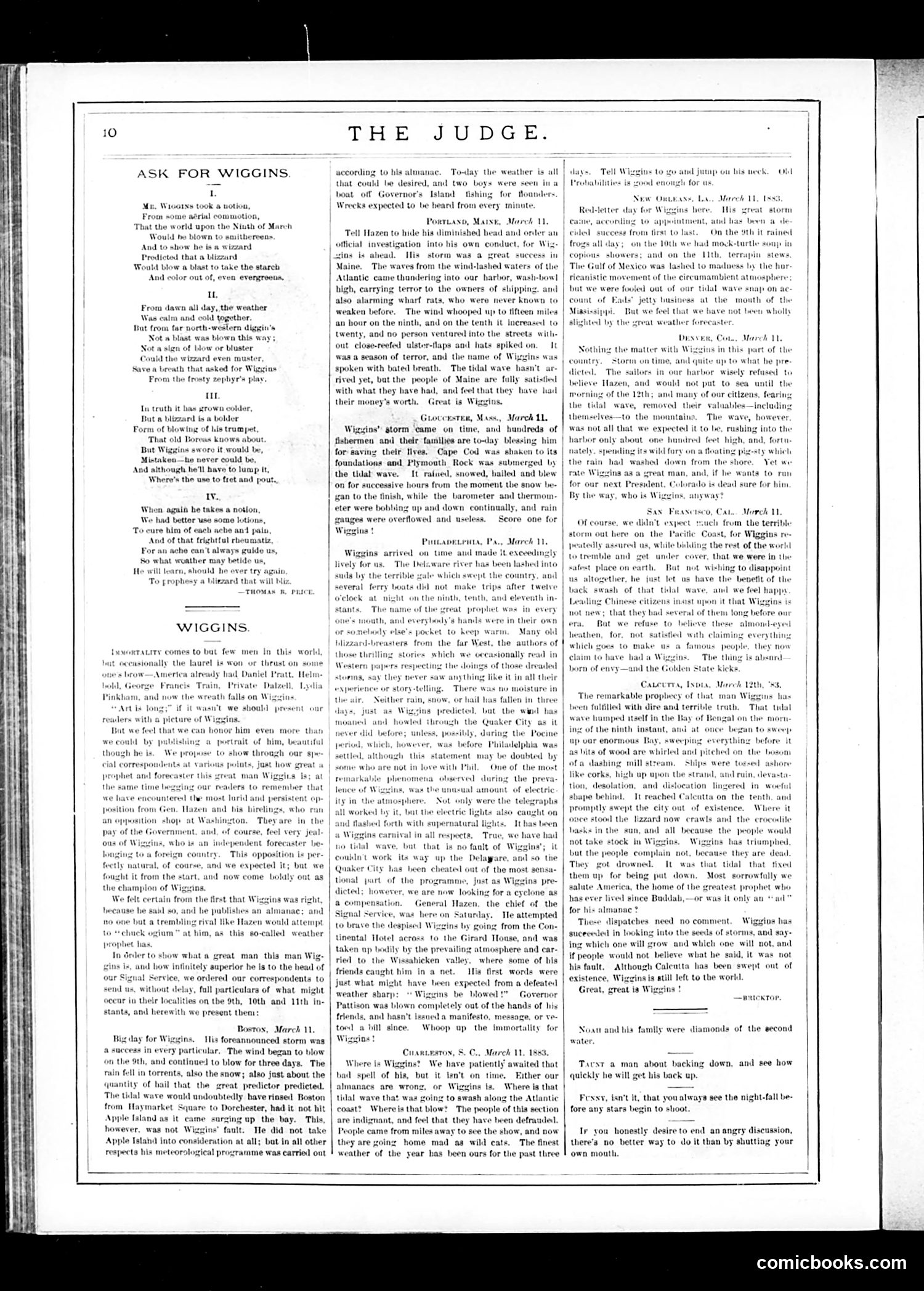
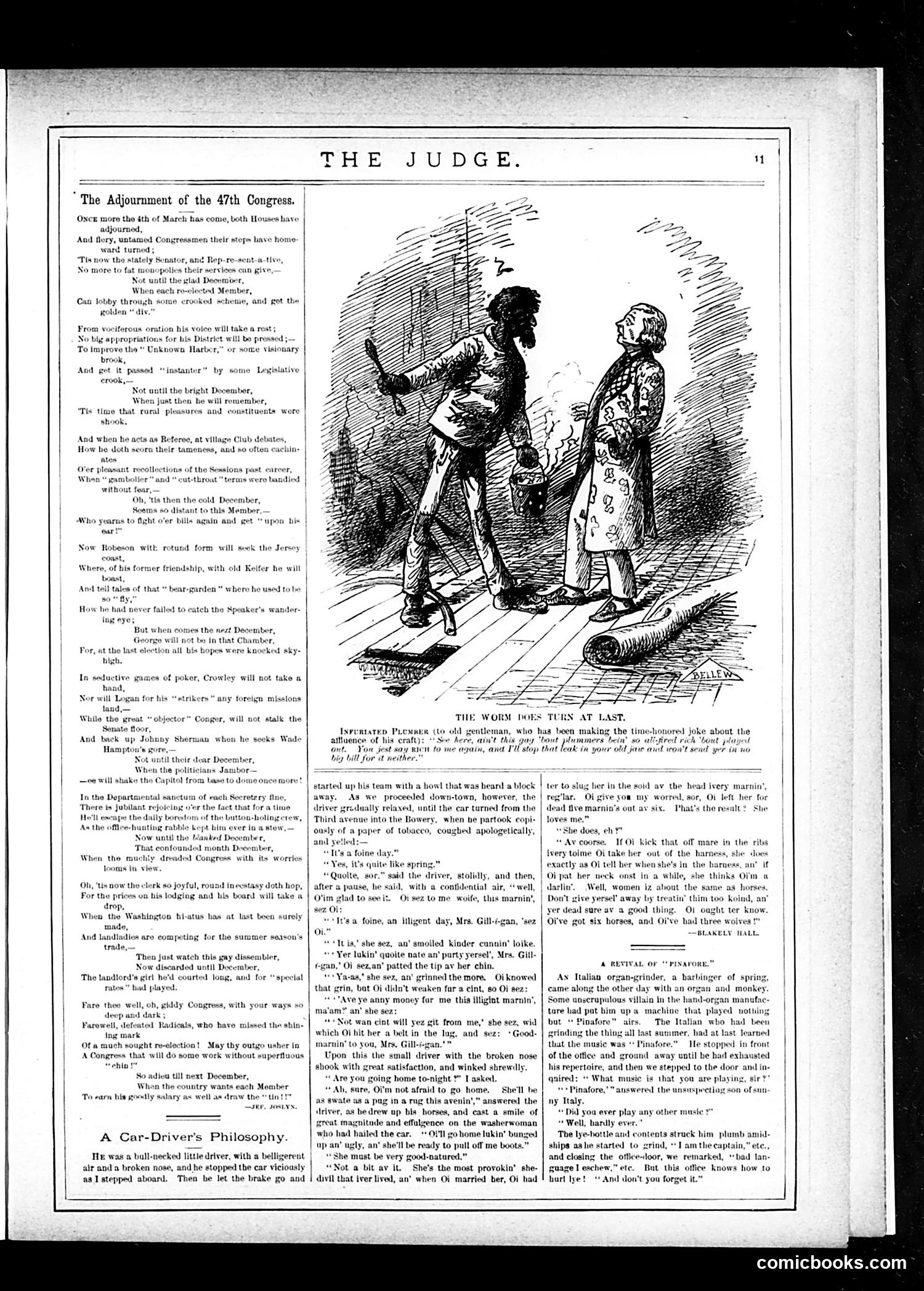
This page contains political satire about Congress's adjournment in March (likely 1882, given "47th Congress"). The poem mocks congressmen who abandon their duties after session ends, portraying them as corrupt self-servers who ignore constituent needs until re-election approaches in December. **Key targets**: Senators and Representatives accused of serving "monopolies" rather than the public, using appropriations for personal gain ("golden 'div'"), and engaging in corrupt practices like poker games and bribery. **The main cartoon** ("The Worm Does Turn at Last") depicts an "Infuriated Plumber" confronting what appears to be a tradesman or laborer, illustrating working-class frustration—likely commentary on class tensions or labor disputes of the era. **"A Car-Driver's Philosophy"** is a separate humorous sketch about a working-class driver flirting with a passenger named Mrs. Gilligan, showing local color humor typical of Judge's content. The overall message: Congress is corrupt, self-interested, and only remembers constituents when elections approach.
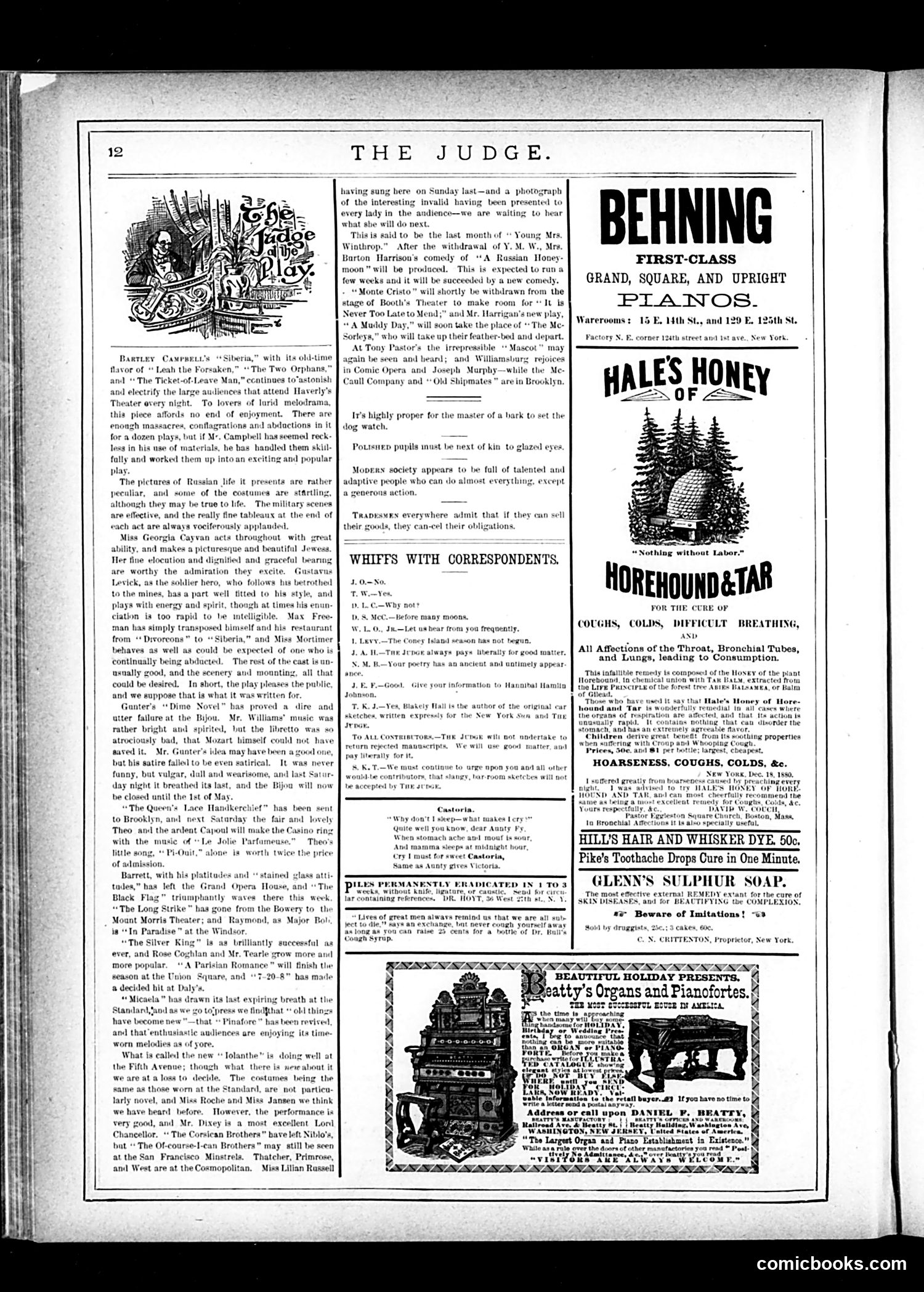
This page is primarily **theater criticism and advertisements** from a late 19th-century issue of Judge magazine. The main content reviews theatrical productions then running in New York, including plays like "Siberia," "The Queen's Lace Handkerchief," and revivals of "The Silver King." The small illustration at top-left appears to be Judge's decorative masthead or section header, not a political cartoon. **Key theatrical references**: Critics discuss acting performances (particularly actress Georgia Cayvan), plot quality, and staging. They note which theaters are hosting productions and mention upcoming shows. The reviews are mixed—some plays praised for spectacle and performances, others criticized as poorly written or acted. The page is largely **advertisements** for medicines (Hale's Honey, Horehound & Tar), pianos, and other products typical of period publications. This represents Judge functioning as an **entertainment/culture publication** rather than political satire on this particular page.
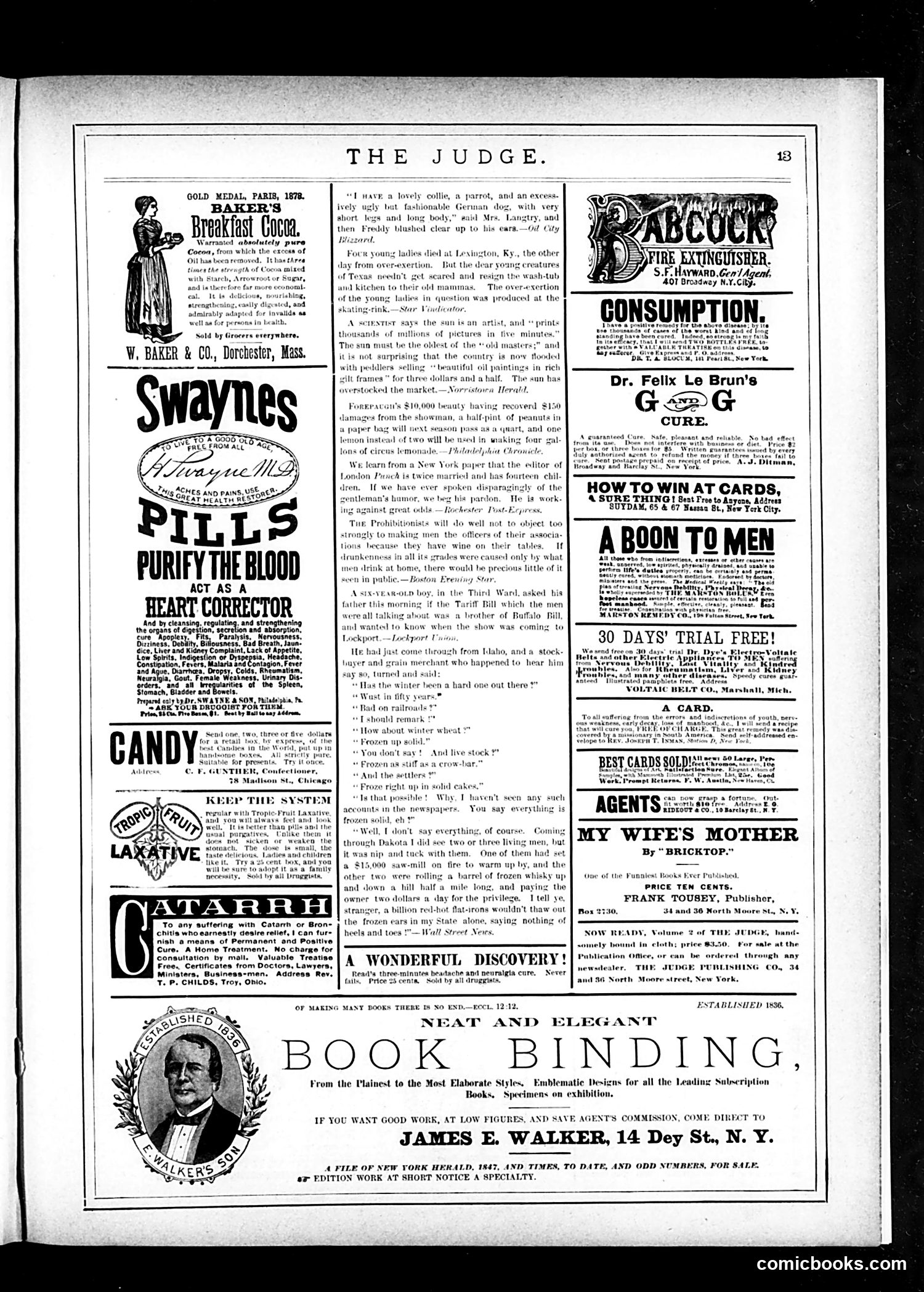
This page is primarily **advertising**, not editorial content or political cartoons. It's from Judge, the American satirical weekly, but this particular page showcases patent medicines and consumer goods typical of 1870s-1880s publications. Notable ads include **Swayne's Pills** (claiming to cure numerous ailments), **Baker's Cocoa**, **Dr. Felix Le Brun's Cure** for consumption, and various other dubious remedies. The text includes scattered brief satirical items—humorous observations about marriage, tariffs, and social foibles—but these are filler content between advertisements. The page demonstrates how 19th-century magazines funded themselves through ads for largely ineffective or unregulated medical products. The small satirical pieces mock contemporary topics (Prohibitionists, tariffs) but lack the developed political cartooning this magazine was known for. This appears to be a back page designed primarily for commercial content rather than editorial satire.
This page appears to be primarily **advertising and editorial content** rather than traditional political cartoons, though the OCR is heavily corrupted and difficult to parse with certainty. The main headline "A STARTING DOMESTIC REVOLUTION" suggests satirical commentary on **domestic life or women's roles**, likely early 20th century. The visible section headers reference "MOST WONDERFUL DISCOVERS OF MODERN TIMES" and include multiple boxed segments with illustrations of hands, suggesting before-and-after product demonstrations typical of vintage advertisements. The fragmented readable text mentions topics like household efficiency, women's work, and consumer products—common *Judge* magazine subjects for satirizing both modern conveniences and changing domestic expectations. Without clearer OCR, the specific satirical target remains unclear, but the overall thrust appears to mock either the exaggerated claims of new domestic products or evolving ideas about housework and gender roles in that era.
This page is primarily **advertising**, not political satire. It promotes Frank Siddall's soap product through multiple promotional sections. The main content includes: 1. **"How a Lady Can Get Soap to Try"** — instructions for obtaining the product at locations where it isn't stocked in stores 2. **"How to Tell a Person of Refinement"** — a tongue-in-cheek guide suggesting that genteel, intelligent women will recognize the soap's quality 3. **Various testimonials and product claims** — emphasizing the soap's uses for toilet and household cleaning, presented as endorsed by "The Judge" magazine itself The satire here is **mild and self-promotional**: Judge magazine essentially advertises a commercial product while framing its endorsement as a mark of sophistication. The humor lies in the implicit suggestion that using this particular soap indicates good breeding and intelligence — a common advertising strategy of the era that conflated consumer choices with social status. No specific political figures or events appear to be referenced.
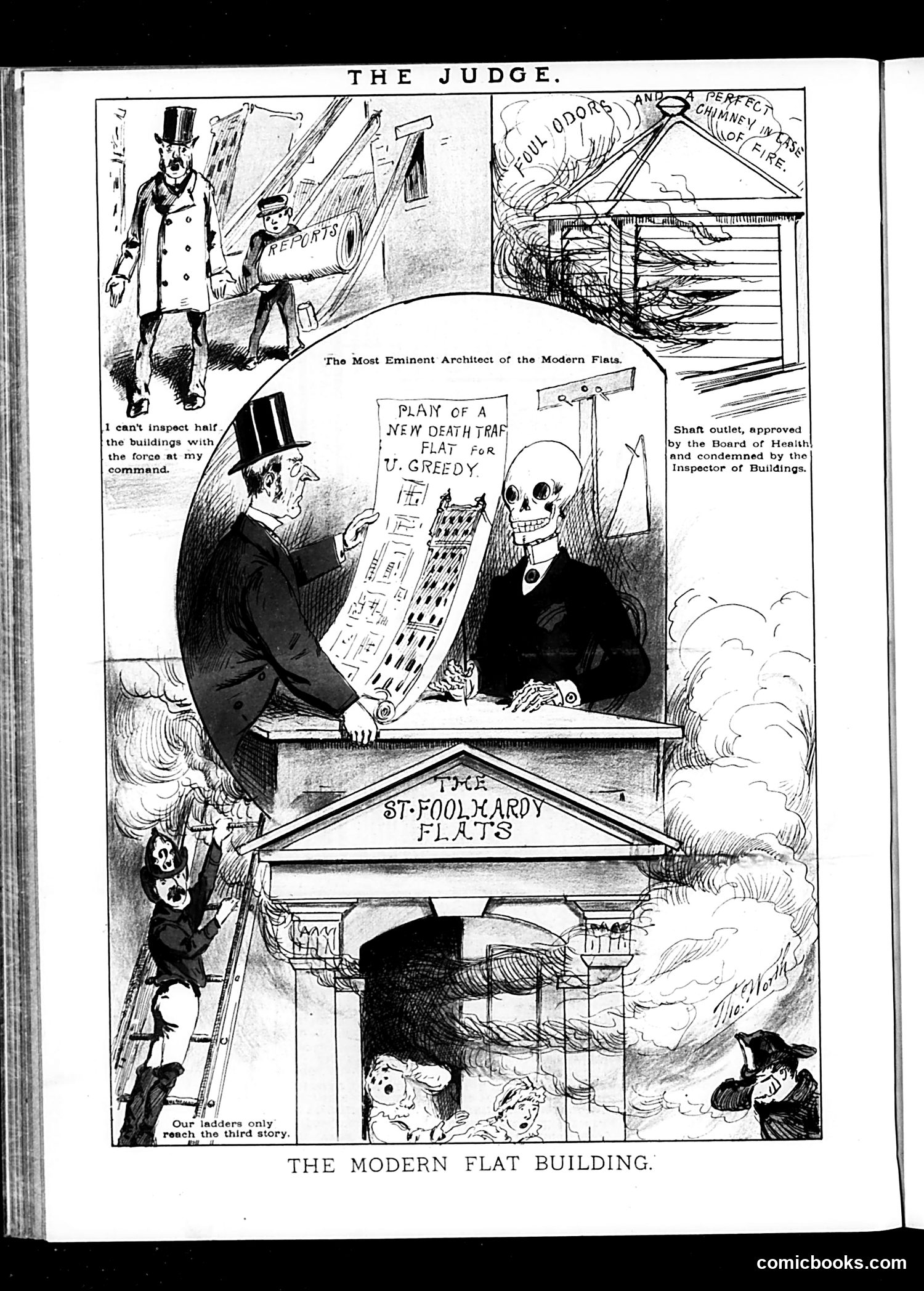
This satirical cartoon critiques dangerously inadequate building inspections and safety standards in modern apartment buildings. The central figure (a building inspector in top hat) discusses a "death trap flat" blueprint with Death personified as a skeleton. The cartoon highlights three safety failures: inspectors lack sufficient staff ("can't inspect half the buildings"), fire hazards abound (noted "foul odors and perfect chimneys for fire"), and rescue equipment is inadequate (ladders "only reach the third story" while buildings are taller). Ironically, dangerous structures gain official approval from the Board of Health and Inspector of Buildings—institutions meant to prevent exactly this negligence. The cartoon satirizes regulatory capture and negligent oversight of tenement housing, a major public health concern during the Progressive Era when cramped, unsafe apartment buildings endangered residents.