
A complete issue · 16 pages · 1882
Judge — November 18, 1882
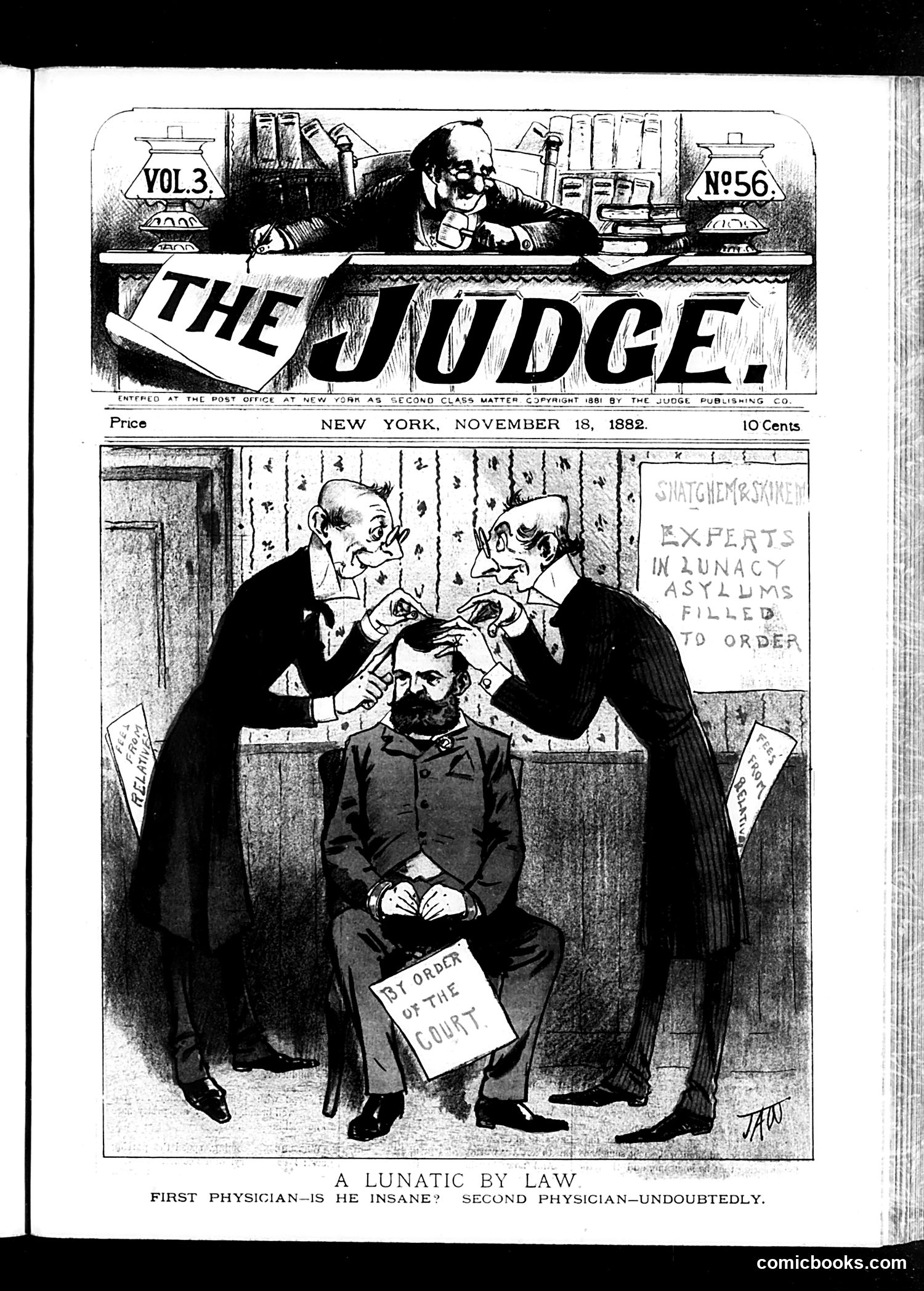
This cartoon satirizes the legal process for declaring someone mentally incompetent. Two physicians examine a bearded man labeled "BY ORDER OF COURT," while a sign reads "SNATCHED FROM STREET: EXPERTS IN LUNACY ASYLUMS FILLED TO ORDER." The satire targets the ease with which people could be institutionalized in 1882 asylums—suggesting physicians would rubber-stamp insanity diagnoses regardless of actual mental condition. The "undoubtedly" response implies automatic agreement between doctors, mocking the lack of genuine medical scrutiny. The sign's reference to asylums being "filled to order" suggests financial incentives drove institutionalizations, making the legal/medical system corrupt. The cartoon criticizes how vulnerable citizens could be arbitrarily committed through collusion between courts and doctors seeking profit.
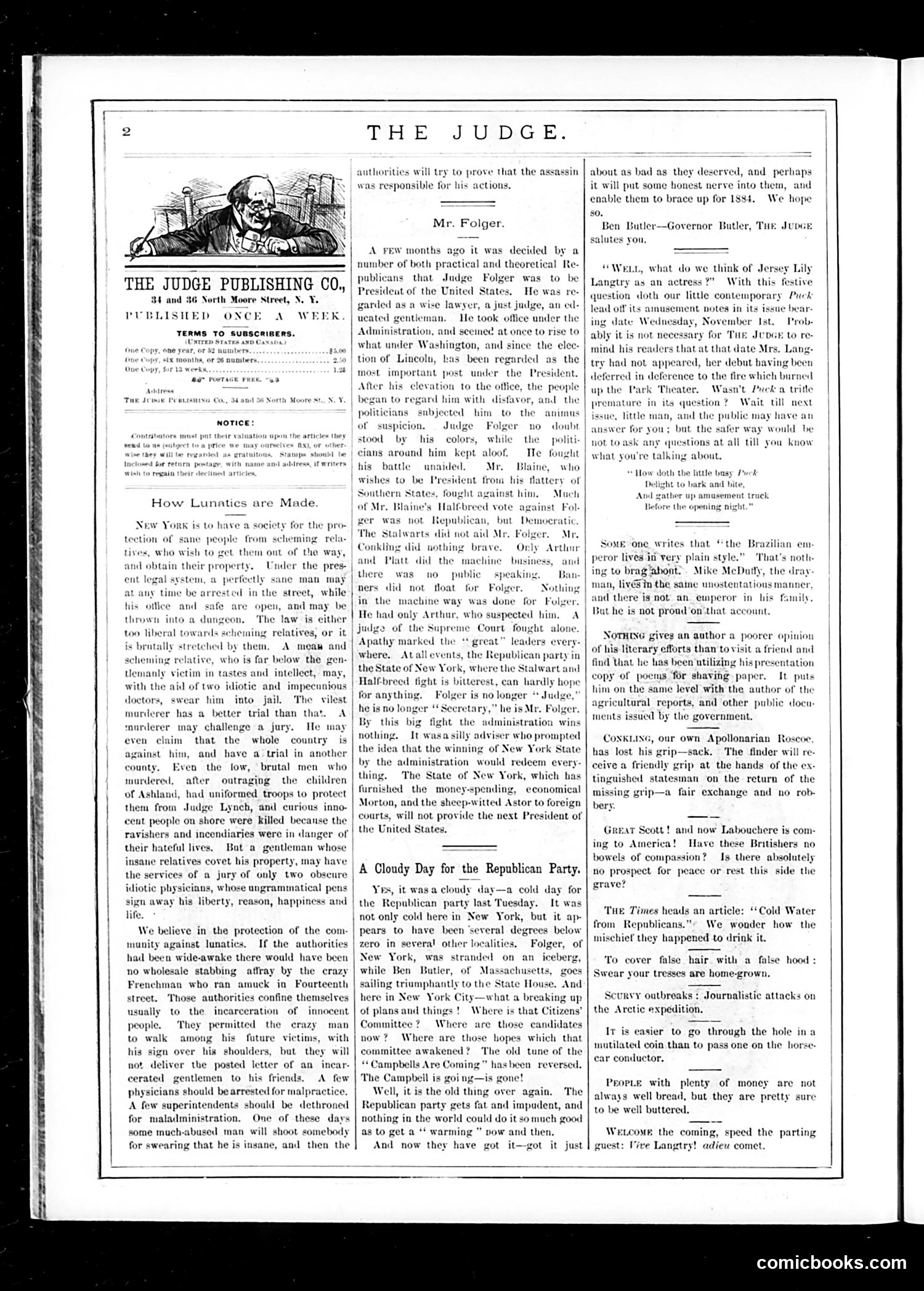
This page contains two main pieces of political satire: **"How Lunatics are Made"** criticizes New York's commitment procedures. The piece argues the system is dangerously flawed: wealthy men with insane relatives can be institutionalized by just two obscure physicians, losing liberty without jury protection—while actual murderers receive better legal safeguards. The satire suggests this enables scheming relatives to steal property from mentally sound gentlemen. **"Mr. Folger"** mocks Republican Judge Charles J. Folger's failed political trajectory. Months earlier, Republicans hoped he'd become President. Though initially respected as a lawyer and judge, his elevation made party factions (Stalwarts, Half-breeds, and Conkling's faction) view him with suspicion. He received no real political support—even Arthur and Platt abandoned him. The satire ridicules how quickly political fortunes reversed and how apathy surrounded his rise and fall. Both pieces lampoon institutional failure and political fickleness in Gilded Age America.
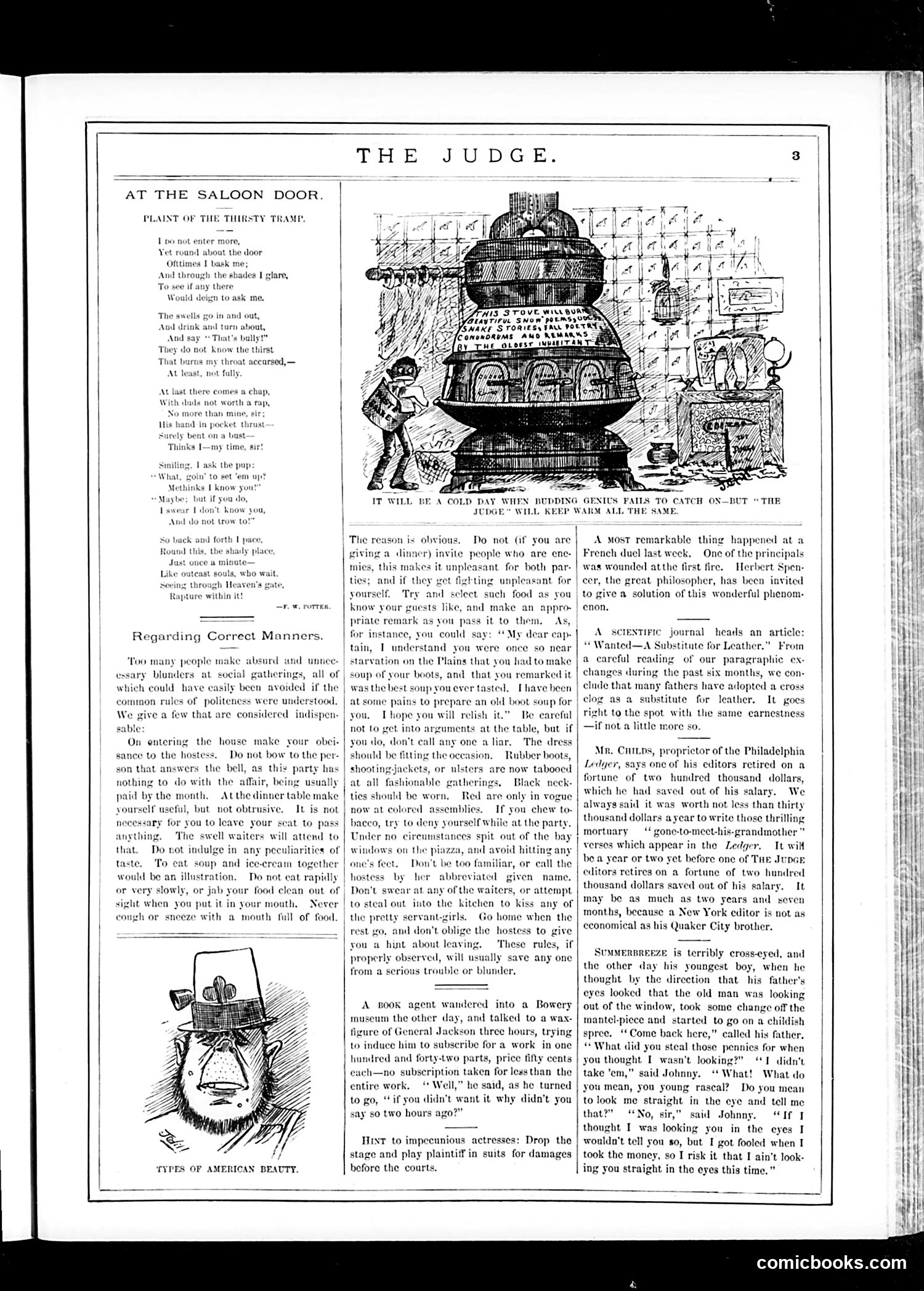
This Judge magazine page satirizes American social manners and etiquette through multiple pieces. The main cartoon shows a stove ("It Will Be a Cold Day When Budding Geniuses Fall to Catch On—But 'The Judge' Will Keep Warm All the Same"), using the stove as metaphor for Judge magazine's durability despite trends. The "Regarding Correct Manners" section mocks upper-class pretension by offering deliberately absurd etiquette advice—like serving old boot soup to dinner guests or wearing rubber boots to formal gatherings. The humor lies in satirizing both wealthy hosts' snobbery and the nouveau-riche's anxious social climbing. The tramp's poem and anecdotes (book agent pitching to a wax museum figure, actress hint) mock gullibility and social desperation. Overall, the page ridicules Gilded Age class consciousness and the anxiety surrounding "proper" social behavior among aspirational Americans.
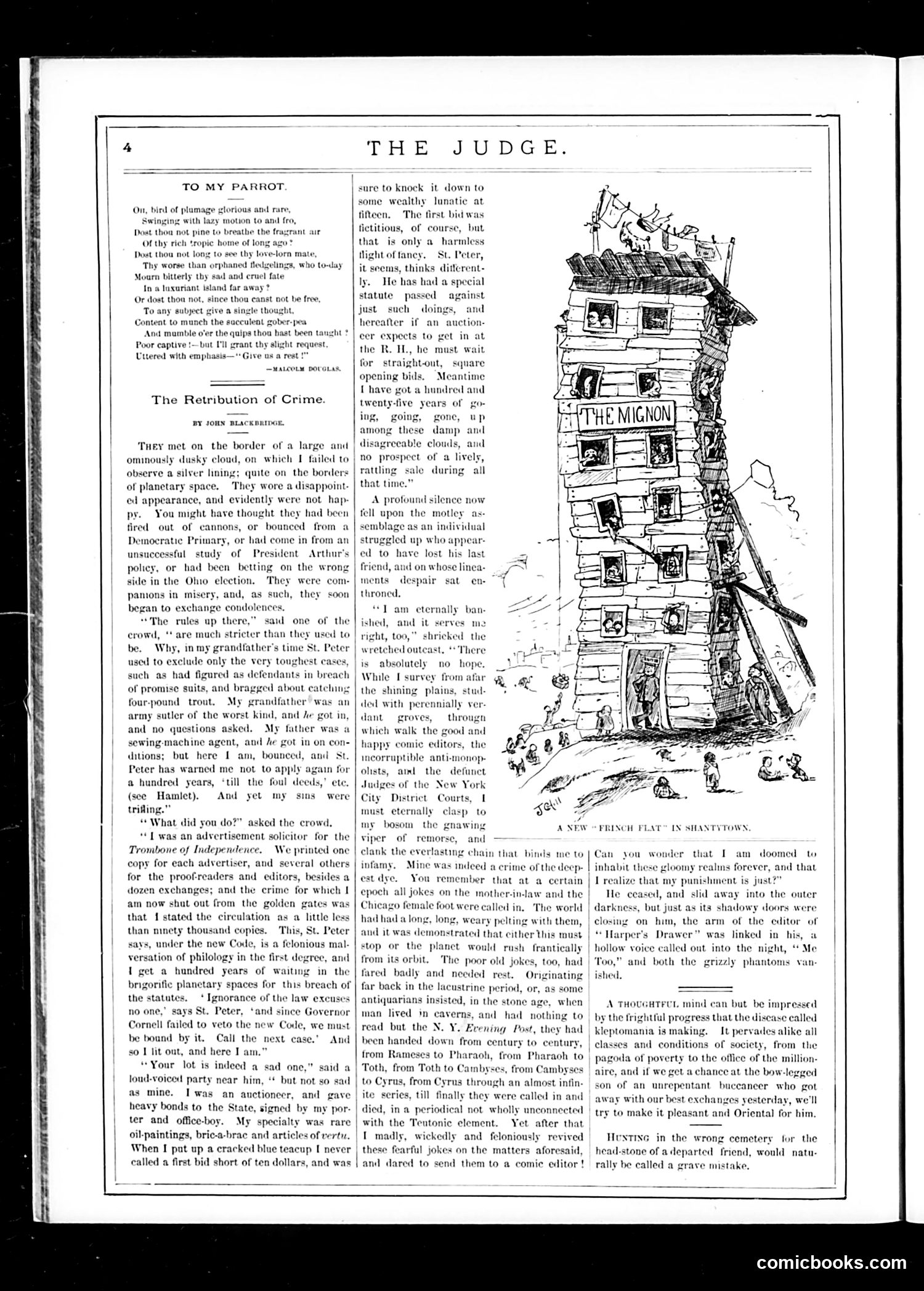
This page from *Judge* satirizes bureaucratic hypocrisy and selective morality through a story about souls denied entry to heaven. The narrative mocks how minor infractions—inflating magazine circulation, misrepresenting auction items, and fraudulent advertising—are now punished with equal severity to serious crimes, while historically worse offenders (army sutlers, corrupt politicians) were admitted without question. The satire targets the gap between old and new moral standards: St. Peter enforces strict rules "much stricter than they used to be," implying contemporary society's selective enforcement of ethics. The specific examples—a *Trombone of Independence* circulation scam and auction house fraud—likely reference real Gilded Age business scandals. The cartoon mocks both crooked businessmen *and* the arbitrary, newly rigid moral judgments being applied to them, suggesting *Judge's* skepticism toward reform efforts and hypocrisy in judging financial misconduct.
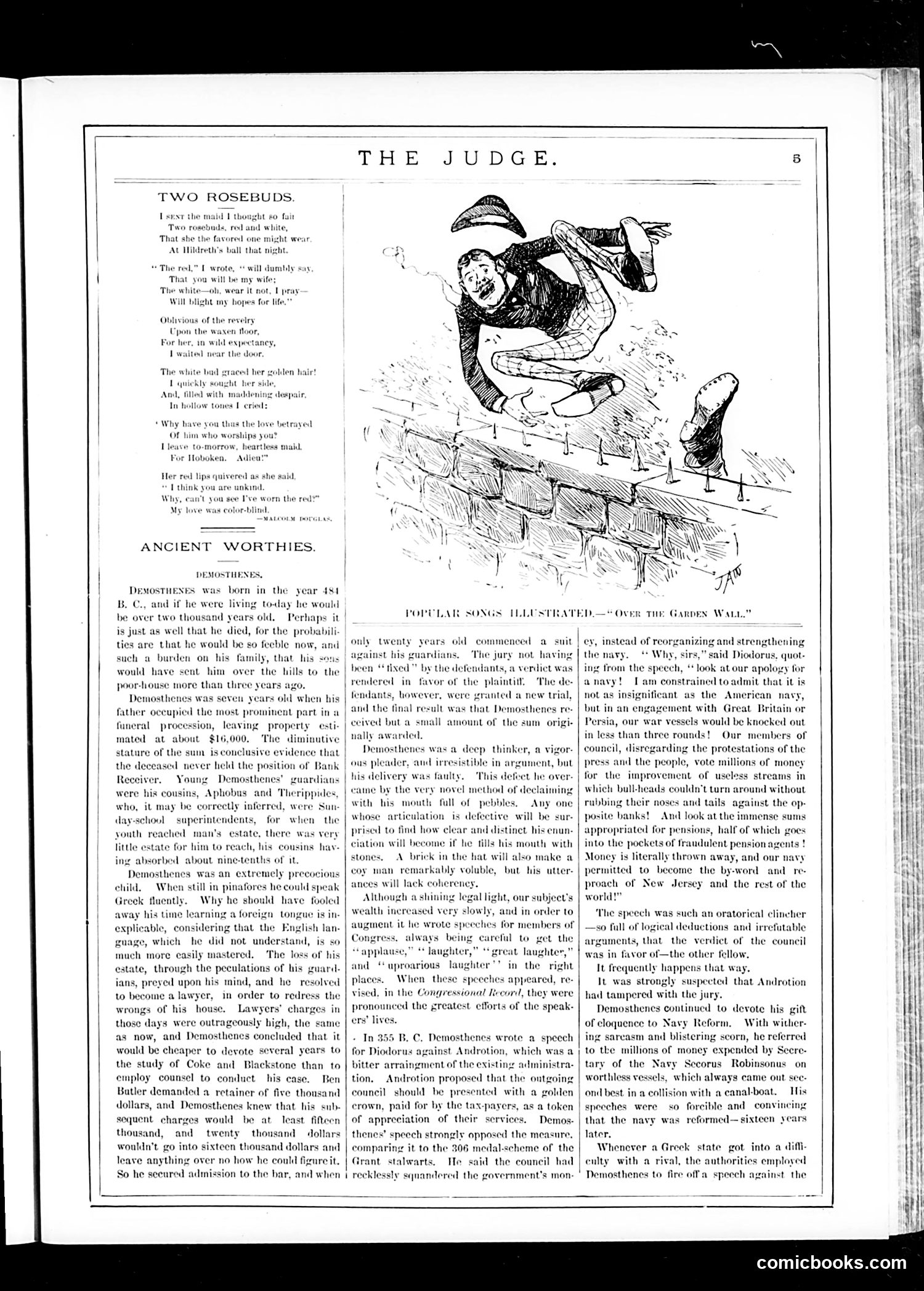
This page contains two separate pieces of satirical content: **"Two Rosebuds"** (poem with illustration): A humorous romantic mishap where a suitor sends a maid red and white rosebuds as coded love tokens, expecting her acceptance. She rejects him, claiming she couldn't read his message because she was "color-blind"—a punchline playing on the literal inability to distinguish the colors meant to communicate his proposal. **"Ancient Worthies: Demosthenes"** (article with sidebar): A biographical satire of the ancient Greek orator Demosthenes, using his life as a vehicle to mock contemporary American legal and political systems. The piece humorously criticizes: expensive lawyers who drain clients' resources, guardians who embezzle estates, the costliness of court cases, and political leaders who ignore naval defense needs. The sidebar "Popular Songs Illustrated" references Demosthenes' famous practice of orating with pebbles in his mouth to improve his delivery. The satire targets American institutions through classical parallels, suggesting little has changed regarding corruption and governmental incompetence.
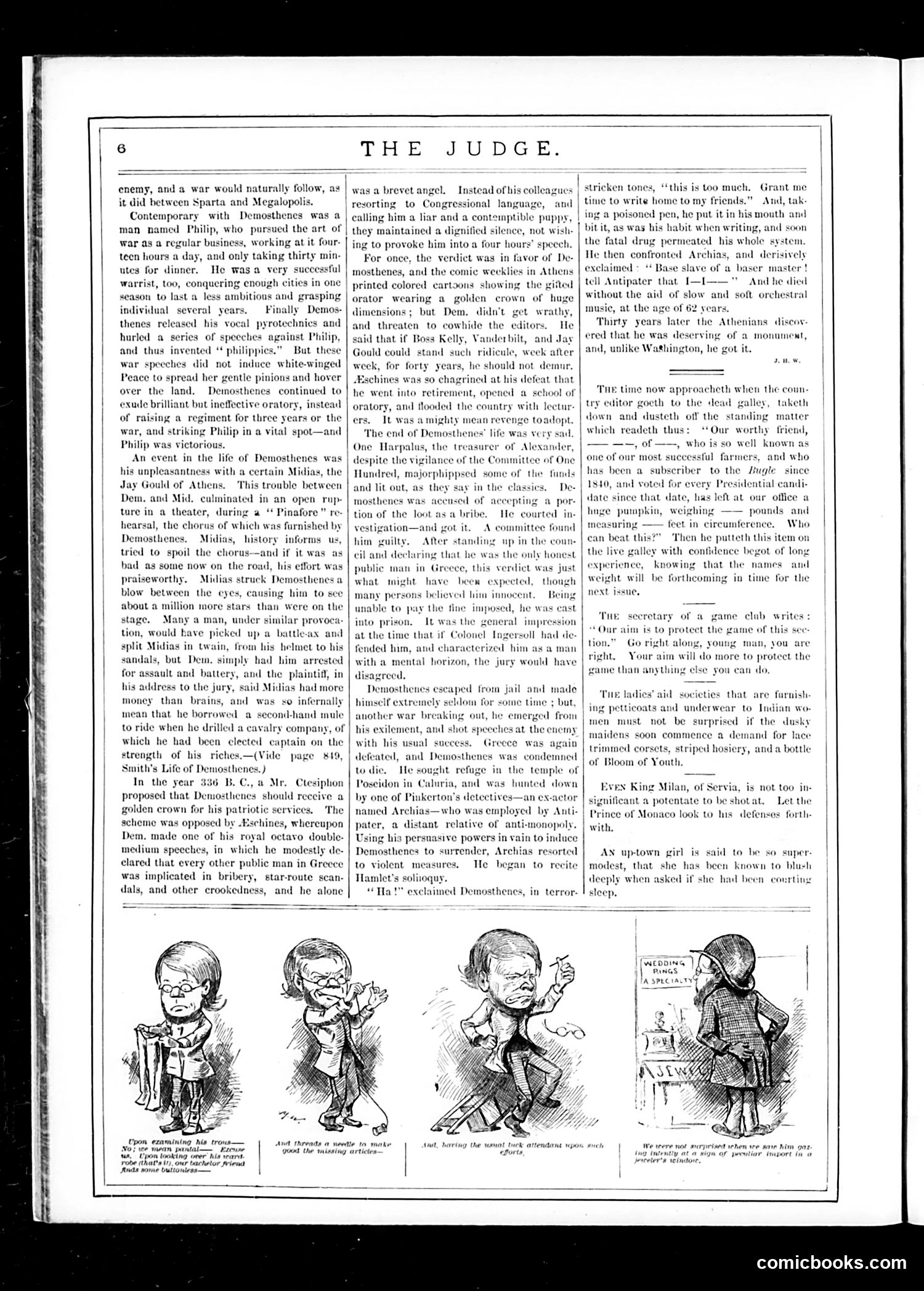
This page satirizes ancient Greek orator Demosthenes by drawing parallels to contemporary American politics (circa 1880s-90s). The text humorously compares Demosthenes to figures like Jay Gould and references "Boss Kelly" and Vanderbilt, suggesting corruption scandals were timeless. The four caricature cartoons below illustrate moments from Demosthenes' life in exaggerated style. They appear to mock his ineffectual oratory, his lawsuit against Midias (compared to modern legal disputes), and his acceptance of bribes—all presented as absurdly self-righteous. The satire's point: even celebrated historical figures engaged in the same petty corruption, bribery, and political posturing Judge's readers encountered in their own era. By treating ancient history comically, the piece suggests American political scandals are nothing new.
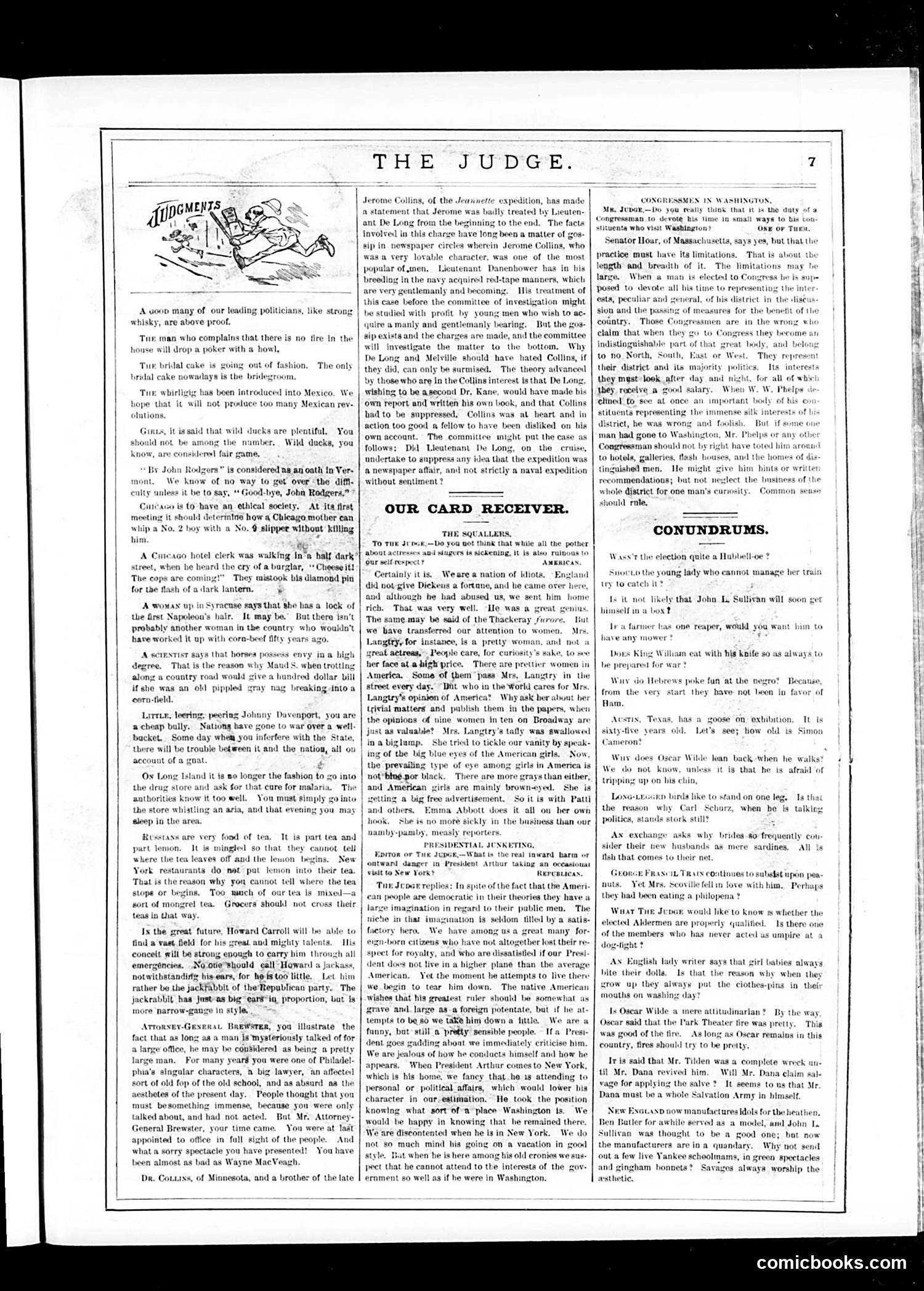
This page from the satirical magazine *Judge* contains several short humorous items and one cartoon (top left, titled "Judgments"). **The Jerome Collins/De Long Reference:** The lead article addresses a controversy over the *Jeannette* Arctic Expedition. Jerome Collins, described as "a very lovable character," was allegedly mistreated by Lieutenant De Long during the voyage. The text sarcastically defends De Long's gentlemanly conduct while questioning why Collins wouldn't have been disliked if he was so likable—a typical *Judge* reversal of logic for comedic effect. **The Cartoon:** "Judgments" (top left) appears to show figures in motion, likely depicting some current political or social figures, though specific identities are unclear from the image quality. **The Remaining Content:** The bulk of the page consists of brief, disconnected satirical quips on American life—complaints about tea quality, fashion, ethics societies, and political figures like Howard Carroll and Attorney General Brewster. These are typical of *Judge's* short-form humor style. The overall tone is mocking of contemporary American politics, society, and manners.
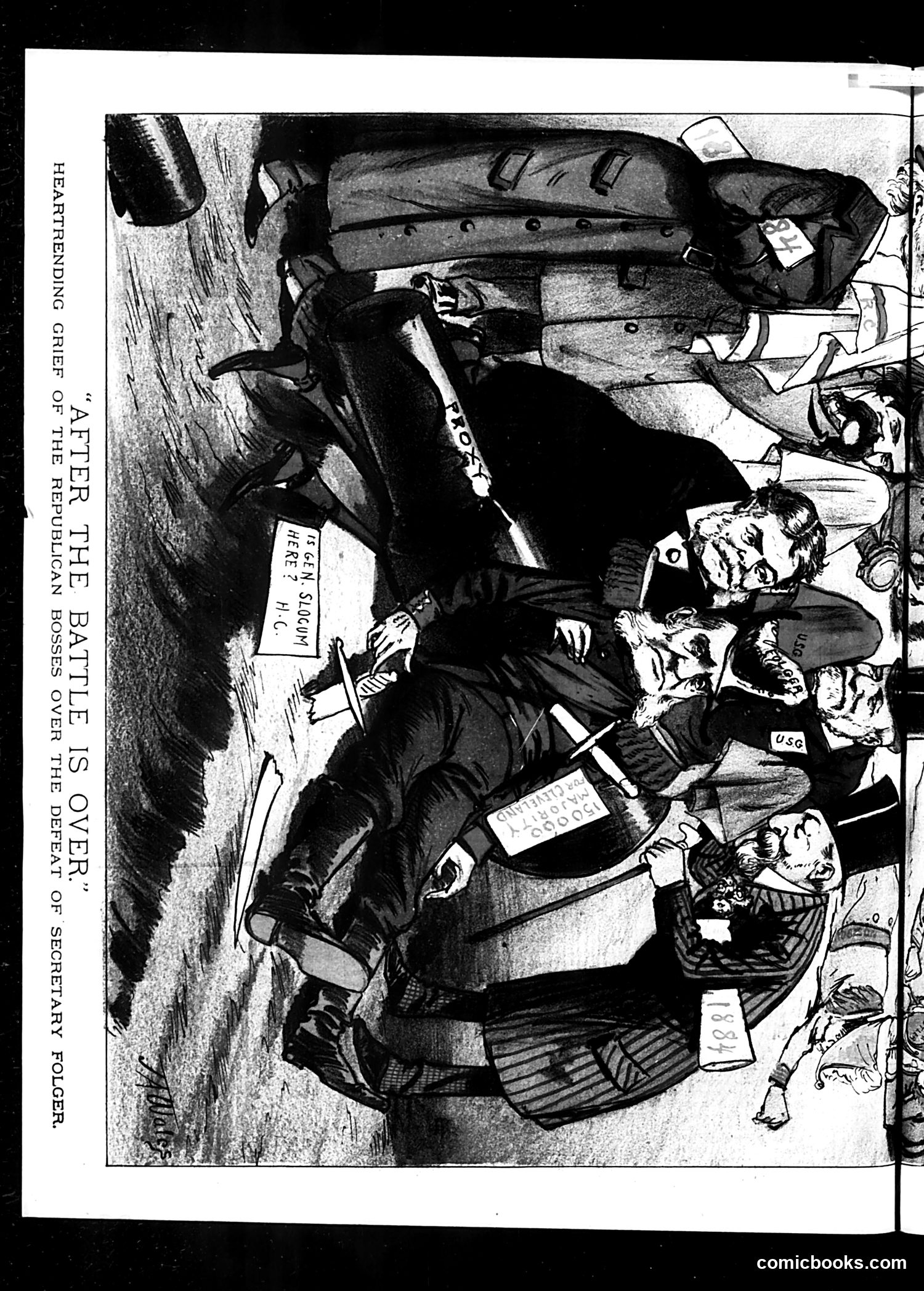
This is a satirical cartoon from *Judge* magazine mocking Republican Party leadership's grief over Secretary Folger's electoral defeat. The image shows caricatured "Republican bosses" in exaggerated mourning poses surrounding what appears to be a coffin or defeated candidate, with labels visible on their clothing. The satire targets the Republican establishment's emotional investment in protecting Folger's political position. The cartoonist is ridiculing their theatricalized grief as insincere or overwrought—suggesting the bosses' concern is self-interested rather than genuinely patriotic. This reflects *Judge*'s general satirical stance toward political machines and their manipulation of power structures during the Gilded Age period when this magazine was published.
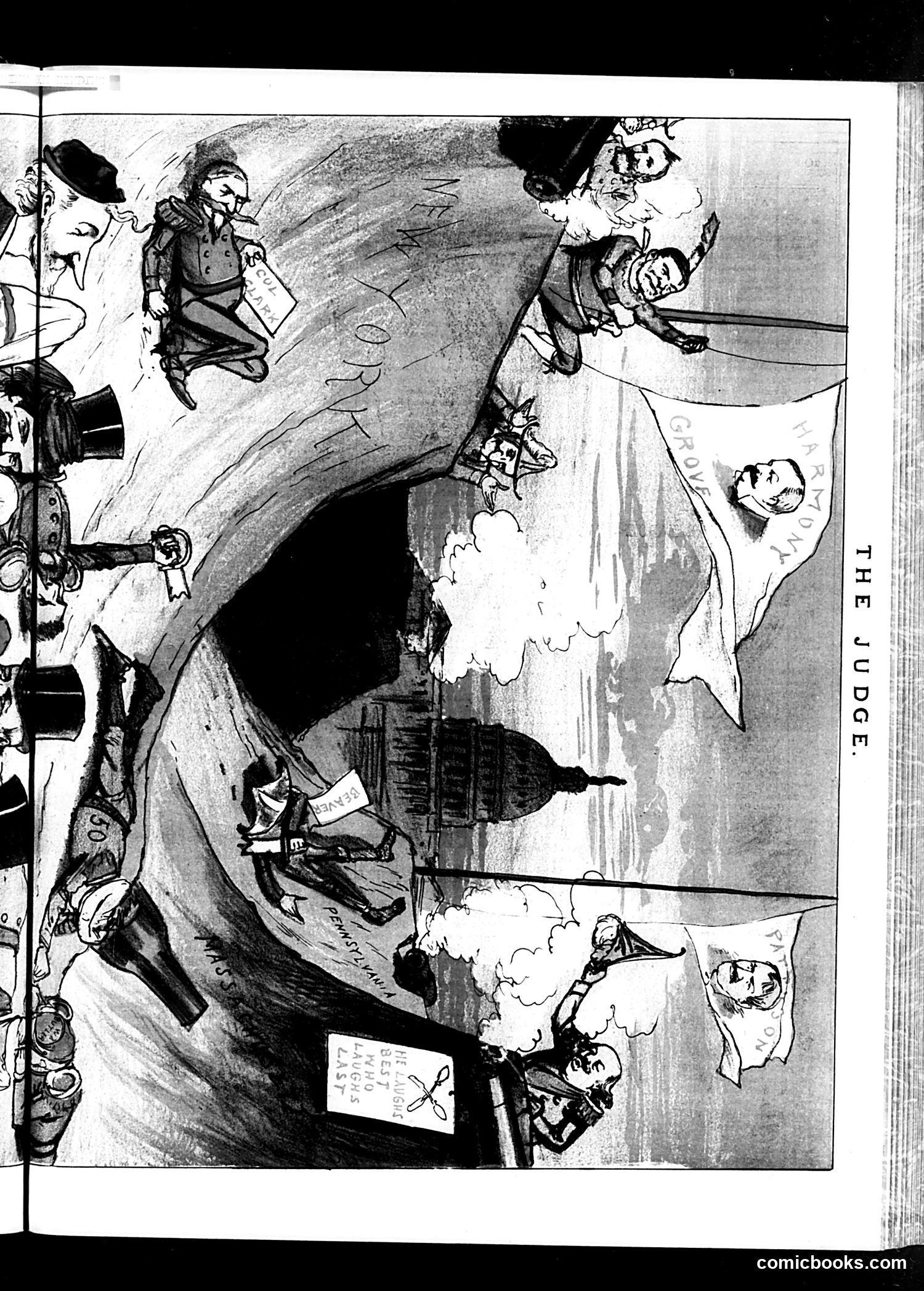
This page is rotated 90 degrees, making full analysis difficult. The visible OCR text appears to be corrupted formatting rather than readable content. The cartoon itself, titled "THE JUDGE" (visible on the spine), depicts what appears to be a courtroom or legal scene with multiple figures in period dress and top hats. There's a large central figure that dominates the composition, with smaller figures arranged around it. However, without clear identifying labels, readable text, or a discernible date visible in the image, I cannot confidently identify the specific political figures, legal case, or satirical point being made. To accurately explain this cartoon's historical context and meaning, I would need either: a legible date, clearer labels identifying the figures, or additional contextual text from the article accompanying it.
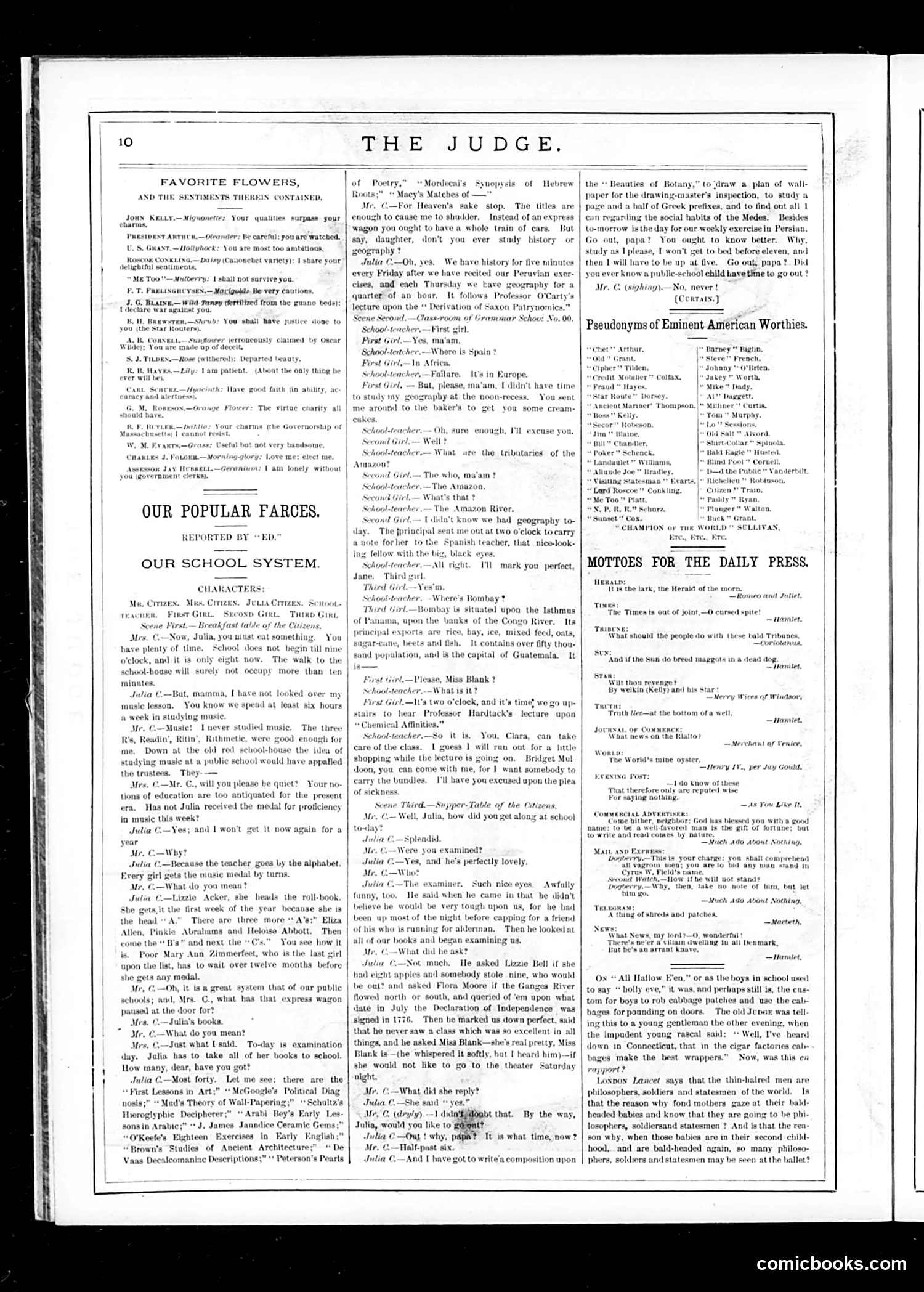
This page from *Judge* satirizes American education through two main features: **"Favorite Flowers" section:** A political joke comparing politicians to flowers with corresponding "sentiments." References include President Arthur (forget-me-not: "you are watched"), President Hayes (withered rose: "departed beauty"), and S.J. Tilden (sunflower: "you lack charity"), mocking these public figures with insulting floral associations. **"Our School System" sketch:** A comedic dialogue between Mr. and Mrs. Citizen and their daughter Julia exposes the absurdity of late-19th-century education. The humor lies in Julia's overloaded curriculum—she carries "forty" books including ridiculous titles like "McGoogles Political Diagnoser" and studies geography only five minutes weekly while spending six hours on music. The sketch ridicules the system's impractical priorities and inefficient subject rotation ("every girl gets the music medal by turns" alphabetically). The satire critiques both corrupt politics and educational inefficiency, hallmarks of *Judge's* muckraking approach.
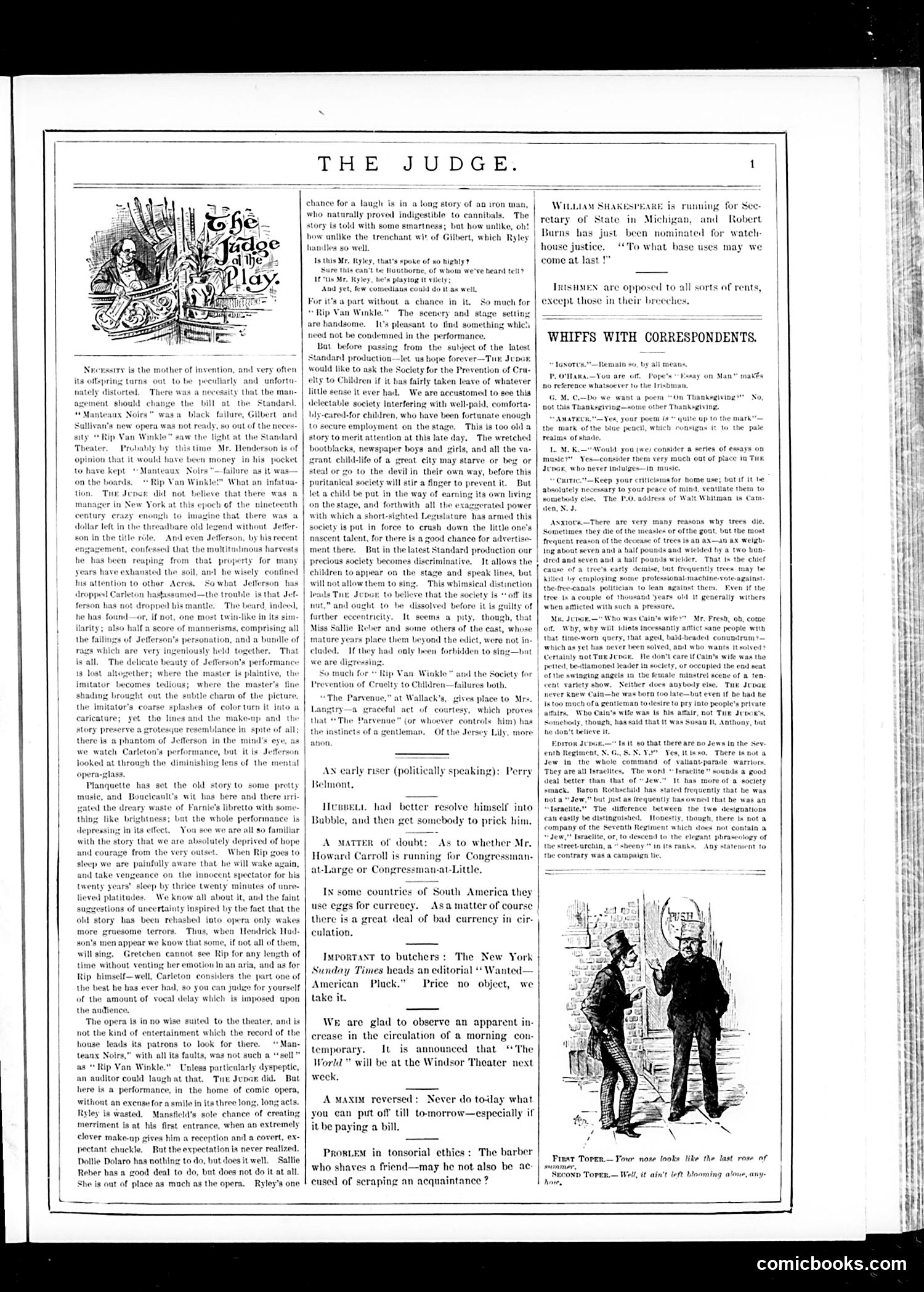
This page from the satirical magazine *Judge* primarily contains theater criticism rather than political cartoons. The main content critiques a production of "Rip Van Winkle" at the Standard Theater. **The Review's Focus:** The critic discusses a new opera adaptation of the classic "Rip Van Winkle" story, comparing it unfavorably to previous versions. The review praises actor Joseph Jefferson's original performance but criticizes the current production's libretto (by W.S. Gilbert appears referenced), music, and overall execution. **Key Complaint:** The critic argues the new version strips away the wit and charm of the original story, becoming a tedious "twenty minutes of unredeemed platitudes." Performers like Dollie Delaro and Sallie Reber receive particular criticism for failing to elevate weak material. **Sidebar Content:** The page includes brief editorial notes about various theatrical and social topics—mentions of "Rip Van Winkle" production details and comments on contemporary politics (references to Perry Richmond and Congressional races appear in fragmentary form). The illustrations appear to be period cartoons accompanying these editorial brief items, though specific details are difficult to discern from the image quality.
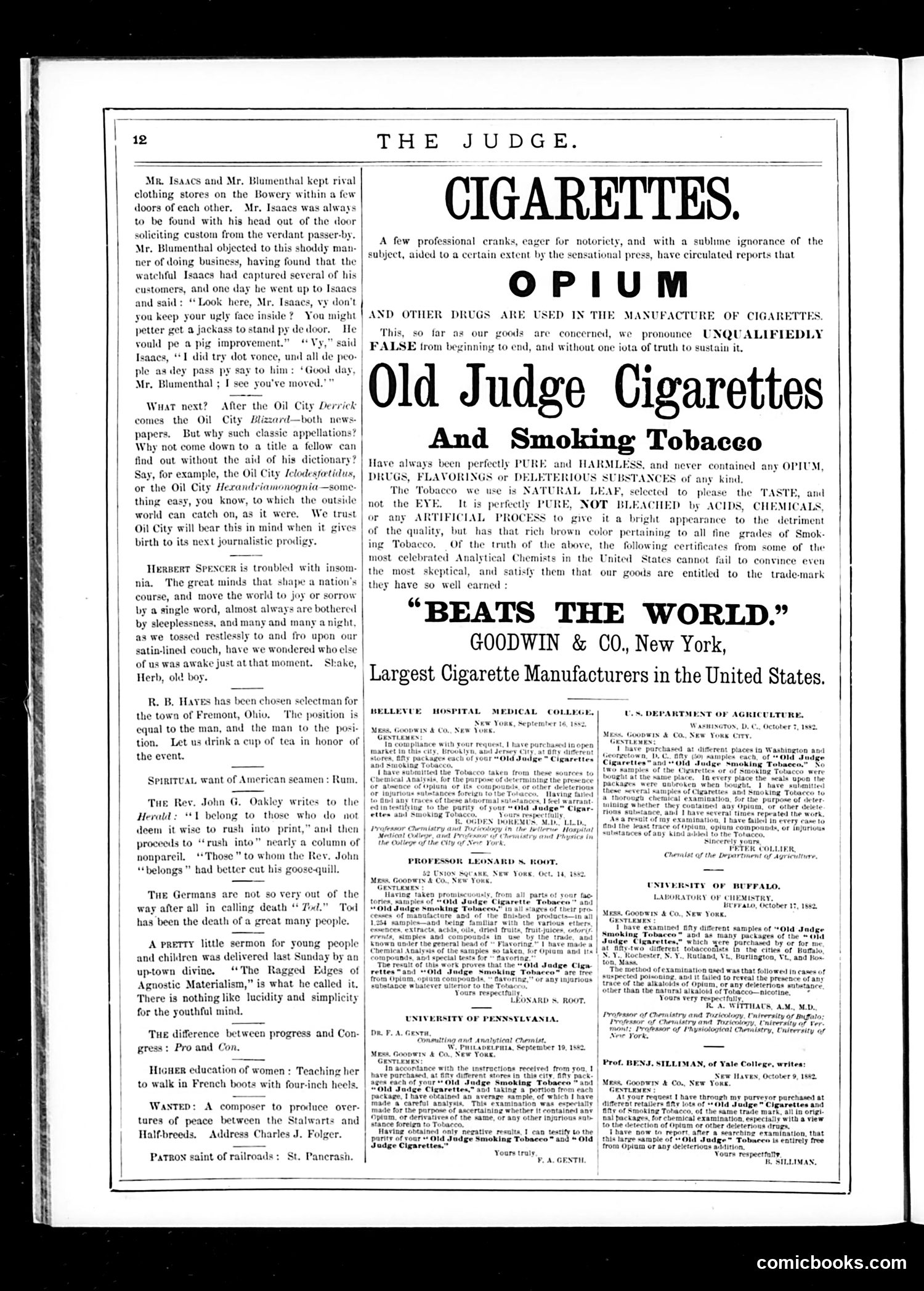
This page is primarily a **cigarette advertisement** with some satirical content framing it. The main focus is a full-page ad by Goodwin & Co. defending their "Old Judge" cigarettes against allegations that they contain **opium and other drugs**. The ad aggressively denies rumors (circulated by "professional cranks" and "sensational press") that their cigarettes contain harmful substances, insisting they use only natural leaf tobacco. They bolster their claims with testimonial letters from prestigious institutions like Bellevue Hospital Medical College and the U.S. Department of Agriculture—lending false scientific authority. The small satirical items at page top (rivalrous Jewish clothing merchants on the Bowery, newspaper naming conventions) serve merely as filler around the advertisement. **Context:** Late 19th-century cigarettes faced genuine concerns about additives and purity. This ad represents early corporate damage control through celebrity endorsement and institutional credibility—tactics still used today in tobacco marketing and health-related advertising disputes.
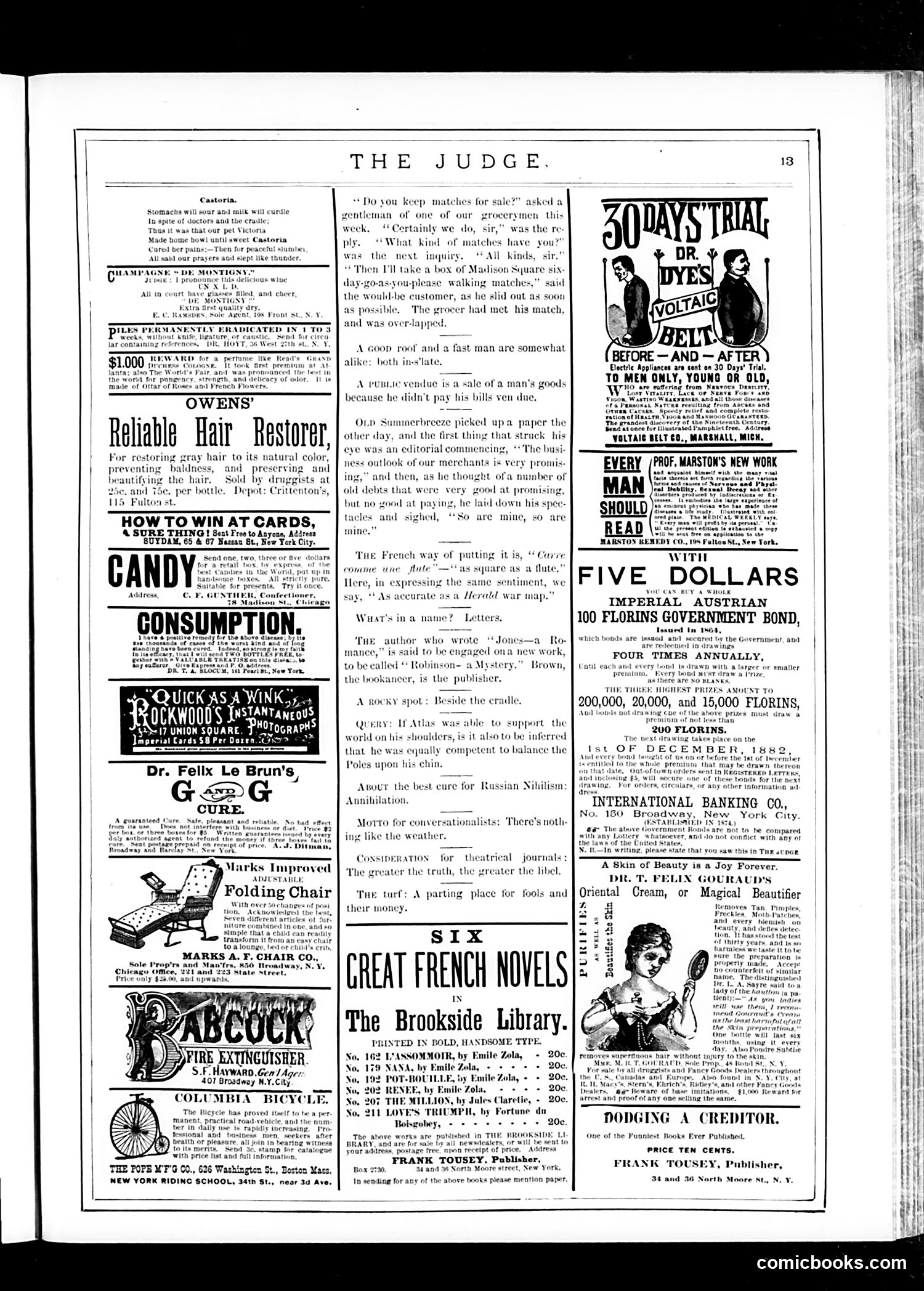
This page is primarily **advertising and humorous short bits**, not political cartoons. The content includes: **The humor pieces** are brief, witty one-liners playing on wordplay and puns: - A grocer selling "day-go-as-you-please walking matches" - Observations that "a public vende is a sale of a man's goods because he didn't pay his bills when due" - Puns on names (Robinson as "Mystery," Jones as "Romance") - A joke about Atlas balancing "Poles upon his chin" **The advertisements** dominate, hawking period remedies: hair restorer, consumption cure, a vibrating "electric belt" device (30-day trial for men), Austrian government bonds, and beauty cream. The overall tone reflects late 19th-century Judge magazine's mix of genteel wordplay and dubious medical/financial products. Nothing here references specific political figures or events—it's generalized social satire about commerce, vanity, and human nature.
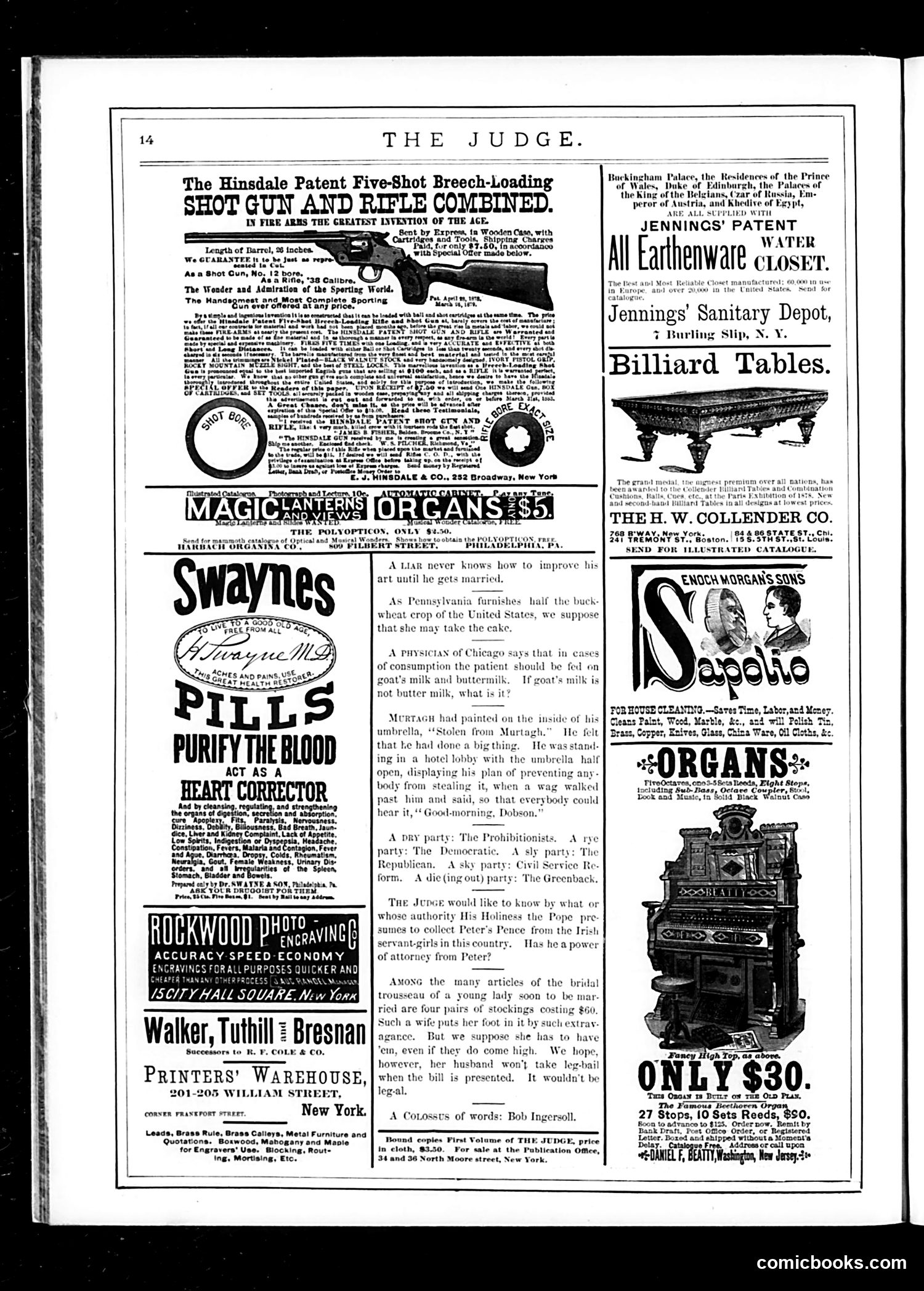
This appears to be primarily an **advertising page** rather than a satirical cartoon page. The dominant content is commercial advertisements for products including firearms (Hinsdale Patent Shot Gun), pills (Swayne's Pills), billiard tables, organs, and printing services. The scattered humorous text snippets between ads are brief jokes typical of Judge's style: - A quip about liars improving their art through marriage - Pennsylvania's buckwheat production - A Chicago physician's dietary recommendations for consumption patients - Anecdotes about a man's umbrella and Mercer's painted umbrella - Political party wordplay ("Prohibitionists," "Democrats," "Greenbackers") - A question about the Pope's authority collecting Peter's Pence from Irish servants - Commentary on expensive bridal stockings These jokes appear to be filler content between advertisements. There are **no clearly identifiable political cartoon figures or caricatures** visible on this page—it's primarily a commercial layout with scattered, topical humor rather than sustained satirical commentary.
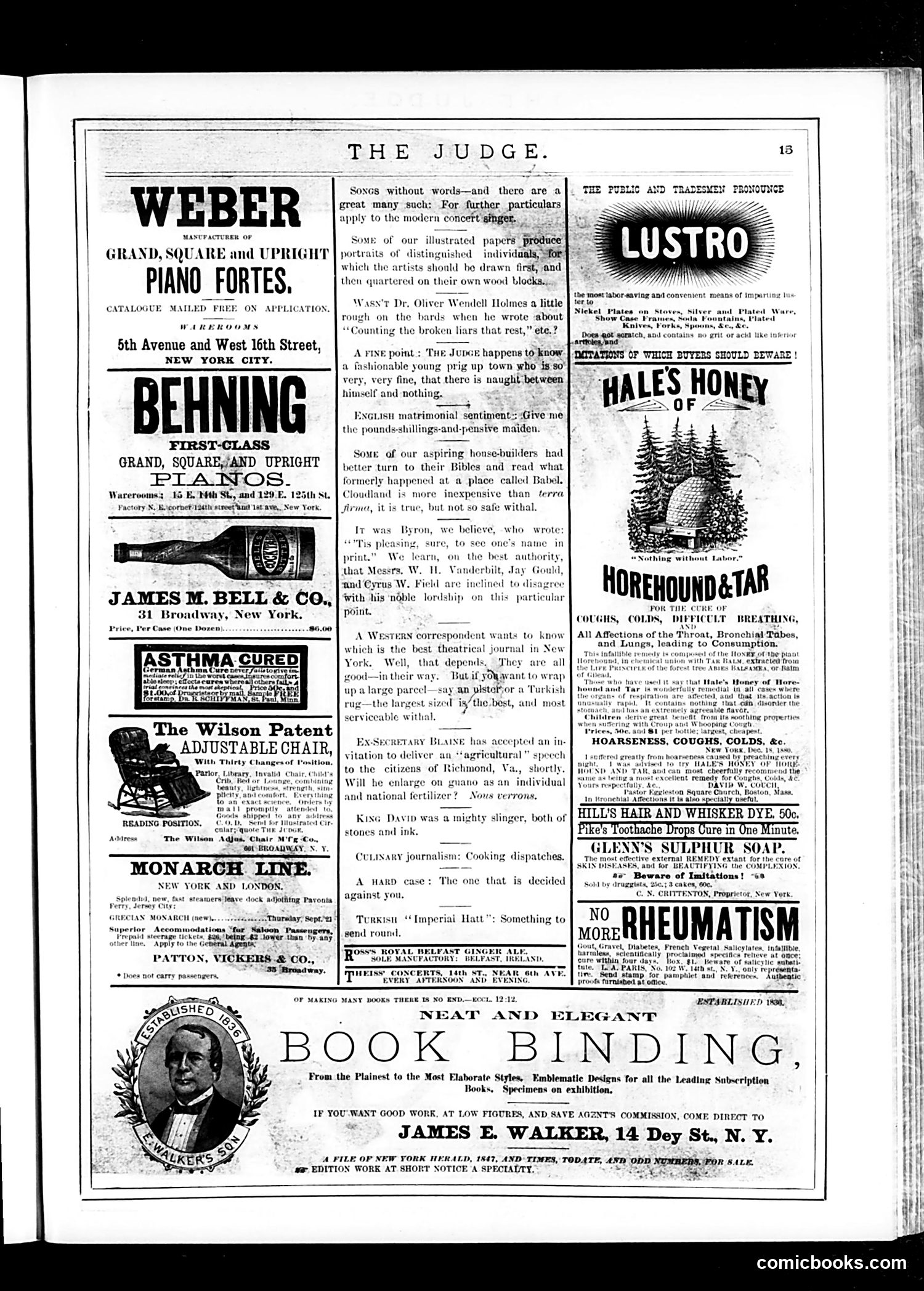
This page is primarily **advertising** for late-19th-century products (pianos, steamships, patent chairs, medicines) with brief satirical editorial commentary interspersed. The **cartoon content** consists of short, pointed jokes: - A jab at **Dr. Oliver Wendell Holmes** for romanticizing broken hearts in poetry - Mockery of **wealthy Manhattan socialites** (Vanderbilt, Jay Gould) posing as refined gentlemen - A dig at **Secretary Blaine** for accepting an invitation to discuss "agriculture" in Richmond—seemingly suggesting he's unqualified or the topic is absurdly mismatched - References to **King David** as both a warrior and writer - Wordplay on journalism ("cooking dispatches") The humor relies on **recognizing contemporary public figures** and understanding current events (Blaine's political role, society gossip about wealthy industrialists). Modern readers would need historical context to appreciate most jokes. The page exemplifies Judge's formula: **satirical commentary on politics, society, and famous people**, mixed with commercial advertising—typical of 1880s American magazines.
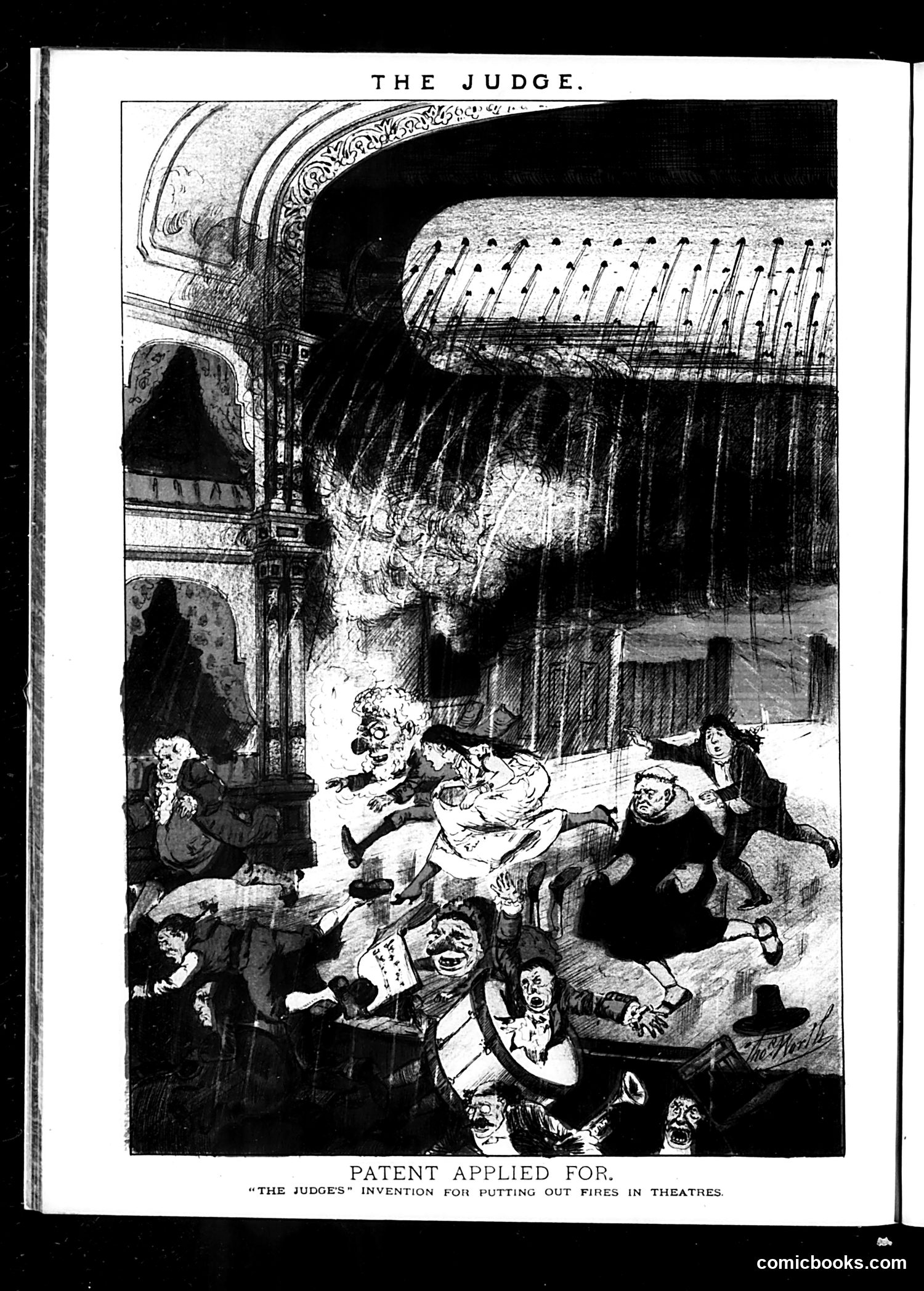
This satirical cartoon depicts a chaotic theater scene where a dramatic fire-suppression device appears to be causing more mayhem than safety. The crude illustrations show numerous figures in distress—some fleeing, others tangled in what appears to be mechanical apparatus designed to extinguish flames. The satire targets theater fire safety, likely responding to actual theater fire disasters (a significant public concern in the late 19th/early 20th century). By presenting an absurdly impractical "invention," Judge magazine mocks either: 1. Poorly designed safety patents being proposed 2. Theater owners' inadequate fire prevention measures 3. The gap between safety innovations and their actual effectiveness The "patent applied for" caption suggests ridicule of inventors promoting impractical solutions to a serious public safety problem. The cartoon uses exaggeration and chaos to highlight how some safety measures might endanger patrons more than protect them.