
Judge, 1882-11-18 · page 3 of 16
Judge — November 18, 1882 — page 3: what you’re looking at
What you’re looking at
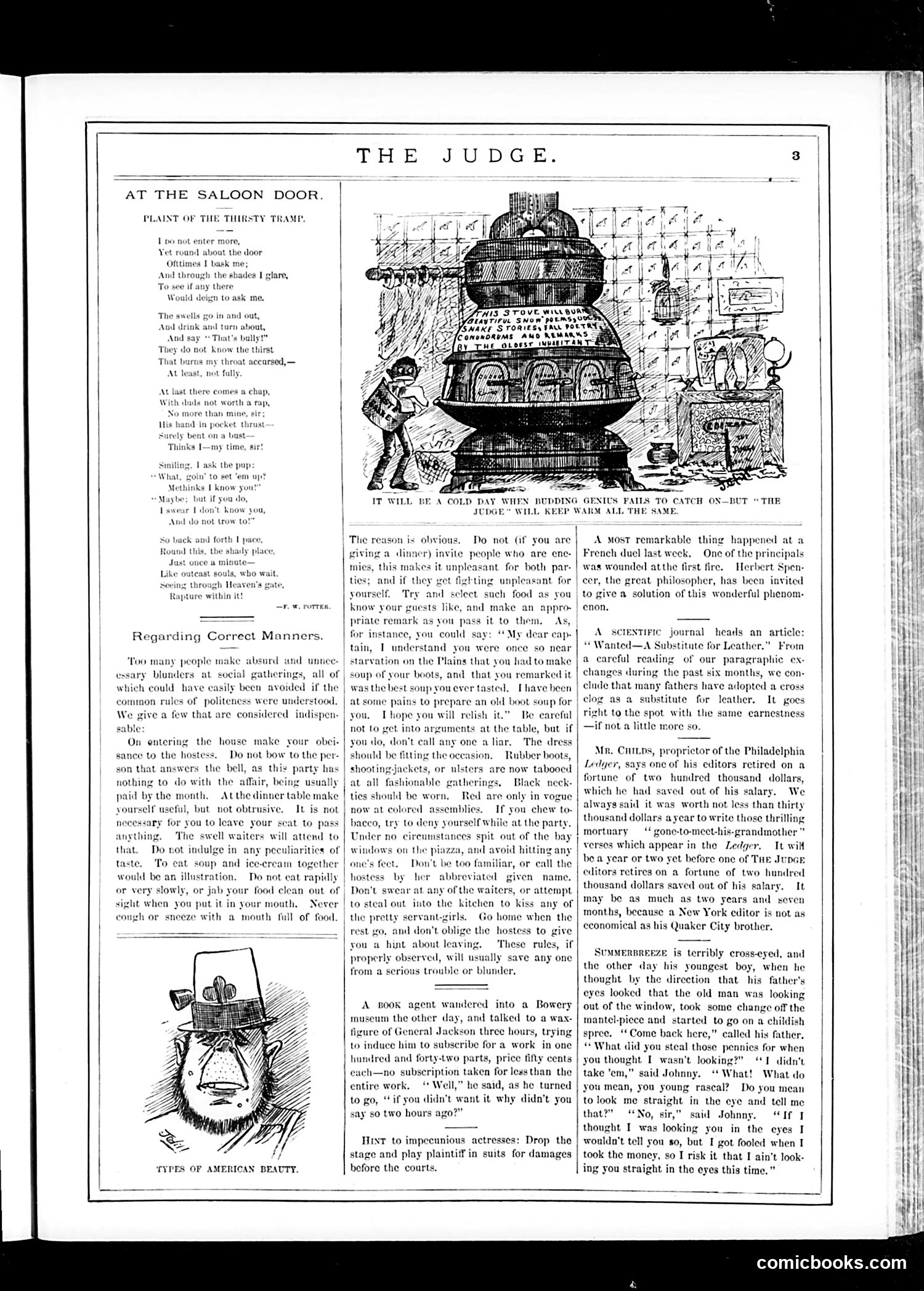
This Judge magazine page satirizes American social manners and etiquette through multiple pieces. The main cartoon shows a stove ("It Will Be a Cold Day When Budding Geniuses Fall to Catch On—But 'The Judge' Will Keep Warm All the Same"), using the stove as metaphor for Judge magazine's durability despite trends. The "Regarding Correct Manners" section mocks upper-class pretension by offering deliberately absurd etiquette advice—like serving old boot soup to dinner guests or wearing rubber boots to formal gatherings. The humor lies in satirizing both wealthy hosts' snobbery and the nouveau-riche's anxious social climbing. The tramp's poem and anecdotes (book agent pitching to a wax museum figure, actress hint) mock gullibility and social desperation. Overall, the page ridicules Gilded Age class consciousness and the anxiety surrounding "proper" social behavior among aspirational Americans.
📄 Transcribed text from this page (OCR, searchable)
Machine-transcribed from the original scan — historical spelling and the odd misread are preserved.
DOOR. AT THE SALOON PLAINT OF THE THIRSTY TRAMP. I bo not enter more, Yet round abo Ofttimes I bs And through t To see if any there shades The swells go in and out, nk and turn about, And say ** That's bully They do not know th That t At le rns my throat not fally At last there comes a chap, With Nom Mis hand bent on a bus Thinks I snot worth a rap, ethan m: pocket thi my time the pup o set “em up? Methinks I know yout” if you do, t know you, ot trow to!” Regarding Correct Manners. ‘Too many people make absurd and unnee: ry blunders at social gathe all of h could have easily been avoided if the sof politene ve a few that are considered indispen- ings, whi common ri We sable On entering the house make sance to the hostess. Do not bow to the per- son that answers the bell, as this party has were understood, your obei- nothing to do with the affair, being usually | paid by the month, Atthe dinner table make yourself useful, but not obtrusiv It is not ry for you to leave your seat to pass anything. The swell waiters will attend to that. Do not indulge in any peculiarities of taste. To cat soup and i would be an illustration. or very sh or jab you Do not ¢: food ¢ r mouth, a mouth full of slowly sight when you put it in y ‘hor sneeze with ‘TYPES OF AMERICAN BEAUTY. fa tayTifve SNOW pO JUDGE The reason is obvio giving a dinner) invit mies, this make t nd if the yourself, ‘Try know your guests like, and make priate remark people who are ene- it unpleasant for both par- t fighting unpleasant for nd select such food as you an appro- ou pass it to them. As, for instance, you could say: ‘My dear tain, I understand you were once so near starvation on the Plains that you had to make soup of your boots, and that you remarke Dest soup you ever tasted. [have be atsome pains to prepare an old boot soup for you. [hope you will relish it.” Be eareful | not to get into arg’ at the table, but if | | ap. was you do, don’t call any one a The dress should be fitting the occasion. Rubber boots, shootingjackets, or ulsters are now tabooed ut all fashionable gatherings, Black neck- | ties should be worn, Red are only in vo | now at colored assemblies. , try to deny yoursel ue If you chew to- while at the party, ces spit out of the bay avoid hitting any miliar, or call the her abbreviated given name. rat any of the waiters, or attempt out into the kitchen to kiss any of the pretty servant-girls. Go home when the rest zo, and don't oblige the hostess to give hint about leaving These rules, if properly observed, will usually save any one from a serious trouble or blunder, ba Und | windows on th Don't be too r no cireut Don't | you A Book agent wandered into a Bowery museum the other day, and talked to a wax- figure of General Jackson three hours, trying to induce him to subscribe for a work in one | hundred and forty-two parts, price fifty cents ch—no subscription taken for less than the entire work.‘ Well,” he said, as he turned to go, “if you didn’t want it why didn’t you so two hours ago?” HiNT to impecunious actresses: Drop the stage and play plaintiff in suits for damages before the cout! Do not Gf you are AIS. STOVE MINA BURNER Ems out ARE S TORIES, FAL POLT SOMORORYME. AMD REMARAS: an yd IT WILL BE A COLD DAY WHEN BUDDING ¢ WILL KEEP WARM ALL THE SAME. | clude that many fathers have adopted a cross | bea year or two yet before one of Tae JUDGE IUS FAIS TO CATCH ON—BUT “THE A Most remarkable thing happene French duel last week, One of the prin was wounded atthe first fire. Herbert Spen- cer, the great philosopher, has been invited to give a solution of this wonderful phenom- chon, A sctestiFic journal heads an article: “Wanted—A Substitute for Leather.” From eful reading of our parag ange phic ex s during the past six months, we con- clog as a substitute for leather. It goes t to the spot with the same carnestness not a little more so. Mr. Ciitps, proprictor of the Philadelphia Ledger, says one of his editors retired on a fortune of two hundred thousand dollars, which he had saved out of his salary. We always said it was worth not less than thirty thousand dollars ayear to write those thrilling mortuary —‘‘ gone-to-meet-his-grandmother " verses which appear in the Ledger. It will editors retires on a fortune of two hundred thousand dollars saved out of his salary. It may be as much as two years and xeven months, because a New York editor is not as economical as his Quaker City brother. SuvMersre terribly cross-eyed, and the other day his youngest boy, when he thought by the direction that his father's eyes looked that the old man was looking out of the window, took some change off the mantel-piece and started to go on a childish spree. ‘Come back here,” called his father. “ What did you steal those pennies for when ‘ou thought I wasn’t looking?” “1 didn't take ‘em,” said Johnny. ‘What! What do you mean, you young rascal? Do you mean to look me straight in the eye and tell me tha “No, sir,” said Johnny, “If 1 thought I was looking you in the eyes I wonldn't tell you so, but I got fooled when I took the money, so I risk it that I ain't look- ing you straight in the eyes this time.” comicbooks.com