
A complete issue · 16 pages · 1882
Judge — July 22, 1882
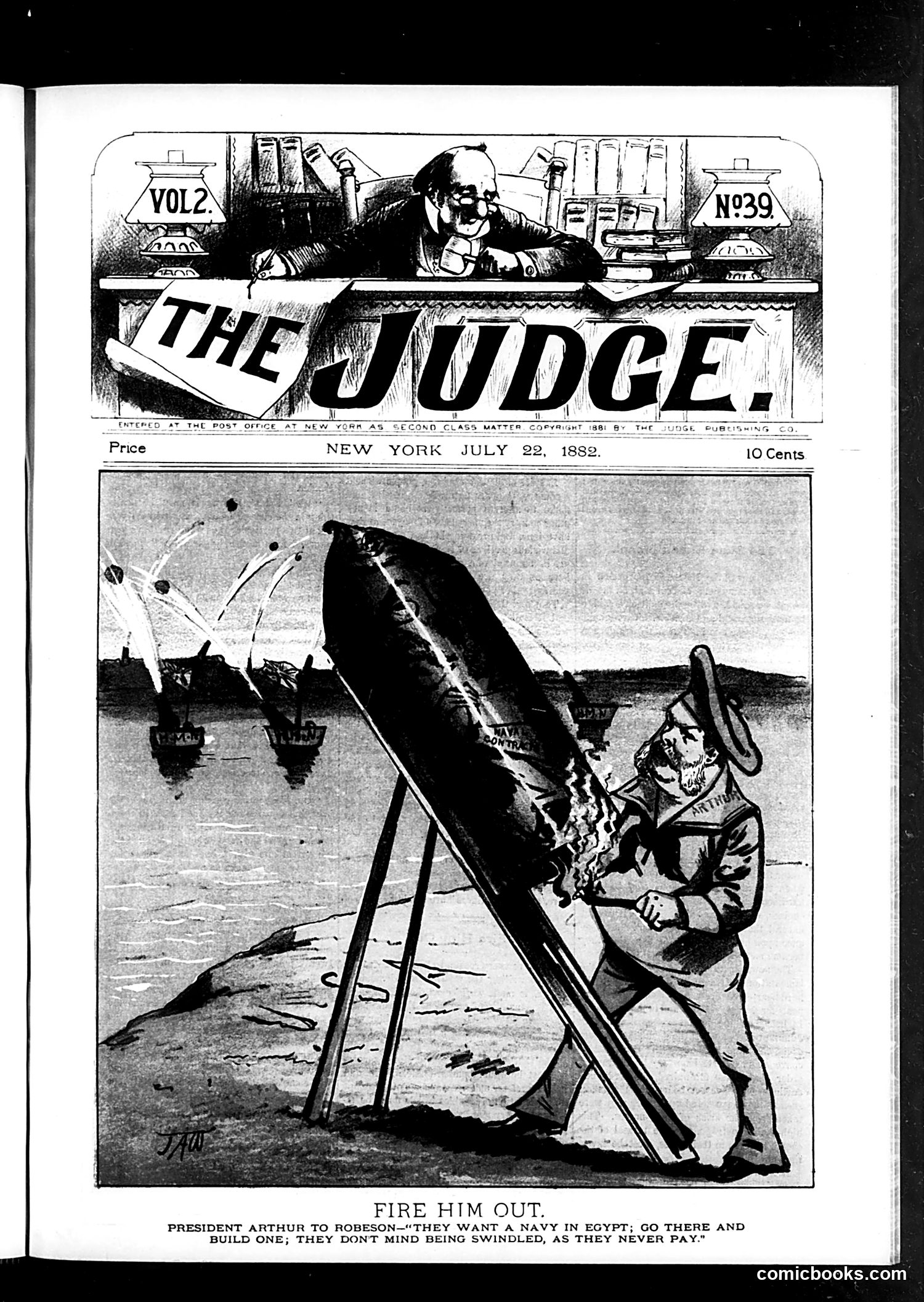
This cartoon satirizes President Chester Arthur's alleged plan to send someone (likely Secretary of Navy George M. Robeson, based on the caption) to Egypt to build a navy there, with the cynical joke that Egypt won't pay for it anyway. The cartoon depicts a large naval cannon or explosive device being fired, with small ships visible in the background waters. The satire targets both American foreign policy adventurism and corruption—suggesting the administration would dispatch officials on expensive, dubious international projects to incompetent or unwilling clients, essentially defrauding them. The "Fire Him Out" title suggests removing Robeson from office through this absurd assignment. This reflects 1880s political criticism of Arthur's administration's naval spending and foreign entanglements during a period of post-Reconstruction political uncertainty.
This page contains two distinct satirical pieces: **"The State Encampment"** mocks wealthy National Guard volunteers complaining about harsh camp conditions at Peekskill. Judge sarcastically defends their grievances—poor food, no ballroom dancing with ladies—treating legitimate military hardship as entitled whining from "peaceful soldiers" expecting Fifth Avenue luxury rather than actual camp life. **"What May Be"** is an antisemitic piece predicting Jewish dominance in America within twenty years. It stereotypes Jewish people as "naturally aggressive" and claims they're "making themselves perfectly at home" in countries they adopt. This reflects 19th-century prejudices common in such publications. The magazine's tone throughout is biting irony, using exaggeration to ridicule both the soft National Guardsmen and, disturbingly, to express xenophobic anxieties about Jewish immigration and influence—views that were mainstream in period satirical publications but are now recognized as offensive and discriminatory.
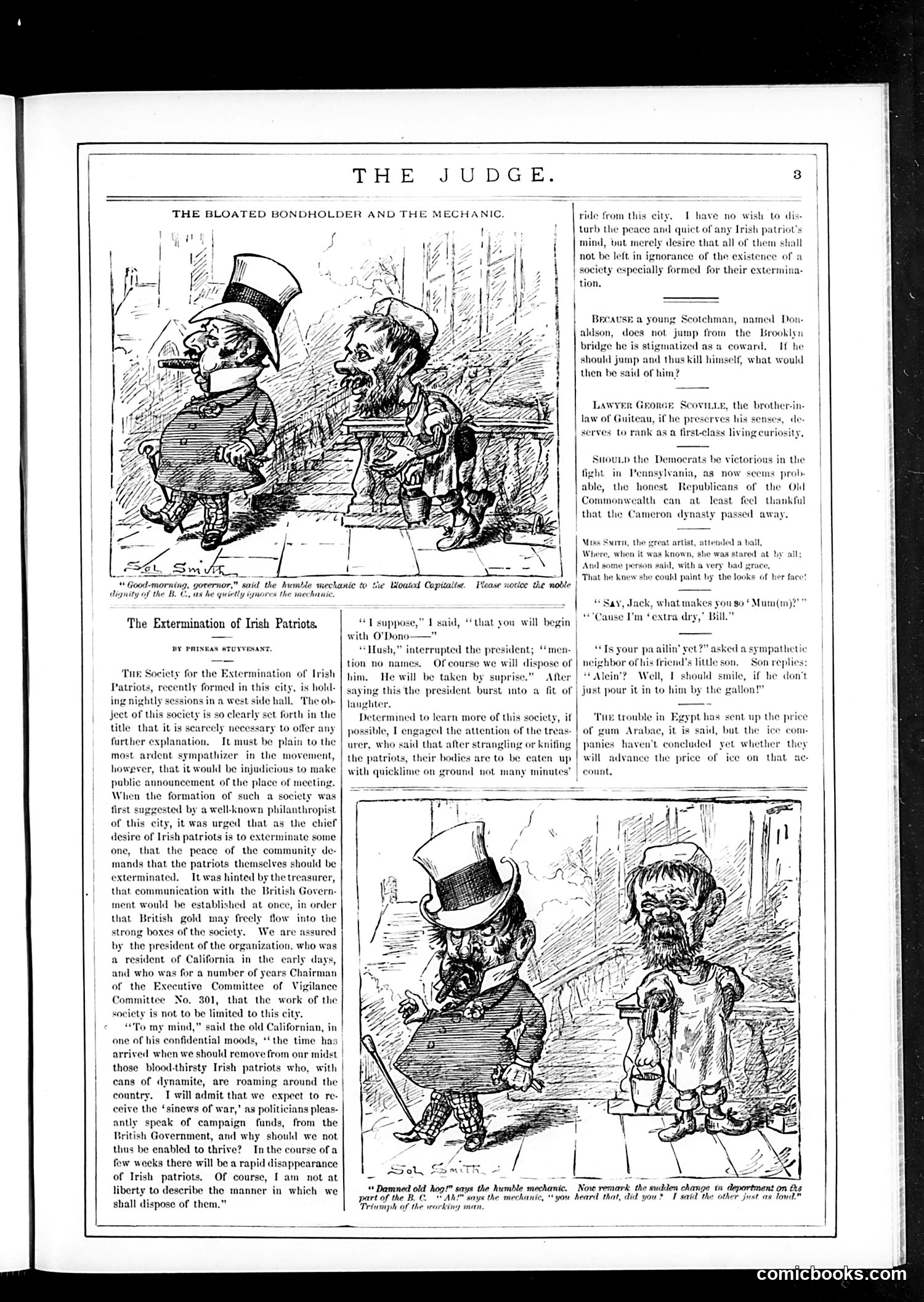
This page contains two satirical pieces attacking Irish immigrants and political corruption in late 19th-century America. **Top cartoon**: "The Bloated Bondholder and the Mechanic" depicts class conflict. A wealthy capitalist ignores a working mechanic's greeting, illustrating economic inequality and the indifference of the rich toward laborers. **Main article**: "The Extermination of Irish Patriots" satirizes nativist hysteria by describing a fictional society formed to eliminate Irish immigrants, framed as dangerous "dynamite-wielding" anarchists. The satire reveals the article's true target: American elites (particularly a former California vigilante) willing to accept British funding to suppress Irish political activism. The piece mocks xenophobic fears while exposing how anti-Irish sentiment served economic and political interests. **Bottom cartoon**: Shows the mechanic's contemptuous response to the capitalist, reversing the power dynamic through verbal mockery. The page reflects 1880s-90s tensions over Irish immigration, labor organizing, and Irish-American nationalist movements, targeting both anti-Irish prejudice and corrupt collaboration between American wealth and British interests.
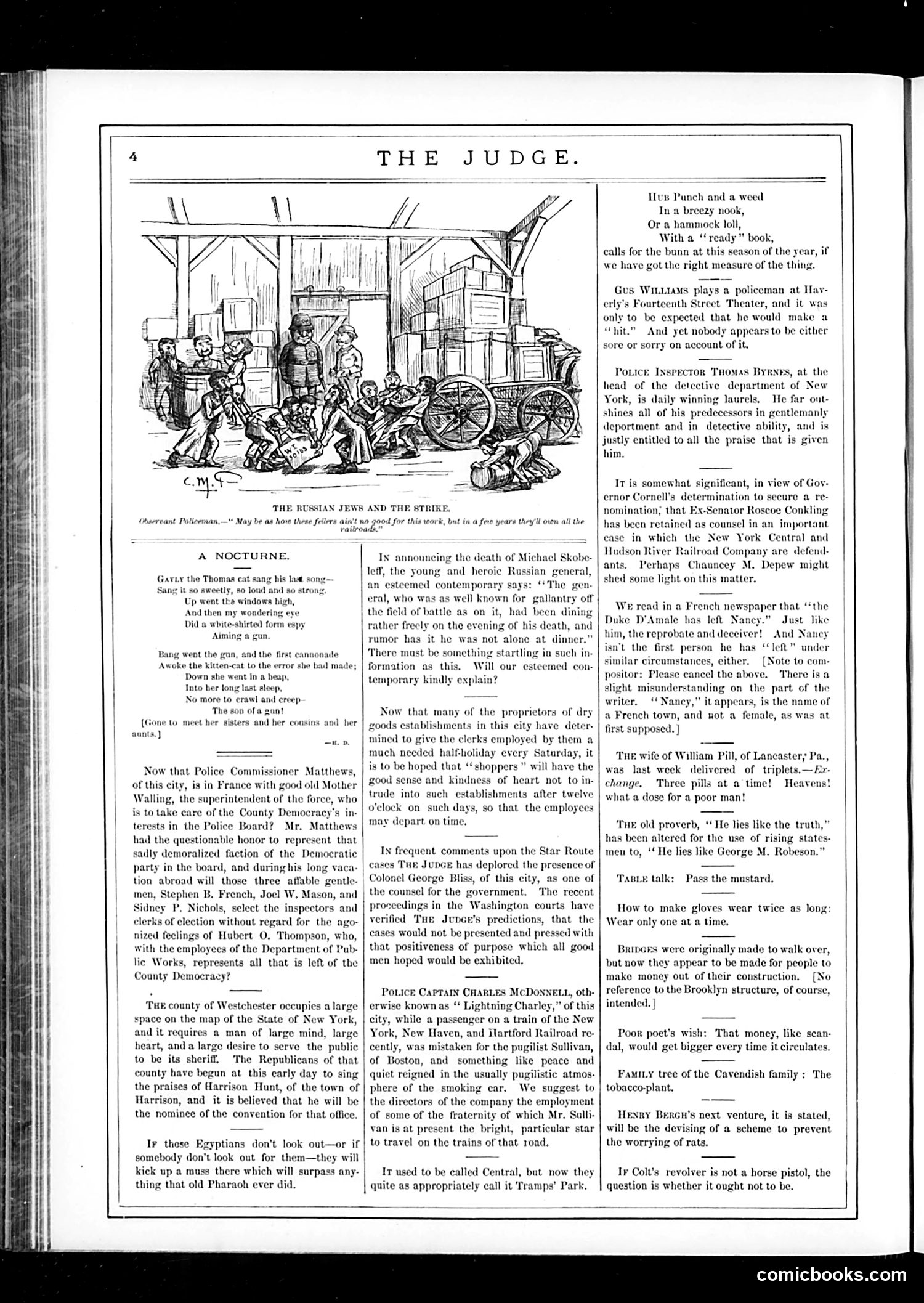
This *Judge* page combines satirical commentary on 1880s New York politics and society with lighter humor pieces. **Main Cartoon:** "The Russian Jews and the Strike" depicts laborers and a cart, likely referencing Jewish immigrant workers and labor disputes—a contemporary social concern in New York. **Political Satire:** The text critiques Police Commissioner Matthews for being absent in France while Democratic Party operatives (French, Mason, Nichols) control police appointments without input from Hubert O. Thompson's faction. This reflects internal Democratic Party feuding. **Other Jabs:** References to Police Captain McDonnell being mistaken for boxer John L. Sullivan (a celebrity of the era); criticism of prosecutor George Bliss's handling of Star Route mail fraud cases in Washington; and commentary on department store clerks needing Saturday half-days. The "Nocturne" poem is unrelated humorous verse. The overall tone is typical *Judge* mix: partisan Democratic criticism, social observation, and celebrity gossip.
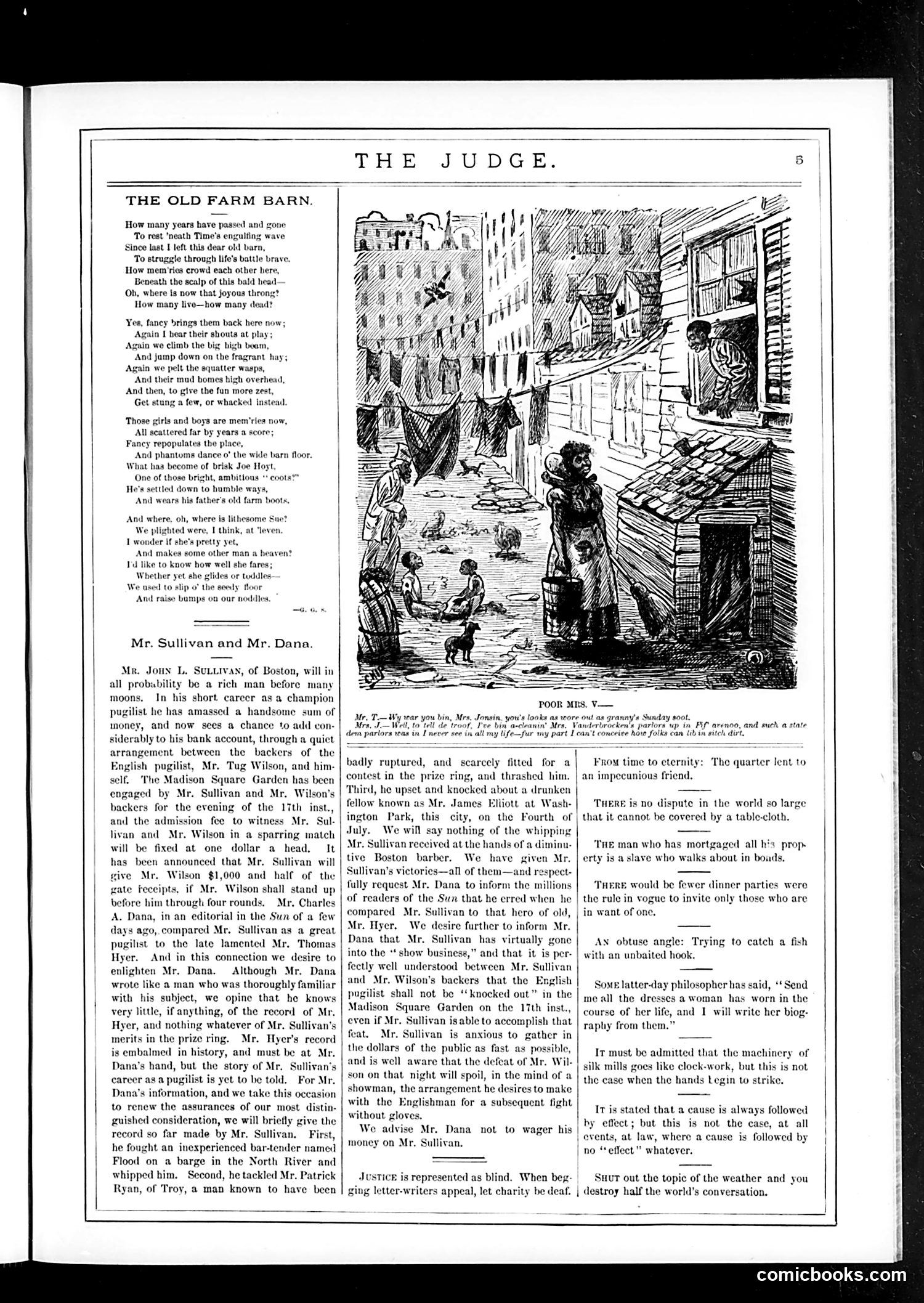
This *Judge* page contains two distinct pieces: a sentimental poem "The Old Farm Barn" about nostalgia and lost youth, and a satirical article about boxer John L. Sullivan. The Sullivan piece mocks *New York Sun* editor Charles A. Dana for comparing Sullivan to legendary boxer Tom Hyer. The satire undercuts Sullivan's reputation by listing his actual fights: he beat an inexperienced bartender named Flood on a barge, fought the injured Patrick Ryan, knocked around a drunk named James Elliott at Washington Park on July 4th, and was whipped by a Boston barber. The article suggests Sullivan has become a carnival attraction rather than a serious fighter, sarcastically praising Dana's "distinguished consideration" while correcting his historical comparison. The accompanying illustration "Poor Mrs. V—" (bottom) depicts urban poverty: children playing in a filthy alley, referenced in a caption questioning how people survive in such conditions.
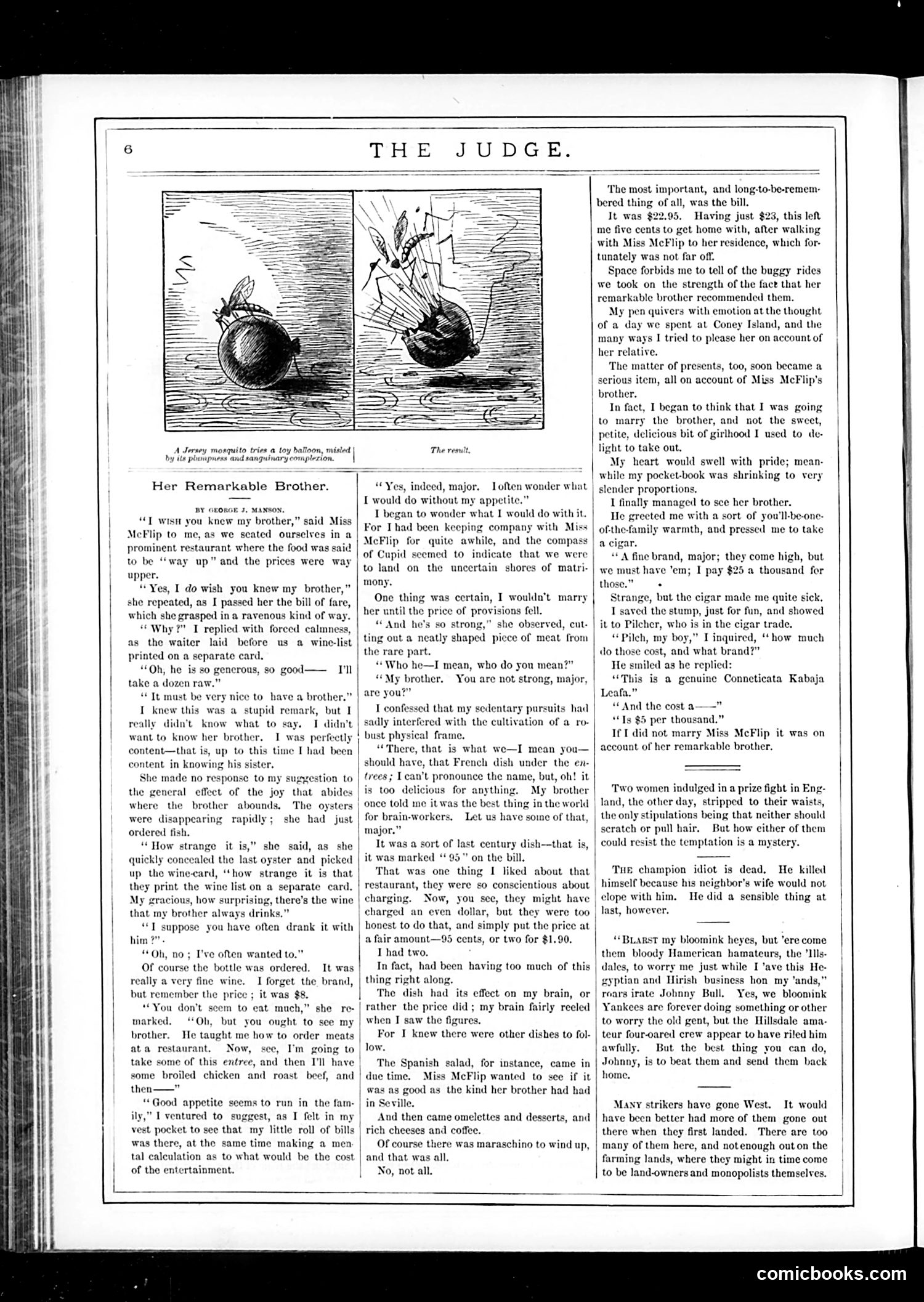
This page contains two satirical pieces: **The Cartoon (top):** A Jersey mosquito mistakes a toy balloon for a blood-filled body, attempting to feed on it. The humor is regional mockery—Jersey mosquitoes were legendary for their size and voracity, making them stock figures of American rural humor. **"Her Remarkable Brother" (main story):** A social satire about a gold-digger. Miss McFlip repeatedly references her "generous" brother while ordering expensive restaurant items—oysters, wine ($8), rare meats, and French dishes marked at inflated prices (95 cents). The narrator, her suitor, grows increasingly horrified at the escalating bill. The joke: she's using the fictional brother as a conversational prop to justify ordering luxuriously while subtly pressuring him to pay. By story's end, he's calculating whether he can afford to marry her—the real subject of her appetite-focused manipulation. The satire mocks both feminine consumerism and the economic anxiety of courtship during this era, when men bore financial responsibility for dating.
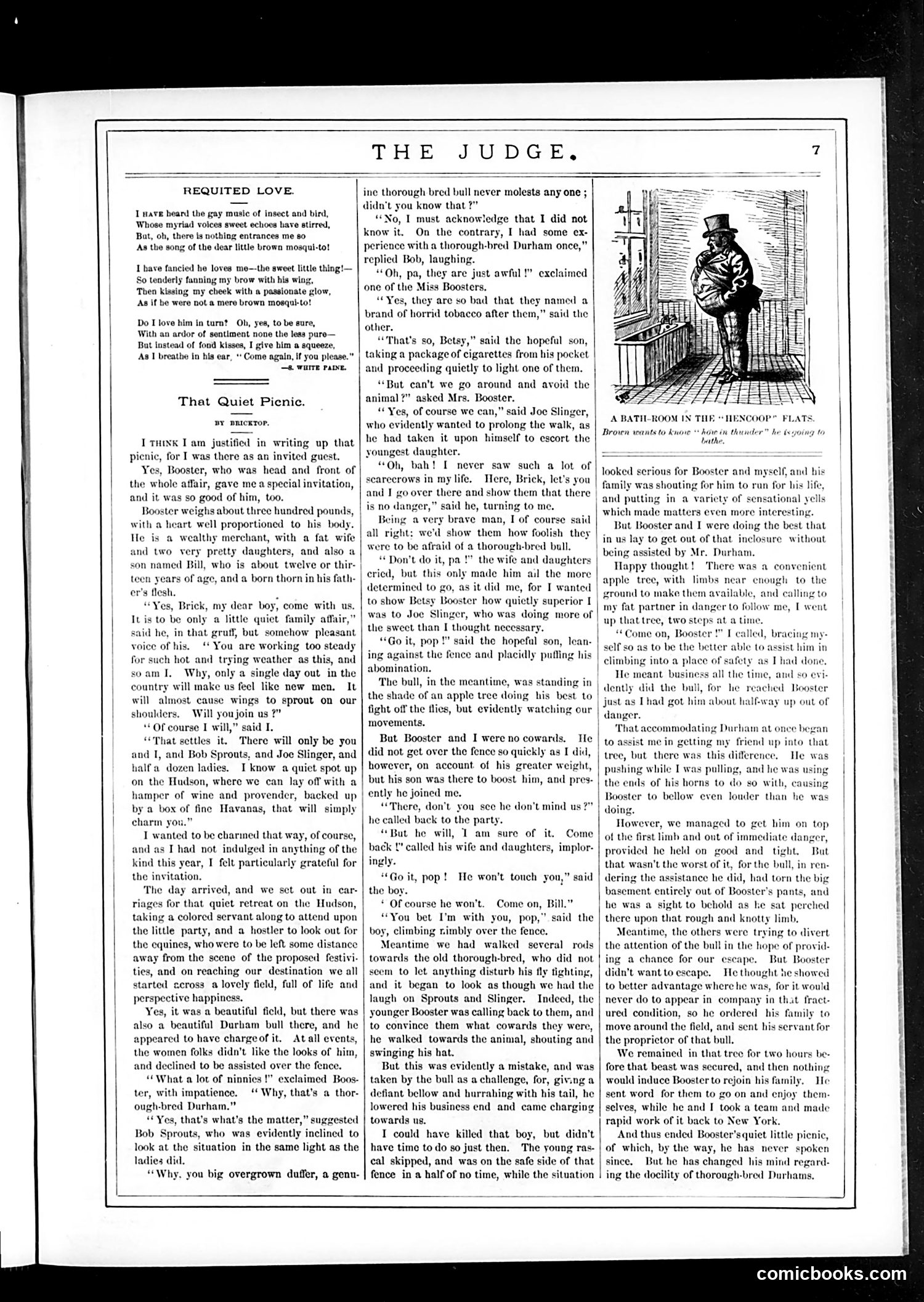
This page contains two humor pieces from *Judge* magazine. "Requited Love" is a brief poem satirizing romantic sentimentality by comparing human courtship to a mosquito encounter—the narrator loves the mosquito's "kisses" but reciprocates with violent swatting. The main story, "That Quiet Picnic," is a comedic narrative about a wealthy merchant named Booster who invites friends on what he promises will be a peaceful Hudson River outing. The humor derives from the tension between his assurances and reality: he insists a "thorough-bred Durham bull" in the picnic field is harmless, but his guests—including women and the cautious Bob Sprouts—are reasonably terrified. The story satirizes male overconfidence and dismissal of women's legitimate safety concerns, played for laughs as Booster confidently contradicts their fears with dubious expertise. The illustration shows a man in a bath house, likely depicting another unrelated anecdote or advertisement.
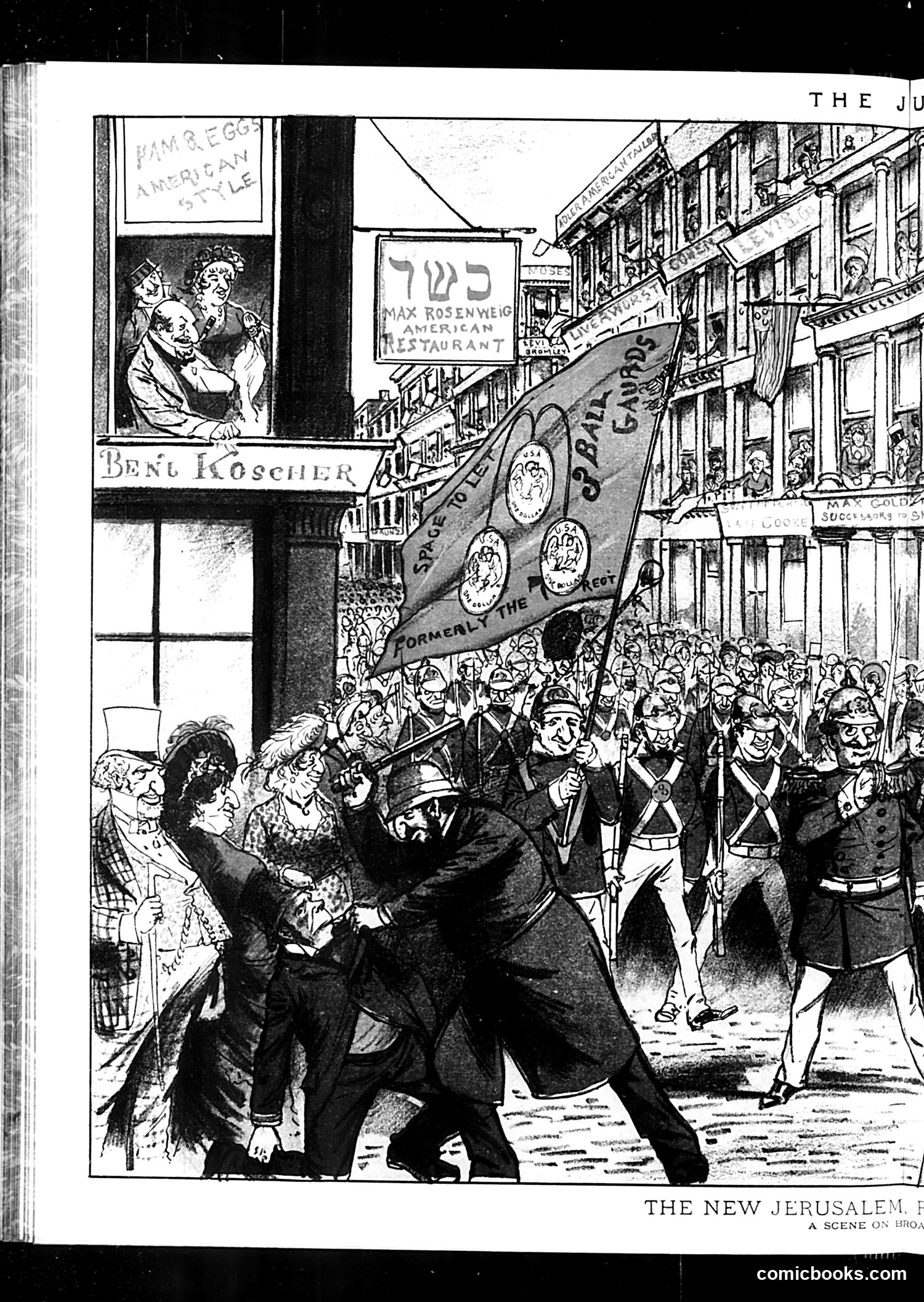
This Judge magazine illustration depicts "The New Jerusalem" - a satirical scene on Broadway showing a street procession. The cartoon uses Jewish cultural references (Hebrew signage visible on storefronts like "Max Rosenweig's Restaurant" and "Berl Koschler") to caricature Jewish immigrants and their establishments in New York's Lower East Side. The large banner and marching figures suggest a parade or demonstration. The detailed architectural backdrop and crowded street represent the densely populated immigrant neighborhood. The style of caricature and exaggerated features reflect the antisemitic visual conventions common in early 20th-century American satire magazines like Judge. The title "The New Jerusalem" sarcastically references the biblical promised land, mocking the Jewish immigrant community's presence in Manhattan.
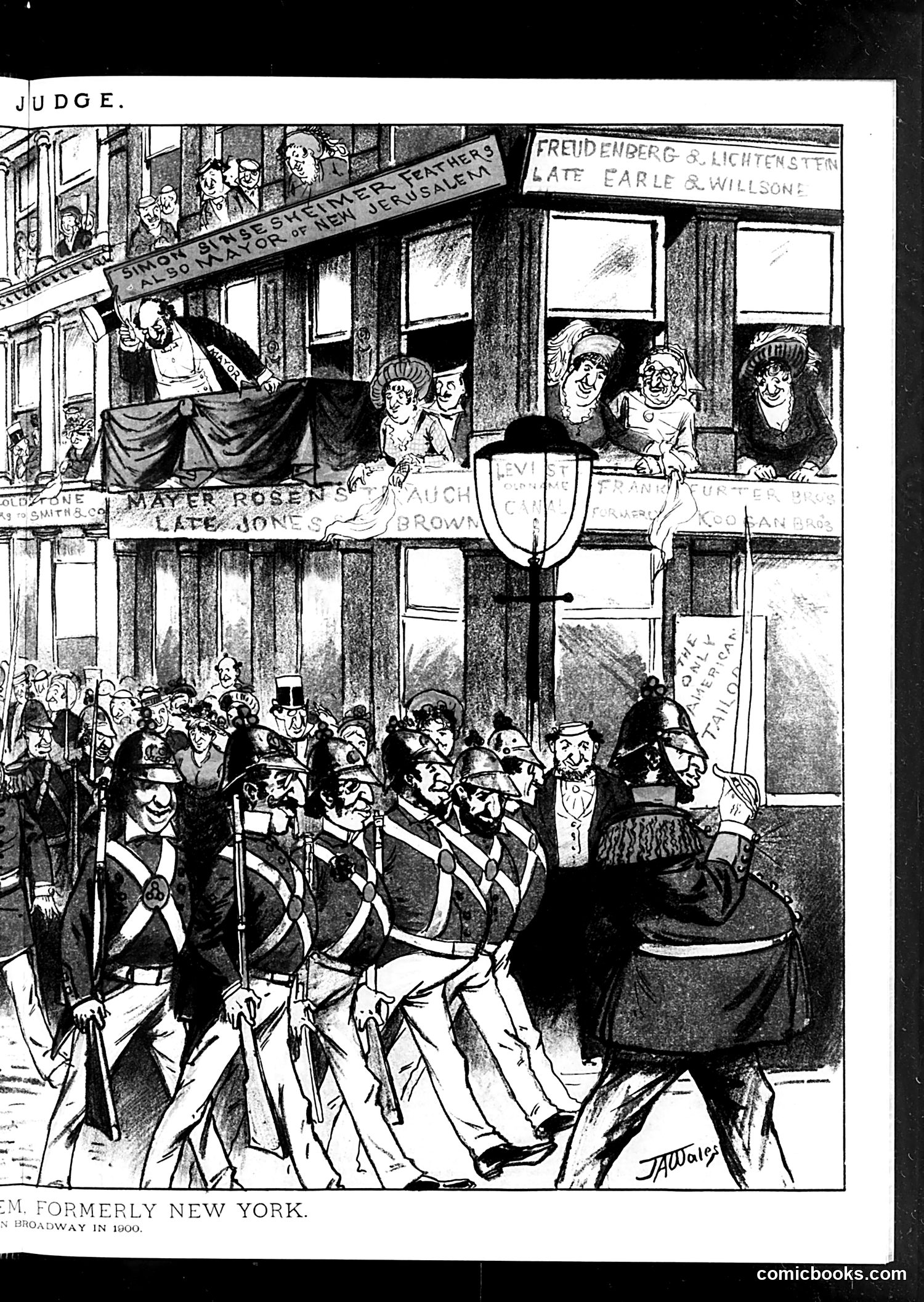
This political cartoon satirizes a parade or procession of military/official figures marching past a building. The visible text references several named individuals including "Mayor Rosen," "Mayer," and references to "Freudenberg & Lichtenstein" and "Late Earle & Wilson" (visible on storefront signs). The upper windows show spectators—appearing to be wealthy citizens or officials—observing the parade from above. The lower street shows uniformed military or police figures in formation marching past. The satire likely critiques either: - Municipal corruption or favoritism in awarding contracts/positions - Class divisions between wealthy observers and marching officials - Post-1900 New York City political machinations The specific individuals referenced and exact event remain unclear without additional context, but the cartoon clearly mocks official pageantry and the relationship between power-holders and common citizens.
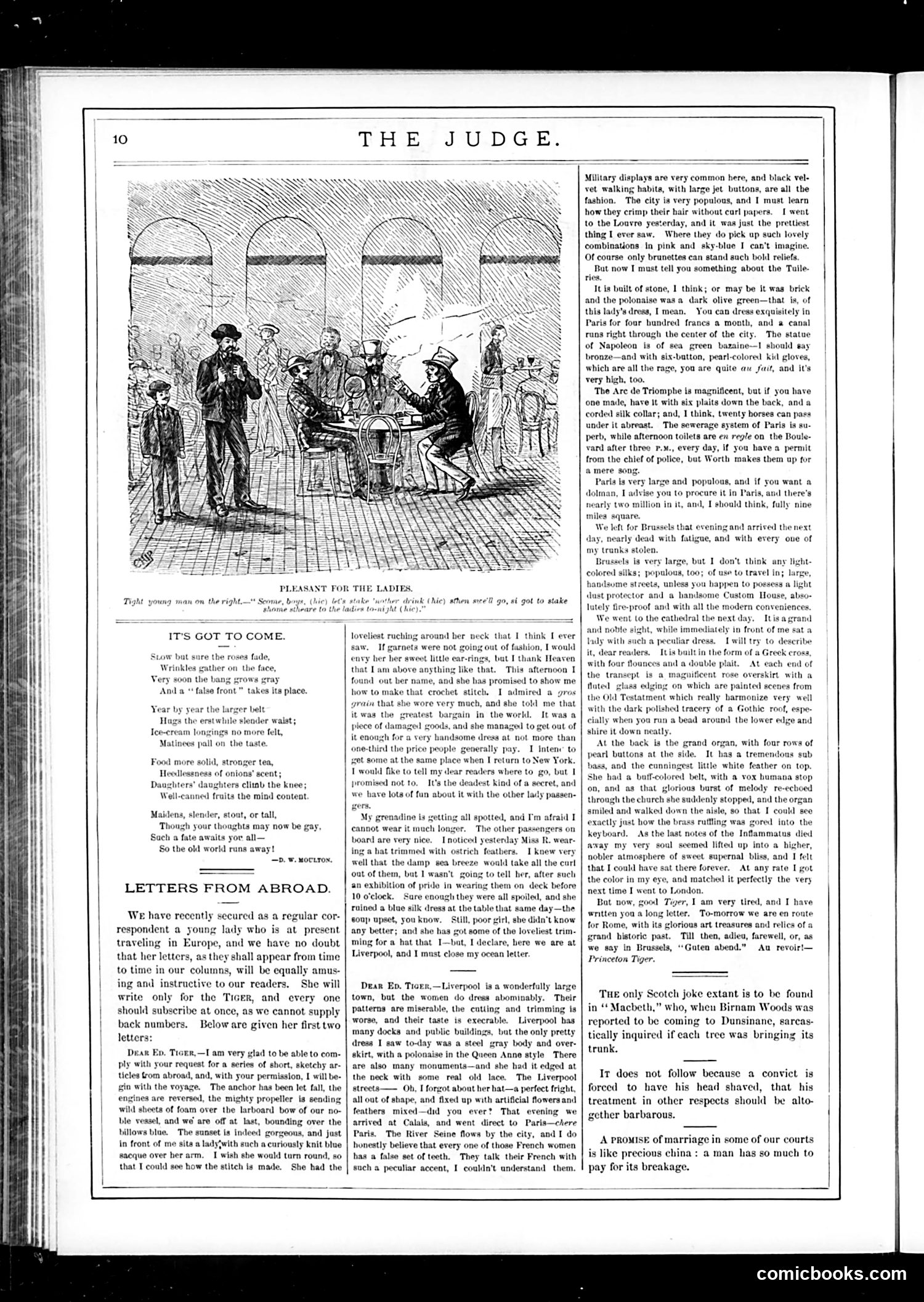
This page contains two satirical pieces about women's fashion and aging. **"Pleasant for the Ladies"** (top cartoon and poem) mocks the inevitable physical changes women experience with age. The illustration shows a crowded street scene, while the accompanying verse by P. W. Moulton cynically predicts women's decline: disappearing beauty, expanding waistlines, loss of refined tastes, and abandonment of youthful interests. The satire targets both women's vanity about appearance and society's cruel indifference to female aging. **"Letters from Abroad"** (bottom section) features a correspondent's observations from Europe, apparently focusing on women's fashion choices and material consumption. The letters satirize female travelers' obsession with clothing details, bargains, and competitive fashion assessment—mocking their preoccupation with dress while also critiquing their poor taste (particularly Liverpool women's "abominable" fashion sense). Both pieces represent 19th-century satirical humor about women, emphasizing appearance, consumption, and social pretension as typical female concerns.
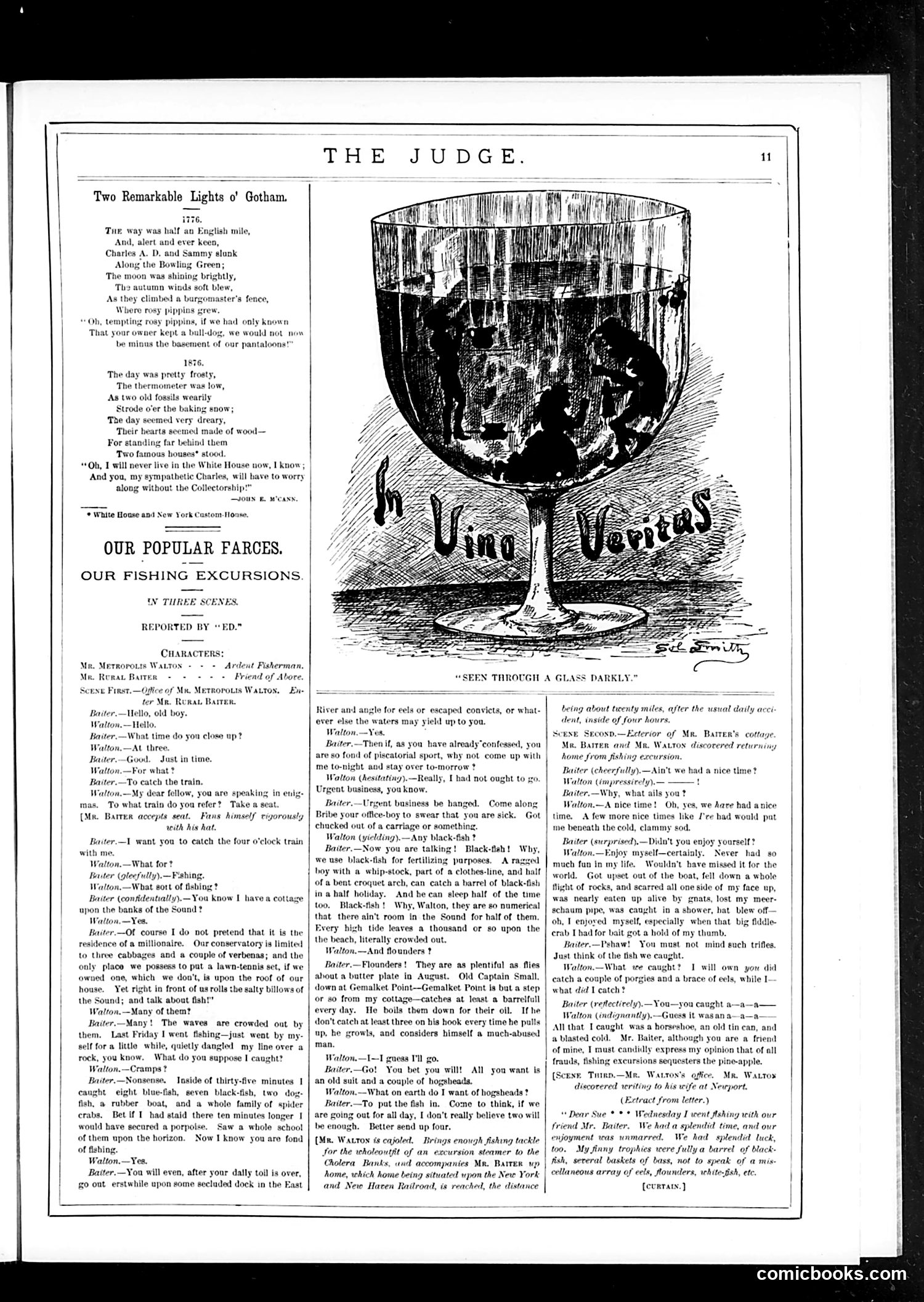
This page contains two distinct pieces. The main cartoon depicts two figures labeled as representing the **White House and New York Custom House**—likely political offices or positions that had become vacant or were in dispute in 1876 (the date shown). The poem's commentary about characters never living in "the White House" and worrying about losing "the Collectorship" suggests this satirizes recent changes in political appointments or electoral outcomes, possibly related to the 1876 presidential election and associated patronage positions. The figures are shown trapped or confined "in a glass darkly," suggesting political figures feel trapped or unable to see clearly during uncertain times. The satire mocks politicians' anxiety over losing prestigious federal positions. Below is an unrelated humorous dialogue about fishing excursions—standard comedic filler content typical of *Judge* magazine.
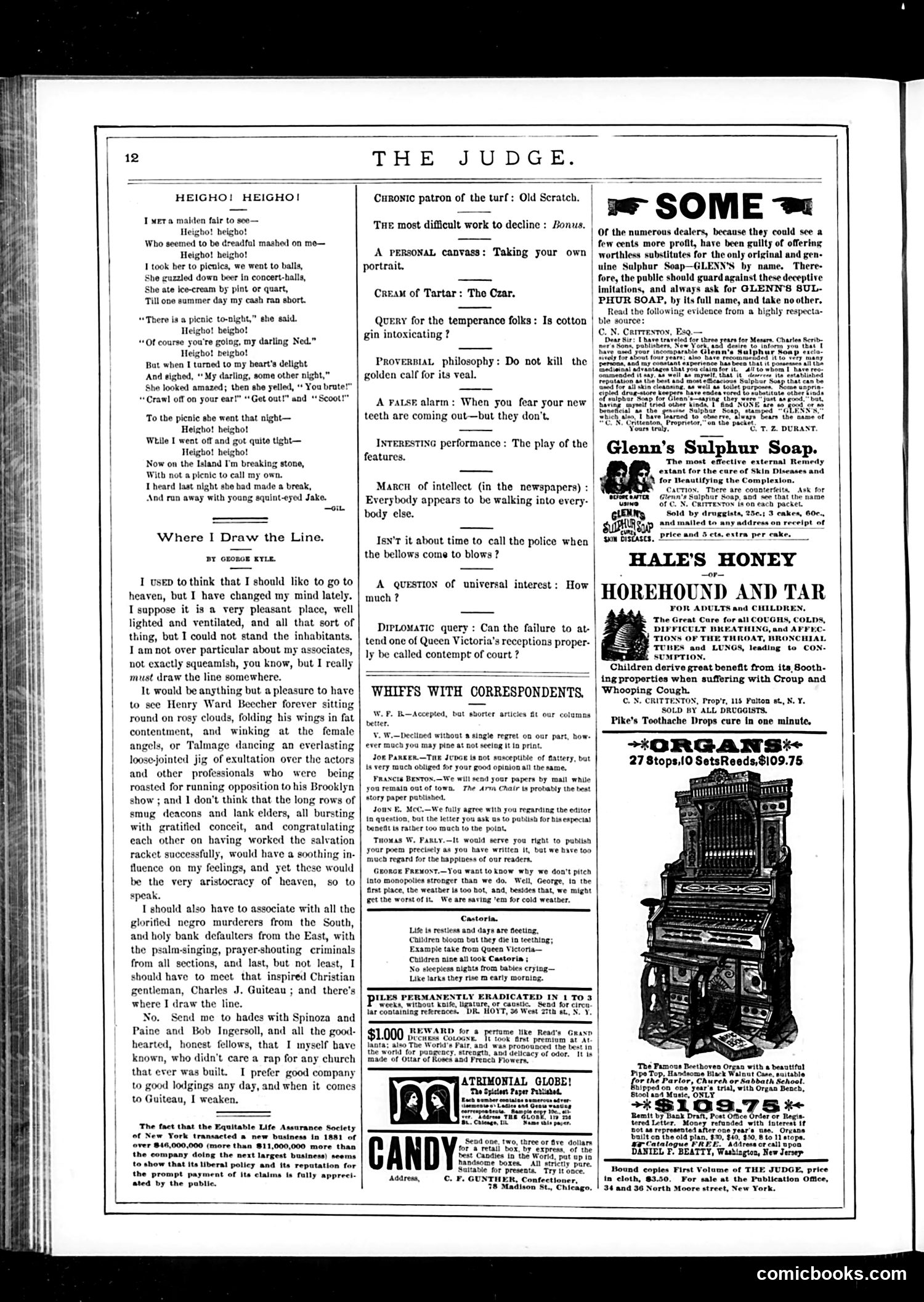
This page from *Judge* magazine contains primarily **satirical short humor pieces and advertisements**, rather than a political cartoon. The main content, "Where I Draw the Line" by George Kyle, is a satirical essay mocking religious hypocrisy. The author expresses he'd prefer Hell with intellectuals like Spinoza, Paine, and Ingersoll over Heaven populated with self-righteous clergy, corrupt deacons, and notably **Charles J. Guiteau** — the assassin of President Garfield (1881). This reference dates the piece to shortly after that assassination. The satire attacks sanctimonious religious figures and suggests moral corruption exists among ostensibly "saved" Christians. The opening poem "Heigho! Heigho!" is a sentimental/comedic story about a man ruined financially by dating an expensive woman who abandons him for another man — typical period humor about courtship and social climbing. The bottom section contains brief witty definitions and wordplay ("Cream of Tartar: The Czar"), standard filler content for the era. The page is **primarily advertising** below the editorial content.
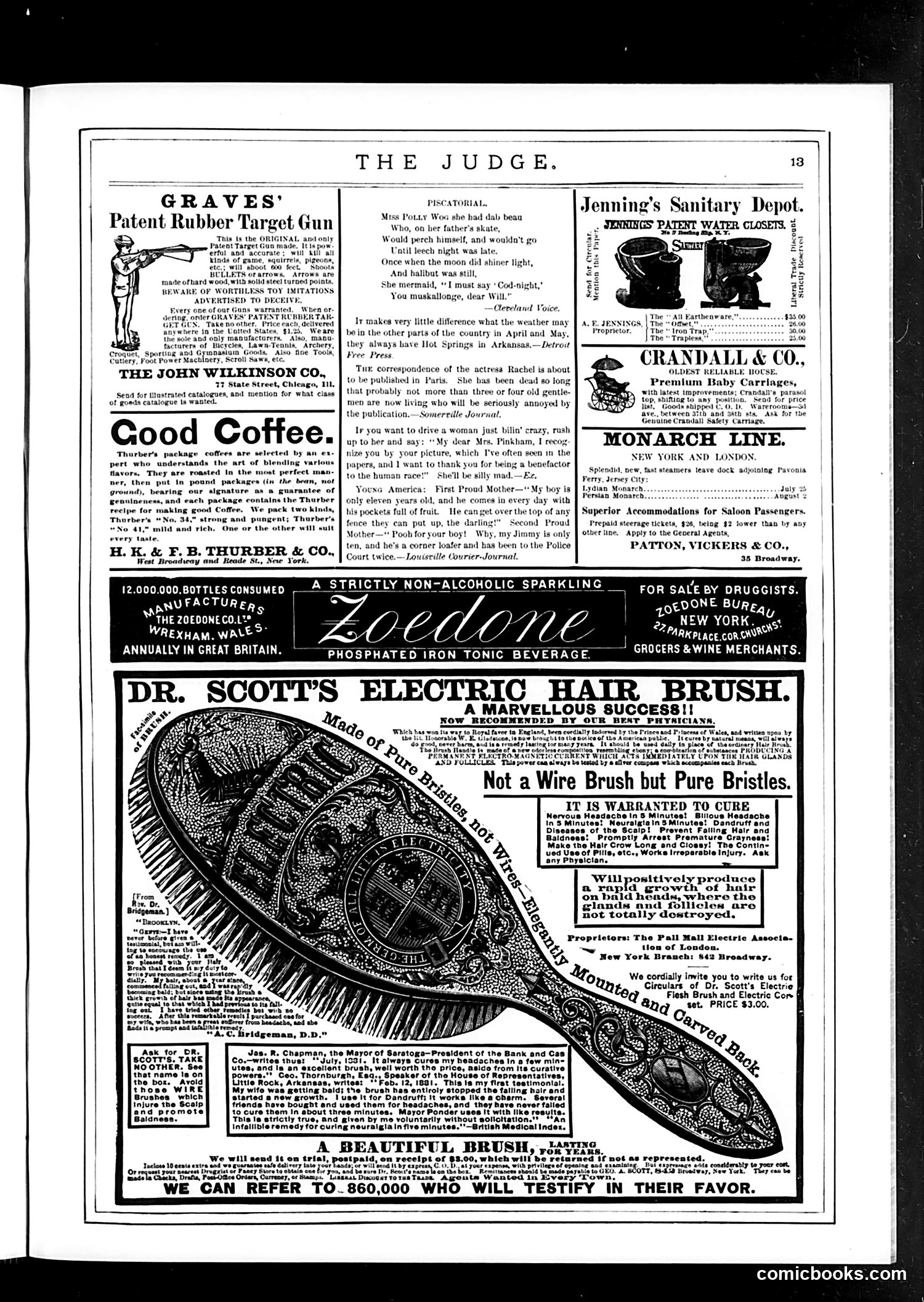
This is primarily an **advertising page** from Judge magazine, with minimal editorial content. The small satirical pieces are brief humor columns typical of the era. The notable content includes: **"FISCATORIAL"** — A short humorous poem about a mermaid rejecting a suitor ("Will"), playing on fishing/romantic terminology. **Scattered joke items** — Brief satirical observations about: - Weather differences by region (Arkansas always has hot springs) - The actress Rachel's forthcoming correspondence causing no scandal (she's been dead so long) - Women's vanity when recognized - Competitive parenting boasts among mothers **Dominant content**: Patent medicines and consumer goods advertisements typical of 1890s magazines—rubber target guns, coffee, hair brushes, ocean liners, baby carriages, and tonic beverages. The **Dr. Scott's Electric Hair Brush** advertisement is particularly prominent, claiming to cure baldness and dandruff through electrical stimulation—a common pseudo-scientific remedy of the period. The page reflects Judge's format: light social satire alongside aggressive advertising for dubious patent products now recognized as quackery.
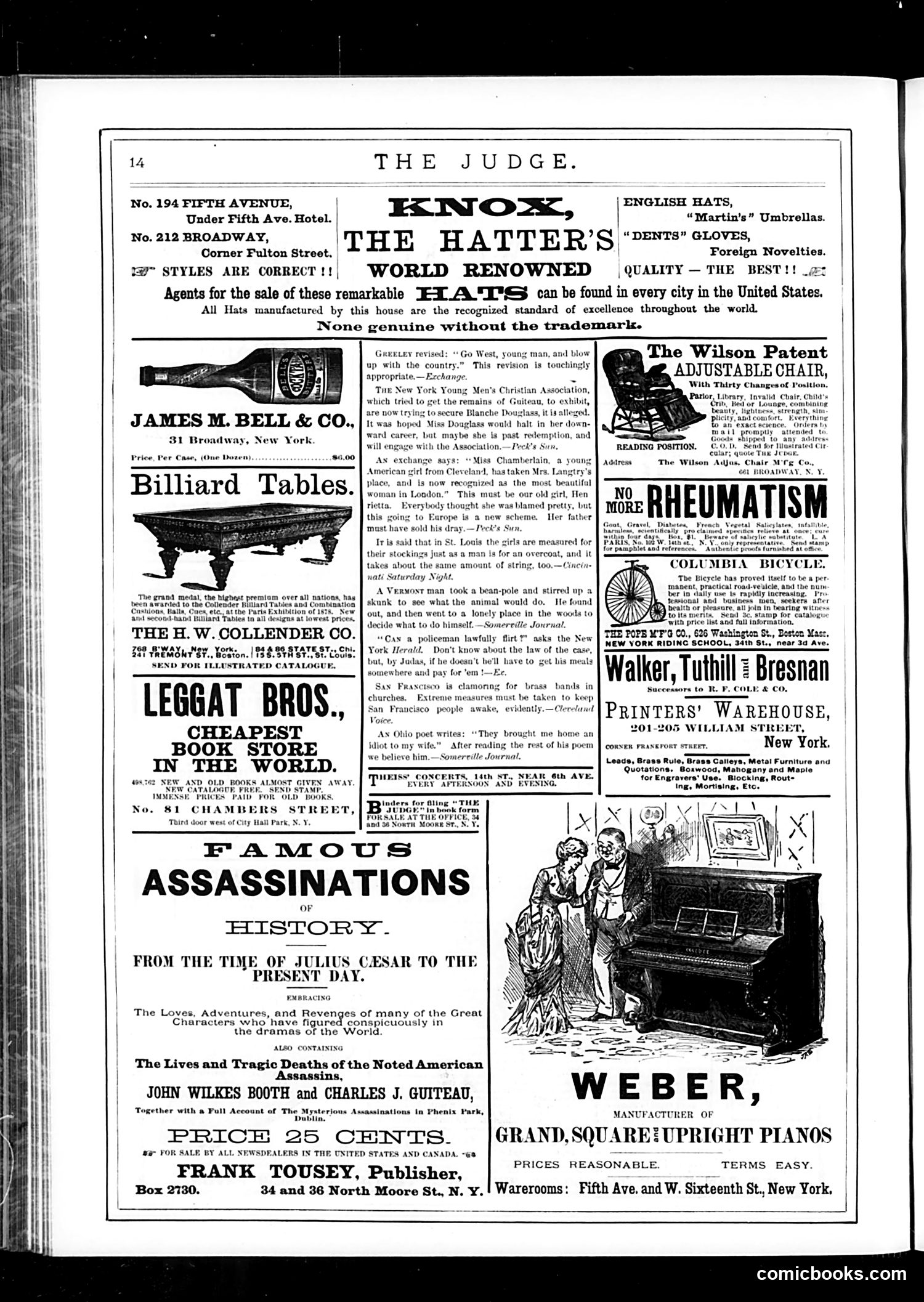
This page is **primarily advertisements** with minimal editorial cartoon content. The visible illustration shows two figures at a piano, accompanying a Weber piano advertisement—a straightforward commercial image with no satirical intent. The substantial text content advertises various products: Knox hats, James M. Bell billiard tables, Wilson adjustable chairs, a Columbia bicycle, and Weber pianos. There is also a prominent ad for a sensationalist book titled "Famous Assassinations of History," featuring the murders of Lincoln (John Wilkes Booth) and President Garfield (Charles J. Guiteau), marketed at 25 cents. The scattered text fragments appear to be humor snippets or anecdotes (references to Vermont men, policemen, bean-poles), typical of Judge's miscellaneous filler content, but they're too fragmented in the OCR to extract coherent satirical meaning. **This is essentially an advertising-heavy page with minimal identifiable political or social satire.**
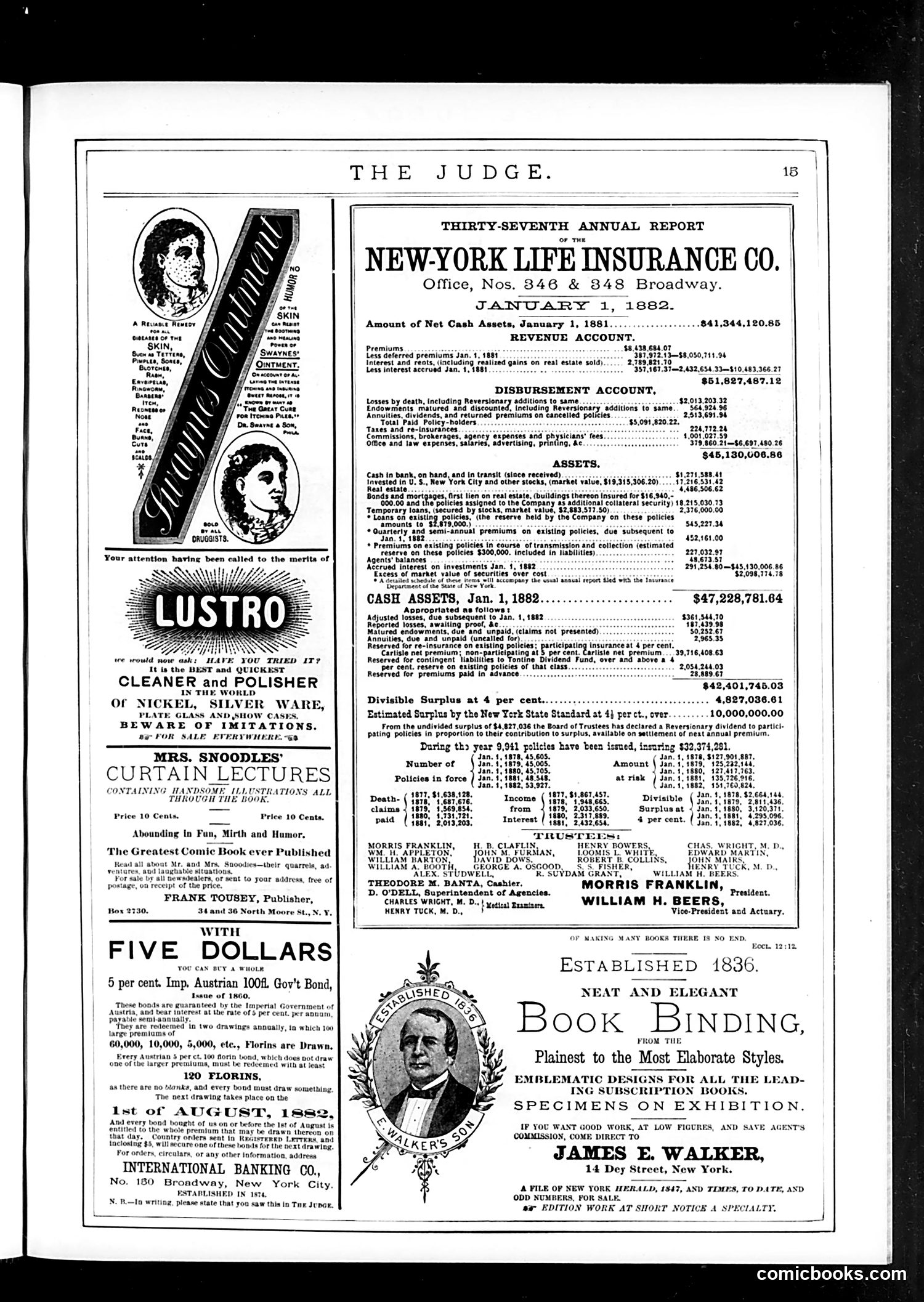
This is primarily a **financial/advertising page** rather than satirical political content. The page features: **Main content:** The New York Life Insurance Company's 37th annual financial report, showing assets of $45,130,000.86 and cash assets of $47,228,781.64—representing substantial institutional wealth in the Gilded Age. **Advertisements** include: - A "Lustro" product for polishing silverware and nickel - Mrs. Snoodles' "Curtain Lectures" (a popular contemporary comic book about domestic quarrels) - An Austrian government bond investment scheme offering 5% returns with lottery-style drawings **Historical context:** The page reflects 1880s consumer capitalism and financial speculation. The Austrian bond advertisement is notable—offering foreign lottery bonds to American investors was common but risky during this era of limited financial regulation. The page contains **no visible political cartoons or satire**—it's a typical Judge issue mixing humorous advertisements with corporate financial statements and investment opportunities targeting the magazine's middle-to-upper-class readership.
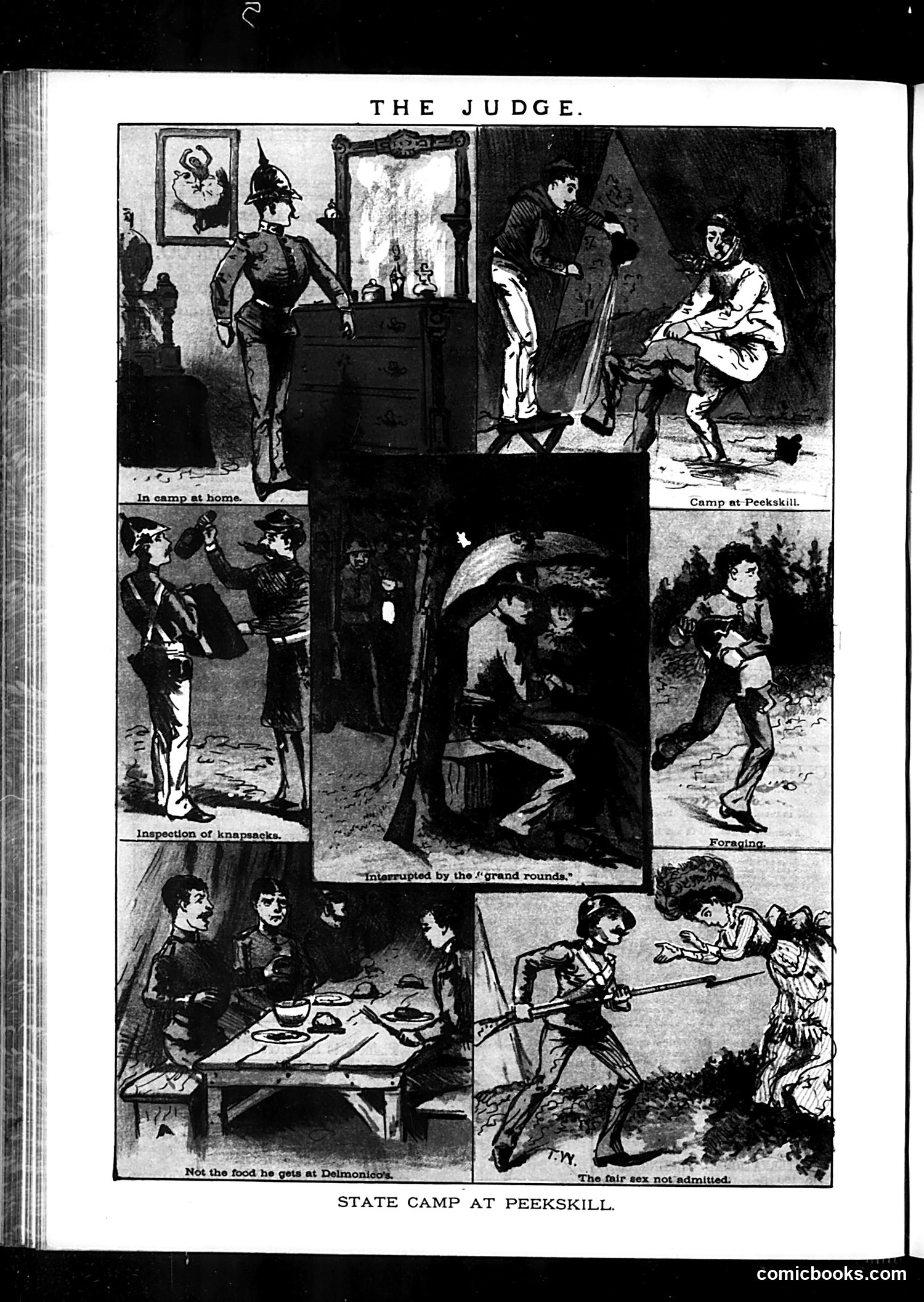
This is a multi-panel satirical comic about a military encampment at Peekskill (likely New York). The panels mock camp life through various scenes: "In camp at home" (contrasting civilian vs. military life), "Camp at Peekskill," "Inspection of knapsacks," "Interrupted by the 'grand rounds,'" "Foraging," "Not the food he gets at Delmonico's" (a famous New York restaurant), and "The fair sex not admitted." The satire appears to target the contrast between soldiers' expectations of camp life versus reality—particularly food quality and romantic opportunities. References to Delmonico's suggest commentary on class differences between officers and enlisted men. The "fair sex not admitted" panel jokes about male-only military camps. Without a visible date, the specific conflict referenced remains unclear, though this style suggests late 19th or early 20th century.