
Judge, 1882-07-22 · page 2 of 16
Judge — July 22, 1882 — page 2: what you’re looking at
What you’re looking at
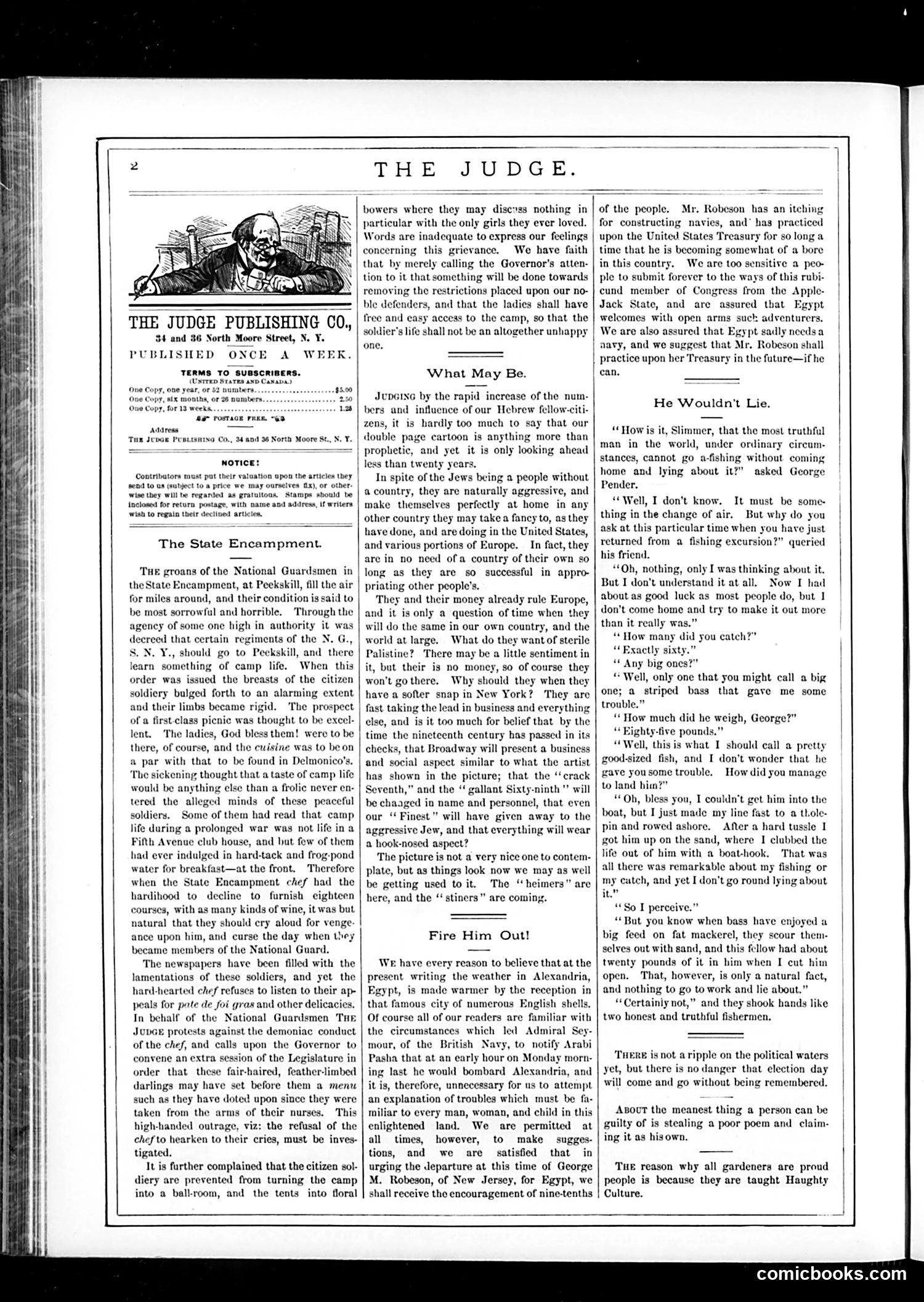
This page contains two distinct satirical pieces: **"The State Encampment"** mocks wealthy National Guard volunteers complaining about harsh camp conditions at Peekskill. Judge sarcastically defends their grievances—poor food, no ballroom dancing with ladies—treating legitimate military hardship as entitled whining from "peaceful soldiers" expecting Fifth Avenue luxury rather than actual camp life. **"What May Be"** is an antisemitic piece predicting Jewish dominance in America within twenty years. It stereotypes Jewish people as "naturally aggressive" and claims they're "making themselves perfectly at home" in countries they adopt. This reflects 19th-century prejudices common in such publications. The magazine's tone throughout is biting irony, using exaggeration to ridicule both the soft National Guardsmen and, disturbingly, to express xenophobic anxieties about Jewish immigration and influence—views that were mainstream in period satirical publications but are now recognized as offensive and discriminatory.
📄 Transcribed text from this page (OCR, searchable)
Machine-transcribed from the original scan — historical spelling and the odd misread are preserved.
THE JUDGE PUBLISHING CO, 34 and 36 North Moore Street, N.Y. PUBLISHED ONCE A WEEK. TEnms To suBscRinens. (Usrren STATES AND | re) one year, of 62 numbers. x months, or 28 numbers... HOF 13 weeks, cesses sar rosa! ery Address Tur JevGE PrBLIsMING Co., 34 and 36 North Moore St., N. Y. Contributors must pat th send to us (subject to a price we may ourselves Ax), or other- wise they will be reganled as gratuitous, Stamps should be inclosed for return postage, with name and address, if writers wiah to regain their declined articles, The State Encampment. ‘Tue groans of the National Guardsmen in theState Encampment, at Peekskill, fill the air for miles around, and their condition is said to be most sorrowful and horrible. Through the agency of some one high in authority it was decreed that certain regiments of the N. G., Y., should go to Peekskill, and there learn something of camp life. When this order was issued the breasts of the citizen soldiery bulged forth to an alarming extent and their limbs became rigid. ‘The prospect of a first-class picnic was thought to be excel- lent. The ladies, God bless them! were to be there, of course, and the cuisine was to be on a par with that to be found in Delmonico’s. ‘The sickening thought that a taste of camp life would be anything else than a frolic never en- tered the alleged minds of these peaceful soldiers. Some of them had read that camp life during a prolonged war was not life ina Fifth Avenue club house, and but few of them had ever indulged in hard-tack and frog-pond water for breakfast—at the front. Therefore when the State Encampment chef had the hardihood to decline to furnish eighteen courses, with as many kinds of wine, it was but natural that they should cry aloud for venge ance upon him, and curse the day when they became members of the National Guard. The newspapers have been filled with the lamentations of these soldiers, and yet the hard-hearted chef refuses to listen to their ap- peals for pate de foi gras and other delicacie: In behalf of the National Guardsmen THe JUDGE protests against the demoniac conduct of the chef, and calls upon the Governor to convene an extra session of the Legislature in order that these fair-haired, feather-limbed darlings may have set before them a menu such as they have doted upon since they were taken from the arms of their nurses. This high-handed outrage, viz: the refusal of the chef to hearken to their cries, must be inves- tigated. It is further complained that the citizen sol- diery are prevented from turning the camp into a ballroom, and the tents into floral F valuation upon the articles they | THE JUDGE. bowers where they may discss nothing in particular with the only girls they ever loved. Words are inadequate to express our feelings concerning this grievance. We have faith that by merely calling the Governor's atten- tion to it that something will be done towards removing the restrictions placed upon our no- ble defenders, and that the ladies shall have free and easy access to the camp, so that the hall not be an altogether unhappy What May Be. by the rapid increase of the num- bers and influence of our Hebrew fellow-citi- zens, it is hardly too much to say that our double page cartoon is anything more than prophetic, and yet it is only looking ahead less than twenty years, In spite of the Jews being a people without a country, they are naturally aggressive, and make themselves perfectly at home in any other country they may take a fancy to, as they have done, and are doing in the United States, and various portions of Europe. In fact, they are in no need of a country of their own so long as they are so successful in appro- priating other people's. ‘They and their money already rule Europe, and it is only a question of time when they will do the same in our own country, and the world at large. What do they wantof sterile Palistine? There may be a little sentiment in it, but their is no money, so of course they won't gothere. Why should they when they have a softer snap in New York? They are t taking the lead in business and everything else, and is it too much for belief that by the time the nineteenth century has passed in its checks, that Broadway will present a business and social aspect similar to what the artist has shown in the picture; that the “crack Seventh,” and the “ gallant Sixty-ninth ” will be chaaged in name and personnel, that even our ‘“ Finest” will have given away to the aggressive Jew, and that everything will wear a hook-nosed aspect? ‘The picture is not a very nice one to contem- plate, but as things look now we may as well be getting used to it. The “heimers” are here, and the “‘ stiners” are coming. Fire Him Out! We have every reason to believe that at the present writing the weather in Alexandria, Egypt, is made warmer by the reception in that famous city of numerous English shells. Of course all of our readers are familiar with the circumstances which led Admiral Sey- mour, of the British N; to notify Arabi Pasha that at an early hour on Monday morn- ing last he would bombard Alexandria, and it is, therefore, unnecessary for us to attempt an explanation of troubles which must be fa- miliar to every man, woman, and child in this enlightened land. We are permitted at all times, however, to make sugges- tions, and we are satisfied that in urging the departure at this time of George M. Robeson, of New Jersey, for Egypt, we shall receive the encouragement of nine-tenths of the people. Mr. Robeson has an itching for constructing navies, and’ has practiced upon the United States Treasury for so long a time that he is becoming somewhat of a bore in this country, We are too sensitive a peo- ple to submit forever to the ways of this rubi- cund member of Congress from the Apple- Jack State, and are assured that Egypt welcomes with open arms such adventurers, We are also assured that Egypt sadly needs a aavy, and we suggest that Mr. Robeson shall practice upon her Treasury in the future—if he can, He Wouldn't Lie. ‘How is it, Slimmer, that the most truthful man in the world, under ordinary circum- stances, cannot go a-fishing without coming home and lying about it?’ asked George Pender. “Well, I don't know. It must be some- thing in the change of air. But why do you ask at this particular time when you have just returned from a fishing excursion?” queried his friend. “Oh, nothing, only I was thinking about it, But I don’t understand it at all. Now I had about as good luck as most people do, but I don't come home and try to make it out more than it really wa: “ How many did you catch?" “ Any big ones? © Well, only one that you might call a big one; a striped bass that gave me some trouble.” “How much did he weigh, George?” ighty-five pounds.” this is what I should call a pretty good-sized fish, and I don’t wonder that he gave yousome trouble. How did you manage to land him?” “Oh, bless you, I couldn't get him into the boat, but I just made my line fast to a thole- pin and rowed ashore. After a hard tussle I got him up on the sand, where I clubbed the life out of him with a boat-hook. That was all there was remarkable about my fishing or my catch, and yet I don’t go round lying about “So I perceive “But you know when bass have enjoy big feed on fat mackerel, they scour them- selves out with sand, and this fellow had about twenty pounds of it in him when I cut him da open. That, however, is only a natural fact, and nothing to go to work and lie about.” “Certainly not,” and they shook hands like two honest and truthful fishermen, ‘Tene is not a ripple on the political waters yet, but there is no danger that election day will come and go without being remembered. Asoct the meanest thing a person can be guilty of is stealing a poor poem and claim- ing it as hisown. Tur reason why all gardeners are proud people is because they are taught Haughty Culture. comicbooks.com