
A complete issue · 16 pages · 1882
Judge — June 24, 1882
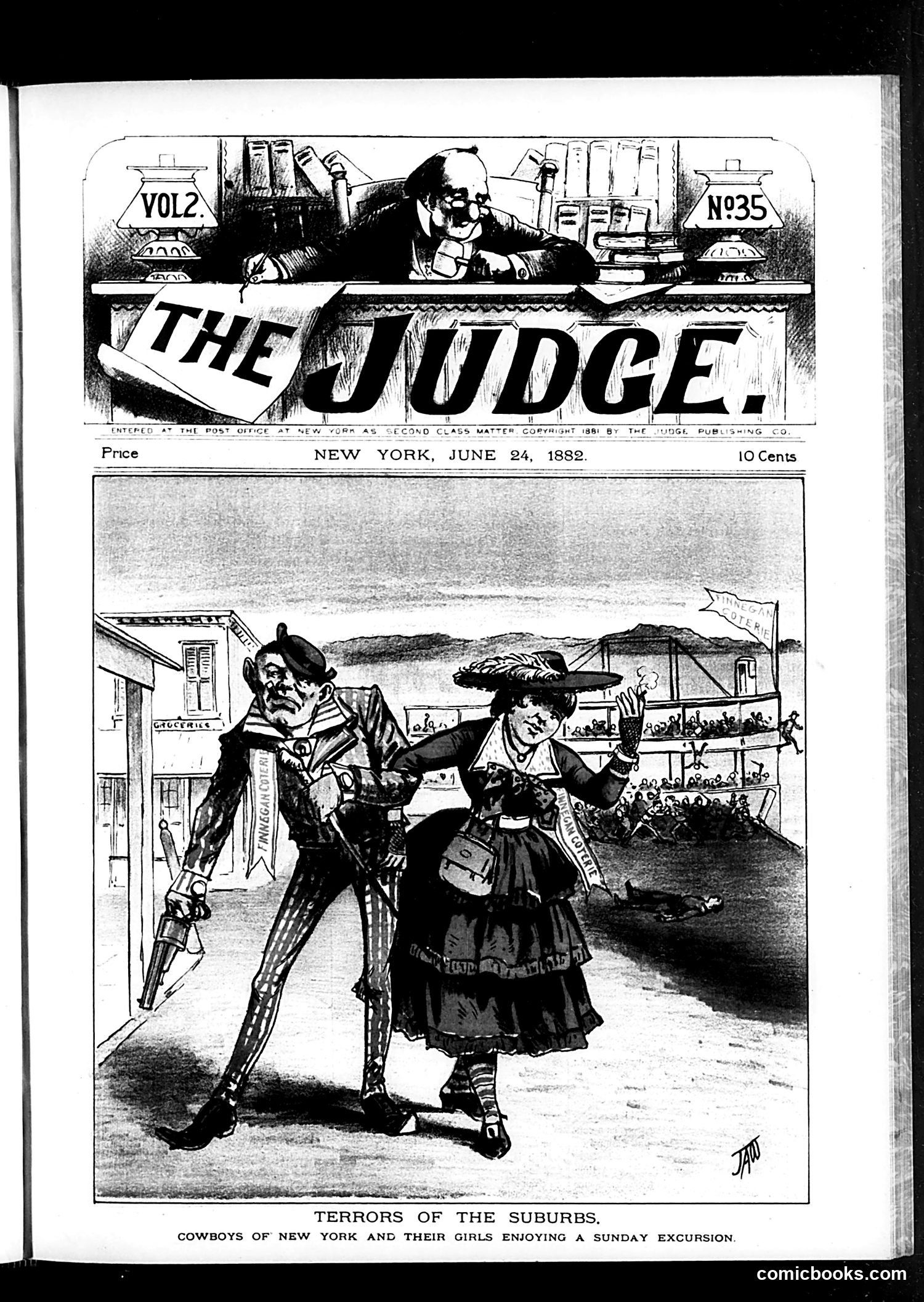
This 1882 cartoon satirizes young working-class New Yorkers on suburban outings. The two figures—a roughneck man and a woman in fashionable dress—are caricatured as "cowboys," a reference to the popular Wild West imagery of the era. The man's exaggerated features and aggressive posture, combined with the title "Terrors of the Suburbs," suggest Judge magazine is mocking these urban visitors as uncouth troublemakers invading respectable suburban areas on Sundays. The satire targets class anxieties: as rail transport improved, working-class urbanites increasingly took day trips to the suburbs, alarming middle-class residents who viewed them as rough, dangerous elements. The cartoon ridicules both the visitors' pretensions to fashionable leisure and suburban fears of urban "invasion." It reflects 1880s tensions over expanding city populations and changing social boundaries.
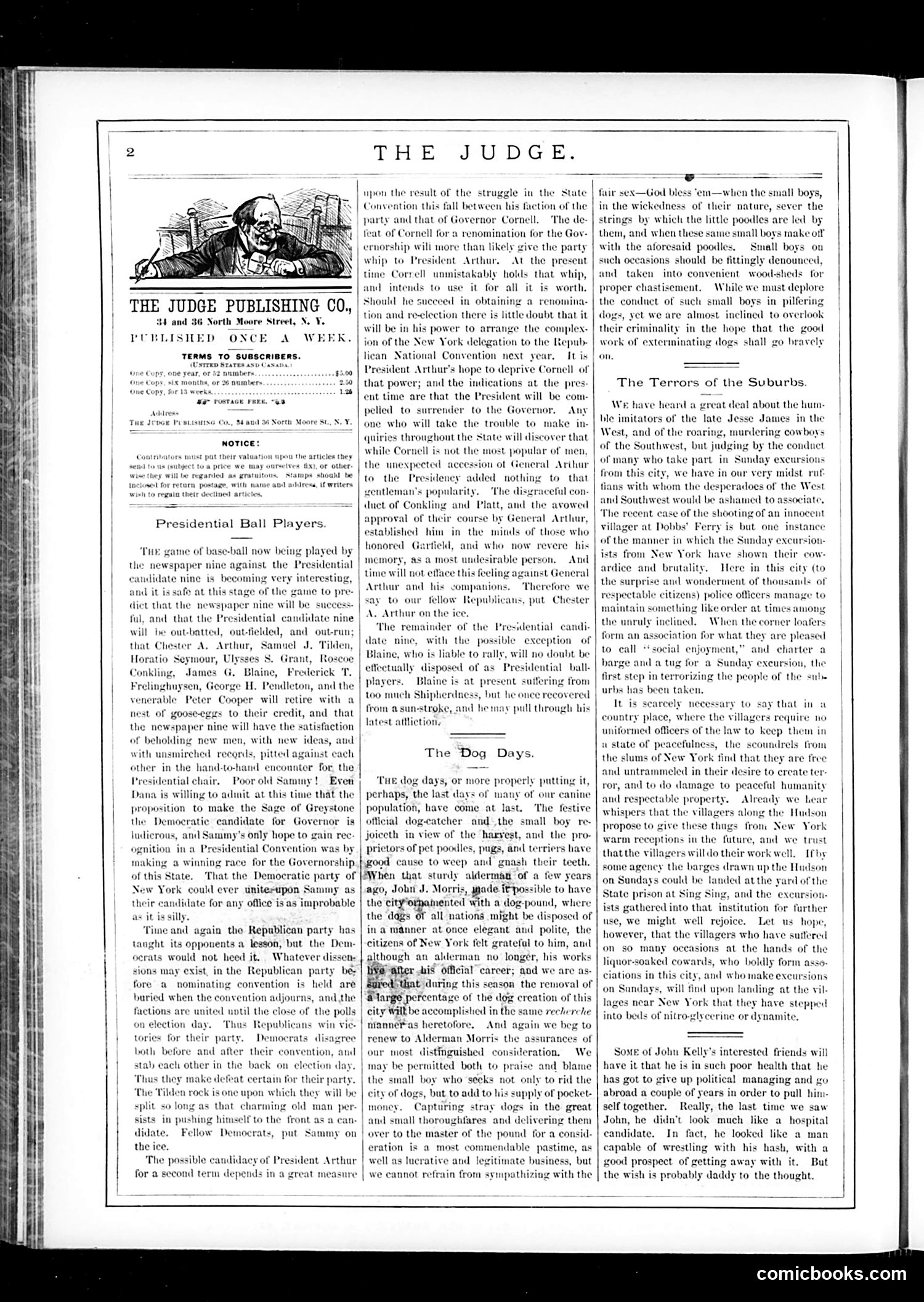
This page from *Judge* magazine contains political commentary on the 1884 presidential race. The main article, "Presidential Ball Players," uses baseball metaphor to mock the Republican presidential candidates—Chester Arthur, James Blaine, and others—comparing them unfavorably to newspaper editors. The piece also critiques New York's state Republican politics, specifically tensions between President Arthur and Governor Cornell over control of the New York delegation to the Republican National Convention. The satirist argues Cornell holds the advantage. The article takes aim at the Democratic Party's dysfunction, particularly its reliance on Samuel J. Tilden (the 1876 nominee), calling him an impediment to party unity—a jab at Democratic disorganization versus Republican discipline. The bottom sections—"The Terrors of the Suburbs" and "The Dog Days"—shift to local New York crime and animal-related commentary, typical lighter fare for the satirical weekly.
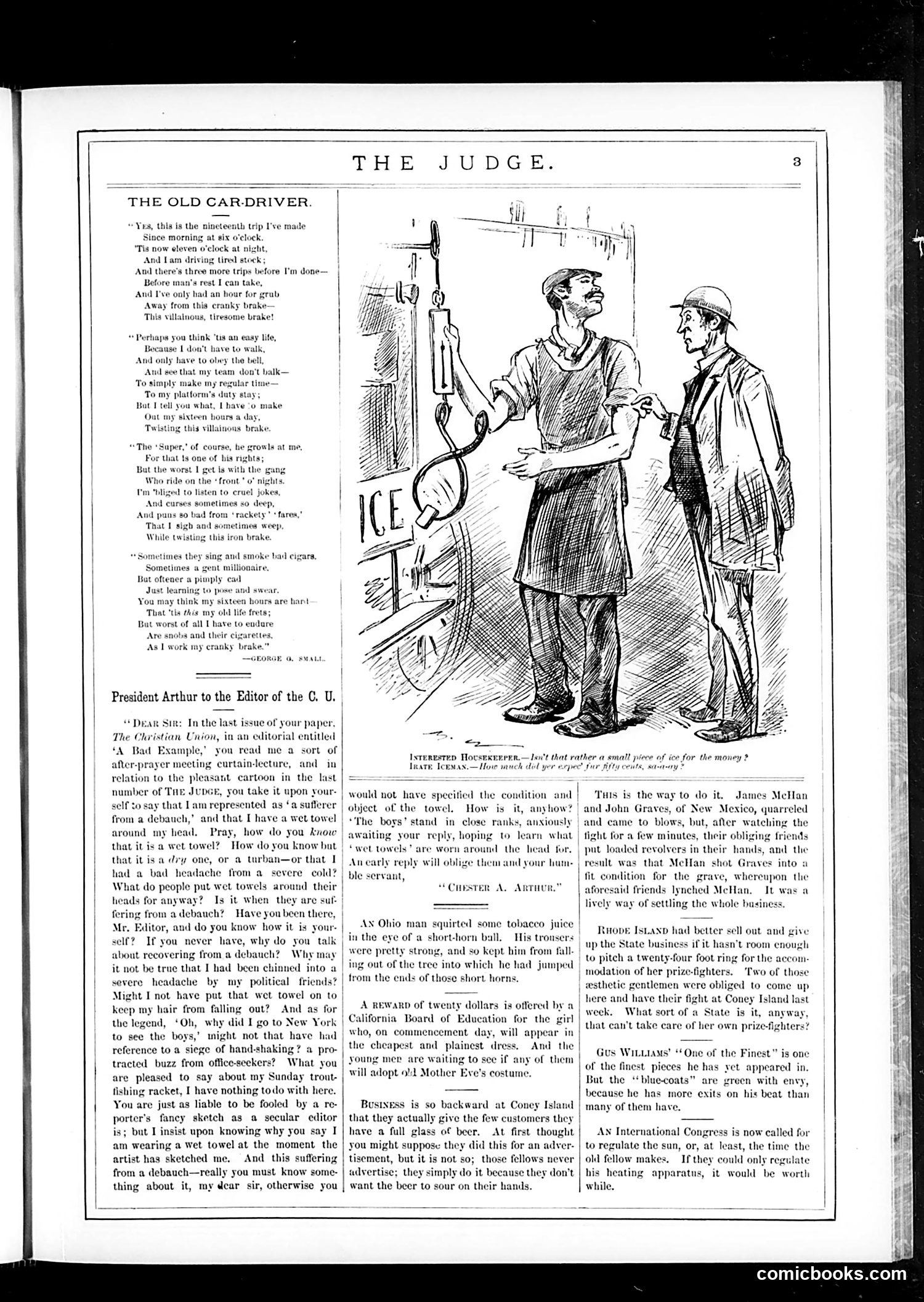
This *Judge* page contains satirical commentary on President Chester Arthur. The main cartoon shows an ice-wagon driver complaining about his grueling work conditions—nineteen trips since 6 a.m., with faulty brakes and difficult passengers. The accompanying letter is Arthur himself responding sarcastically to a previous *Judge* cartoon that depicted him recovering from "a debauch" (drunken excess) with a wet towel around his head. Arthur defensively argues the towel could have been for a headache, hair loss, or political stress—not necessarily hangover recovery. He also questions the magazine's assumption about his visit to New York to "see the boys." The satire targets Arthur's reputation for heavy drinking and alleged dissolute behavior. The ice-wagon complaint appears thematically connected—both pieces critique working conditions and exhaustion, possibly alluding to Arthur's own weariness or incompetence in office. The letter's mock-serious tone amplifies the magazine's mockery of the president.
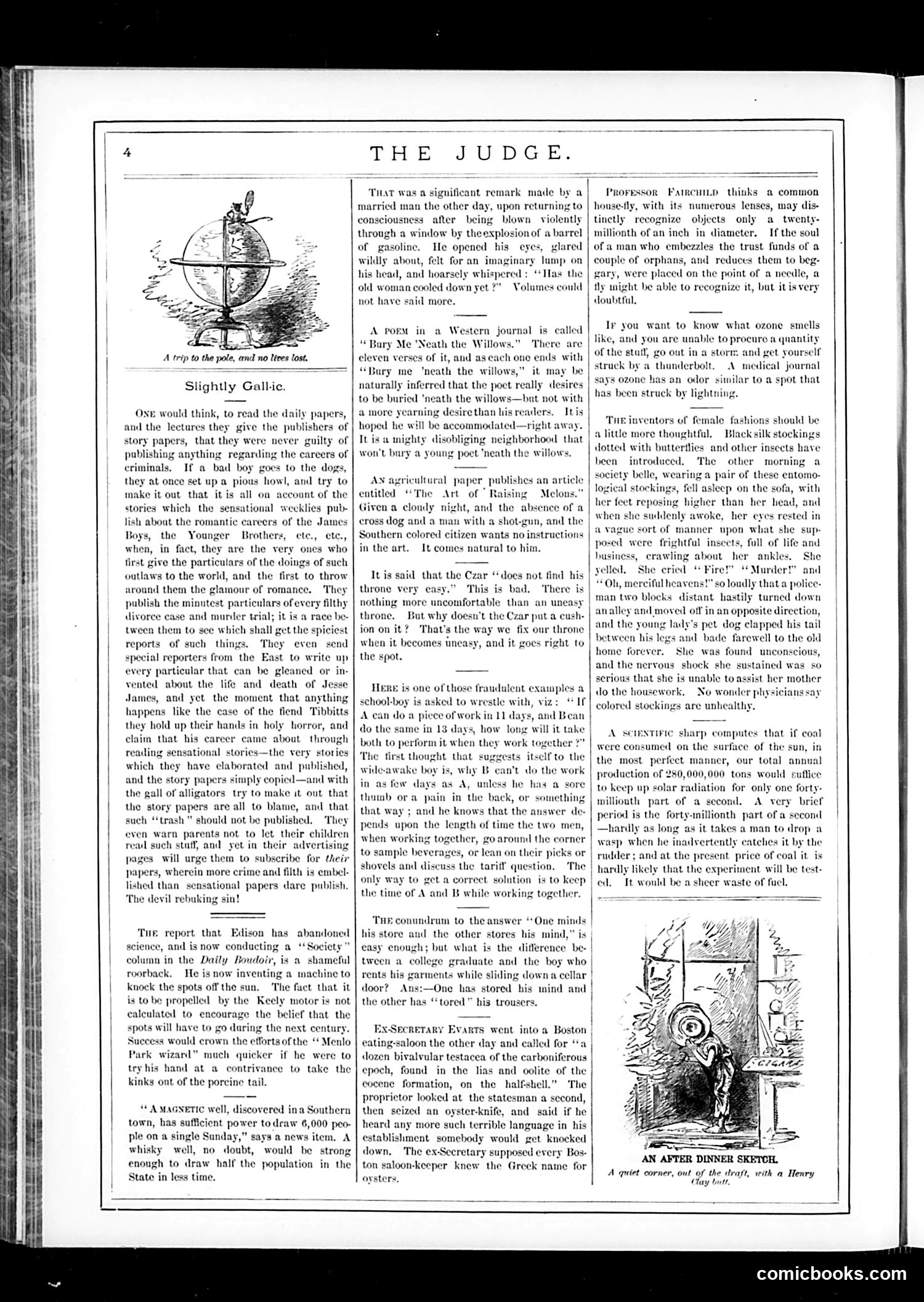
This page from the satirical magazine **Judge** contains several unrelated short commentaries and jokes typical of the publication's format: **"Slightly Gallic"** (top cartoon): Shows a globe with a cannon, apparently satirizing French military ambitions or grandiosity—the title suggests mocking "French-like" pretensions. **Main text content**: The lengthy editorial critiques newspapers and story papers for hypocrisy—they publish sensational crime stories while simultaneously blaming those same stories for corrupting youth. Judge attacks this moral contradiction with characteristic sarcasm: "The devil rebuking sin!" **Other brief items** mock: - Edison's purported abandonment of science (likely referencing real public skepticism about his inventions) - A "magnetic well" attracting crowds (implying whisky's greater draw) - A repetitive poem about burial under willows - A joke about Southern melon-stealing The page exemplifies Judge's approach: sardonic commentary on contemporary news, public figures, and social hypocrisy, presented without deep political allegory—mostly casual satire of everyday absurdities.
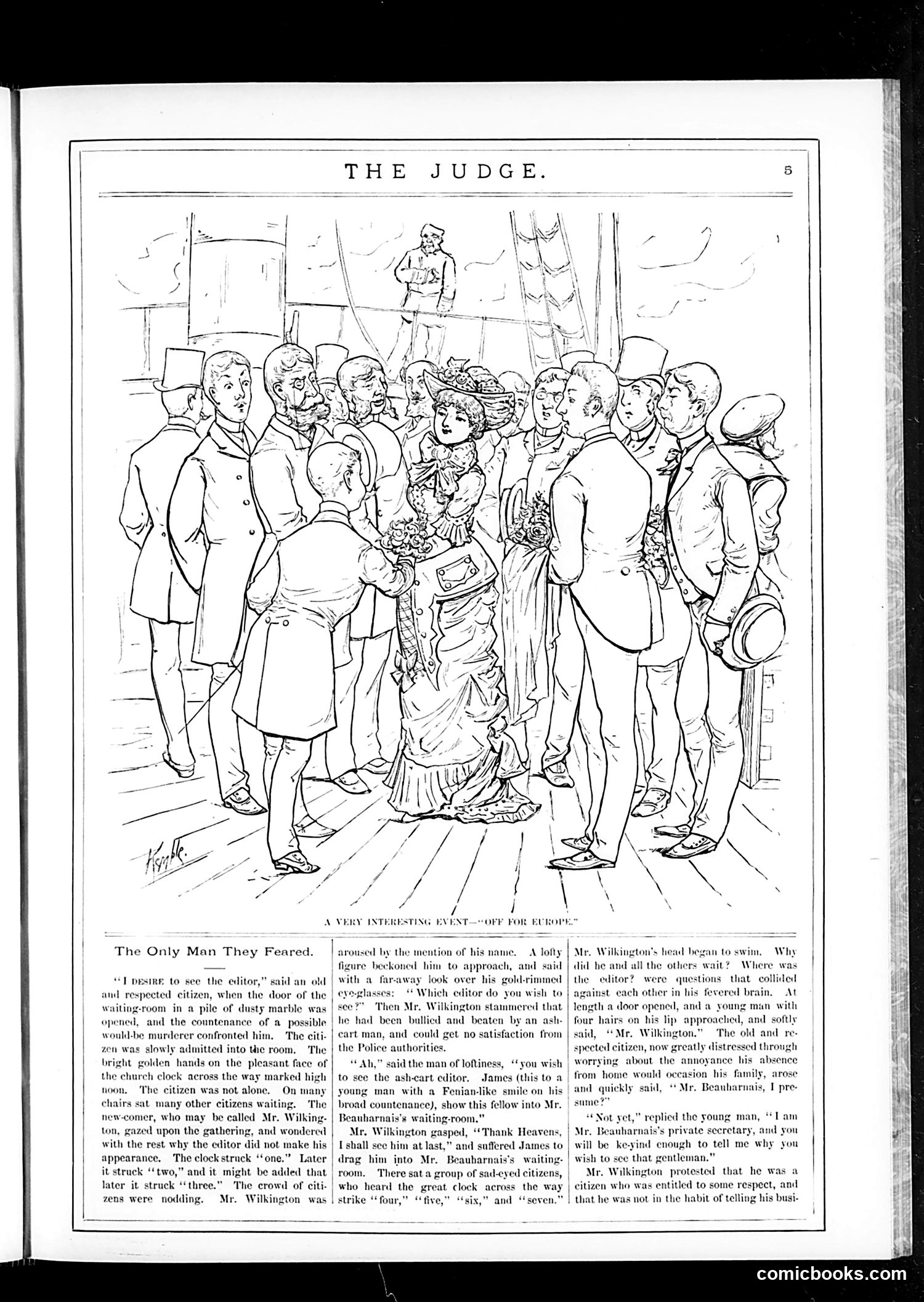
This satirical piece mocks an inaccessible newspaper editor—likely the publication's own editor or a prominent contemporary figure—by depicting the absurd bureaucracy surrounding him. Citizens wait hours (the clock strikes repeatedly) to see "the ash-cart editor," apparently called Mr. Beauharnais, only to encounter layers of gatekeepers and secretaries who refuse to let them through. The satire targets the editor's pretentiousness and abuse of power: despite being a public figure who should answer to citizens, he hides behind assistants and endless waiting, treating ordinary people (including one man beaten by a cart driver seeking justice) with contempt. The "Fenian-like smile" reference suggests Irish political undertones. The joke is that this self-important editor—feared and unapproachable—is the only person these citizens truly fear, exposing the corruption of access to authority and justice through the press.
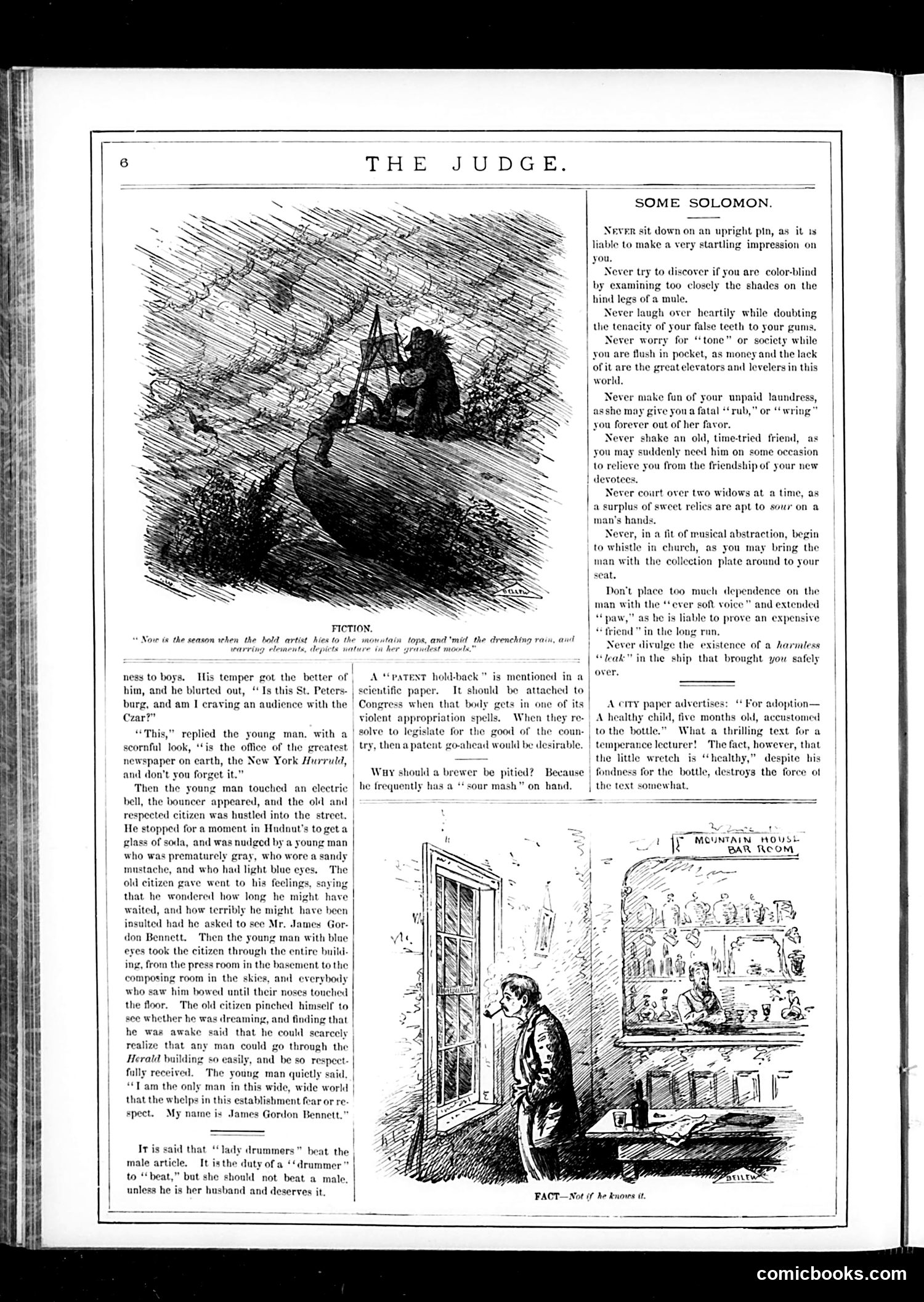
This page from the satirical magazine *Judge* contains three distinct pieces: **"Some Solomon"** (right column): Humorous advice-column style tips mocking social pretensions and human folly—warnings about upright pins, false teeth, unpaid laundresses, and overeager charity cases. It's gentle satire on middle-class vanities. **"Fiction"** (lower left): A brief story satirizing the *New York Herald* newspaper's power and mystique. A respectful citizen is thrown out by the Herald's bouncer, but when he later meets James Gordon Bennett (the Herald's actual owner/editor), everyone bows obsequiously. The joke: Bennett's mere name commands reverence, mocking both newspaper arrogance and public deference to press moguls. **Minor quips** (bottom right): Brief jokes about "patent hold-backs" for Congress spending, adoption advertisements promoting bottle-fed infants to temperance lecturers, and female "drummers" (salespeople) outperforming male counterparts. The page is light satirical commentary on American institutions, social behavior, and contemporary business figures—typical *Judge* fare from the Gilded Age.
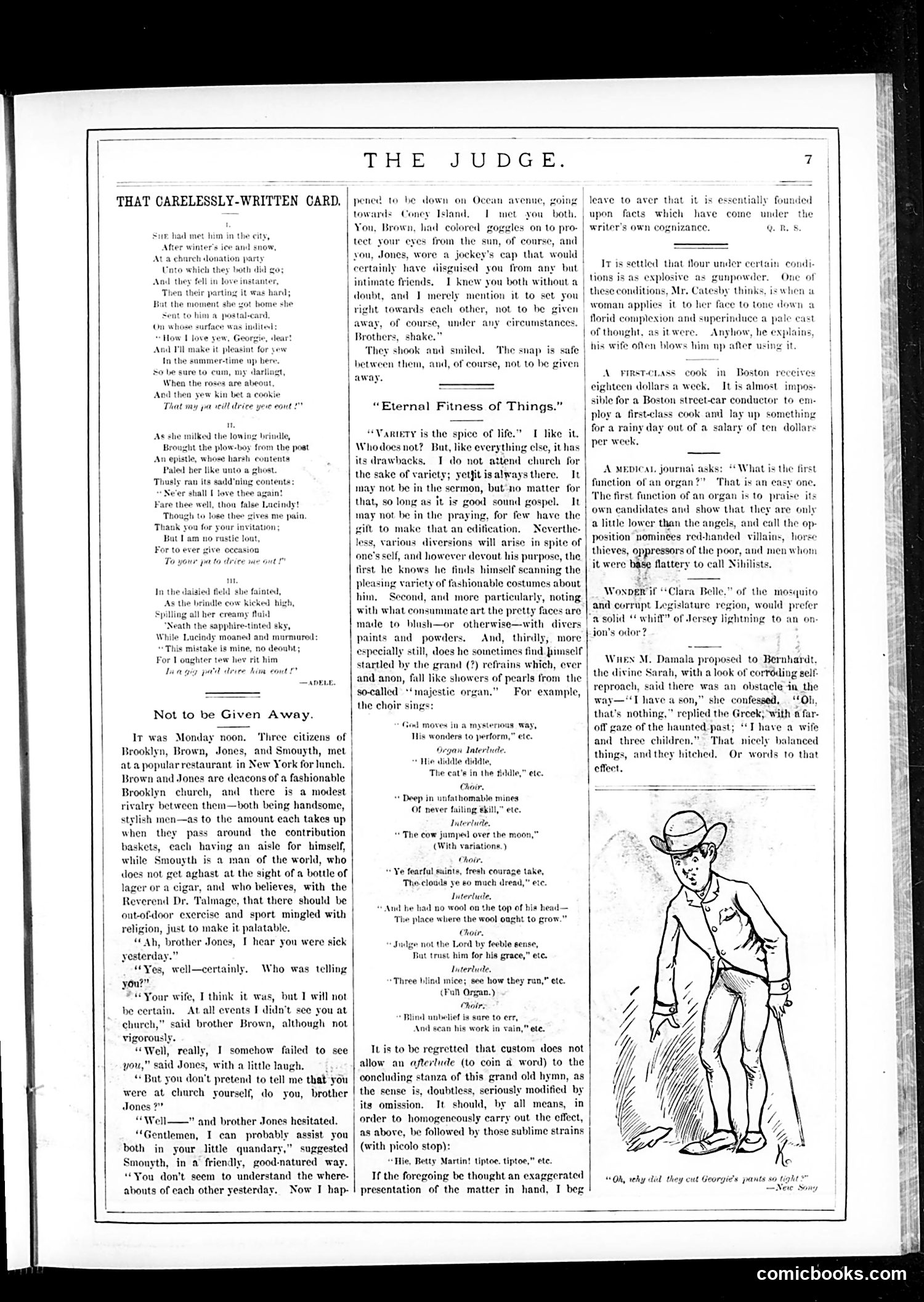
This page contains two distinct pieces of satirical humor: **"Not to be Given Away"** (main story): Three Brooklyn churchgoers—two respectable deacons (Brown and Jones) and a worldly man (Smouyth)—encounter each other at a restaurant. Each claims not to have seen the others at church the previous day, but Smouyth reveals he spotted all of them on Ocean Avenue in disguises (goggles, jockey cap), clearly avoiding church attendance. The satire mocks the hypocrisy of prominent church members who publicly present themselves as devout while privately neglecting religious obligations. The joke's title suggests their mutual cover-up is "not to be given away"—their secret stays buried among friends. **Accompanying editorial snippets** discuss variety in church attendance and the distractions of fashionable dress and cosmetics during services, reinforcing themes of superficial religiosity. The cartoon (right) shows a dandy figure, likely illustrating the "worldly man" character type being satirized.
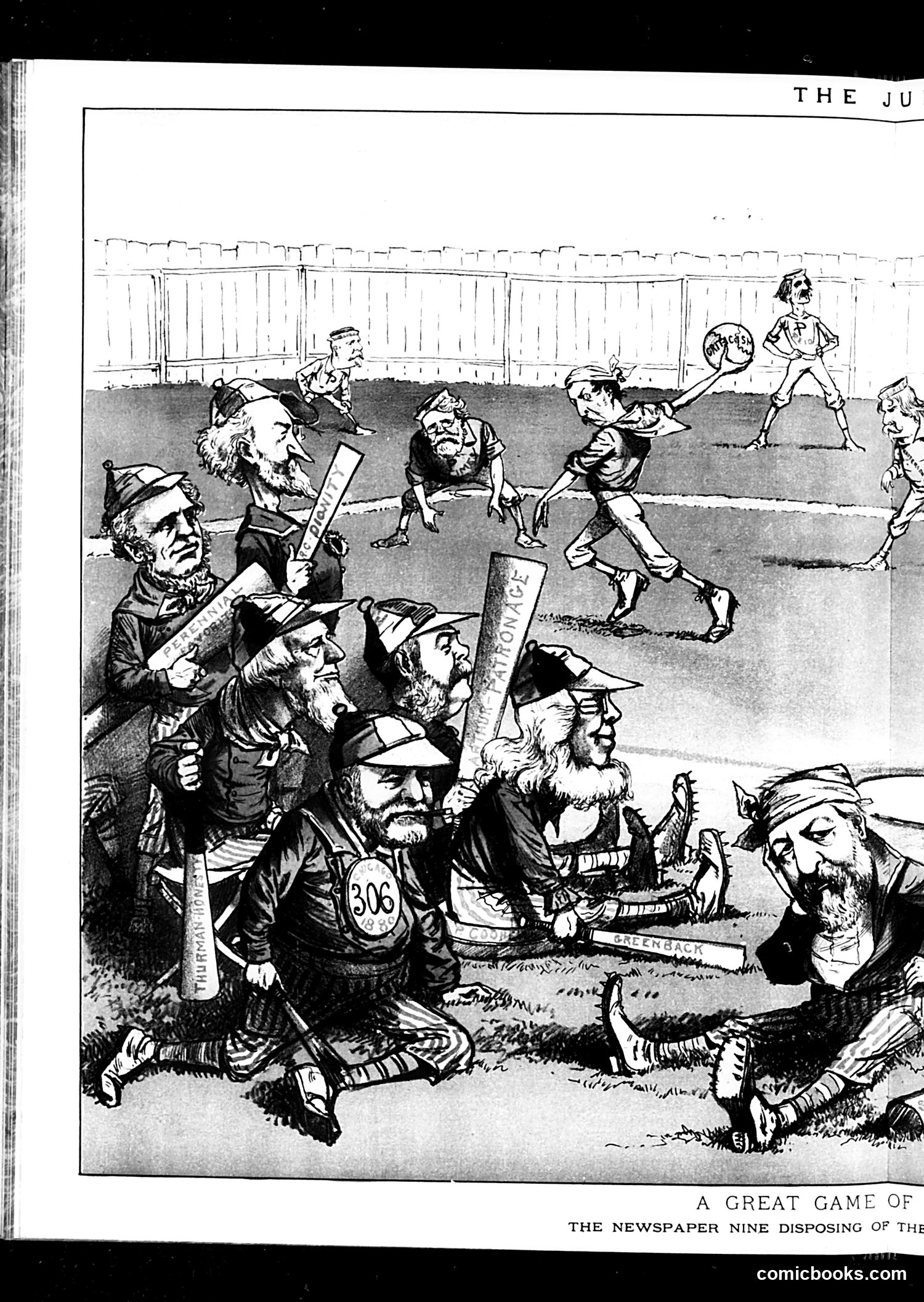
This satirical cartoon depicts a baseball game where caricatured figures represent newspapers competing against each other. The title references "The Newspaper Nine" disposing of competitors—likely critiquing newspaper rivalries and media consolidation of the era. The bearded men in the foreground, drawn with exaggerated features typical of Judge's style, appear to represent newspaper owners or editors. One figure wears a jersey marked "306," suggesting specific publication identification. The baseball setting serves as metaphor for commercial competition between news outlets. The cartoon satirizes how newspapers "played" against each other in cutthroat competition, using sports language to mock journalistic rivalry. Without the complete caption visible, the specific newspapers targeted remain unclear, though this likely comments on major 19th-century American media conflicts.
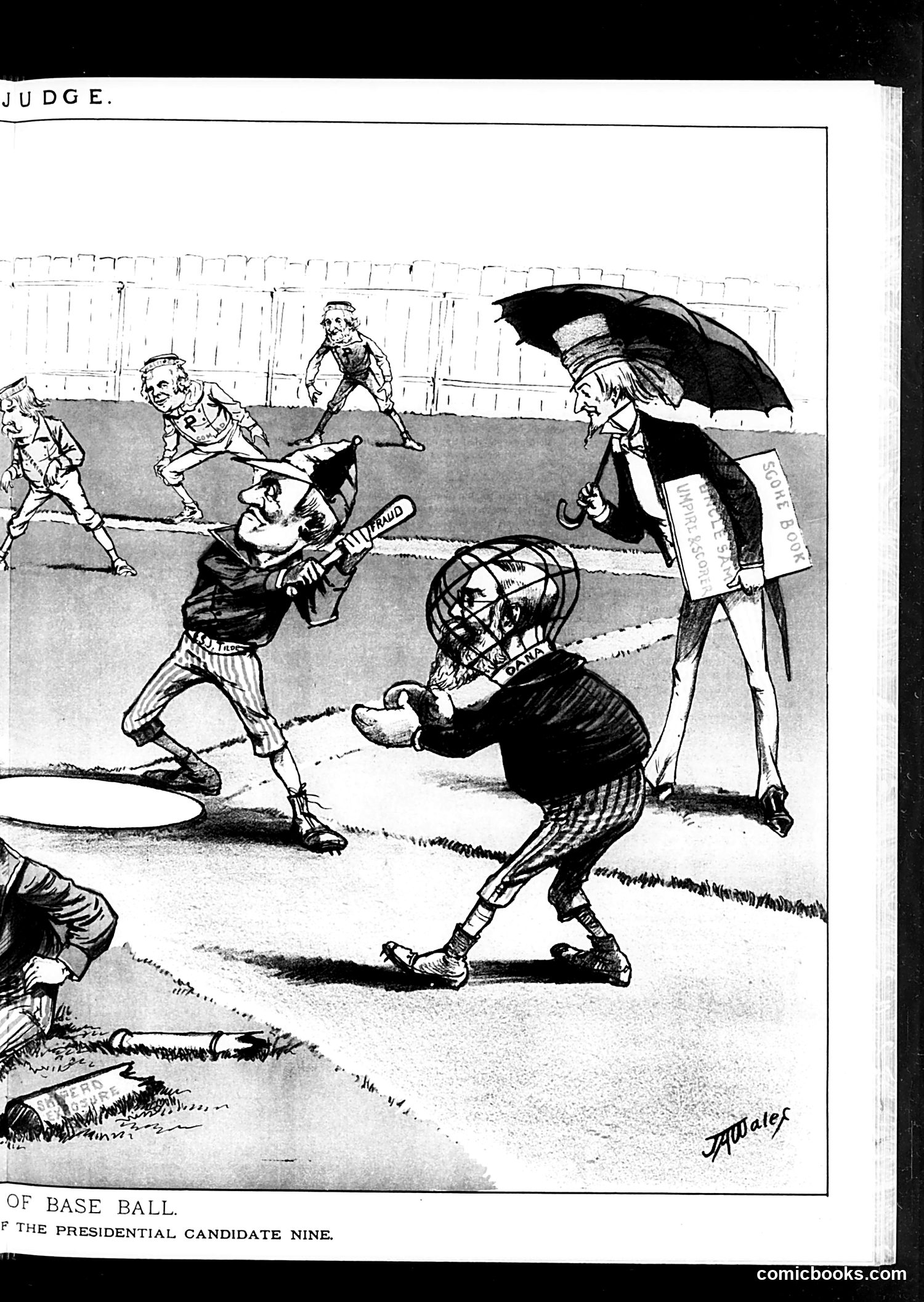
This political cartoon depicts a baseball game as metaphor for the 1900 presidential election. The figure on the right—identified by his umbrella and formal dress as "the Judge" (likely representing judicial authority or establishment wisdom)—oversees a match between "the Presidential Candidate Nine" (a baseball team representing candidates). The cartoon satirizes the election process by treating it as sport, with various political figures as players. The batter appears to be swinging while others assume fielding positions, suggesting competition among presidential hopefuls. The Judge watches critically, implying scrutiny of candidates' fitness for office. The satire mocks how elections reduce serious governance to entertainment and spectacle, while the Judge represents stern oversight of this chaotic democratic process. The specific candidates remain unclear without additional context.
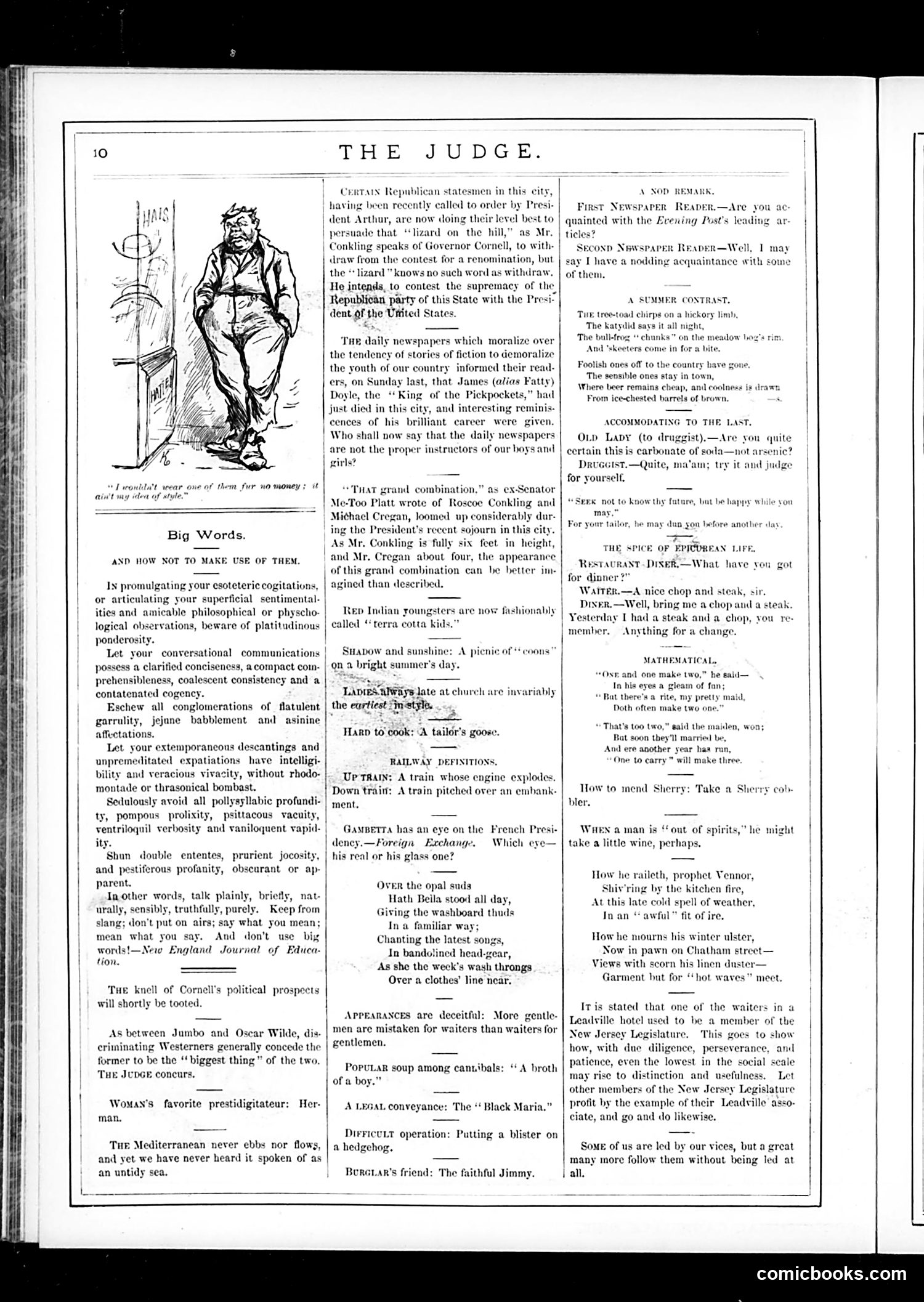
This page from *Judge* magazine contains political satire and humor pieces targeting 1880s Republican figures and social trends. **Main cartoon (left):** The sketch depicts a poorly-dressed man refusing to wear fur, with the caption "I wouldn't wear one of them fur no money; it ain't my idea of style." This appears to mock working-class affectations about fashion. **Political content:** Multiple references attack New York Republican politics. The text mentions President Arthur pressuring Governor Cornell (called a "lizard") to withdraw from renomination, while ex-Senator Platt and Roscoe Conkling maneuver politically. The satire mocks these elite Republicans' internal power struggles. **"Big Words" section:** This lengthy essay satirizes verbose language, ironically using elaborate vocabulary while arguing against it—a common *Judge* tactic mocking pompous speakers and writers. **Other jokes:** Brief items mock newspapers moralizing about pickpockets, racial stereotypes ("terra cotta kids," "coons"), and working-class life (washday labor). The page reflects *Judge*'s approach: attacking political corruption, mocking pretension, and reinforcing period stereotypes.
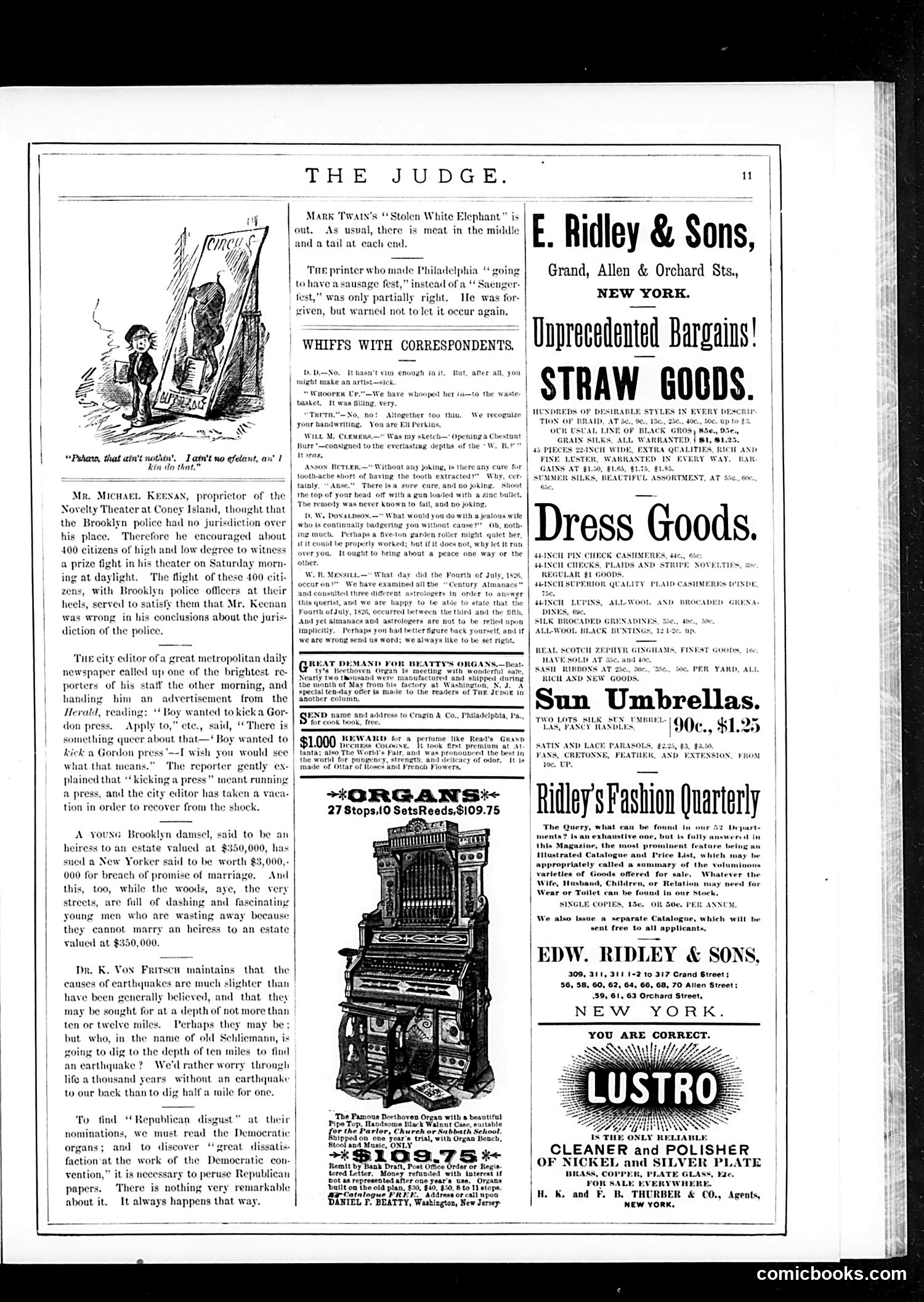
This page mixes editorial content with advertisements, primarily showcasing the satirical magazine's humor. ## The Main Cartoon The visible cartoon depicts a figure examining what appears to be a large object or person, with the caption "Pshaw, that ain't nothin'. I ain't no efelant, an' I kin do that." This appears to reference **Mark Twain's "The Stolen White Elephant,"** mentioned in the editorial text above—the joke plays on the absurdity of the elephant theft narrative. ## Editorial Jokes The page contains brief satirical items mocking newspaper errors, theater proprietors overstepping authority, and journalistic mishaps. One notes a printer's mistake transforming "Saengerfest" into "sausage fest" in Philadelphia coverage—humor based on typographical comedy. ## Context for Modern Readers Judge was primarily a **humor and satire magazine** aimed at educated urban audiences. This page is largely **advertising-heavy** (E. Ridley & Sons dress goods, organs, umbrellas), which was typical for 19th-century publications. The brief jokes target contemporary urban life, journalism, and popular culture references (Twain, local scandals) rather than political issues.
This page satirizes New York's insurance regulation through a mock courtroom dialogue. The satire targets a law prohibiting foreign insurance companies from publishing their financial facts to the public. The cartoon presents testimony from two witnesses: "John Seltishness" and "Honest John," exposing the law's corrupt origins. According to the satire, the law was allegedly pushed through by Insurance Department officials to extract a $100,000 fee and allow the insolvent "Sun Insurance Company of London" to operate without financial disclosure. The piece argues the law: - Suppresses legitimate information - Enables dishonest companies to hide insolvency - Undermines public protection - Benefits corrupt officials and their allies Judge frames this as a case where special interests—not public welfare—drove legislation. The testimony format allows satirists to present accusations (with disclaimers like "it is rumored") while maintaining plausible deniability. This exposes what the magazine saw as regulatory capture and institutional corruption benefiting insurance industry insiders.
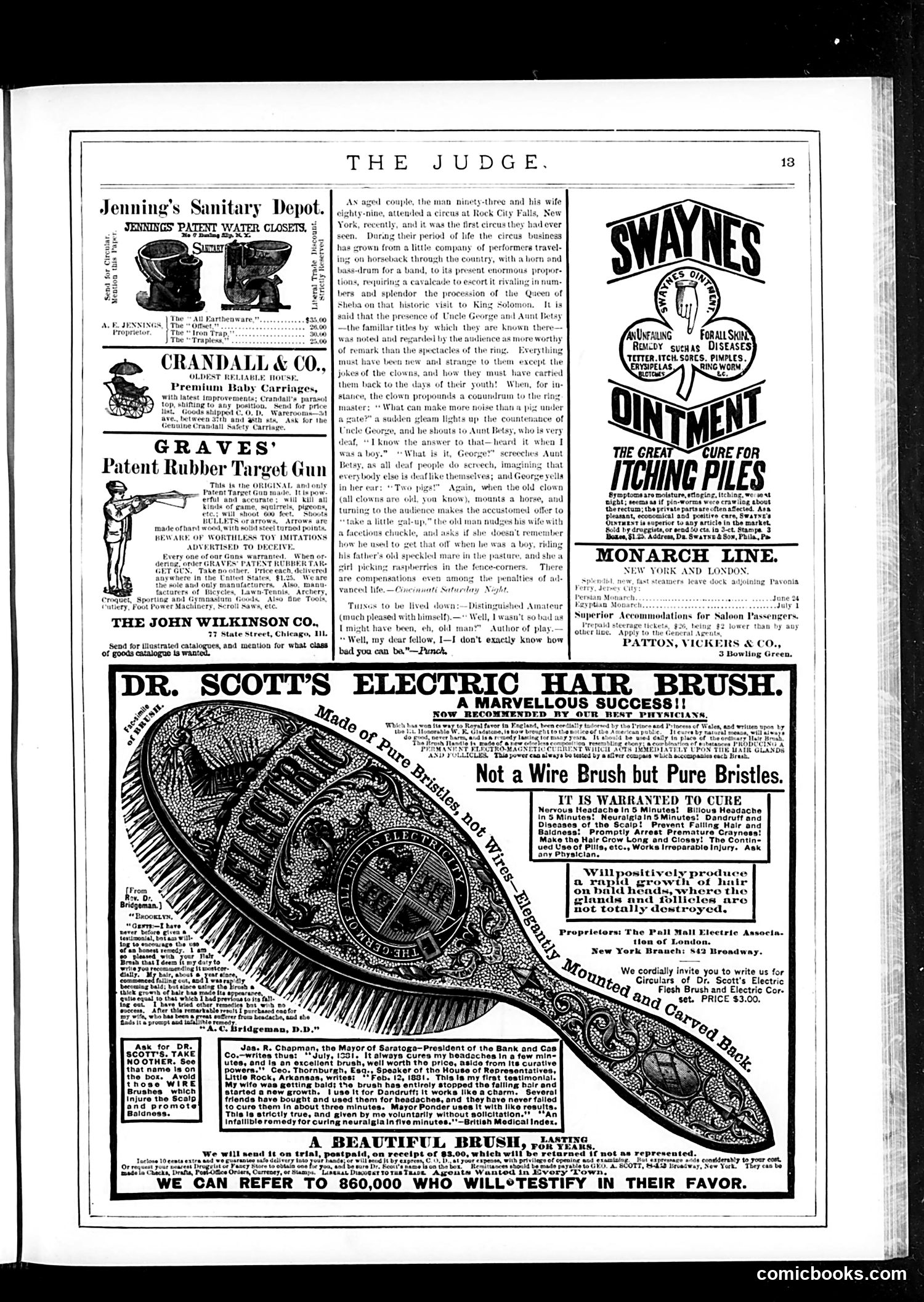
This page is primarily **advertising**, not satirical editorial content. It contains multiple patent medicine and novelty product ads typical of late-19th-century publications. The main editorial content is a brief anecdote about an elderly couple (93 and wife) attending a circus at Rock City Falls, New York—apparently their first circus experience. The passage humorously notes how the clowns and spectacles must have seemed strange to them, yet they found the performance more impressive than contemporary shows, wistfully remembering their youth. The bulk of the page features ads for: - **Dr. Scott's Electric Hair Brush** (heavily promoted with testimonials from supposed authority figures) - **Swaynes Ointment** (for itching piles and skin diseases) - Various other Victorian-era patent products These ads reflect common practices of the era: unregulated health claims, dubious "electric" products exploiting public fascination with electricity, and heavy use of fabricated endorsements. The ads are historically significant as examples of pre-FDA consumer culture, not as satire.
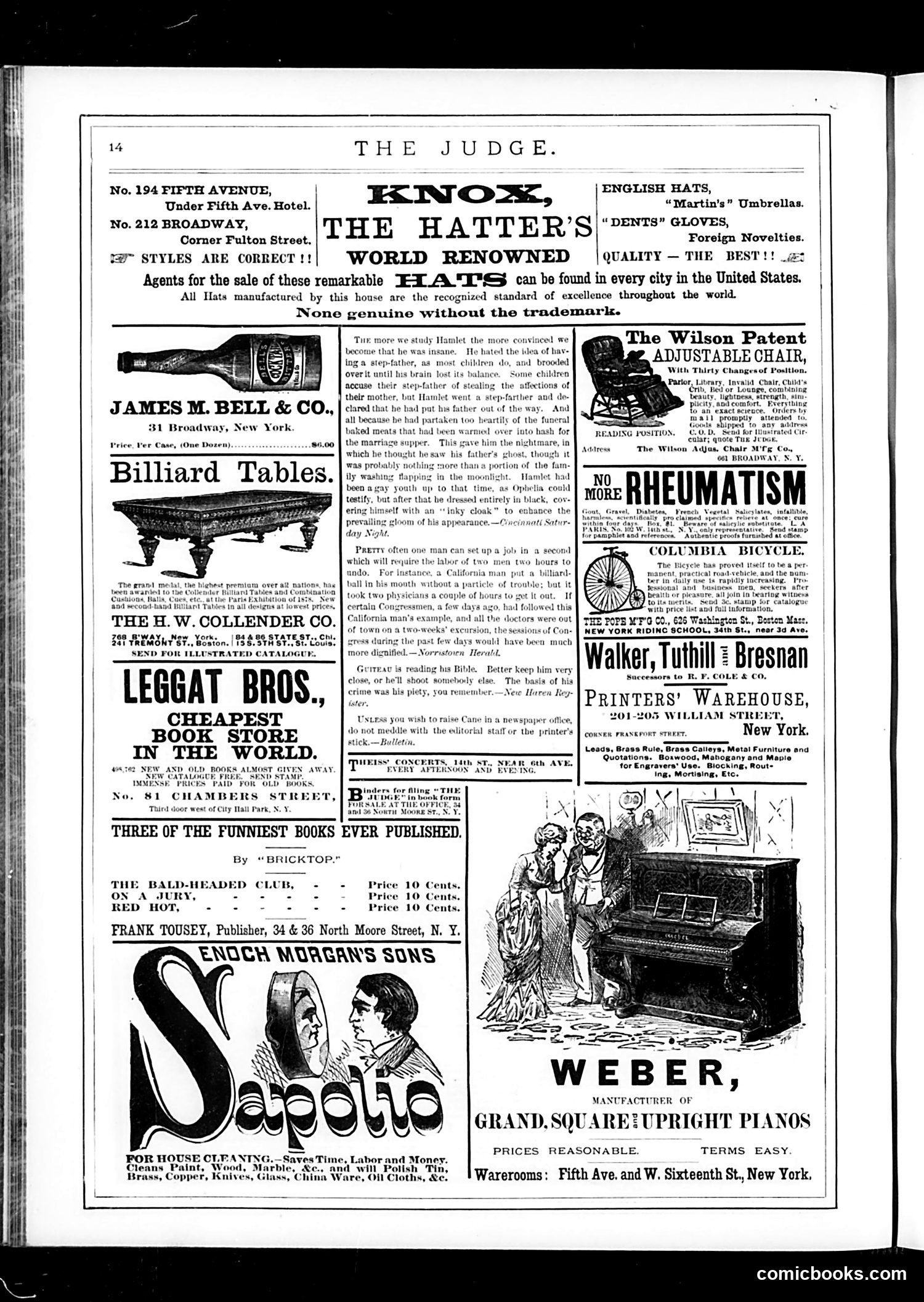
This is primarily an **advertising page** from Judge magazine, not a satirical cartoon page. The page is filled with commercial advertisements for various products and services popular in late 19th-century New York. The only content approaching humor is a brief **literary reference** in the middle discussing Hamlet's psychology—comparing the fictional character's emotional struggles to real-world scenarios like a California man dealing with a toothache. This appears to be filler text rather than original satire. The advertisements promote: Knox hats (the page's major advertiser), billiard tables, books, a patent adjustable chair, pianos, and cleaning products. The imagery is typical Victorian commercial art—product illustrations and engravings. **There is no identifiable political cartoon or satirical content** to decode on this page. It represents Judge functioning as a standard commercial publication selling advertising space, though the magazine itself was known for political satire elsewhere.
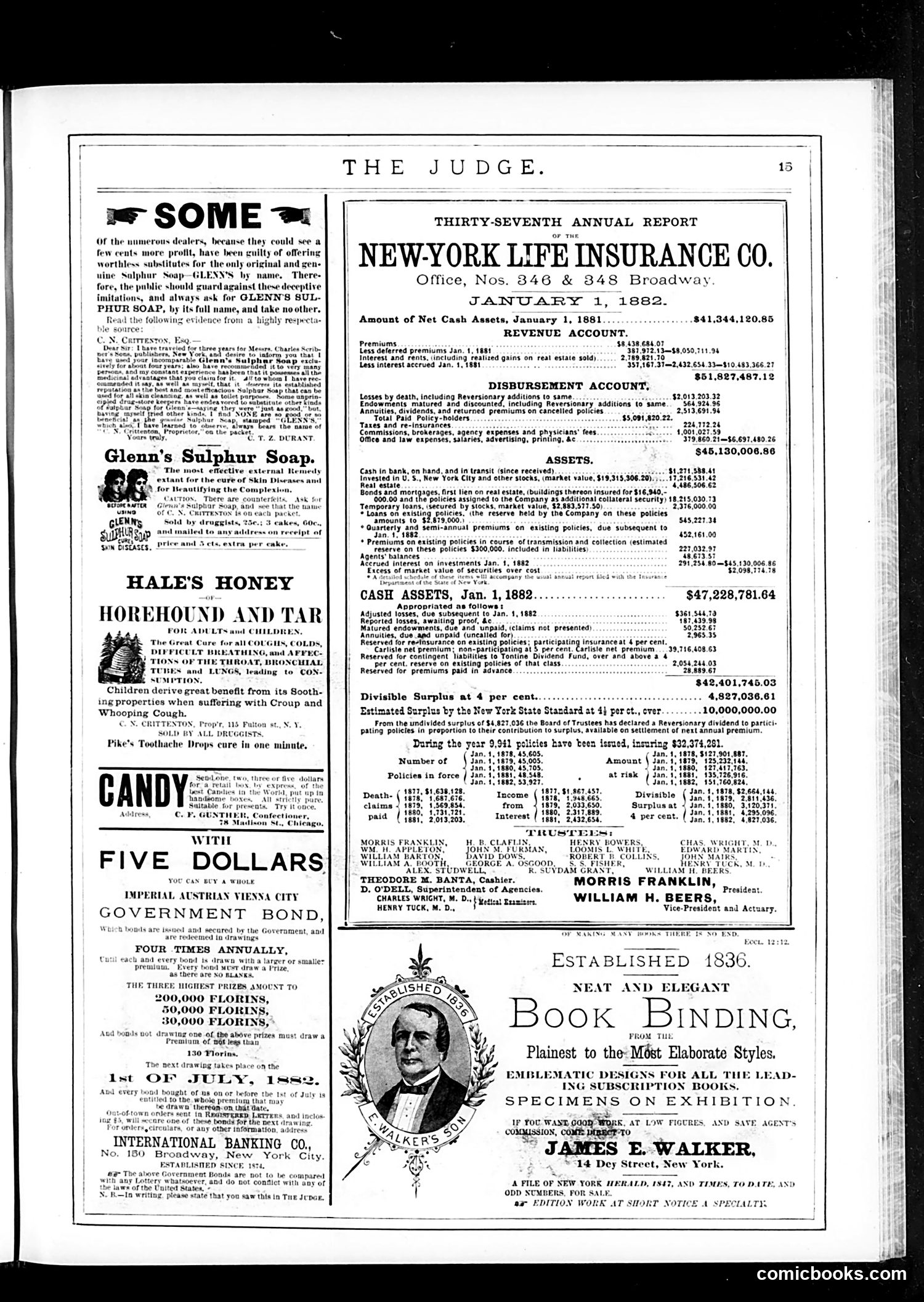
This page is primarily **advertising and financial reporting**, not political satire. The main content is the **Thirty-Seventh Annual Report of the New-York Life Insurance Company** (January 1, 1882), displaying detailed financial statements: assets of $41.3 million, revenue accounts, and disbursement records. The surrounding advertisements are typical 1880s patent medicine and financial product promotions: Glenn's Sulphur Soap (warning against counterfeits), Hale's Honey and Horehound (cough remedy), Pike's Toothache Drops, and notably an **Austrian Government Bond lottery scheme** offering prizes up to 200,000 florins—the kind of speculative investment that would raise modern fraud concerns. The page contains **no visible political cartoons or satire**. The Judge masthead appears at top, but the issue's satirical content occupies other pages. This is a typical interior advertisement page from the magazine's 1882 publication.
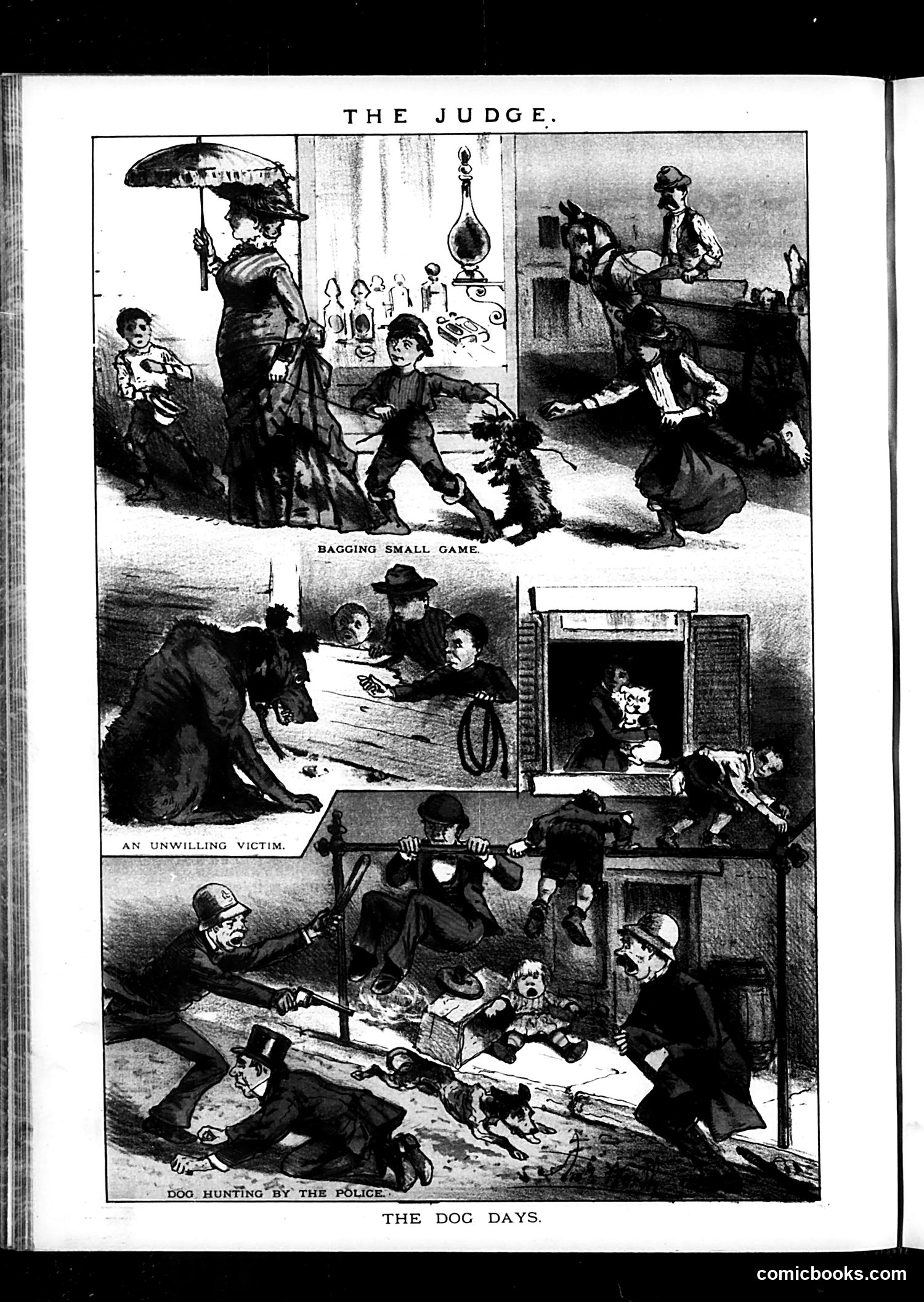
This page presents two connected satirical sequences titled "Bagging Small Game" and "Dog Hunting by the Police," collectively labeled "The Dog Days." The cartoons appear to mock law enforcement and upper-class society's treatment of street children and the poor. The top sequence shows well-dressed adults (likely representing authority figures or judges) pursuing and capturing children in urban settings. The lower sequence depicts police officers actively hunting children with implements, treating them as quarry. The satirical point seems to criticize how authorities hunted down vagrant or orphaned children as if they were animals—reflecting late 19th-century American social problems and the criminalization of poverty. The title "Dog Days" puns on both the summer season and the dehumanizing treatment of society's most vulnerable members.