
Judge, 1882-06-24 · page 7 of 16
Judge — June 24, 1882 — page 7: what you’re looking at
What you’re looking at
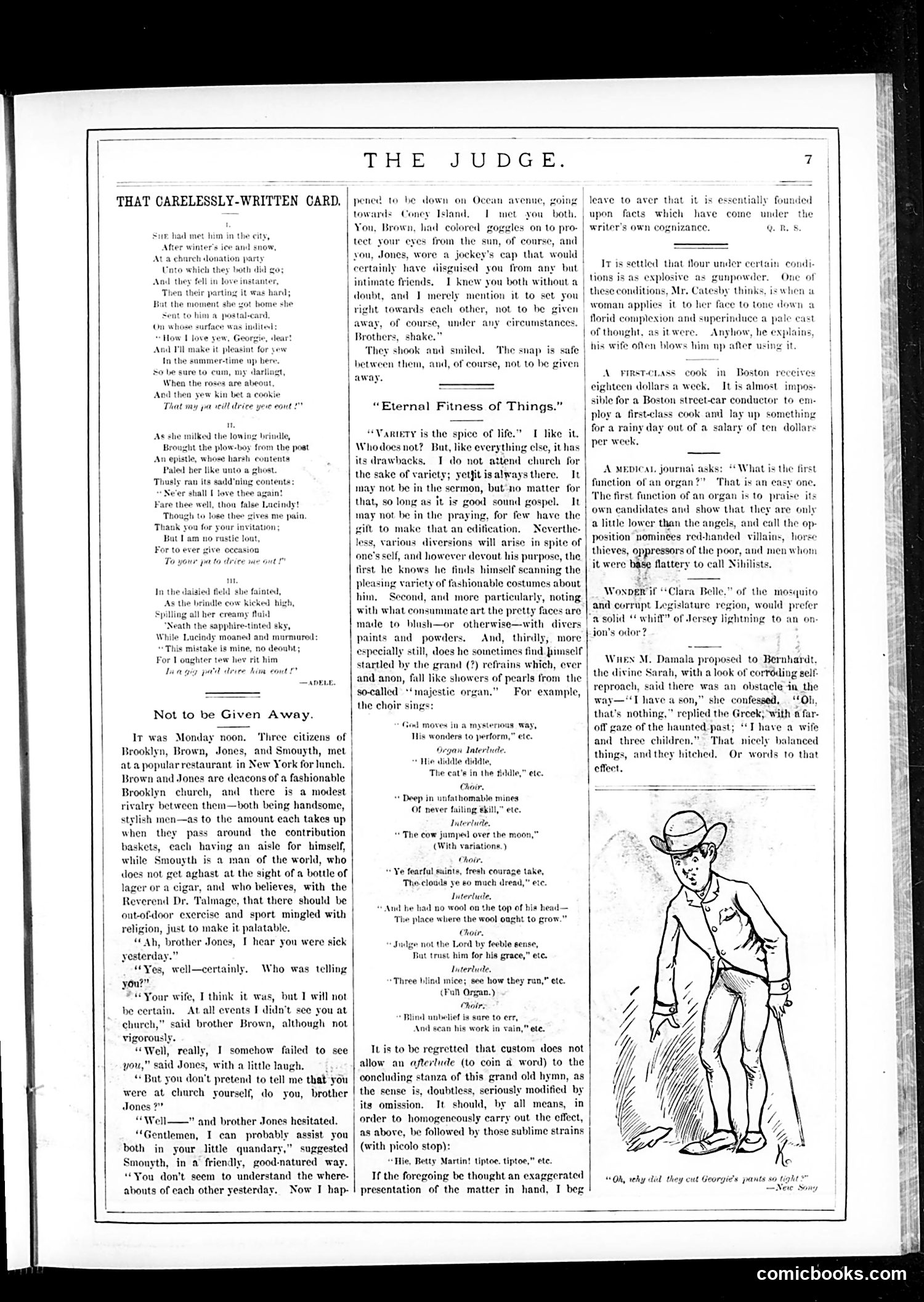
This page contains two distinct pieces of satirical humor: **"Not to be Given Away"** (main story): Three Brooklyn churchgoers—two respectable deacons (Brown and Jones) and a worldly man (Smouyth)—encounter each other at a restaurant. Each claims not to have seen the others at church the previous day, but Smouyth reveals he spotted all of them on Ocean Avenue in disguises (goggles, jockey cap), clearly avoiding church attendance. The satire mocks the hypocrisy of prominent church members who publicly present themselves as devout while privately neglecting religious obligations. The joke's title suggests their mutual cover-up is "not to be given away"—their secret stays buried among friends. **Accompanying editorial snippets** discuss variety in church attendance and the distractions of fashionable dress and cosmetics during services, reinforcing themes of superficial religiosity. The cartoon (right) shows a dandy figure, likely illustrating the "worldly man" character type being satirized.
📄 Transcribed text from this page (OCR, searchable)
Machine-transcribed from the original scan — historical spelling and the odd misread are preserved.
nireh don ty hoth did go; tion which the} And they fell in I . Then their parting it was hand; Bat the moment sh ne zot home she Sent to him a postal-card it How I love yew, And Til In the Ke it pleasint for yew ammer-time up here So be sure to cum, my dar When the roses are abeout And thea yew kin bet a cookie That my pa reill drive yeve eou As she milked the Brought the plow-t An epist Paled her like unto a g Thu its sadd’n| Ne'er shall [ love thee a 1, thon false Lucindy! 0 Tose thes lowing brindle, y from the whose harsh contents y ra Fare thee wi Thoug Thank you fo But Pam no For to ev me our invitation ; fe lout, eceasion In the daisied fleld she fainted, As the brindle hi Spilling all amy fluid » sapphire-tinted sky, While Lucindy moaned and murmured: “This mistake is mine, no deoubt; For 1 onghter tew hey rit him —anenr Not to be Given Away. It was Monday noon. ‘Three citizens of | Brooklyn, Brown, Jones, and Smouyth, met ata popularrestaurant in New York for lunch. Brown and Jones are deacons of a fashionable Brooklyn church, and there is a modest rivalry between them—both being handsome, stylish men—as to the amount each takes up when they pass around the contribution baskets, each having an aisle for himself, while Smouyth is a man of the world, who does not get aghast at the sight of a bottle of lager or a cigar, and who believes, with the Reverend Dr. Talmage, that there should be out-ofdoor exercise and sport mingled with | religion, just to make it palatable, | “Ah, brother Jones, I hear you were sick sterday.” “Yes, well—certainly, you?” “Your wife, I think it was, but I will not be certain, At all events I didn’t see you at chureh,” said brother Brown, although not | vigorously. “Well, really, I somehow failed to see you,” said Jones, with a little laugh. * But you don't pretend to tell me that you were at church yourself, do you, brother | Jones 7” | Who was telling | “Well—” and brother Jones hesitated. “Gentlemen, I can probably assist you both in your little quandary,” suggested Smonyth, in a friendly, good-natured way. “You don’t seem to understand the where- abouts of each other yesterday. Now I hap- betw THE JUDGE. to be down on Ocean avenut rds Island, 1 You, Brown, ha pene towards Coney met you both. tect your eyes from the sun, of course, and ‘ou, Jones, wore a jockey’s cap that would certainly have disguised you from any but intimate friends. 1 knew you both without a doubt, and J merely mention it to set you right towards each other, not to be given away, of course, under Brothers, shake. They shook ny circumstances. nd smiled, ‘The snap is safe n them, and, of course, not to be given away. “Eternal Fitness of Things.” “Variety is the spice of life.” I Whodoes not? But, like everythin; its drawbacks. I do not attend church for the sake of varicty; yetfit isalways there. It may not be in the sermon, but-no matter for that, so long as it is good sound gospel. It may not be in the praying, for few have the gift to make that an editication. Neverthe- less, various diversions will arise in spite of one’s self, and however devout his purpose, the first he knows he finds himself scanning the pleasing varicty of fashionable costumes about him. Second, and more particularly, noting with what consummate art the pretty faces are made to blush—or otherwise—with divers paints and powders. And, thirdly, more especially still, does he sometimes find pimself startled by the grand (?) refrains which, ever and anon, fall like showers of pearls from the so-called “‘inajestic organ.” For example, the choir sings: like it, else, ithas én moves In a mysterio His wonders to perform Organ Interlude. Hie diddte aide The cat's in the fiddle,” Choir, + Deep in unfathomable mines Of never failing ell Interlunte, “The cow jumped over the moon,” (With variations.) “Ye fearful saints, fresh courage take, Tho-clouds ye eo much dread,” & Interlude, “And he had no wool on the top of his head— The place where the wool ought to grow.” Coir, Jurlge not the Lord by feeble sense, But trust him for his grace,” ete. Interlude. ind mice; see how they run," ete. (Full Organ.) Ohoirs Three nl unbelief is sure to err, sean his work in vain," ete. It is to be regretted that custom does not allow an afterlude (to coin a word) to the concluding stanza of this grand old hymn, as the sense is, doubtless, seriously modified by | its omission. It should, by all means, in order to homogencously carry out the effect, as above, be followed by those sublime strains (with picolo stop): “Hie, Betty Martin! tiptoe. tiptoe,” ete. If the foregoing be thought an exaggerated presentation of the matter in hand, I beg «1 colored goggles on to pro- | vA leave to aver that | upon facts which founded under it is es ally have come writer's own cognizance. the It is settled that four under certain condi- tions is as exph One of | these conditions, ive as gunpowde Mr. Catesby thinks. n applies it to her fi florid complexion and superinduce a pale east | of thonght, as itwere. Anyhow, he expl | his wife of'en blows him np afer usin: wom to tone down a ns A FIRST-CLASS cook in eighteen dollars a week. It is almost sible for a Boston street-car conductor | ploy a first-class cook aml In for a rainy day out of a sala! per week, oston receives impos- to em- yup something y of ten dollars A MEDICAL journal asks: “What is the first function of an organ?" ‘That is ane ‘The first function of an organ is to praise its own candidates and show that they are only a little lower than the angels, and call the op- position nominees red-handed villains, horse thieves, oppressors of the poor, and men whon, it were base flattery to call Nihilists. sy one. Wonper if “Clara Belle.” of the mosquito and corrupt Legislature region, would y a solid whiff” of Jersey lightning to an ion's odor? Wuey M. Damala proposed to Bernhardt. the divine Sarah, with a look of corréding self: reproach, said there was an obstacle in the way—T have a son,” she confessed, “Oh, that’s nothing,” replied the Greek, with a fa off gaze of the haunted-past; “Ihave a wife and three children,” That nicely balanced things, and they hitched. Or words to that effect. K- “Oh, why did they cut Georgie’s pants so tight © comicbooks.com