
A complete issue · 16 pages · 1882
Judge — April 8, 1882
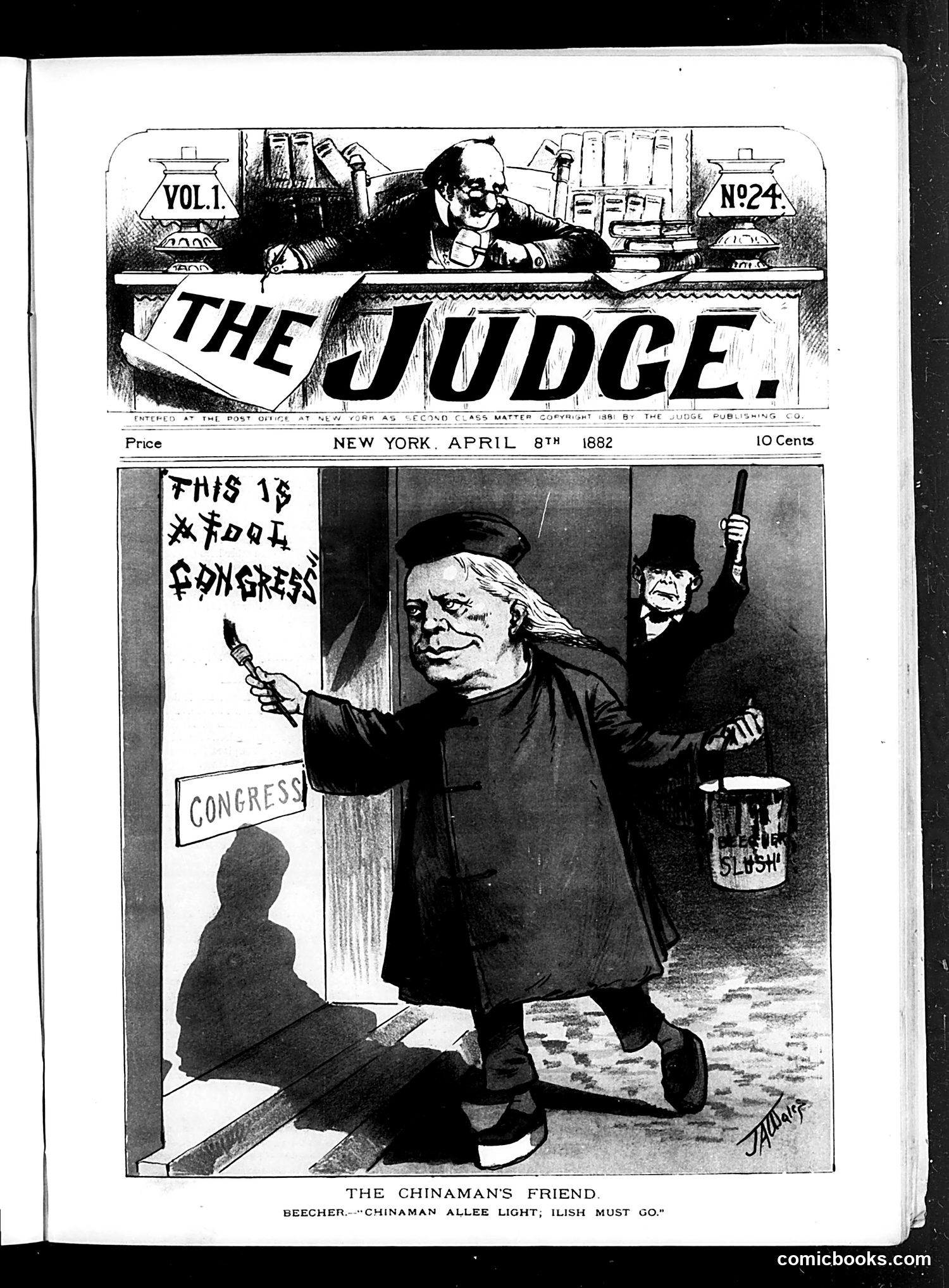
This cartoon satirizes Henry Ward Beecher, a prominent clergyman and abolitionist, depicted as a hypocrite. The caricature shows him holding a sign reading "THIS IS A HEATHEN CONGRESS" while seemingly advocating for Chinese immigration ("Chinaman allee light, Irish must go"). The satire appears to critique Beecher's selective morality: he champions Chinese laborers while simultaneously denigrating Irish immigrants. The "Congress" reference likely connects to contemporary anti-Chinese legislation debates of 1882 (the Chinese Exclusion Act passed that year). The cartoon suggests Beecher's professed humanitarian principles are inconsistent—he favors one immigrant group over another based on economic or racial interests rather than genuine principle. This reflects the bitter anti-Irish and anti-Chinese immigrant tensions prevalent in Gilded Age America.
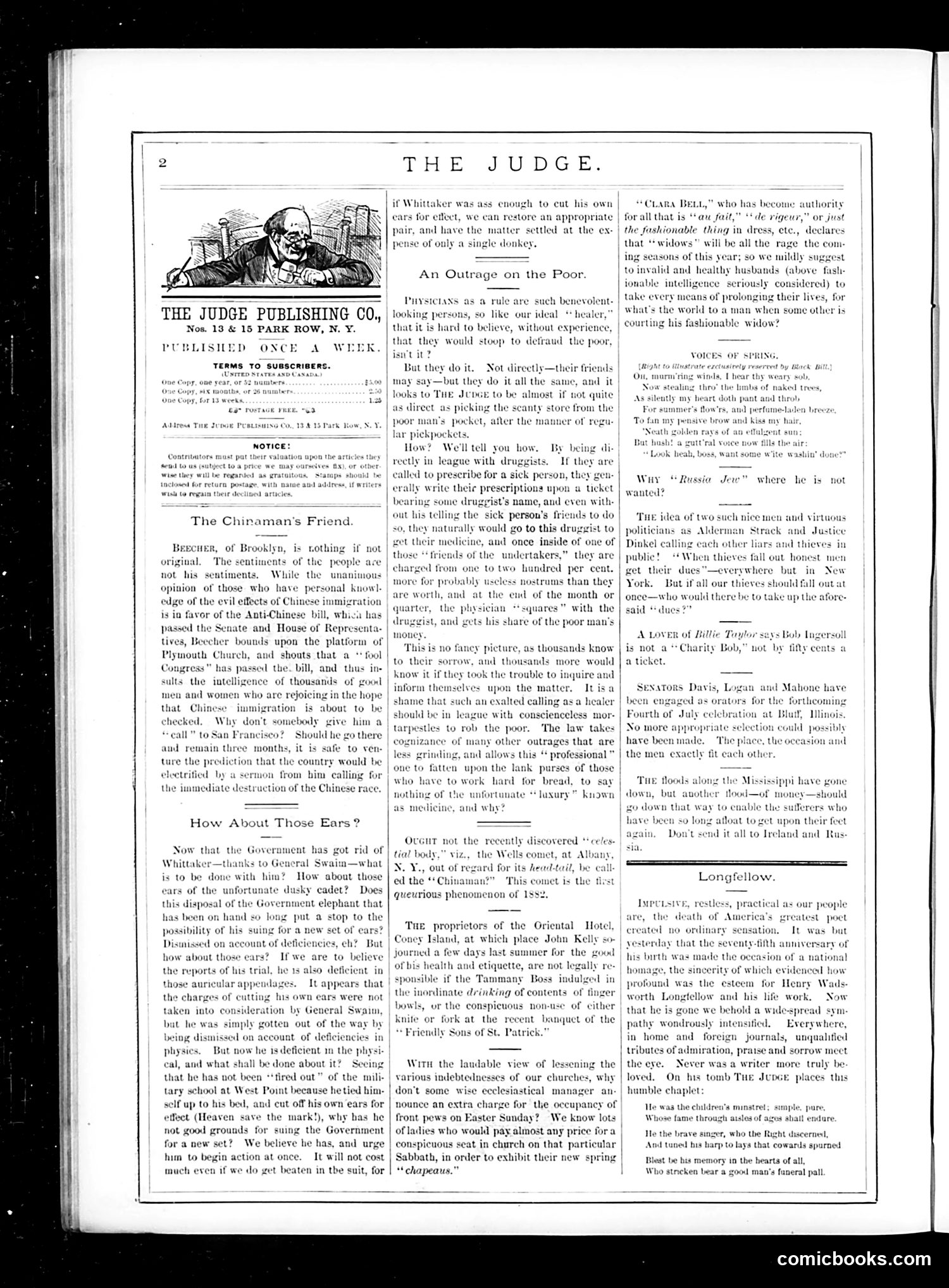
This page from *Judge* magazine satirizes several 1880s social and political issues: **"The Chinaman's Friend"** targets Henry Ward Beecher, the famous Brooklyn preacher who opposed the Chinese Exclusion Act. The cartoon ridicules him for condemning Congress's passage of anti-Chinese legislation while remaining safely in the North, suggesting he should visit San Francisco to witness Chinese immigration firsthand before forming opinions. **"How About Those Ears?"** references the Whittaker case—a scandal involving a cadet at West Point who allegedly cut off his own ears. The piece sarcastically suggests the government should compensate him for this injury since it dismissed him for "deficiencies" rather than addressing his self-mutilation. **"An Outrage on the Poor"** exposes medical fraud: physicians prescribe expensive medications to poor patients, earning kickbacks from druggists who mark up prices 200 percent. The satire criticizes how doctors exploit vulnerable populations through collusion with pharmacists. All three pieces employ *Judge's* typical approach: mocking hypocrisy, institutional corruption, and social injustice through pointed ridicule.
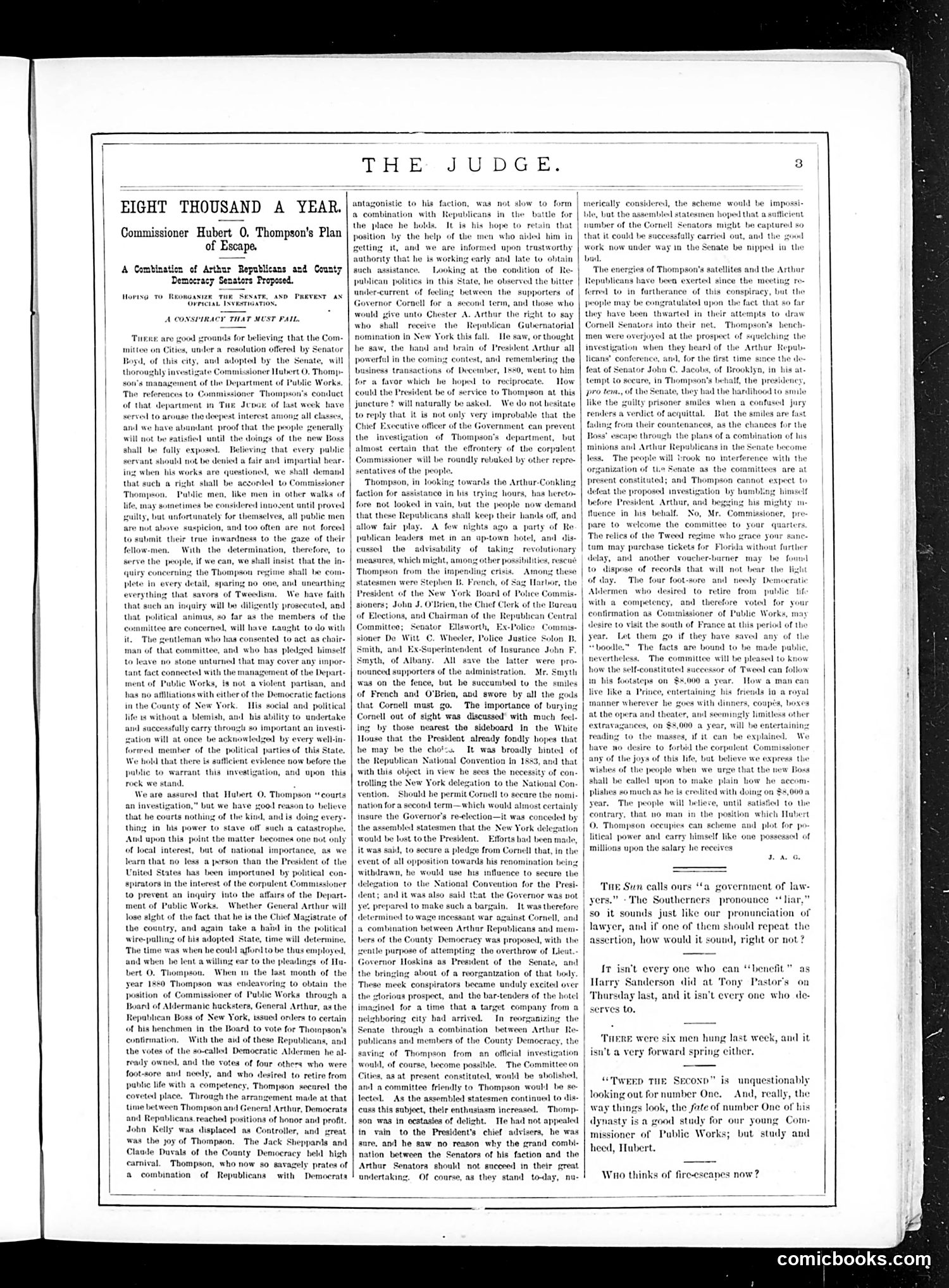
This page attacks **Commissioner Hubert O. Thompson** of New York's Public Works Department, whose $8,000 annual salary the article finds suspect. The piece alleges Thompson secured his position through a corrupt bargain between **Arthur Republicans** (supporters of President Chester Arthur) and **County Democracy** Democrats—two rival Democratic factions. The satire's core accusation: Thompson obtained the position through machine politics, trading patronage positions to various aldermen and political figures. The article notes the irony that Thompson now claims purity while his appointment resulted from exactly the kind of party combination (Republican-Democratic) he publicly opposes. The piece calls for a Senate investigation into Thompson's department, framing it as exposing machine corruption affecting city governance. The title references Thompson's generous salary as reward for political loyalty rather than merit—a classic Gilded Age critique of civil service corruption.
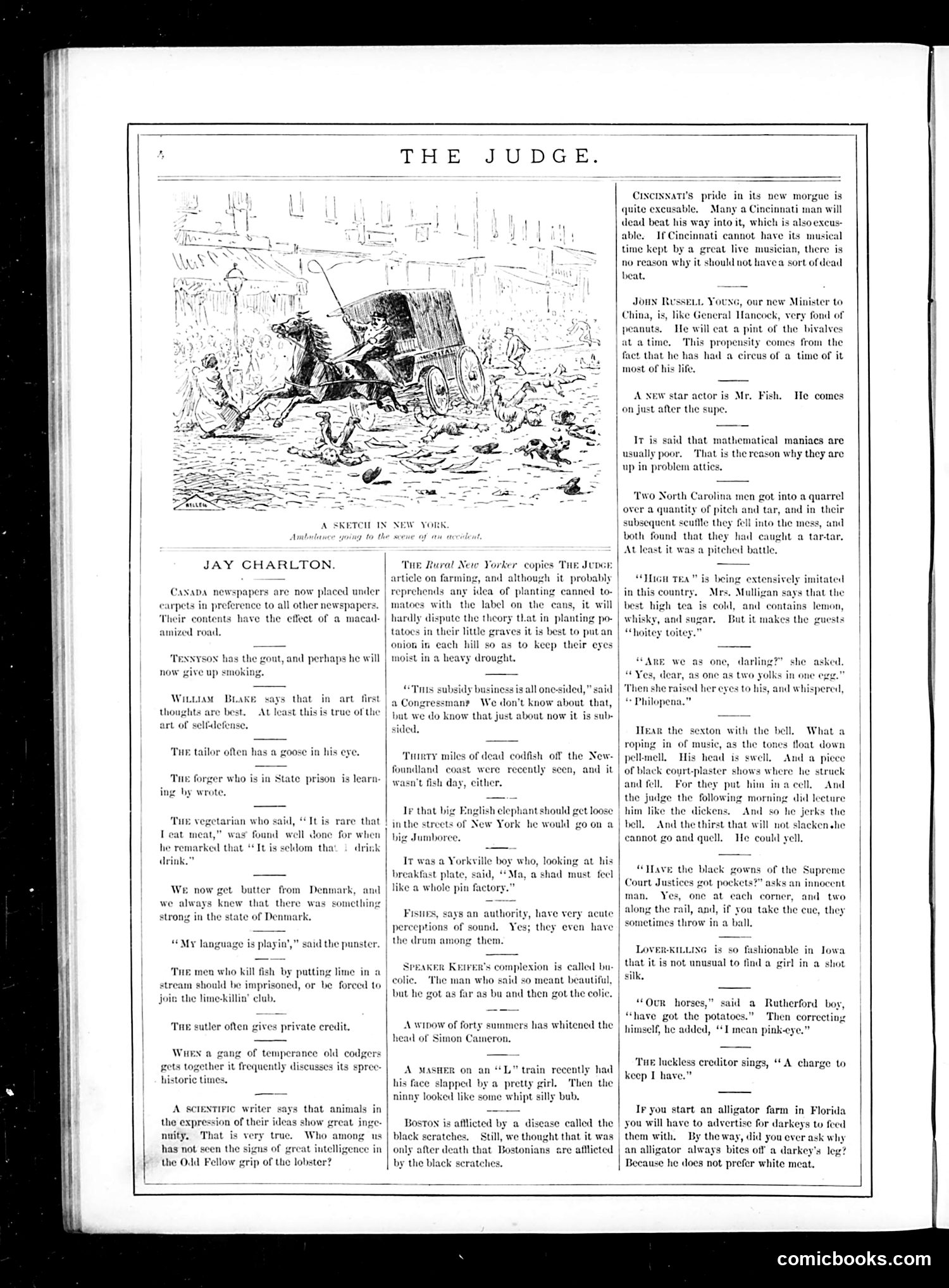
This page's main cartoon depicts an ambulance scene in New York City, illustrating the magazine's satirical commentary on urban chaos and mishaps. The accompanying text column, titled "The Judge," contains brief humorous anecdotes and observations on contemporary American life. The cartoon's specific subject appears unclear from the image alone, but the caption "Ambulance going to the scene of an accident" suggests it satirizes New York's chaotic street conditions. The text below includes commentary on various topics: Cincinnati's new morgue, John Russell Young (the new Minister to China), and various social observations about Danish butter, fish, elephants, and Boston diseases. The humor is largely observational rather than overtly political—typical Judge fare mocking everyday American absurdities, regional peculiarities, and minor public figures of the era.
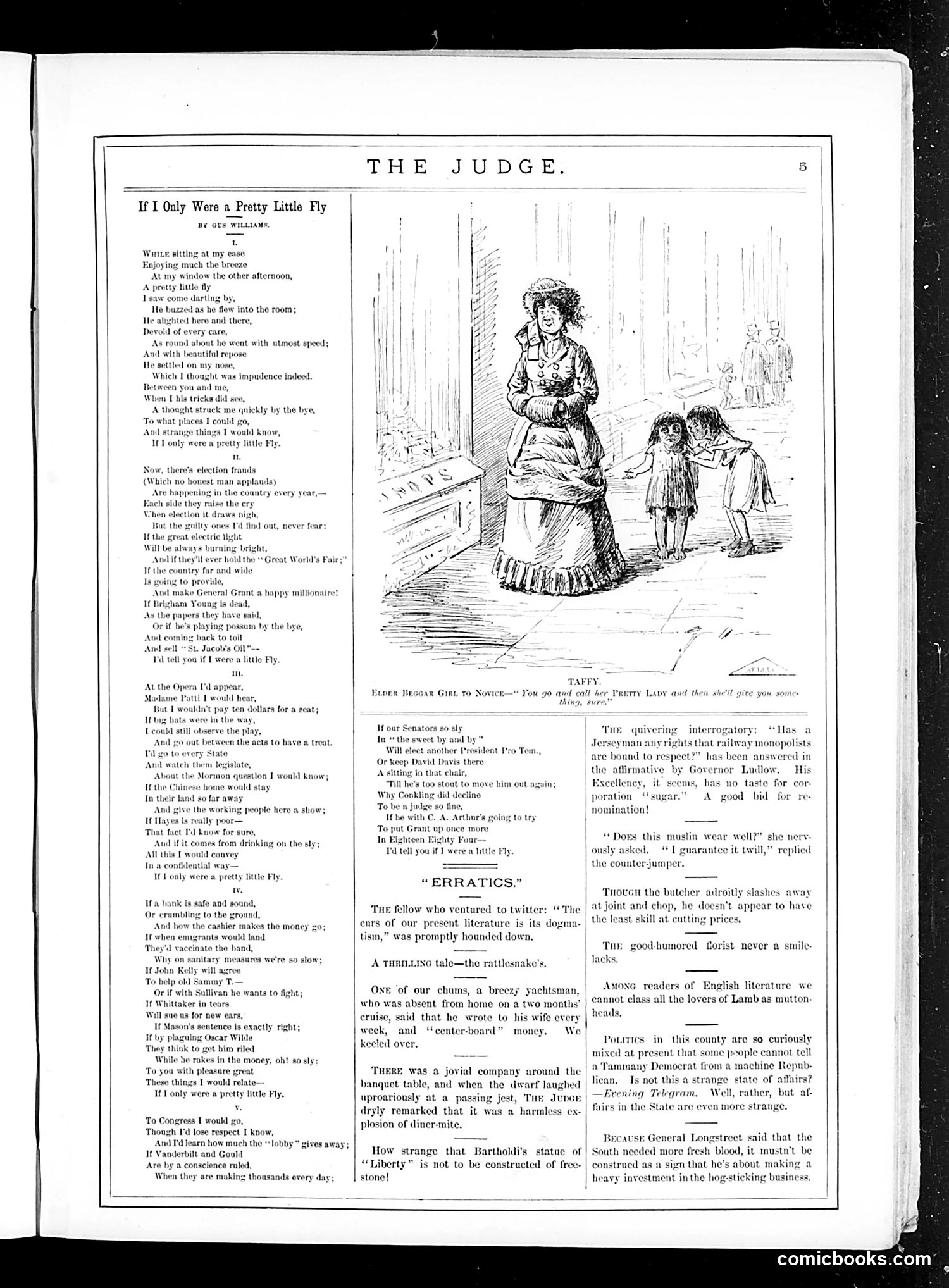
This page from Judge (likely 1880s, based on references) contains a satirical poem "If I Only Were a Pretty Little Fly" by Ben Williams, imagining what political secrets a fly could discover. **The Satire's Targets:** The poem mock-laments not being able to observe: - **Election fraud** ("election frauds / Which no honest man applauds") - **Mormon polygamy** (Brigham Young) - **Political corruption** and the "lobby" giving away money to congressmen - **Specific political figures**: Hayes (likely President Rutherford B. Hayes), Conkling, Arthur, Grant, and David Davis—apparently discussing Grant's potential 1884 comeback - **Labor disputes** (Jon Kelly, possibly John Kelly of Tammany Hall, versus Sullivan) **The Cartoon's Message:** A woman and children observe a fly—the visual punchline to Williams's poem about flies having better access to society's scandals than ordinary citizens. **The Page's Additional Content:** Brief satirical quips mock literary dogmatism, railroad monopolies, and corporate corruption. The humor relies on readers' familiarity with contemporary political scandals and personalities now largely obscure.
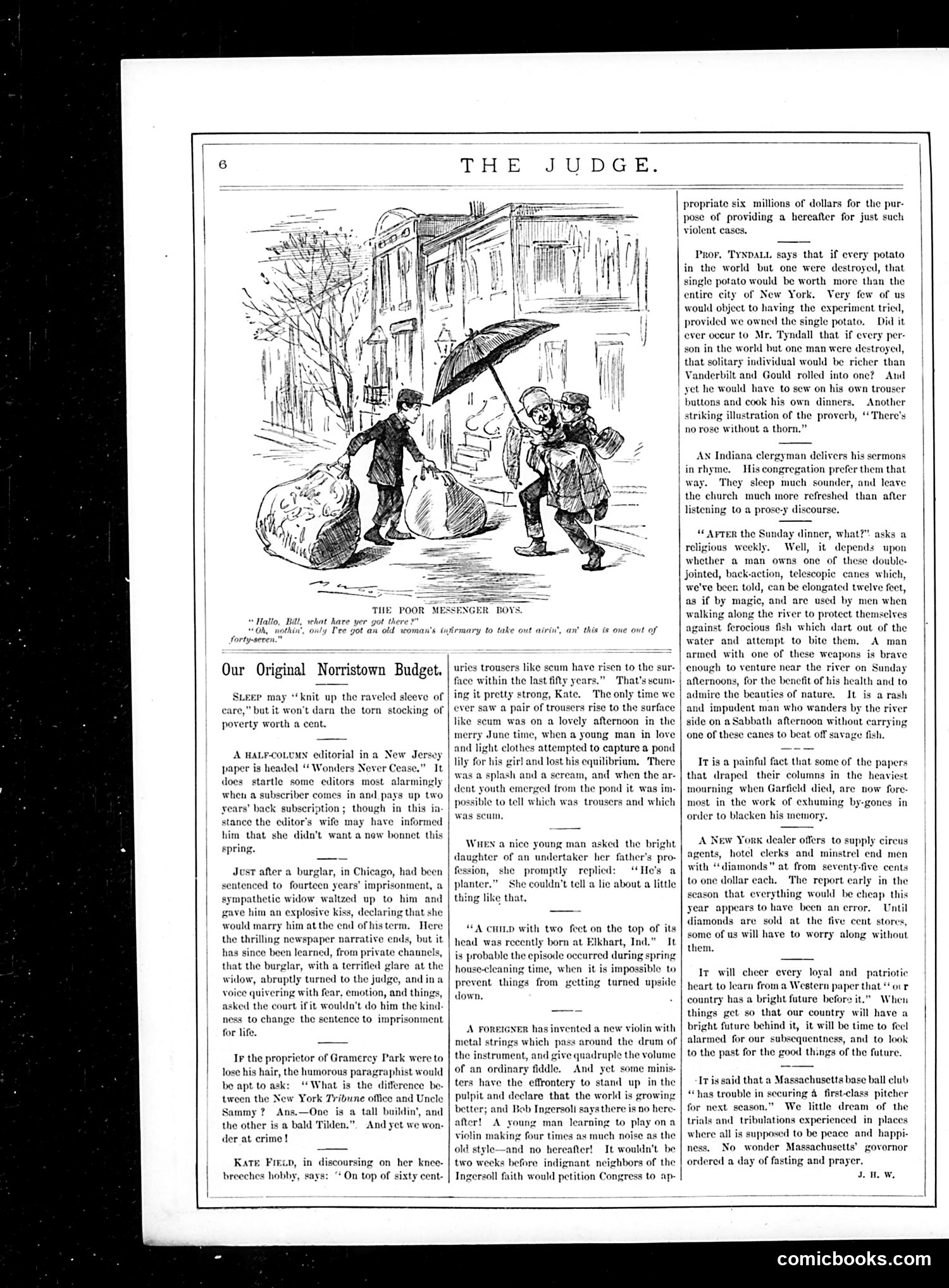
This page from Judge magazine contains satirical commentary on contemporary issues circa the 1880s-1890s. The main cartoon depicts two poor boys ("The Poor Messenger Boys") in an urban street scene—a common Judge subject ridiculing poverty and social inequality. The text below collects brief satirical anecdotes mocking various targets: - **Editorial absurdity**: A New Jersey paper's amazement when a subscriber actually pays back dues - **Criminal justice**: A burglar's fiancée is so terrible he requests life imprisonment instead - **Political figures**: References to Samuel Tilden (former Democratic presidential candidate, bald) and apparent criticism of Tribune editors - **Social hypocrisy**: Ministers claiming the world improves while noise pollution increases; references to atheist Robert Ingersoll The satire aims at contemporary foibles—poverty, crime, journalism, politics, and religious hypocrisy—through absurdist humor. Most specific references are now obscure, though the general targets remain recognizable.
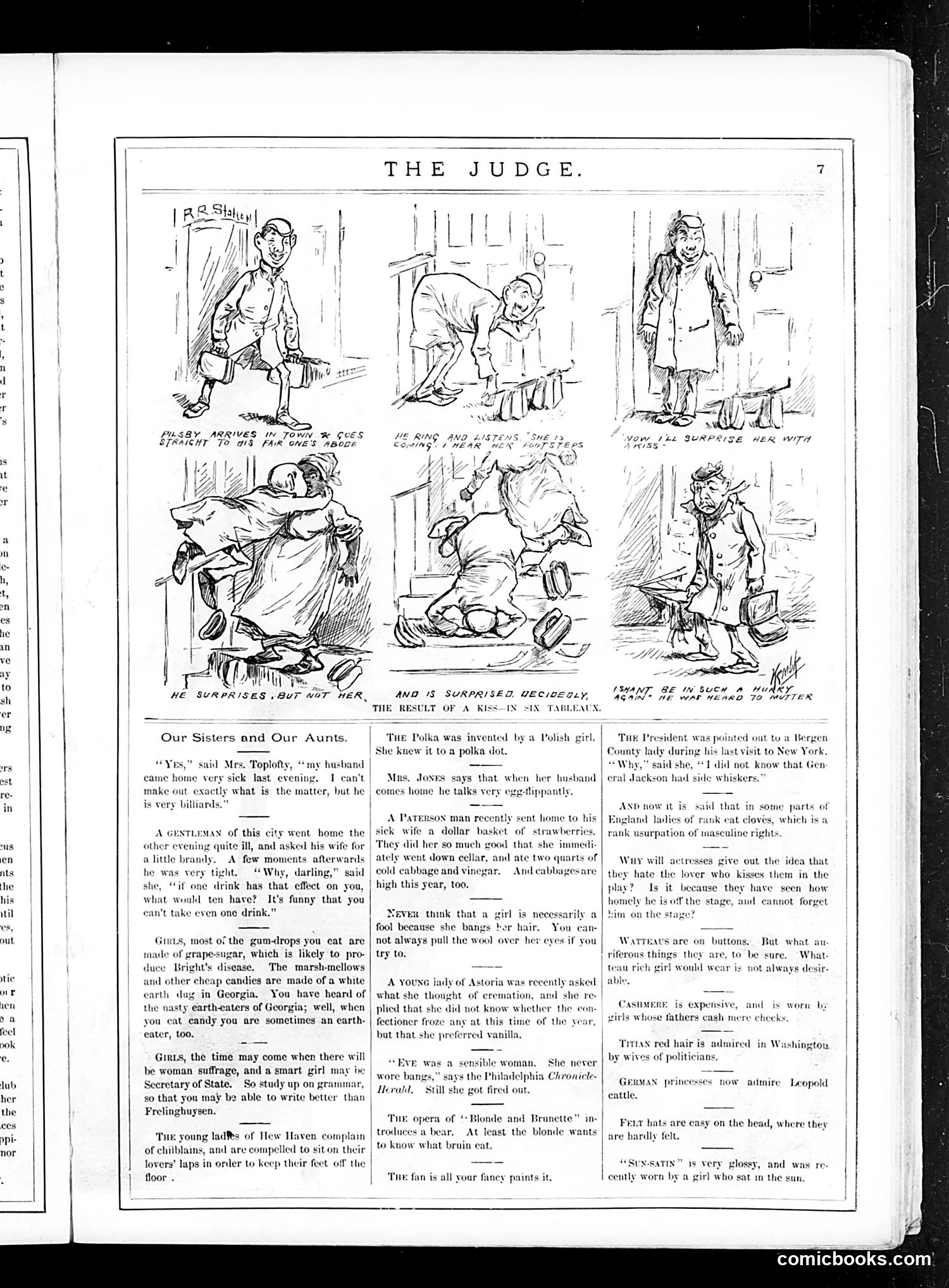
This page from *Judge* magazine contains six comic panels titled "The Result of a Kiss—in Six Tableaux," depicting slapstick domestic violence. The sequence shows a man progressively beating a woman after kissing her, culminating in him being surprised by her retaliation. The humor, typical of 19th-century satirical magazines, relies on exaggerated physical comedy treating spousal assault as entertainment. The accompanying text features brief humorous observations about contemporary life: women's fashion (polka dots, felt hats), marriage dynamics, dietary habits, and social conventions. References include the polka dance's Polish origins, President's whiskers, and debates about women's rights and education. The satire targets gender relations, consumer culture, and manners—standard *Judge* fare mocking both societal pretension and domestic life. The content reflects period attitudes that modern readers would find offensive regarding both violence and gender.
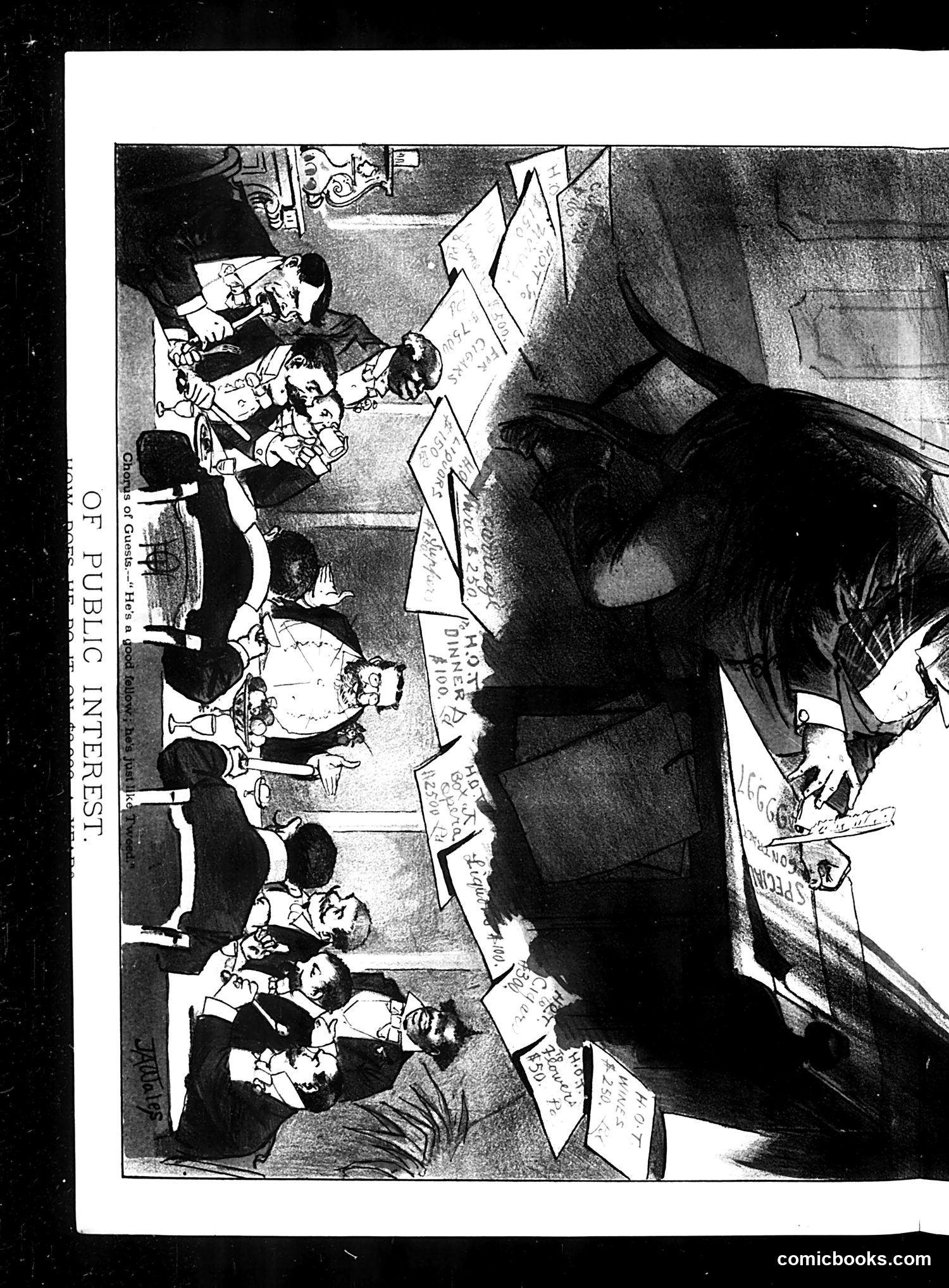
This appears to be a political cartoon satirizing public discourse or debate, likely from the early-to-mid 20th century. The image shows multiple figures engaged in animated discussion or argument, with papers scattered about—suggesting bureaucratic proceedings, legislative debate, or public controversy. The title "OF PUBLIC INTEREST" indicates commentary on matters claiming public importance. The cartoon's style and chaotic composition suggest satire of how various parties (politicians, officials, or interest groups) engage in loud, overlapping arguments while claiming to serve the public good. However, without clearer identification of specific figures or visible date information, I cannot determine the precise political event or individuals being satirized. The OCR text is largely illegible characters, preventing definitive interpretation of the cartoon's specific target or message.
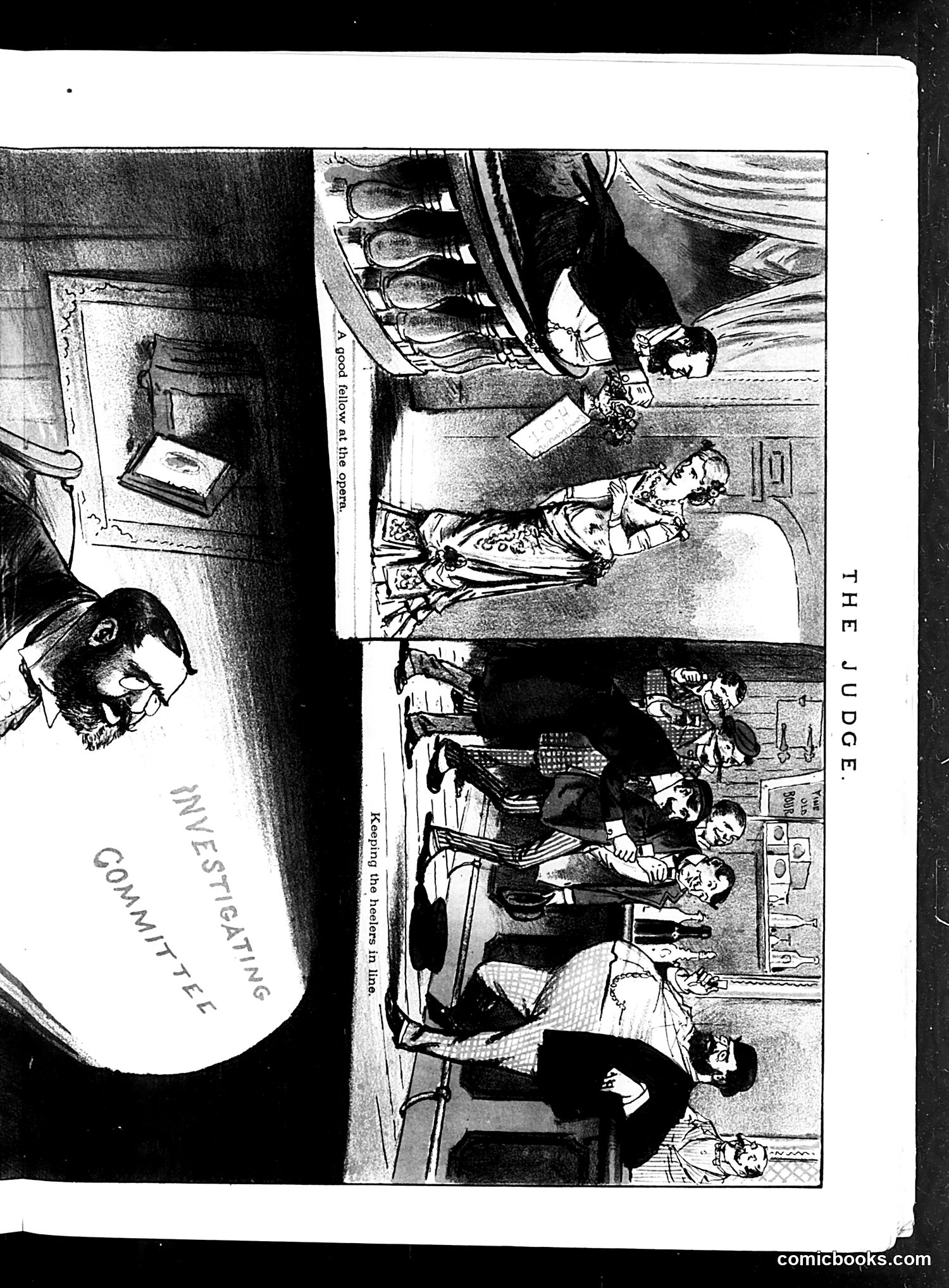
This page contains multiple cartoon panels titled "THE JUDGE" showing domestic scenes, likely satirizing courtroom or legal judgment in home/family situations. The visible text references "keeping the butcher in line" and mentions "good dining at the opera," suggesting social commentary on household management and domestic authority. The cartoons appear to depict family disputes or marital conflicts being "judged," with characters in period dress (appears early 20th century). The satire likely mocks how domestic disagreements are resolved—suggesting wives or family members exercise judgment over household matters and social spending. Without clearer OCR text, the specific satirical targets remain partially unclear, though the general theme appears to be gender dynamics and domestic economics during this era.
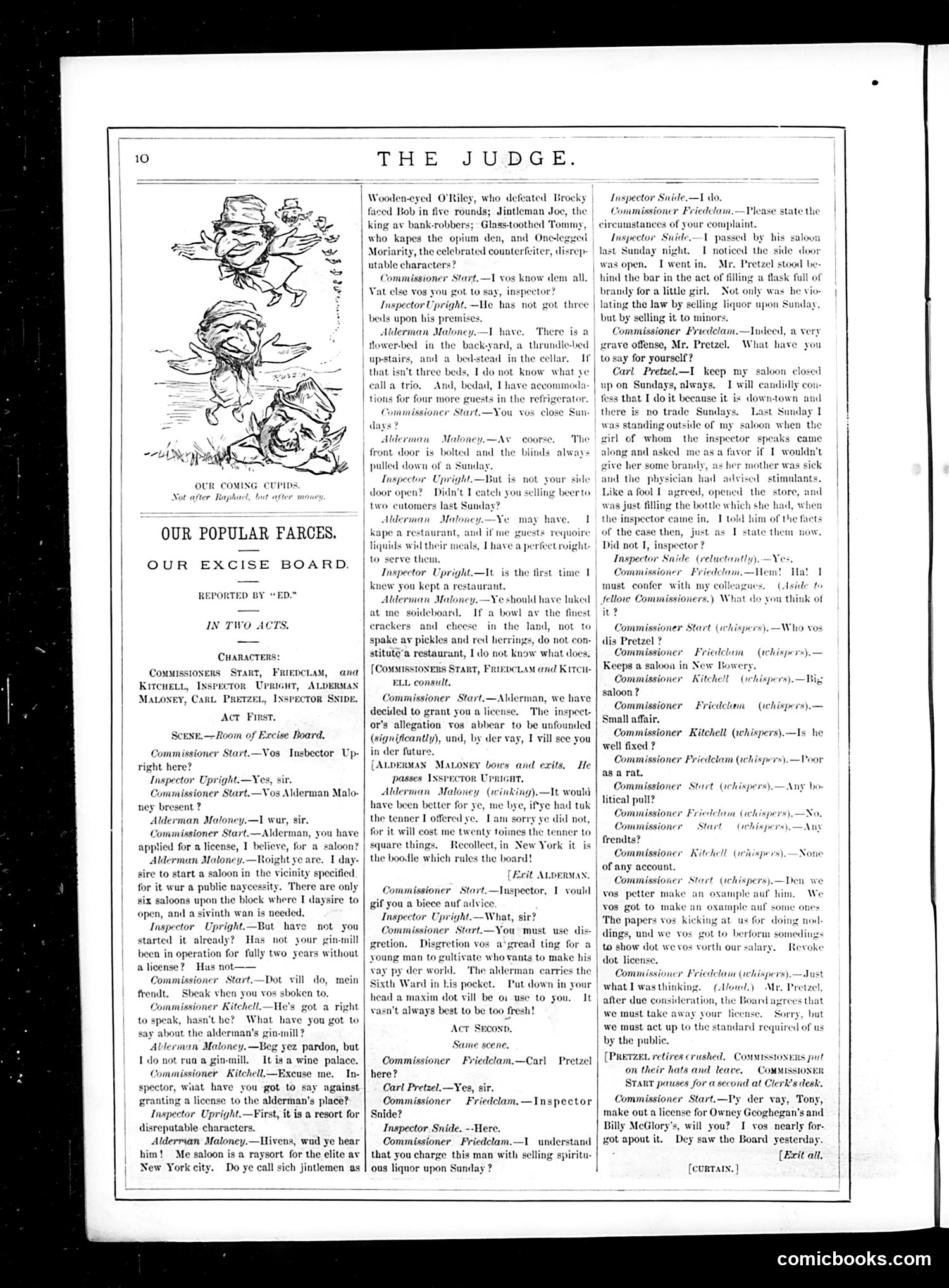
This page presents a satirical farce mocking New York City's liquor licensing board and the corruption within it. The sketch depicts an **Alderman Maloney** (an Irish-immigrant character, indicated by phonetic dialect speech) applying for a saloon license while admitting to already operating one illegally for two years. The satire targets: 1. **Bribery and favoritism**: The board members appear willing to overlook violations if the applicant has political connections. 2. **Hypocrisy**: Maloney claims his illegal establishment is a "wine palace" for the "elite," not a disreputable gin-mill, despite housing criminals like "Wooden-eyed O'Riley" and counterfeiters. 3. **Child endangerment**: Inspector Snide catches Maloney's bartender (Carl Pretzel) selling brandy to a young girl—a serious offense the board seems inclined to minimize. 4. **Regulatory theater**: Sunday closing laws are openly flouted while board members ask performative questions. The humor relies on ethnic stereotyping (Irish dialect) and exposing the gap between official regulations and actual practice in Gilded Age urban governance.
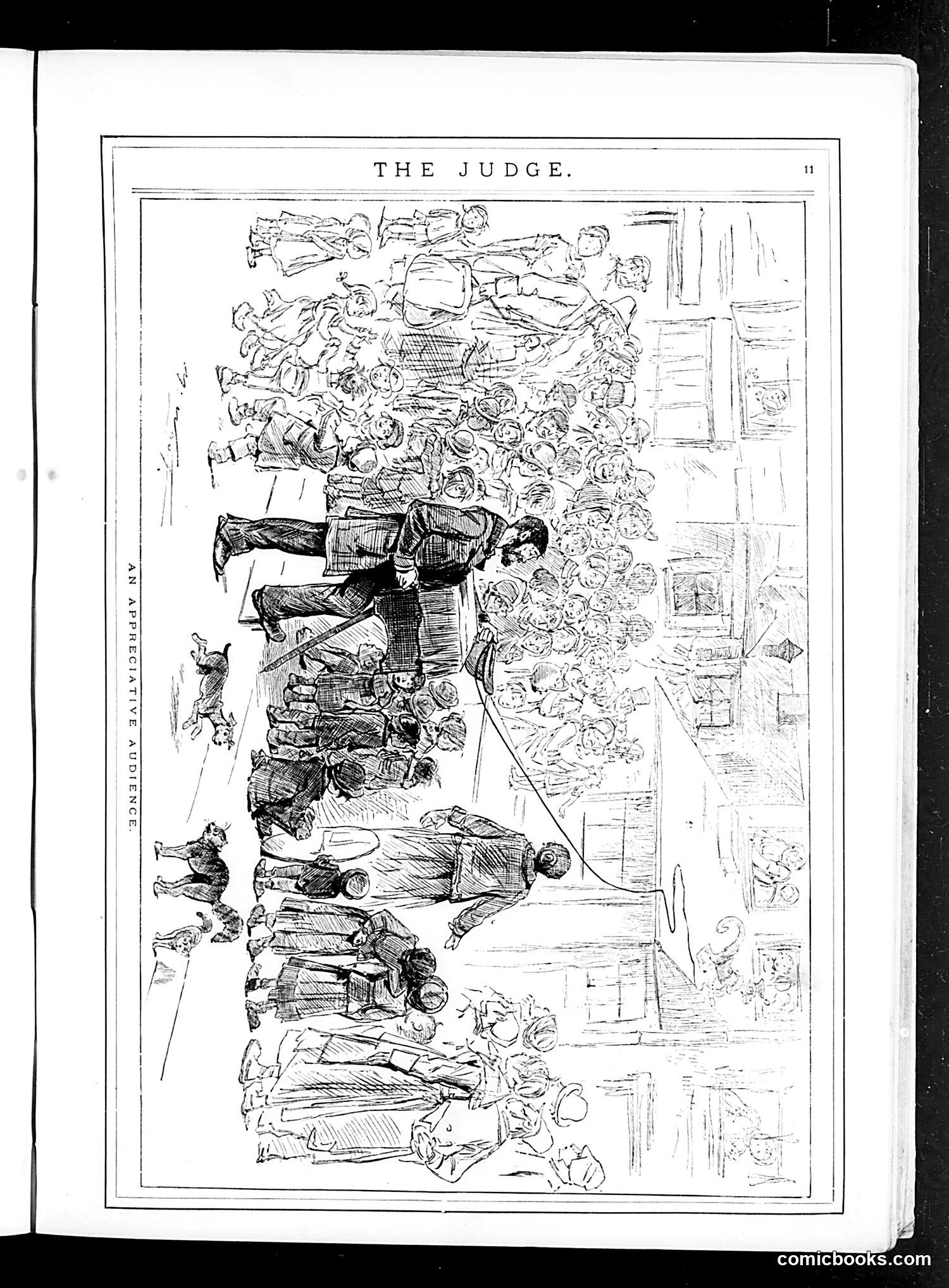
This Judge cartoon depicts a courtroom scene titled "An Appreciative Audience." The image shows a central figure (likely a judge or lawyer) addressing a crowded courtroom filled with spectators. The composition emphasizes the large audience surrounding the main speaker, suggesting satire about public fascination with legal proceedings or a particular trial. The cartoon likely mocks either the sensationalism of a famous court case that drew crowds, or satirizes the legal profession's tendency toward theatrical performance for audience approval. The title "Appreciative Audience" suggests irony—the crowded courtroom may represent either genuine public interest in justice, or more cynically, the public's appetite for entertainment masquerading as civic engagement. Without the specific date or case context visible on this page, the exact target remains unclear, though the style indicates late 19th or early 20th-century American legal/social commentary.
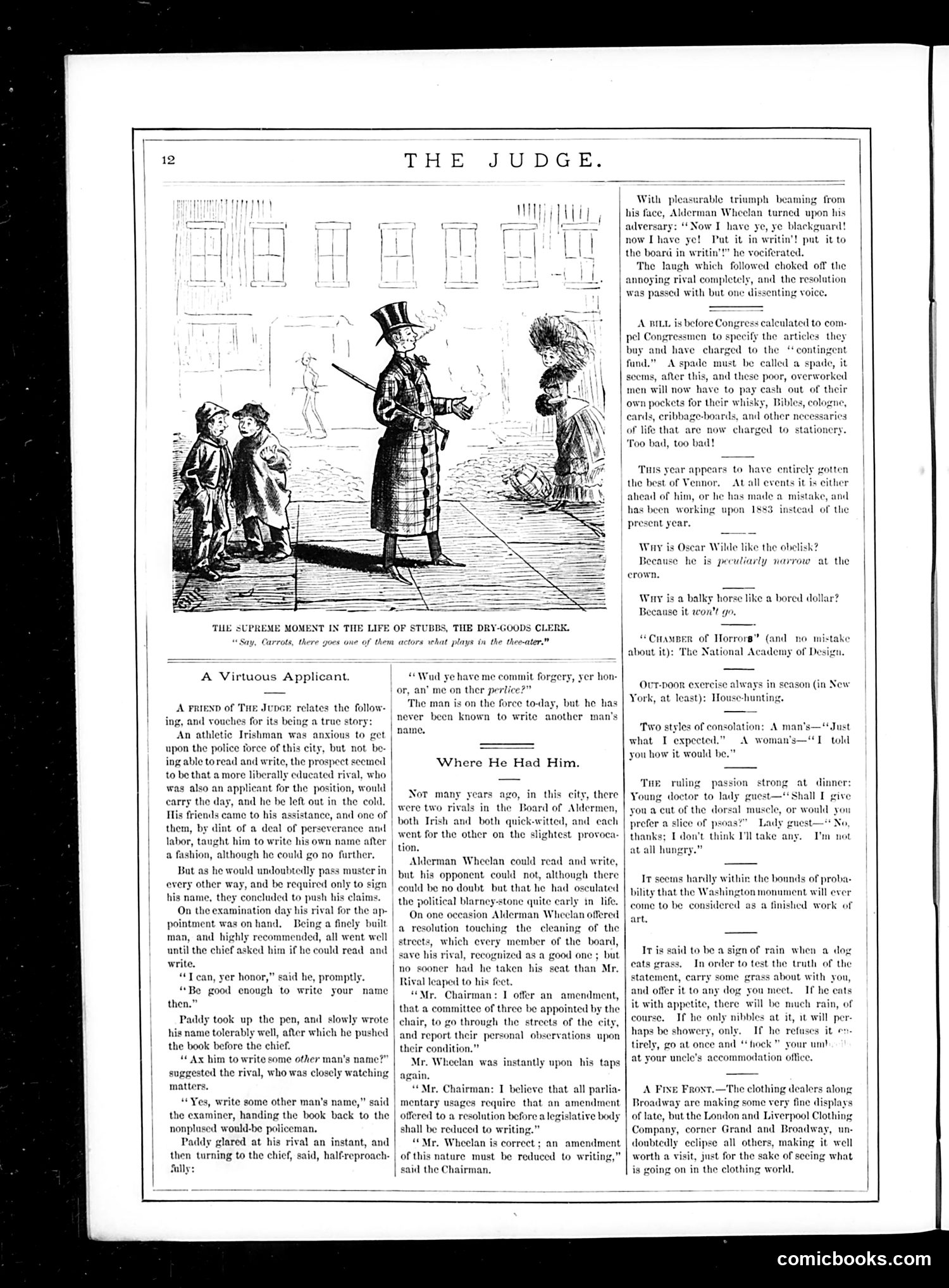
This page contains two satirical anecdotes about Irish politicians and applicants in late 19th-century America, plus a cartoon illustration. **The Main Cartoon** depicts "Stubbs, the Dry-Goods Clerk"—apparently a working-class character making an observation about theatrical actors, reflecting period class consciousness about entertainment and social status. **"A Virtuous Applicant"** mocks an illiterate Irish immigrant seeking police work. Through tutoring, he learns to write only his own name. When asked to write another man's name to test literacy, he refuses, claiming it would constitute forgery—exploiting a technicality to pass the exam despite genuine illiteracy. The satire targets both Irish immigrants and the inadequate vetting procedures allowing such obvious fraud. **"Where He Had Him"** describes two rival Irish aldermen. The literate Wheelan defeats his illiterate opponent by invoking parliamentary procedure requiring amendments in writing—trapping him publicly. The satire celebrates procedural rules as tools against those lacking education. Both stories perpetuate common 19th-century stereotypes of Irish immigrants as clever but uneducated, using humor to critique both their perceived craftiness and their limited education.
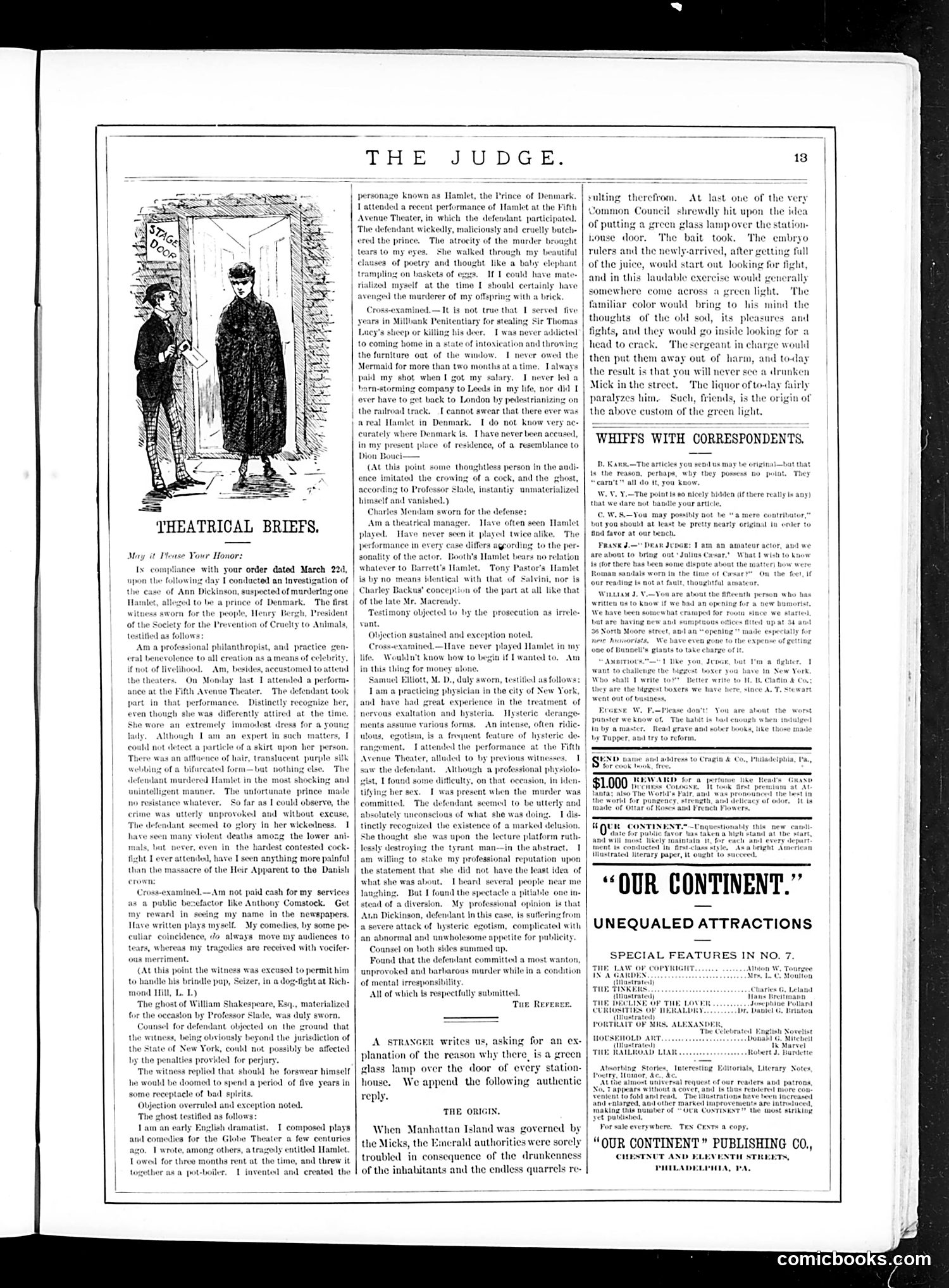
This page satirizes a contemporary production of *Hamlet* at the Fifth Avenue Theater through mock courtroom testimony. The humor operates on multiple levels: **The Setup:** A society figure testifying about the actress playing Hamlet appearing partially undressed—attacking both her scandalous costume choices and what he sees as theatrical incompetence. He compares her "butchery" of the Prince of Denmark to animal cruelty, absurdly invoking the ASPCA. **The Satire:** The testimony parodies: - Pretentious theater critics claiming moral authority - The actual ghost of Shakespeare testifying that he himself wrote *Hamlet* centuries ago and created it deliberately, undercutting the critic's complaints - Theater's perennial tension between artistic license and propriety **The Point:** Judge magazine mocks both Victorian moralism about female performers' bodies AND self-important critics who confuse their prudishness with legitimate artistic judgment. Shakespeare's ghost, materializing to defend his work's integrity, is the ultimate punchline—suggesting the critic misses the entire play's point.
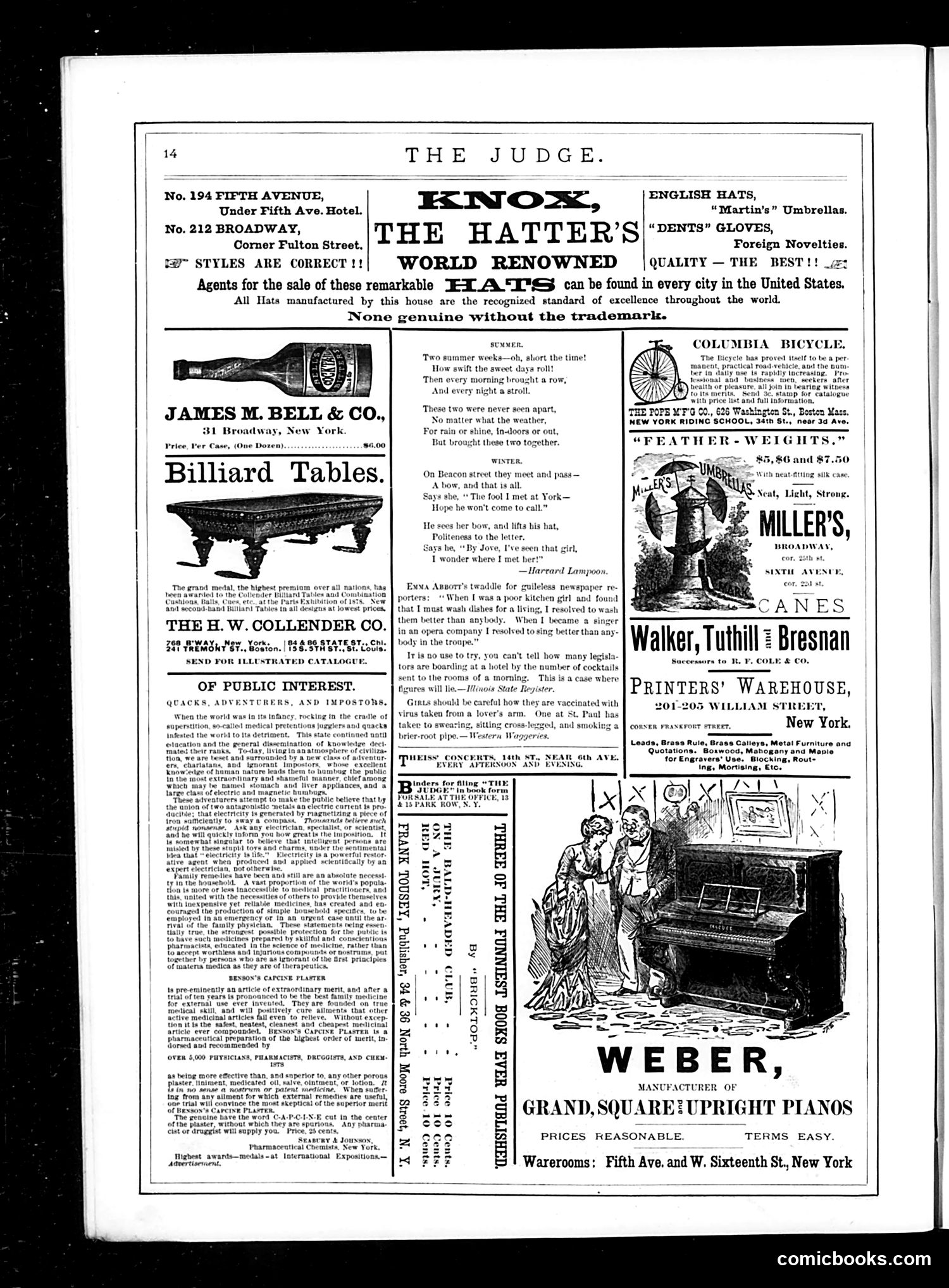
This page is primarily **advertising**, featuring commercial notices for products (hats, billiard tables, pianos, bicycles, gloves) rather than political satire. The only substantial editorial content is a short poetry section titled "Summer" and "Winter" (attributed to *Harvard Lampoon*), which contains mild social humor about romantic courtship—a young man persistently courting a woman who remains distant, then lamenting her coldness. This reflects typical genteel magazine verse of the era, not political commentary. There is also a brief article "Of Public Interest" discussing quack doctors and medical fraudsters—a legitimate consumer-protection concern of the time period. The text warns readers about unqualified practitioners. The page represents *Judge* primarily as a venue for **commercial advertising** rather than the satirical cartooning the publication was known for. The cartoons visible are minimal and decorative rather than pointed social commentary.
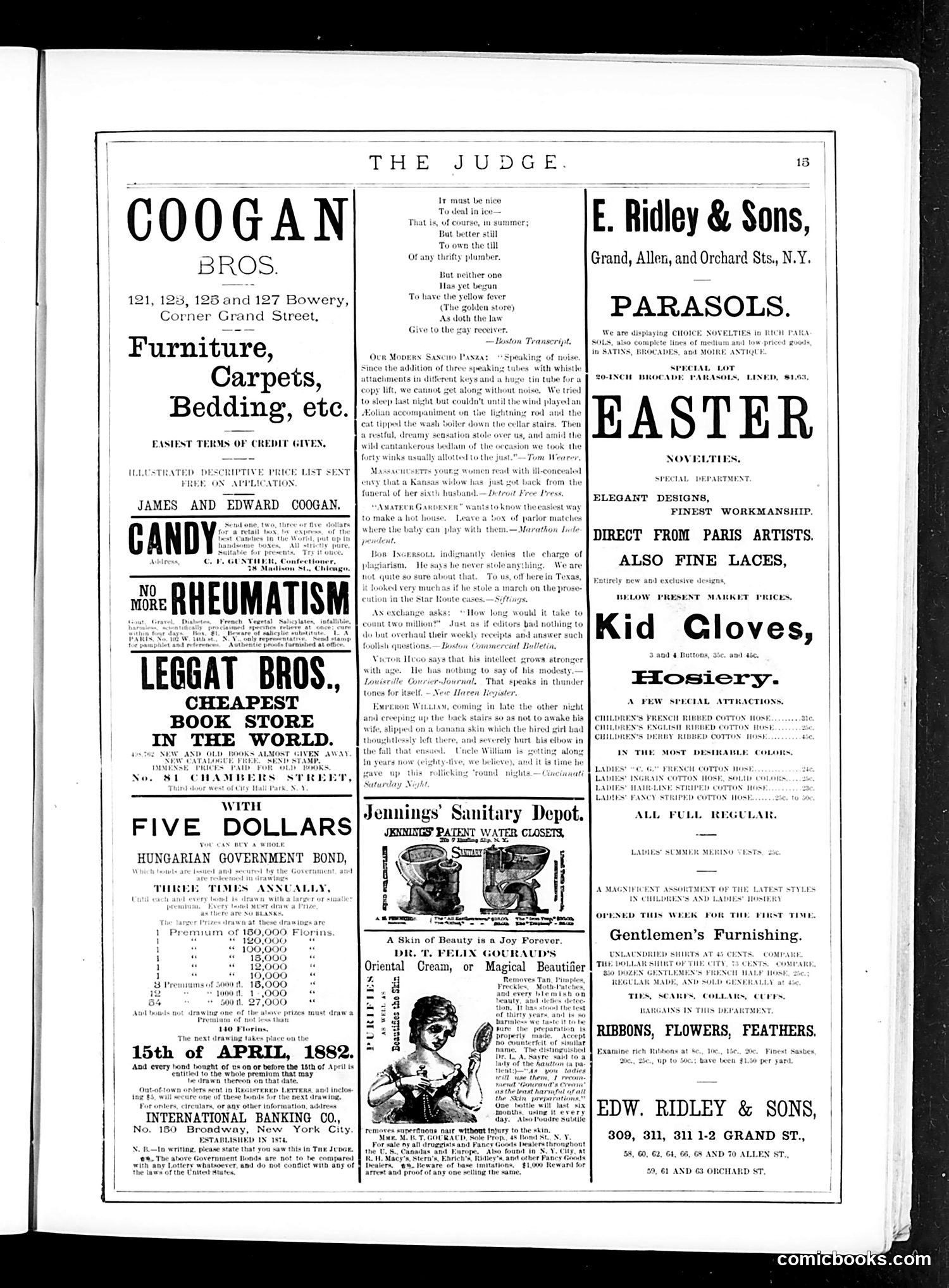
This is primarily an **advertising page** from Judge magazine (page 13), not a satirical cartoon page. It contains numerous merchant advertisements for 1880s New York retailers, including furniture stores (Coogan Bros.), bookstores (Leggat Bros.), and clothing shops (E. Ridley & Sons). The only editorial content is a brief **poetry excerpt** at the top by Boston Transcript about Modern Parlor conversation—a mild satire on pretentious social talk where people speak through "speaking tubes" and discuss fashionable but shallow topics. The poem gently mocks how parlor conversation deteriorates into gossip and superficial chatter. The rest of the page is commercial: advertisements for parasols, hosiery, kid gloves, beauty cream (Gouraud's "Magical Beautifier"), and Hungarian government bonds—typical 1880s consumer goods and financial products targeting middle-class readers.
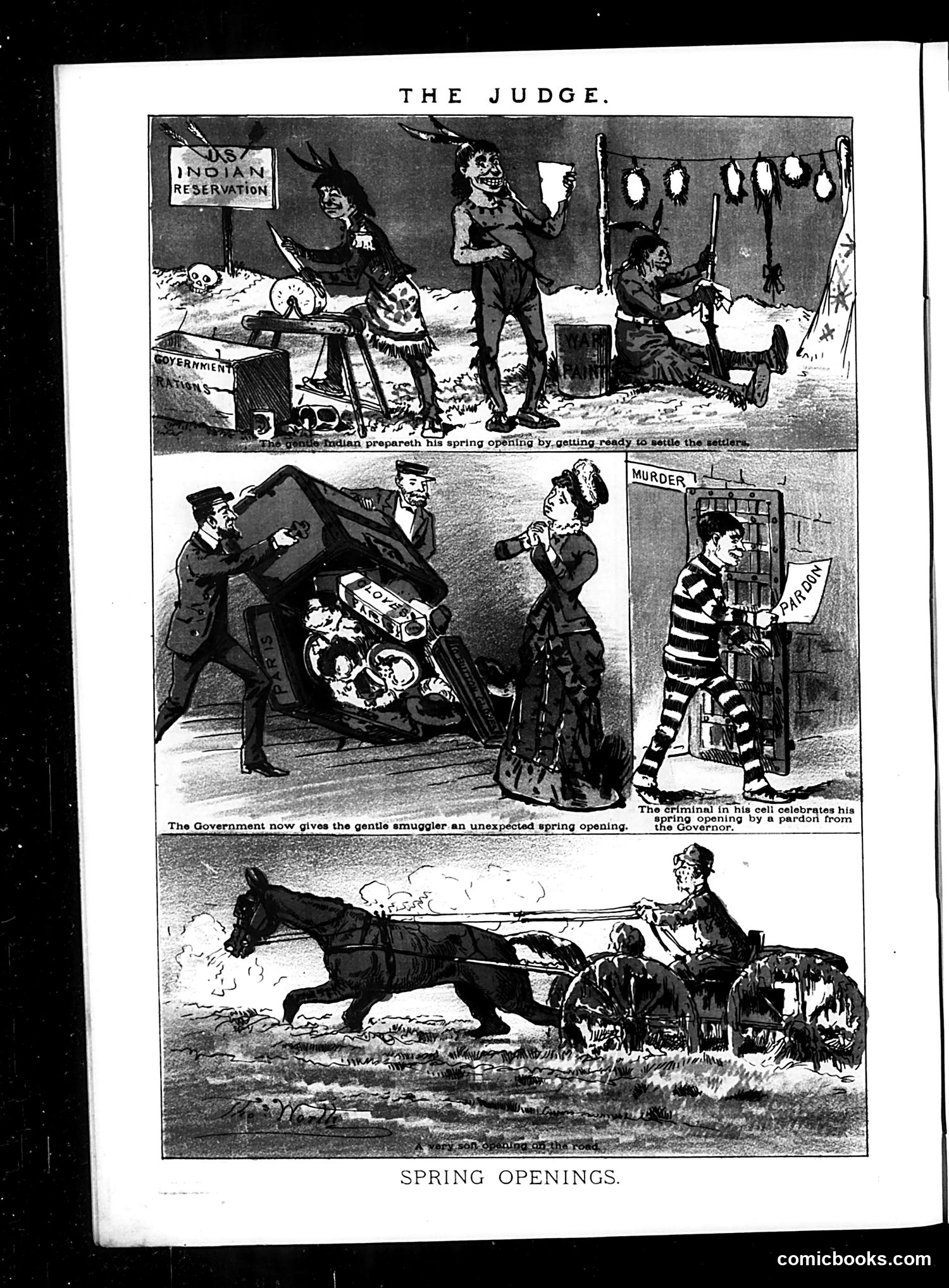
This satirical cartoon criticizes government corruption and selective justice. The title "Spring Openings" uses double meaning: literal spring season alongside metaphorical "openings" — opportunities for crime. The top panel shows the U.S. Indian Reservation being "prepared" for exploitation. The middle panels depict the government providing "unexpected spring opening" to smugglers and criminals through pardons/leniency. A convict in striped clothing receives a pardon "by a person from the Governor," suggesting the governor's office grants clemency to criminals. The bottom panel shows someone being "let out of the bag" — released or freed. The satire suggests the government hypocritically enforces laws selectively, granting pardons to favored criminals while punishing others, and simultaneously exploiting vulnerable populations like Native Americans. The cartoon mocks governmental corruption and favoritism.