
A complete issue · 16 pages · 1882
Judge — April 1, 1882
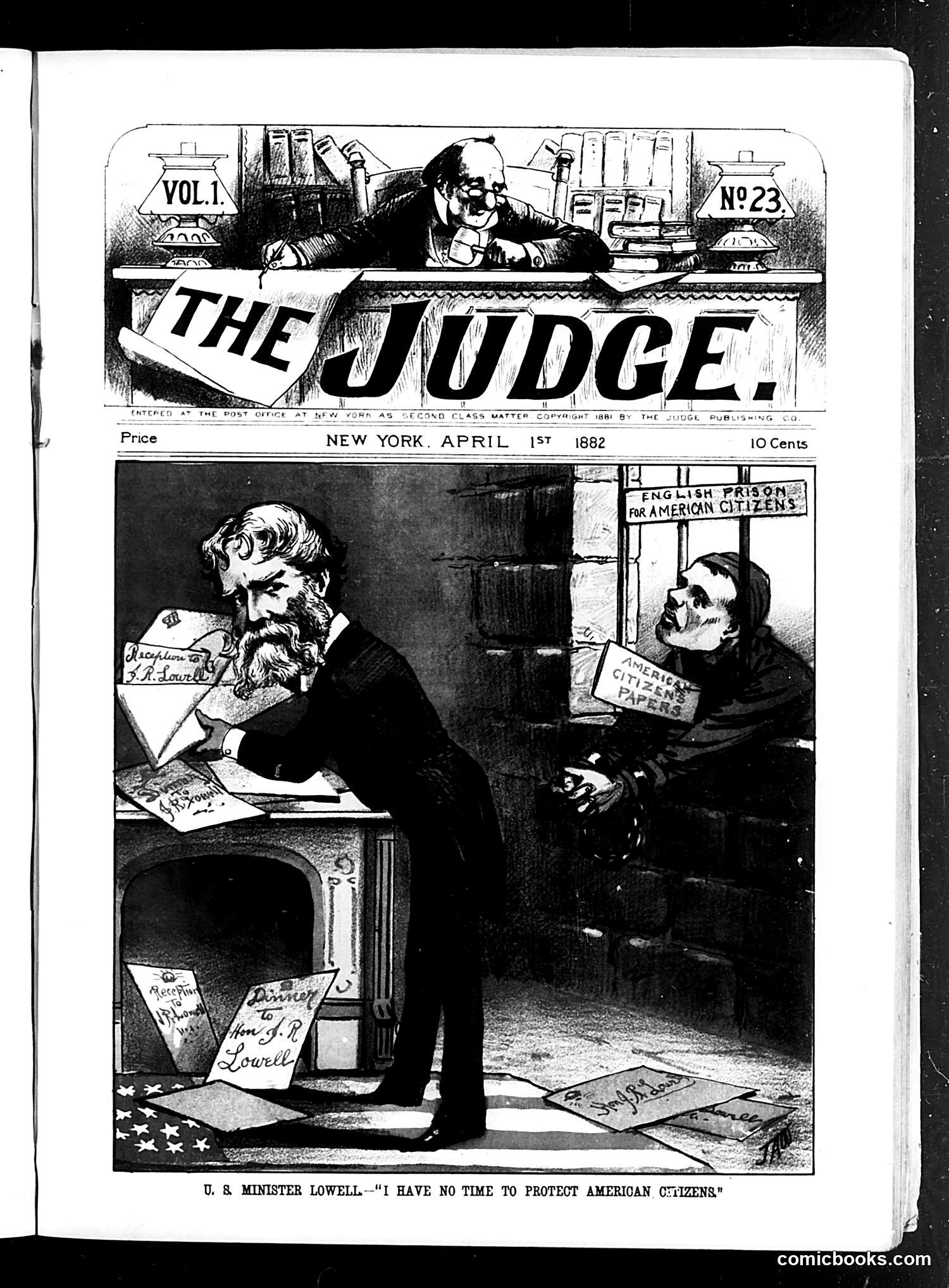
This cartoon satirizes U.S. Minister James Russell Lowell's alleged neglect of American citizens abroad. The bearded figure (Lowell) sits at a desk marked with diplomatic credentials, dismissing a distressed American visitor seeking help. The sign reads "English Prison for American Citizens," indicating Americans were imprisoned in Britain without adequate diplomatic intervention. The cartoon criticizes Lowell for prioritizing other diplomatic duties over protecting U.S. nationals' rights and safety. Documents labeled "American Citizenship Papers" lie scattered, emphasizing his disregard. The satire suggests the minister's indifference to constituents' welfare—a common 19th-century complaint about diplomatic representation. The April 1882 date places this within specific Anglo-American tensions of that period regarding prisoner treatment.
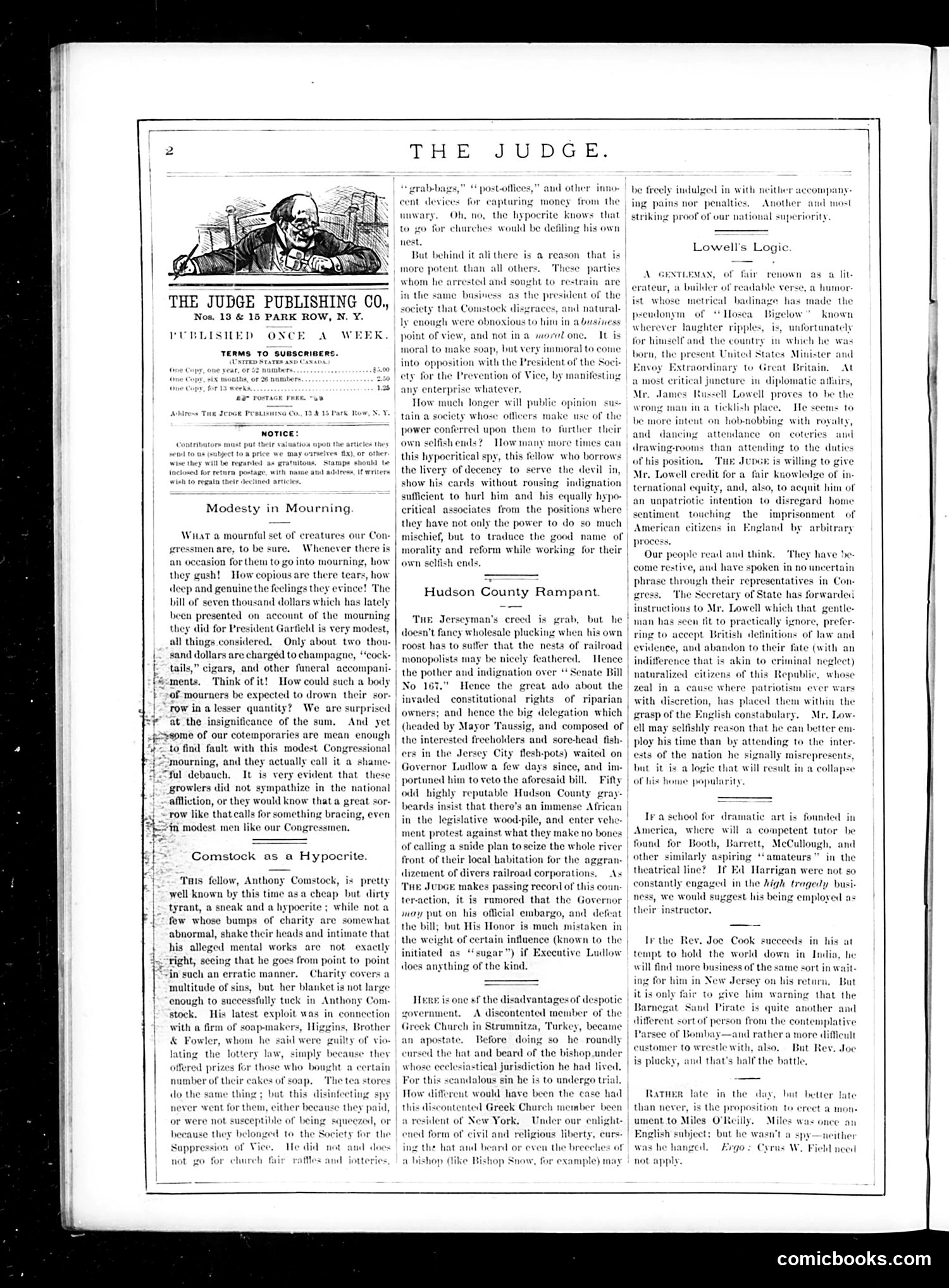
This page from Judge magazine contains several political satirical pieces: **"Modesty in Mourning"** criticizes Congressional hypocrisy following President Garfield's assassination (1881). Congress charged $7,000 in mourning expenses, with $2,000 spent on champagne, cocktails, and cigars—allegedly necessary to properly grieve. Judge mocks this as sanctimonious excess disguised as respectful mourning. **"Comstock as a Hypocrite"** attacks Anthony Comstock, the famous anti-vice crusader. Judge accuses him of selective enforcement: he prosecuted soap makers for offering prizes (claiming lottery violations) while ignoring similar practices by churches. The satire suggests Comstock uses moral posturing to silence business competitors and consolidate power rather than genuinely reform society. **"Hudson County Rampant"** (partial) appears to critique New Jersey political corruption, suggesting legislators prioritize self-enrichment over constituents' interests.
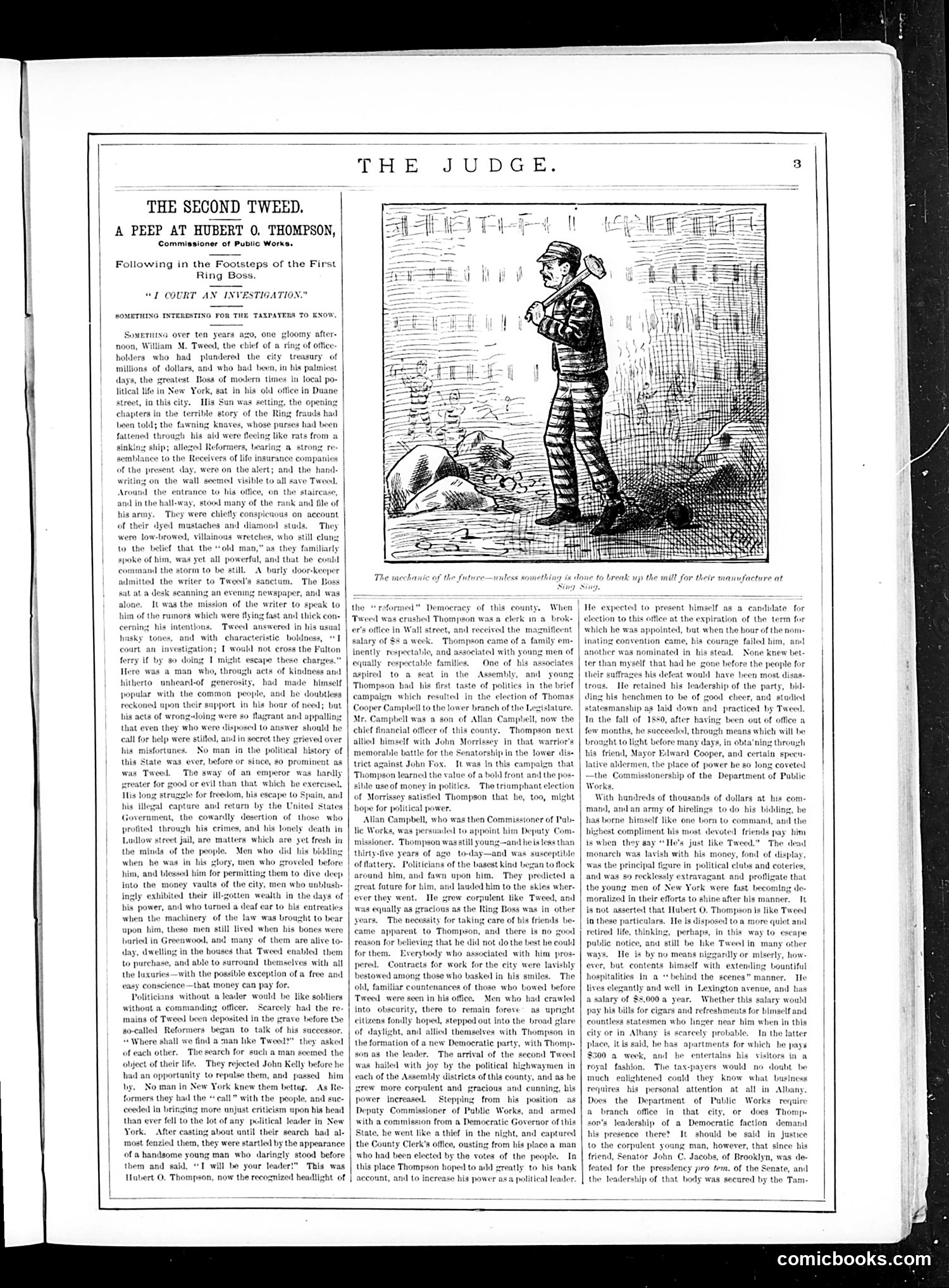
This article attacks **Hubert O. Thompson, Commissioner of Public Works**, comparing him to **William M. Tweed**, the infamous Tammany Hall boss who embezzled millions from New York City in the 1870s. The satire suggests Thompson is following Tweed's corrupt playbook: accumulating power, surrounding himself with loyalists, and enriching himself through city contracts while maintaining a veneer of respectability. The cartoon's image shows Thompson as a well-dressed politician examining plans—visualizing his role as a modern corrupt administrator. Judge argues that just as reformers sought Tweed's successor after his death, they've now found one in Thompson. The phrase "I court an investigation" (Thompson's claimed stance) is presented as hollow posturing, similar to Tweed's denial of wrongdoing. The satire's point: New York's political corruption persists—the "Boss" system never truly died; it simply found a new figurehead. Thompson represents the recycling of Tammany-style machine politics into the present era.
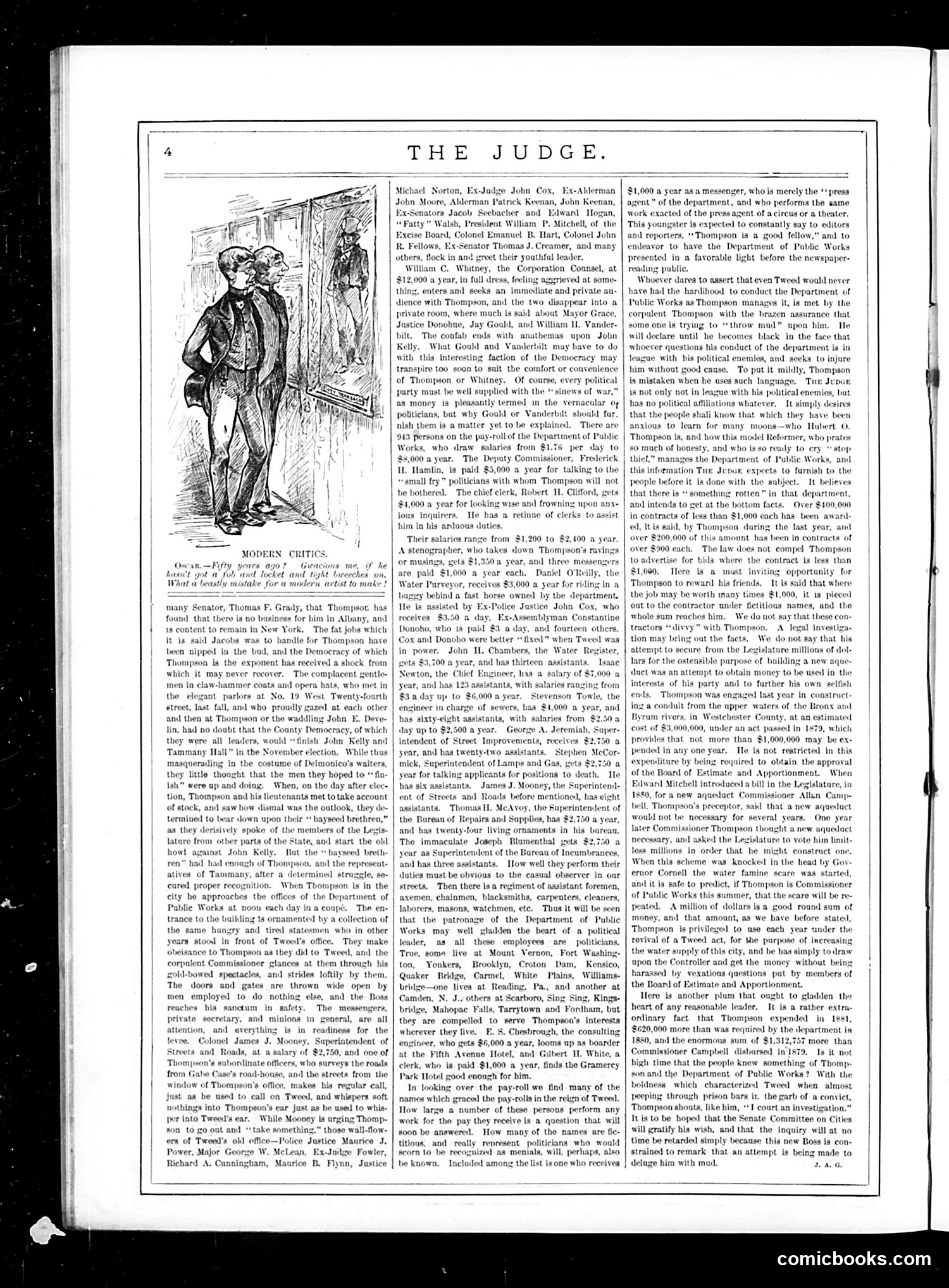
This political cartoon satirizes the rise of John Thompson, New York's Department of Public Works Commissioner, as a new "boss" figure replacing the recently-deceased William "Boss" Tweed. The text details how Thompson has surrounded himself with Tammany Hall politicians and wealthy capitalists (notably Jay Gould and William Vanderbilt), echoing Tweed's corrupt patronage system. The cartoon's central figure appears to be Thompson, depicted as a portly, self-important bureaucrat modeled visually on Tweed. The satire exposes how despite reformers' claims to have "finished" Tammany, the same corrupt machinery persists under new leadership—the same hungry office-seekers, the same backroom dealing with wealthy industrialists, and the same bloated city payroll (943 employees drawing inflated salaries). The joke: plus ça change—the Democratic reformers who claimed victory over Tammany have simply recreated the boss system under Thompson's control.
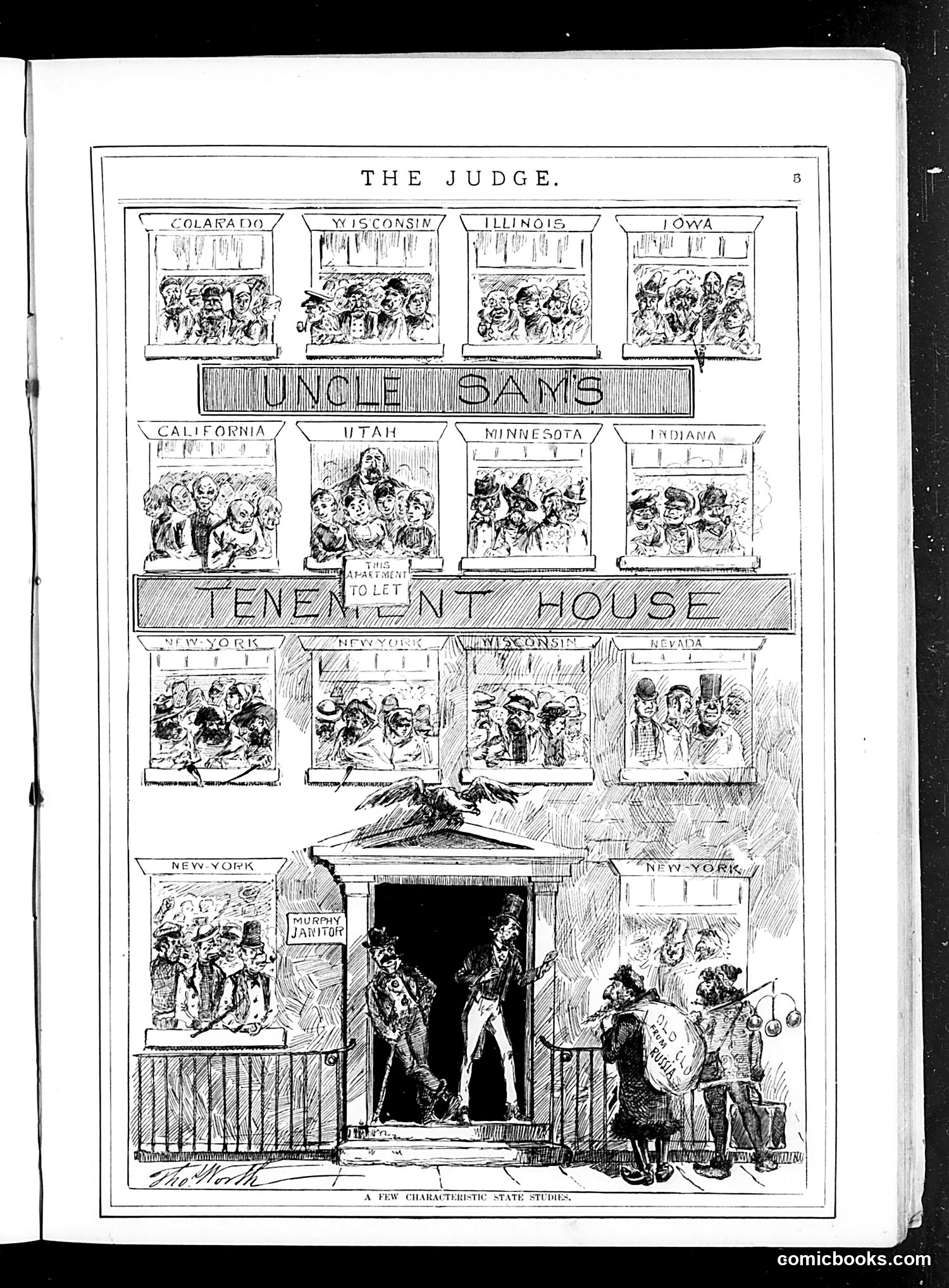
This satirical cartoon depicts "Uncle Sam's Tenement House" — a metaphor for the United States as a overcrowded, poorly-maintained building. Each window represents a different state (Colorado, Wisconsin, Illinois, Iowa, California, Utah, Minnesota, Indiana, New York, Nevada), with caricatured figures representing that state's population or characteristics. The central door features "The North," suggesting regional tensions. A janitor (labeled "Murphy") appears unable to maintain order in this chaotic structure. The subtitle "A Few Characteristic State Studies" indicates the cartoon mocks how different states embodied distinct social problems or ethnic stereotypes. The overall message critiques American governance: the nation's various states are portrayed as a mismanaged tenement full of unruly inhabitants, suggesting poor political leadership and social disorder across the country. This likely reflects late 19th-century anxieties about immigration, urbanization, and regional conflicts.
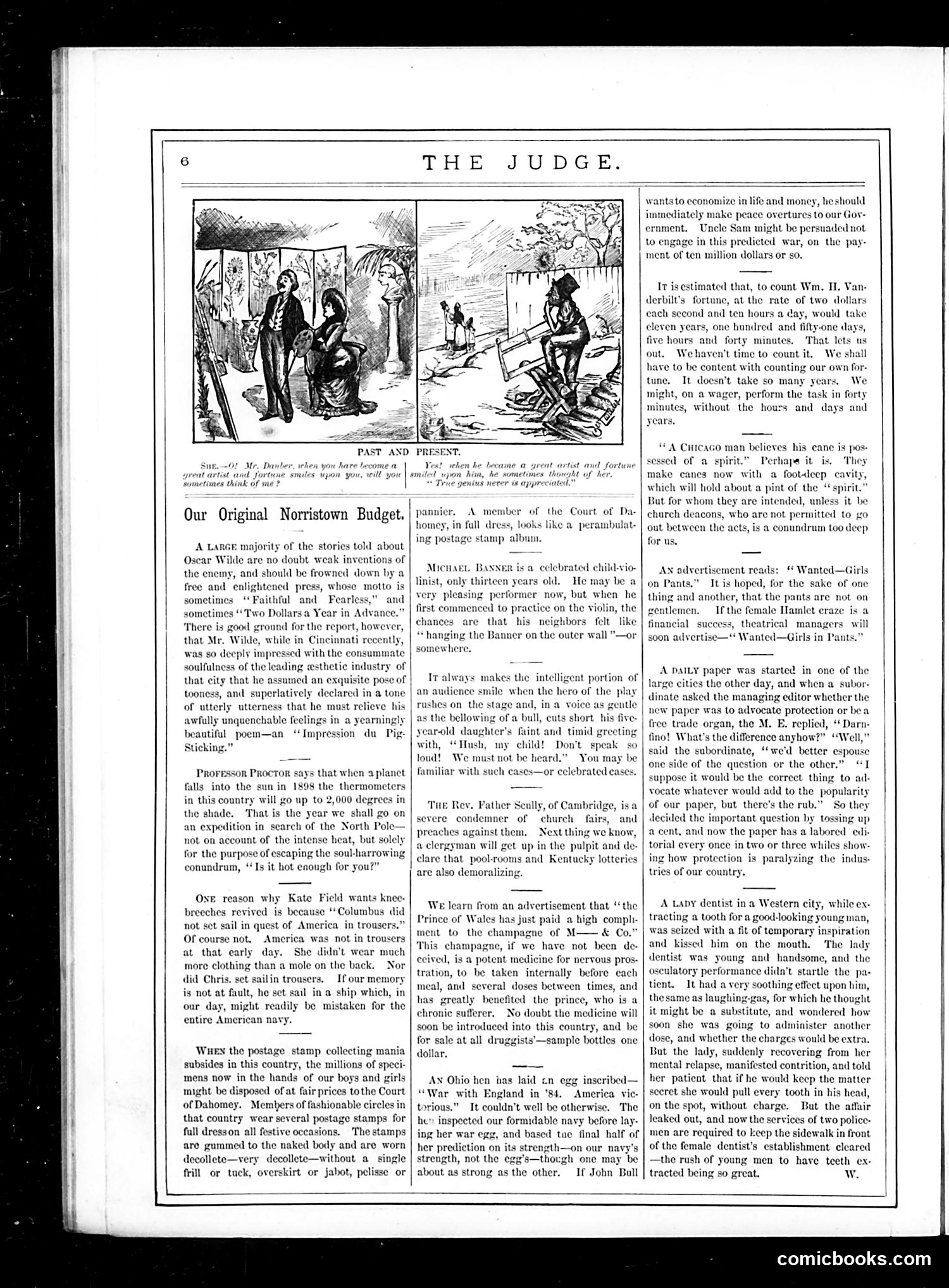
This page from the satirical magazine *Judge* contains brief humorous commentaries rather than political cartoons. The two small illustrations at top appear to show scenes of everyday life but lack clear captions identifying specific figures. The text mocks various contemporary targets through short anecdotes: Oscar Wilde's aesthetic pretensions during an American tour; the absurdity of "postage stamp collecting mania"; a child violinist's noisy practice sessions troubling neighbors; and Rev. Father Scully's hypocrisy in condemning church fairs while other clergy engage in questionable activities. There's also gentle mockery of Kate Field's advocacy for knee-breeches revival and satirical commentary on Professor Proctor's astronomical predictions about planetary collision in 1898. The humor relies on wordplay, exaggeration, and social observation typical of *Judge's* satirical style—aimed at educated readers familiar with contemporary personalities and trends rather than specific political events.
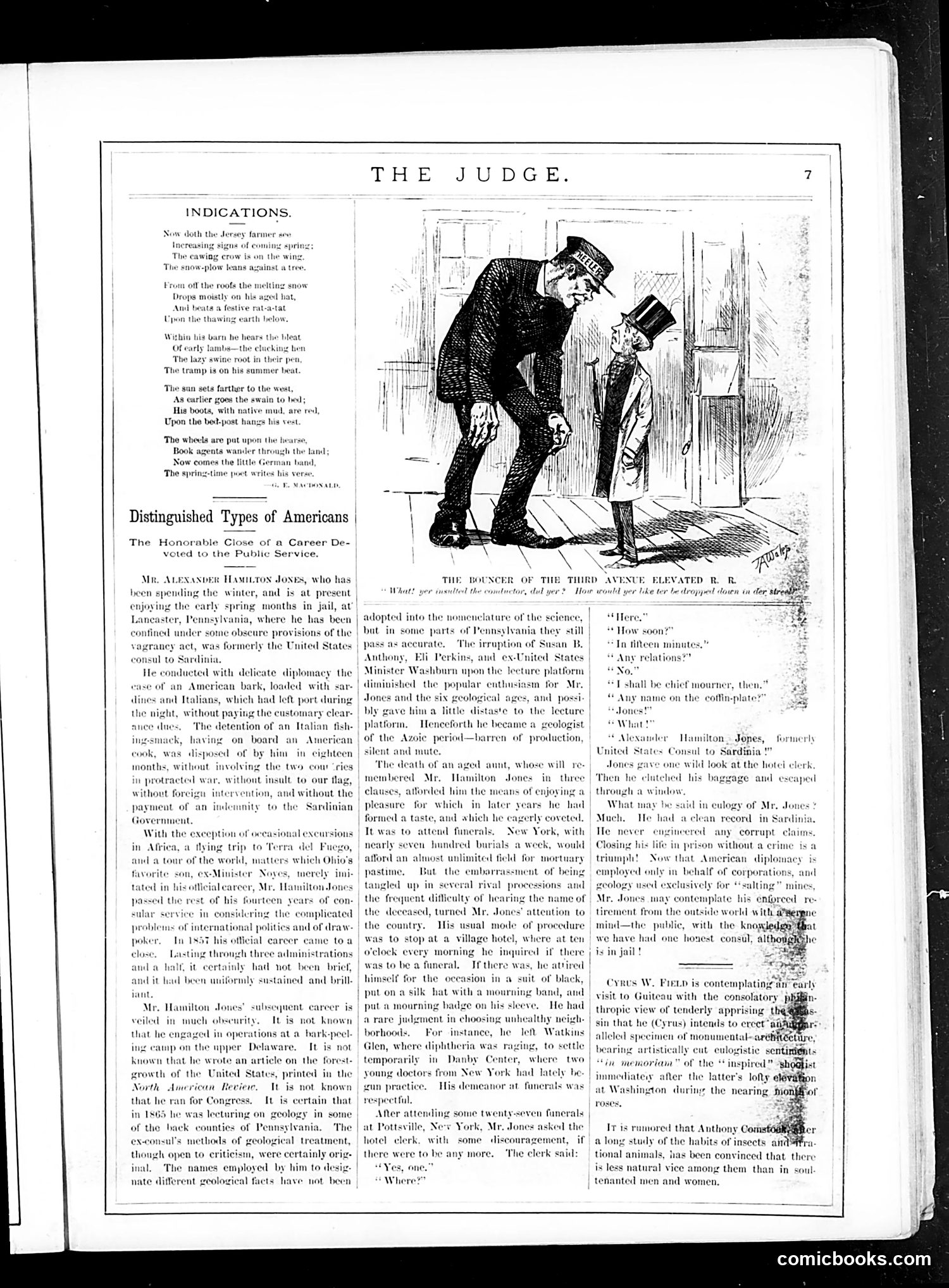
This cartoon satirizes a petty bureaucrat abusing minor authority. A conductor or bouncer confronts a passenger about an alleged insult, threatening to have him "dropped down in the street." The joke appears to mock the pompous officiousness of low-level transit workers who wielded their tiny powers aggressively. The accompanying article about Alexander Hamilton Jones—a former U.S. consul to Sardinia who became an obsessive funeral attendee—serves as complementary satire about Americans pursuing dignified public service only to end in absurdity and obscurity. The text's deadpan tone describing Jones's elaborate mortuary hobby suggests Judge magazine's mockery of pretentious career ambitions and the decline of professional respectability. Together, the pieces target American social pretension and the gap between official importance and actual human behavior.
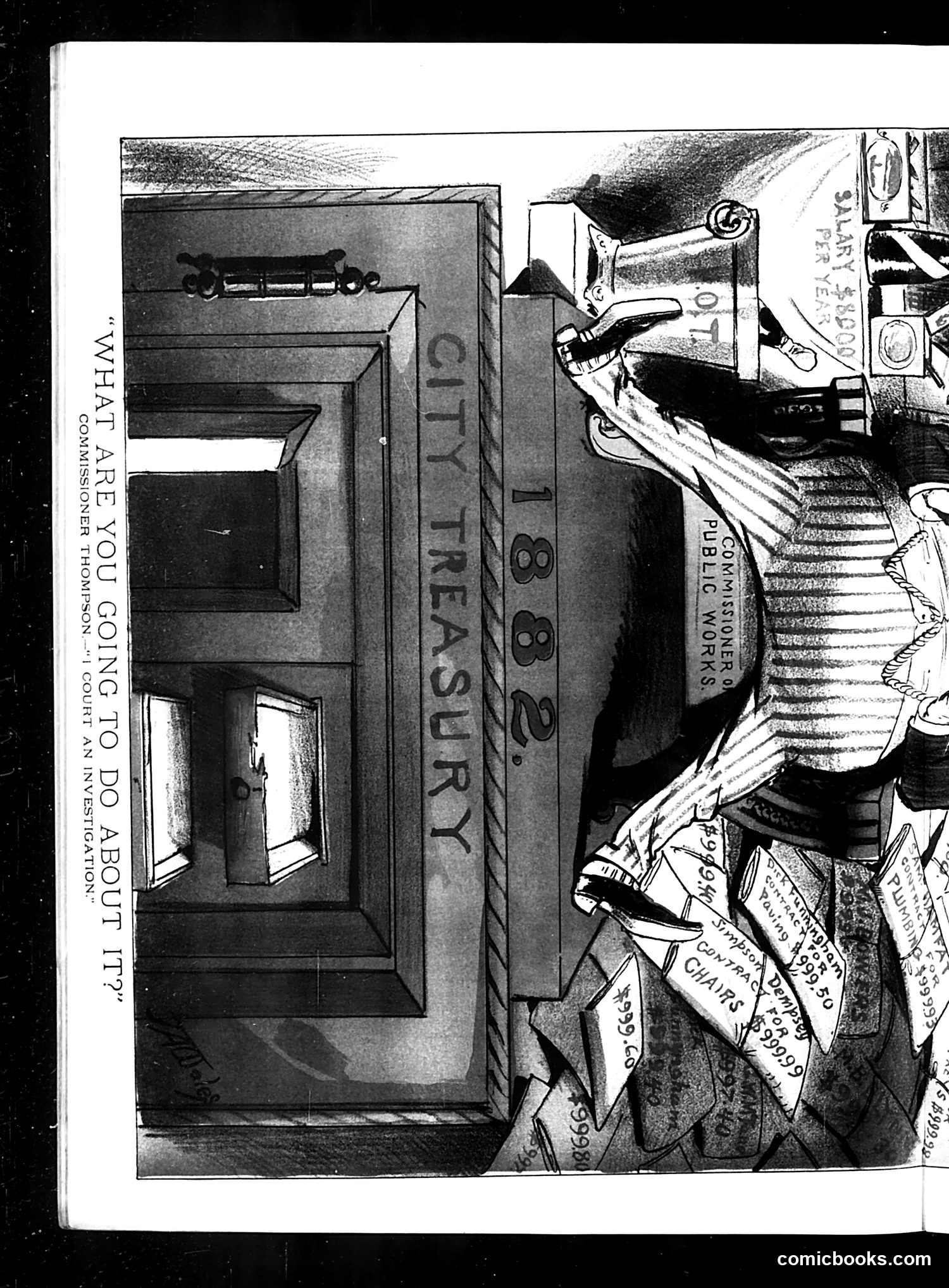
This appears to be a satirical cartoon from *Judge* magazine featuring Commissioner Thompson being confronted about an unspecified issue or scandal. The questioner demands action, to which Thompson responds he will "conduct an investigation"—a classic bureaucratic deflection. The satire targets the common political practice of using investigations as a stalling tactic rather than genuine problem-solving. The cartoon suggests Thompson's promise of investigation is merely performative, avoiding real accountability or solutions. Without the complete date or context visible, I cannot identify the specific Commissioner Thompson or the particular scandal referenced. However, the satire's point is clear: investigations announced by officials often serve as a way to appear responsive while delaying actual consequences or reform.
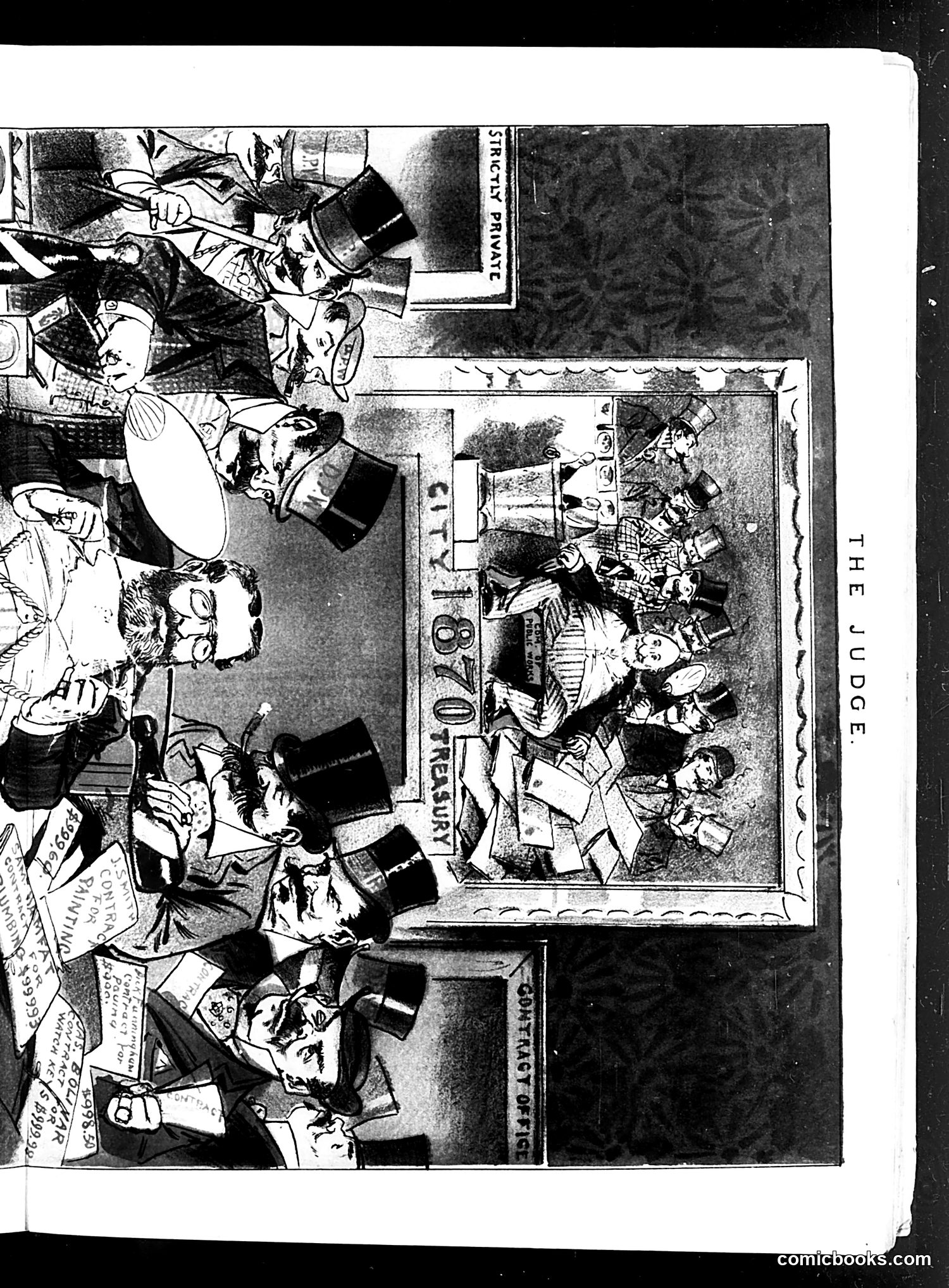
This page appears to be titled "The Judge" and contains satirical cartoon panels, though the image quality and orientation make precise interpretation difficult. The cartoons seem to depict social or political commentary typical of Judge magazine's style—featuring caricatured figures in various scenarios. Without clearer visibility of specific text labels, character names, or dialogue within the panels, I cannot reliably identify the particular political figures, events, or social issues being satirized. The presence of top hats and formal dress suggests commentary on upper-class or political subjects, common Judge targets. However, asserting specific meanings would require legible text identifying the subjects and context, which isn't sufficiently clear in this image. To properly explain this satire's meaning to modern readers would require either higher image resolution or additional contextual information about Judge's publication date.
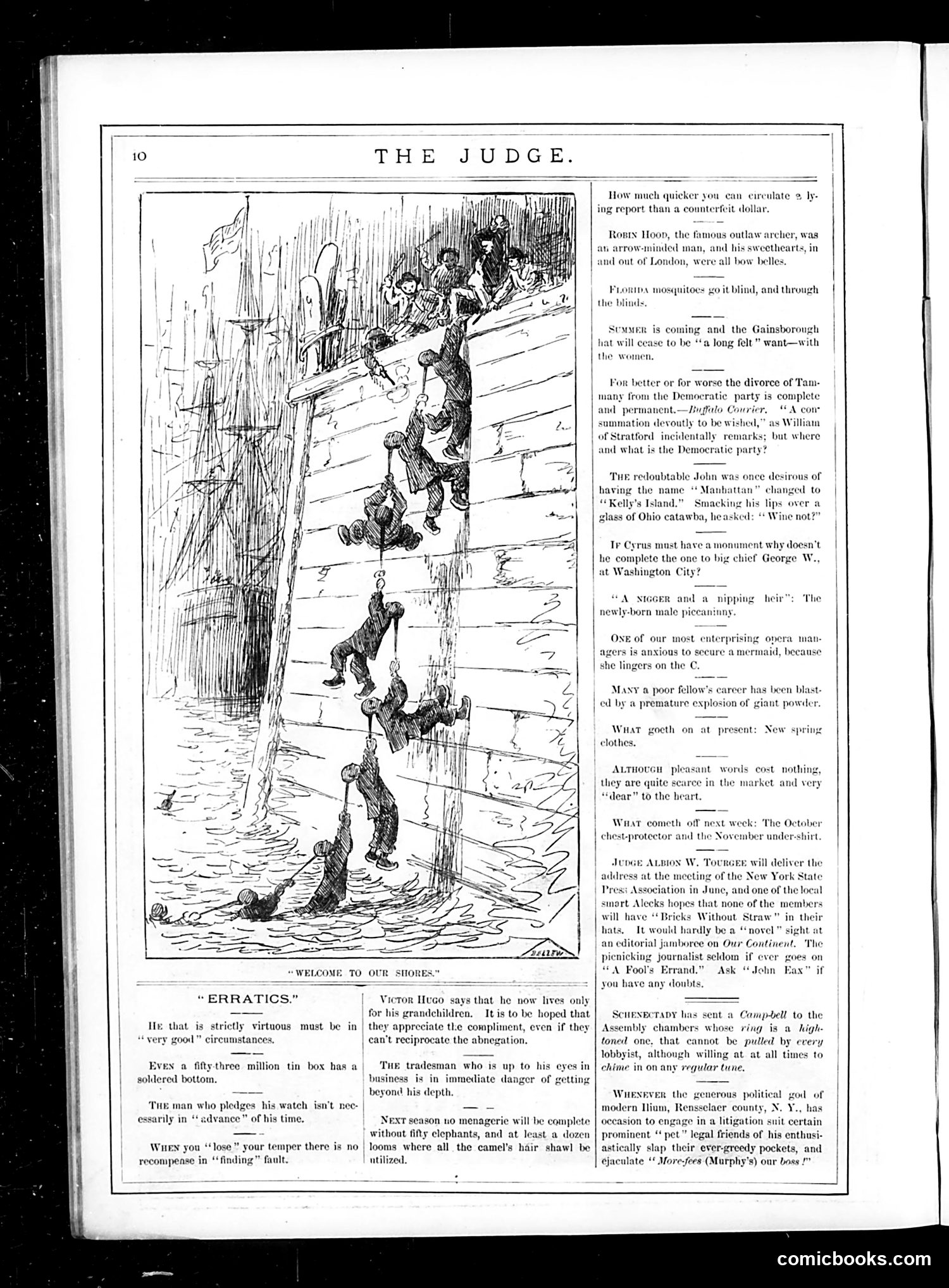
The main cartoon depicts immigrants climbing up the side of a ship arriving at America. The title's irony is sharp: while the caption suggests welcome, the visual shows figures struggling desperately to scale the vessel's hull, suggesting the difficulty and desperation of immigration rather than a warm greeting. The page also contains "Erratics"—a humor section with brief satirical quips on various topics: Victor Hugo's devotion to grandchildren, the dangers of overextending oneself in business, circus menageries acquiring elephants, divorce proceedings, and political monuments (likely referencing an incomplete monument to George Washington). References to "Robin Hood," "Kelly's Island," and Ohio wine suggest period-specific American cultural touchstones. The jokes target wealthy pretension, political corruption, and social hypocrisy—typical Judge magazine fare mocking the American establishment and immigrant experience circa the late 19th century.
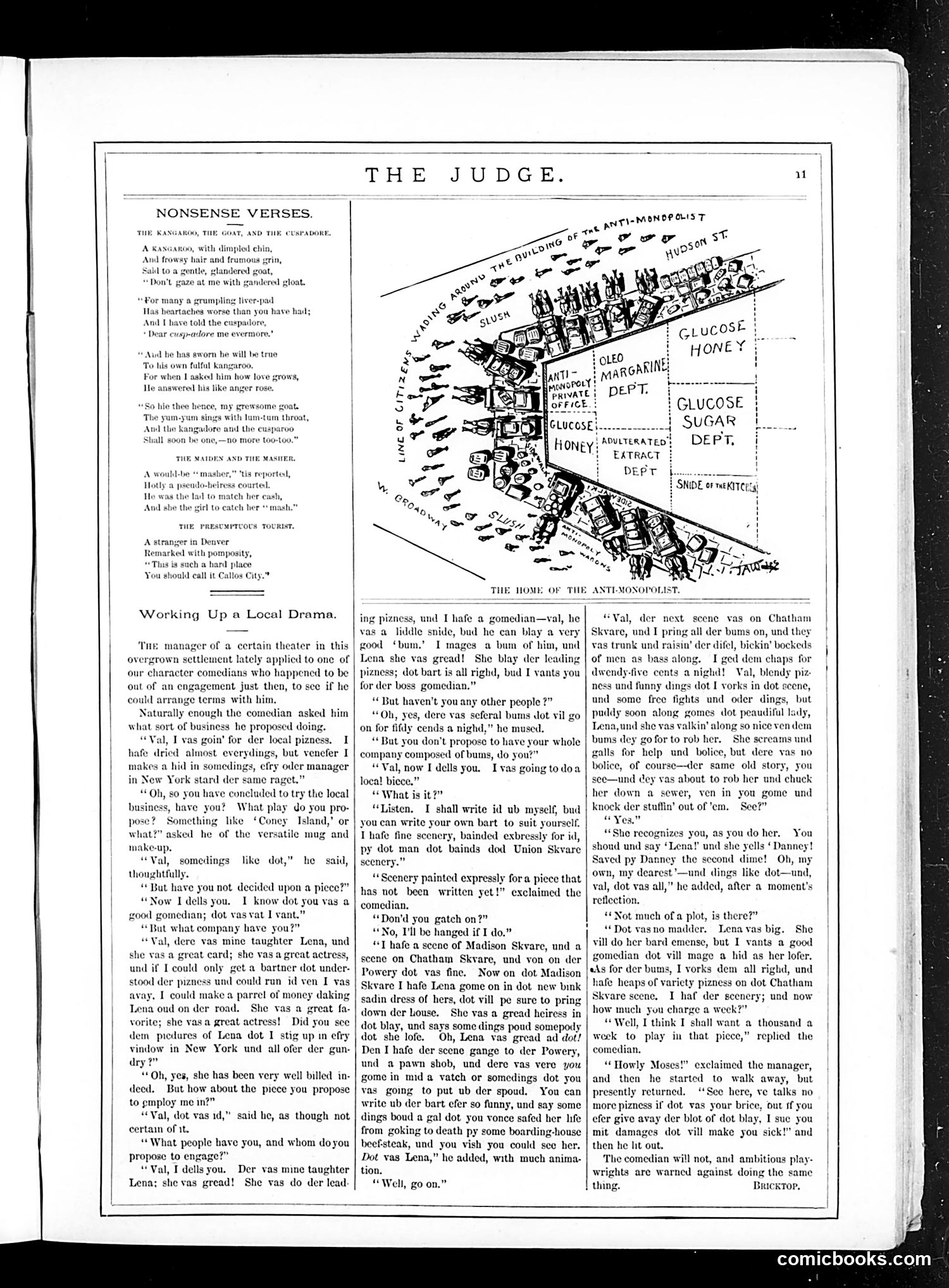
This page satirizes a newly-arrived immigrant theater manager pitching a vaudeville play concept. The humor relies entirely on ethnic caricature: the manager speaks in heavy Yiddish-accented English ("dells you," "vas," "blay," "pizness"), which Judge's audience would have found comedic. The joke is that this bumbling impresario proposes to mount a "local drama" using scenery painted *before* writing the script, starring his daughter Lena as a society heiress, populated by "several bums" at fifty cents per night. He's simultaneously delusional and incompetent—confident yet unable to articulate his own concept clearly. The cartoon diagram (top right) appears to show a tenement building labeled with domestic products (glucose, honey, margarine), satirizing urban immigrant neighborhoods as commercial spaces. The satire mocks both theatrical amateurism and immigrant pretension to respectability through show business.
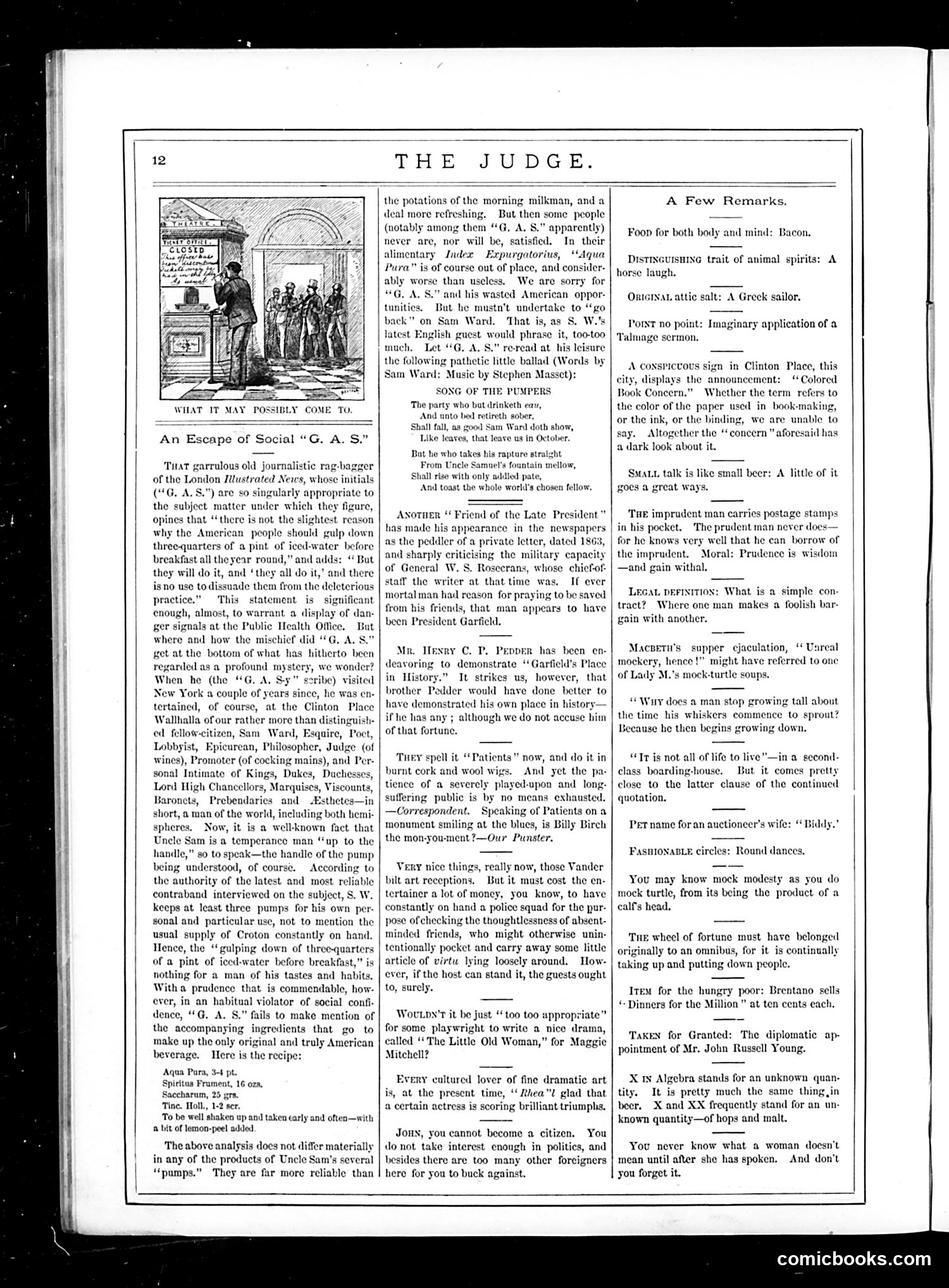
This satirical piece attacks a London *Illustrated News* columnist (identified only by initials "G.A.S.") who criticized Americans for drinking large quantities of iced water before breakfast. Judge magazine defends the practice by praising **Sam Ward**, a prominent New York socialite and lobbyist, as the authority on American habits. The satire works on multiple levels: the columnist's initials literally spell "gas" (empty talk); Judge suggests his criticism is unfounded nonsense. More pointedly, the piece mocks Ward's actual reputation—he was a known drinker and man-about-town—by presenting him as a temperance exemplar. The humorous "recipe" reveals the actual contents of American "water": whiskey, sugar, and bitters. Judge defends American excess against foreign criticism while simultaneously ridiculing both the pompous British commentator and Ward's own dubious character.
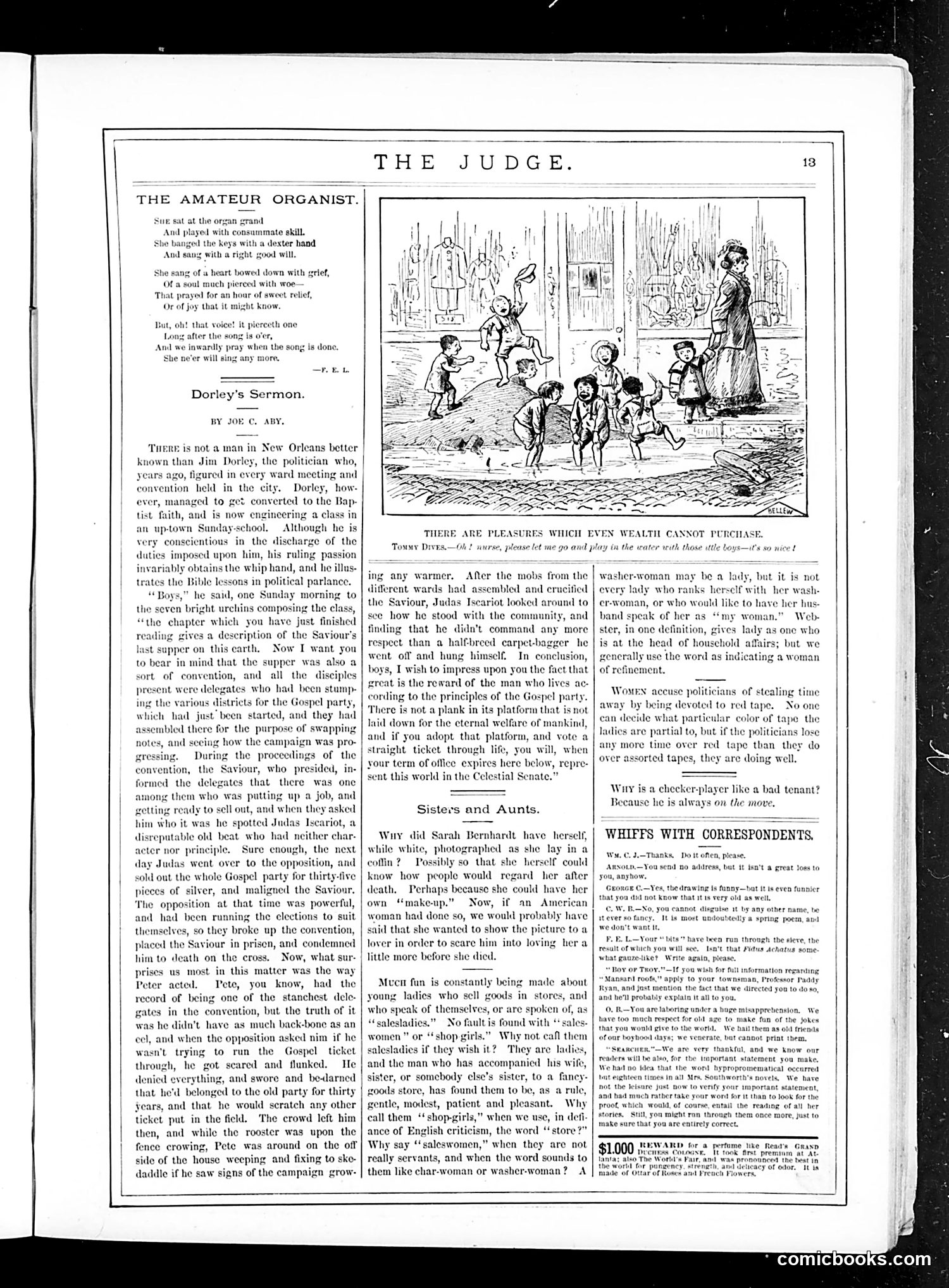
This page from *Judge* magazine contains "Dorley's Sermon," a political satire by Joe C. Aby. The humor lies in a New Orleans politician named Jim Dorley—a converted Baptist Sunday School teacher—who cannot help but explain Biblical stories through the lens of machine politics. Dorley teaches the Last Supper as a political "convention," the apostles as "delegates," and Judas as a corrupt operative "selling out" to the opposition party. Peter's denial becomes cowardly ticket-scratching. The satire mocks how thoroughly politics dominated Dorley's worldview—he cannot discuss spiritual lessons without reducing them to ward politics, backroom deals, and party loyalty. The cartoon above (captioned "There Are Pleasures Which Even Wealth Cannot Purchase") depicts children playing, unrelated to the sermon below. The joke targets both Dorley's inability to transcend partisan thinking and, broadly, the dominance of machine politics in American civic life.
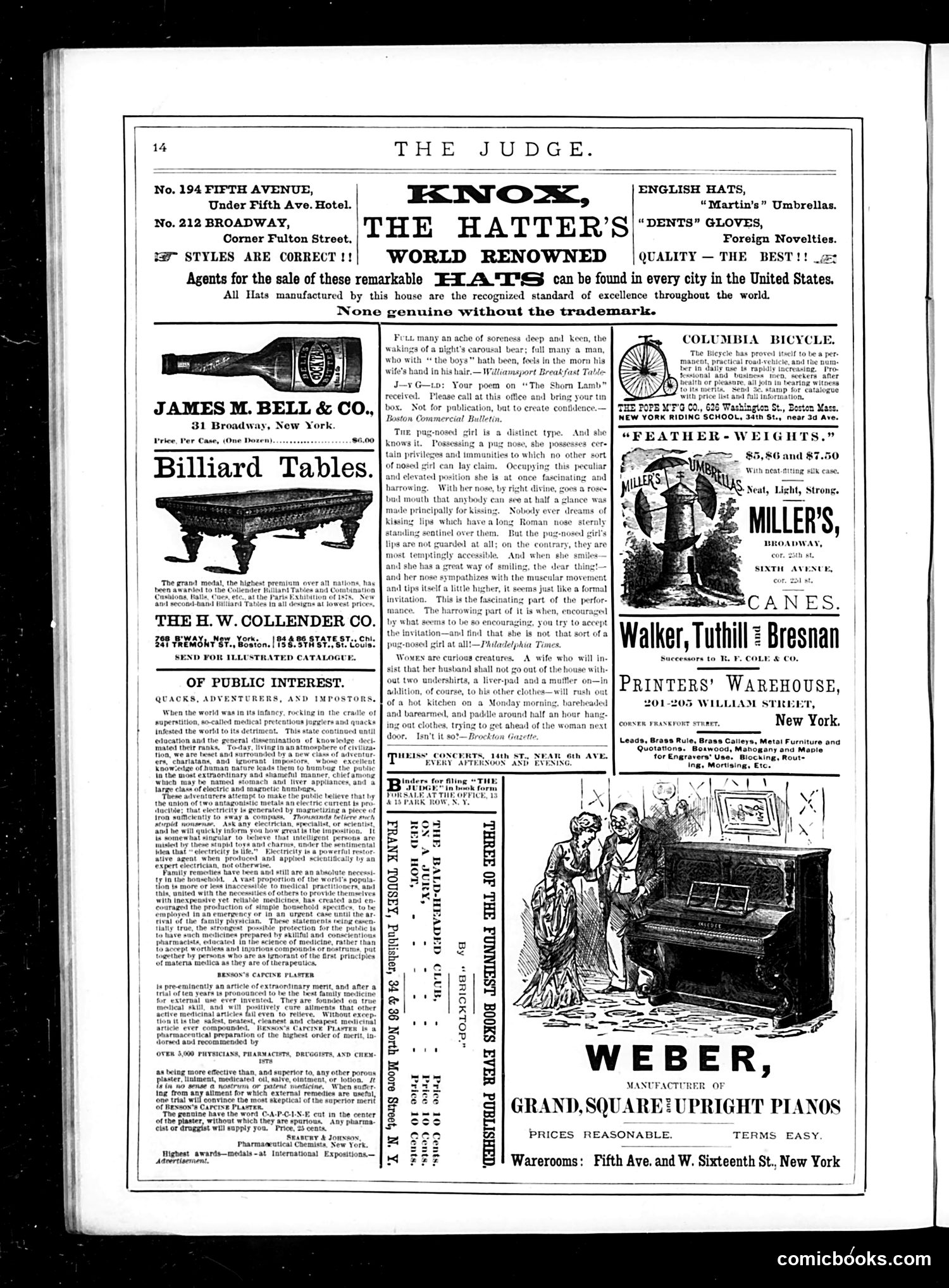
This page is primarily **advertisements** rather than editorial satire or political cartoons. It contains various commercial ads for products like Knox hats, billiard tables, bicycles, pianos, and printing services typical of late 19th-century Judge magazine. The only editorial content visible is a fragmentary article titled "OF PUBLIC INTEREST" (left column), which appears to discuss some social or scientific topic—the OCR text is too garbled to extract specific meaning, though it mentions topics like "electricity and magnetic teachings" and family/domestic matters. The page lacks coherent political cartoons or satirical illustrations with identifiable figures. The small illustrations accompanying ads (bicycles, canes, pianos) are product images rather than commentary. Without clearer OCR or complete visible text, I cannot identify specific satirical targets or explain particular jokes to a modern reader. This appears to be a typical 19th-century magazine page mixing advertising with fragmentary editorial content.
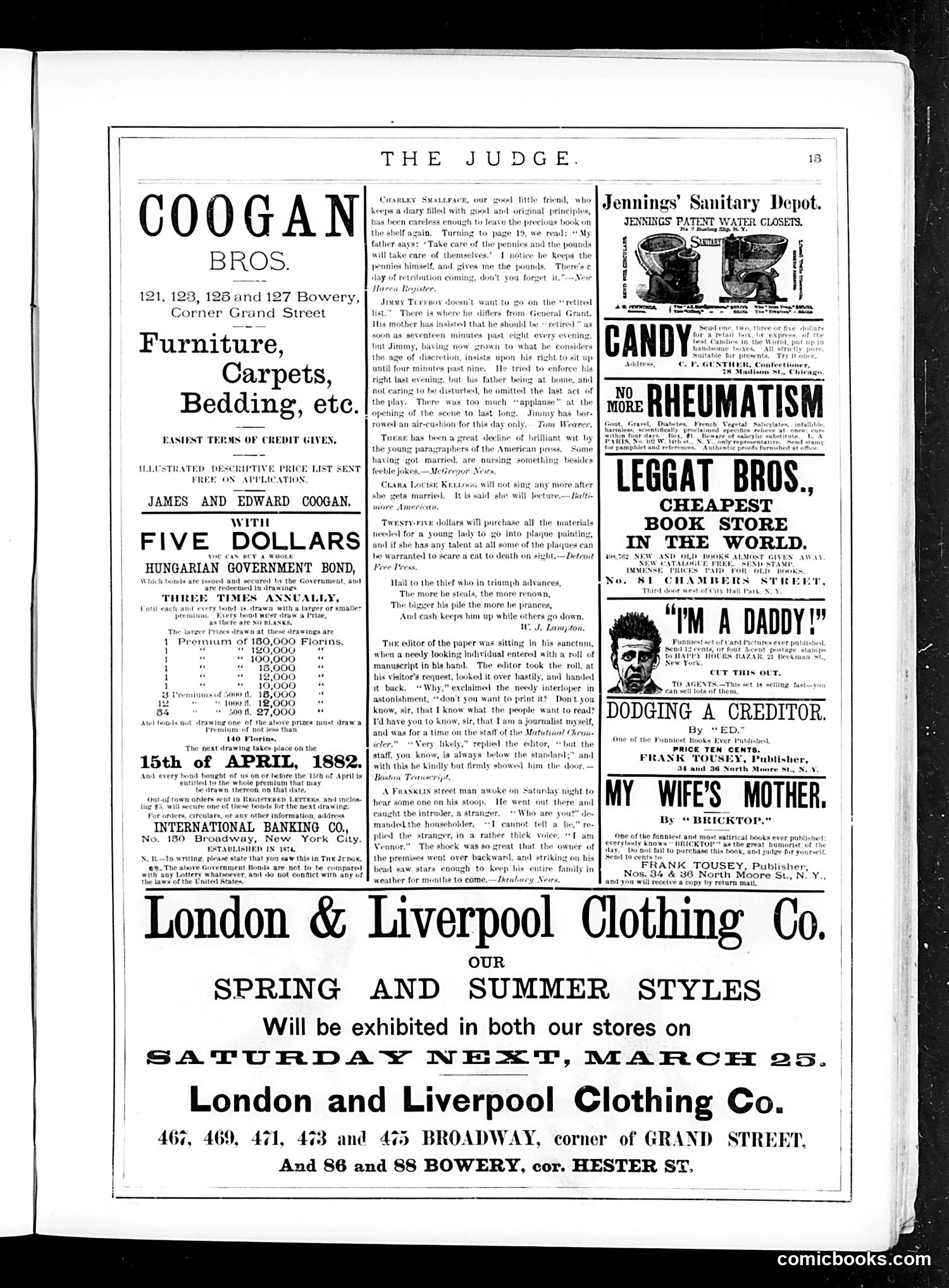
This page is primarily **advertising**, not editorial content or satire. It features commercial advertisements for period businesses: furniture retailers (Coogan Bros.), a lottery scheme (Hungarian Government Bond drawing), sanitary fixtures (Jennings), patent medicines ("No More Rheumatism"), a bookstore (Leggat Bros.), and clothing stores (London & Liverpool Clothing Co.). The small editorial content visible includes brief humorous anecdotes—one about a journalist's manuscript and another about a man catching an intruder—typical of Judge's satirical humor. There are also advertisements for serialized fiction like "My Wife's Mother" and "Dodging a Creditor." The "I'm a Daddy!" section appears to be a humor column. Without clearer images of any cartoons or caricatures, I cannot identify specific satirical targets or political figures. This appears to be a typical late-19th-century magazine page mixing advertising with light humor content.
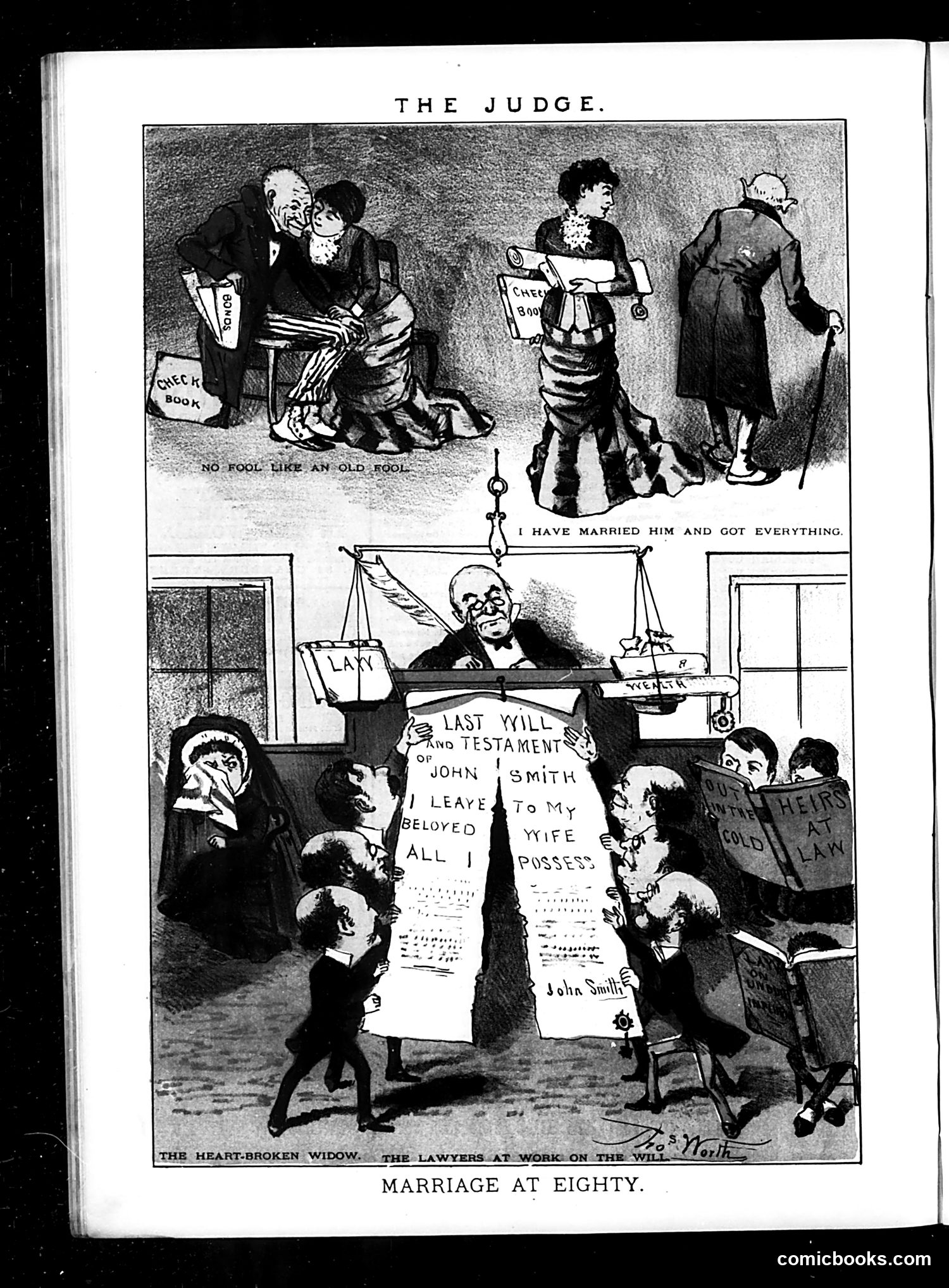
This satirical cartoon depicts a wealthy elderly man's marriage and subsequent death, mocking both the marriage itself and the legal chaos that follows. The top panel shows the phrase "No fool like an old fool" as an elderly man marries a young woman with a "Check Book." The middle panel depicts the widow claiming "I have married him and got everything." The bottom panel shows the man's will being read in court, with lawyers ("The Lawyers at Work on the Will") surrounding the document while various heirs—including a heart-broken widow and others—squabble over the inheritance, holding signs reading "Heirs at Law." The cartoon satirizes May-December marriages motivated by money, inheritance disputes, and lawyers' opportunistic involvement in estate battles. The central joke: the old man's death triggers exactly the legal conflict his wealth made inevitable.