
A complete issue · 16 pages · 1882
Judge — February 11, 1882
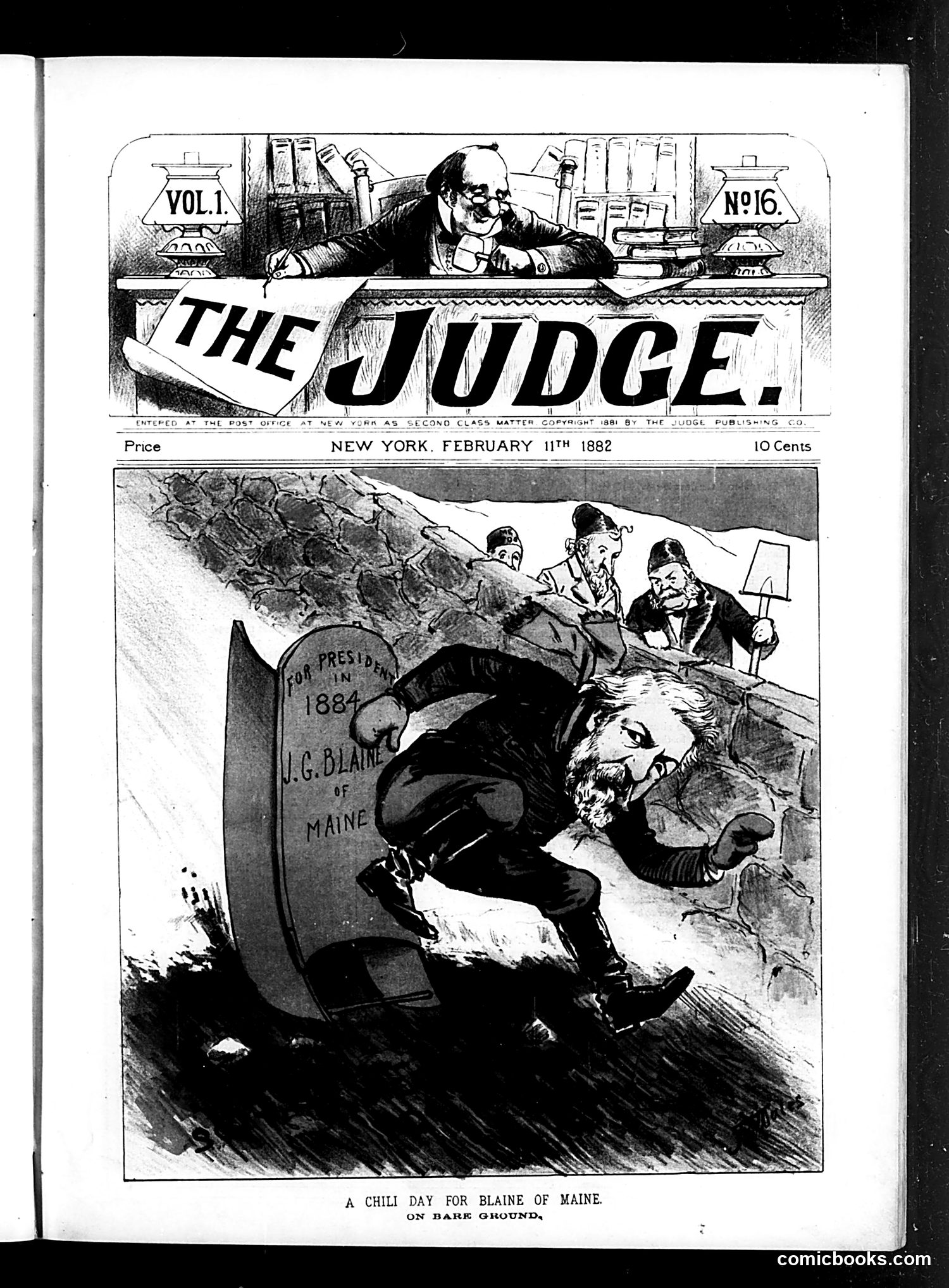
This 1882 *Judge* cartoon satirizes James G. Blaine of Maine, a prominent Republican politician. The imagery shows Blaine being literally "chilled" (a pun on "chili") by political opposition. He appears distressed near a gravestone marked "FOR PRESIDENT IN 1884," suggesting doubts about his presidential viability. Three figures observe from above—likely rival politicians or party members—appearing to mock or undermine him. The "bare ground" reference and winter setting reinforce the cold reception Blaine faced. This cartoon reflects internal Republican Party tensions and skepticism about Blaine's electability before the 1884 presidential race, which he eventually contested unsuccessfully.
## "The Dread Alternative" This editorial cartoon critiques the exploitation of poor women in 1890s America. The illustration shows a demonic figure, likely representing poverty, vice, or urban corruption. The accompanying article laments how impoverished girls—lacking resources and hope—face a grim choice: starvation or prostitution (the "dread alternative"). The piece appeals for societal sympathy and suggests alternative solutions to prevent their moral ruin, arguing that respectable women and men should help rather than condemn these victims of circumstance. ## "Bobtailed Cars" This section satirizes street railroads in New York and Brooklyn that cut costs by eliminating conductors, replacing them with cheaper "bob-tailed" or "jigger" cars where passengers self-collected fares. Judge mocks railroads for profit-driven corners-cutting that inconveniences the public while companies like Boston's reportedly maintained proper service. The article demands citizens "kick" (protest) against directors until they restore respectable transportation standards. Both pieces target industrial-era inequality and corporate greed affecting working-class New Yorkers.
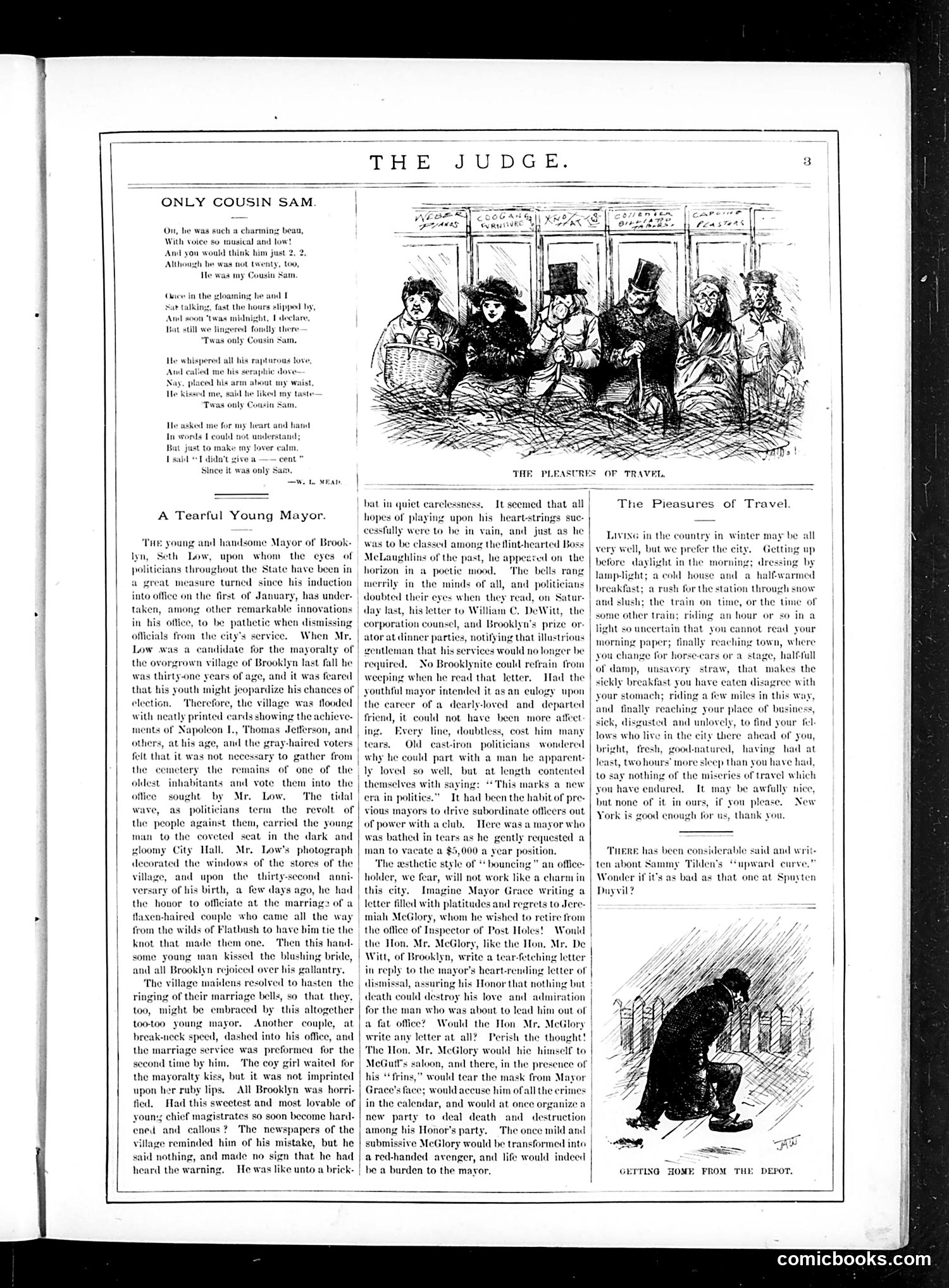
This page satirizes **Seth Low**, Brooklyn's young mayor (elected January 1st), through two pieces: **"A Tearful Young Mayor"**: The article mocks Low's reputation for sentimentality. It recounts how Low kissed a bride at his first wedding ceremony, delighting Brooklyn's eligible maidens. When he *didn't* kiss the second bride, newspapers criticized his inconsistency. The satire peaks when Low writes an emotional letter dismissing William C. DeWitt (corporation counsel and dinner-party organizer), written so affectingly that hardened politicians weep—establishing Low as unprecedentedly gentle compared to previous mayors who fired people "with a club." The joke: Low's excessive emotionalism and dramatic style represent an absurd departure from tough-guy politics. **"Only Cousin Sam"** (poem): A sentimental love ballad about a charming suitor. **"The Pleasures of Travel"**: An unrelated section about winter countryside living. The cartoons accompanying these pieces feature period-appropriate illustrations of characters in Victorian dress.
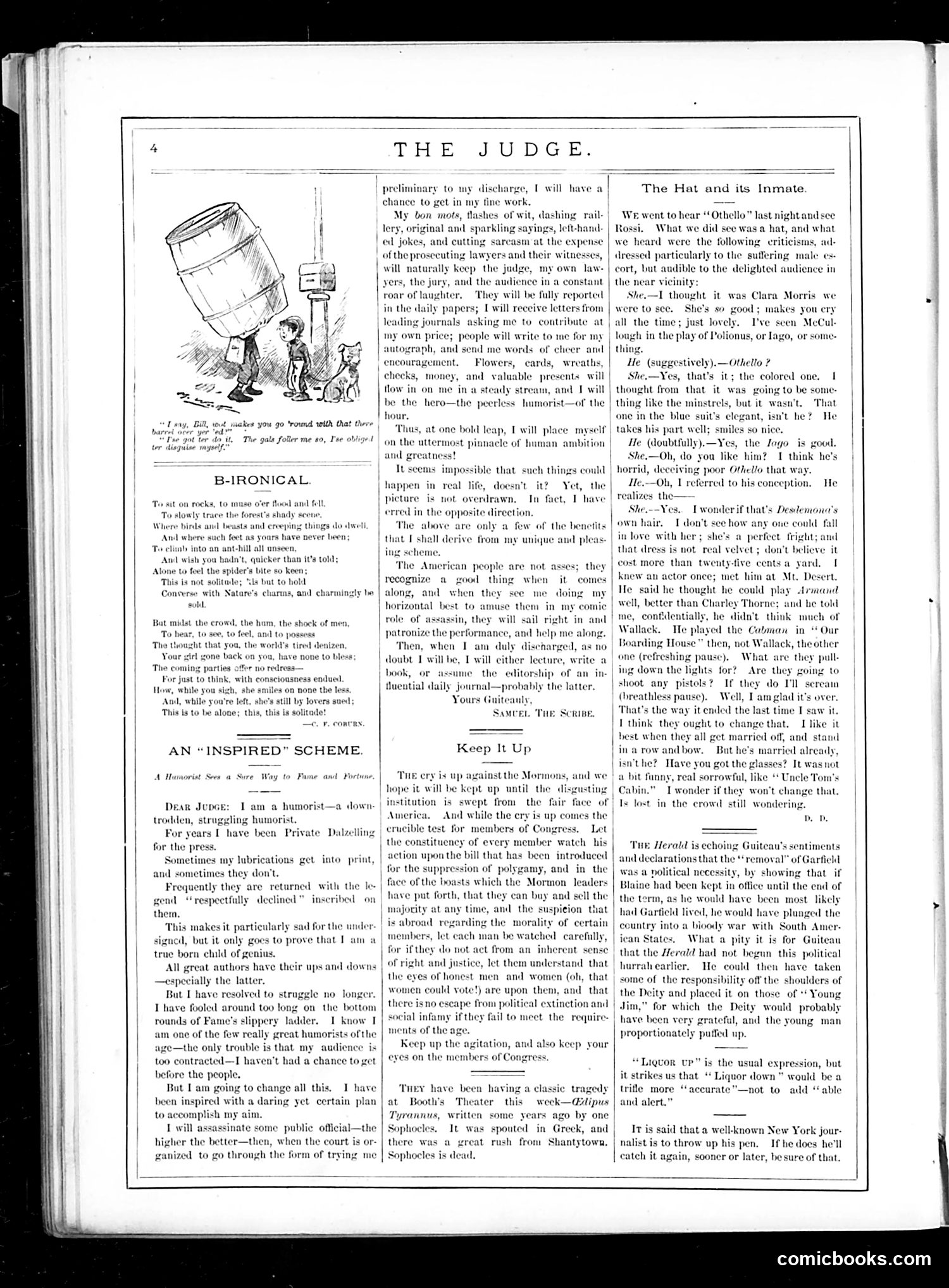
This page contains two distinct satirical pieces: **"B-Ironical"** is a poetic mockery of Romantic solitude literature, lampooning overwrought nature poetry popular in the era. **"An 'Inspired' Scheme"** presents a letter from a struggling humorist proposing to assassinate a public official to gain fame. The satirical point: by committing murder, he'd receive newspaper coverage during his trial, finally achieving the publicity his mediocre humor couldn't earn honestly. The writer signs "Guiteauly"—a clear reference to Charles J. Guiteau, who assassinated President Garfield in 1881, claiming it would make him famous. **"Keep It Up"** addresses the anti-Mormon campaign, urging Congress to maintain pressure against the LDS Church's polygamy practices. The satire works by exposing the desperation of failed artists and the absurdity of seeking notoriety through crime—mocking both the humorist's delusion and society's reward of criminals with publicity.
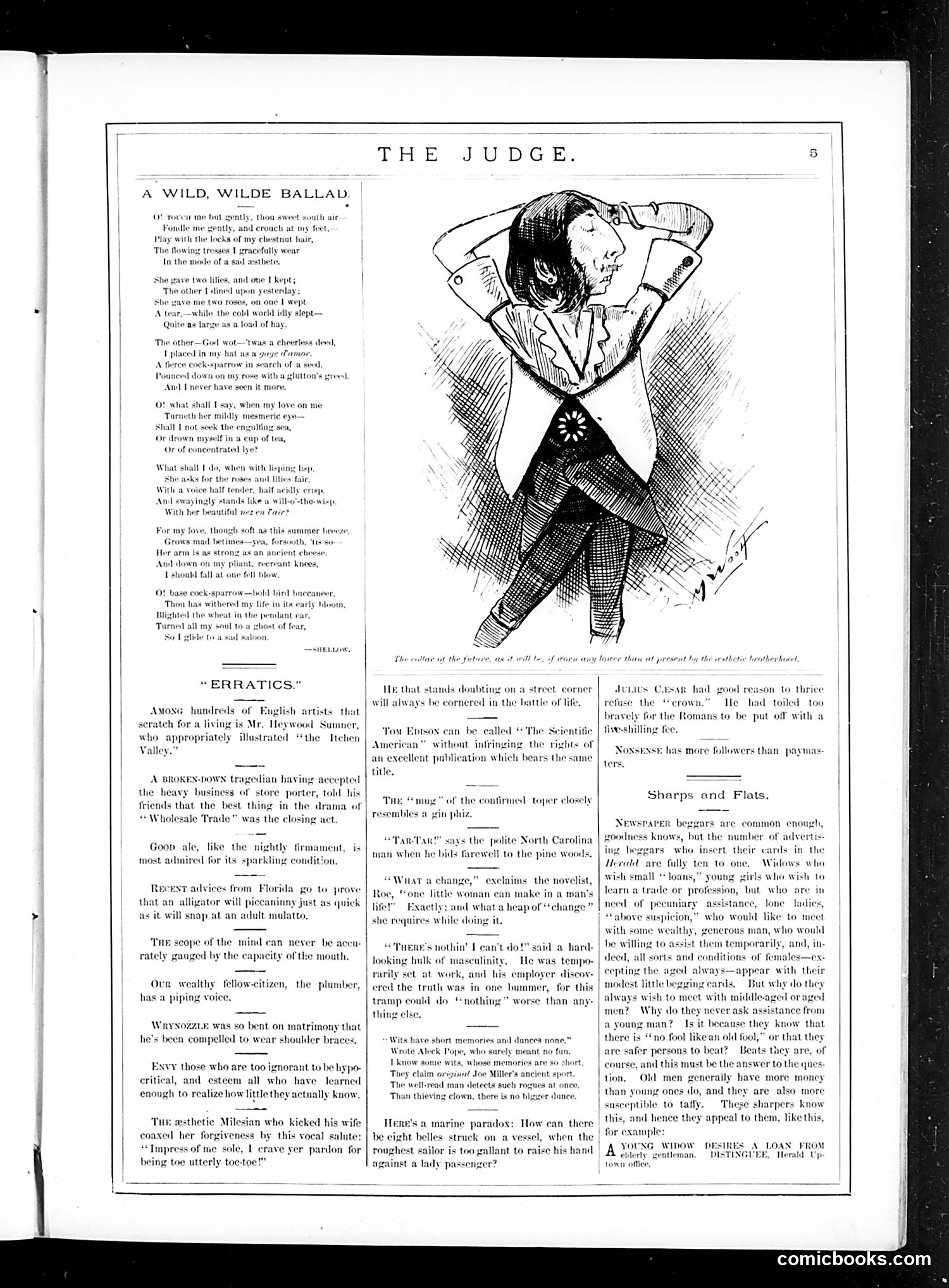
This page contains a satirical poem titled "A Wild, Wilde Ballad"—a parody of Oscar Wilde's aesthetic poetry style. The accompanying caricature depicts an exaggerated "aesthetic" figure with long hair and affected posture, mocking the late-19th-century Aesthetic Movement. The poem ridicules Wilde's overwrought, self-indulgent romantic writing through absurd declarations of love and melodramatic suffering. References to "lilies," "roses," and affected language ("'twas a cheerless dove") satirize the movement's emphasis on "art for art's sake" and elaborate emotional expression. The section "ERRATICS" contains brief satirical quips about various social types—broken-down actors, wealthy plumbers, hypocrites. One mentions an artist named Heywood Sumner illustrating "the Itchen Valley." The right column, "Sharps and Flats," offers editorial observations on newspaper advertising beggars and social behaviors—typical Judge filler content. The overall satire targets the pretentiousness of Aesthetic Movement advocates and their affected sensibilities.
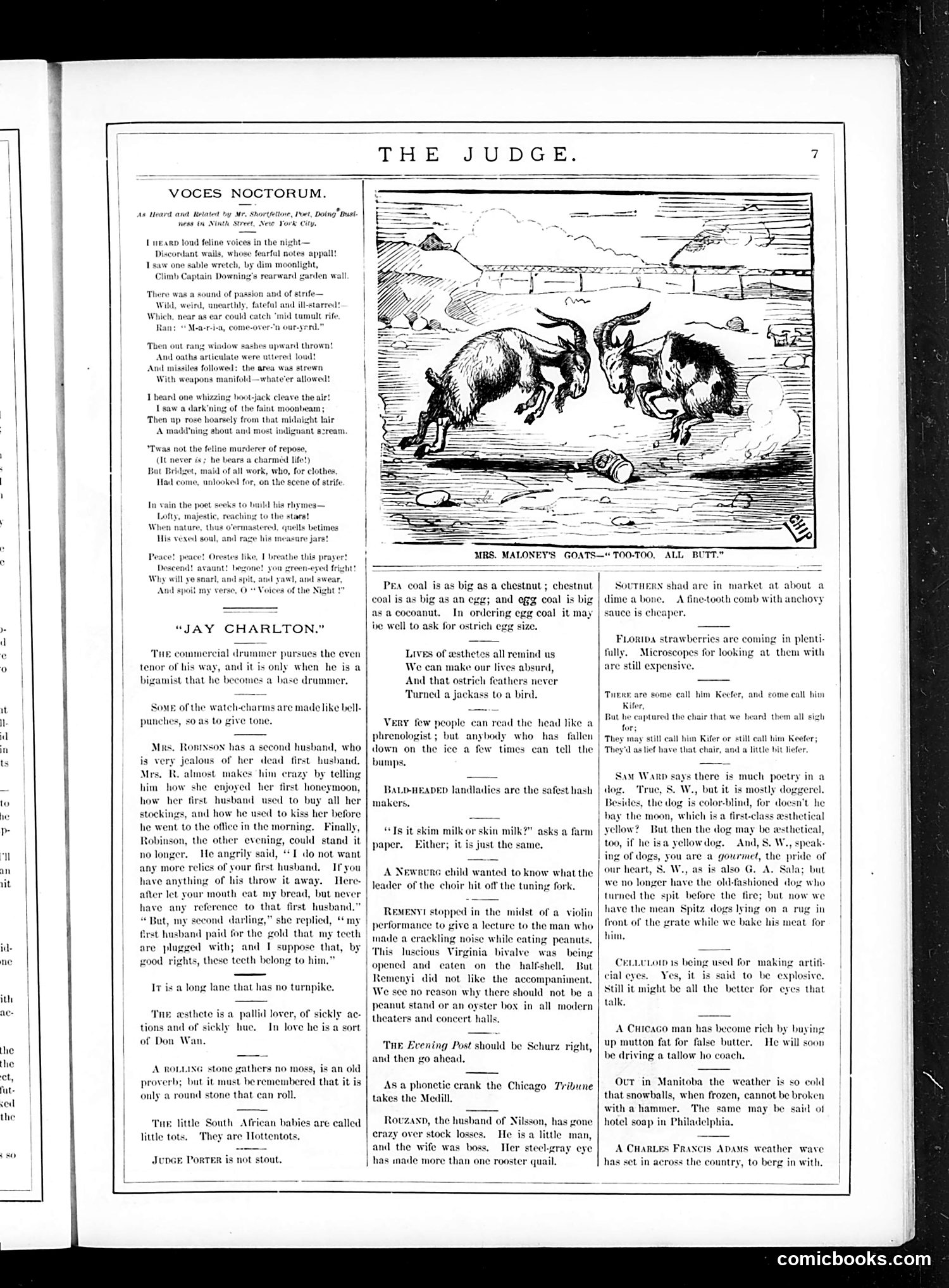
This page from Judge satirizes various aspects of contemporary American life through humorous vignettes and commentary. The main illustrated cartoon depicts **Mrs. Maloney's goats fighting**, labeled "Too-Too, All Butt"—likely a pun on their aggressive behavior. The lead piece, "Voces Noctorum" (Voices of the Night), humorously describes a poet disturbed by late-night urban noise—feline screeches and domestic chaos—capturing 19th-century frustrations with city living. Other sections mock everyday social absurdities: a jealous second husband tormented by his wife's nostalgic references to her first marriage; debates about coal sizing and milk quality; phrenologists reading bumps on heads; aesthetic pretensions; and various linguistic pedantries (like the Chicago Tribune's "phonetic crank" spelling reform). The tone is gently satirical, poking fun at middle-class pretensions, domestic life, and contemporary fads—typical Judge content aimed at educated urban readers. No specific political figures appear identifiable here.
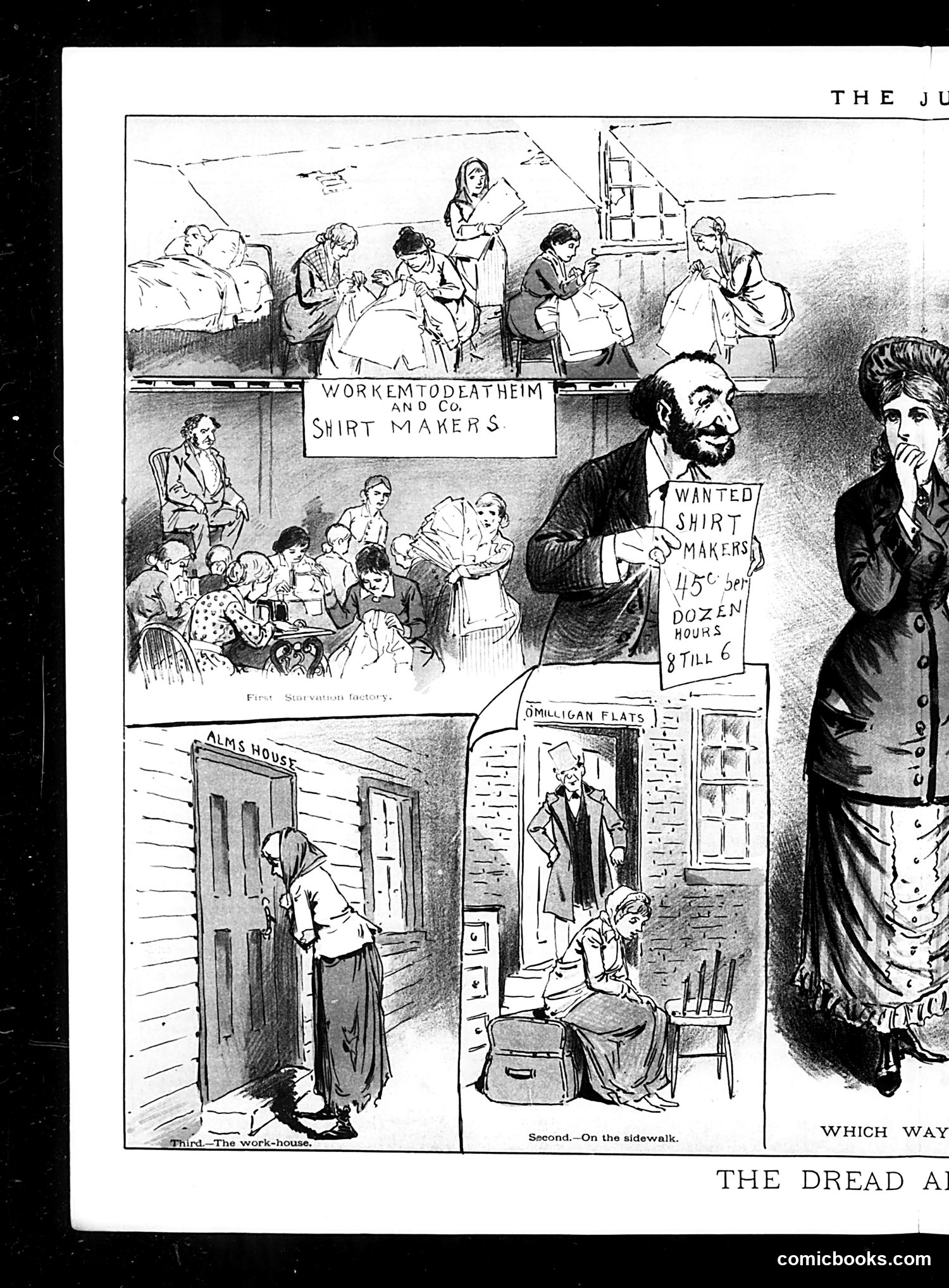
This cartoon depicts **labor exploitation in the garment industry**, specifically targeting shirt manufacturers. The narrative shows: **First panel (top)**: A sweatshop factory where women work in cramped conditions on shirts. **Second panel (bottom left)**: "Alms House" - a poorhouse where desperate workers seek shelter. **Third panel (bottom right)**: "Omilligan Flats" - tenement housing where workers live in poverty. A bearded man holds a "Wanted: Shirt Makers" sign demanding workers at "45 cents, 12-hour days, 8 till 6" — exploitative wages. The satirical point is stark: manufacturers profit while paying poverty wages that force workers into poorhouses and slums. The title "Which Way / The Dread Alternative" suggests workers face impossible choices: accept exploitation or destitution. This appears to critique Gilded Age labor conditions and unsafe, underpaid garment work.
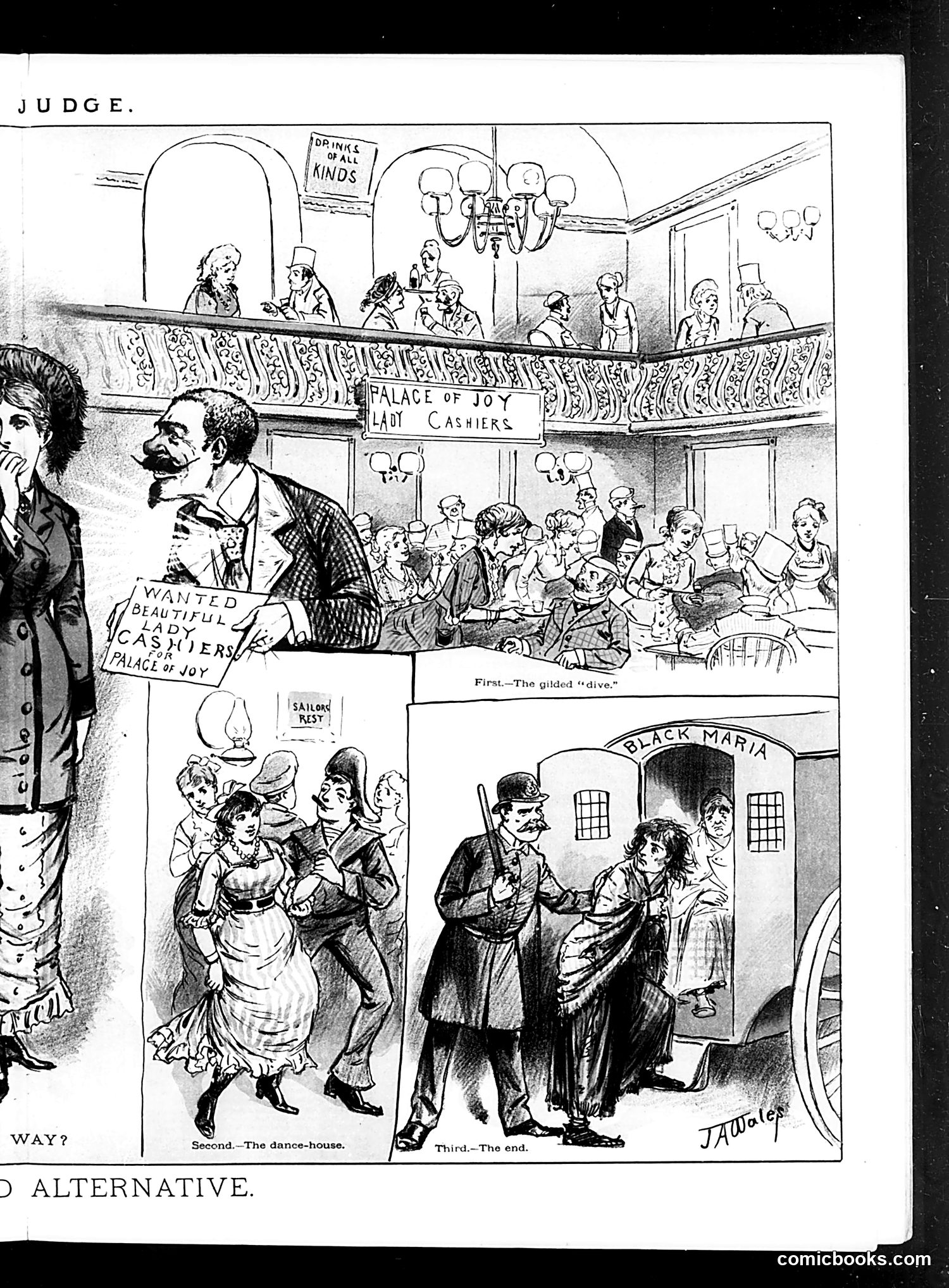
This satirical cartoon mocks establishments advertising for "beautiful lady cashiers" at venues like the "Palace of Joy." The three panels trace a narrative: First, a gilded nightclub scene with well-dressed patrons; Second, a dance-house where men pursue women; Third, a ship named "Black Maria" (period slang for a police wagon), showing arrest. The satire targets the exploitation of women in entertainment venues that operated as fronts for vice. The ironic title "Palace of Joy" and the progression from glamorous recruitment to criminal consequences suggest these establishments were actually brothels or illegal operations. The cartoon criticizes both the deceptive hiring practices ("wanted beautiful lady cashiers") and the inevitable legal outcomes, implying moral judgment on both the businesses and their patrons.
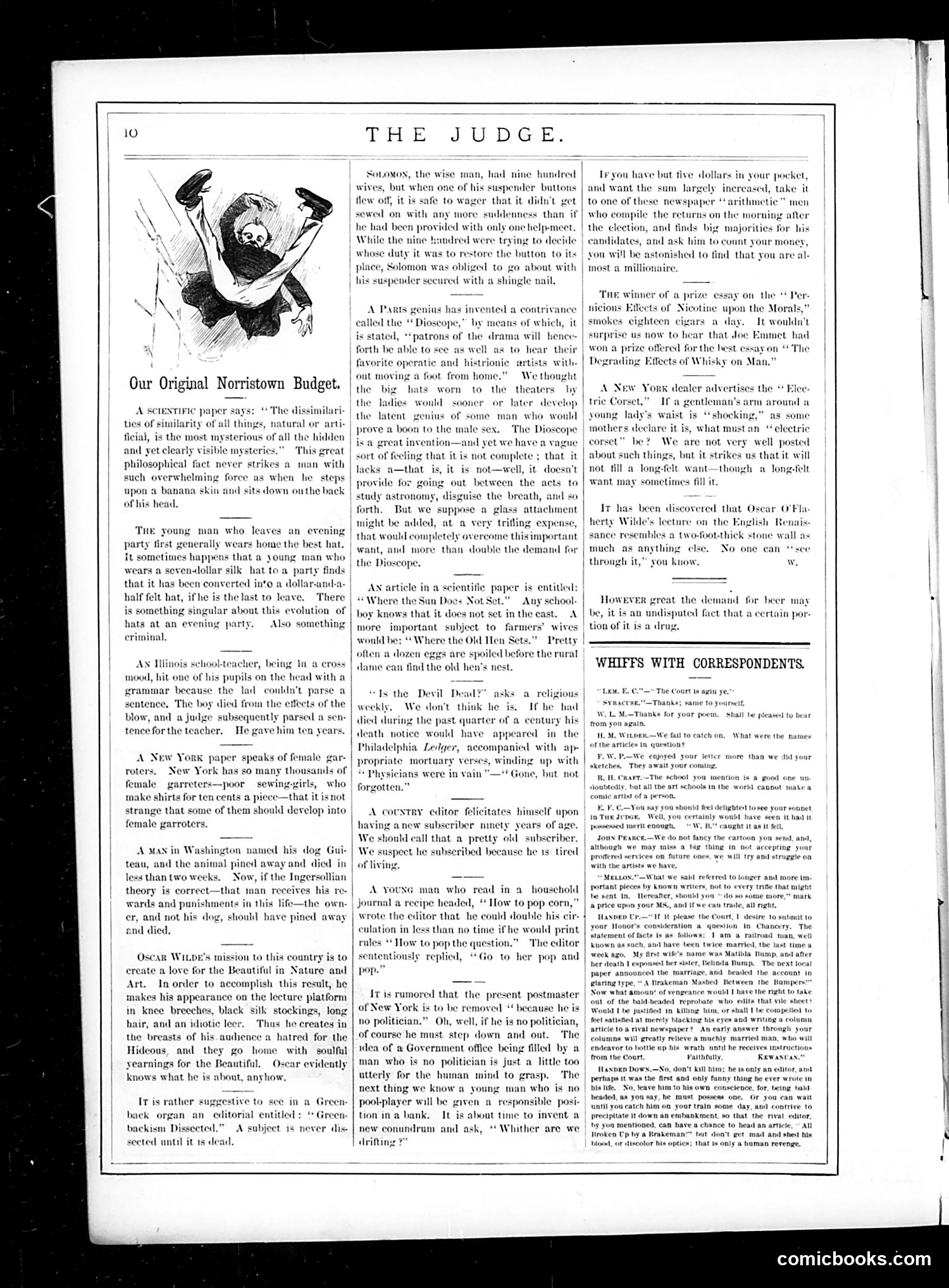
This page from the satirical magazine *Judge* contains multiple humorous commentaries typical of late 19th-century American humor. The main cartoon (top left) depicts a man whose suspender has broken, forcing him to hold up his pants—a visual joke about everyday male inconvenience. The accompanying text references Solomon's nine hundred wives, using the anecdote to mock the complexity of domestic life and suggest that even wisdom cannot solve practical problems. Below, "Our Original Norristown Budget" satirizes various social absurdities: a schoolteacher punishing a student so harshly he dies; Oscar Wilde's visit to America (mocking his aesthetic pretensions and flamboyant appearance); a woman who names her dog after her husband, then kills it; and a man who abandoned his dog in Washington. The final section mocks pseudo-scientific articles in newspapers—one about where the sun doesn't set (absurdly suggesting the east, when any schoolchild knows better) and another about hens' nesting habits, presented as if profound. Overall, the page exemplifies *Judge*'s formula: satirizing contemporary figures, social pretensions, domestic mishaps, and journalistic absurdity through exaggeration and ridicule.
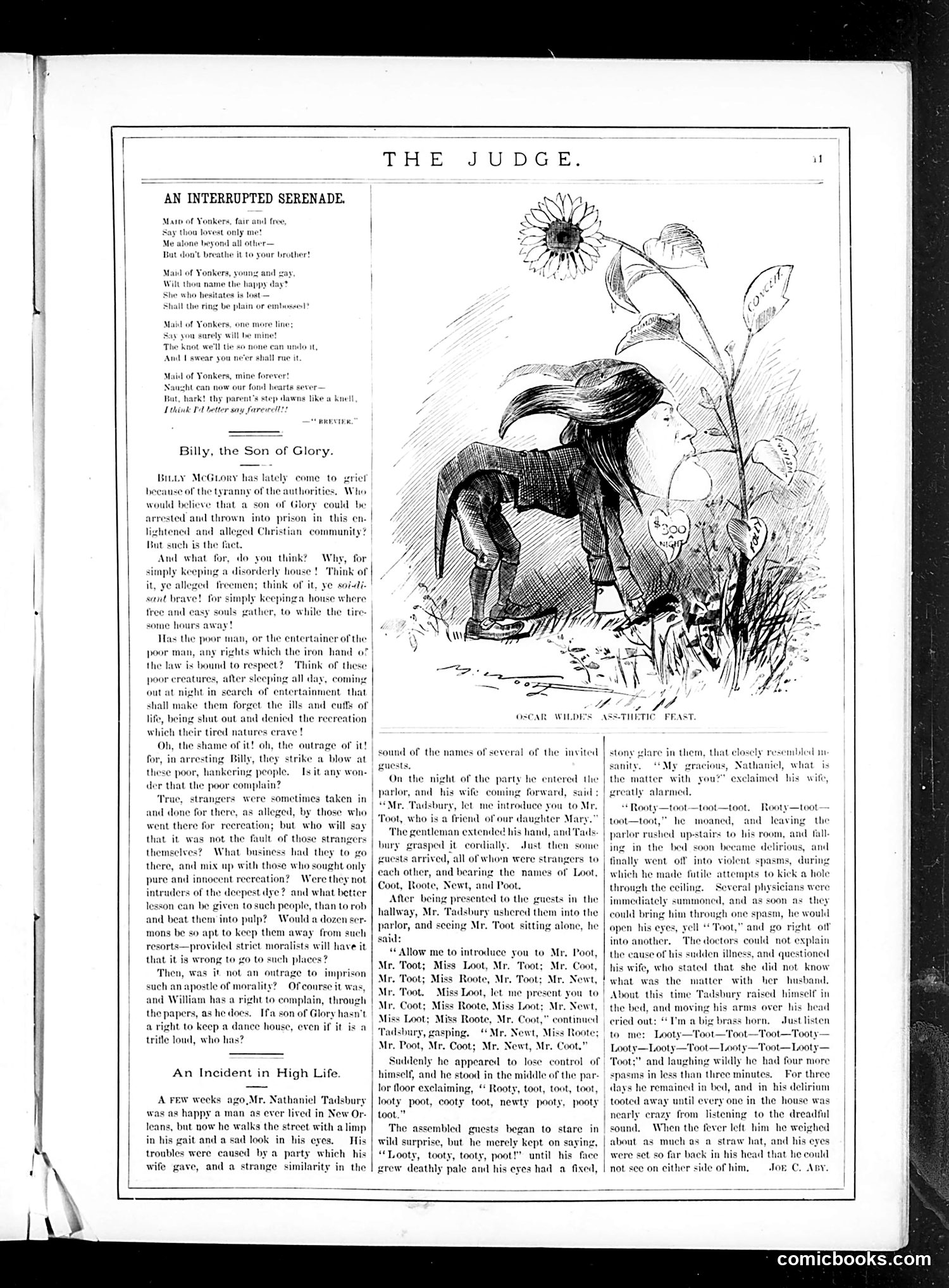
This page contains two satirical pieces from Judge magazine: **"Billy, the Son of Glory"** critiques police raids on working-class establishments. It sarcastically defends "Billy," arrested for running a disorderly house where poor people gather for entertainment. The satire attacks authorities for criminalizing the innocent recreation of the poor while mocking Billy's defenders for complaining—a pointed jab at selective law enforcement and class-based justice. **"An Incident in High Life"** is a absurdist humor piece about Mr. Nathaniel Tadsbury, whose wife's party features guests with rhyming, silly names: Toot, Poot, Coot, Loot, Roote, Newt. When introducing them all in rapid succession, Tadsbury suffers a mental breakdown, repeatedly saying "Rooty-toot-toot" until he becomes delirious. It's a comedic exaggeration mocking upper-class social awkwardness and the ridiculousness of elaborate name-introductions at formal gatherings. The illustration depicts the second story's chaotic moment.
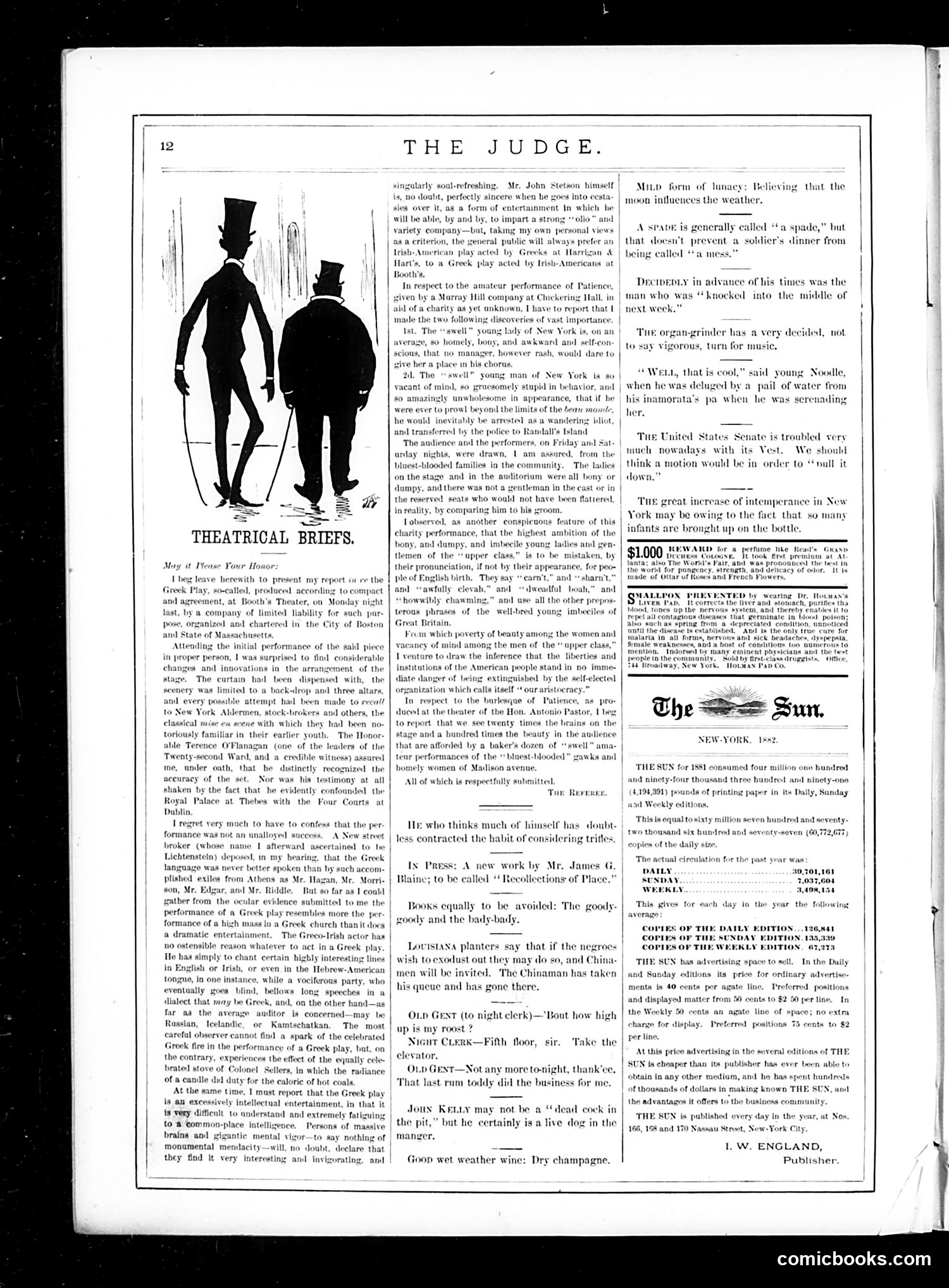
This page contains **theatrical criticism** rather than political cartoons. The single illustration shows two silhouetted figures in top hats—apparently gentlemen attending a theatrical production. The text is a satirical review of recent New York theatrical performances, written in the voice of an official "report." The critic lambastes: 1. **A Greek Play production** at Booth's Theater—mocking its pretentiousness and the amateur cast's inability to perform classical drama authentically, particularly an Irish-American actor whose accent renders the dialogue incomprehensible. 2. **"Patience"** (Gilbert & Sullivan's operetta) performed by the Murray Hill company—savagely critiquing both the "swell" (wealthy upper-class) young male characters depicted as stupid and homely, and the female performers as equally unattractive and inarticulate. The satire targets **class pretension**: wealthy New Yorkers' attempts at cultural sophistication while lacking talent or genuine understanding. The critic prefers accessible Irish-American theater ("Hart's") to intellectually demanding classical works. The tone is mock-official, using bureaucratic language to deliver cutting social commentary about 1880s New York theater and society.
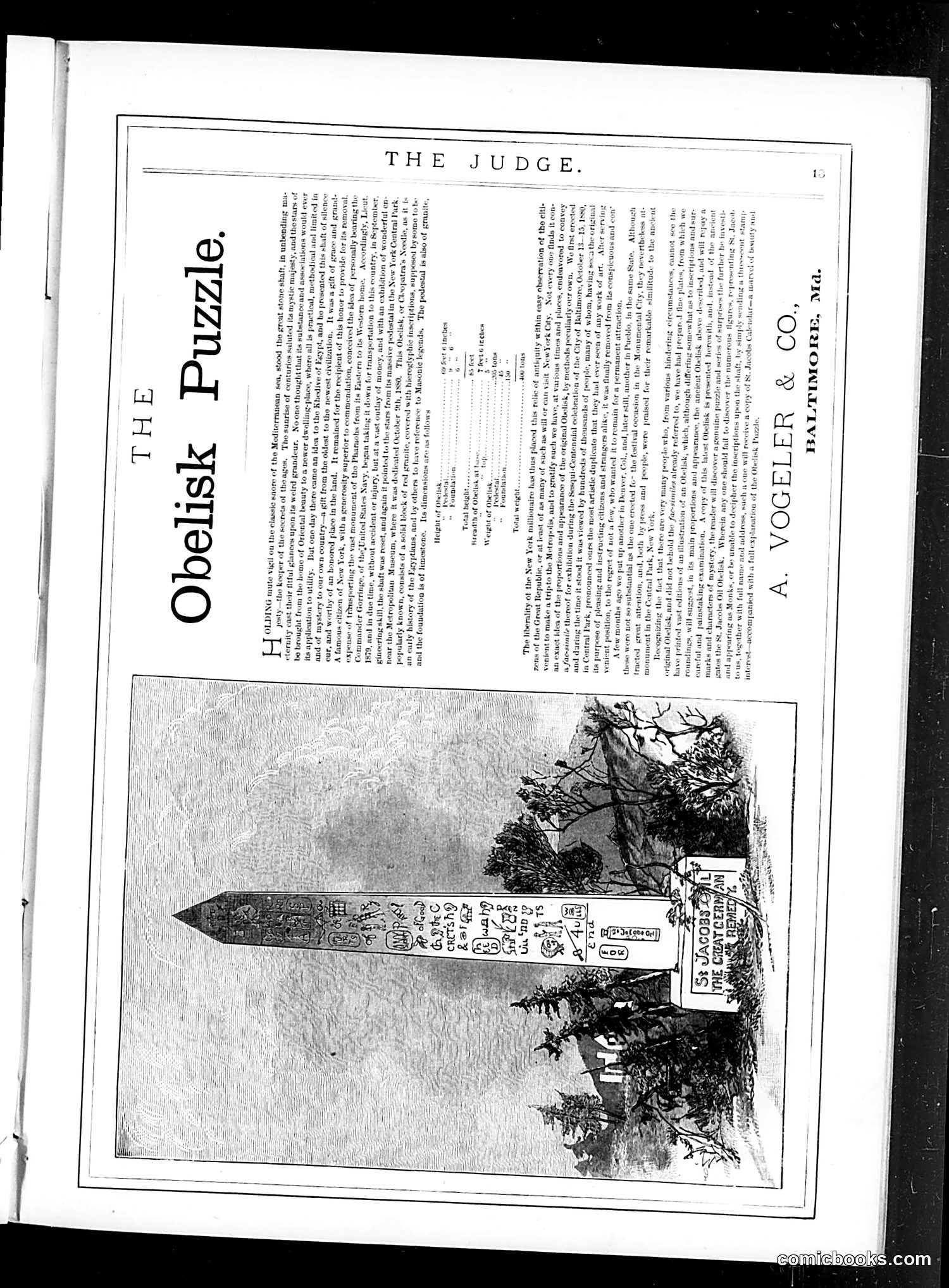
This page from *Judge* magazine presents "The Obelisk Puzzle" by A. Voegeler & Co., Baltimore, Md. The OCR text is severely corrupted and largely unreadable, making it impossible to determine the specific political or social satire intended. The image shows what appears to be an obelisk or monument with hieroglyphics and text inscribed upon it, positioned in a landscape setting. Without legible text explaining the puzzle's meaning or context, I cannot reliably identify what historical figure, political event, or social commentary this represents. To properly interpret this cartoon's satirical intent, clearer source material or additional context about the publication date would be necessary.
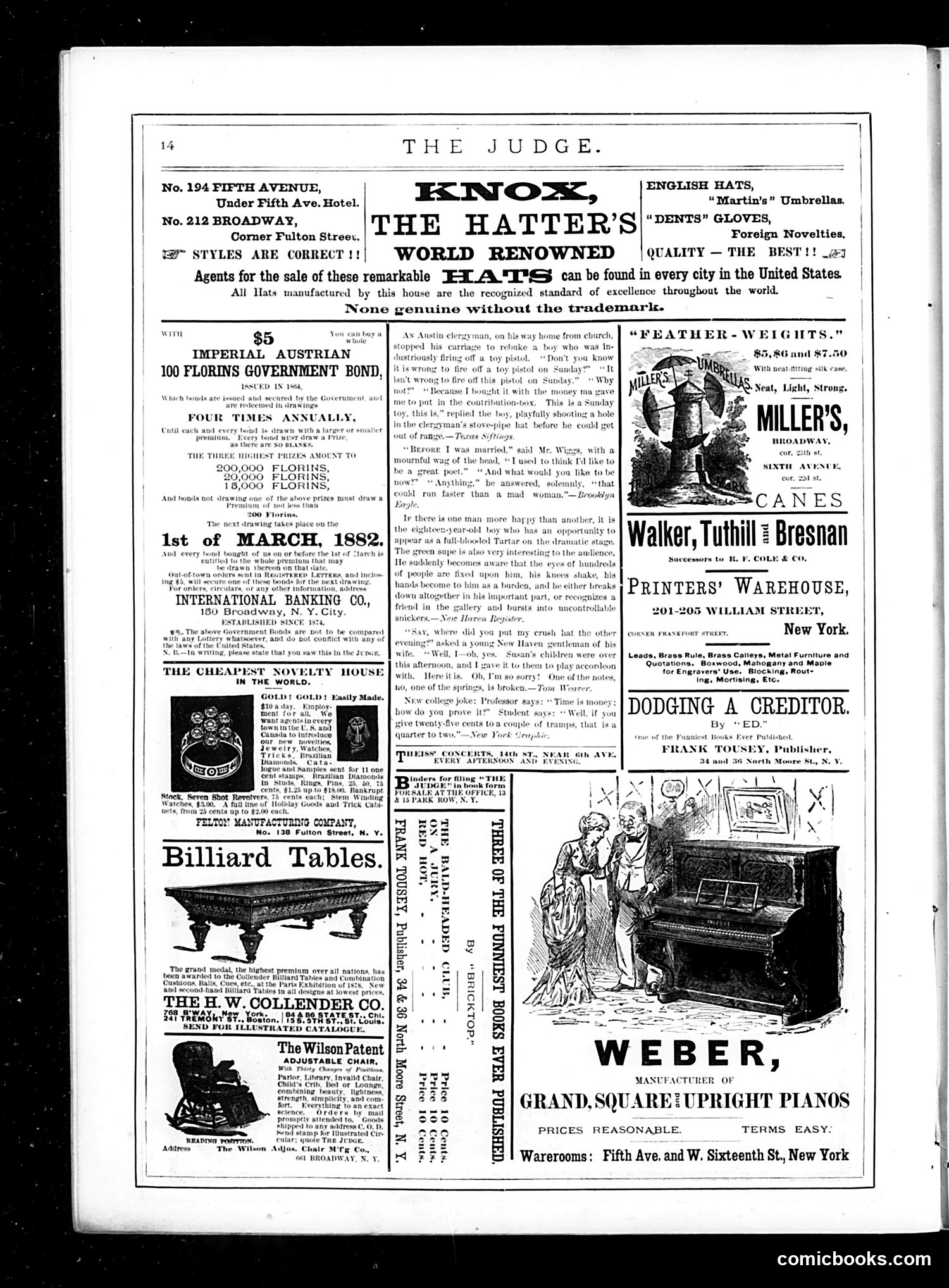
This page is primarily **advertisements** for luxury goods (hats, pianos, billiard tables, bond investments). However, the main cartoon titled **"Dodging a Creditor"** depicts a woman at a piano being confronted by what appears to be a creditor or bill collector at the door. The satire targets **wealthy women's frivolous spending** and avoidance of financial responsibility. The woman pretends not to be home or ignores the creditor while sitting at an expensive Weber piano—itself an advertisement on the page. The joke operates on irony: she purchases costly items (the grand piano) while evading those demanding payment. This reflects late-19th-century anxieties about **women's consumer spending** and lack of financial accountability, particularly among the wealthy leisure class. The cartoon mocks both the woman's evasiveness and, implicitly, the credit system enabling such behavior. The surrounding advertisements ironically reinforce the satire by showcasing exactly the luxury items such women purchased.
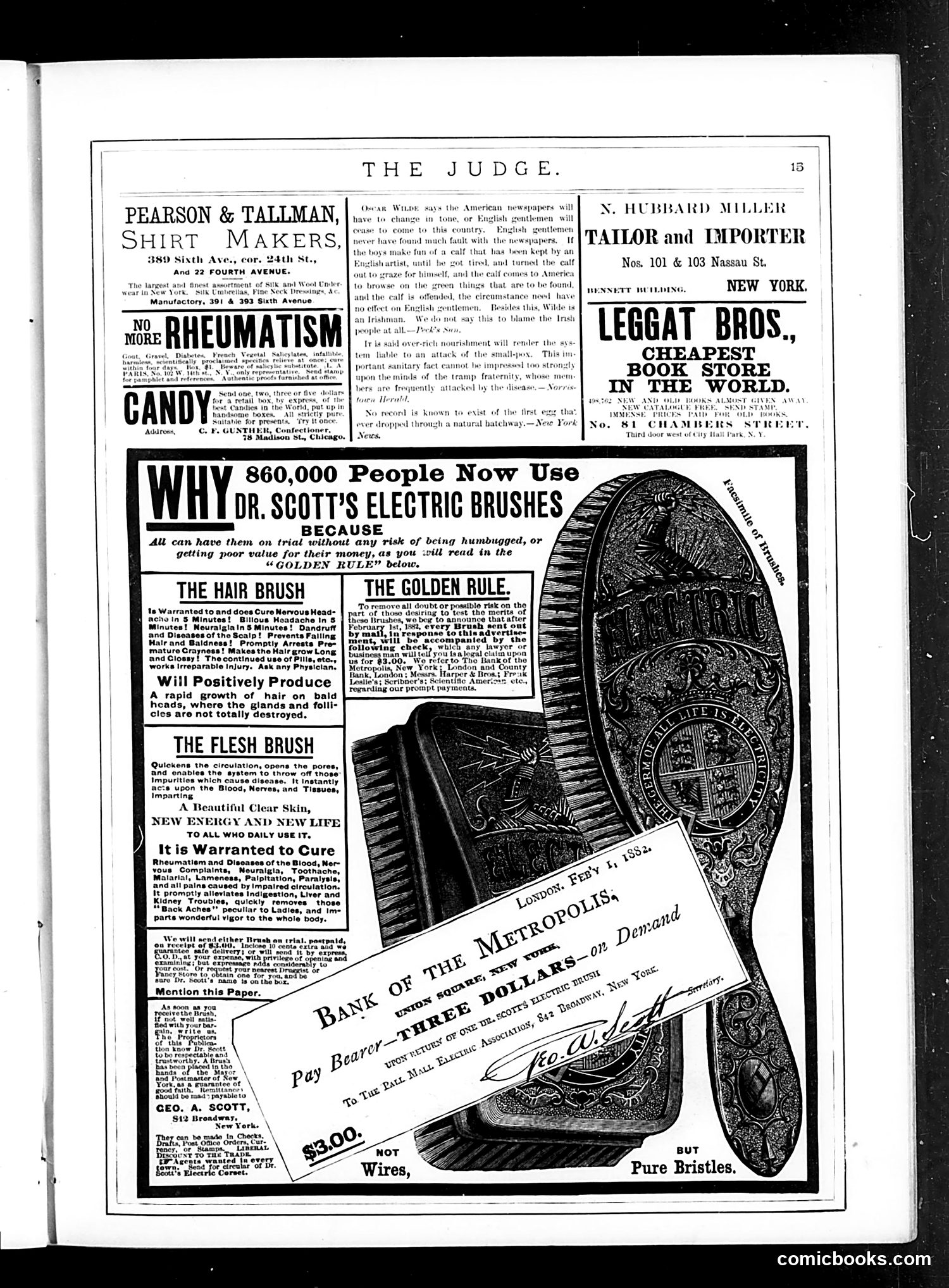
This page is primarily **advertising**, not editorial satire. The dominant feature is a large advertisement for Dr. Scott's Electric Brushes, which claims 860,000 users and promises to cure rheumatism, produce hair growth, and provide various health benefits through electrical stimulation. The surrounding ads include shirt makers, a bookstore, a tailor, and candy remedies—typical late 19th-century patent medicine marketing. **The satire context:** Judge magazine occasionally ran advertisements, but this page reflects the era's widespread medical quackery. The grandiose health claims ("Warranted to Cure" rheumatism, neuralgia, toothache) and the "Golden Rule" guarantee were common snake-oil tactics. Modern readers should note that electrical-brush devices were genuinely marketed as cure-alls despite lacking scientific basis—this represents an era before FDA regulation of medical claims. There is **no identified political cartoon** on this page; it's a commercial advertisement section.
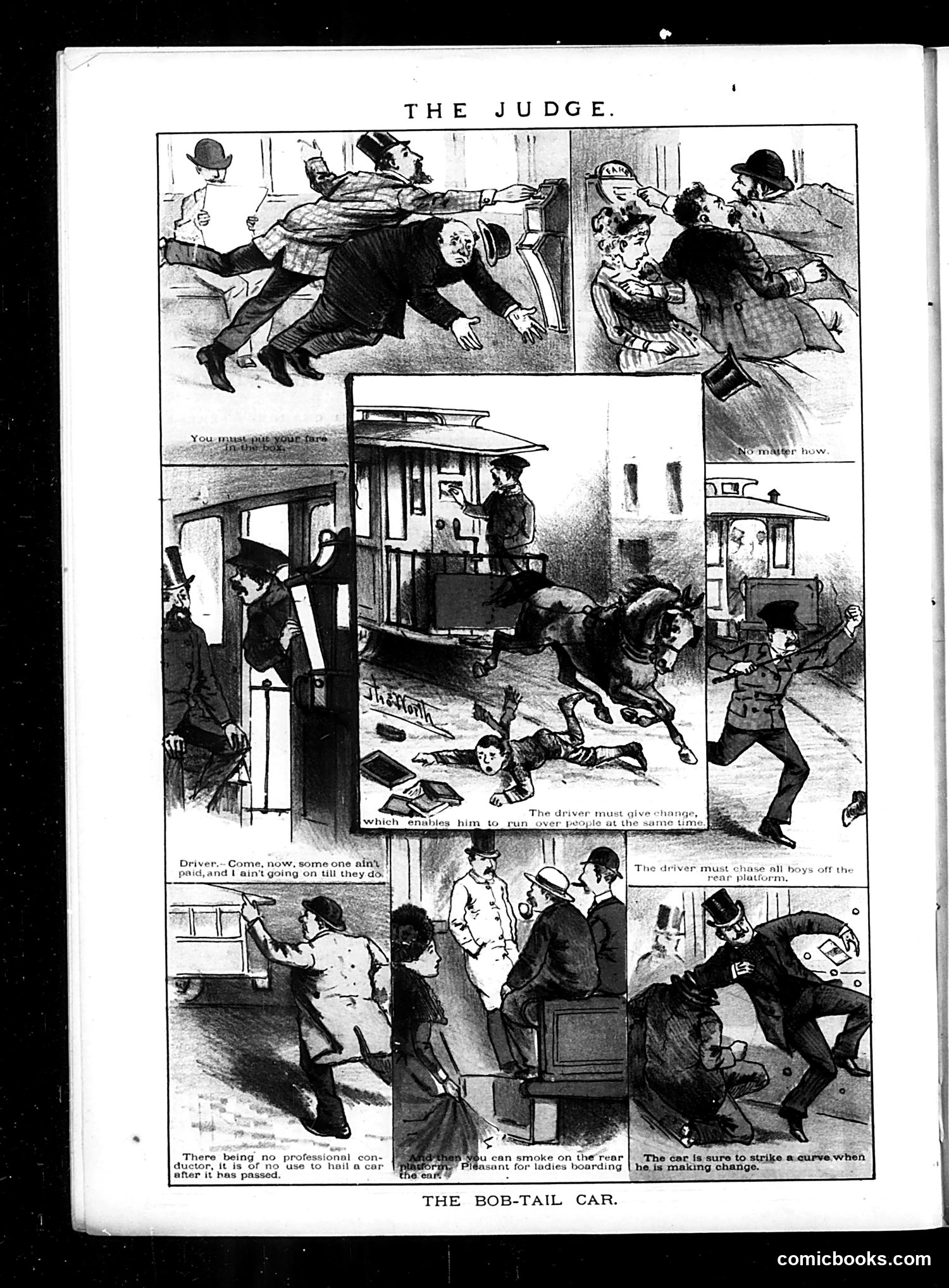
This satirical comic mocks the early electric streetcar system, specifically "bob-tail" cars (single-unit trolleys without a separate motorman's cabin). The panels ridicule various operational failures and safety hazards: - Drivers who won't move until paid, or demand payment before service - No professional conductors to manage passengers properly - Boys allowed on rear platforms creating chaos - Unsafe practices like smoking near passengers - Drivers unable to safely navigate curves while making change - Overall incompetence endangering pedestrians and passengers The satire targets the poorly-managed, dangerously under-staffed public transit systems of the era. Judge uses exaggerated scenarios to critique how these new streetcars were operated with inadequate safety protocols and untrained staff, making them hazards to urban commuters and the public.