
A complete issue · 16 pages · 1882
Judge — January 28, 1882
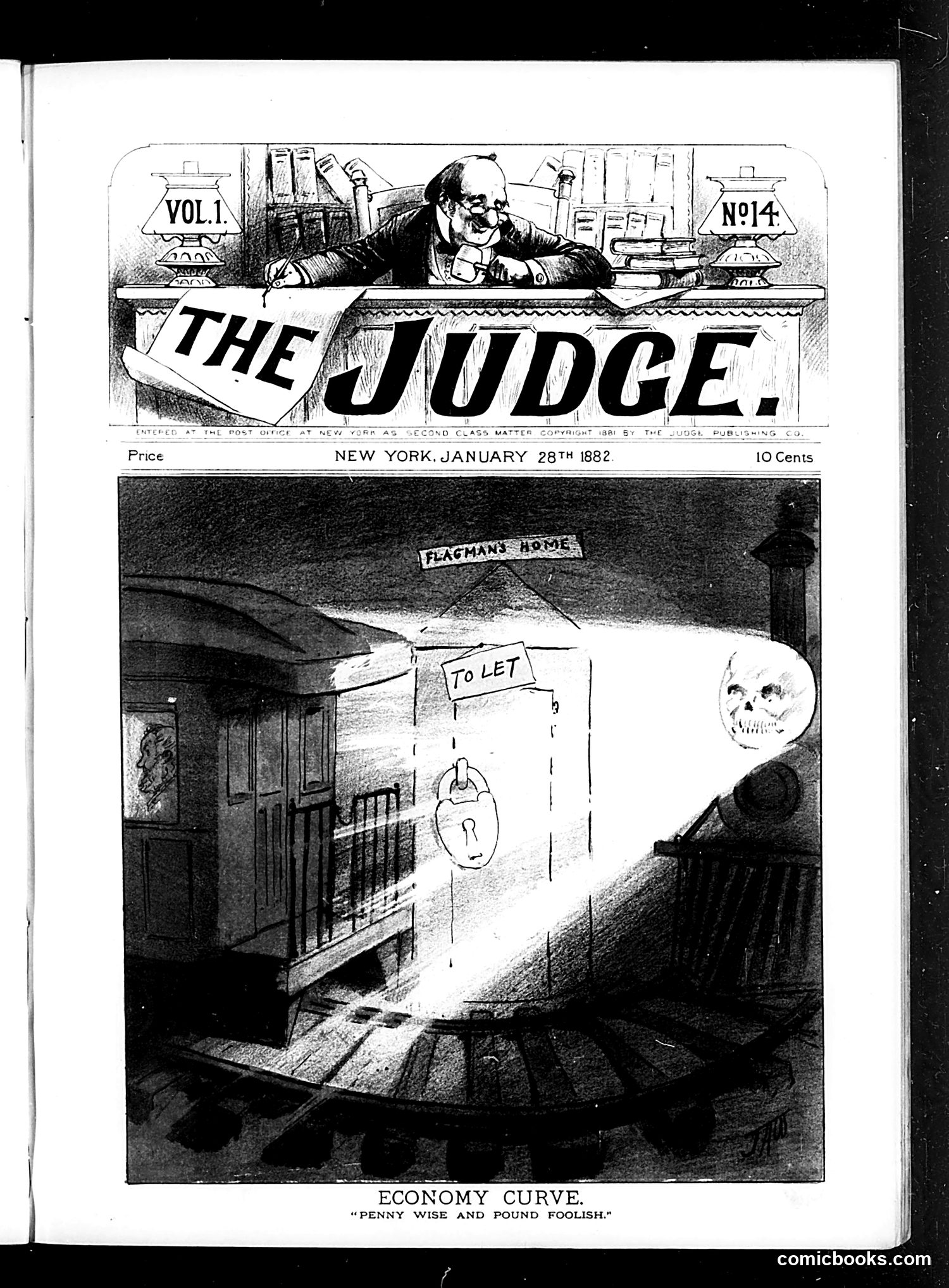
This *Judge* magazine cover from January 1882 satirizes the housing crisis and economic inequality through the caption "Penny Wise and Pound Foolish." The cartoon depicts a haunted-looking tenement building labeled "Flackman's Home" with a "To Let" sign. A ghostly skull peers from the right—likely representing death or disease associated with poor housing conditions. The contrast between the miserly figure at the top (counting coins) and the deteriorating building below suggests landlords prioritizing small profits over maintaining livable conditions. The satire critiques how penny-pinching on maintenance creates false economy—saving small amounts while properties decay into uninhabitable structures, ultimately causing greater losses and human suffering. This reflects 1880s concerns about tenement housing exploitation in industrial cities like New York.
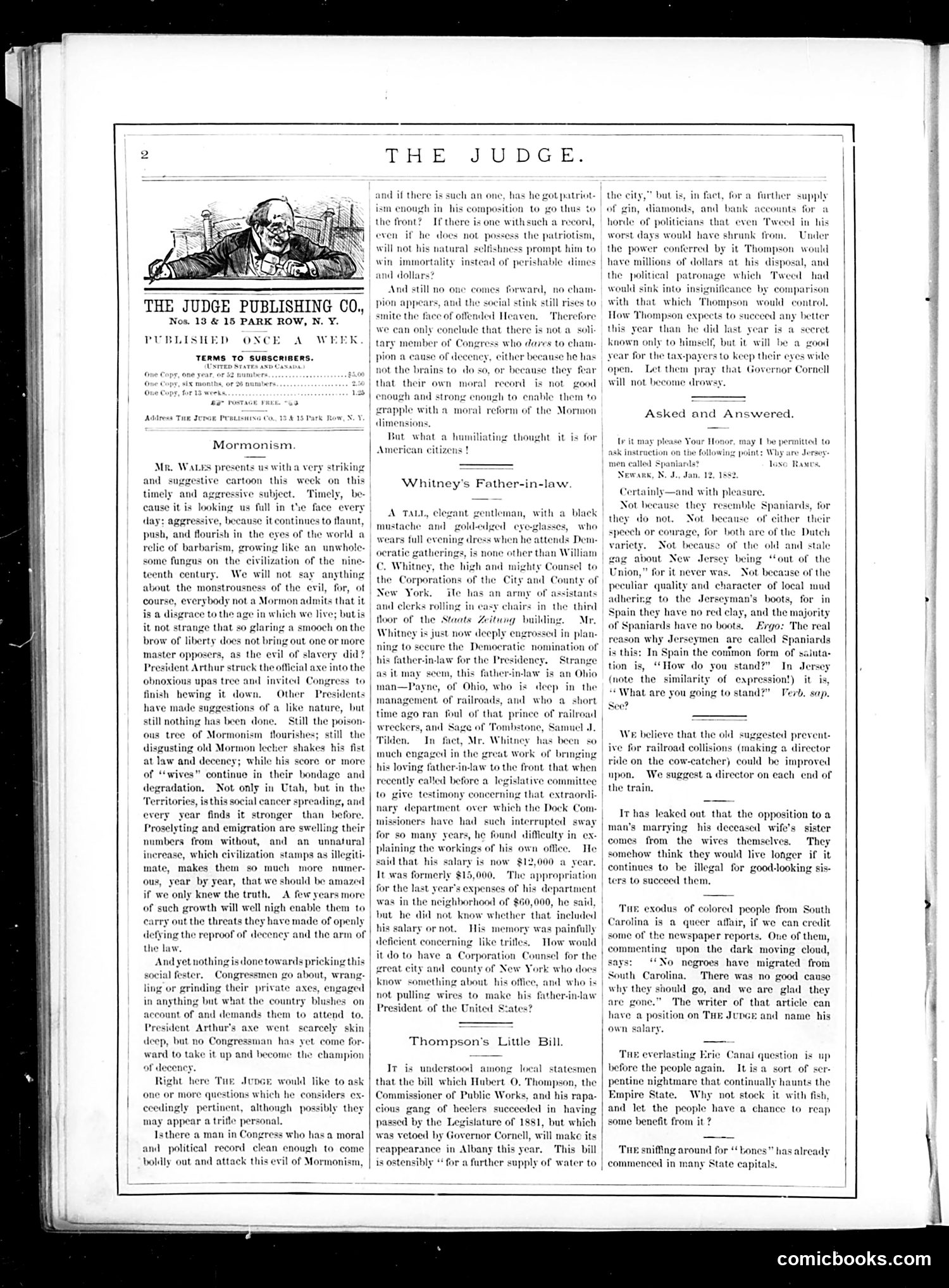
This page critiques the failure of U.S. political leaders to combat Mormonism, which Judge treats as a barbaric social evil flourishing in Utah and Western territories. The editorial mocks Congress and President Arthur for inaction despite the practice of polygamy ("wives"), characterizing it as an embarrassing stain on American civilization. The cartoon sarcastically questions whether any congressman possesses sufficient moral courage and clean political record to lead opposition—suggesting most politicians are too self-interested or compromised to champion moral reform. The accompanying article on Whitney's father-in-law appears to exemplify this corruption: a railroad developer seeking the presidency through nepotistic connections. The satire targets political cowardice and hypocrisy around addressing what 19th-century Americans viewed as Mormonism's fundamental incompatibility with American values.
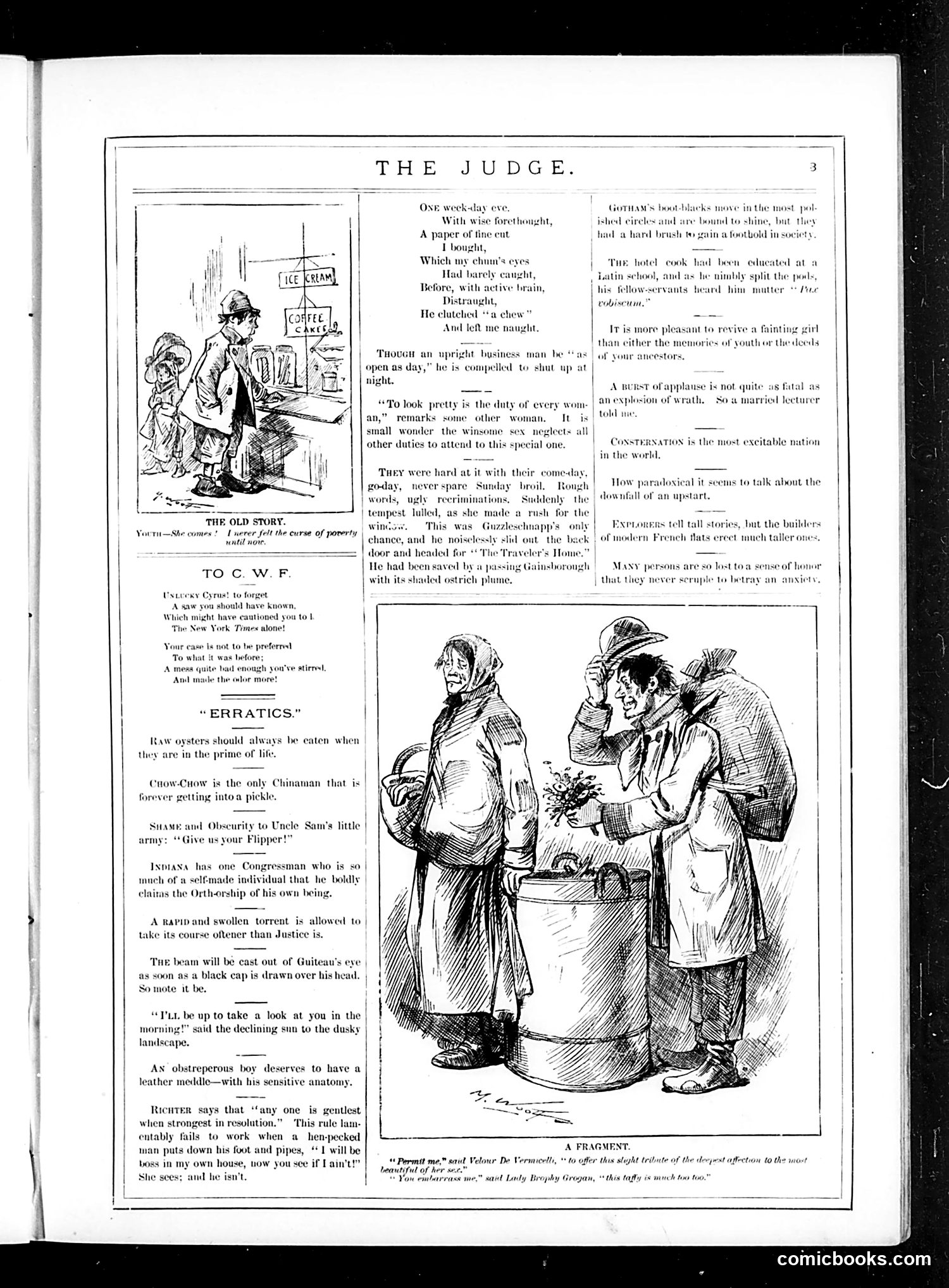
This page contains miscellaneous satirical content typical of Judge's format. **"The Old Story"** depicts a poor youth entering a shop—likely commentary on class struggle or poverty's humbling effects. **"To C.W.F."** is a poem addressed to someone (possibly a public figure), warning against relying solely on the *New York Times*. **"Erratics"** comprises brief satirical observations mocking contemporary absurdities: raw oysters, a Chinese laundryman stereotype, Uncle Sam's army, an Indiana congressman's self-aggrandizement, and married men's domestic subjugation ("She sees; and he isn't"). **"A Fragment"** shows three figures in a domestic scene, with dialogue about "Parquet" and "taffy"—appearing to satirize aristocratic affectation or romantic pretension. The large illustration depicts working-class or street characters in conversation. Overall, the page reflects Judge's late-19th/early-20th-century format: mixing visual cartoons with editorial barbs targeting politicians, social conventions, ethnic stereotypes, and domestic dynamics.
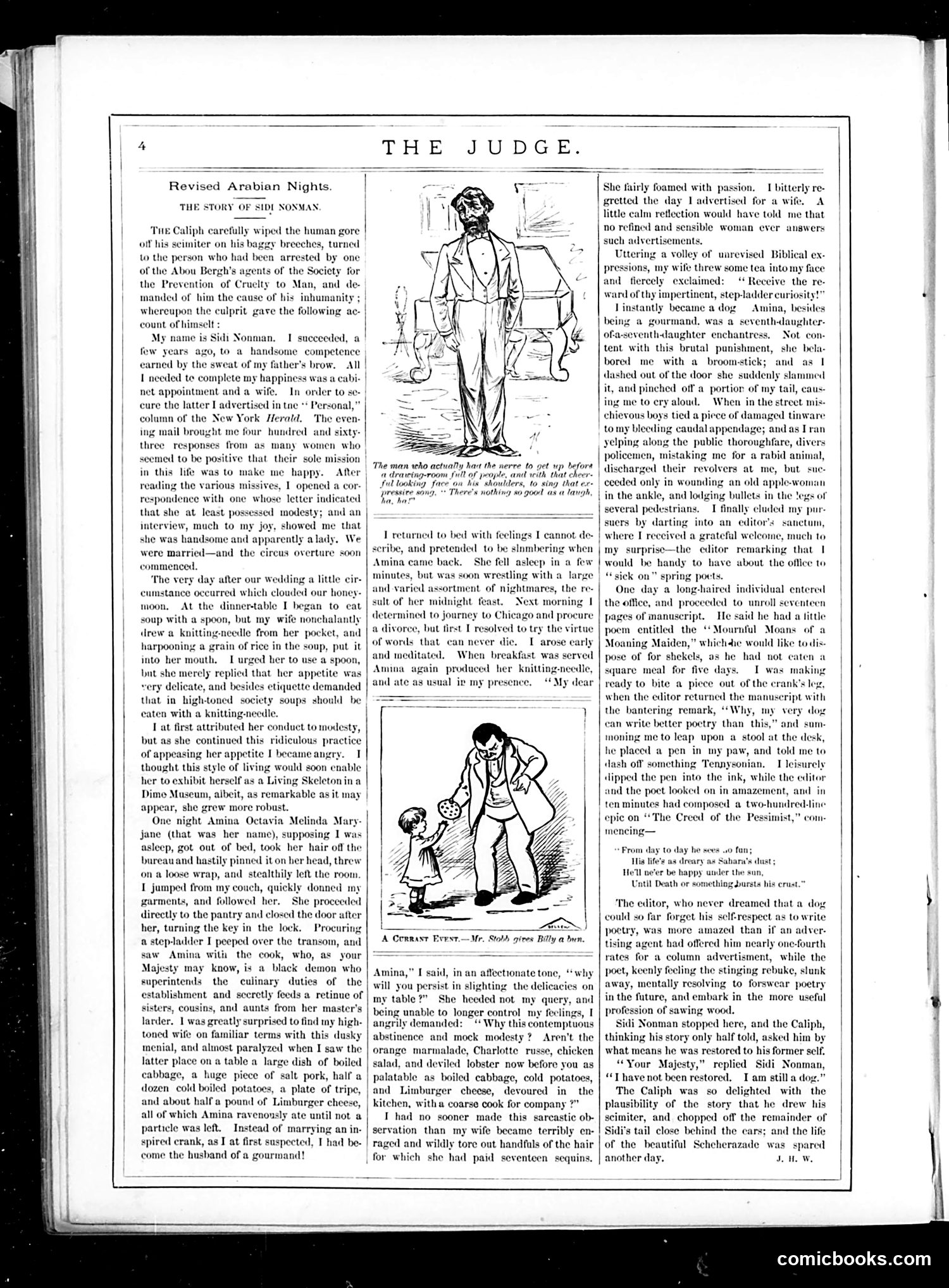
This satirical story titled "Revised Arabian Nights: The Story of Sidi Nonman" is a **domestic comedy** mocking marriage and women's behavior. **The setup:** A man advertises for a wife in the New York Herald's personal column, receives hundreds of responses, and marries an apparently modest woman named Amina. **The satire:** The joke relies on revealing hidden female nature—she eats soup with a knitting needle (affectation of delicacy), secretly hoards food with the cook while pretending refinement, and proves to be a "gourmand" (glutton) despite appearing ladylike. **The social commentary:** This reflects late-19th-century anxieties about women's deception and the gap between public propriety and private behavior. The irony—that personal advertisements were supposed to find "honest" women—undercuts that optimism. The accompanying illustrations show the husband and the secret pantry scene. The humor targets both naive men seeking wives through ads and women's hypocrisy.
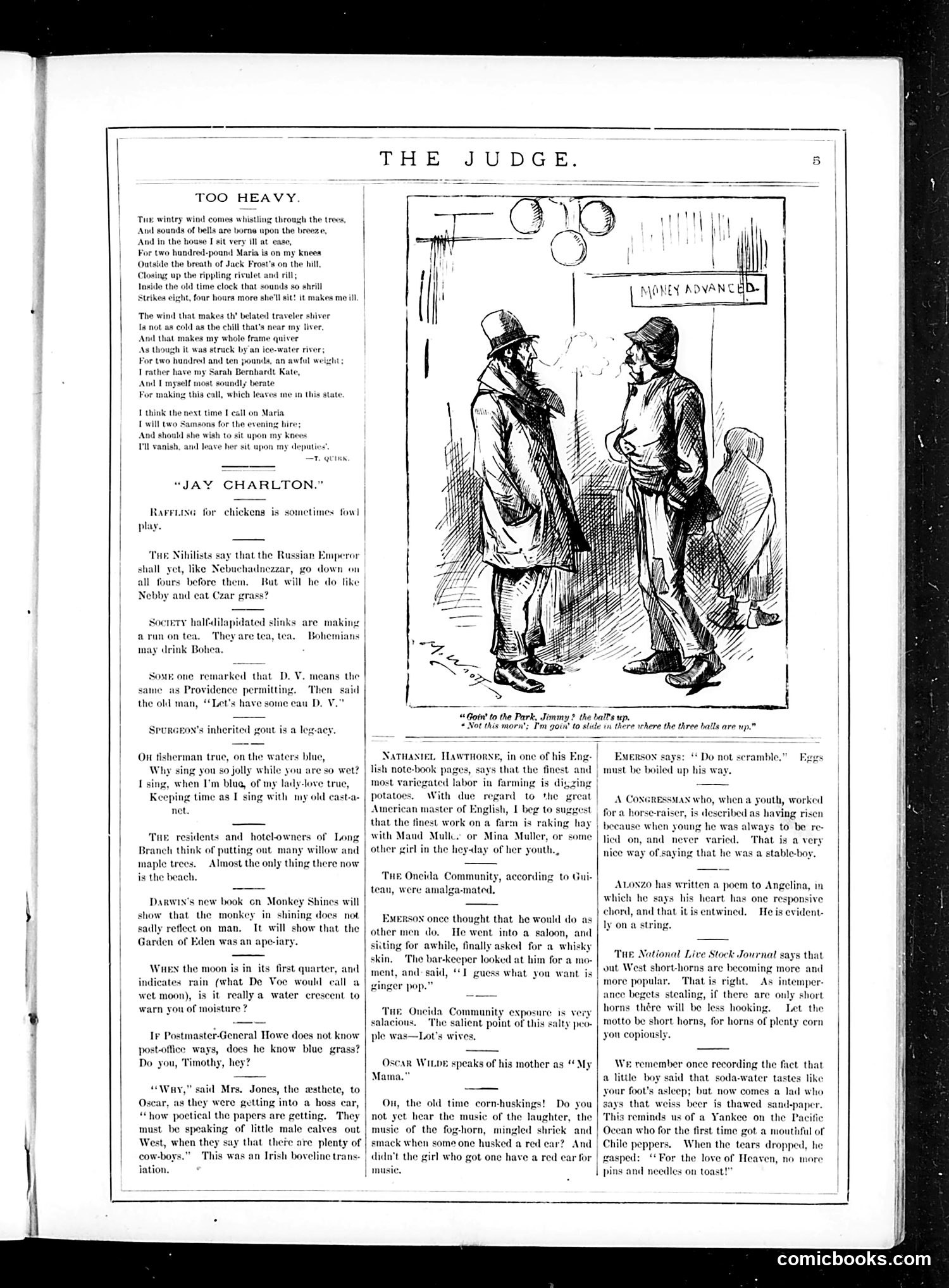
This page from *Judge* magazine contains brief satirical items and a cartoon. The main cartoon depicts two men in conversation, with a sign reading "MONEY ADVANCED" visible—likely depicting a loan transaction or financial deal. The satirical items mock contemporary figures and social trends: references to Russian nihilists, Darwin's evolution theory, Postmaster-General Howe, Ralph Waldo Emerson (mocked for attempting to fit in at a saloon), the Oneida Community (a real utopian commune), and Oscar Wilde (through the character "Oscar"). The opening poem "Too Heavy" complains about a woman visitor weighing 200+ pounds, using exaggerated language about her physical burden. This reflects period attitudes toward women's weight and social visits. Most humor relies on wordplay, puns, and topical references to 1880s cultural figures and events now obscure to modern readers. The magazine operated as a humor publication targeting educated, politically-aware readers familiar with current events and public figures.
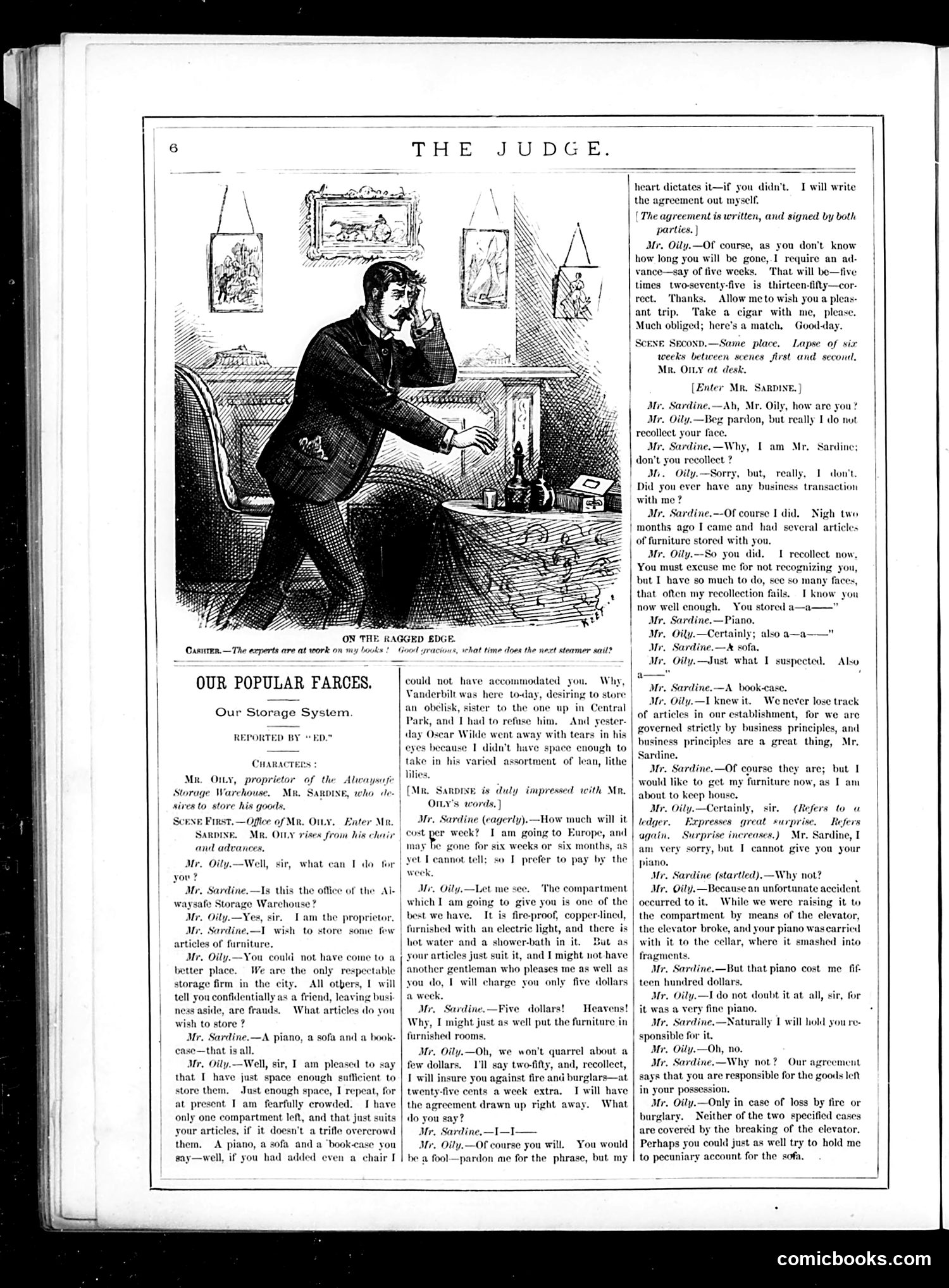
This page presents a two-scene satirical play mocking unscrupulous storage warehouse operators. Mr. Oily, a slippery proprietor, cons Mr. Sardine into storing furniture at what seems like a reasonable rate ($2.75/week). Oily employs classic con-artist tactics: flattery ("just what I suspected"), manufactured urgency (claiming the compartment is his "only" space), and escalating fees (adding $0.25/week insurance). The satire targets the nascent storage industry's predatory practices during the Gilded Age. When Sardine returns after six weeks (Scene Second), Oily feigns not recognizing him—suggesting customers were easily forgotten marks. The play implies Oily may have deliberately miscalculated costs or hidden fees, playing on public anxieties about entrusting valuable goods to dishonest operators. The joke exposes how seemingly professional businesses exploited trusting customers through smooth-talking deception and contractual fine print.
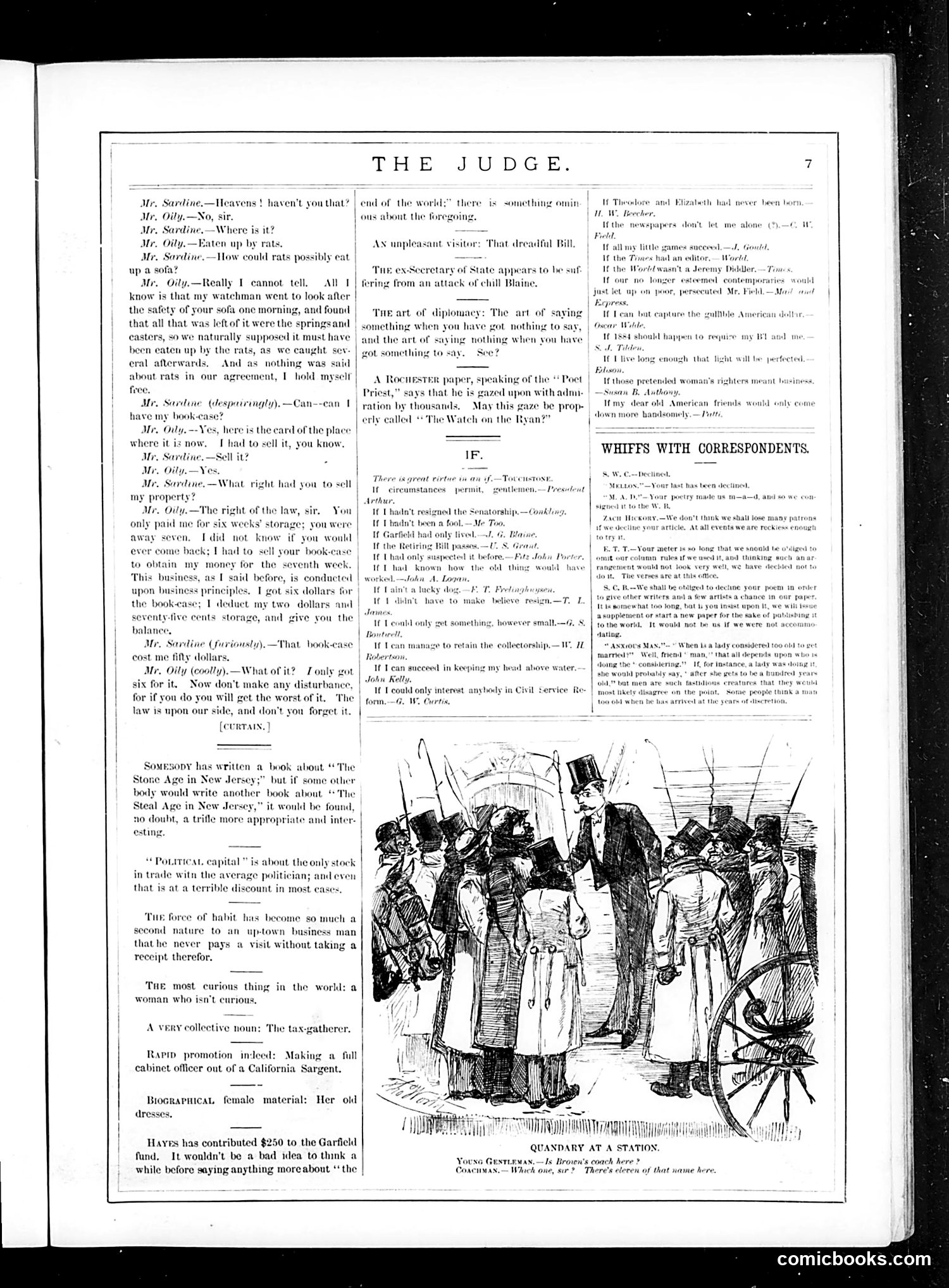
This page from the satirical magazine *Judge* contains multiple elements: **Main Cartoon ("Quandary at a Station"):** The illustration depicts a crowded railway station where a gentleman seeks "Brown's coach," only to be told eleven Browns are present—a visual joke about common names creating confusion. **Text Content:** The page is primarily dominated by satirical commentary on contemporary political figures, particularly references to the 1880 election aftermath. Multiple brief quips mock politicians including Garfield, Blaine, Conkling, and Hayes, with repeated "If only..." constructions satirizing their failures and miscalculations. The jokes suggest disappointment with Republican leadership and political outcomes. **Sidebar Dialogue:** An earlier comic dialogue about a stored book-case satirizes a storage company's harsh business practices—selling the item to recover unpaid fees—mocking both legalistic profit-seeking and the customer's impotence. The overall tone reflects post-election political disillusionment common in 1880s satirical journalism.
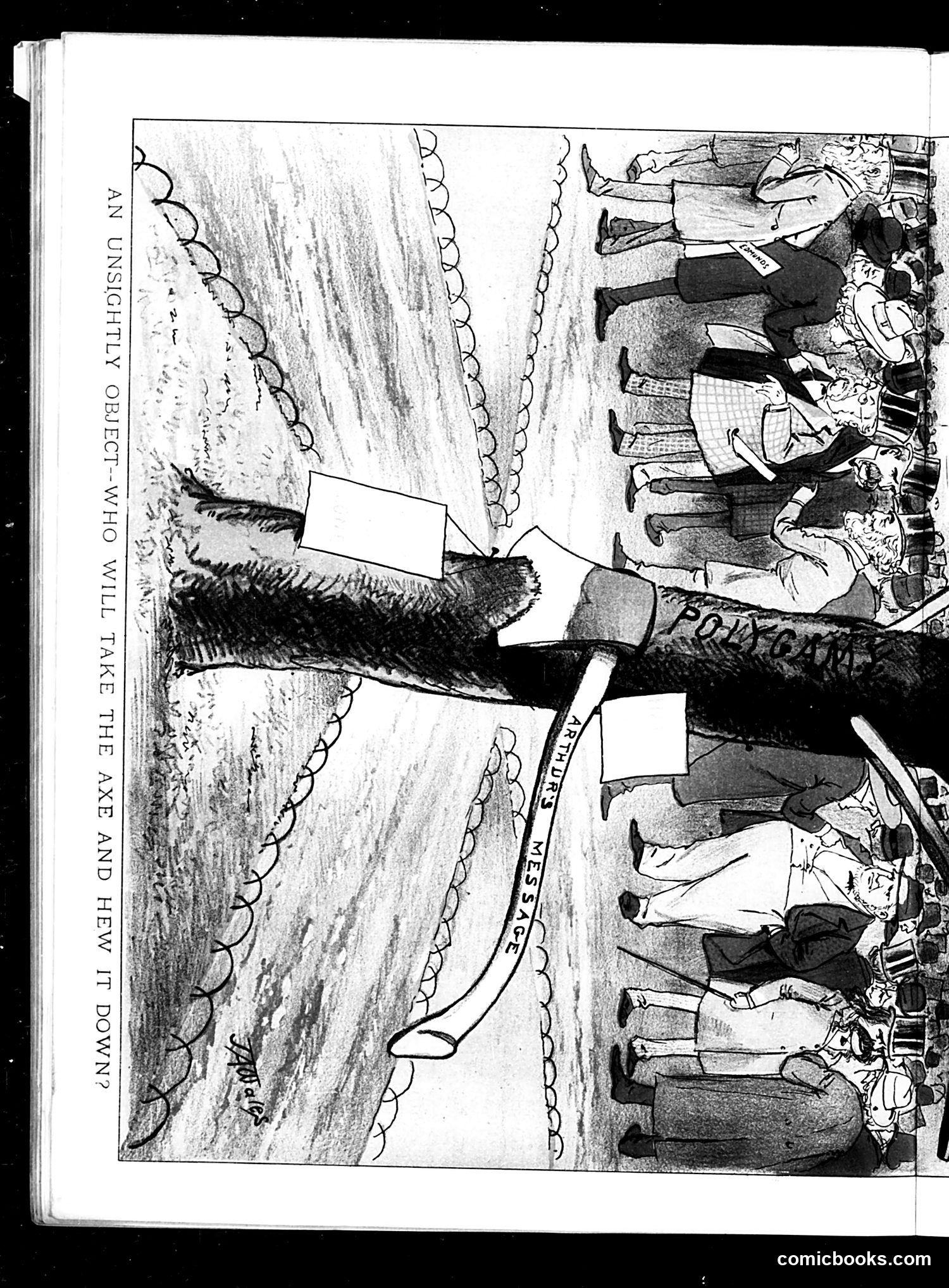
This Judge magazine cartoon depicts a large, menacing axe labeled "PROMISE" being wielded by what appears to be a grotesque figure. The caption asks "AN UNSIGHTLY OBJECT—WHO WILL TAKE THE AXE AND HEW IT DOWN?" The image appears to critique political promises—specifically, someone's unfulfilled or broken campaign pledges. The axe as an "unsightly object" suggests these promises have become destructive or embarrassing. The question posed to readers implies that political action is needed to remove or eliminate this problem. Without the publication date visible, the specific politician or promise referenced remains unclear, though the satire generally mocks political rhetoric and the gap between campaign assurances and actual governance.
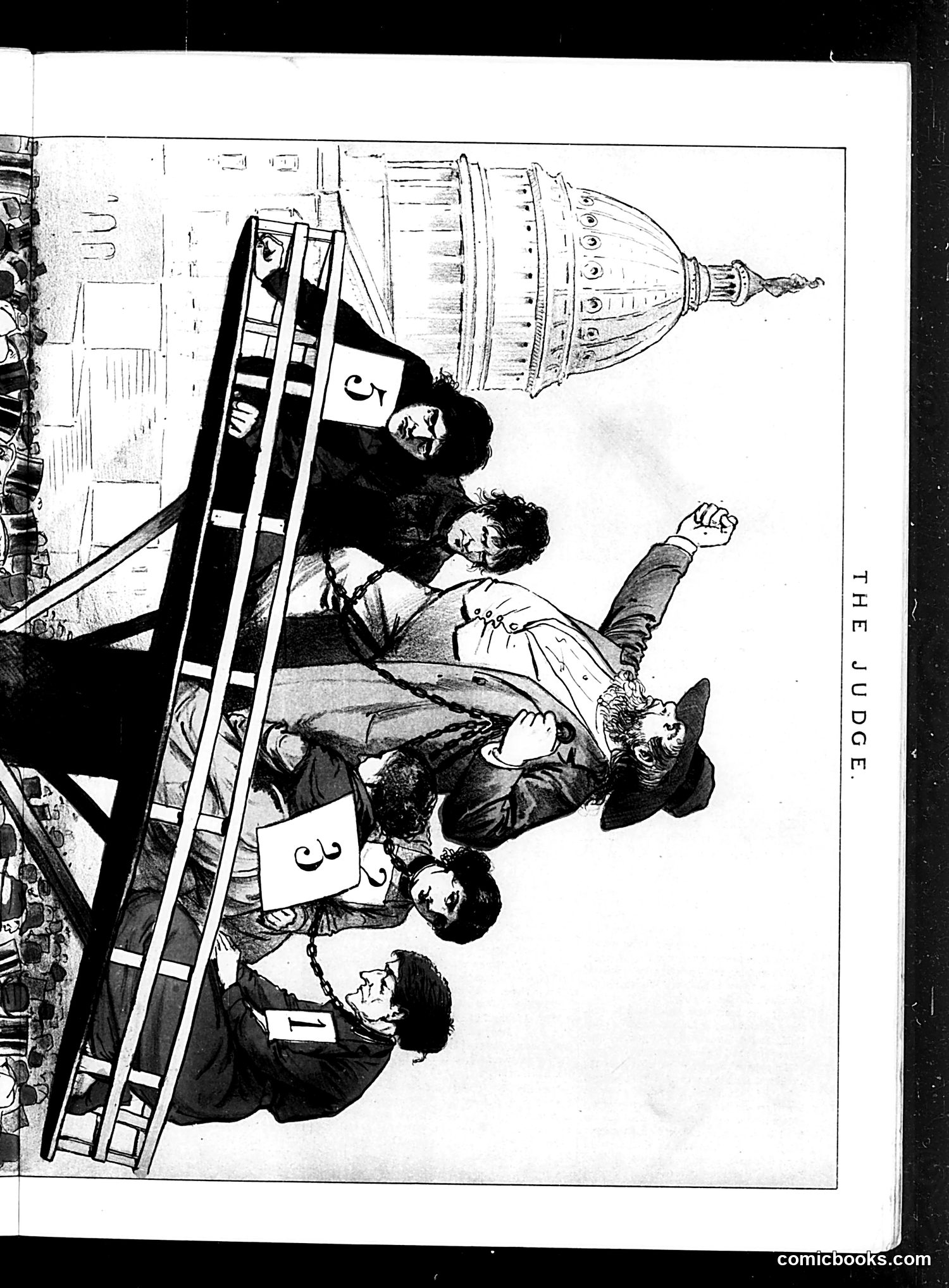
This appears to be a political cartoon titled "The Judge" showing five figures positioned around a ladder leaning against what looks like the U.S. Capitol dome. The figures wear numbered tags (1-5), suggesting they represent different political actors or groups being evaluated or judged. The ladder itself may symbolize climbing to power or accessing governmental authority. Without clearer identification of the specific figures or their labels, I cannot definitively state which politicians or groups are being satirized. The composition suggests commentary on political ambition, hierarchy, or competition for influence during a particular historical period. The Capitol imagery indicates this concerns federal governance and political power struggles, but the specific historical context and identities remain unclear from the image alone.
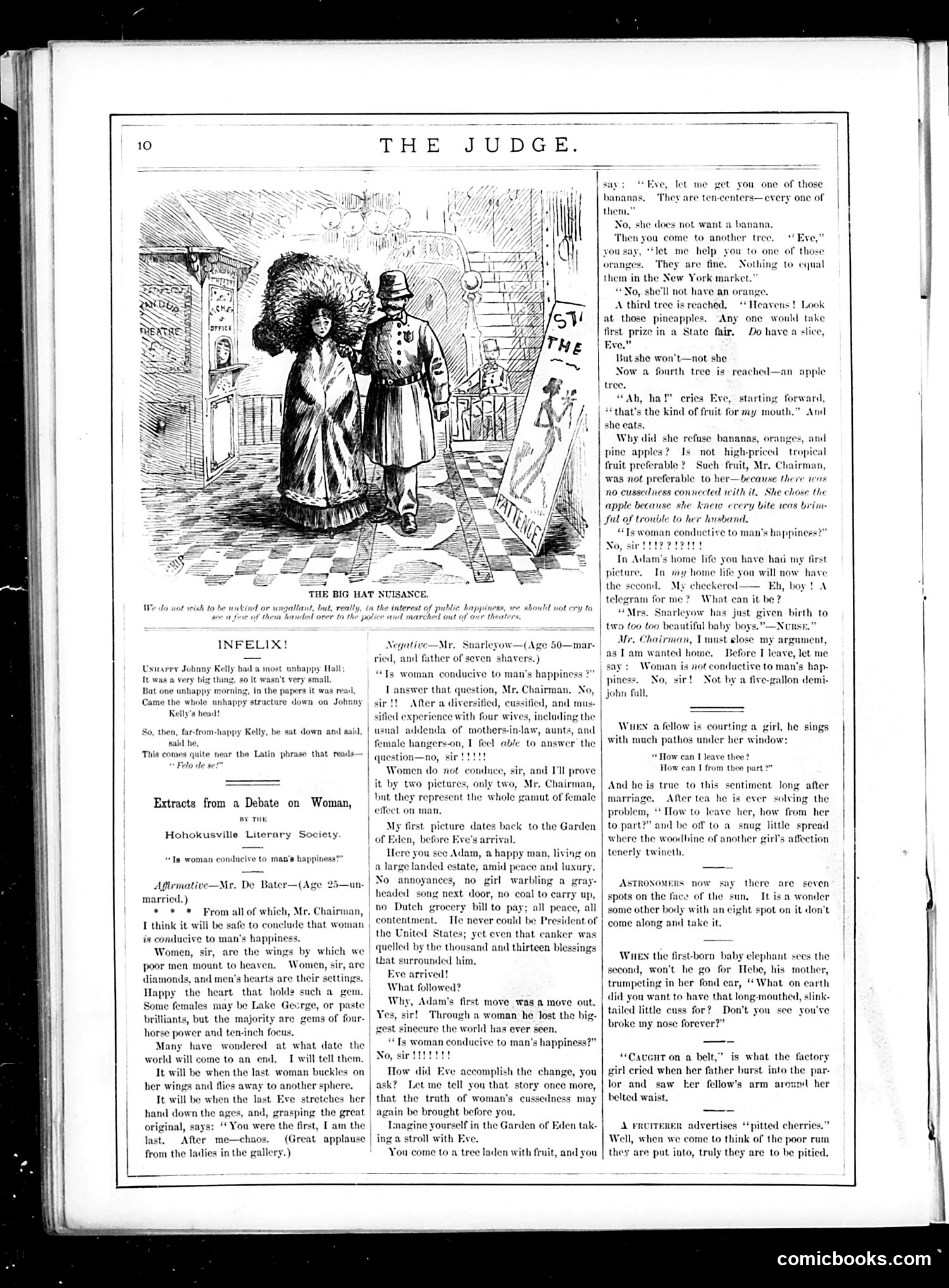
This page features two satirical pieces mocking women. **"The Big Hat Nuisance"** (illustrated cartoon, top left) depicts a woman wearing an enormous hat blocking the view of theater patrons behind her—a genuine contemporary complaint about women's oversized millinery fashion obstructing sightlines. **"Extracts from a Debate on Woman"** presents a mock-serious debate on whether women are "conducive to man's happiness." The negative speaker (Mr. Snarleyow) argues women cause unhappiness, using the Adam and Eve story as "evidence": Adam was happy alone until Eve arrived and caused trouble. The satire criticizes women for being inherently troublemaking and "cussed" (obstinate/disagreeable). Both pieces reflect late-19th/early-20th-century misogynistic attitudes common in satirical magazines, attacking women's fashion choices and suggesting female nature itself is destructive to male contentment. The "humor" relies entirely on anti-woman stereotypes now recognized as sexist.
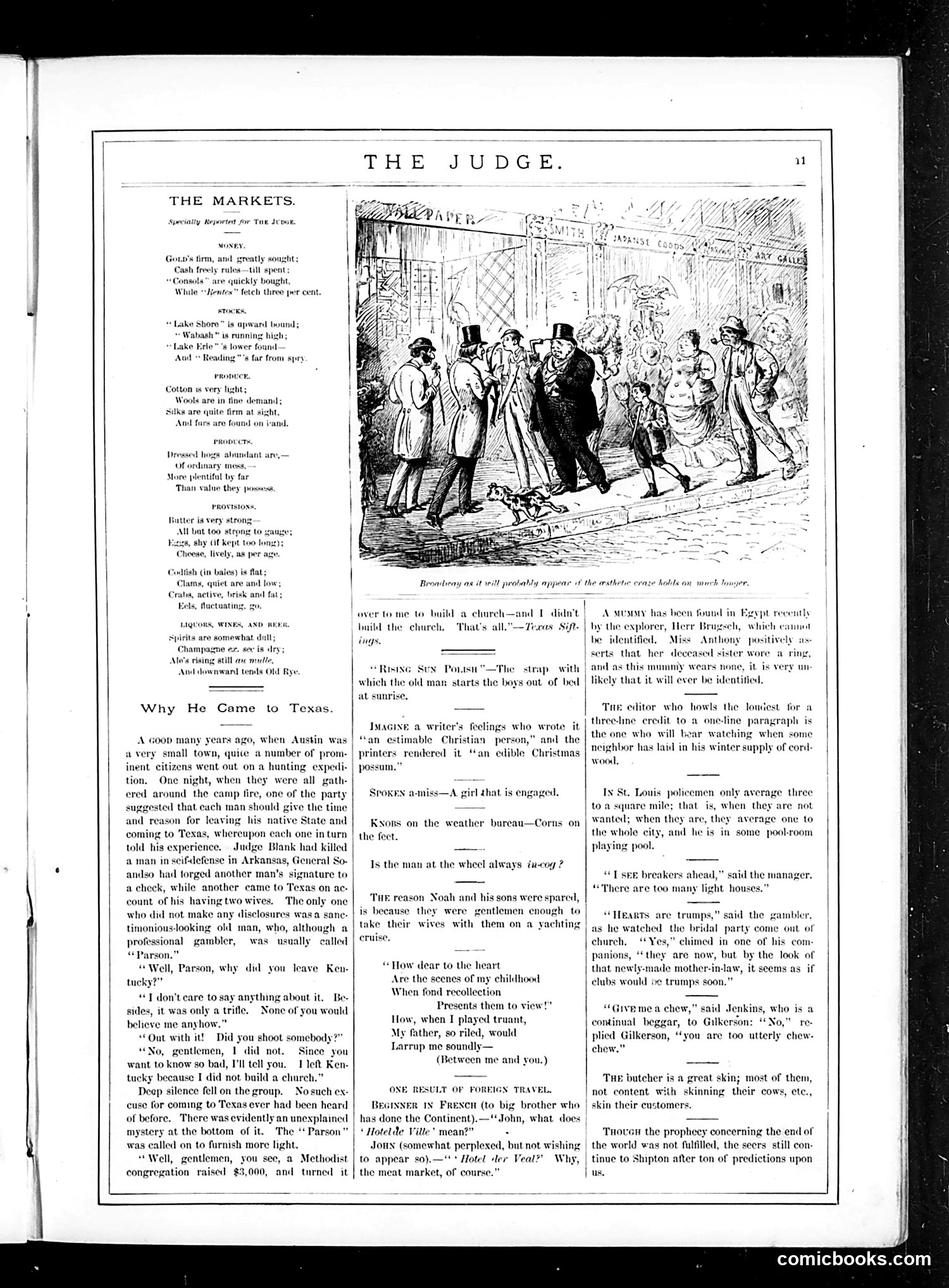
This page from *Judge* (a 19th-century satirical magazine) contains multiple short humor pieces and market reports, not a single political cartoon. The main illustrated item shows a street scene captioned about "aesthetic craze"—likely mocking the Aesthetic Movement's influence on fashion and appearance. The accompanying text jokingly predicts how "nursery" will look if aesthetic trends continue. Other content includes: - **"Why He Came to Texas"**: A humorous tall tale where a sanctimonious preacher admits he fled Kentucky because he pocketed $3,000 donated to build a church but didn't build it—played for ironic contrast with others' violent crimes. - **Wordplay jokes**: Printer errors ("edible Christmas possum" instead of "estimable Christian person"), linguistic confusion, and puns about contemporary life. - **Market reports**: Dry commodity/stock listings typical of financial journalism of the era. The satire targets hypocrisy, pretension, and social absurdities rather than specific political figures. The tone is lighthearted rather than hard-hitting political commentary.
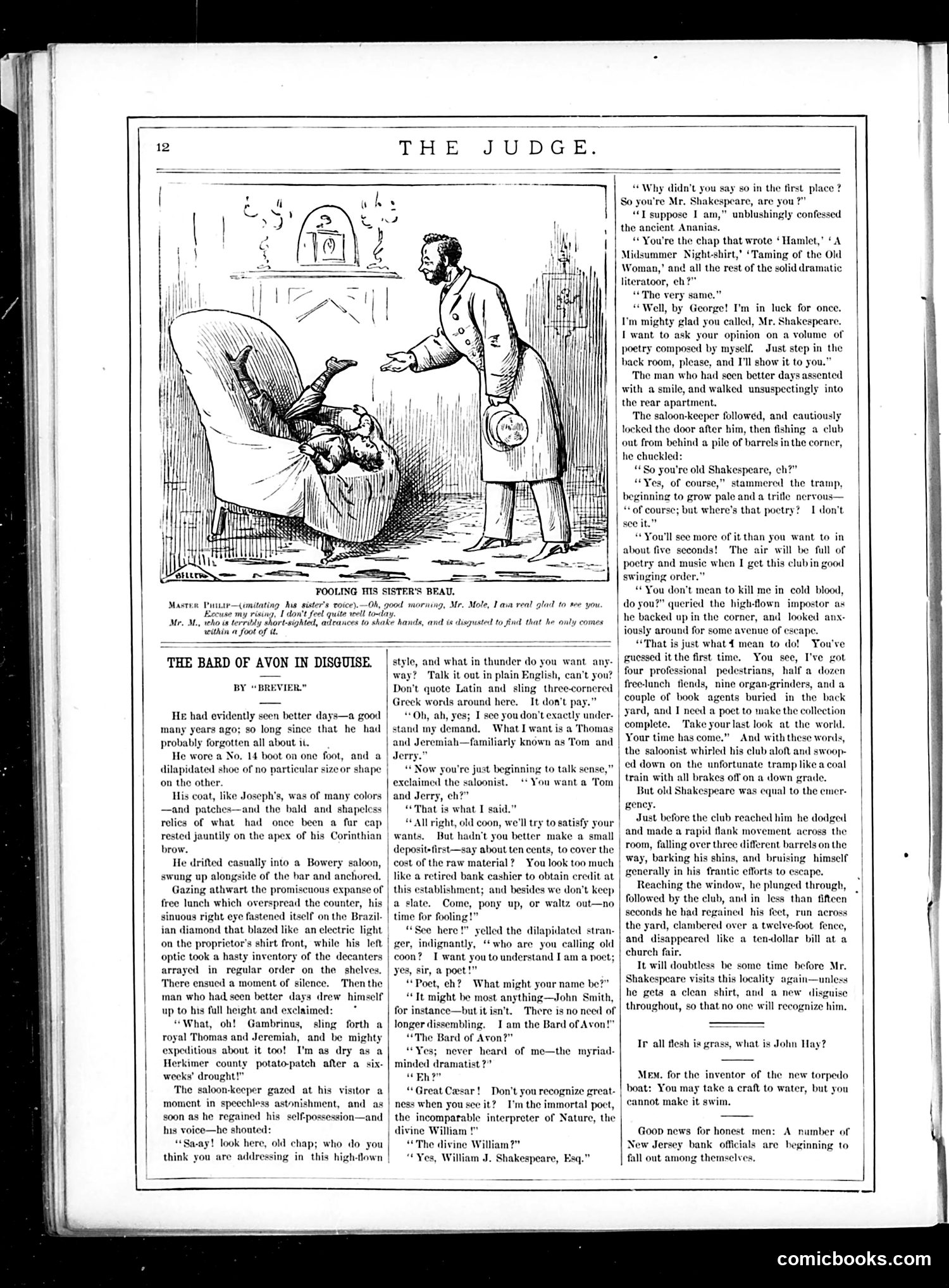
This satirical story mocks a shabby vagrant who claims to be William Shakespeare. The humor lies in the absurd pretense: a clearly destitute man—wearing mismatched boots and a tattered coat—enters a Bowery saloon and speaks in flowery, affected language ("Thomas and Jeremiah," Latin phrases) to seem cultured. The saloon-keeper, unimpressed, demands plain English and payment. When the vagrant finally reveals himself as "William J. Shakespeare, Esq." and the author of famous plays (though deliberately misspelled as "Midsummer Nightshirt" and "Taming of the Old Woman"), the proprietor ironically becomes delighted—not from genuine belief, but because he now has a captive audience for his own mediocre poetry. The satire targets both pretentious affectation (the vagrant's faux-eloquence) and American cultural aspirations (the saloon-keeper's eagerness to discuss literature with someone he believes is Shakespeare, however implausibly).
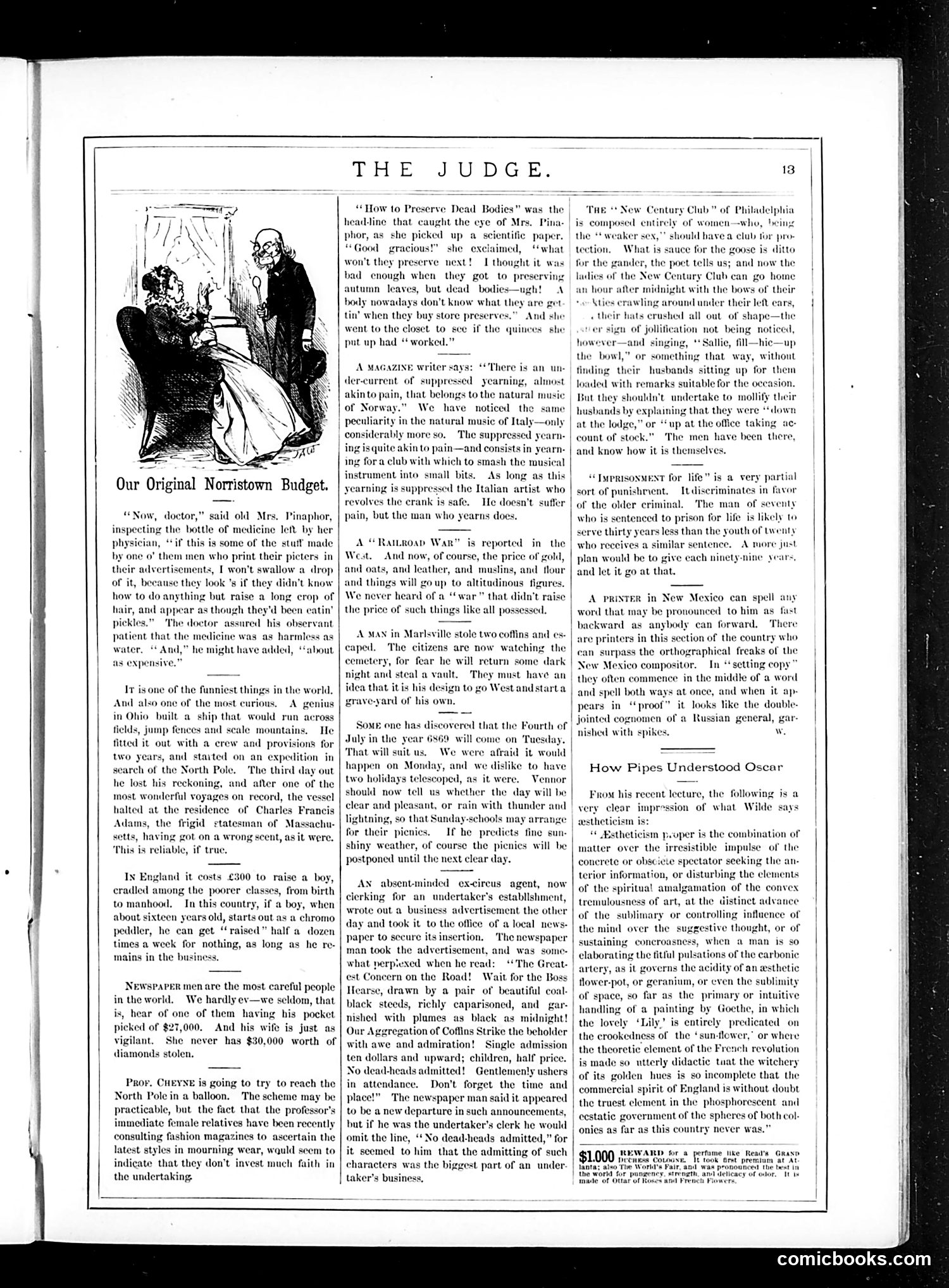
This page's main cartoon depicts an elderly woman (Mrs. Pinaphor) consulting a doctor about patent medicine, skeptical of its efficacy. The joke satirizes the common practice of physicians advertising dubious "cure-all" medicines through illustrated advertisements in periodicals—she distrusts the product partly because the doctor's own printed ads look amateurish and unconvincing. The surrounding text contains brief satirical items mocking contemporary absurdities: women's emerging independence (the "New Century Club"), suppressed yearning in Norwegian music, railroad price wars, a Marblsville grave-robber, and a New Mexico printer's backwards spelling ability. These are typical Judge magazine fare—light social commentary on modern life's quirks and hypocrisies, rather than serious political satire.
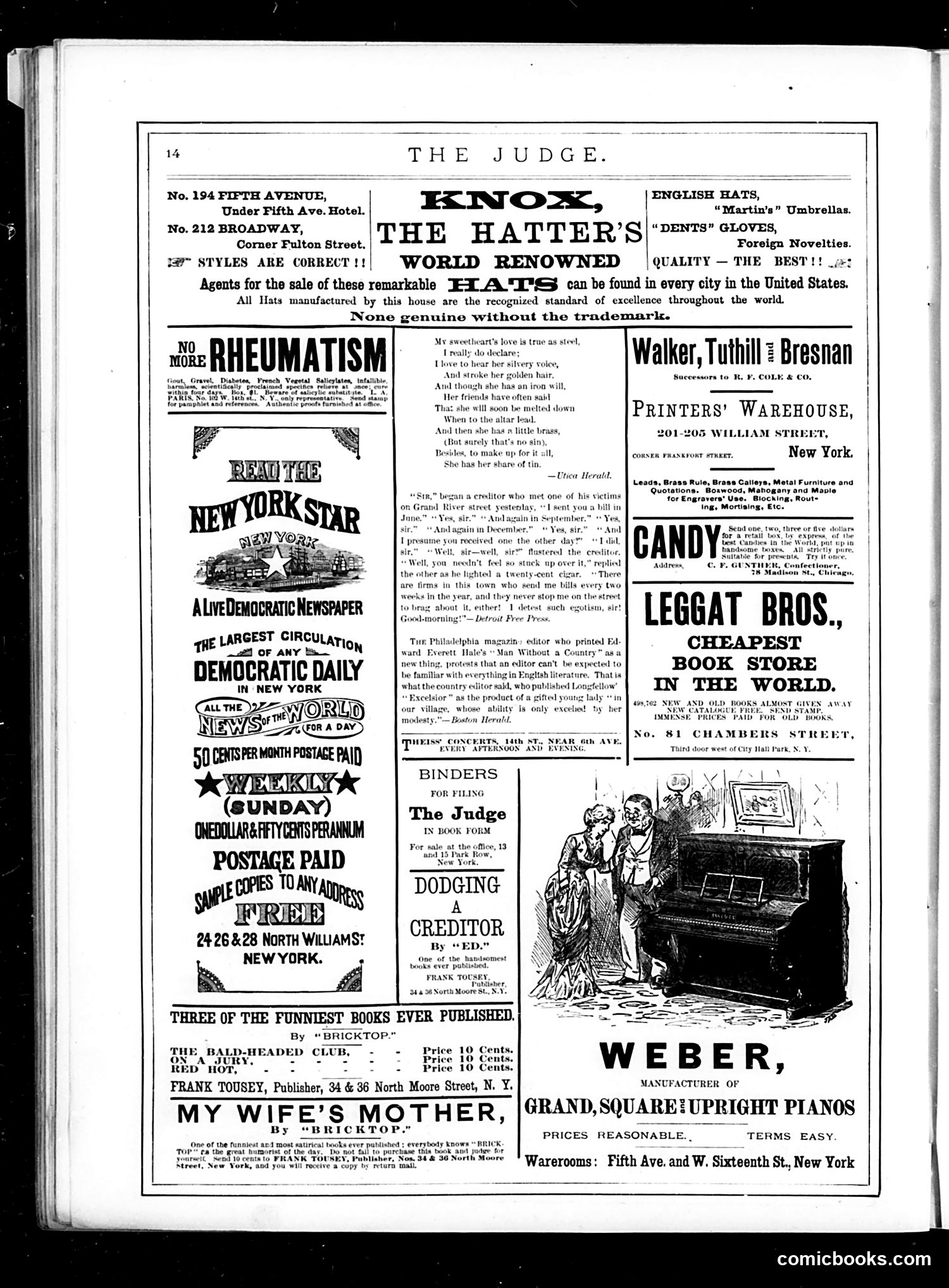
This page is overwhelmingly commercial—mostly advertisements for period products and services. The only apparent editorial content is a small cartoon captioned "Dodging a Creditor" (center-right), showing a man and woman at a piano, likely illustrating a common social anxiety of the era: avoiding debt collectors. The ads promote Knox hats, pianos, book stores, printing services, and humorous publications like "My Wife's Mother" by "Bricktop"—suggesting domestic comedy was popular. The New York Star newspaper advertisement emphasizes its democratic circulation. Without more context or visible bylines, the cartoon's specific satirical target is unclear, though "dodging a creditor" was apparently considered amusing enough to warrant illustration—reflecting period attitudes toward debt and financial obligation as sources of comedy rather than serious concern.
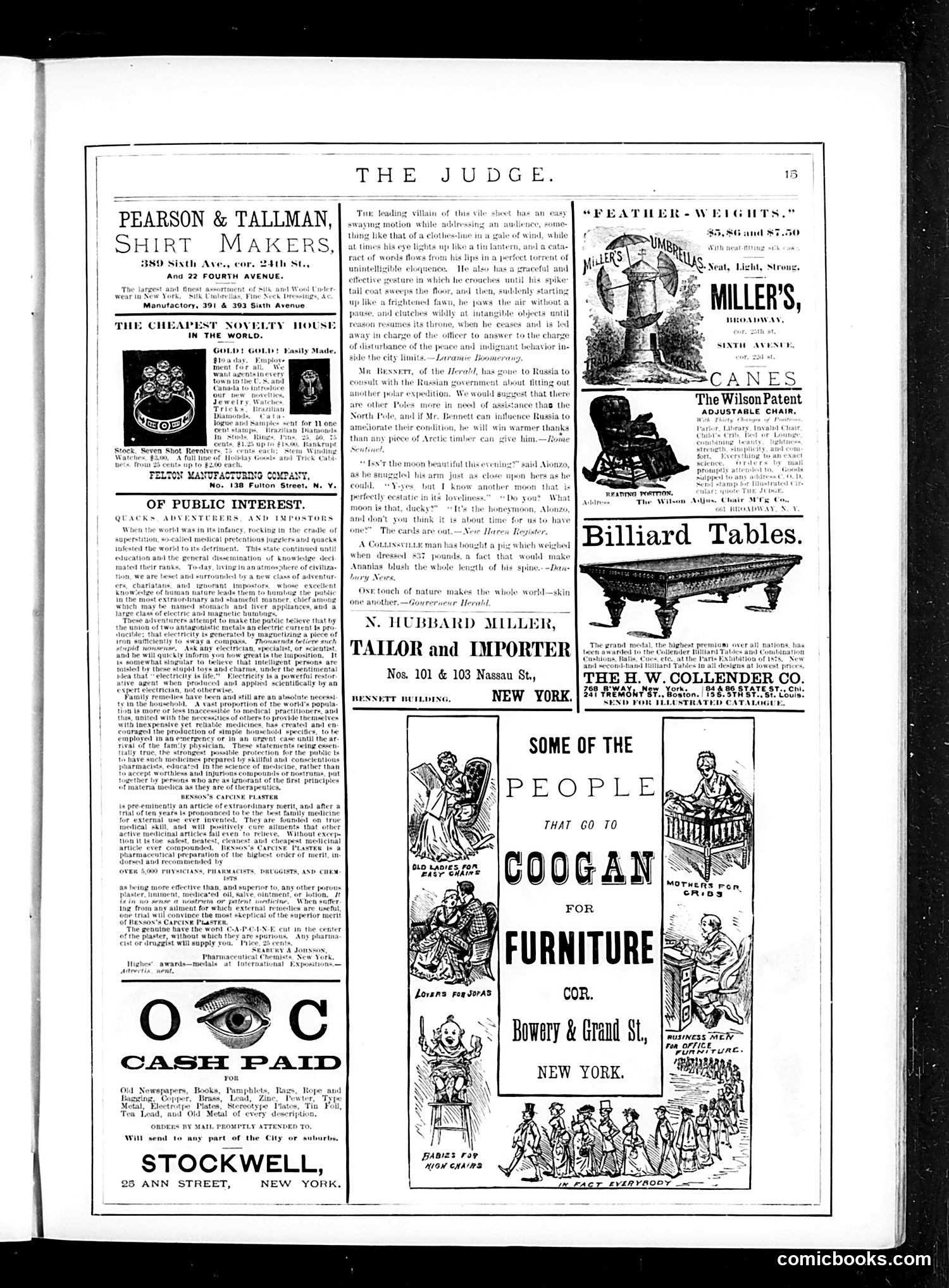
This page is primarily **advertising**, not editorial content or political satire. It features various 19th-century New York City merchants and manufacturers: **Notable ads include:** - Pearson & Tallman (shirt makers) - Miller's (feather-weight canes, $5-$7.50) - The Wilson Patent adjustable chair - N. Hubbard Miller (tailor/importer) - H.W. Collender Co. (billiard tables) - Coogan furniture store (Bowery & Grand St.) - Stockwell (appears to deal in scrap materials) The only editorial content visible is "The Judge" column at top left, which discusses polar expeditions and Arctic conditions—unrelated to the advertisements surrounding it. **Context for modern readers:** This reflects late 19th-century consumer culture and how satirical magazines relied heavily on advertising revenue. The ornate typography and illustrated product images were typical of period advertising design.
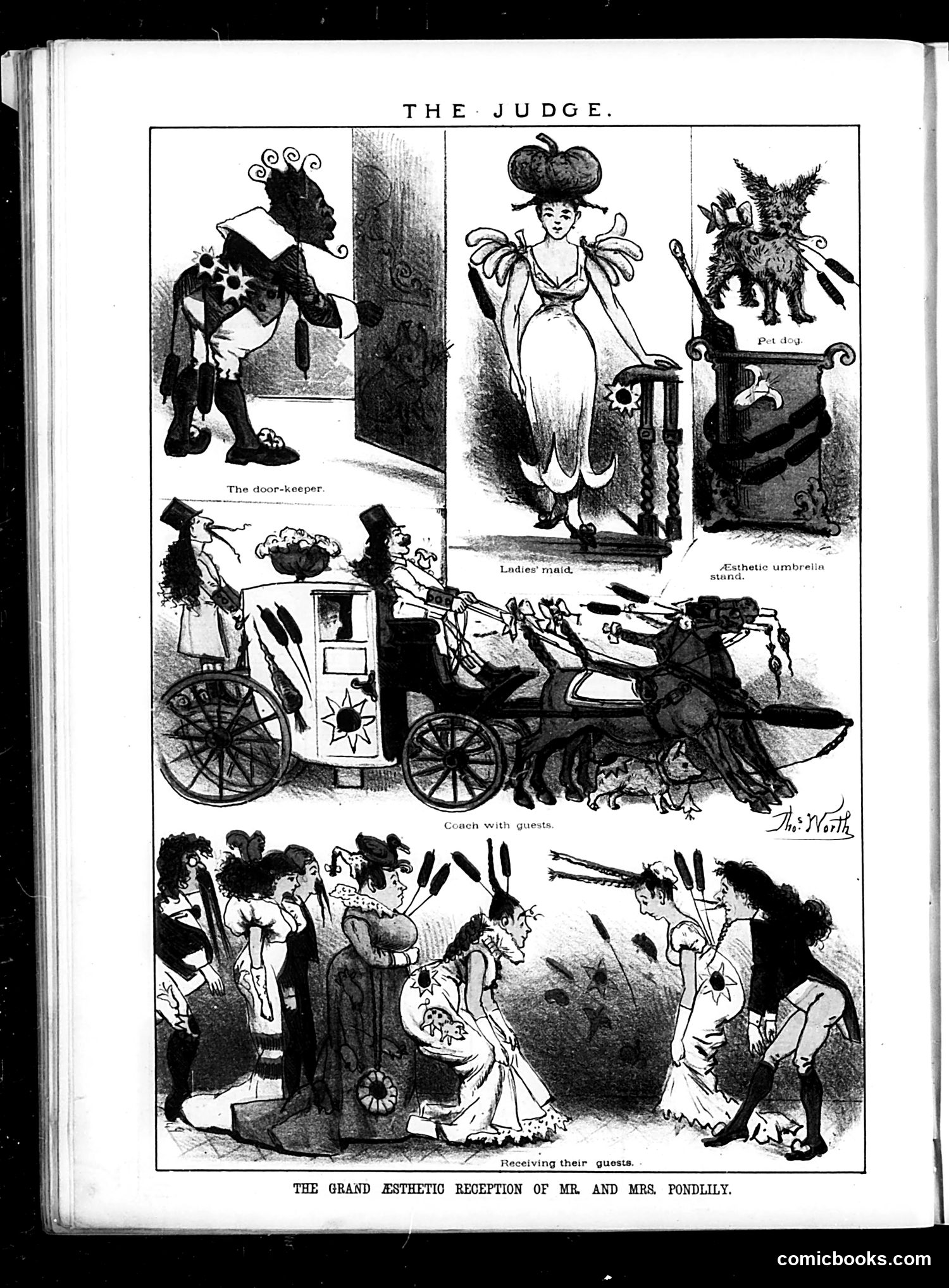
This satirical illustration mocks "The Grand Aesthetic Reception of Mr. and Mrs. Pondlilly," likely wealthy social climbers attempting fashionable "aesthetic" pretensions—a movement emphasizing art and beauty over substance that was frequently ridiculed in late 19th-century America. The cartoon ridicules excessive ornamentation and artificiality: a pompous door-keeper, an overdressed lady's maid, impractical aesthetic umbrellas, and a chaotic coach arrival. The bottom panel shows guests arriving with exaggerated affectation. The satire targets the era's nouveau riche adopting "aesthetic" style to signal sophistication while appearing absurd. The grotesque servants and overcomplicated details suggest that pretentious aestheticism creates more chaos than elegance. Judge magazine regularly lampooned such social pretension and the gap between aspiration and reality among the aspirant middle class.