
A complete issue · 16 pages · 1882
Judge — January 21, 1882
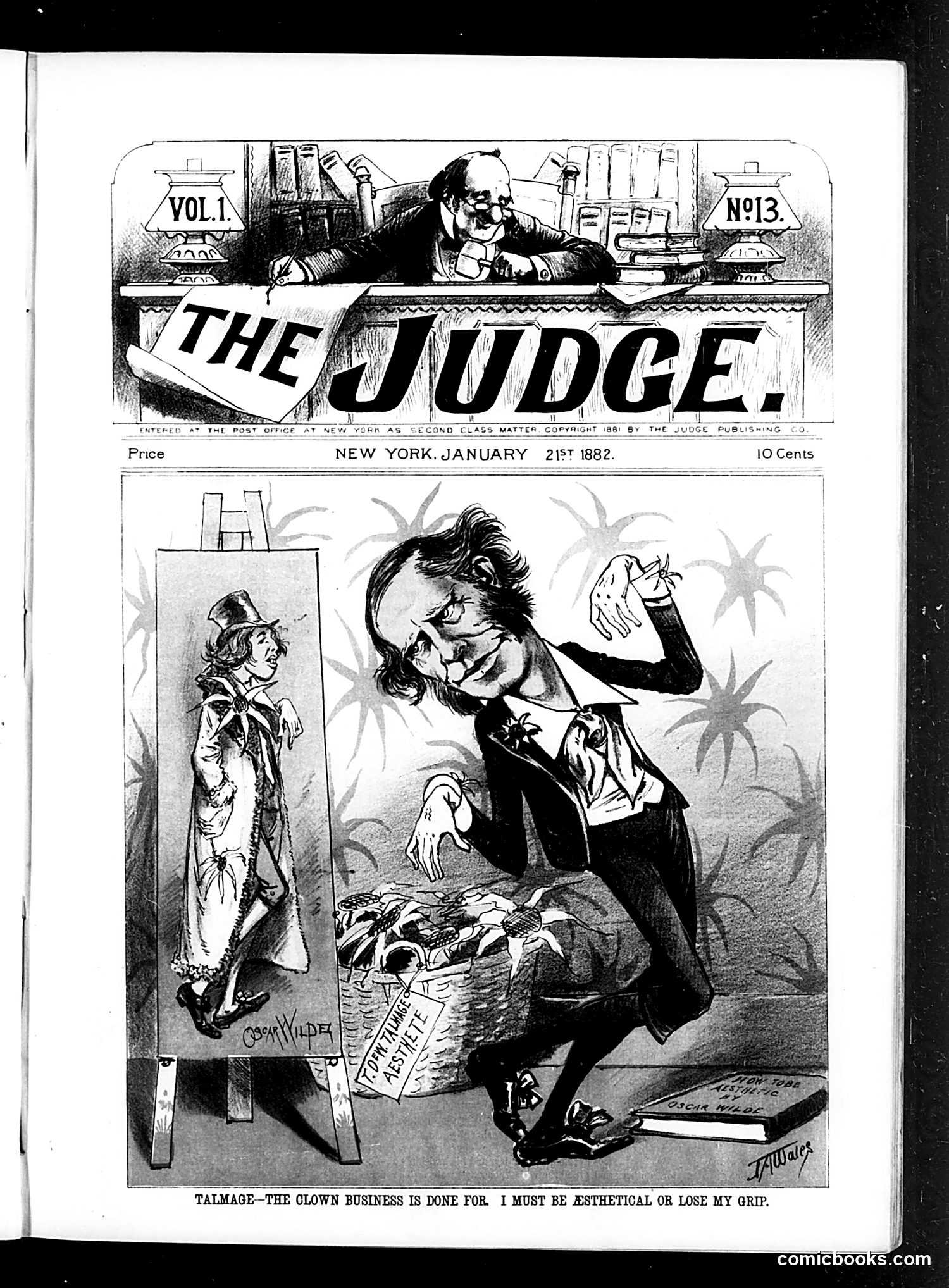
This satirical cartoon titled "Talmage—The Clown Business is Done For. I Must Be Aesthetical or Lose My Grip" mocks Thomas DeWitt Talmage, a prominent Brooklyn preacher known for theatrical sermons. The image shows a man (Talmage) examining his portrait as a clown in a mirror, suggesting his preaching style relied on entertainment and spectacle. The basket labeled "Portable Aesthetic" indicates he's adopting the "aesthetic movement"—a 1880s artistic trend emphasizing beauty over substance—as his new approach. The satire implies Talmage's ministry depended on sensational "clown business" rather than genuine spiritual substance, and that he must now reinvent himself by embracing fashionable aestheticism to maintain his audience and influence.
The main cartoon depicts two prominent New York politicians—**Lord O'Brien** and **Chevalier Jerome Buck**—during the famous blizzard of January 9, 1882. The satire mocks their pretentious affectations: they're portrayed as affected aesthetes, with one described as Apollo-like with a "raven mustache," speaking in theatrical language about their sleigh ride through the snow. The joke targets their inflated self-importance and grandiose behavior during a genuine city crisis. While ordinary New Yorkers suffered in the storm, these politicians cavalierly enjoyed winter recreation, discussing fashionable dinner parties and literary pursuits. The reference to their manuscript "The Wanderings of James O'Brien and Jerome Buck among the Crowned Heads of Europe" further mocks their pretensions. **Judge** uses the storm as backdrop to satirize political vanity and disconnection from common citizens' hardships.
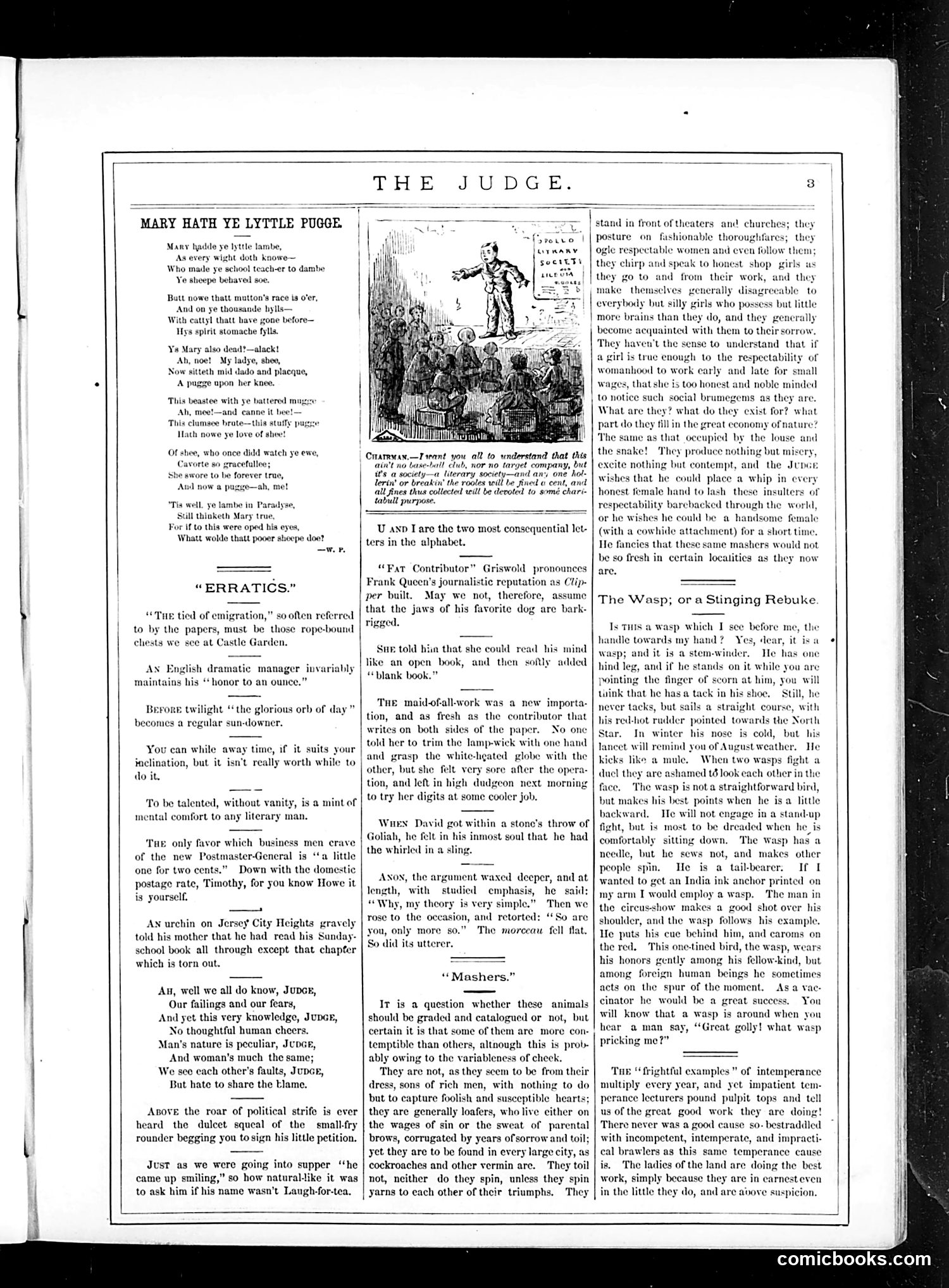
This page contains primarily **satirical text columns and miscellaneous humor** rather than political cartoons. The one illustration shows a preacher addressing an audience in what appears to be a morality scene. The main content includes: 1. **"Mary Hath Ye Lyttle Pugge"** — mock-archaic verse mocking the Victorian fashion for lap dogs, contrasting a shepherd's practical sheep with a lady's frivolous pet pug. 2. **"Erratigs"** — brief satirical observations on contemporary life: emigration, theatrical pretense, postal rates, political petitions, and domestic servants. 3. **Social commentary** on "mashers" (street harassers), criticizing certain men as contemptible parasites preying on women. The humor targets **Victorian affectations, social hypocrisy, and urban vices**—typical Judge content of the Gilded Age. The mock-medieval language parodies sentimental literature popular at the time.
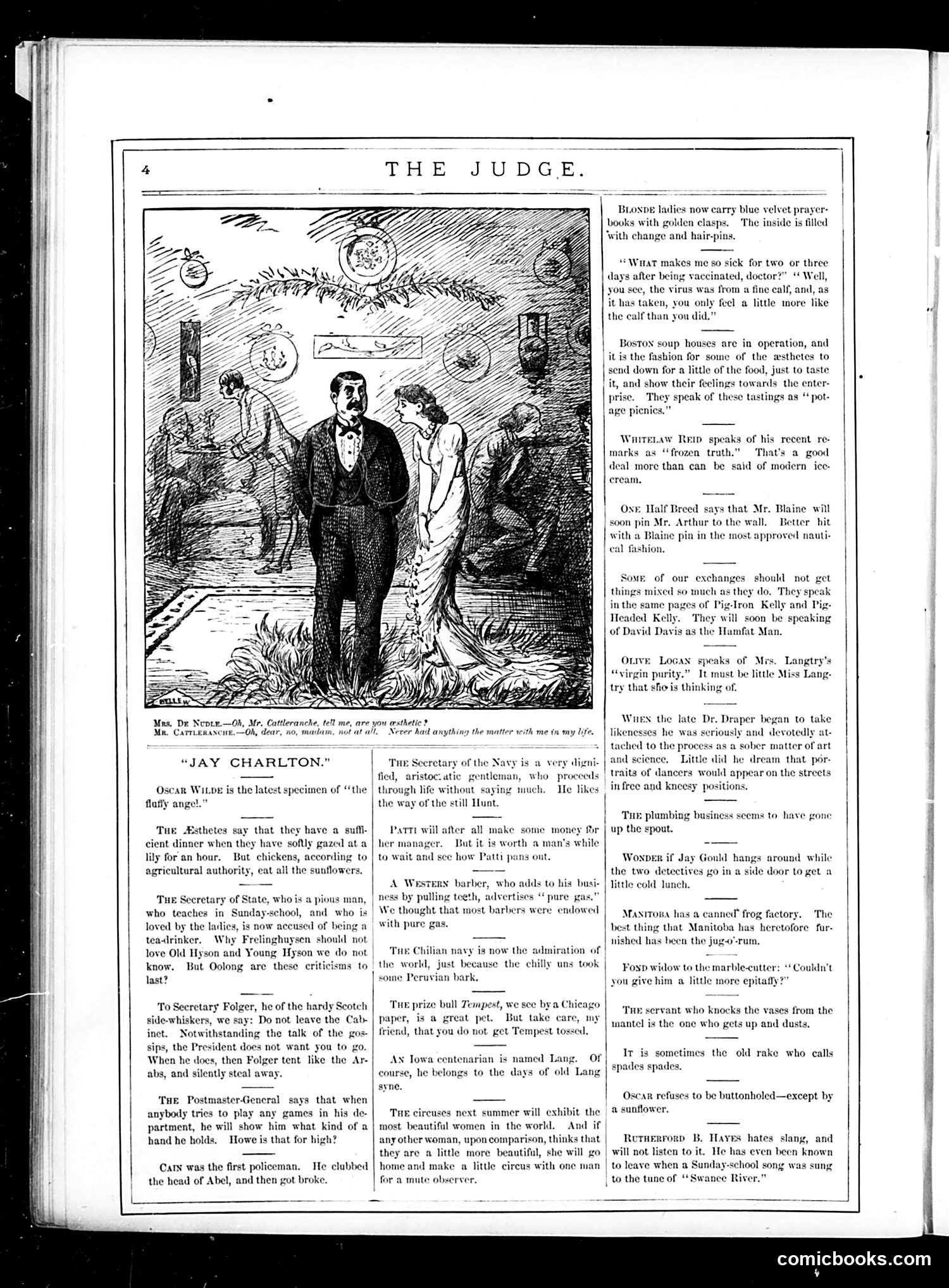
This page from the satirical magazine *Judge* contains brief topical jokes about contemporary 1880s American politics and society, accompanied by one central cartoon. **The Main Cartoon "Jay Charlton"** depicts what appears to be an "aesthete"—a fashionable person devoted to art and beauty—being mocked. The caption suggests debate over whether someone is truly aesthetic. This satirizes the Aesthetic Movement, a real late-19th-century cultural trend emphasizing "art for art's sake." **The surrounding brief items** target: - **Cabinet officials** (Secretary of State Frelinghuysen, Secretary Folger, Postmaster-General Howe)—poking fun at scandals or perceived weaknesses - **Political figures** (Blaine, Arthur—likely referencing 1884 presidential tensions) - **Cultural trends**: aesthetes eating only while gazing at flowers; vaccination side effects - **Celebrities**: the opera singer Patti; actress Langtry The humor relies on readers' familiarity with contemporary scandals, political figures, and cultural fads. Without that context, most references remain opaque today.
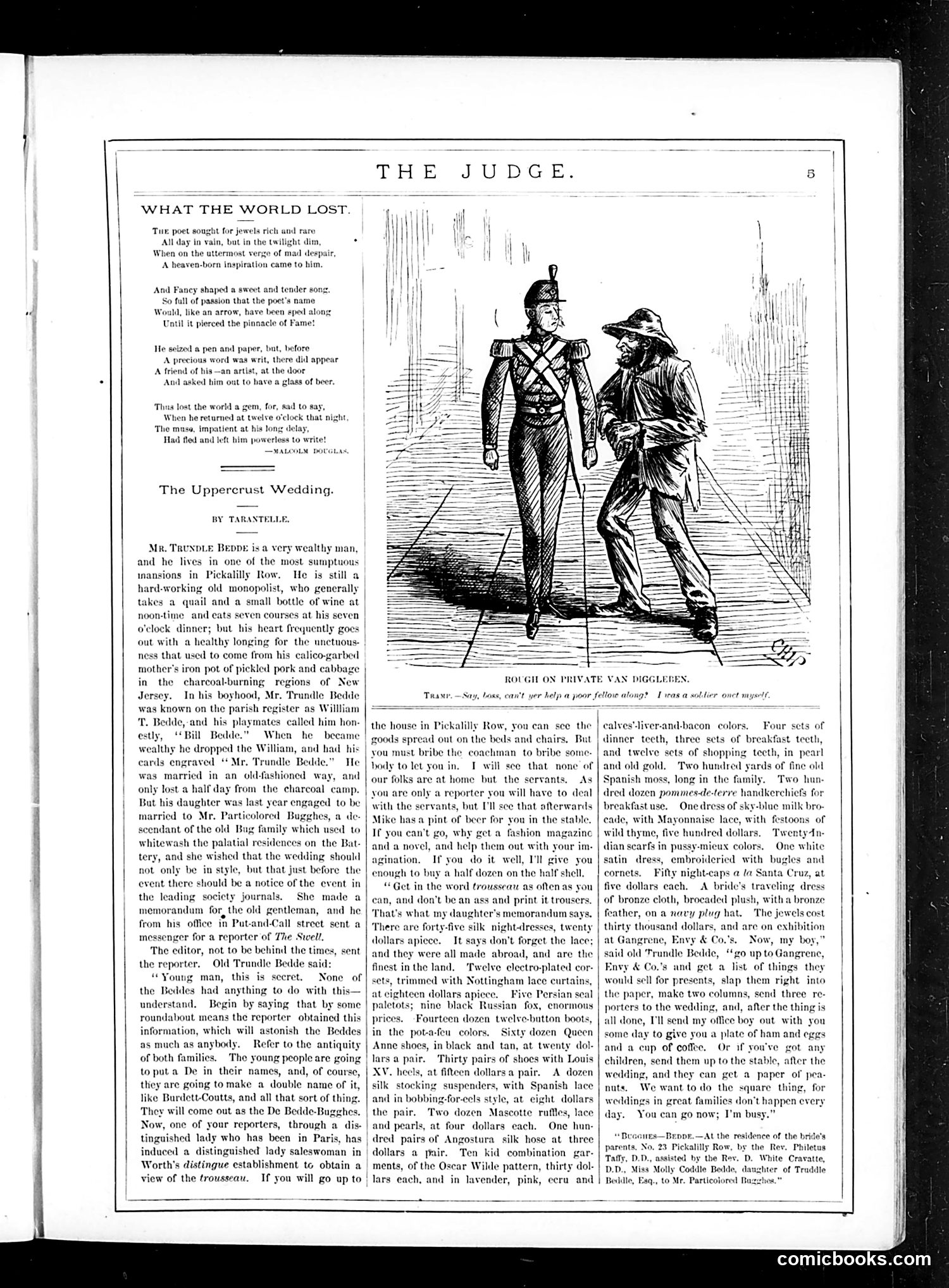
This Judge magazine page contains two satirical pieces mocking upper-class pretension: **"What the World Lost"** ridicules how a poet loses creative inspiration when interrupted by a friend inviting him for beer—a commentary on distraction and wasted potential among the artistic class. **"The Uppercrust Wedding"** is the main satire. Mr. Trundle Bedde, a self-made wealthy man from humble origins ("Bill Bedde"), now wealthy enough to live on Piccadilly Row, wants his daughter's wedding announced in society journals. He cynically instructs a reporter to fabricate an impressive story: claim he obtained information "roundabout," refer to both families' antiquity, add French name affectations ("De Bedde-Bugghes"), and repeatedly mention the elaborate "trousseau" to sound fashionable. The satire targets nouveau riche social climbing—how the newly wealthy manufacture false prestige through media manipulation, name-dropping, and pretension to aristocratic connections, while their humble origins remain visible.
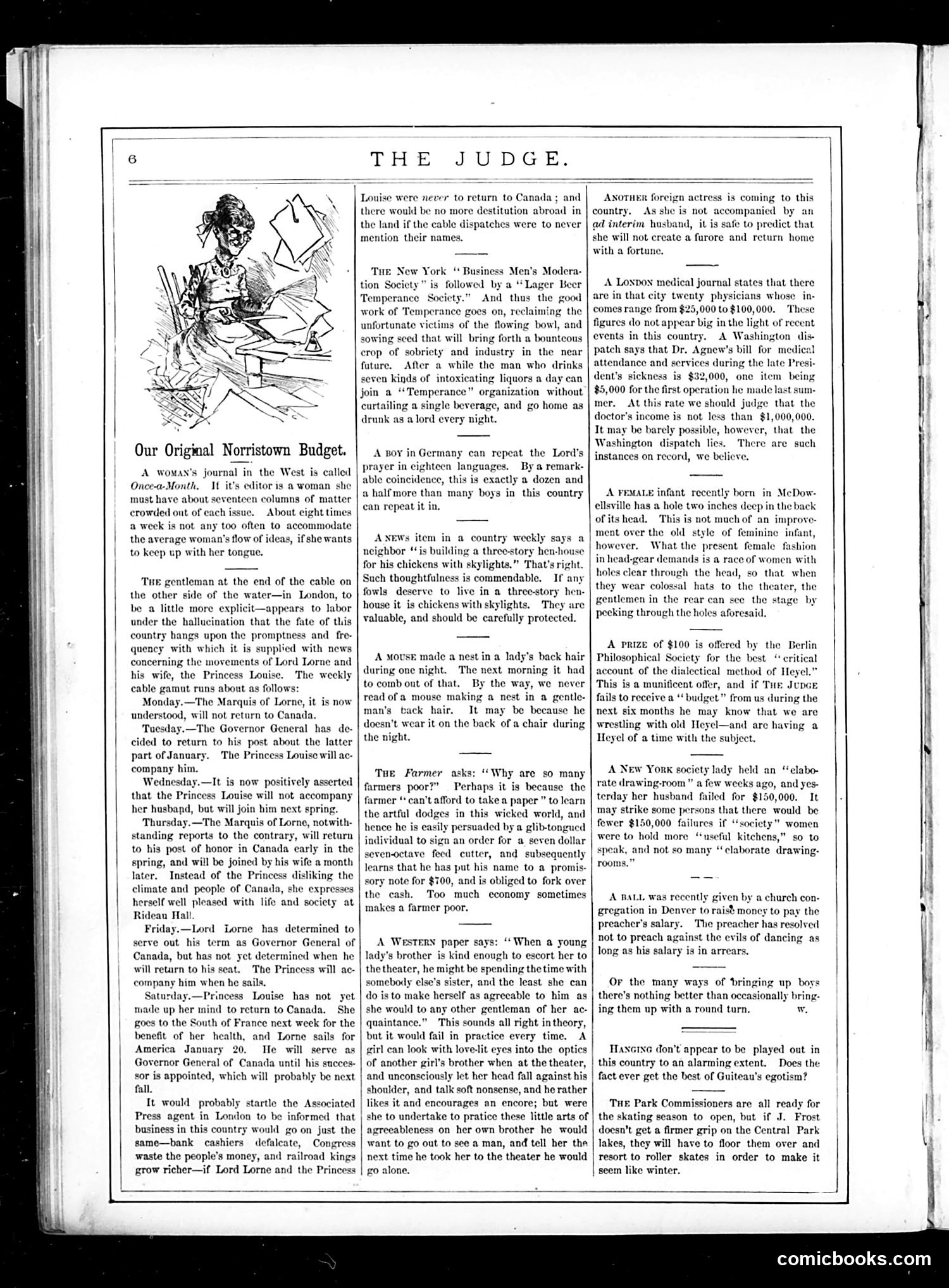
This page from the satirical magazine *Judge* contains several short humorous pieces mocking contemporary topics: **Lord Lorne and Princess Louise**: The main cartoon targets obsessive cable-news coverage of the Governor General of Canada and his wife. Judge ridicules the London press for sending contradictory dispatches weekly about whether they'll return to Canada—while American business (bank fraud, congressional waste, railroad corruption) goes unaddressed. The satire suggests this trivial celebrity gossip distracts from actual national problems. **Other brief satirical items** mock: - A women's journal that can't contain female verbosity - A "Temperance Society" for beer drinkers (contradiction) - Excessive concern for chickens' comfort (skylights in henhouses) - A "Business Men's Moderation Society" followed immediately by a lager beer society The overall tone is *Judge*'s characteristic irreverent mockery of public obsessions and social hypocrisy in the 1880s.
This page contains two theatrical satires from Judge magazine: **"Taking a Liberty with Herrick"** is a humorous poem mocking a drinker who misquotes Robert Herrick's famous line "I dare not take a drink" — inverting the original poem's meaning about restraint. **"Our Popular Farces"** satirizes amateur theatrical productions. The sketch depicts a chaotic rehearsal where nothing works: actors don't know their lines, props are missing (a dagger used for sardine boxes), costumes are incomplete, and the script itself is a confused adaptation. Characters constantly interrupt with petty complaints and forgotten blocking. The humor targets the pretensions of amateur theater — people attempting serious dramatic performances (including references to classic works like "Rob Roy") while being utterly incompetent and unprepared. It's satire of middle-class vanity and the gap between aspiration and ability in entertainment, a common theme in Judge's mockery of contemporary society.
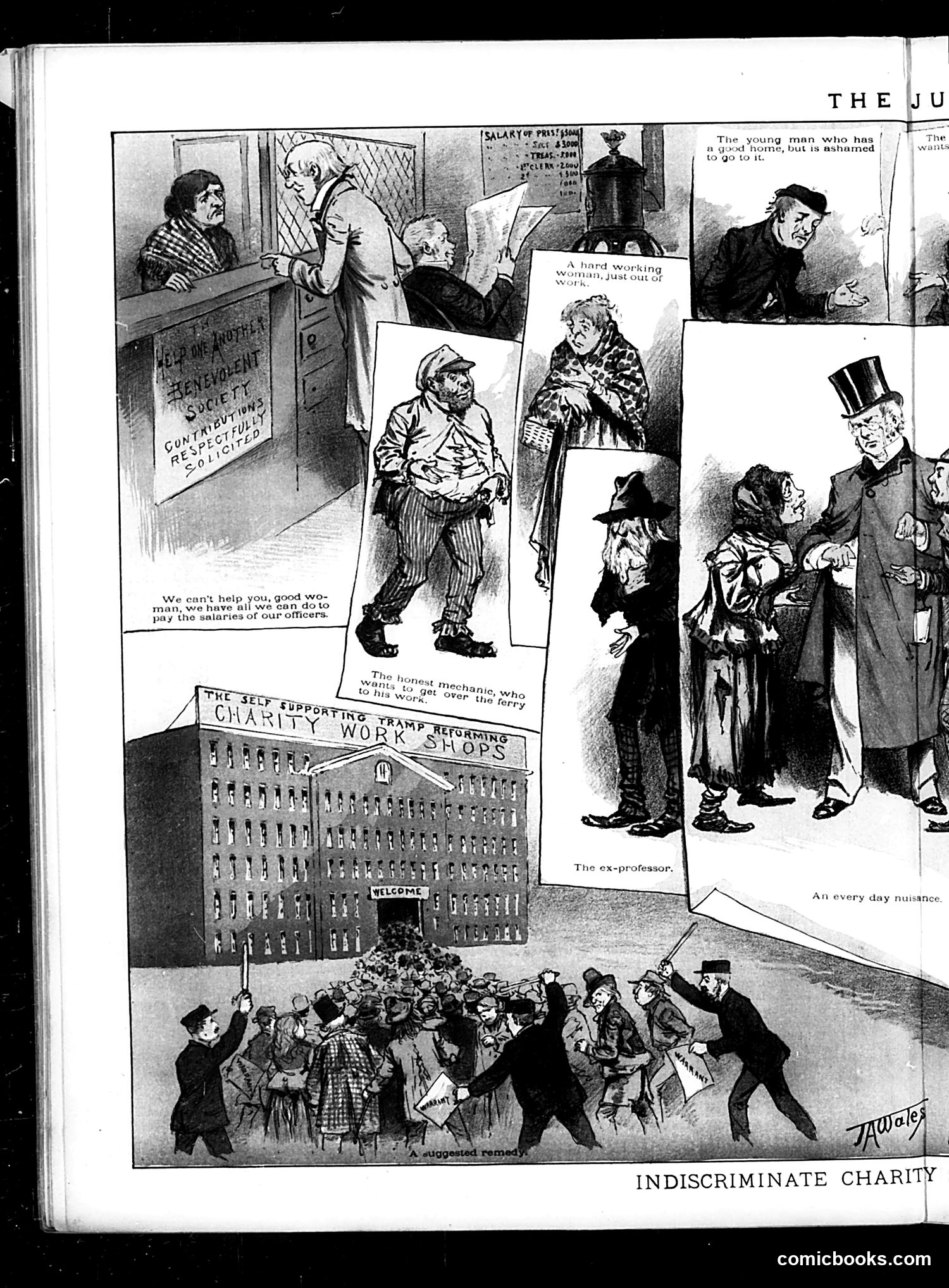
This satirical cartoon critiques poorly-managed charitable organizations. The central building labeled "Charity Work Shops" represents a charity that claims to support "Tramp Reforming" but fails its mission. The vignettes show various people seeking help—a desperate woman at an office window (rejected because funds go to officer salaries), a mechanic, a hard-working woman, an ex-professor, and "an everyday nuisance"—all gathered outside the building in "A suggested remedy." The satire's point: charitable institutions waste money on administrative overhead rather than helping the genuinely needy. The phrase "indiscriminate charity" refers to aid given without discernment—the organization both fails to help deserving poor and apparently supports unworthy recipients. The cartoon criticizes inefficient bureaucracy masquerading as benevolence.
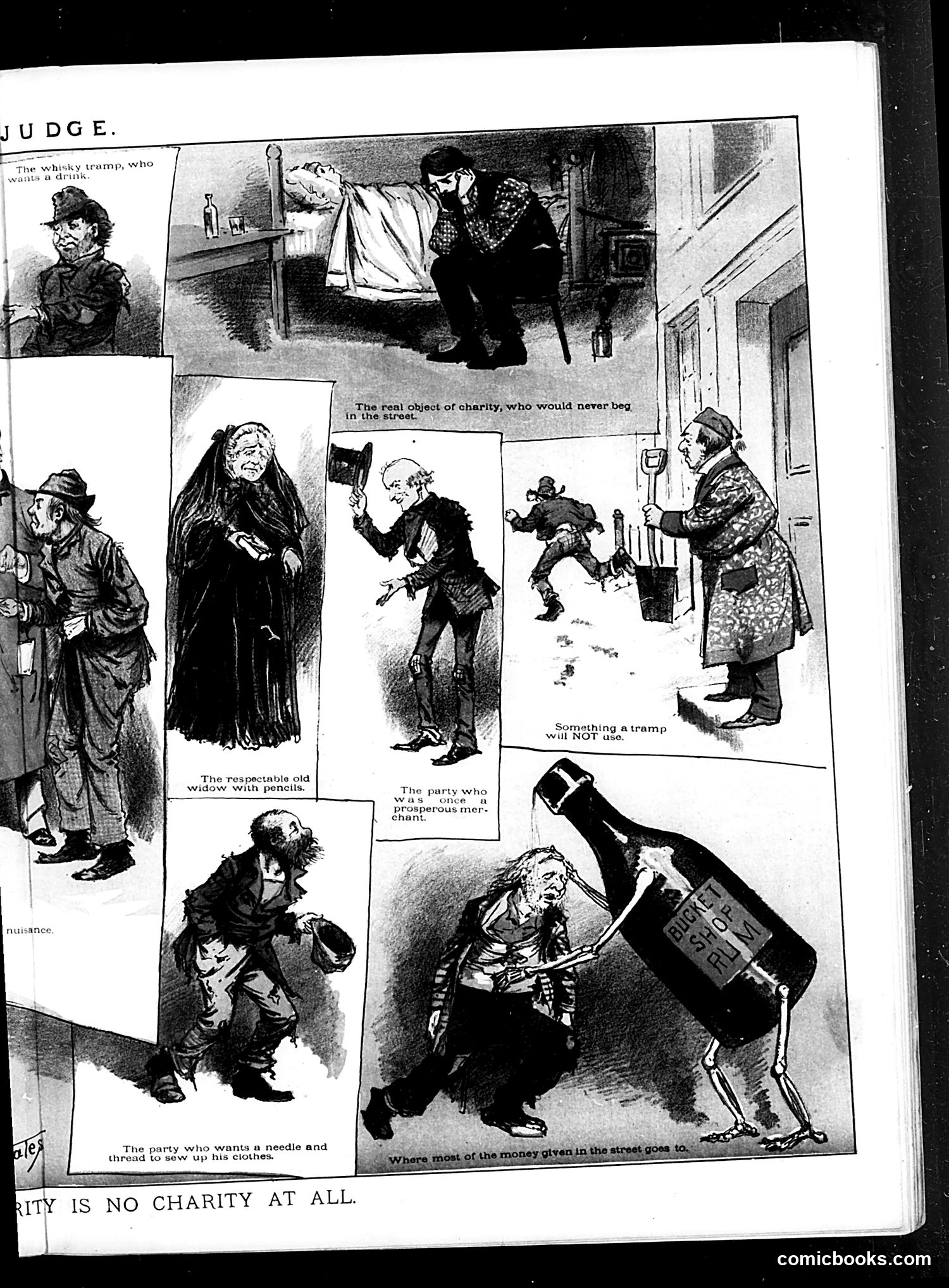
This satirical cartoon critiques how street charity actually functions. The page shows various poor people—a widow selling pencils, a formerly prosperous merchant, someone needing needle and thread—alongside the caption "The real object of charity, who would never beg in the street." The bottom panel depicts money being funneled into a large container labeled "Where most of the money given in the street goes to," revealing the cartoon's central message: that charitable donations ostensibly given to genuinely needy people instead go to fraudsters and con artists ("Something a tramp will NOT use"). The satire targets both unscrupulous street beggars and the ineffectiveness of street-level charity, suggesting that spontaneous donations fail to reach legitimate poor. The title "Charity Is No Charity At All" reinforces this critique—indiscriminate almsgiving accomplishes nothing for actual need.
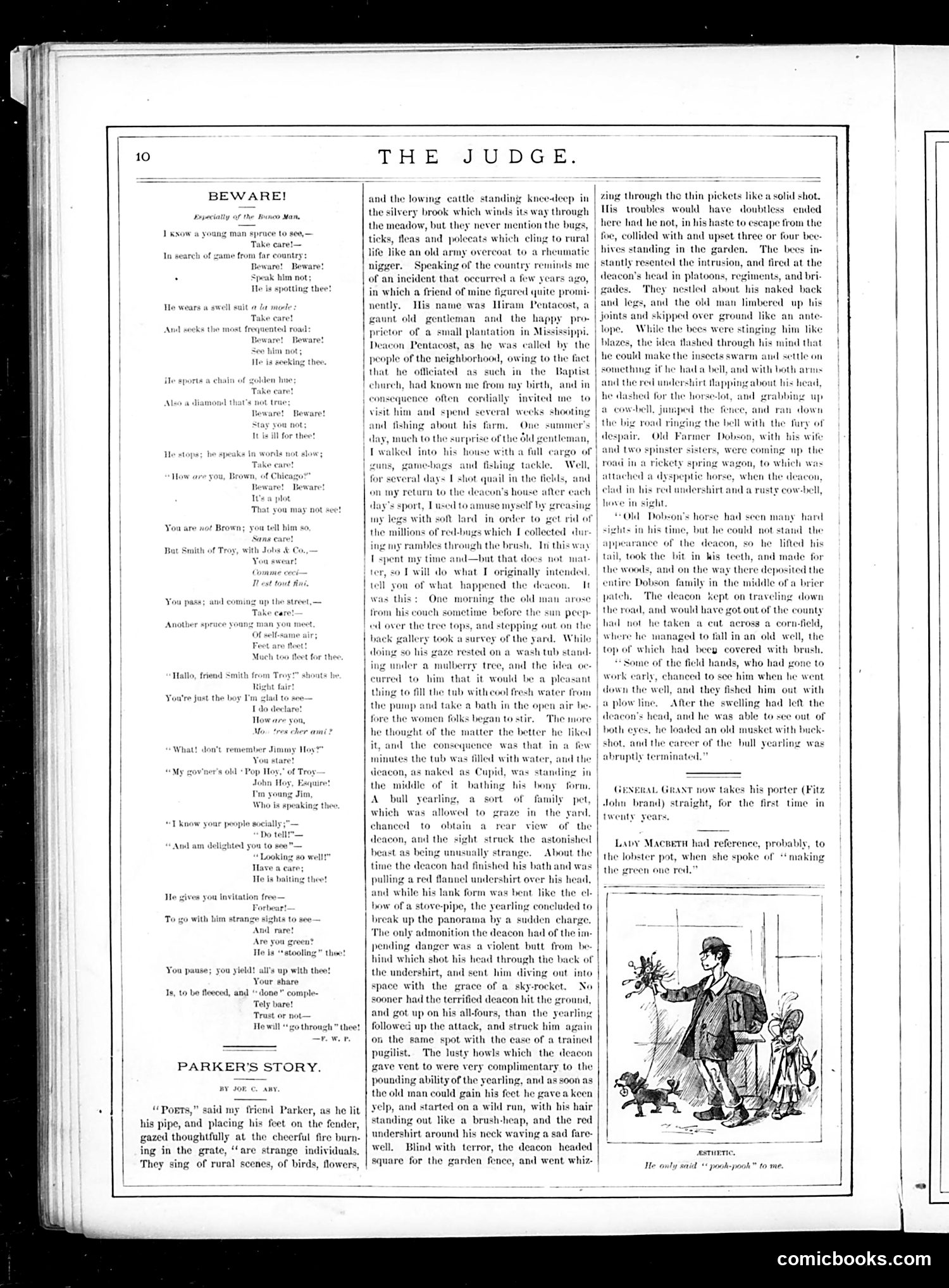
This page contains two distinct pieces from *Judge* magazine: **"Beware!"** (left column) is a cautionary poem warning young men about con artists and swindlers. The narrative depicts a naive country youth encountering seemingly respectable strangers who gain his trust through false friendliness—claiming to "know your people socially"—before fleecing him of money. The repeated refrain "Beware! Beware!" emphasizes the dangers of trusting well-dressed strangers in cities, a common 19th-century cautionary theme. **"Parker's Story"** (center/right) is a humorous anecdote about a guest visiting a Mississippi plantation owner named Deacon Hiram Pent. The story satirizes rural life by contrasting romantic pastoral poetry with unglamorous reality—specifically the protagonist's battle with red-bugs (chiggers) during hunting trips, which he treats by greasing his legs with lard. The climax involves a bull attacking the naked deacon mid-bath, launching him through the air with "the grace of a sky-rocket." Both pieces mock naiveté—urban and rural respectively—reflecting *Judge's* satirical approach to American life.
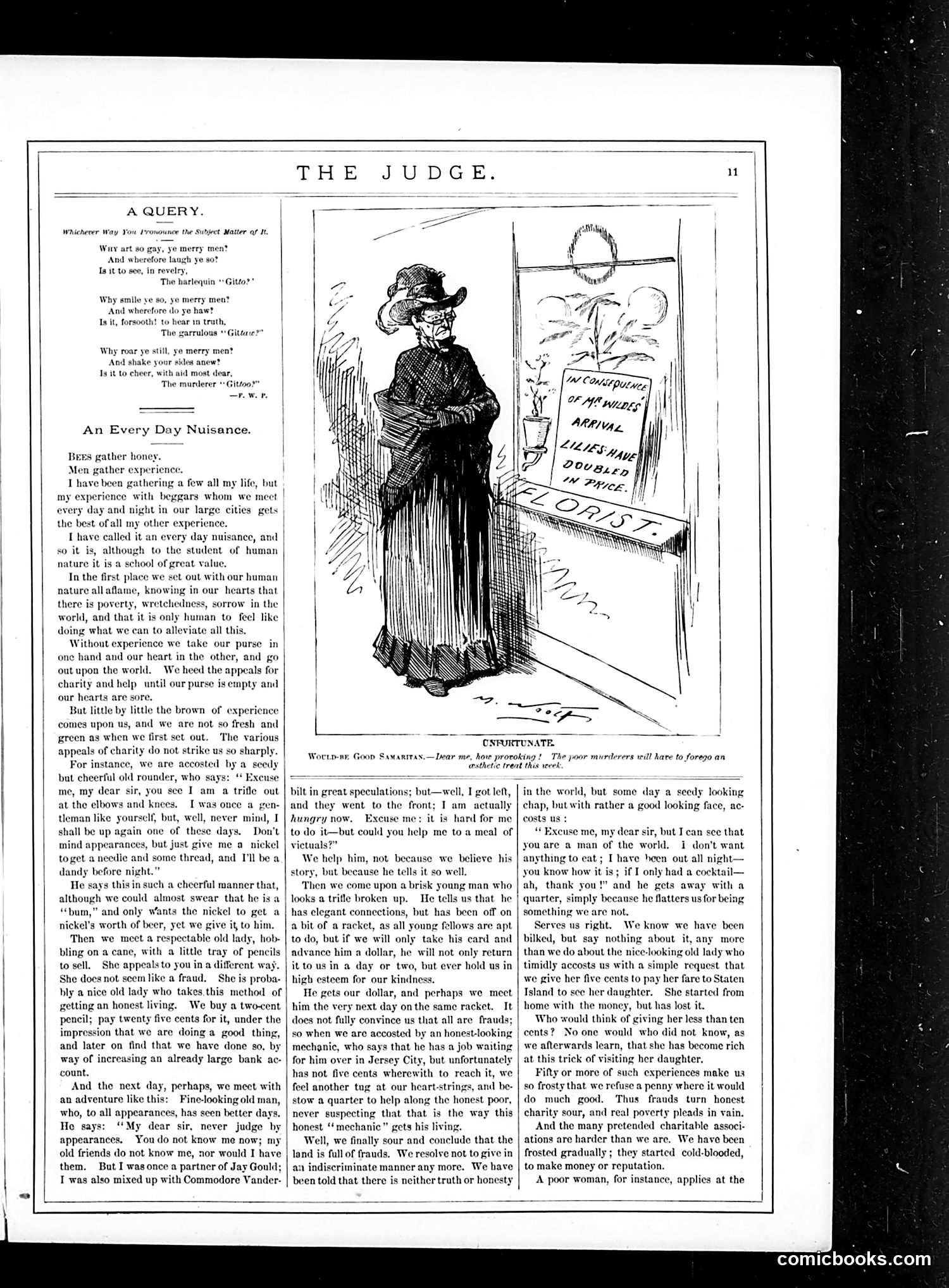
This satirical essay critiques the difficulty of charitable giving in urban America. The author describes how experience gradually hardens donors against street beggars' appeals—despite good intentions. The piece catalogs common beggar "types" encountered daily: the shabby but genteel man needing a nickel for thread, the elderly pencil vendor, and a well-dressed man claiming to be a ruined partner of Jay Gould or Cornelius Vanderbilt (real Gilded Age magnates). Each tells a compelling story. The satire's target isn't primarily the beggars but rather the donors' dilemma: sophisticated city dwellers cannot easily distinguish genuine need from fraud. The accompanying illustration shows a woman at a door with a sign about "the consequences of my husband's arrival"—suggesting domestic hardship. The essay suggests that repeated exposure to (possibly fake) sob stories makes compassionate people cynical, yet they keep giving anyway—trapped between skepticism and humanitarian instinct.
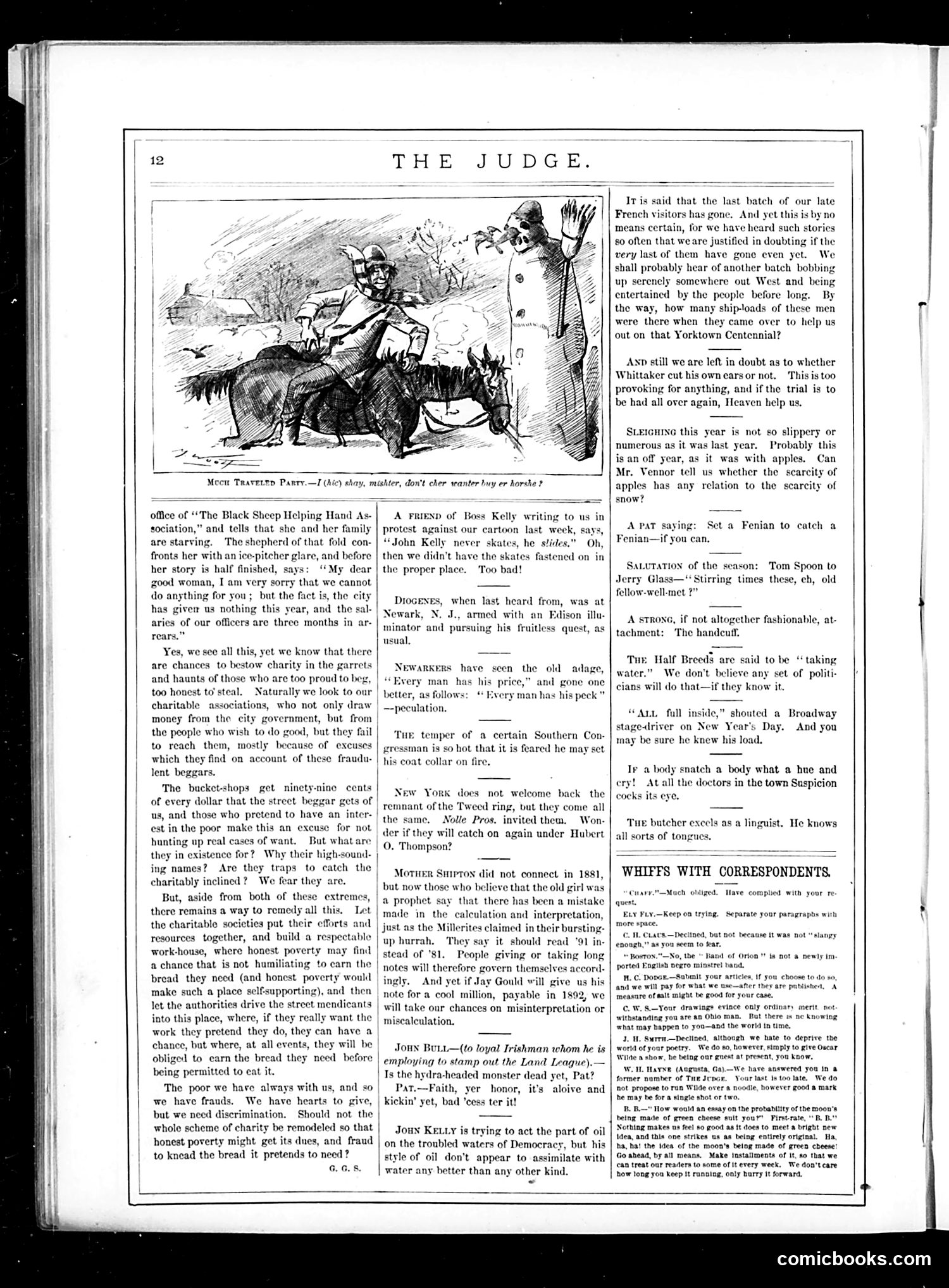
The main cartoon depicts a "Meet Traveled Party"—a shabby beggar attempting to sell a horse to a well-dressed man, illustrating the page's central theme: **distinguishing genuine poverty from charitable fraud**. The accompanying editorial attacks corrupt charitable organizations that claim to help the poor but actually enrich their officers while the city (government) provides no funding. Judge argues these organizations use poverty as an excuse for inaction and calls for consolidating charity efforts into a respectable workhouse where honest poor can earn bread without humiliation. The "Whiffs with Correspondents" section mocks various political figures and recent events: Boss Kelly's skating habits, Diogenes' fruitless Edison-lamp search, a hot-tempered Southern congressman, the Tweed ring's return to New York, Mother Shipton's failed prophecies, and John Bull's efforts against the Irish Land League. The satire targets **institutional hypocrisy**—charitable organizations and political corruption—rather than the poor themselves.
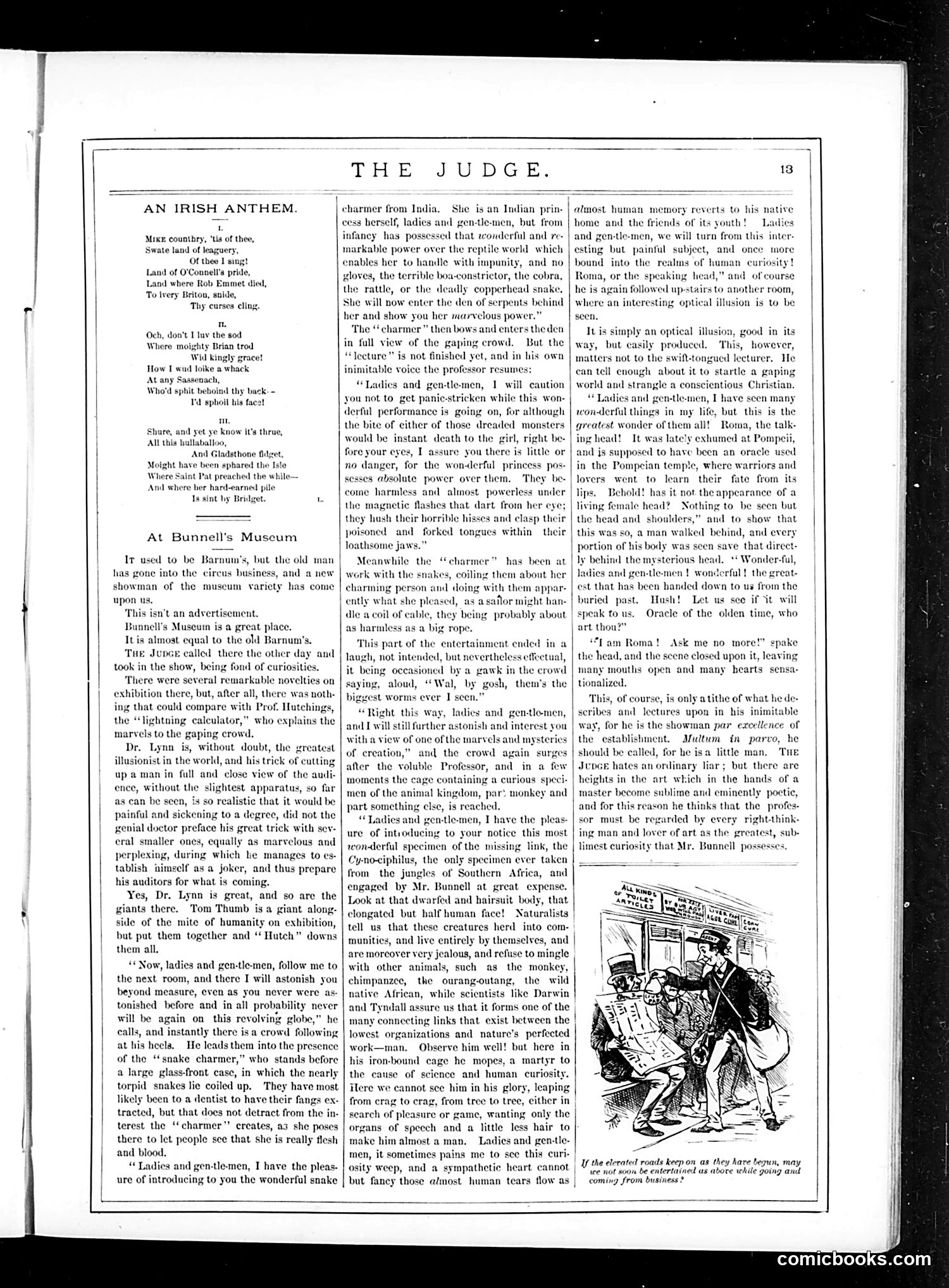
This page contains two unrelated pieces: **"An Irish Anthem"** is a satirical poem mocking Irish nationalism. It uses exaggerated Irish dialect ("Swate land," "Sassenach") to parody patriotic Irish songs, referencing historical Irish nationalist figures like O'Connell and Robert Emmet. The final verse undercuts the sentiment—suggesting Irish patriotic fervor is hollow when Irish immigrants send money home via their servants ("Bridget"). **"At Bunnell's Museum"** is a humorous account of a museum attraction (successor to Barnum's) featuring a "snake charmer" presented as an Indian princess. The lengthy buildup by the showman Professor Hutchings uses hyperbolic carnival-barker language to advertise the act. The satire targets both the gullibility of audiences and the deceptive promotional tactics of museum exhibitions of this era, which often featured exotic or fabricated acts.
This is primarily an **advertising page** from Judge magazine, with minimal editorial content. The few short humor pieces are typical of the era's "filler" jokes rather than political satire. ## The Humor Content: The page includes brief anecdotes lampooning contemporary absurdities: - A French politician's illogical proposal to end suicides by making suicide a capital offense - A man who deliberately gets arrested for fast driving to increase his horse's value - A young woman who accepts money to break off her engagement, then marries the same man anyway - Jokes about plumbers and the missing "Charley Ross" (likely a reference to a kidnapping case) These are **gentle social satire**—poking fun at human irrationality and hypocrisy—rather than pointed political commentary. ## The Advertisements: The bulk of the page features ads for hats (Knox), The New York Star newspaper, books ("Dodging a Creditor," "My Wife's Mother"), pianos (Weber), and bookstores, reflecting the commercial nature of 19th-century magazine publishing. **Bottom line:** This is a commercial product page, not political-cartoon content of historical significance.
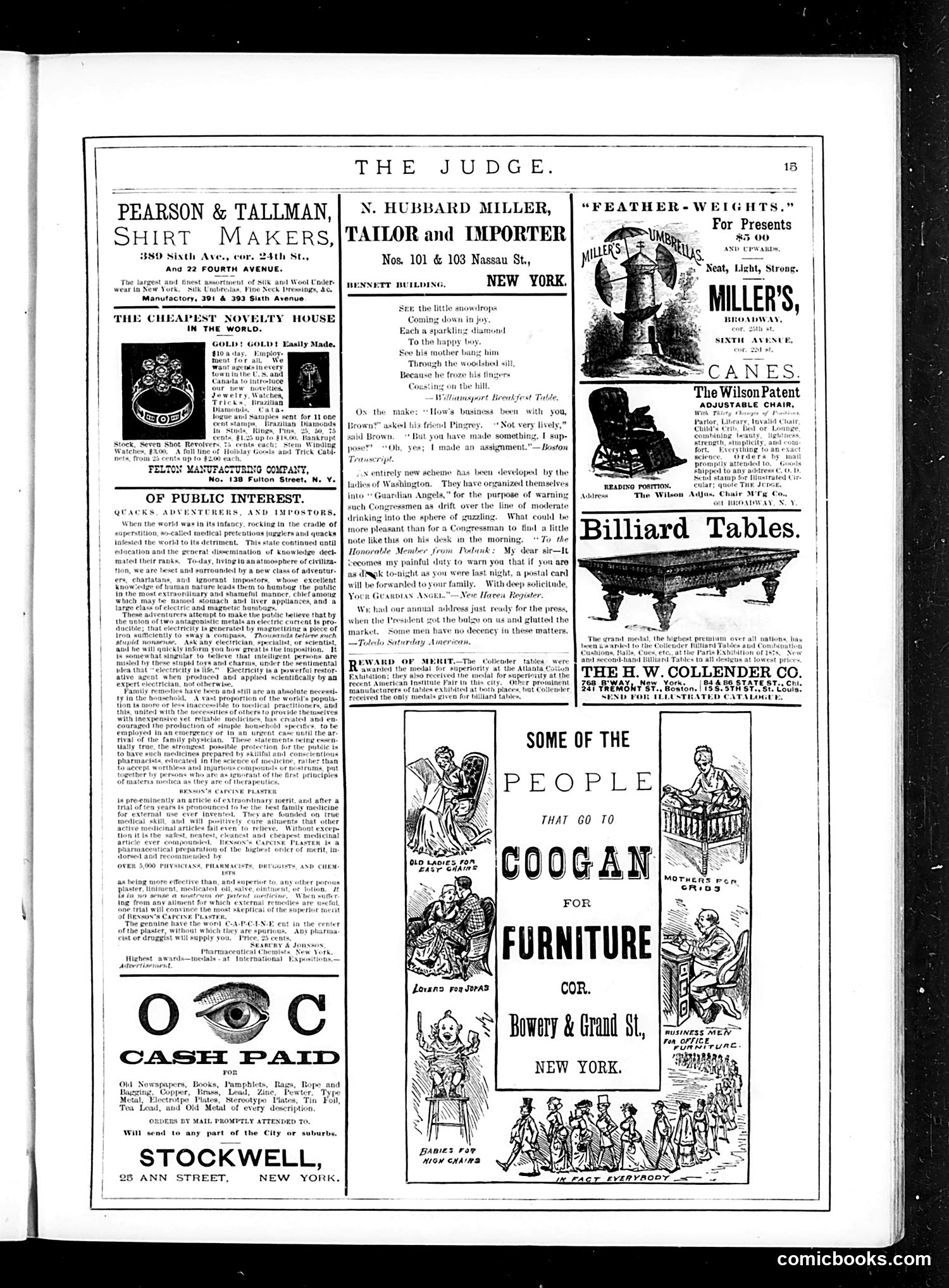
This page is primarily **advertisements** with one significant satirical illustration. The main content is a large central cartoon titled "Some of the People That Go to Coogan Furniture Cor." at Bowery and Grand Street in New York. The cartoon depicts various working-class and immigrant figures—including what appears to be laborers, domestic workers, children, and families of modest means—all patronizing this furniture store. The illustration uses exaggerated caricature typical of the era, likely playing on ethnic stereotypes common to 1880s-90s New York. The satirical point appears to be **social commentary on class and commerce**: Judge is humorously suggesting that Coogan's furniture store serves "everybody"—a broad cross-section of NYC's working poor and immigrant population. The phrase "in fact everybody" emphasizes the store's universal appeal across social strata. The surrounding advertisements for shirt makers, tailors, jewelry dealers, and other vendors reinforce this as a magazine targeting urban, middle-class readers with commercial interests.
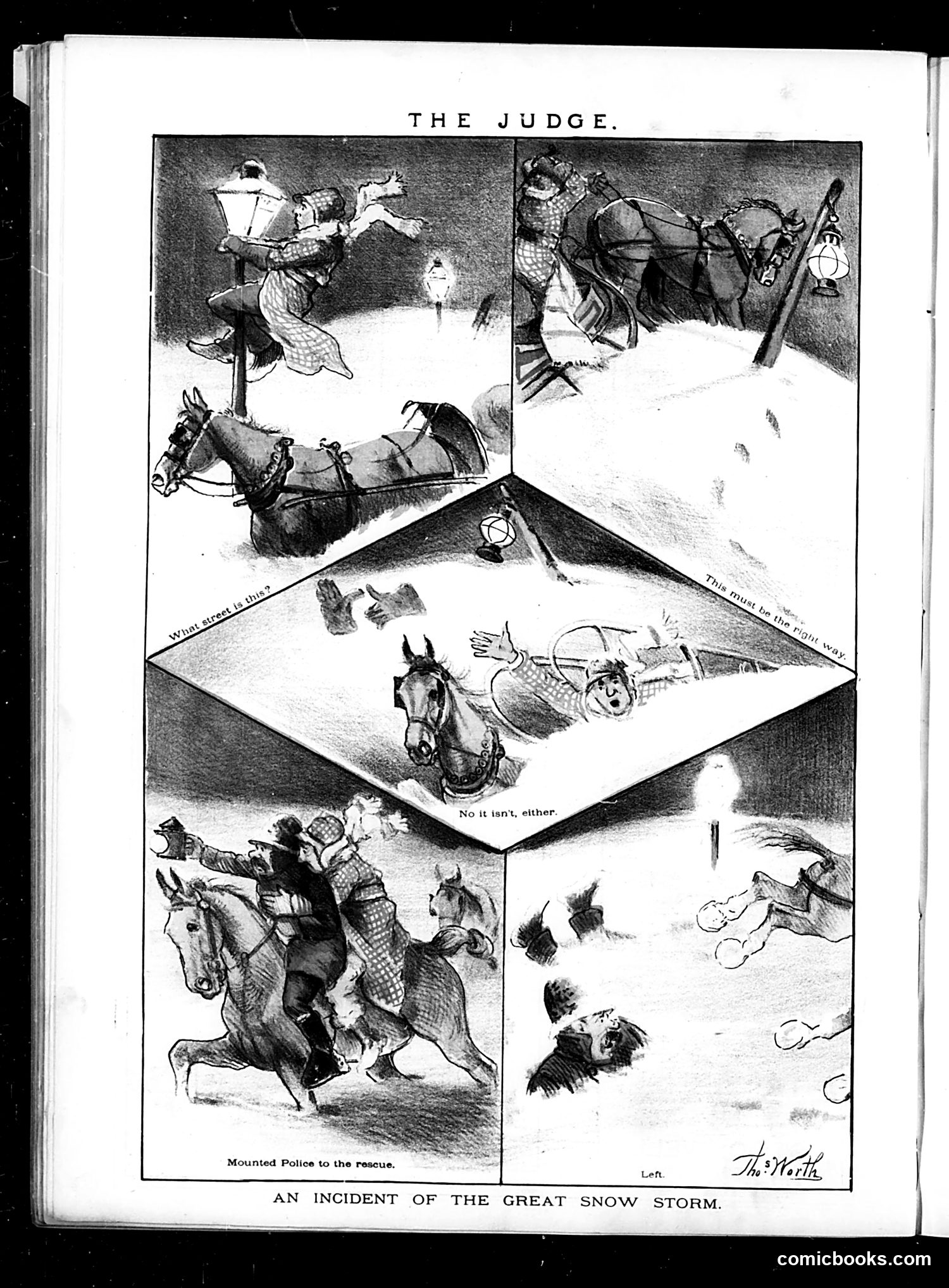
This six-panel comic depicts a dramatic winter rescue sequence. The narrative shows mounted police responding to people stranded in heavy snow. The panels progress from characters struggling in a blizzard (top panels) through a central panel captioned "No it isn't, either" to a dramatic mounted police rescue (bottom left) and what appears to be the aftermath or resolution (bottom right). The satire likely comments on either the effectiveness or incompetence of police response to natural disasters, though the exact political target remains unclear from the image alone. The "No it isn't, either" caption suggests a debate or disagreement about the incident's nature or circumstances. Without additional historical context about a specific major snowstorm referenced, the exact satirical point isn't fully determinable.