
Judge, 1882-01-21 · page 3 of 16
Judge — January 21, 1882 — page 3: what you’re looking at
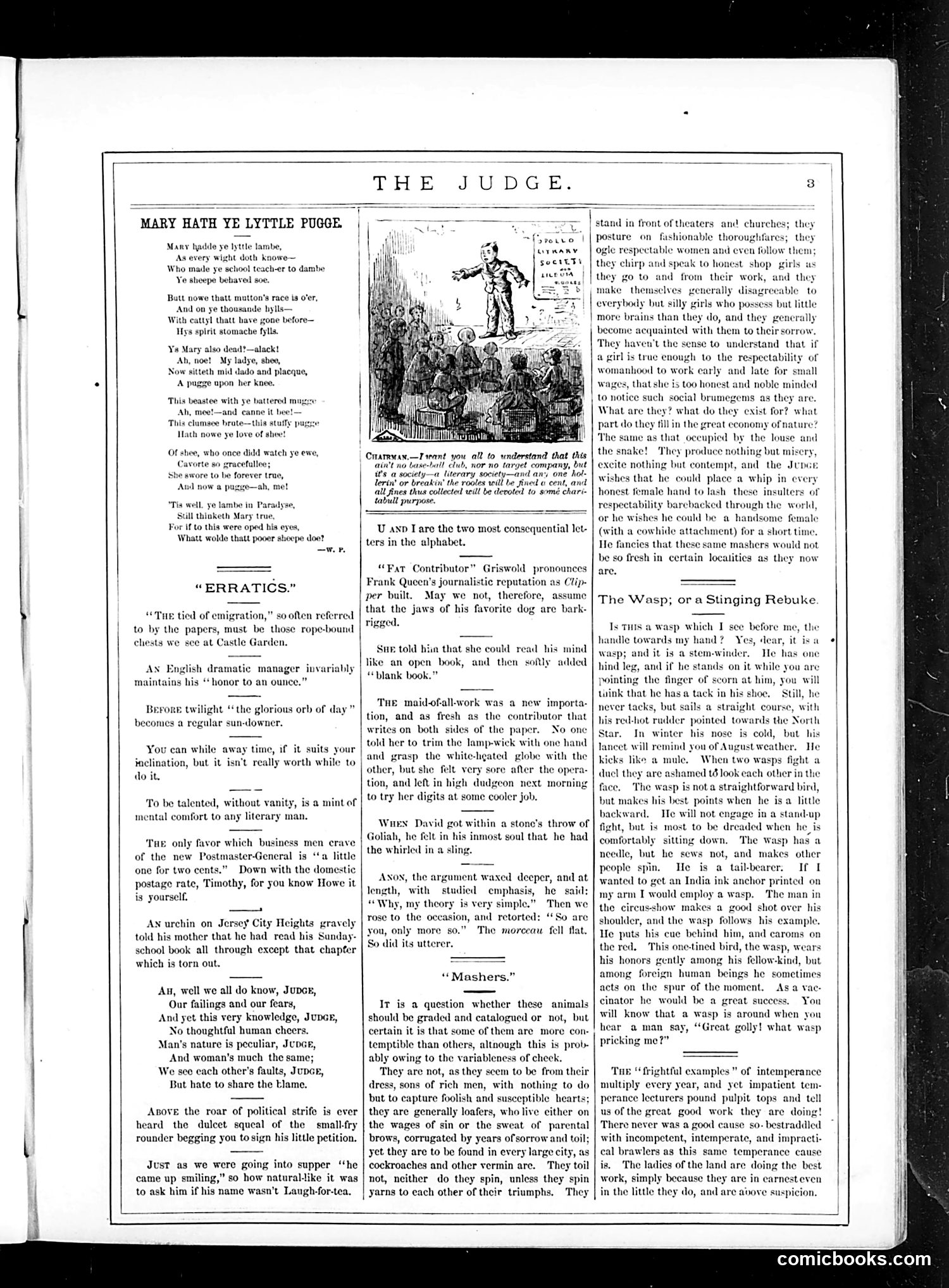
What you’re looking at
This page contains primarily **satirical text columns and miscellaneous humor** rather than political cartoons. The one illustration shows a preacher addressing an audience in what appears to be a morality scene. The main content includes: 1. **"Mary Hath Ye Lyttle Pugge"** — mock-archaic verse mocking the Victorian fashion for lap dogs, contrasting a shepherd's practical sheep with a lady's frivolous pet pug. 2. **"Erratigs"** — brief satirical observations on contemporary life: emigration, theatrical pretense, postal rates, political petitions, and domestic servants. 3. **Social commentary** on "mashers" (street harassers), criticizing certain men as contemptible parasites preying on women. The humor targets **Victorian affectations, social hypocrisy, and urban vices**—typical Judge content of the Gilded Age. The mock-medieval language parodies sentimental literature popular at the time.
📄 Transcribed text from this page (OCR, searchable)
Machine-transcribed from the original scan — historical spelling and the odd misread are preserved.
MARY HATH YE LYTTLE PUGGE ¢ lyttle Lambe, nt doth knowe— school teach-er to dambe Ve sheepe behaved soe, Batt nowe thatt mutton’s race is o'er, And on ye thousande hylls— With cattyl thatt have gone before— Hys spirit stomache fylls. Ya Mary also dead?—alackt ‘Ab, noe! My ladye, shee, Now sitteth mid dado and placque, A pugge apon her knee. This Leastee with ye battered may. Ah, mee!—and cane it bee!— This cl this stuffy pugs Hach nowe ye love of sh ce brat , who once didd watch ye ewe, 80 gracefulloe; e swore to be forever true, And now a pugge—ah, me! "Tis well. ye I nbe in Paradyse, For if to this were oped his eyes, Whatt wolle that pooer sheepe doet —wer, “ ERRATIGS.” “Tue tied of emigration,” so often referred to by the papers, must be those rope-bound chests we see at Castle Garden, AN English dramatic manager inv maintains his “honor to an ounce.” ably Berore twilight “the glorious orb of becomes a regular sun-downer. ov can while away time, if it suits your | inclination, but it isn’t really worth while to do it, ‘To be talented, without vanity, is a mint of mental comfort to any literary man. ‘Tue only favor which business men crave of the new Postmaster-General is ‘a litle one for two cents.” Down with the domestic postage rate, Timothy, for you know Howe it is yourself. urchin on Jersey City Heights gravely told his mother that he had read his Sunday: school book all through except that chapter which is torn out. ‘Au, well we all do know, Jupcr, Our failings and our fears, And yet this very knowledge, Jupcr, No thoughtfal human cheers. Man's nature is peculiar, Jupce, And woman’s much the same; We see each other's faults, Jupce, But hate to share the tlame. Anove the roar of political strife is ever heard the dulcet squeal of the small-fry rounder begging you to sign his little petition. Just as we were going into supper “he came up smiling,” so how naturaliike it was I thinketh Mary true, | to ask him if his name wasn't Langh-for-tea, THE JUDGE. Jur many society Cirarnwax.—Trrant you all to understand that this ain't no tase-hall club, nor no target company, but t's a society—a literary society—and any one hol- erin’ o breakin’ the rooles will be fined « cent, ant all fines thus collected will be devoted to somé chari- tabull purpose. U anp Tare the two most consequential let- ters in the alphabet. “Fat Contributor” Griswold pronounces Frank Queen's journalistic reputation Clip- per built. May we not, therefore, assume that the jaws of his favorite dog are bark- rigged. old hisn that she could read his mind like an open book, and then softly added “blank book.” THe maidofall-work was a new importa- tion, and as fresh as the contributor that writes on both sides of the paper. No one told her to trim the lamp-wick with one hand and grasp the white-hgated globe with the other, but she felt very sore afer the opera- tion, and left in high dudgeon next morning to try her digits at some cooler job. Wu David got within a stone's throw of Goliah, he felt in his inmost soul that he had the whirled in a sling. Avos, the argument waxed deeper, and at length, with studied emphasis, he said: “Why, my theory is very simple.” Then we rose to the occasion, and retorted: ‘So are you, only more so.” The morceau fell flat. So did its utterer, “‘Mashers.” Ir is a question whether these animals should be graded and catalogued or not, but certain it is that some of them are more con- temptible than others, altnough this is prob- ably owing to the variableness of check. They are not, as they scem to be from their dress, sons of rich men, with nothing to do but to capture foolish and susceptible hearts; they are generally loafers, who live either on the wages of sin or the sweat of parental brows, corrugated by years of sorrow and toil: yet they are to be found in every large city, cockroaches and other vermin are. They toil not, neither do they spin, unless they spin yarns to cach other of their triumphs. They | stand in front of theaters and churches; they posture on fashionable thoroughfares; they ogle respectable women and even fi they chirp and speak to honest shop girls they go to and from their work, and they make themselves gene jow them; ly disagreeable to erybody but silly girls who possess but little | more brains than they do, and they generally become acquainted with them to their sorrow. They haven't the sense to understand that if a girl is true enough to the respectability of womanhood to work carly and late for small wages, that she is too honest and noble minded to notice such social brumegems as they are. What are they? what do they exist for? what part do they fill in the great economy of nature? ‘The same as that occupied by the louse and the snake! They produce nothing but misery, excite nothing but contempt, and the Jepce wishes that he could place a whip in every honest female hand to lash these insulters of respectability ba Ked through the world, or he wishes he could be a handsome fen (with a cowhide attachment) for a short time. He fancies that these same mashers would not be so fresh in certain localities as they now are. © The Wasp; or a Stinging Rebuke. Is Tis. a wasp which I sce before me, the handle towards my hand? Ye: wasp; and it is a stem-winder, He has onc hind leg, and if he stands on it while you pointing the finger of scorn at him, you will tiink that he has a tack in his shoe, Still, he never tacks, but sails a straight course, with his red-hot rudder pointed towards the North r. In winter his nose is cold, but his lancet will remind you of August weather, He kicks like a mule, When two wasps fight a duel they ar ned t8 look each other in asp is nota straightforward bird, is best points when he isa little He will not engage in a stand-up fight, but is most to be dreaded when he, is comfortably sitting down. The wasp has a needle, but he sews not, and makes other people spin, He is a tailbearer, If I wanted to get an India ink anchor printed on my arm I would employ a wasp, The man in the circusshow makes a good shot over his shoulder, and the wasp follows his example. He puts his cue behind him, and caroms on the red. This one-tined bird, the wasp, wears his honors gently among his fellow-kind, but among foreign human beings he sometimes acts on the spur of the moment. Asa vac- cinator he would be a great snecess. You will know that a wasp is around when you hear a man say, “Great golly! what wasp pricking me?” dear, it is a Tue “frightful examples” of intemperance multiply every year, and yet impatient tem- perance lecturers pound pulpit tops and tell us of the great good work they are doing! There never was a good cause so- bestraddled with incompetent, intemperate, and impracti- cal brawlers as this same temperance cai is. The ladies of the land are doing the best work, simply because they are in earnesteven in the little they do, and are avove suspicion. comicbooks.com