
Judge, 1882-01-21 · page 11 of 16
Judge — January 21, 1882 — page 11: what you’re looking at
What you’re looking at
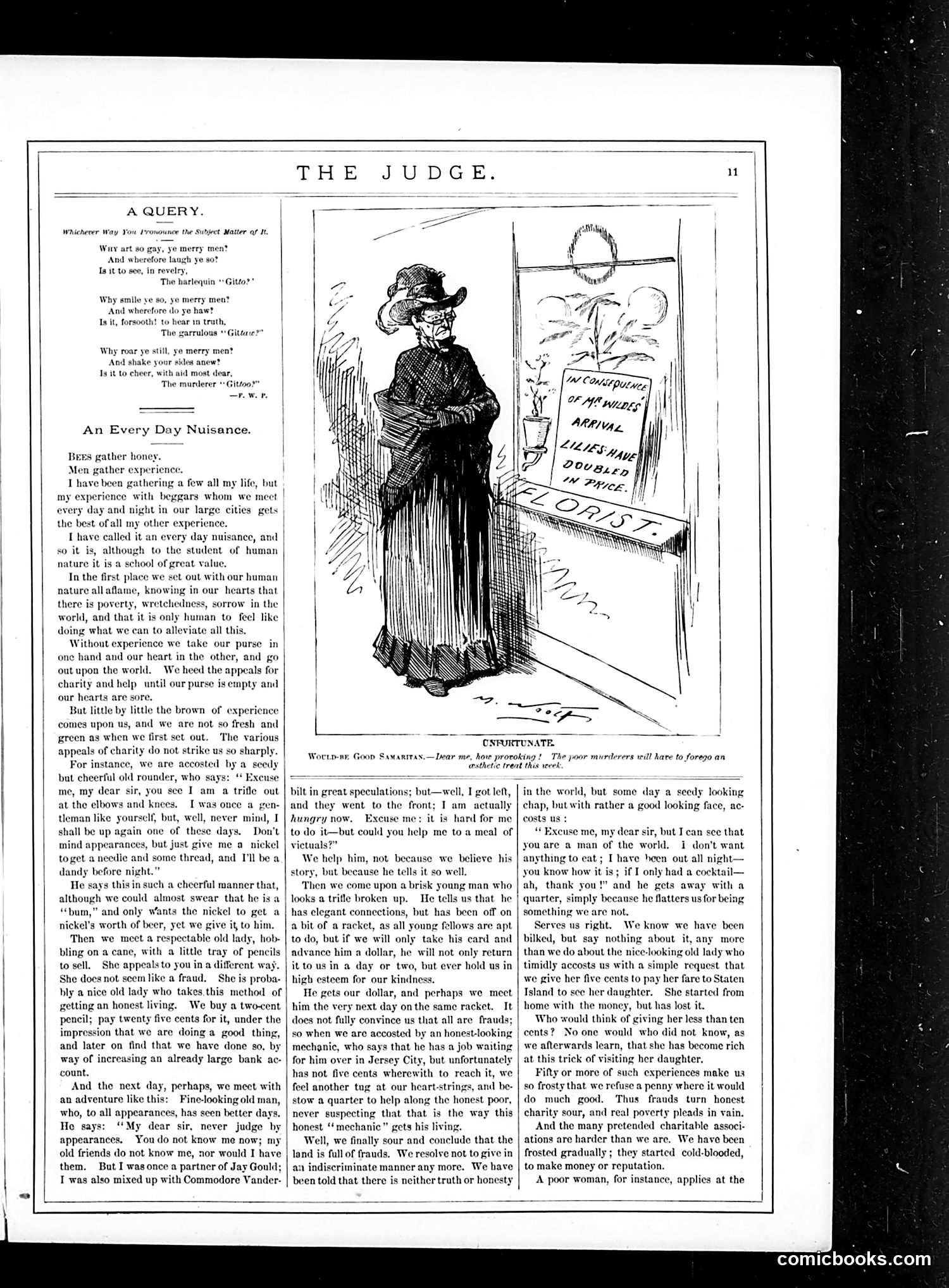
This satirical essay critiques the difficulty of charitable giving in urban America. The author describes how experience gradually hardens donors against street beggars' appeals—despite good intentions. The piece catalogs common beggar "types" encountered daily: the shabby but genteel man needing a nickel for thread, the elderly pencil vendor, and a well-dressed man claiming to be a ruined partner of Jay Gould or Cornelius Vanderbilt (real Gilded Age magnates). Each tells a compelling story. The satire's target isn't primarily the beggars but rather the donors' dilemma: sophisticated city dwellers cannot easily distinguish genuine need from fraud. The accompanying illustration shows a woman at a door with a sign about "the consequences of my husband's arrival"—suggesting domestic hardship. The essay suggests that repeated exposure to (possibly fake) sob stories makes compassionate people cynical, yet they keep giving anyway—trapped between skepticism and humanitarian instinct.
📄 Transcribed text from this page (OCR, searchable)
Machine-transcribed from the original scan — historical spelling and the odd misread are preserved.
A QUERY. Whichever Way You Pre ounce the Subject Matter af It, art so gay, ye merry ment And wherefore laugh y Is it to see, in rev The w arlequin **Gitto?” Why smile ye so, ye merry men? ‘And wherefore do yo haw Is it, forsooth! to hear in trath, still, ye merry men? | ‘our ekles anew? ear, Why roar y And shake Is it to cheer, wit J most An Every Day Nuisance. $s gather honey. Men gather experience. I have been gathering a few all my life, but xperience with beggars whom we meet y day and night in our la cities gets the best of all my other experience. | I have called it an every day nuisance, and so it is, although to the student of human nature it i of great value, In the first pl ot out with our human nature all aflame, knowing in our hearts that there is poverty, wretchedness, sorrow in the world, and that it is only human to feel like doing what we can to alleviate all thi | Without experience we take our purse in and and our heart in the other, and go outupon the world. We heed the appeals for charity and help until our purse is empty and our hearts ar But little by little the brown of experience comes upon us, and we are not so fresh and green as when we first set out. ‘The various appeals of charity do not strike us so sharply. For instance, we are accoste seedy but cheerful old rounder, who me, my dear sir, you see I am a trifle out at the elbows and knees, I was once a gen- tleman like yourself, but, well, never mind, I shall be up again one of these days. Don't mind appearances, but just give me a nickel toget a needic and some thread, and I'll be a dandy before night.” He says this in such a cheerful manner that, although we could almost swear that he is a | “bum,” and only wants the nickel to get a nickel’s worth of beer, yet we give it, to him. ‘Then we meet a respectable old lady, hob- bling on a cane, with a little tray of pencils to sell. She appeals to you ina different way. | She docs not seem like a fraud. She is proba- bly a nice old lady who takes.this method of getting an honest living. We buy a two-cent pencil: y twenty five cents for it, under the impression that we are doing a good thing, and later on find that we have done so, by way of increasing an already large bank ac- count. And the next day, perhaps, we meet with an adventure like this: Fine-looking old man, who, to all appearances, has seen better da; He says: “My dear sir, never judge by | appearances. You do not know me now; my | old friends do not know me, nor would I have | them. But I was once a partner of Jay Gould; I was also mixed up with Commodore Vander- choo! we one h re, THE JUDGE. Je —~s—, ONFURTU DP Sawanitax.—Dear me, how provoking ? ATE. The poor murderers will have to forego an aesthetic treat this week bilt in great speculations; but—well, I got left, and they went to the front; I am actually hungry now, Excuse me; it is hard for me to do it—but could you help me to a meal of victuals?” We help him, not because we believe his story, but because he tells it so well. Then we come upon a brisk young man who looks a trifle broken up. He tells us that he has elegant connections, but has been off on a bit of a racket, as all young fellows are apt to do, but if we will only take his card and advance him a dollar, he will not only return it to us in a day or two, but ever hold us in high esteem for our kindness. He gets our dollar, and perhaps we meet him the very next day onthe same racket. It does not fully convince us that all are frauds; so when we are accosted by an honest-looking mechanic, who says that he has a job waiting for him over in Jersey City, but unfortunately has not five cents wherewith to reach it, we feel another tug at our heart-strings, and be- stow a quarter to help along the honest poor, never suspecting that that is the way this honest ‘“ mechanic” gets his living. Well, we finally sour and conclude that the land is full of frauds. We resolve not to give in an indiscriminate manner any more. We have been told that there is neither truth or honesty in the world, but some day a seedy looking chap, but with rather a good looking face, ac- costs us: “Excuse me, my dear sir, but Tcan sce that you are a man of the world. i don't want anything to ¢ have heen out all night— you know how it is; if I only had a cocktail— ah, thank you!" and he gets away with a quarter, simply because he flatters us for being something we are not. Serves us right. We know we have been bilked, but say nothing about it, any more than we do about the nice-looking old lady who timidly accosts us with a simple request that we give her five cents to pay her fare to Staten Island to see her daughter. She started from home with the money, but has lost it. Who would think of giving her less than ten cents? Noone would who did not know, as we afterwards learn, that she has become rich at this trick of visiting her daughter, Fifty or more of such experiences make ua so frosty that we refuse a penny where it would do much good. Thus frauds turn honest charity sour, and real poverty pleads in vain, ‘And the many pretended charitable associ- ations are harder than we are. We have been frosted gradually ; they started cold-blooded, to make money or reputation. A poor woman, for instance, applies at the comicbooks.com