
Puck, 1879-07-23 · page 6 of 16
Puck — July 23, 1879 — page 6: what you’re looking at
What you’re looking at
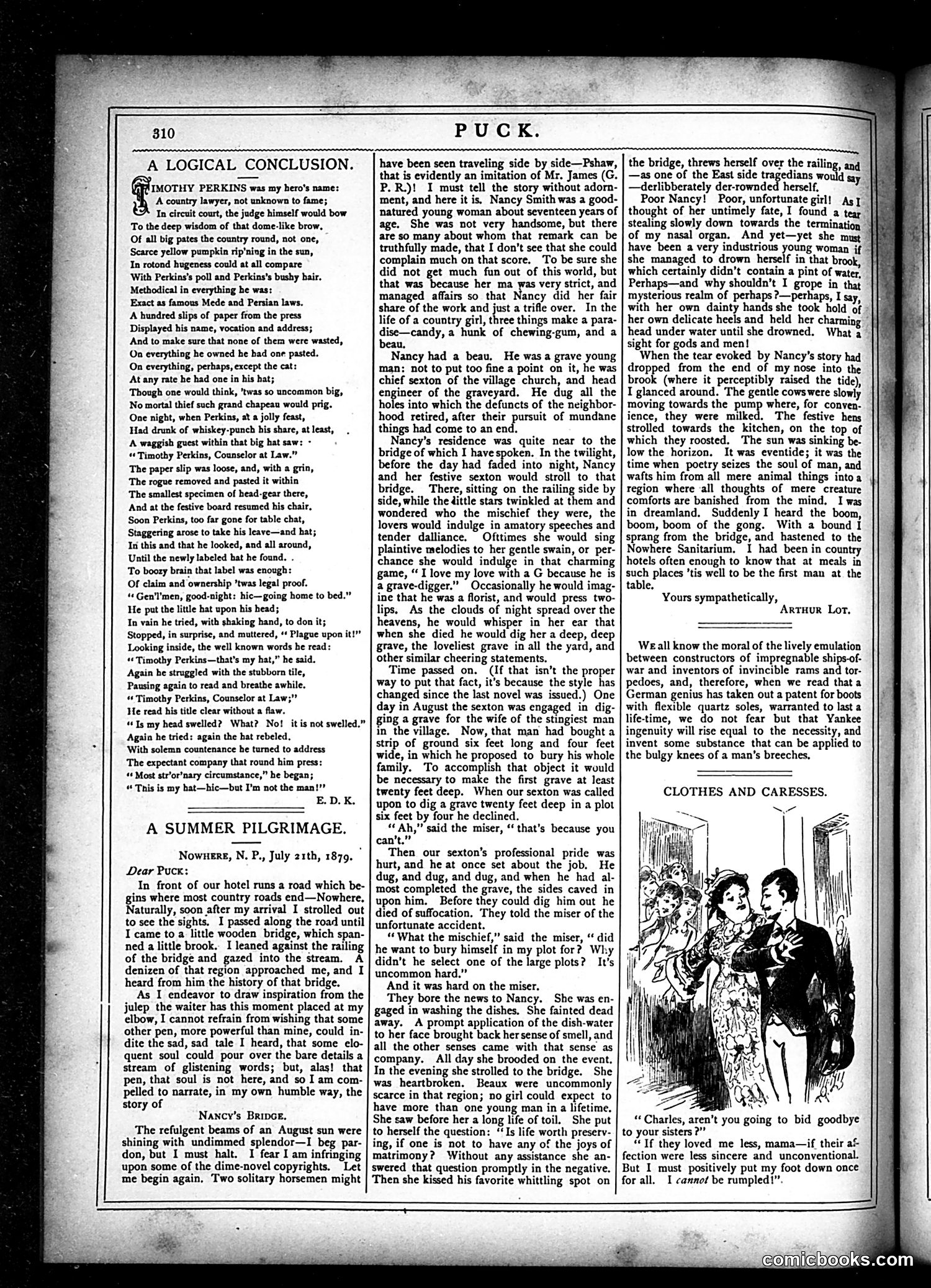
This page contains three distinct sections: a poem titled "A Logical Conclusion" satirizing a country lawyer's questionable legal reasoning; a letter titled "A Summer Pilgrimage" from Nowhere, N.P., describing a humorous anecdote about a sexton's mishap digging a grave; and an illustration labeled "Clothes and Caresses" showing what appears to be a domestic scene with women near a wardrobe. The "Logical Conclusion" poem mocks verbose, contradictory legal arguments. The "Summer Pilgrimage" letter uses rural humor—a sexton digging a grave too deep, then too shallow—to poke fun at incompetence. The illustration appears to depict a period domestic moment, though its specific satirical target remains unclear from the visible image alone.
📄 Transcribed text from this page (OCR, searchable)
Machine-transcribed from the original scan — historical spelling and the odd misread are preserved.
PUCK. A LOGICAL CONCLUSION. IMOTHY PERKINS was my hero's name: ‘A country lawyer, not unknown to fame; In circuit court, the judge himself would bow To the deep wisdom of that dome-like brow. Of all big pates the country round, not one, Scarce yellow pumpkin rip'ning in the sun, In rotond hugeness could at all compare With Perkins’s poll and Perkins’s bushy hair. ‘Methodical in everything he was: Exact as famous Mede and Persian laws. ‘A hundred slips of paper from the press Displayed his name, vocation and address; And to make sure that none of them were wasted, On everything he owned he had one pasted. On everything, perhaps, except the cat: At any rate he had one in his hat; ‘Though one would think, "twas so uncommon big, No mortal thief such grand chapeau would prig. One night, when Perkins, at a jolly feast, Had drunk of whiskey-punch his share, at least, A waggish guest within that big hat saw: - «Timothy Perkins, Counselor at Law.” The paper slip was loose, and, with a grin, The rogue removed and pasted it within ‘The smallest specimen of head-gear there, And at the festive board resumed his chair, Soon Perkins, too far gone for table chat, Staggering arose to take his leave—and hat; In this and that he looked, and all around, Until the newly labeled bat he found. . To boozy brain that label was enough: Of claim and ownership ’twas legal proof. “«Gen'l'men, good-night: hic—going home to bed.” He put the little hat upon his head; In vain he tried, with shaking hand, to don it; Stopped, in surprise, and muttered, “¢ Plague upon it!”” Looking inside, the well known words he read: «Timothy Perkins—that’s my hat,” he said. ‘Again he struggled with the stubborn tile, Pausing again to read and breathe awhile. “Timothy Perkins, Counselor at Law;”” He read his title clear without a flaw. «Is my head swelled? What? No! it is not swelled.” Again he tried: again the hat rebeled. With solemn countenance he turned to address ‘The expectant company that round him press: “ Most str’or'nary circumstance,” he began; “This is my hat—hic—but I’m not the man!’? E.D.K. A SUMMER PILGRIMAGE. Nownerg, N. P., July 21th, 1879. | Dear Puck: In front of our hotel runs a road which be- gins where most country roads end—Nowhere, Naturally, soon after my arrival I strolled out to see the sights, I passed along the road until I came to a little wooden bridge, which span- ned a little brook. I leaned against the railing of the bridge and gazed into the stream. A denizen of that region approached me, and I heard from him the history of that bridge. As I endeavor to draw inspiration from the julep the waiter has this moment placed at my elbow, I cannot refrain from wishing that some other pen, more powerful than mine, could in- dite the sad, sad tale I heard, that some elo- quent soul could pour over the bare details a stream of glistening words; but, alas! that pen, that soul is not here, and so I am com- pelled to narrate, in my own humble way, the story of Nancy's Brive. ‘The refulgent beams of an August sun were shining with undimmed splendor—I beg par- don, but I must halt. I fear I am infringing upon some of the dime-novel copyrights. Let me begin again. Two solitary horsemen might have been seen traveling side by side—Pshaw, that is evidently an imitation of Mr. James (G. P.R.)! I must tell the story without adorn- ment, and here it is, Nancy Smith was a good- natured young woman about seventeen years of age. She was not very handsome, but there are so many about whom that remark can be truthfully made, that I don’t see that she could complain much on that score. To be sure she did not get much fun out of this world, but that was because her ma very strict, and managed affairs so that Nancy did her fair share of the work and just a trifle over. In the life of a country girl, three things make a para- dise—candy, a hunk of chewing-gum, and a beau. Nancy had a beau, He was a grave young man: not to put too fine a point on it, he was chief sexton of the village church, and head engineer of the graveyard. He dug all the holes into which the defuncts of the neighbor- hood retired, after their pursuit of mundane things had come to an end, Nancy’s residence was quite near to the bridge of which I have spoken. In the twilight, before the day had faded into night, Nancy and her festive sexton would stroll to that bridge. There, sitting on the railing side by side, while the dittle stars twinkled at them and wondered who the mischief they were, the lovers would indulge in amatory speeches and tender dalliance. Ofttimes she would sing plaintive melodies to her gentle swain, or per- chance she would indulge in that charming game, “I love my love with a G because he is a grave-digger.” Occasionally he would imag- ine that he was a florist, and would press two- lips. As the clouds of night spread over the heavens, he would whisper in her ear that when she died he would dig her a deep, deep grave, the loveliest grave in all the yard, and other similar cheering statements. ‘Time passed on. (If that isn’t the proper way to put that fact, it’s because the style has changed since the last novel was issued.) One day in August the sexton was engaged in dig- ging a grave for the wife of the stingiest man in the village. Now, that man had bought a strip of ground six feet long and four feet wide, in which he proposed to bury his whole family. To accomplish that object it would be necessary to make the first grave at least twenty feet deep. When our sexton was called upon to dig a grave twenty feet deep in a plot six feet by four he declined. “Ah,” said the miser, “ that's because you can’t." Then our sexton’s professional pride was hurt, and he at once set about the job. He dug, and dug, and dug, and when he had al- most completed the grave, the sides caved in upon him. Before they could dig him out he died of suffocation. They told the miser of the unfortunate accident. ‘What the mischief,” said the miser, ‘“ did he want to bury himself in my plot for? Why didn't he select one of the large plots? It’s uncommon hard.” And it was hard on the miser. They bore the news to Nancy. She was en- gaged in washing the dishes. She fainted dead away. A prompt application of the dish-water to her face brought back her sense of smell, and all the other senses came with that sense as company. All day she brooded on the event. In the evening she strolled to the bridge. She was heartbroken. Beaux were uncommonly scarce in that region; no girl could expect to have more than one young man in a lifetime. She saw before her a long life of toil. She put to herself the question: “Is life worth preserv- ing, if one is not to have any of the joys of matrimony? Without any assistance she an- swered that question promptly in the negative. Then she kissed his favorite whittling spot on the bridge, threws herself over the raili —as one of the East side tragedians wo —derlibberately der-rownded herself. Poor Nancy! Poor, unfortunate girl! As] thought of her untimely fate, I found a tear ” stealing slowly down towards the termination — of my nasal organ. And yet—yet she must have been a very industrious young woman if she managed to drown herself in that b: which certainly didn’t contain a pint of water, Perhaps—and why shouldn't I grope in that mysterious realm of perhaps ?—perhaps, I say, with her own dainty hands she took hold of her own delicate heels and held her charming ” head under water until she drowned. What a sight for gods and men! When the tear evoked by Nancy's story had dropped from the end of my nose into the brook (where it perceptibly raised the tide), I glanced around. The gentle cowswere slowly moving towards the Purp where, for conven- ience, they were milked. The festive hens strolled towards the kitchen, on the top of which they roosted. The sun was sinking be- low the horizon. It was eventide; it was the time when poetry seizes the soul of man, and wafts him from all mere animal things intoa | region where all thoughts of mere creature comforts are banished from the mind. I was in dreamland. Suddenly I heard the boom, boom, boom of the gong. With a bound I sprang from the bridge, and hastened to the Nowhere Sanitarium. I had been in country hotels often enough to know that at meals in such places ’tis well to be the first man at the table. Sy, Yours sympathetically, ArtHuR Lot, Weall know the moral of the lively emulation between constructors of impregnable ships-of- war and inventors of invincible rams and tor- pedoes, and, therefore, when we read that a German genius has taken out a patent for boots with flexible quartz soles, warranted to last a life-time, we do not fear but that Yankee ingenuity will rise equal to the necessity, and invent some substance that can be applied to the bulgy knees of a man’s breeches. CLOTHES AND CARESSES. “Charles, aren’t you going to bid goodbye to your sisters ?”” “Tf they loved me less, mama—if their af fection were less sincere and unconventional. But I must positively put my foot down once for all. 1 cannot be rumpled!” icomicbooks.com