
Puck, 1879-07-23 · page 5 of 16
Puck — July 23, 1879 — page 5: what you’re looking at
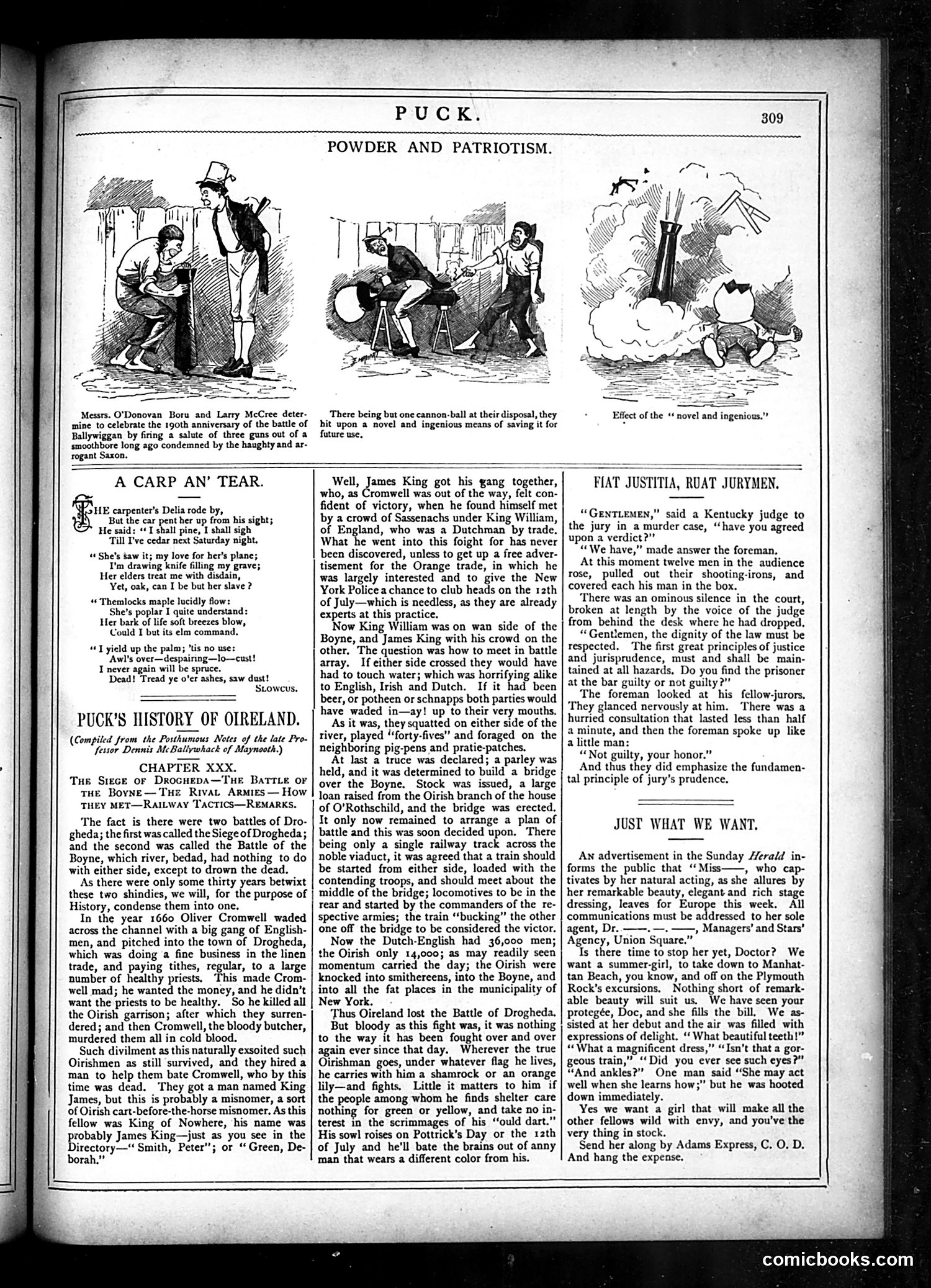
What you’re looking at
This three-panel cartoon satirizes Irish-American political figures commemorating the 1798 Battle of Ballynahinch. The OCR text identifies "Messrs. O'Donovan Rossa and Lary McCree" organizing this anniversary celebration. The first panel shows them planning with gunpowder; the middle panel depicts them with a cannon on improvised supports; the third shows an explosion. The caption explains they sought a "novel and ingenious" means to save gunpowder for "future use." The satire targets Irish nationalist commemorations and suggests these politicians are dangerously incompetent—their patriotic celebration literally backfires. The joke critiques both their revolutionary posturing and practical ineptitude, common themes in Puck's treatment of ethnic and political groups.
📄 Transcribed text from this page (OCR, searchable)
Machine-transcribed from the original scan — historical spelling and the odd misread are preserved.
PUCK. Messrs. O'Donovan Boru and Larry McCree deter- mine to celebrate the 190th anniversary of the battle of Ballywiggan by firing a salute of three guns out of a smoothbore long ago condemned by the haughty and ar- rogant Saxon. POWDER AND PATRIOTISM. There being but one cannon-ball at their disposal, they hit upon a novel and ingenious means of saving it for future use, Effect of the “novel and ingenious.”” A CARP AN’ TEAR. HE carpenter's Delia rode by, But the car pent her up from his sight; He said: ‘+I shall pine, I shall sigh Till I've cedar next Saturday night, «# She's saw it; my love for her’s plane; I’m drawing knife filling my grave; Her elders treat me with disdain, Yet, oak, can I be but her slave ? ««Themlocks maple lucidly flow: She's poplar I quite understand: Her bark of life soft breezes blow, Could I but its elm command. “1 yield up the palm ‘Awl's over—despairing—lo—cust! I never again will be spruce. Dead! Tread ye o'er ashes, saw dust! Stowcus. PUCK’S HISTORY OF OIRELAND. (Compiled from the Posthumous Notes of the late Pro- fessor Dennis McBallywhack of Maynooth.) CHAPTER XXX. Tue Siece or DrocuepaA—TuE BattLe or tHE Boyne—TuHe Riva Armies— How THEY MET—RalLway TACTICS—REMARKS. The fact is there were two battles of Dro- gheda; the first was called the Siege of Drogheda; and the second was called the Battle of the Boyne, which river, bedad, had nothing to do with either side, except to drown the dead. As there were only some thirty years betwixt these two shindies, we will, for the purpose of History, condense them into one. In the year 1660 Oliver Cromwell waded across the channel with a big gang of English- men, and pitched into the town of Drogheda, which was doing a fine business in the linen trade, and paying tithes, regular, to a large number of healthy priests. This made Crom- well mad; he wanted the money, and he didn’t want the priests to be healthy. So he killed all the Oirish garrison; after which they surren- dered; and then Cromwell, the bloody butcher, murdered them all in cold blood. Such divilment as this naturally exsoited such Oirishmen as still survived, and they hired a man to help them bate Cromwell, who by this time was dead. They got a man named King James, but this is probably a misnomer, a sort of Oirish cart-before-the-horse misnomer. As this fellow was King of Nowhere, his name was Pebably: James King—just as you see in the irectory—‘ Smith, Peter"; or “Green, De- borah,” Well, James King got his gang together, who, as Cromwell was out of the way, felt con- fident of victory, when he found himself met by a crowd of Sassenachs under King William, of England, who was a Dutchman by trade. What he went into this foight for has never been discovered, unless to get up a free adver- tisement for the Orange trade, in which he was largely interested and to give the New York Police a chance to club heads on the 12th of July—which is needless, as they are already experts at this practice. Now King William was on wan side of the Boyne, and James King with his crowd on the other, The question was how to meet in battle array. If either side crossed they would have had to touch water; which was horrifying alike to English, Irish and Dutch. If it had been beer, or potheen or schnapps both parties would have waded in—ay! up to their very mouths. As it was, they squatted on either side of the river, played “forty-fives” and foraged on the neighboring pig-pens and pratie-patches. At last a truce was declared; a parley was held, and it was determined to build a bridge over the Boyne, Stock was issued, a large loan raised from the Oirish branch of the house of O’Rothschild, and the bridge was erected. It only now remained to arrange a plan of battle and this was soon decided upon, There being only a single railway track across the noble viaduct, it was agreed that a train should be started from either side, loaded with the contending troops, and should meet about the middle of the bridge; locomotives to be in the rear and started by the commanders of the re- spective armies; the train “bucking” the other one off the bridge to be considered the victor. Now the Dutch-English had 36,000 men; the Oirish only 14,000; as may readily seen momentum carried the day; the Oirish were knocked into smithereens, into the Boyne, and into all the fat places in the municipality of New York. ‘Thus Oireland lost the Battle of Drogheda. But bloody as this fight was, it was nothing to the way it has been fought over and over again ever since that day. Wherever the true Oirishman goes, under whatever flag he lives, he carries with him a shamrock or an orange lily—and fights. Little it matters to him if the people among whom he finds shelter care nothing for green or yellow, and take no in- terest in the scrimmages of his “ould dart.” His sow] roises on Pottrick’s Day or the 12th of July and he'll bate the brains out of anny man that wears a different color from his. RUAT JURYMEN, FIAT JUSTITIA, “GENTLEMEN,” said a Kentucky judge to the jury in a murder case, “have you agreed upon a verdict?” “We have,” made answer the foreman. At this moment twelve men in the audience rose, pulled out their shooting-irons, and covered each his man in the box. There was an ominous silence in the court, broken at length by the voice of the judge from behind the desk where he had dropped. “Gentlemen, the dignity of the law must be respected, The first great principles of justice and jurisprudence, must and shall be main- tained at all hazards, Do you find the prisoner at the bar guilty or not guilty?” The foreman looked at his fellow-jurors, ‘They glanced nervously at him. ‘There was a hurried consultation that lasted less than half a minute, and then the foreman spoke up like a little man: “Not guilty, your honor.” And thus they did emphasize the fundamen- tal principle of jury’s prudence, JUST WHAT WE WANT. An advertisement in the Sunday Herald in- forms the public that ‘Miss——, who cap- tivates by her natural acting, as she allures by her remarkable beauty, elegant and rich stage dressing, leaves for Europe this week. All communications must be addressed to her sole agent, Dr. ——. —. ——, Managers’ and Stars’ Agency, Union Square.” Is there time to stop her yet, Doctor? We want a summer-girl, to take down to Manhat- tan Beach, you know, and off on the Plymouth Rock's excursions. Nothing short of remark- able beauty will suit us, We have seen your protegée, Doc, and she fills the bill. We as- sisted at her debut and the air was filled with expressions of delight, ‘‘ What beautiful teeth!” “What a magnificent dress,” “Isn't that a gor- geous train,” ‘Did you ever see such eyes?” “And ankles?” One man said “She may act well when she learns how;" but he was hooted down immediately. Yes we want a girl that will make all the other fellows wild with envy, and you've the very thing in stock. Send her along by Adams Express, C. O, D. And hang the expense. comicbooks.com