
Puck, 1879-07-23 · page 7 of 16
Puck — July 23, 1879 — page 7: what you’re looking at
What you’re looking at
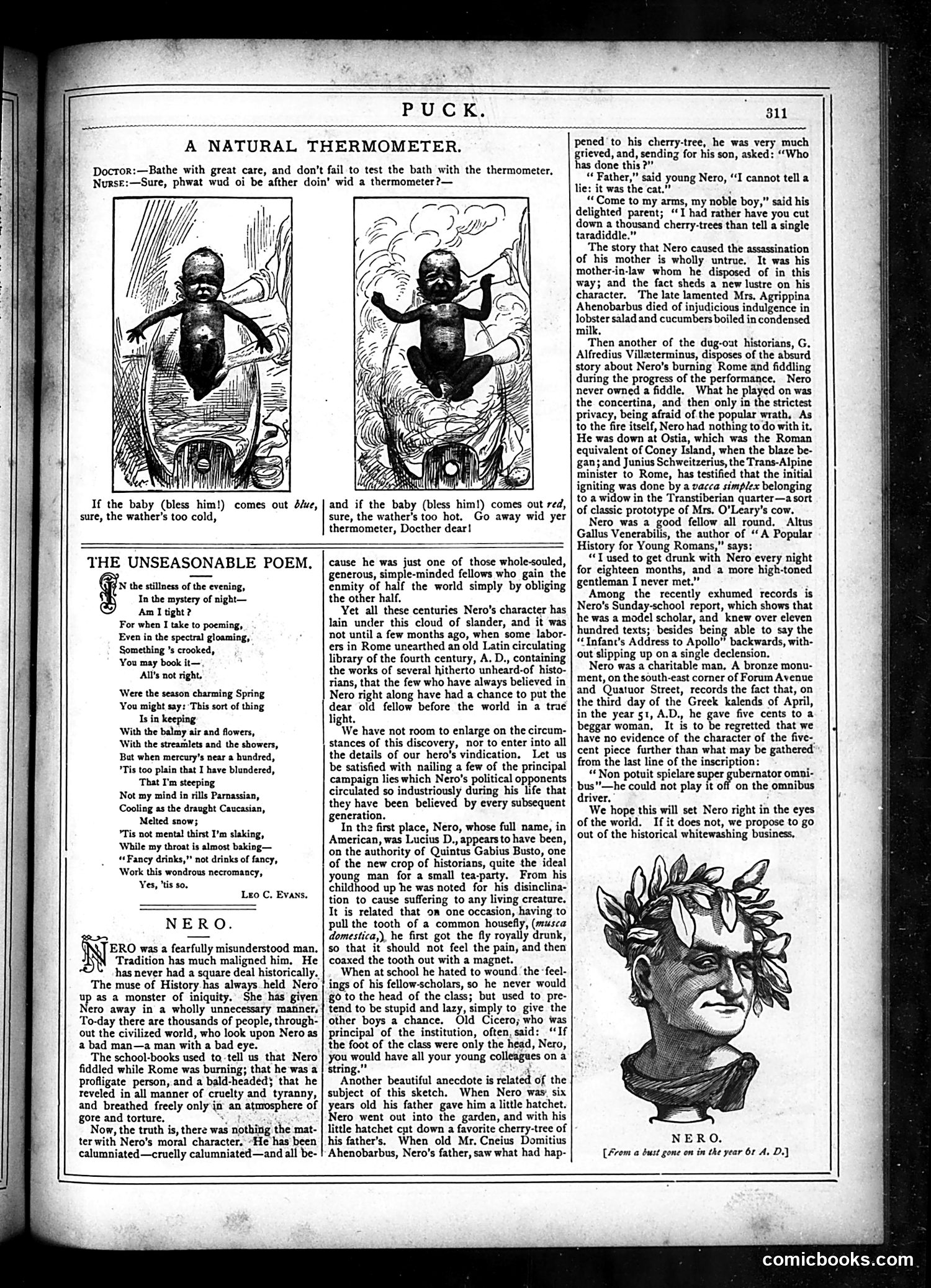
The top cartoon shows a baby in hot and cold water as a "thermometer"—a dark joke about parental negligence. The doctor's instruction to "bathe with great care" is undercut by the visual: if the baby emerges "blue" (cold) or "red" (hot), you'll know the water temperature. This satirizes careless or incompetent parenting. The main article discusses the historical Roman emperor Nero, debunking popular myths—that he was a monster of cruelty, that he fiddled while Rome burned, that he was bald and cross-eyed. The text argues these slanders were spread by his political enemies and weren't believed by subsequent generations. This appears to be historical revisionism challenging conventional wisdom about a infamous historical figure.
📄 Transcribed text from this page (OCR, searchable)
Machine-transcribed from the original scan — historical spelling and the odd misread are preserved.
Docror:—Bathe with great care, and don’t fail to test the bath with the thermometer, Nurse:—Sure, phwat wud oi be afther doin’ wid a thermometer?— If the baby (bless him!) comes out s/ue, sure, the wather’s too cold, and if the baby (bless him!) comes out red, sure, the wather’s too hot. Go away wid yer thermometer, Docther dear! THE UNSEASONABLE POEM. N the stillness of the evening, In the mystery of night— Am I tight? For when I take to poeming, Even in the spectral gloaming, Something ’s crooked, You may book it— All's not right, Were the season charming Spring You might say: ‘This sort of thing Is in keeping With the balmy air and flowers, With the streamlets and the showers, But when mercury’s near a hundred, ‘Tis too plain that I have blundered, That I'm steeping Not my mind in rills Parnassian, Cooling as the draught Caucasian, Melted snow; Tis not mental thirst I’m slaking, While my throat is almost baking— «Fancy drinks,” not drinks of fancy, ‘Work this wondrous necromancy, Yes, "tis so. Lxo C. Evans. NERO. ERO was a fearfully misunderstood man. Tradition has much maligned him. He has never had a square deal historically. The muse of History.has always held Nero wp as a monster of iniquity. She has giyen lero away in a wholly unnecessary manner, To-day there are thousands of people, through- out the civilized world, who look upon Nero as a bad man—a man with a bad eye. The school-books used to-tell us that Nero fiddled while Rome was burning; that he was a profligate person, and a bald-headed$ that he reveled in all manner of cruelty and tyranny, and breathed freely only in an atmosphere of gore and torture, *, yh Now, the truth is, there was nothing the mat- terwith Nero’s moral character. “He has been calumniated—cruelly calumniated—and all be- cause he was just one of those whole-souled, generous, simple-minded fellows who gain the enmity of half the world simply by obliging the other half. Yet all these centuries Nero's character has lain under this cloud of slander, and it was not until a few months ago, when some labor- ers in Rome unearthed an old Latin circulating library of the fourth century, A. D., containing the works of several hitherto unheard-of histo- tians, that the few who have always believed in Nero right along have had a chance to put the dear old fellow before the world in a trae light. We have not room to enlarge on the circum- stances of this discovery, nor to enter into all the details of our hero's vindication, Let us be satisfied with nailing a few of the principal campaign lies which Nero’s political opponents circulated so industriously during his life that they have been believed by every subsequent generation. In the first place, Nero, whose full name, in American, was Lucius D., appears to have been, on the authority of Quintus Gabius Busto, one of the new crop of historians, quite the ideal young man for a small tea-party. From his childhood up he was noted for his disinclina- tion to cause suffering to any living creature. It is related that on one occasion, having to pull the tooth of a common housefly, (musca domestica,) he first got the fly royally drunk, so that it should not feel the pain, and then coaxed the tooth out with a magnet. When at school he hated to wound the ‘feel- ings of his fellow-scholars, so he never would go to the head of the class; but used to pre- tend to be stupid and lazy, simply to give the other boys a chance. Old Cicero; who was principal of the institution, often, said: “If the foot of the class were only the head, Nero, you would have all your young colleagues on a string.” 3 Another beautiful anecdote is related of the subject of this sketch. When Nero was. six years old his father gave him a little hatchet. Nero went out into the garden, and with his little hatchet cut down a favorite cherry-tree of his father’s. When old Mr. Cneius Domitius Ahenobarbus, Nero's father, saw what had hap- pened to his cherry-tree, he was very much grieved, and, sending for his son, asked: “Who. as done this ?” “ Father,” said young Nero, “I cannot tell a lie: it was the cat.” . “Come to my arms, my noble boy,” said his delighted parent; “I had rather have you cut down a thousand cherry-trees than tell a single taradiddle.” ‘The story that Nero caused the assassination of his mother is wholly untrue. It was his mother-in-law whom he disposed of in this way; and the fact sheds a new lustre on his character. The late lamented Mrs. Agrippina Ahenobarbus died of injudicious indulgence in lobster salad and cucumbers boiled in condensed milk, Then another of the dug-out historians, G. Alfredius Villzterminus, disposes of the absurd story about Nero's burning Rome and fiddling during the progress of the performance, Nero never owned a fiddle, What he played on was the concertina, and then only in the strictest privacy, being afraid of the popular wrath, As to the fire itself, Nero had nothing to do with it. He was down at Ostia, which was the Roman equivalent of Coney Island, when the blaze be- gan; and Junius Schweitzerius, the Trans-Alpine minister to Rome, has testified that the initial igniting was done by a vacca simplex belonging to a widow in the Transtiberian quarter—a sort of classic prototype of Mrs. O'Leary's cow. Nero was a good fellow all round. Altus Gallus Venerabilis, the author of ‘A Popular History for Young Romans,” sa “T used to get drunk with Nero every night for eighteen months, and a more high-toned gentleman I never met.” Among the recently exhumed records is Nero's Sunday-school report, which shows that he was a model scholar, and knew over eleven hundred texts; besides being able to say the “(Infant’s Address to Apollo” backwards, with- out slipping up ona single declension. Nero was a charitable man, A bronze monu- ment, on the south-east corner of Forum Avenue and Quatuor Street, records the fact that, on the third day of the Greek kalends of April, in the year 51, A.D., he gave five cents to a beggar woman, It is to be regretted that we have no evidence of the character of the five- cent piece further than what may be gathered’ from the last line of the inscription: “Non potuit spielare super gubernator omni- bus"—he could not play it off on the omnibus driver. 7 We hope this will set Nero right in the eyes of the world. If it does not, we propose to go out of the historical whitewashing business, [From a bust gone on in the year 61 A. D.) comicbooks.com