
Puck, 1878-08-28 · page 4 of 16
Puck — August 28, 1878 — page 4: what you’re looking at
What you’re looking at
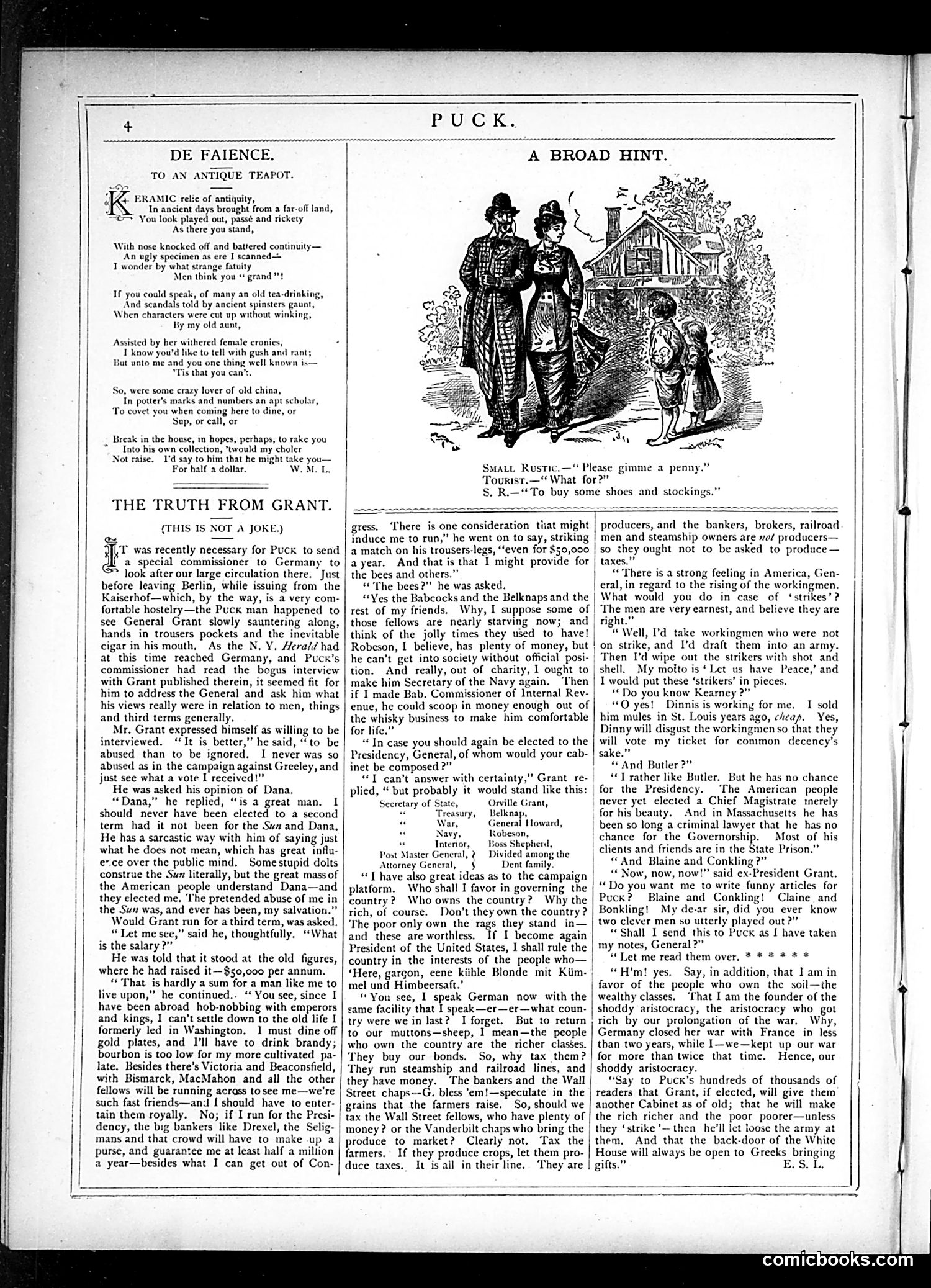
The cartoon "A Broad Hint" depicts a tourist asking a small rustic child for directions to buy shoes and stockings. It's a gentle joke about rural poverty—the implication being that such items are scarce in the countryside. "The Truth from Grant" is a political satire where General Ulysses S. Grant discusses economic policy and taxation. The text presents Grant defending his administration against criticism, arguing that taxing farmers and producers unfairly enriches bankers and railroad monopolies. The satire critiques Grant's actual policies and his relationships with wealthy industrialists, suggesting his presidency favored the rich over working people and farmers—a genuine political controversy of his era.
📄 Transcribed text from this page (OCR, searchable)
Machine-transcribed from the original scan — historical spelling and the odd misread are preserved.
DE FAIENCE. TO AN ANTIQUE TEAPOT. ERAMIC relic of antiquity, In ancient days brought from a far-off land, You look played out, passé and rickety | ‘As there you stand, With nose knocked off and battered continuity— An ugly specimen as ere I scanned 1 wonder by what strange fatuity Men think you * grand"! If you could speak, of many an old tea-drinking, And scandals told by ancient spinsters gaunt, When characters were cut up without winking, By my old aunt, Assisted by her withered female cronics, I know you'd like to tell with gush and rant; But unto me and you one thing well known is— ‘Tis that you can’. So, were some crazy lover of old china, In potter's marks and numbers an apt scholar, To covet you when coming here to dine, or Sup, or call, or Break in the house, in hopes, perhaps, to rake you Into his own collection, "twould my choler Not raise, I'd say to him that he might take you— For half a dollar. W. ML. THE TRUTH FROM GRANT. (THIS IS NOT A JOKE.) the was recently necessary for Puck to send a special commissioner to Germany to look after our large circulation there. Just before leaving Berlin, while issuing from the Kaiserhof—which, by the way, is a very com- fortable hostelry—the Puck man happened to see General Grant slowly sauntering along, hands in trousers pockets and the inevitable cigar in his mouth. As the N. Y. Hera/d had at this time reached Germany, and Puck’s commissioner had read the bogus interview with Grant published therein, it seemed fit for him to address the General and ask him what his views really were in relation to men, things and third terms generally. Mr. Grant expressed himself as willing to be interviewed. ‘It is better,” he said, “to be abused than to be ignored. I never was so abused as in the campaign against Greeley, and just see what a vote I received!” He was asked his opinion of Dana. “Dana,” he replied, “is a great man. 1 should never have been elected to a second term had it not been for the Sux and Dana, He has a sarcastic way with him of saying just what he does not mean, which has great influ- ev.ce over the public mind. Somestupid dolts construe the Suz literally, but the great mass of the American people understand Dana—and they elected me. ‘The pretended abuse of me in the Sux was, and ever has been, my salvation.” Would Grant run for a third term, was asked. “Let me see,” said he, thoughtfully. “What is the salary ?” He was told that it stood at the old figures, where he had raised it—$50,000 per annum. “That is hardly a sum for a man like me to live upon,” he continued.- “ You see, since I have been abroad hob-nobbing with emperors and kings, I can’t settle down to the old life I formerly led in Washington. 1 must dine off gold plates, and I'll have to drink brandy; bourbon is too low for my more cultivated pa- late. Besides there’s Victoria and Beaconsfield, with Bismarck, MacMahon and all the other fellows will be running acrass tosee me—we're such fast friends—anil I should have to enter- tain them royally. No; if I run for the Presi dency, the big bankers like Drexel, the Selig- mans and that crowd will have to make up a purse, and guarantee me at least half a million a year—besides what I can get out of Con- A BROAD HINT. SMALL Rustic.—“ Please gimme a penny.” ‘Tourist — "What for?” —“To buy some shoes and stock gress. ‘There is one consideration tiiat might induce me to run,” he went on to say, striking a match on his trousers-legs, “even for $50,000 ayear. And that is that I might provide for the bees and others.” “The bees?” he was asked. “Yes the Babcocks and the Belknapsand the rest of my friends. Why, I suppose some of those fellows are nearly starving now; and think of the jolly times they used to have! Robeson, I believe, has plenty of money, but he can’t get into society without official posi- tion. And really, out of charity, I ought to make him Secretary of the Navy again. ‘I'hen if I made Bab. Commissioner of Internal Rev- enue, he could scoop in money enough out of the whisky business to make him comfortable for life.” “Tn case you should again be elected to the Presidency, General, of whom would your cab- | inet be composed ?” “‘T can’t answer with certainty,” Grant r plied, “ but probably it would stand like thi Secretary of State, Orville Grant, “ Treasury, elknap, War, General Howard, “ Navy, Robeson, “ Interior, Hoss Shepherd, Post Master General, 2 led among the Attorney General, | § Dent family. “1 have also great ideas as to the campaign platform. Who shall I favor in governing the country? Who owns the country? Why the rich, of course. Don’t they own the country? ‘The poor only own the rags they stand in— and these are worthless. If I become again President of the United States, I shall rule the country in the interests of the people who— ‘Here, gargon, cene kiihle Blonde mit Kiim- mel und Himbeersaft.’ “You see, I speak German now with the same facility that 1 speak —er—er—what coun- try were we in last? I forget. But to return to our muttons—sheep, I mean—the people who own the country are the richer classes. They buy our bonds. So, why tax them? They run steamship and railroad lines, and they have money. The bankers and the Wall Street chaps—-G. bless ’em!—speculate in the gtains that the farmers raise. So, should we | tax the Wall Street fellows, who have plenty of money ? or the Vanderbilt chaps who bring the produce to market? Clearly not. Tax the farmers. If they produce crops, let them pro- duce taxes, It is ail in their line. They are | producers, and the bankers, brokers, railroad | men and steamship owners are of producers— so they ought not to be asked to produce— taxes.” “There is a strong feeling in America, G eral, in regard to the rising of the workingmen. What would you do in case of ‘strikes’? ‘The men are very earnest, and believe they are right.” “Well, I'd take workingmen who were not ‘on strike, and I’d draft them into an army. Then I'd wipe out the strikers with shot and shell. My molto is ‘Let us have Peace,’ and I would put these ‘strikers’ in pieces. | «Do you know Kearney ?” “O yes! Dinnis is working for me. I sold him mules in St. Louis years ago, cieap. Yes, Dinny will disgust the workingmen so that they will vote my ticket for common decency’s sake.” «And Butler ?” “T rather like Butler. But he has no chance for the Presidency. ‘fhe American people never yet elected a Chief Magistrate merely for his beauty. And in Massachusetts he has been so long a criminal lawyer that he has no | chance for the Governorship. Most of his | clients and friends are in the State Prison.” “And Blaine and Conkling ?” “ Now, now, now id ex-President Grant. “Do you want me to write funny articles for Puck? Blaine and Conkling! Claine and | Bonkling! My de-ar sir, did you ever know two clever men so utterly played out?” “Shall I send this to Puck as I have taken | my notes, General?” | ‘* Let me read them over, * * * * * “H'm! yes. Say, in addition, that 1 am in | favor of the people who own the soil—the | wealthy classes. ‘That I am the founder of the shoddy aristocracy, the aristocracy who got ; rich by our prolongation of the war. Why, Germany closed her war with France in less than two years, while I—we—kept up our war for more than twice that time. Hence, our shoddy aristocracy. “Say to Puck’s hundreds of thousands of readers that Grant, if elected, will give them another Cabinet as of old; that he will make the rich richer and the poor poorer—unless they ‘strike ’—then he'll let loose the army at them, And that the back-door of the White House will always be open to Greeks bringing | gifts.” E.S.1