
Puck, 1878-08-28 · page 3 of 16
Puck — August 28, 1878 — page 3: what you’re looking at
What you’re looking at
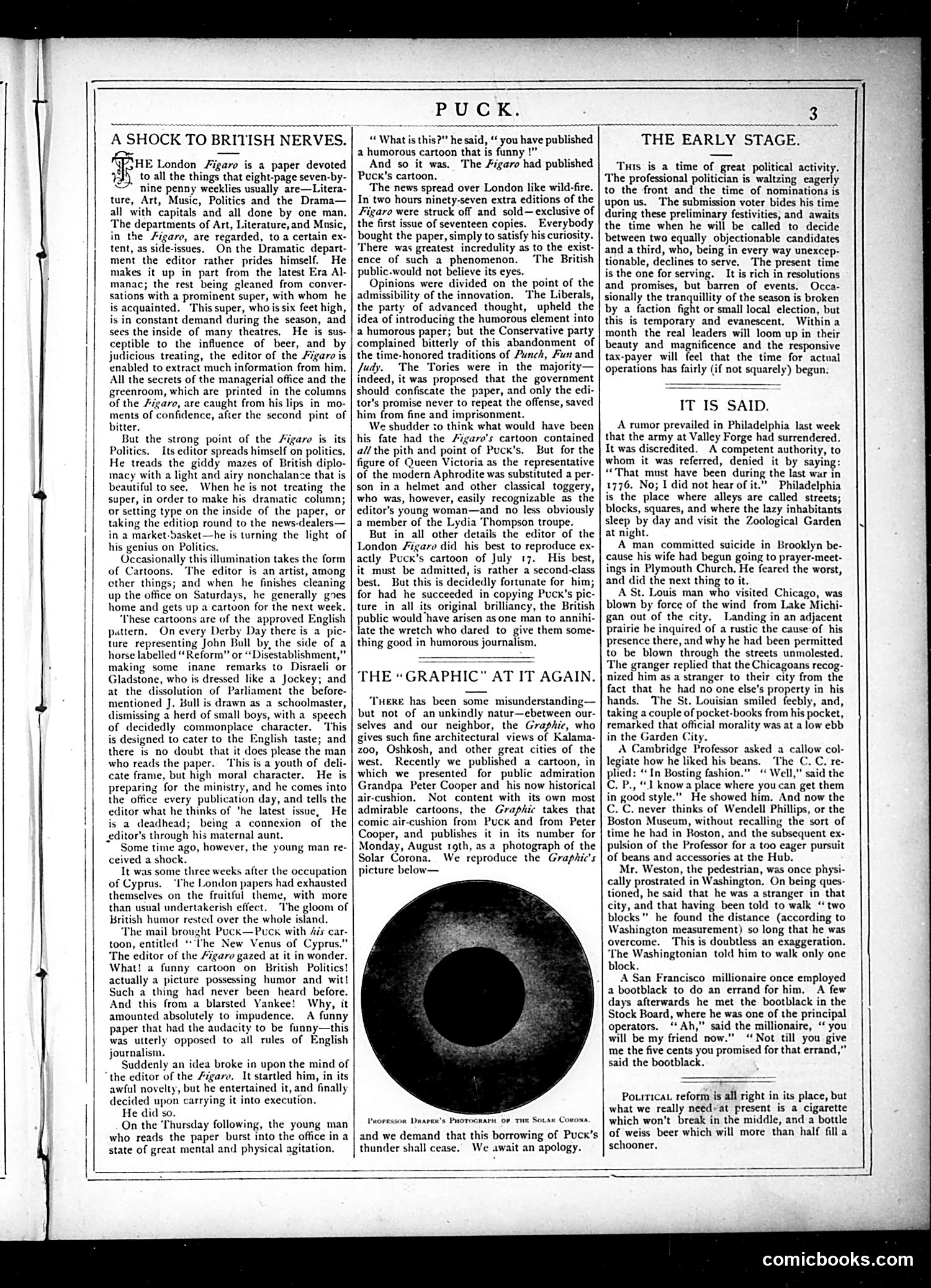
The editorial criticizes the *Figaro* (a French publication) for publishing a humorous cartoon about British life that some found offensive. The text reveals that the cartoon spread rapidly through London in multiple editions, shocking British sensibilities. The main image shows **Professor Huxley's photograph of the Solar Corona**—a scientific illustration, not political satire. The editors note they're reprinting it as "a photograph of the Solar Corona" after it was misidentified or misused elsewhere. The satire targets British resistance to French humor and the *Figaro's* audacity in lampooning English customs. Puck defends the humorous element in journalism, arguing the British shouldn't be so thin-skinned about foreign mockery of their traditions and peculiarities.
📄 Transcribed text from this page (OCR, searchable)
Machine-transcribed from the original scan — historical spelling and the odd misread are preserved.
A SHOCK TO BRITISH NERVES. ee London Figaro is a paper devoted to all the things that eight-page seven-by- nine penny weeklies usually are—Litera- ture, Art, Music, Politics and the Drama— all with capitals and all done by one man. The departments of Art, Literature,and Music, in the Figaro, are regarded, to a certain ex- tent, as side-issues. On the Dramatic depart- ment the editor rather prides himself. He makes it up in part from the latest Era Al- manac; the rest being gleaned from conver- sations with a prominent super, with whom he is acquainted. ‘This super, who is six feet high, is in constant demand during the season, and sees the inside of many theatres. He is sus- ceptible to the influence of beer, and by judicious treating, the editor of the Figaro is enabled to extract much information from him. All the secrets of the managerial office and the greenroom, which are printed in the columns of the /igaro, are caught from his lips in mo- ments of confidence, after the second pint of bitter. But the strong point of the Figaro is its Politics. Its editor spreads himself on politics. He treads the giddy mazes of British diplo- macy with a light and airy nonchalanze that is beautiful to see. When he is not treating the super, in order to make his dramatic column; or setting type on the inside of the paper, or taking the edition round to the news-dealers— in a market-basket—he is turning the light of his genius on Politi Occasionally this illumination takes the form of Cartoons, The editor is an artist, among other things; and when he finishes cleaning up the office on Saturdays, he generally goes home and gets up a cartoon for the next week. ‘These cartoons are of the approved English pattern, On every Derby Day there is a pic- ture representing John Bull by, the side of a horse labelled “Reform” or ‘‘Disestablishment,” making some inane remarks to Disraeli or Gladstone, who is dressed like a Jockey; and at the dissolution of Parliament the before- mentioned J. Bull is drawn as a schoolmaster, dismissing a herd of small boys, with a speech of decidedly commonplace character. ‘This is designed to cater to the English taste; and there is no doubt that it does please the man who reads the paper. ‘This is a youth of deli- cate frame, but high moral character. He is preparing for the ministry, and he comes into the office every publication day, and tells the editor what he thinks of ‘he latest issue, He is a deadhead; being a connexion of the editor's through his maternal aunt. Some time ago, however, the young man re- ceived a shock. It was some three weeks after the occupation of Cyprus. ‘The London papers had exhausted themselves on the fruitful theme, with more than usual undertakerish effect. ‘he gloom of British humor rested over the whole island. The mail brought Puck—Puck with Ais car- toon, entitled “The New Venus of Cyprus.” The editor of the /igaro gazed at it in wonder. What! a funny cartoon on British Politics! actually a picture possessing humor and wit! Such a thing had never been heard before. ‘And this from a blarsted Yankee! Why, it amounted absolutely to impudence. A funny paper that had the audacity to be funny—this was utterly opposed to all rules of English journalism. Suddenly an idea broke in upon the mind of “the editor of the Figaro. It startled him, in its awful novelty, but he entertained it, and finally decided upon carrying it into execution. He did so. On the ‘Thursday following, the young man who reads the paper burst into the office in a state of great mental and physical agitation, PUCK. “ What is this?” he said, ‘ you have published a humorous cartoon that is funny !” And so it was. The Figaro had published Puck's cartoon. The news spread over London like wild-fire. In two hours ninety-seven extra editions of the Figaro were struck off and sold—exclusive of the first issue of seventeen copies. Everybody bought the paper, simply to satisfy his curiosity, ‘There was greatest incredulity as to the exist- ence of such a phenomenon. The British public.would not believe its eyes. Opinions were divided on the point of the admissibility of the innovation. ‘The Liberals, the party of advanced thought, upheld the idea of introducing the humorous element into a humorous paper; but the Conservative party complained bitterly of this abandonment of the time-honored traditions of Punch, Fun and Judy. The Tories were in the majority— indeed, it was proposed that the government should confiscate the paper, and only the edi- tor’s promise never to repeat the offense, saved him from fine and imprisonment. We shudder to think what would have been his fate had the /igaro’s cartoon contained ail the pith and point of Puck's. But for the figure of Queen Victoria as the representative of the modern Aphrodite was substituted a per- son ina helmet and other classical toggery, who was, however, easily recognizable as the editor’s young woman—and no less obviously a member of the Lydia Thompson troupe. But in all other details the editor of the London Figaro did his best to reproduce ex- actly Puck’s cartoon of July 17. His best, it must be admitted, is rather a second-class best. But this is decidedly fortunate for him; for had he succeeded in copying Puck's pic- ture in all its original brilliancy, the British public would have arisen as one man to annihi- late the wretch who dared to give them some- thing good in humorous journalism. THE “GRAPHIC” AT IT AGAIN. ‘THere has been some misunderstanding— but not of an unkindly natur—ebetween our- selves and our neighbor, the Graphic, who gives such fine architectural views of Kalama- 200, Oshkosh, and other great cities of the west. Recently we published a cartoon, in which we presented for public admiration Grandpa Peter Cooper and his now historical air-cushion, Not content with its own most admirable cartoons, the Graphic takes that comic air-cushion from Puck and from Peter Cooper, and publishes it in its number for Monday, August rgth, as a photograph of the Solar Corona. We reproduce the Graphic's picture below— GRAPH OP THE SoLaK Corona. Provesson Dearen's Puor and we demand that this borrowing of Puck's thunder shall cease. We await an apology. THE EARLY STAGE. Tuts is a time of great political activity. The professional politician is waltzing ener to the front and the time of nominations is upon us. The submission voter bides his time during these preliminary festivities, and awaits the time when he will be called to decide between two equally objectionable candidates and a third, who, being in every way unexcep- tionable, declines to serve. The present time is the one for serving. It is rich in resolutions and promises, but barren of events. Occa- sionally the tranquillity of the season is broken by a faction fight or small local election, but this is temporary and evanescent. Within a month the real leaders will loom up in their beauty and magnificence and the responsive tax-payer will feel that the time for actual operations has fairly (if not squarely) begun. IT IS SAID. A rumor prevailed in Philadelphia last week that the army at Valley Forge had surrendered. It was discredited. A competent authority, to whom it was referred, denied it by saying: “That must have been during the last war in 1776. No; 1 did not hear of it.” Philadelphia is the place where alleys are called streets; blocks, squares, and where the lazy inhabitants sleep by day and visit the Zoological Garden at night. A man committed suicide in Brooklyn be- cause his wife had begun going to prayer-meet- ings in Plymouth Church. He feared the worst, and did the next thing to it. A St. Louis man who visited Chicago, was blown by force of the wind from Lake Michi- gan out of the city. Landing in an adjacent prairie he inquired of a rustic the cause of his presence there, and why he had been permitted to be blown through the streets unmolested. The granger replied that the Chicagoans recog- nized him as a stranger to their city from the fact that he had no one else's property in his hands. The St. Louisian smiled feebly, and, taking a couple of pocket-books from his pocket, remarked that official morality was at a low ebb in the Garden City. A Cambridge Professor asked a callow col- legiate how he liked his beans. The C. C, re- “In Bosting fashion.” ‘‘ Well,” said the . “1 know a place where you can get them in good style.” He showed him. And now the C. C. never thinks of Wendell Phillips, or the Boston Museum, without recalling the sort of time he had in Boston, and the subsequent ex- pulsion of the Professor for a too eager pursuit of beans and accessories at the Hub. Mr. Weston, the pedestrian, was once physi- cally prostrated in Washington. On being ques- tioned, he said that he was a stranger in that city, and that having been told to walk ‘two blocks” he found the distance (according to Washington measurement) so long that he was overcome. This is doubtless an exaggeration. ‘The Washingtonian told him to walk only one block. A San Francisco millionaire once employed a bootblack to do an errand for him. A few days afterwards he met the bootblack in the Stock Board, where he was one of the principal operators. ‘ Ah," said the millionaire, “ you will be my friend now.” ‘Not till you give me the five cents you promised for that errand,” said the bootblack. Pouirica reform is all right in its place, but what we really needvat present is a cigarette which won't break in the middle, and a bottle of weiss beer which will more than half fill a schooner, comicbooks.com