
Puck, 1878-08-28 · page 12 of 16
Puck — August 28, 1878 — page 12: what you’re looking at
What you’re looking at
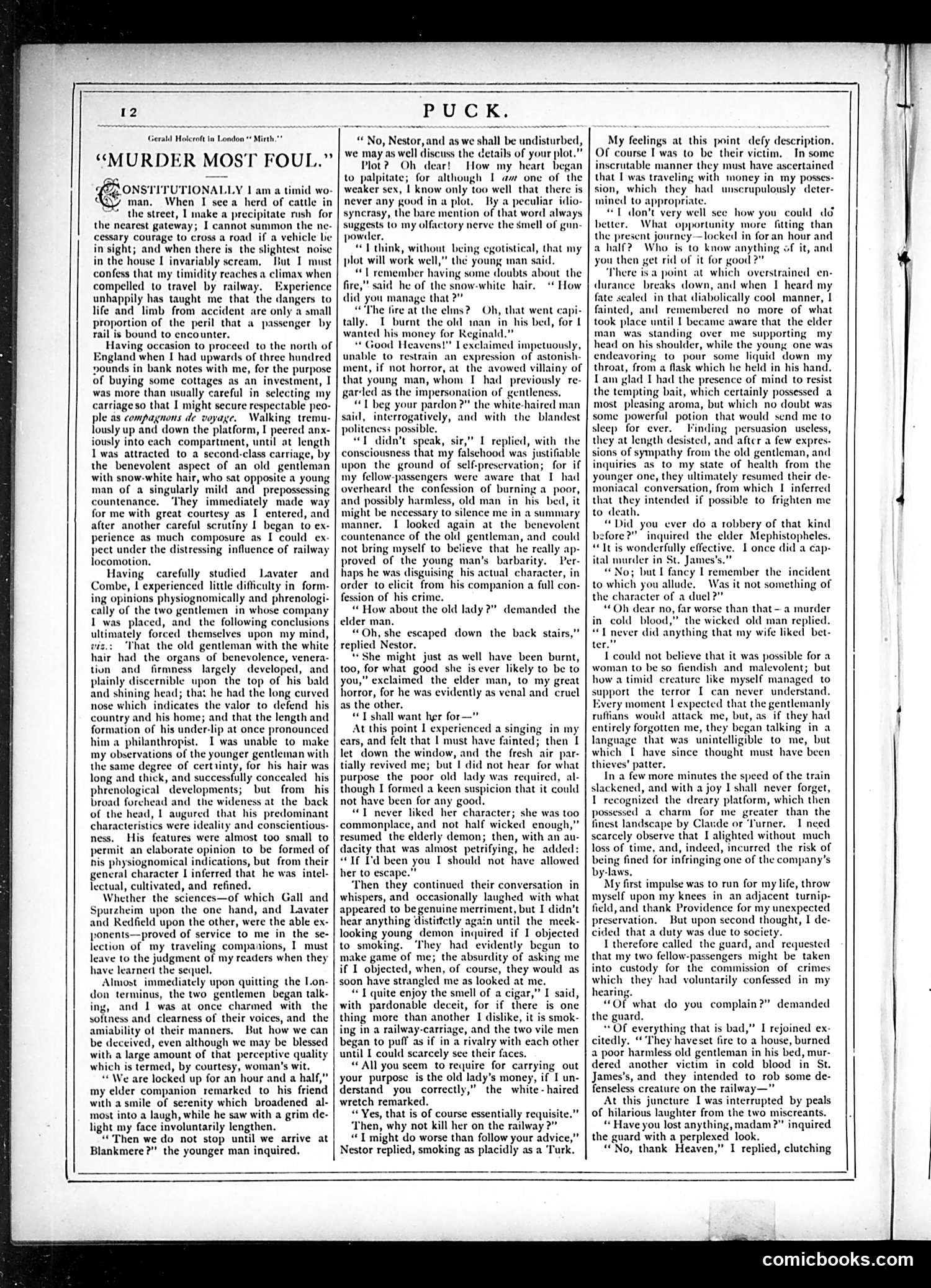
This page presents a serialized story rather than a political cartoon. The narrative depicts a conversation between passengers in a railway carriage involving an older gentleman, a younger man, and a white-haired woman. The plot involves discussion of a crime—apparently a murder—with mentions of "St. James's" and references to silencing witnesses. The story appears to be a Gothic melodrama emphasizing class anxieties (references to "gentlemen," servants, and social propriety). The text plays on Victorian concerns about railway travel safety and criminal deception. Without seeing the illustrations or knowing the serial's full context, the exact satirical target remains unclear, though it likely reflects period anxieties about crime, class, and urban danger.
📄 Transcribed text from this page (OCR, searchable)
Machine-transcribed from the original scan — historical spelling and the odd misread are preserved.
ral Hoteroft in London ** M “MURDER MOST FOUL.” q % ONSTITUTIONALL Y lama timid w QYy man. When I see a herd of cattle in the street, I make a precipitate rush for the nearest gateway; I cannot summon the ne- cessary courage to cross a road if a vehicle be in sight; and when there is the slightest noise in the house I invariably scream, But I must confess that my timidity reaches a climax when compelled to travel by railway, Experience unhappily has taught me that the dangers to life and limb from accident are only a small proportion of the peril that a passenger by rail is bound to encounter. Having occasion to proceed to the north of England when I had upwards of three hundred pounds in bank notes with me, fer the purpose of buying some cottages as an investment, I was more than usually careful in selecting my carriage so that I might secure respectable peo- ple as compagnons de voyage, Walking tremu- lously up and down the platform, I peered anx- iously into cach compartinent, until at length 1 was attracted to a second-class carriage, by the benevolent aspect of an old gentleman with snow-white hair, who sat opposite a young man of a singularly mild and prepossessing countenance. ‘They immediately made way for me with great courtesy as I entered, and after another careful scrutiny 1 began to ex- perience as much composure as I could. ex- pect under the distressing influence of railway locomotion. Having carefully studied Lavater and Combe, | experienced little difficulty in form- ing opinions physiognomically and phrenologi- cally of the two gentlemen in whose company 1 was placed, and the following conclusions ultimately forced themselves upon my mind, ‘That the old gentleman with the white hair had the organs of benevolence, venera- tiun and firmness largely developed, and plainly discernible upon the top of his bald and shining head; that he had the long curved nose which indicates the valor to defend his country and his home; and that the length and formation of his under-lip at once pronounced him a philanthropist. I was unable to make my observations of the younger gentleman with the same degree of certiinty, for his hair was long and thick, and successfully concealed his vis.: phrenological ‘developments; but from his broad forehead and the wideness at the back of the head, 1 augured that his predominant characteristics were ideality and conscientious- ness. His features were almost too small to permit an elaborate opinion to be formed of nis physiognomical indications, but from their general character I inferred that he was intel- lectual, cultivated, and refined. Whether the sciences—of which Gall and Spurzheim upon the one hand, and Lavater and Redfield upon the other, were the able ex- ponents—proved of service to me in the se- lection of my traveling companions, I must leave to the judgment of my readers when they have learned the sequel, Almost immediately upon quitting the Lon- don terminus, the two gentlemen began talk- ing, and 1 was at once charmed with the softness and clearness of their voices, and the amiability of their manners, But how we can be deceived, even although we may be blessed with a large amount of that perceptive quality which is termed, by courtesy, woman's wit. “We are locked up for an hour and a half,” my elder companion remarked to his friend with a smile of serenity which broadened al- most into a laugh, while he saw with a grim de- lig! he my face involuntarily lengthen. Then we do not stop until we arrive at Blankmere ?” the younger man inquired. PUCK. “No, Nestor, and as we shall be undisturbed, we may as well discuss the details of your plot.” Plot? Oh dear! How my heart began to palpitate; for although I am one of the weaker sex, | know only too well that. there is never any good in a plot. By a peculiar idio- syncrasy, the bare mention of that word always suggests to my olfactory nerve the smell of gun- powiler. “T think, without being egotistical, about the “How ving some doubts fire," said he of the snow-white hair. did you manage that ?” “The fire at the elms? Oh, that went eapi- tally, I burnt the old ian in his bed, for 1 wanted his money for Reginald.” “Good Heavens!" Lexclaimed impetuously, unable to restrain an expression of astonish: ment, if not horror, at the avowed villainy of that young man, whom I had_ previously re- garded as the impersonation of gentleness, “T beg your pardon ?” the white-haired man said, interrogatively, and with the blandest politeness possible. “1 didn't speak, sir,” I replied, with the consciousness that my falsehood was justifiable upon the ground of self-preservation; for if my fellow-passengers were aware that I had overheard the confession of burning a poor, and possibly harmless, old man in his bed, it might be necessary to silence me in a summary manner, I looked again at the benevolent countenance of the old gentleman, and could not bring myself to believe that he really ap- proved of the young man's barbarity. “Per- haps he was disguising his actual character, in order to elicit from his companion a full con- fession of his crime. “ How about the old lady?” demanded the elder man. “Oh, she escaped down the back stairs,” replied Nestor. “She might just as well have been burnt, too, for what good she isever likely to be to you,” exclaimed the elder man, to my great horror, for he was evidently as venal and cruel as the other. “T shall want her for At this point I experienced a singing in my ears, and felt that I must have fainted; then I let_ down the window, and the fresh air par- tially revived me; but I did not hear for what purpose the poor old lady was required, al- though I formed a keen suspicion that it could not have been for any good. “T never liked her character; she was too commonplace, and not half wicked enough,” resumed the elderly demon; then, with an au- dacity that was almost petrifying, he added: “If I'd been you I should not have allowed her to escape.” ‘Then they continued their conversation in whispers, and occasionally laughed with what appeared to begenuine merriment, but I didn’t hear anything distittctly again until the meck- looking young demon inquired if I objected to smoking. ‘hey had evidently begun to make game of me; the absurdity of asking me if I objected, when, of course, they would as soon have strangled me as looked at me. “ T quite enjoy the smell of a cigar,” I said, with pardonable deceit, for if there is one thing more than another I dislike, it is smok- ing in a railway-carriage, and the two vile men began to puff as if in a rivalry with each other until I could scarcely see their faces. “All you seem to require for carrying out your purpose is the old lady’s money, if I un- derstand you correctly,” the white-haired wretch remarked. “Yes, that is of course essentially requisite.”” ‘Then, why not kill her on the railway ?” “I might do worse than follow your advice,” Nestor replied, smoking as placidly as a ‘Turk. My feelings at this point defy description. Of course I was to be their victim. In some inscrutable manner they must have ascertained that I was traveling with money in my posses- sion, which they had unscrupulously deter- mined to appropriate “TL don't very well see how you could dé better, What opportunity more fitting than the present journey—locked in foran hour and a half? Who is to know anything of it, and you then get rid of it for good ?” ‘There isa point at which overstrained en- durance breaks down, and when I heard my fate sealed in that diabolically cool manner, I fainted, and remembered no more of what took place until I became aware that the elder man was standing over me supporting my head on his shoulder, while the young one was endeavoring to pour some liquid down my throat, from a flask which he held in his hand. Lam glad I had the presence of mind to resist the tempting bait, which certainly possessed a most pleasing aroma, but which no doubt was some powerful potion that would send me to sleep for ever. Finding persuasion useles they at length desisted, and after a few expres- sions of sympathy from the old gentleman, and inquiries as to my state of health from the younger one, they ultimately resumed their de- moniacal conversation, from which I inferred that they intended if possible to frighten me to death, “Did you ever do a robbery of that kind before?” inquired the elder Mephistopheles. “It is wonderfully effective. 1 once did a cap- ital murder in St. James “No; but I fancy L remember the incident to which you allude, Was it not something of the character of a duel?’ “Oh dear no, far worse than that - a murder in cold blood,” the wicked old man replied. “T never did anything that my wife liked bet- ter.” I could not believe that it possible for a woman to be so fiendish and malevolent; but how a timid creature like myself managed to support the terror I can never understand. very moment I expected that the gentlemanly ruftians would attack me, but, as if they had entirely forgotten me, they began talking in a language that was unintelligible to me, but which [ have since thought must have been thieves’ patter. In a few more minutes the speed of the train slackened, and with a joy I shall never forget, I recognized the dreary platform, which then possessed a charm for me greater than the finest landscape by Claude or Turner. I need scarcely observe that I alighted without much loss of time, and, indeed, incurred the risk of being fined for infringing one of the company’s by-laws. My first impulse was to run for my life, throw myself upon my knees in an adjacent turnip- field, and thank Providence for my unexpected preservation. But upon second thought, I de- cided that a duty was due to society. I therefore called the guard, and requested that my two fellow-passengers might be taken into custody for the commission of crimes which they had voluntarily confessed in my hearing. “Of what do you complain?” demanded the guard, “ Of everything that is bad,” I rejoined ex citedly, “ ‘They haveset fire to a house, burned a poor harmless old gentleman in his bed, mur- dered another victim in cold blood in St. James's, and they intended to rob some de- fenseless creature on the railway—"” At this juncture I was interrupted by peals of hilarious laughter from the two miscreants. “ Have you lost anything, madam?” inquired the guard with a perplexed. loo! “No, thank Heaven,” I replied, clutching comicbooks.com