
Puck, 1878-06-26 · page 3 of 16
Puck — June 26, 1878 — page 3: what you’re looking at
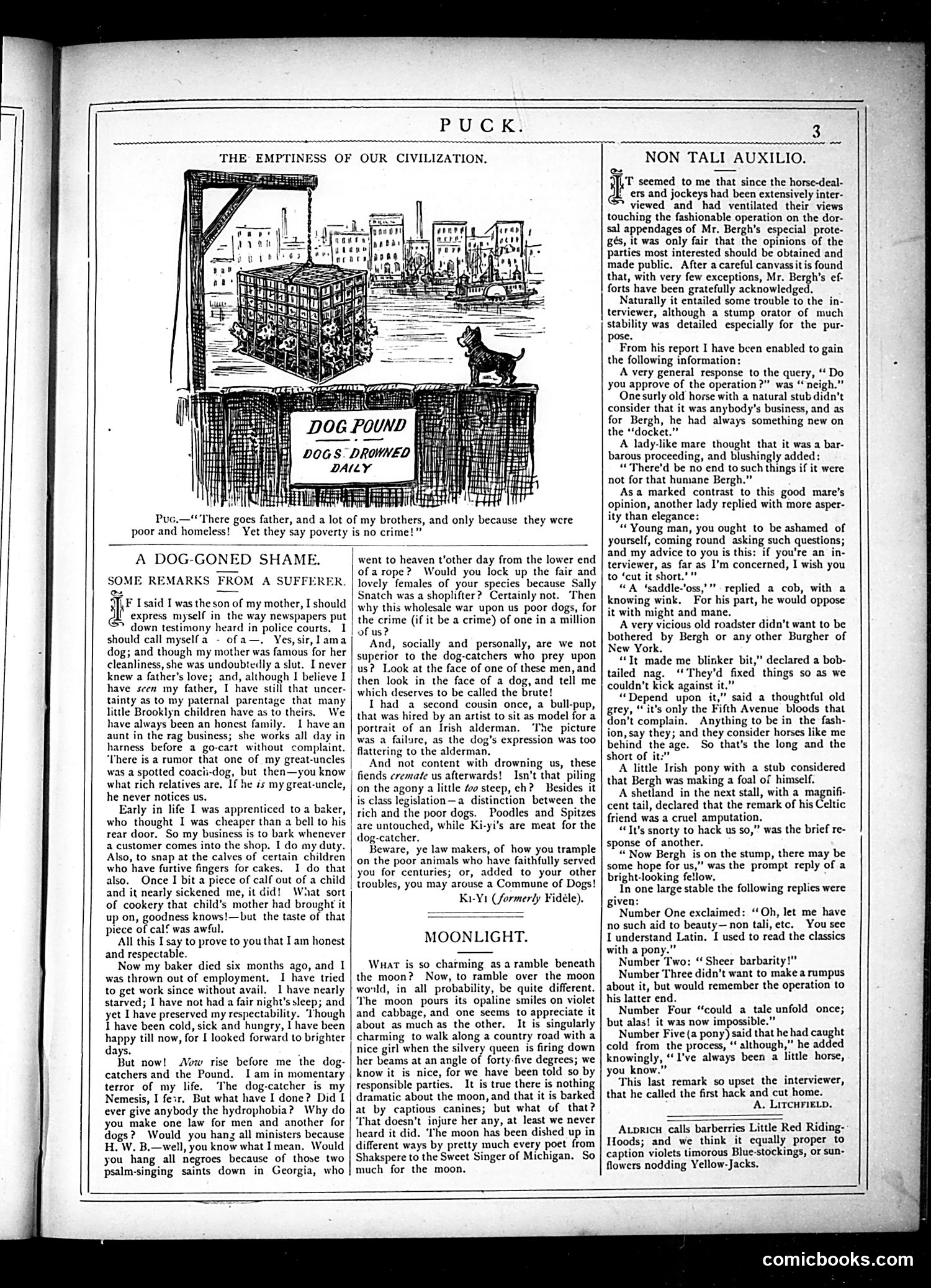
What you’re looking at
The main cartoon, "The Emptiness of Our Civilization," depicts a large dog pound structure dominating a cityscape, with a small dog nearby. The satire criticizes urban indifference to animal suffering: the caption quotes a horse questioning why society builds elaborate infrastructure to catch and kill stray dogs while claiming moral superiority. Below, "A Dog-Goned Shame" features a lengthy letter from "Some Woman from a Suburb" complaining that her unemployed father is reduced to begging while society prioritizes animal welfare. The satire suggests hypocrisy: Americans spend resources on dog shelters yet ignore human poverty and homelessness. Both pieces critique what Puck sees as misplaced moral priorities in American civilization—caring more for animals than for destitute humans.
📄 Transcribed text from this page (OCR, searchable)
Machine-transcribed from the original scan — historical spelling and the odd misread are preserved.
PUCK. 3 THE EMPTINESS OF OUR CIVILIZATION. DOG POUND DOGS. DROWNED ¥ 1G.—" There goes father, and a lot of my brothers, and only because they were poor and homeless!” Yet they say poverty is no crime!”” A DOG-GONED SHAME. ; SOME REMARKS FROM A SUFFERER. oe aaa I F Isaid I was the son of my mother, I should at express myself in the way newspapers put "> down testimony heard in police courts. I should call myself a - ofa—. Yes,sir,lama dog; and though my mother was famous for her cleanliness, she was undoubtedly a slut. I never knew a father’s love; and, although I believe I have seen my father, I have still that uncer- tainty as to my paternal parentage that many little Brooklyn children have as to theirs. We have always been an honest family. 1 have an aunt in the rag business; she works all day in harness before a go-c: ‘There is a rumor that one of my great-uncles was a spotted coacii-dog, but then—you know what rich relatives are. If he és my great-uncle, | he never notices us. Early in life 1 was apprenticed toa baker, who thought I was cheaper than a bell to his rear door. So my business is to bark whenever a customer comes into the shop. I do my duty. Also, to snap at the calves of certain children who have furtive fingers for cakes. I do that also. Once I bit a piece of calf out of a child and it nearly sickened me, it did! What sort of cookery that child's mother had brought it up on, goodness knows!—but the taste of that piece of calf was awful. All this I say to prove to you that Iam honest and respectable. Now my baker died six months ago, and I was thrown out of employment. I have tried to get work since without avail. I have nearly starved; I have not had a fair night's sleep; and yet I have preserved my respectability. ‘Though I have been cold, sick and hungry, I have been happy till now, for I looked forward to brighter days. Bat now! Now rise before me the dog- catchers and the Pound. Iam in momentary terror of my life. ‘The dog-catcher is my Nemesis, I feir, But what have I done? Did 1 ever give anybody the hydrophobia? Why do you make one law for men and another for dogs? Would you hang all ministers because H. W. B.—well, you know what I mean. Would you hang all negroes because of those two psalm-singing saints down in Georgia, who t without complaint. | | went to heaven t’other day from the lower end ofarope? Would you lock up the fair and lovely females of your species because Sally Snatch was a shoplifter? Certainly not. ‘Then why this wholesale war upon us poor dogs, for the crime (if it be a crime) of one in a million of us? And, socially and personally, are we not superior to the dog-catchers who prey upon us? Look at the face of one of these men, and then look in the face of a dog, and tell me which deserves to be called the brute! I had a second cousin once, a bull-pup, that was hired by an artist to sit as model for a portrait of an Irish alderman. ‘The picture was a failure, as the dog's expression was too flattering to the alderman, And not content with drowning us, these fiends cremate us afterwards! Isn't that piling on the agony a little foo steep, ch? Besides it is class legislation—a distinction between the rich and the poor dogs. Poodles and Spitzes | are untouched, while Ki-yi's are meat for the | dog-catcher. Beware, ye law makers, of how you trample on the poor animals who have faithfully served you for centuries; or, added to your other troubles, you may arouse a Commune of Dogs! K1-Y1 (formerly Fidéle). MOONLIGHT. Wuart is so charming as a ramble beneath the moon? Now, to ramble over the moon world, in all probability, be quite different. ‘The moon pours its opaline smiles on violet and cabbage, and one seems to appreciate it about as much as the other. It is singularly charming to walk along a country road with a nice girl when the silvery queen is firing down her beams at an angle of forty-five degrees; we know it is nice, for we have been told so by responsible parties. It is true there is nothing dramatic about the moon, and that it is barked at by captious canines; but what of that? ‘That doesn’t injure her any, at least we never heard it did. ‘I'he moon has been dished up in different ways by pretty much every poet from Shakspere to the Sweet Singer of Michigan. So much for the moon, NON TALI AUXILIO. ie seemed to me that since the horse-deal- E ers and jockeys had been extensively inter- viewed and had ventilated their views touching the fashionable operation on the dor- sal appendages of Mr. Bergh’s especial prote- gés, it was only fair that the opinions of the parties most interested should be obtained and made public. After a careful canvassit is found that, with very few exceptions, Mr. Bergh’s ef- forts have been gratefully acknowledged. Naturally it entailed some trouble to the in- terviewer, although a stump orator of much stability was detailed especially for the pur- pose. From his report I have been enabled to gain the following information: A very general response to the query, ‘Do you approve of the operation ?” was “neigh.” One surly old horse with a natural stub didn’t consider that it was anybody's business, and as for Bergh, he had always something new on the *‘docket.”” A lady-like mare thought that it was a bar- barous proceeding, and blushingly added: “There'd be no end to such things if it were not for that humane Bergh.” Asa marked contrast to this good mare's opinion, another lady replied with more asper- ity than elegance: “Young man, you ought to be ashamed of yourself, coming round asking such question: and my advice to you is this: if you're an in- terviewer, as far as I'm concerned, I wish you to ‘cut it short.’”” “A ‘saddle-'oss,’"" replied a cob, with a knowing wink. For his part, he would oppose it with might and mane. A very vicious old roadster didn’t want to be bothered by Bergh or any other Burgher of New York. “Tt made me blinker bit,” declared a bob- tailed nag. ‘They'd fixed things so as we couldn't kick against it.” “Depend upon it,” said a thoughtful old grey, ‘it’s only the Fifth Avenue bloods that don’t complain. Anything to be in the fash- ion, say they; and they consider horses like me behind the age. So that’s the long and the short of it:”” A little Irish pony with a stub considered that Bergh was making a foal of himself. A shetland in the next stall, with a magnifi- cent tail, declared that the remark of his Celtic friend was a cruel amputation. “It's snorty to hack us so,” was the brief re- sponse of another. “ Now Bergh is on the stump, there may be some hope for us,” was the prompt reply of a bright-looking fellow. In one large stable the following replies were given: Number One exclaimed: ‘‘Oh, let me have no such aid to beauty—non tali,etc. You see I understand Latin. I used to read the classics with a pony.” Number Two: “ Sheer barbarity!” Number Three didn’t want to make a rumpus about it, but would remember the operation to his latter end. Number Four “could a tale unfold once; but alas! it was now impossible.” Number Five (a pony) said that hehad caught cold from the process, “ although,” he added knowingly, “I've always been a little horse, you know.” Pats This last remark so upset the interviewer, that he called the first hack and cut home. A, LiTcHFigELp. ALpRICH calls barberries Red Riding- Hoods; and we think it equally proper to caption violets timorous Blue-stockings, or sun- flowers nodding Yellow-Jacks. comicbooks.com