
Puck, 1878-06-26 · page 4 of 16
Puck — June 26, 1878 — page 4: what you’re looking at
What you’re looking at
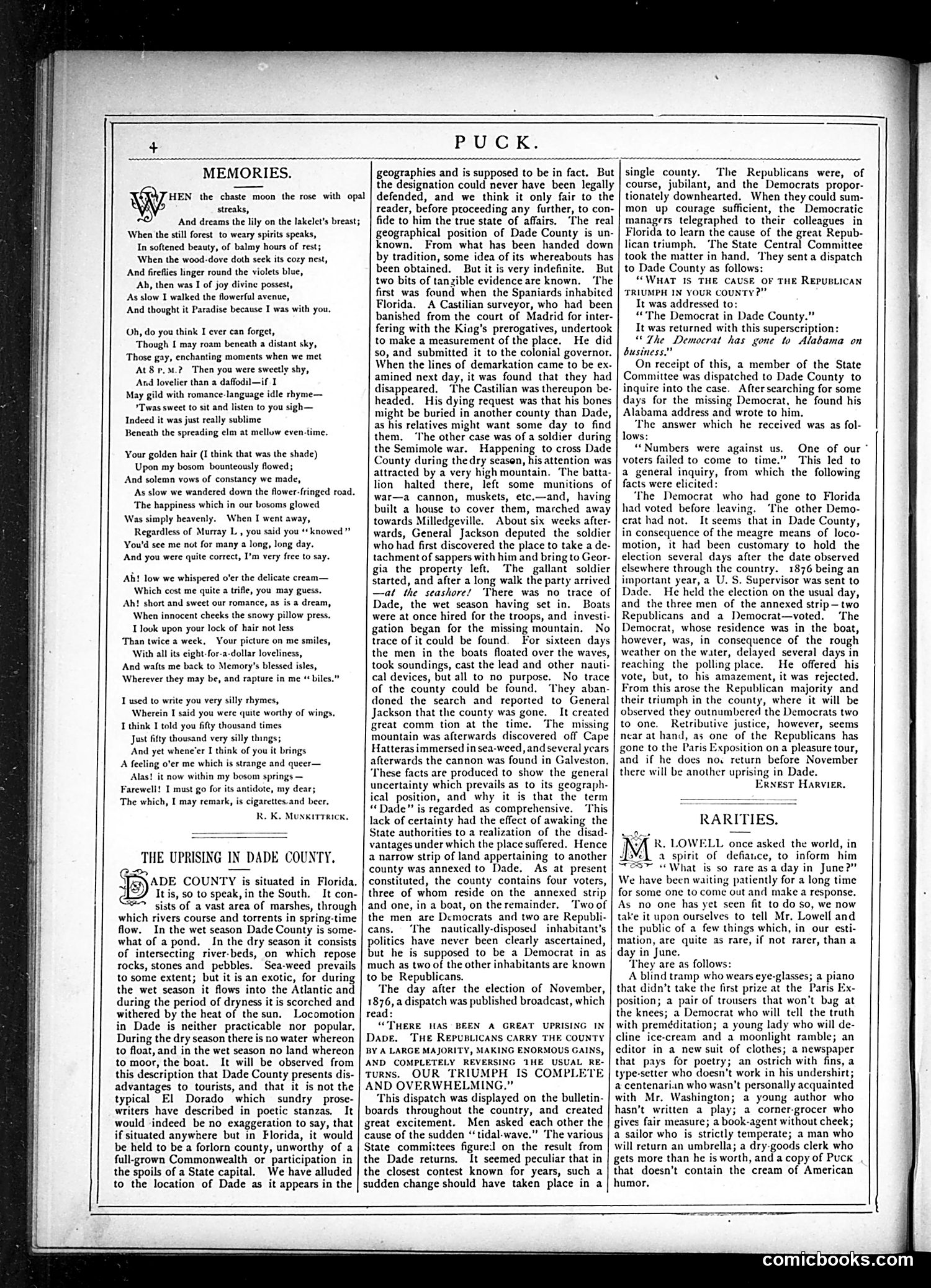
This page contains **no political cartoons**. Instead, it features: 1. **"Memories"** — a poem by H. K. Smuckthrick, appearing to be sentimental verse about nostalgia and lost love. 2. **"The Uprising in Dade County"** — a detailed article about a Republican electoral victory in Florida's Dade County. The piece describes how Republicans unexpectedly won this typically Democratic area, attributing the triumph to various local political maneuvering and the Democrats' missteps (including a missing party operative sent to secure the region). 3. **"Rarities"** — a brief humor section listing unusual items Mr. Lowell has encountered, serving as light comic filler. The page is primarily **textual political commentary and poetry**, not visual satire.
📄 Transcribed text from this page (OCR, searchable)
Machine-transcribed from the original scan — historical spelling and the odd misread are preserved.
PUCK. MEMORIES. HEN the chaste moon the rose with opal streaks, And dreams the lily on the lakelet’s breast; When the still forest to weary spirits speaks, In softened beauty, of balmy hours of rest; ‘When the wood-dove doth seek its cozy nest, And fireflies linger round the violets blue, Ab, then was I of joy divine possest, As slow I walked the flowerful avenue, ‘And thought it Paradise because I was with you, Oh, do you think I ever can forget, Though I may roam beneath a distant sky, Those gay, enchanting moments when we met At8r.M.? Then you were sweetly shy, ‘And lovelier than a daffodil—if 1 May gild with romance-language idle rhyme— "Twas sweet to sit and listen to you sigh— Indeed it was just really sublime Beneath the spreading elm at mellow even-time. Your golden hair (I think that was the shade) Upon my bosom bounteously flowed; And solemn vows of constancy we made, As slow we wandered down the flower-fringed road. ‘The happiness which in our bosoms glowed Was simply heavenly. When I went away, Regardless of Murray L , you said you “* knowed ” You'd sce me not for many a long, long day. And you were quite correct, I’m very free to say. Ab! low we whispered o'er the delicate cream— Which cost me quite a trifle, you may guess. Ah! short and sweet our romance, as is a dream, When innocent cheeks the snowy pillow press. T look upon your lock of hair not less ‘Than twice a week, Your picture on me smiles, With all its eight-for-a-dollar loveliness, And wafts me back to Memory’s blessed isles, Wherever they may be, and rapture in me *biles.” I used to write you very silly rhymes, Wherein I said you were quite worthy of wings. I think I told you fifty thousand times Just fifty thousand very silly things; ‘And yet whene’er I think of you it brings A feeling o'er me which is strange and queer— Alas! it now within my bosom springs — Farewell! I must go for its antidote, my dear; The which, I may remark, is cigarettes.and beer. R. K. Munxrrtrick. THE UPRISING IN DADE COUNTY. aS Swe COUNTY is situated in Florida. <7 It is, so to speak,in the South. It con- GS sists of a vast area of marshes, through which rivers course and torrents in spring-time In the wet season Dade County is some- what of a pond. In the dry season it consists of intersecting river-beds, on which repose rocks, stones and pebbles. Sea-weed prevails to some extent; but it isan exotic, for during the wet season it flows into the Atlantic and during the period of dryness it is scorched and withered by the heat of the sun. Locomotion in Dade is neither practicable nor popular. During the dry season there is no water whereon to float, and in the wet season no land whereon to moor, the boat. It will be observed from this description that Dade County presents dis- advantages to tourists, and that it is not the typical El Dorado which sundry prose- writers have described in poetic stanzas. It would indeed be no exaggeration to say, that if situated anywhere but in Florida, it would be held to be a forlorn county, unworthy of a full-grown Commonwealth or participation in the spoils of a State capital. We have alluded to the location of Dade as it appears in the flow. geographies and is supposed to be in fact. But the designation could never have been legally defended, and we think it only fair to the reader, before proceeding any further, to con- fide to him the true state of affairs, The real geographical position of Dade County is un- known. From what has been handed down by tradition, some idea of its whereabouts has been obtained. But it is very indefinite. But two bits of tanzible evidence are known. ‘The first was found when the Spaniards inhabited Florida. A Castilian surveyor, who had been banished from the court of Madrid for inter- fering with the King’s prerogatives, undertook to make a measurement of the place. He did so, and submitted it to the colonial governor. When the lines of demarkation came to be ex- amined next day, it was found that they had disappeared. ‘The Castilian was thereupon be- headed. His dying request was that his bones might be buried in another county than Dade, as his relatives might want some day to find them. ‘The other case was of a soldier during the Semimole war. Happening to cross Dade County during thedry season, his attention was attracted by a very high mountain. ‘The batta- lion halted there, left some munitions of war—a cannon, muskets, etc.—and, having built a house to cover them, marched away towards Milledgeville. About six weeks after- wards, General Jackson deputed the soldier who had first discovered the place to take a de- tachment of sappers with him and bring to Geor- gia the property left. The gallant soldier started, and after a long walk the party arrived —at the seashore! There was no trace of Dade, the wet season having set in. Boats were at once hired for the troops, and investi- gation began for the missing mountain. No trace of it could be found. For sixteen days the men in the boats floated over the waves, took soundings, cast the lead and other nauti- cal devices, but all to no purpose. No trace of the county could be found. They aban- doned the search and reported to General Jackson that the county was gone. It created great comm tion at the time. The missing mountain was afterwards discovered off Cape Hatteras immersed in sea-weed, and several years afterwards the cannon was found in Galveston. ‘These facts are produced to show the general uncertainty which prevails as to its geograph- ical position, and why it is that the term “Dade” is regarded as comprehensive. This lack of certainty had the effect of awaking the State authorities to a realization of the disad- vantages under which the place suffered. Hence a narrow strip of land appertaining to another county was annexed to Dade. As at present constituted, the county contains four voters, three of whom reside on the annexed strip and one, in a boat, on the remainder. ‘Two of the men are Democrats and two are Republi- cans. ‘The nautically-disposed inhabitant’s politics have never been clearly ascertained, but he is supposed to be a Democrat in as much as two of the other inhabitants are known to be Republicans. ‘The day after the election of November, 1876, a dispatch was published broadcast, which read: “THERE HAS BEEN A GREAT UPRISING IN Dave. THe REPUBLICANS CARRY THE COUNTY BY A LARGE MAJORITY, MAKING ENORMOUS GAINS, AND COMPLETELY REVERSING 1HE USUAL RE- turns. OUR TRIUMPH IS COMPLETE AND OVERWHELMING.” This dispatch was displayed on the bulletin- boards throughout the country, and created great excitement. Men asked each other the cause of the sudden “tidal-wave.” The various State committees figured on the result from the Dade returns. It seemed peculiar that in the closest contest known for years, such a sudden change should have taken place in a single county. The Republicans were, of course, jubilant, and the Democrats propor- tionately downhearted, When they could sum- mon up courage sufficient, the Democratic managers telegraphed to their colleagues in Florida to learn the cause of the great Repub- lican triumph, ‘The State Central Committee took the matter in hand, ‘They sent a dispatch to Dade County as follows: “WHAT IS THE CAUSE OF THE REPUBLICAN TRIUMPH IN YOUR COUNTY ?”” It was addressed to: “The Democrat in Dade County.” It was returned with this superscription: “The Democrat has gone to Alabama on business.” On receipt of this, a member of the State Committee was dispatched to Dade County to inquire into the case. After searching for some days for the missing Democrat, he found his Alabama address and wrote to him, ‘The answer which he received was as fol- lows: “Numbers were against us. One of our” voters failed to come to time.” This led to a general inquiry, from which the following facts were elicited: ‘The Democrat who had gone to Florida had voted before leaving. ‘The other Demo- crat had not. It seems that in Dade County, in consequence of the meagre means of loco- motion, it had been customary to hold the election several days after the date observed Isewhere through the country. 1876 being an important year, a U. S. Supervisor was sent to Dade. He held the election on the usual day, and the three men of the annexed strip—two Republicans and a Iemocrat—voted. ‘The Democrat, whose residence was in the boat, however, was, in consequence of the rough weather on the water, delayed several days in reaching the polling place. He offered his vote, but, to his amazement, it was rejected. From this arose the Republican majority and their triumph in the county, where it will be observed they outnumbered the Democrats two to one. Retributive justice, however, seems near at hand, as one of the Republicans has gone to the Paris Exposition on a pleasure tour, and if he does nov return before November there will be another uprising in Dade. SRNEST HaRVIER. RARITIES, R. LOWELL once asked the world, in a spirit of defiance, to inform him “What is so rare asa day in June?” We have been waiting patiently for a long time for some one to come out and make a response, As no one has yet scen fit to do so, we now take it upon ourselves to tell Mr. Lowell and the public of a few things which, in our esti- mation, are quite as rare, if not rarer, than a day in June. ‘They are as follow A blind tramp who wears eye-glasses; a piano that didn’t take the first prize at the Paris Ex- position; a pair of trousers that won't bag at the knees; a Democrat who will tell the truth with premeditation; a young lady who will de- cline ice-cream and a moonlight ramble; an editor in a new suit of clothes; a newspaper that pays for poetry; an ostrich with fins, a type-setter who doesn't work in his undershirt; a centenarian who wasn’t personally acquainted with Mr. Washington; a young author who hasn’t written a play; a corner-grocer who gives fair measure; a book-agent without cheek; a sailor who is strictly temperate; a man who will return an umbrella; a dry-goods clerk who gets more than he is worth, and a copy of Puck that doesn’t contain the cream of American comicbooks.com