
Puck, 1878-06-26 · page 12 of 16
Puck — June 26, 1878 — page 12: what you’re looking at
What you’re looking at
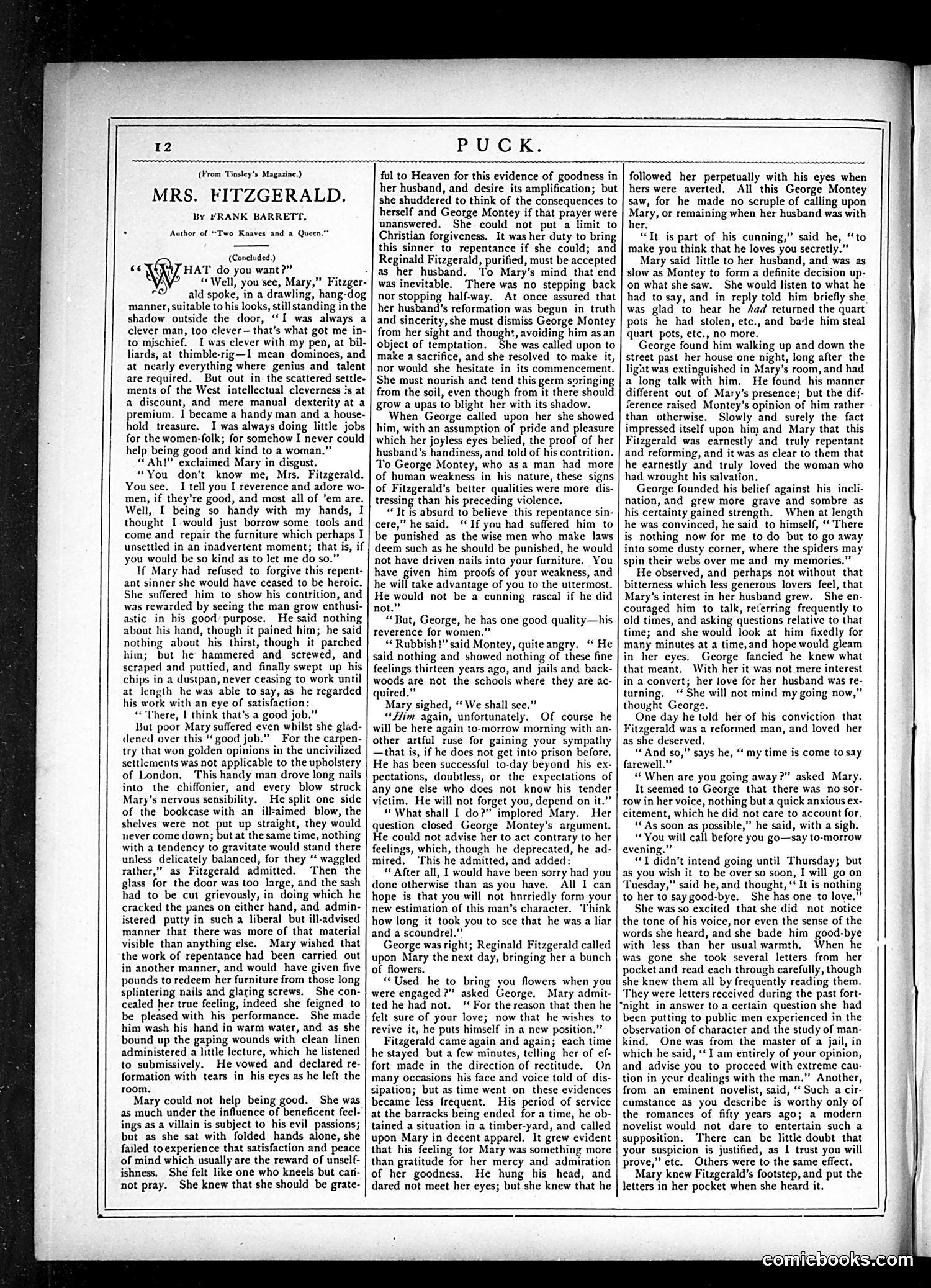
This page contains the conclusion of a serialized story titled "Mrs. Fitzgerald" by Frank Barrett, credited as author of "Two Saved a Queen." The content is primarily **literary fiction, not political satire or cartooning**. It depicts a domestic drama involving characters named Mary and George Montey, exploring themes of marriage, repentance, and moral reformation. The narrative discusses George's past failings, his redemption through Mary's influence, and their reconciliation. There are **no visible political cartoons or caricatures** on this page. Rather than satirizing current events or public figures, this appears to be Puck magazine's serialized fiction content—a common feature in late 19th-century publications that mixed humor, satire, and literary entertainment for general audiences.
📄 Transcribed text from this page (OCR, searchable)
Machine-transcribed from the original scan — historical spelling and the odd misread are preserved.
(From Tinsley's Magazine.) MRS. FITZGERALD. By FRANK BARRETT, . Author of “Two Knaves and a Queen."* (Concluded.) HAT do you want?” : “Well, you see, Mary,” Fitzger- ald spoke, in a drawling, hang-dog manner, suitable to his looks, still standing in the shadow outside the door, “I was always a clever man, too clever— that’s what got me in- to mischief. I was clever with my pen, at Dil- liards, at thimble-rig—1 mean dominoes, and at nearly everything where genius and talent are required. But out in the scattered settle- ments of the West intellectual cleverness is at a discount, and mere manual dexterity at a premium. I became a handy man and a house- hold treasure. I was always doing little jobs for the women-folk; for somehow I never could help being good and kind to a woman.” “ Ah!" exclaimed Mary in disgust. “You don't know me, Mrs. Fitzgerald. You see. I tell you I reverence and adore wo- men, if they're good, and most all of ‘em are. Well, I being so handy with my hands, I thought I would just borrow some tools and come and repair the furniture which perhaps I unsettled in an inadvertent moment; that is, if you would be so kind as to let me do so.” If Mary had refused to forgive this repent- ant sinner she would have ceased to be heroic. She suffered him to show his contrition, and was rewarded by seeing the man grow enthusi- astic in his good’ purpose. He said nothing about his hand, though it pained him; he said nothing about his thirst, though it parched him; but he hammered and screwed, and scraped and puttied, and finally swept up his chips in a dustpan, never ceasing to work until at length he was able to say, as he regarded his work with an eye of satisfaction “There, | think that’s a good job. But poor Mary suffered even whilst she glad- dened over this “good job.” For the carpen- try that won golden opinions in the uncivilized settlements was not applicable to the upholstery of London. This handy man drove long nails into the chiffonier, and every blow struck Mary's nervous sensibility. He split one side of the bookcase with an ilkaimed blow, the shelves were not put up straight, they would never come down; but at the same time, nothing with a tendency to gravitate would stand there unless delicately balanced, for they “ waggled rather,” as Fitzgerald admitted. Then the glass for the door was too large, and the sash had to be cut grievously, in doing which he cracked the panes on either hand, and admin- istered putty in such a liberal but ill-advised manner that there was more of that material visible than anything else. Mary wished that the work of repentance had been carried out in another manner, and would have given five pounds to redeem her furniture from those long splintering nails and glaring screws. She con- cealed her true feeling, indeed she feigned to be pleased with his performance. She made him wash his hand in warm water, and as she bound up the gaping wounds with clean linen administered a little lecture, which he listened to submissively. He vowed and declared re- formation with tears in his eyes as he left the room. Mary could not help being good. She was as much under the influence of beneficent feel- ings as a villain is subject to his evil passions; but as she sat with folded hands alone, she failed to experience that satisfaction and peace of mind which usually are the reward of unself- ishness. She felt like one who kneels but cari- not pray. She knew that she should be grate- PUCK. ful to Heaven for this evidence of goodness in her husband, and desire its amplification; but she shuddered to think of the consequences to herself and George Montey if that prayer were unanswered. She could not put a limit to Christian forgiveness. It was her duty to bring this sinner to repentance if she could; and Reginald Fitzgerald, purified, must be accepted as her husband. ‘To Mary’s mind that end was inevitable. There was no stepping back nor stopping half-way. At once assured that her husband’s reformation was begun in truth and sincerity, she must dismiss George Montey from her sight and thought, avoiding him asan object of temptation. She was called upon to make a sacrifice, and she resolved to make it, nor would she hesitate in its commencement. She must nourish and tend this germ springing from the soil, even though from it there should grow a upas to blight her with its shadow. When George called upon her she showed him, with an assumption of pride and pleasure which her joyless eyes belied, the proof of her husband’s handiness, and told of his contrition. ‘To George Montey, who asa man had more of human weakness in his nature, these signs of Fitzgerald's better qualities were more dis- tressing than his preceding violence. “It is absurd to believe this repentance sin- cere,” he said. ‘If you had suffered him to be punished as the wise men who make laws deem such as he should be punished, he would not have driven nails into your furniture. You have given him proofs of your weakness, and he will take advantage of you to the uttermost. He would not be a cunning rascal if he did not.” “But, George, he has one good quality—his reverence for women,” “Rubbish!” said Montey, quite angry. “ He said nothing and showed nothing of these fine feelings thirteen years ago, and jails and back- woods are not the schools where they are ac- quired.” Mary sighed, We shall see. “Him again, unfortunately. Of course he will be here again to-morrow morning with an- other artful ruse for gaining your sympathy —that is, if he does not get into prison before. He has been successful to-day beyond his ex- pectations, doubtless, or the expectations of any one else who does not know his tender victim. He will not forget you, depend on it.” “What shall I do?” implored Mary. Her question closed George Montey’s argument. He could not advise her to act contrary to her feelings, which, though he deprecated, he ad- mired. ‘This he admitted, and added: “After all, I would have been sorry had you done otherwise than as you have. All I can hope is that you will not hnrriedly form your new estimation of this man’s character. ‘Think how long it took you to see that he was a liar and a scoundrel.”” George was right; Reginald Fitzgerald called upon Mary the next day, bringing her a bunch of flowers. “Used he to bring you flowers when you were engaged ?” asked George. Mary admit- ted he had not. ‘‘ For the reason that then he felt sure of your love; now that he wishes to revive it, he puts himself in a new position.” Fitzgerald came again and again; each time he stayed but a few minutes, telling her of ef- fort made in the direction of rectitude. On many occasions his face and voice told of dis- sipation; but as time went on these evidences became less frequent. His period of service at the barracks being ended for a time, he ob- tained a situation in a timber-yard, and called upon Mary in decent apparel. It grew evident that his feeling for Mary was something more than gratitude for her mercy and admiration of her goodness, He hung his head, and dared not meet her eyes; but she knew that he followed her perpetually with his eyes when hers were averted. All this George Montey saw, for he made no scruple of calling upon Mary, or remaining when her husband was with er. “Tt is part of his cunning,” said he, “to make you think that he loves you secretly.” Mary said little to her husband, and was as slow as Montey to form a definite decision up- on what she saw. She would listen to what he had to say, and in reply told him briefly she was glad to hear he Aad returned the quart pots he had stolen, etc., and bade him steal quart pots, etc., no more. George found him walking up and down the street past her house one night, long after the light was extinguished in Mary's room, and had a long talk with him. He found his manner different out of Mary’s presence; but the dif- ference raised Montey’s opinion of him rather than otherwise. Slowly and surely the fact impressed itself upon him and Mary that this Fitzgerald was earnestly and truly repentant and reforming, and it was as clear to them that he earnestly and truly loved the woman who had wrought his salvation. George founded his belief against his incli- nation, and grew more grave and sombre as his certainty gained strength. When at length he was convinced, he said to himself, ‘ There is nothing now for me to do but to go away into some dusty corner, where the spiders may spin their webs over me and my memories.” He observed, and perhaps not without that bitterness which less generous lovers feel, that Mary's interest in her husband grew. She en- couraged him to talk, reterring frequently to old times, and asking questions relative to that time; and she would look at him fixedly for many minutes at a time, and hope would gleam in her eyes. George fancied he knew what that meant. With her it was not mere interest in a convert; her love for her husband was re- turning. ¢ She will not mind my going now,” thought George. One day he told her of his conviction that Fitzgerald was a reformed man, and loved her as she deserved. “And so,” says he, “ my time is come to say farewell.” “When are you going away?” asked Mary. It seemed to George that there was no sor- row in her voice, nothing but a quick anxious ex- citement, which he did not care to account for. “ As soon as possible,” he said, with a sigh, “You will call before you go—say to-morrow evening.” “J didn’t intend going until Thursday; but as you wish it to be over so soon, I will go on Tuesday,” said he, and thought, “It is nothing to her to say good-bye. She has one to love.” She was so excited that she did not notice the tone of his voice, nor even the sense of the words she heard, and she bade him good-bye with less than her usual warmth, When he was gone she took several letters from her pocket and read each through carefully, though she knew them all by frequently reading them. They were letters received during the past fort- ‘night in answer to a certain question she had been putting to public men experienced in the observation of character and the study of man- kind. One was from the master of a jail, in which he said, ‘I am entirely of your opinion, and advise you to proceed with extreme cau- tion in your dealings with the man.”” Another, from an eminent novelist, said, ‘Such a cir- cumstance as you describe is worthy only of the romances of fifty years ago; a modern novelist would not dare to entertain such a supposition. There can be little doubt that your suspicion is justified, as 1 trust you will prove,” etc, Others were to the same effect. Mary knew Fitzgerald’s footstep, and put the letters in her pocket when she heard it. COMICDOOKS=