
Puck, 1878-06-26 · page 13 of 16
Puck — June 26, 1878 — page 13: what you’re looking at
What you’re looking at
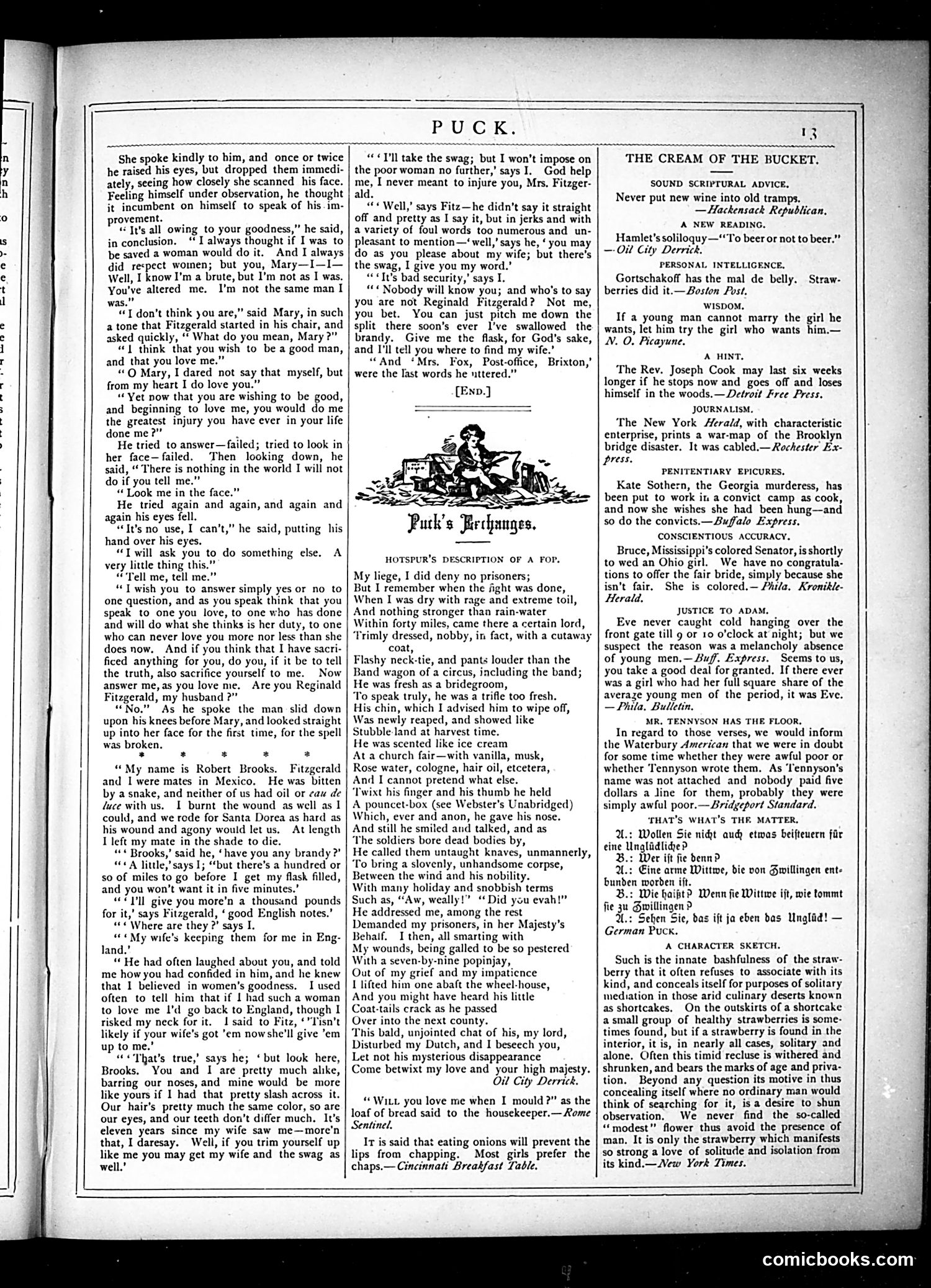
This page contains primarily **text content** rather than political cartoons. The main illustrated element is "Puck's Beginnings," a humorous story about a fox, featuring a small sketch of a fox's head among various objects. The page includes satirical commentary sections like "Personal Intelligence" and "A Hint," which mock contemporary figures and social situations through brief, sardonic notices. These appear to target individuals in politics, society, and journalism—typical of Puck's format—though specific identities are not clearly indicated in the visible portions. The overall tone is **gossipy and mocking**, characteristic of Puck's satirical approach to American public life, but without distinctive political cartoons, the specific targets and references remain unclear from this page alone.
📄 Transcribed text from this page (OCR, searchable)
Machine-transcribed from the original scan — historical spelling and the odd misread are preserved.
She spoke kindly to him, and once or twice he raised his eyes, but dropped them immedi- ately, seeing how closely she scanned his face. Feeling himself under observation, he thought it incumbent on himself to speak of his.im- provement. i « Tr’s all owing to your goodness,” he said, in conclusion, ‘I always thought if I was to be saved a woman would do it. And I always did respect wonen; but you, Mary—I—I— Well, I know I’m a brute, but I’m not as I was. You've altered me. I’m not the same man I was.” «T don’t think you are,” said Mary, in such a tone that Fitzgerald started in his chair, and asked quickly, “ What do you mean, Mary?” “1 think that you wish to be a good man, and that you love me.” “O Mary, I dared not say that myself, but from my heart I do love you.” “Yet pow that you are wishing to be good, and beginning to love me, you would do me the greatest injury you have ever in your life done me?” 5 He tried to answer—failed; tried to look in her face—failed. Then looking down, he said, “ There is nothing in the world I will not do if you tell me.” “Look me in the face.” He tried again and again, and again and | again his eyes fell. “It’s no use, I can’t,” he said, putting his hand over his eyes. “Twill ask you to do something else. A very little thing this.” “Tell me, tell me. “T wish you to answer simply yes or no to one question, and as you speak think that you speak to one you love, to one who has done and will do what she thinks is her duty, to one who can never love you more nor less than she does now. And if you think that I have sacri- ficed anything for you, do you, if it be to tell the truth, also sacrifice yourself to me. Now answer me, as you love me, Are you Reginald Fitzgerald, my husband ?” “No.” As he spoke the man slid down upon his knees before Mary, and looked straight up into her face for the first time, for the spell was broken. * * * * “My name is Robert Brooks. Fitzgerald and I were mates in Mexico. He was bitten by a snake, and neither of us had oil or cau de duce with us. 1 burnt the wound as well as 1 could, and we rode for Santa Dorea as hard as his wound and agony would let us. At length I left my mate in the shade to die. “« Brooks,’ said he, ‘have you any brandy ?* “A little,’says 1; “but there’s a hundred or so of miles to go before I get my flask filled, and you won't want it in five minutes.’ “PL give you more'n a thousand pounds for it,’ says Fitzgerald, ‘ good English notes.’ «Where are they ?” says I. «My wife's keeping them for me in Eng- land.’ “ He had often laughed about you, and told me how you had confided in him, and he knew that I believed in women's goodness. I used often to tell him that if 1 had such a woman to love me I'd go back to England, though I risked my neck for it. 1 said to Fitz, ¢"Tisn't likely if your wife's got ‘em nowshe'll give ‘em up to me.’ “«bat’s true,’ says he; ‘but look here, Brooks, You and I are pretty much alike, barring our noses, and mine would be more like yours if 1 had that pretty slash across it. Our hair’s pretty much the same color, so are our eyes, and our teeth don’t differ much. It's eleven years since my wife saw me—more'n that, I daresay. Well, if you trim yourself up like me you may get my wife and the swag as well.’ V3) ««T'll take the swag; but I won't impose on the poor woman no further,’ says I. God help me I never meant to injure you, Mrs. Fitzger- ald. “* Well,’ says Fitz—he didn’t say it straight off and pretty as I say it, but in jerks and with a variety of foul words too numerous and un- pleasant to mention—‘ well,’ says he, ‘ you may do as you please about my wife; but there's the swag, I give you my word.’ “«Iv’s bad security,’ says I. “* Nobody will know you; and who's to say you are not Reginald Fitzgerald? Not me, you bet. You can just pitch me down the split there soon’s ever I’ve swallowed the. brandy. Give me the flask, for God's sake, and I'll tell you where to find my wife.’ “And. ‘Mrs. Fox, Post-office, Brixton,’ were the last words he uttered.” HOTSPUR’S DESCRIPTION OF A FOP. My liege, I did deny no prisoners; But I remember when the fight was done, When I was dry with rage and extreme toil, And nothing stronger than rain-water Within forty miles, came there a certain lord, ‘Trimly dressed, nobby, in fact, with a cutaway coat, Flashy neck-tie, and pants louder than the Band wagon of a circus, including the band; He was fresh as a bridegroom, ‘To speak truly, he was a trifle too fresh. His chin, which I advised him to wipe off, Was newly reaped, and showed like Stubble-land at harvest time. He was scented like ice cream Ata church fair—with vanilla, musk, Rose water, cologne, hair oil, etcetera, And I cannot pretend what else. ‘Twixt his finger and his thumb he held A pouncet-box (see Webster's Unabridged) Which, ever and anon, he gave his nose. And still he smiled and talked, and as ‘The soldiers bore dead bodies by, He called them untaught knaves, unmannerly, To bring a slovenly, unhandsome corpse, Between the wind and his nobility. With many holiday and snobbish terms Such as, “Aw, weally!” “Did you evah!” He addressed me, among the rest Demanded my prisoners, in her Majesty's Behalf. I then, all smarting with My wounds, being galled to be so pestered With a seven-by-nine popinjay, Out of my grief and my impatience 1 lifted him one abaft the wheel-house, And you might have heard his little Coat-tails crack as he passed Over into the next county. This bald, unjointed chat of his, my lord, Disturbed my Dutch, and I beseech you, Let not his mysterious disappearance Come betwixt my love and your high majesty. Oil City Derrick. “Witt you love me when I mould?” as the loaf of bread said to the housekeeper.—Rome Sentinel. It is said that eating onions will prevent the lips from chapping. Most girls prefer the chaps.— Cincinnati Breakfast Table, THE CREAM OF THE BUCKET. SOUND SCRIPTURAL ADVICE, Never put new wine into old tramps. —Hackensack Republican, A NEW READING. Hamlet's soliloquy —‘To beer or not to beer.” —- Oil City Derrick, PERSONAL INTELLIGENCE, Gortschakoff has the mal de belly. Straw- berries did it.—Boston Post. WISDOM, If a young man cannot marry the girl he wants, let him try the girl who wants him.— N. O. Picayune. A HINT, ‘The Rev. Joseph Cook may last six weeks longer if he stops now and goes off and loses himself in the woods.—Detroit Free Press. JOURNALISM, ‘The New York Hera/d, with characteristic enterprise, prints a war-map of the Brooklyn bridge disaster. It was cabled.— Rochester Ex- press. PENITENTIARY EPICURES, Kate Sothern, the Georgia murderess, has been put to work in a convict camp as cook, and now she wishes she had been hung—and so do the convicts.—Buffalo Express. CONSCIENTIOUS ACCURACY. Bruce, Mississippi's colored Senator, is shortly to wed an Ohio girl. We have no congratula- tions to offer the fair bride, simply because she isn’t fair. She is colored.—/%ila, Kronikle- Herald, JUSTICE TO ADAM. Eve never caught cold hanging over the front gate till 9 or 10 o'clock at night; but we suspect the reason was a melancholy absence of young men.—Buff. Express. Seems to us, you take a good deal for granted. If there ever was a girl who had her full square share of the average young men of the period, it was Eve. —Phila, Bulletin, MR, TENNYSON HAS THE FLOOR. In regard to those verses, we would inform the Waterbury American that we were in doubt for some time whether they were awful poor or whether Tennyson wrote them. As ‘Tennyson's name was not attached and nobody paid five dollars a line for them, probably they were simply awful poor.—Bridgeport Standard. ‘THAT'S WHAT'S THR MATTER, A.: Wollen Sie nit aud etwas beifteuern far eine Unglidlide? B.: Weer ift fie denn? A.: Eine arme Wittwe, die von Fwillingen ent- bunden worden ift. B.: Wie haipt? Wenn fie Wittwe ijt, wie tommt fie 3u Gwillingen ? A.: Sehen Sie, das ijt ja eben bas Unglid! — German Puck. A CHARACTER SKETCH. Such is the innate bashfulness of the straw- berry that it often refuses to associate with its kind, and conceals itself for purposes of solitary mediation in those arid culinary deserts known as shortcakes, On the outskirts of a shortcake a small group of healthy strawberries is some- times found, but if a strawberry is found in the interior, it is, in nearly all cases, solitary and alone. Often this timid recluse is withered and shrunken, and bears the marks of age and priva- tion. Beyond any question its motive in thus concealing itself where no ordinary man would think of searching for it, isa desire to shun observation, We never find the so-called “modest” flower thus avoid the presence of man, It is only the strawberry which manifests so strong a love of solitude and isolation from its kind.—Mew York Times. comicbooks.com