
Puck, 1878-06-26 · page 11 of 16
Puck — June 26, 1878 — page 11: what you’re looking at
What you’re looking at
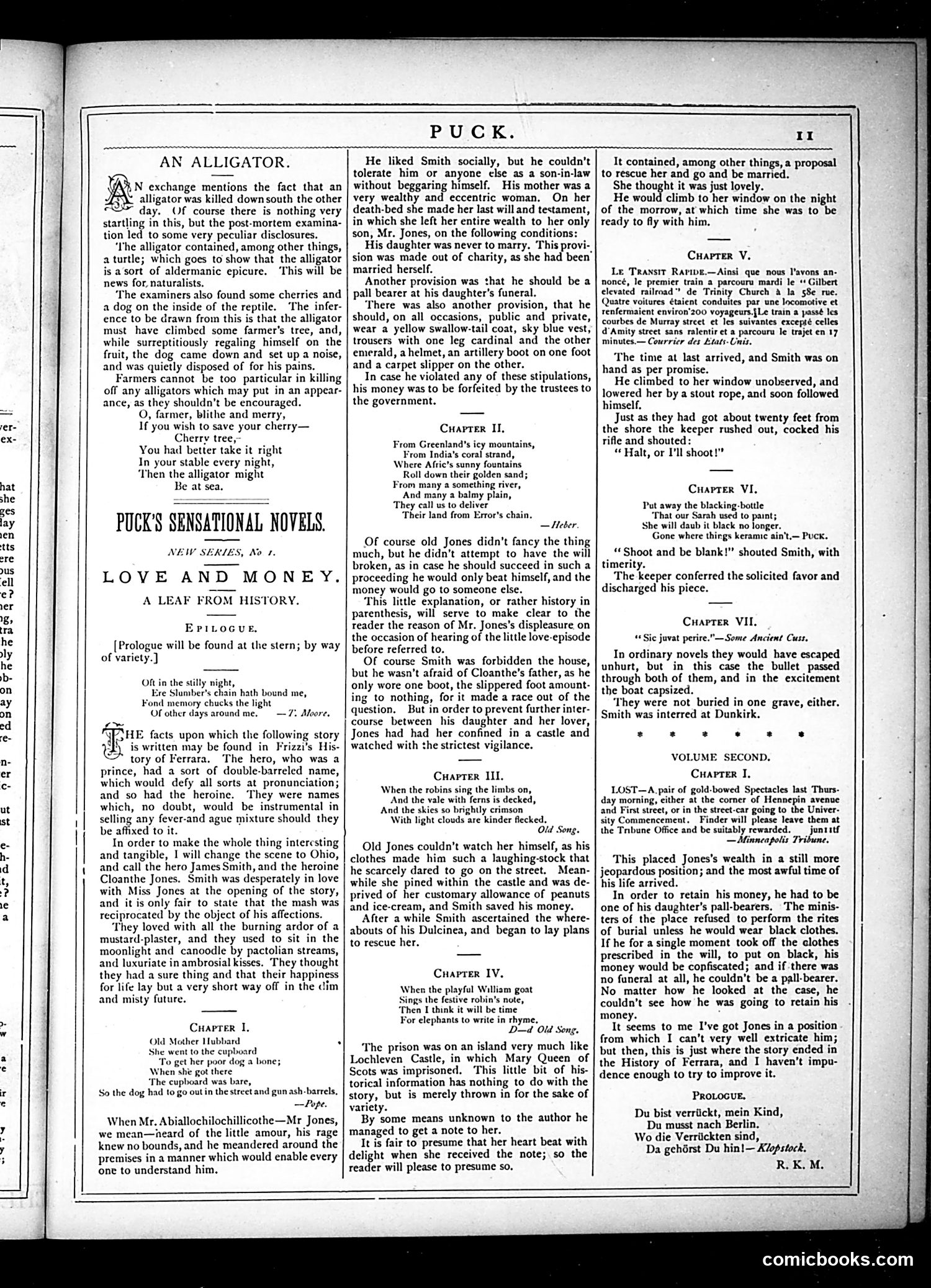
This page is primarily **literary content, not political satire**. It features the opening installments of "Love and Money: A Leaf from History," a serialized novel in Puck's "New Series, No. 1." The page includes: - **Chapter headings and story text** about characters named Mr. Jones, Smith, and Cloanthe - **Poems and epigraphs** from authors like Hecker and Old Song - A subtitle indicating the story is set in **Ferrara** and involves a prince and heroine - Standard **serial fiction formatting** common to 19th-century magazines Rather than political commentary, this represents how Puck balanced satirical humor with serialized entertainment fiction to attract diverse readers. The elaborate chapter structure and literary framing suggest sophisticated audience engagement through narrative storytelling.
📄 Transcribed text from this page (OCR, searchable)
Machine-transcribed from the original scan — historical spelling and the odd misread are preserved.
PUCK. II AN ALLIGATOR. N exchange mentions the fact that an $k alligator was killed down south the other eS day. Of course there is nothing very startling in this, but the post-mortem examina- tion led to some very peculiar disclosures. ‘Ihe alligator contained, among other things, aturtle; which goes to show that the alligator is asort of aldermanic epicure. ‘This will be news for, naturalists. ‘The examiners also found some cherries and a dog on the inside of the reptile. ‘The infer- ence to be drawn from this is that the alligator must have climbed some farmer's tree, and, while surreptitiously regaling himself on the fruit, the dog came down and set up a noise, and was quietly disposed of for his pains. Farmers cannot be too particular in killing off any alligators which may put in an appear- ance, as they shouldn't be encouraged. O, farmer, blithe and merry, If you wish to save your cherry— Cherry tree, You had better take it right In your stable every night, ‘Then the alligator might Be at sea. PUCK'S SENSATIONAL NOVELS. NEW SERIES, No 1. LOVE AND MONEY. A LEAF FROM HISTORY. EPiLoGue, [Prologue will be found at the stern; by way of variety.] Oft in the stilly night, Ere Slumber's chain hath bound me, Fond memory chucks the light Of other days around me, ~ ‘pur facts upon which the following story is written may be found in Frizzi’s His- tory of Ferrara. The hero, who was a prince, had a sort of double-barreled name, which would defy all sorts at pronunciation; and so had the heroine. They were names which, no doubt, would be instrumental in selling any fever-and ague mixture should they be affixed to it. In order to make the whole thing interesting and tangible, I will change the scene to Ohio, and call the hero James Smith, and the heroine Cloanthe Jones. Smith was desperately in love with Miss Jones at the opening of the story, and it is only fair to state that the mash was reciprocated by the object of his affections. ‘They loved with all the burning ardor of a mustard-plaster, and they used to sit in the moonlight and canoodle by pactolian streams, and luxuriate in ambrosial kisses. They thought they had a sure thing and that their happiness for life lay but a very short way off in the dim and misty future. —7: Mloore, Cuaprer 1. Old Mother Hubbard : She went to the cupboard 9 get her poor dog a bone; When she got there ‘The cupboard was bare, So the dog had to go out in the street and gun ash-barrels, —Pope. When Mr. Abiallochilochillicothe—Mr Jones, we mean—neard of the little amour, his rage knew no bounds, and he meandered around the premises in a manner which would enable every one to understand him. He liked Smith socially, but he couldn't tolerate him or anyone else as a son-in-law without beggaring himself. His mother was a very wealthy and eccentric woman. On her death-bed she made her last will and testament, in which she left her entire wealth to her only son, Mr. Jones, on the following conditions: His daughter was never to marry. ‘This provi- sion was made out of charity, as she had been’ married herself. Another provision was that he should be a pall bearer at his daughter's funeral. ‘There was also another provision, that he should, on all occasions, public and private, wear a yellow swallow-tail coat, sky blue vest, trousers with one leg cardinal and the other emerald, a helmet, an artillery boot on one foot and a carpet slipper on the other. In case he violated any of these stipulations, his money was to be forfeited by the trustees to the government. Cuapter II, From Greenland’s icy mountains, From India’s coral strand, Where Afric’s sunny fountains Roll down their golden sand; From many a something river, ‘And many a balmy plain, They call us to deliver ‘Their land from Error's chain, — Heber. Of course old Jones didn’t fancy the thing much, but he didn’t attempt to have the will broken, as in case he should succeed in such a proceeding he would only beat himself, and the money would go to someone else. This little explanation, or rather history in parenthesis, will serve to make clear to the reader the reason of Mr. Jones's displeasure on the occasion of hearing of the little love-episode before referred to. Of course Smith was forbidden the house, but he wasn’t afraid of Cloanthe’s father, as he only wore one boot, the slippered foot amount- ing to nothing, for it made a race out of the question. But in order to prevent further inter- course between his daughter and her lover, Jones had had her confined in a castle and watched with the strictest vigilance. Cuarter III. When the robins sing the limbs on, And the vale with ferns is decked, And the skies so brightly crimson With light clouds are kinder flecked. Old Song. Old Jones couldn’t watch her himself, as his clothes made him such a laughing-stock that he scarcely dared to go on the street. Mean- while she pined within the castle and was de- prived of her customary allowance of peanuts and ice-cream, and Smith saved his money. After a while Smith ascertained the where- abouts of his Dulcinea, and began to lay plans to rescue her. Cnapter IV, When the playful William goat Sings the festive robin’s note, ‘Then I think it will be time For elephants to write in rhyme, D—d Old Song. The prison was on an island very much like Lochleven Castle, in which Mary Queen of Scots was imprisoned. This little bit of his- torical information has nothing to do with the story, but is merely thrown in for the sake of variety. By some means unknown to the author he managed to get a note to her. It is fair to presume that her heart beat with delight when she received the note; so the reader will please to presume so. It contained, among other things, a proposal to rescue her and go and be manicd: Le She thought it was just lovely. He would climb to her window on the night of the morrow, at which time she was to be ready to fly with him. Cuarter V. Le Transit Raripg.—Ainsi que nous I'avons an- noncé, le premier train a parcouru mardi le + Gilbert elevated railroad” de Trinity Church a la 58e rue. Quatre voitures étaient conduites par une locomotive et renfermaient environ'200 voyageurs.jLe train a passé les courbes de Murray street et les suivantes excepsé celles dAmity street sans ralentir et a parcouru le trajet en 17 minutes.— Courrier des Etats-Unis. The time at last arrived, and Smith was on hand as per promise. He climbed to her window unobserved, and lowered her by a stout rope, and soon followed himself, Just as they had got about twenty feet from the shore the keeper rushed out, cocked his rifle and shouted : “ Halt, or I'll shoot!"* Cuarter VI. Put away the blacking-bottle ‘That our Sarah used to paint; She will daub it black no longer. Gone where things keramic ain't,— Puck. ‘Shoot and be blank!" shouted Smith, with timerity. The keeper conferred the solicited favor and discharged his piece. Cuarter VII. «Sic juvat perire."—Some Ancient Cust, In ordinary novels they would have escaped unhurt, but in this case the bullet passed through both of them, and in the excitement the boat capsized. ‘They were not buried in one grave, either. Smith was interred at Dunkirk. + * * * * . VOLUME SECOND. Cuarter I, LOST—A. pair of gold-bowed Spectacles last Thurs- day morning, either at the corner of Hennepin avenue and First street, or in the street-car going to the Univer sity Commencement. Finder will please leave them at the Tribune Office and be suitably rewarded. —_juntitf —Minneapolis Tribune. This placed Jones's wealth in a still more jeopardous position; and the most awful time of his life arrived. In order to retain his money, he had to be one of his daughter's pall-bearers. The minis- ters of the place refused to perform the rites of burial unless he would wear black clothes. If he for a single moment took off the clothes prescribed in the will, to put on black, his money would be copfiscated; and if there was no funeral at all, he couldn't be a pall-bearer. No matter how he looked at the case, he couldn't see how he was going to retain his money. . It seems to me I’ve got Jones in a position from which I can’t very well extricate him; but then, this is just where the story ended the History of Ferrara, and I haven't impu- dence enough to try to improve it. PROLOGUE. Du bist verriickt, mein Kind, Du musst nach Berlin, Wo die Verriickten sind, Da gehérst Du hin!— X/opstock. R.K. M. comicbooks.com