
Puck, 1878-04-17 · page 3 of 16
Puck — April 17, 1878 — page 3: what you’re looking at
What you’re looking at
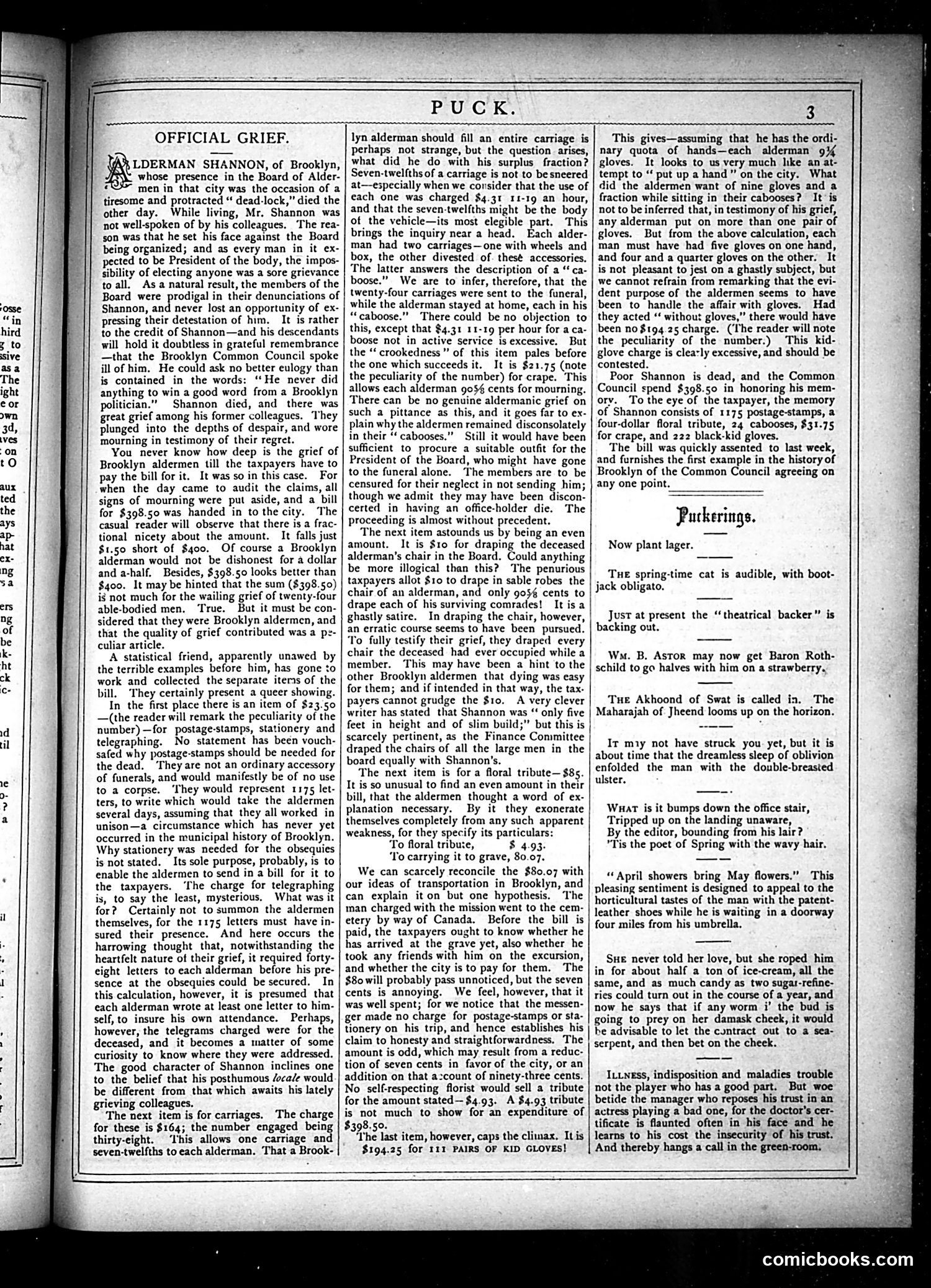
This page from *Puck* magazine (page 3) contains primarily text articles rather than cartoons. The main piece, "Official Grief," is a satirical commentary on Brooklyn aldermen's expenses related to Alderman Shannon's funeral. The satire attacks the aldermen for billing the city for various funeral-related costs—carriages, gloves, draping chairs—claiming these were legitimate municipal expenses. The author argues these charges are excessive and questions whether dying aldermen should cost taxpayers money through inflated "official grief" expenses. The smaller sections ("Puckerings") are brief humorous quips about contemporary topics like spring, theater, and romance—typical of *Puck's* miscellaneous satirical humor. The overall thrust critiques municipal corruption and wasteful government spending disguised as solemn ceremony.
📄 Transcribed text from this page (OCR, searchable)
Machine-transcribed from the original scan — historical spelling and the odd misread are preserved.
PUCK. OFFICIAL GRIEF. LDERMAN SHANNON, of Brooklyn, whose presence in the Board of Alder- 72% men in that city was the occasion of a tiresome and protracted “ dead-lock,” died the other day. While living, Mr. Shannon was not well-spoken of by his colleagues. ‘The rea- son was that he set his face against the Board being organized; and as every man in it ex- pected to be President of the body, the impos- sibility of electing anyone was a sore grievance to all. Asa natural result, the members of the Board were prodigal in their denunciations of Shannon, aed neice lost an opportunity of ex- pressing their detestation of him, It is rather to the credit of Shannon—and his descendants will hold it doubtless in grateful remembrance —that the Brooklyn Common Council spoke ill of him. He could ask no better eulogy than is contained in the words: ‘‘He never did anything to win a good word from a Brookly politician.” Shannon died, and there w: great grief among his former colleagues. ‘They plunged into the depths of despair, and wore mourning in testimony of their regret. You never know how deep is the grief of Brooklyn aldermen till the taxpayers have to pay the bill for it. It was so in this case. For when the day came to audit the claims, all signs of mourning were put aside, and a bill for $398.50 was handed in tothe city. The casual reader will observe that there is a frac- tional nicety about the amount. It falls just $1.50 short of $400, Of course a Brooklyn alderman would not be dishonest for a dollar and a-half, Besides, $398.50 looks better than $400. It may be hinted that the sum ($398.50) ig not much for the wailing grief of twenty-four able-bodied men. ‘True. But it must be con- sidered that they were Brooklyn aldermen, and that the quality of grief contributed was a p:- culiar article. A statistical friend, apparently unawed by the terrible examples before him, has gone to work and collected the separate iteras of the bill. They certainly present a queer showing. In the first place there is an item of $23.50 —(the reader will remark the peculiarity of the number) —for postage-stamps, stationery and telegraphing. No statement has been vouch- safed why postage-stamps should be needed for the dead. ‘They are not an ordinary accessory of funerals, and would manifestly be of no use to a corpse. ‘They would represent 1175 let- ters, to write which would take the aldermen several days, assuming that they all worked in unison—a circumstance which has never yet occurred in the municipal history of Brooklyn. Why stationery was needed for the obsequies is not stated. Its sole purpose, probably, is to enable the aldermen to send in a bill for it to the taxpayers. ‘The charge for telegraphing is, to say the least, mysterious. What was it for? Certainly not to summon the aldermen themselves, for the 1175 letters must have in- sured their presence, And here occurs the harrowing thought that, notwithstanding the heartfelt nature of their grief, it required forty- eight letters to each alderman before his pre- sence at the obsequies could be secured. In this calculation, however, it is presumed that each alderman wrote at least one letter to him- self, to insure his own attendance. Perhaps, however, the telegrams charged were for the deceased, and it becomes a matter of some curiosity to know where they were addressed. The good character of Shannon inclines one to the belief that his posthumous /oca/e would be different from that which awaits his lately grieving colleagues. The next item is for carriages. The charge for these is $164; the number engaged being thirty-eight. ‘This allows one carriage and seven-twelfths to each alderman. That a Brook- lyn alderman should fill an entire carriage is perhaps not strange, but the question arises, what did he do with his surplus fraction? Seven-twelfths of a carriage is not to besneered at—especially when we consider that the use of each one was charged $4.31 11-19 an hour, and that the seven-twelfths might be the body of the vehicle—its most elegible part. This brings the inquiry near a head. Each alder- man had two carriages—one with wheels and box, the other divested of. thesé accessories. The latter answers the description of a “ ca- boose.” We are to infer, therefore, that the twenty-four carriages were sent to the funeral, while the alderman stayed at home, each in his “caboose.” There could be no objection to this, except that $4.31 11-19 per hour for aca- boose not in active service is excessive. But the ‘ crookedness ” of this item pales before the one which succeeds it. It is $21.75 (note the peculiarity of the number) for crape. This allows each alderman go$¢ cents for mourning. There can be no genuine aldermanic grief on such a pittance as this, and it goes far to ex- plain why the aldermen remained disconsolately in their “ cabooses.” Still it would have been sufficient to procure a suitable outfit for the President of the Board, who might have gone to the funeral alone. The members are to be censured for their neglect in not sending him; though we admit they may have been discon- certed in having an office-holder die. The proceeding is almost without precedent. The next item astounds us by being an even amount. It is $10 for draping the deceased alderman's chair in the Board. Could anything be more illogical than this? The penurious taxpayers allot $10 to drape in sable robes the chair of an alderman, and only 9054 cents to drape each of his surviving comrades! It is a ghastly satire. In draping the chair, however, an erratic course seems to have been pursued. To fully testify their grief, they draped every chair the deceased had ever occupied while a member. This may have been a hint to the other Brooklyn aldermen that dying was easy for them; and if intended in that way, the tax- payers cannot grudge the $10. A very clever writer has stated that Shannon was “ only five feet in height and of slim build;” but this is scarcely pertinent, as the Finance Committee draped the chairs of all the large men in the board equally with Shannon's. The next item is fora floral tribute—$85. It is so unusual to find an even amount in their bill, that the aldermen thought a word of ex- planation necessary. By it they exonerate themselves completely from any such apparent weakness, for they specify its particulars: To floral tribuie, $ 4.93- ‘To carrying it to grave, 80.07. We can scarcely reconcile the $80.07 with our ideas of transportation in Brooklyn, and can explain it on but one hypothesis. The man charged with the mission went to the cem- etery by way of Canada. Before the bill is paid, the taxpayers ought to know whether he has arrived at the grave yet, also whether he took any friends with him on the excursion, and whether the city is to pay for them. The $8owill probably pass unnoticed, but the seven cents is annoying. We feel, however, that it was well spent; for we notice that the messen- ger made no charge for postage-stamps or sta- tionery on his trip, and hence establishes his claim to honesty and straightforwardness. The amount is odd, which may result from a reduc- tion of seven cents in favor of the city, or an addition on that a:count of ninety-three cents. No self-respecting florist would sell a tribute for the amount stated— $4.93. A $4.93 tribute is not much to show for an expenditure of $398.50. ‘The last item, however, caps the climax. Itis $194.25 for 111 PAIRS OF KID GLOvES! This gives—assuming that he has the ordi- nary quota of hands—each alderman 9} gloves. It looks to us very much like an at- tempt to “ put up a hand” on the city. What did the aldermen want of nine gloves and a fraction while sitting in their cabooses? It’ is not to be inferred that, in testimony of his grief, any alderman put on more than one pair of gloves. But from the above calculation, each man must have had five gloves on one hand, and four and a quarter gloves on the other. It is not pleasant to jest on a ghastly subject, but we cannot refrain from remarking that the evi- dent purpose of the aldermen seems to have been to handle the affair with gloves. Had they acted ‘‘ without gloves,” there would have been no $194.25 charge. (‘The reader will note the peculiarity of the number.) This kid- glove charge is clearly excessive, and should be contested. Poor Shannon is dead, and the Common Council spend $398.50 in honoring his mem- ory. To the eye of the taxpayer, the memory of Shannon consists of 1175 postage-stamps, a four-dollar floral tribute, 24 cabooses, $31.75 for crape, and 222 black-kid gloves. The Dill was quickly assented to last week, and furnishes the first example in the history of Brooklyn of the Common Council agreeing on any one point. Puckerings. Now plant lager. Tue spring-time cat is audible, with boot- jack obligato. Just at present the ‘theatrical backer” is backing out. Ws. B, Astor may now get Baron Roth- schild to go halves with him on a strawberry. Tue Akhoond of Swat is called in. The Maharajah of Jheend looms up on the horizon. Ir mny not have struck you: yet, but it is about time that the dreamless sleep of oblivion enfolded the man with the double-breasted ulster. Waar is it bumps down the office stair, ‘Tripped up on the landing unaware, By the editor, bounding from his lair? 'Tis the poet of Spring with the wavy hair, “April showers bring May flowers.” This pleasing sentiment is designed to appeal to the horticultural tastes of the man with the patent- leather shoes while he is waiting in a doorway four miles from his umbrella. Sue never told her love, but she roped him in for about half a ton of ice-cream, all the same, and as much candy as two sugar-refine- ries could turn out in the course of a year, and now he says that if any worm i’ the bud is going to prey on her damask cheek, it would be advisable to let the contract out to a sea- serpent, and then bet on the cheek. Ixtngss, indisposition and maladies trouble not the player who has a good part. But woe betide the manager who reposes his trust in an actress playing a bad one, for the doctor's cer- tificate is flaunted often in his face and he learns to his cost the insecurity of his trust. And thereby hangs a call in the green-room, comicbooks.com