
Puck, 1878-04-17 · page 4 of 16
Puck — April 17, 1878 — page 4: what you’re looking at
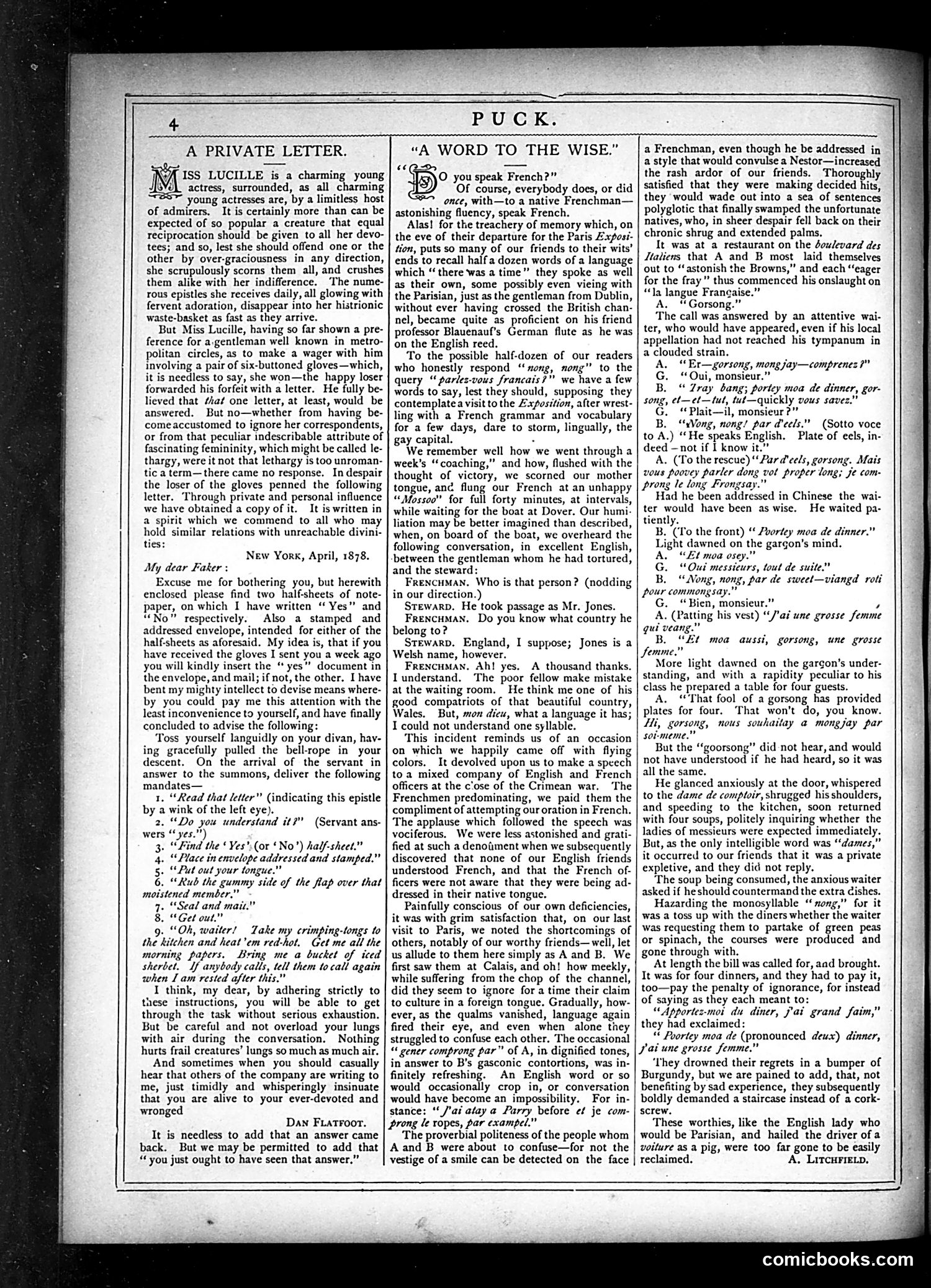
What you’re looking at
This page contains three articles rather than political cartoons: 1. **"A Private Letter"** - A humorous piece about Miss Lucille, a young actress, discussing her correspondence habits and social etiquette regarding letter-writing and glove-wearing. 2. **"A Word to the Wise"** - A satirical commentary on French language usage among English speakers, particularly mocking affectations and pretension. It includes anecdotes about English people attempting French and the absurdities that result, suggesting the author views such linguistic pretension as ridiculous and affecting. 3. The page contains social commentary typical of Puck's satirical approach, targeting upper-class affectations and cultural pretensions of the era. The content focuses on social satire rather than political figures, ridiculing contemporary manners and linguistic snobbery among the English gentry.
📄 Transcribed text from this page (OCR, searchable)
Machine-transcribed from the original scan — historical spelling and the odd misread are preserved.
A PRIVATE LETTER. W ISS LUCILLE is a charming young [N actress, surrounded, as all charming young actresses are, by a limitless host of admirers. It is certainly more than can be expected of so popular a creature that equal reciprocation should be given to all her devo- tees; and so, lest she should offend one or the other by over-graciousness in any direction, she scrupulously scorns them all, and crushes them alike with her indifference. The nume- rous epistles she receives daily, all glowing with fervent adoration, disappear into her histrionic waste-basket as fast as they arrive. But Miss Lucille, having so far shown a pre- ference for a.gentleman well known in metro- politan circles, as to make a wager with him involving a pair of six-buttoned gloves—which, it is needless to say, she won—the happy loser forwarded his forfeit with a letter. He fully be- lieved that ¢+aé one letter, at least, would be answered. But no—whether from having be- come accustomed to ignore her correspondents, or from that peculiar indescribable attribute of fascinating femininity, which might be called le- thargy, were it not that lethargy is too unroman- tic a term—there came no response. In despair the loser of the gloves penned the following letter. ‘Through private and personal influence we have obtained a copy of it. It is written in a spirit which we commend to all who may hold similar relations with unreachable divini- ties: New York, April, 1878. My dear Faker : Excuse me for bothering you, but herewith enclosed please find two half-sheets of note- paper, on which I have written “ Yes” and “No” respectively. Also a stamped and addressed envelope, intended for either of the half-sheets as aforesaid. My idea is, that if you have received the gloves I sent you a week ago you will kindly insert the “ yes” document in the envelope, and mail; if not, the other. I have bent my mighty intellect to devise means where- by you could pay me this attention with the least inconvenience to yourself, and have finally concluded to advise the following: Toss yourself languidly on your divan, hav- ing gracefully pulled the bell-rope in your descent. On the arrival of the servant in answer to the summons, deliver the following mandates— 1. “Read that letter” (indicating this epistle by a wink of the left eye). 2. “Do you understand it?” wers “yes.”) 3. “Find the ‘Yes’, (or ‘No’) half-sheet.” 4. ‘Place in envelope addressed and stamped.” 5. “Put out your tongue.” 6. “ub the gummy "side of the flap over that estnies member.” 7. “Seal and mait.” 8. “Get out.” 9. “Oh, waiter! Take my crimping-tongs to the kitchen and heat'em red-hot. Get me all the morning papers. Bring me a bucket of ited sherbet. If anybody calls, tell them to call again when Lam rested after this.” I think, my dear, by adhering strictly to these instructions, you will be able to get through the task without serious exhaustion. But be careful and not overload your lungs with air during the conversation. Nothing hurts frail creatures’ lungs so much as much air. And sometimes when you should casually hear that others of the company are writing to me, just timidly and whisperingly insinuate that you are alive to your ever-devoted and wronged (Servant ans- Dan Fiatroor. It is needless to add that an answer came back. But we may be permitted to add that “you just ought to have seen that answer,” «A WORD TO THE WISE.” “ec = O you speak French?” Of course, everybody does, or did once, with—to a native Frenchman— astonishing fluency, speak French. Alas! for the treachery of memory which, on the eve of their departure for the Paris Exposi- tion, puts so many of our friends to their wits’ ends to recall half dozen words of a language which “there was a time” they spoke as well as their own, some possibly even vieing with the Parisian, just as the gentleman from Dublin, without ever having crossed the British chan- nel, became quite as proficient on his friend professor Blauenauf’s German flute as he was on the English reed. To the possible half-dozen of our readers who honestly respond ‘ong, nong" to the query “ parles-vous francais?” we have a few words to say, lest they should, supposing they contemplatea visit to the Exfosition, after wrest- ling with a French grammar and vocabulary for a few days, dare to storm, lingually, the gay capital. We remember well how. we went through a week's “coaching,” and how, flushed with the thought of victory, we scorned our mother tongue, anc flung our French at an unhappy “Mossoo” for full forty minutes, at intervals, while waiting for the boat at Dover. Our humi- liation may be better imagined than described, when, on board of the boat, we overheard the following conversation, in excellent English, between the gentleman whom he had tortured, and the steward: FrencuMan. Who is that person? (nodding in our direction.) Srewarp. He took passage as Mr. Jones. FrencuMan. Do you know what country he belong to? Stewarp. England, I suppose; Jones is a Welsh name, however. FRENCHMAN, Ah! yes. A thousand thanks. lunderstand. The poor fellow make mistake at the waiting room. He think me one of his good compatriots of that beautiful country, Wales. But, mon diew, what a language it has; I could not understand one syllable. This incident reminds us of an occasion on which we happily came off with flying colors. It devolved upon us to make a speech toa mixed company of English and French officers at the c'ose of the Crimean war. The Frenchmen predominating, we paid them the compliment of attempting our oration in French. The applause which followed the speech was vociferous. We were less astonished and grati- fied at such a denofiment when we subsequently discovered that none of our English friends understood French, and that the French of- ficers were not aware that they were being ad- dressed in their native tongue. Painfully conscious of our own deficiencies, it was with grim satisfaction that, on our last visit to Paris, we noted the shortcomings of others, notably of our worthy friends—well, let us allude to them here simply as A and B. We first saw them at Calais, and oh! how meekly, while suffering from the chop of the channel, did they seem to ignore for a time their claim to culture in a foreign tongue. Gradually, how- ever, as the qualms vanished, language again fired their eye, and even when alone they struggled to confuse each other. The occasional “ gener comprong par” of A, in dignified tones, in answer to B’s gasconic contortions, was in- finitely refreshing. An English word or so would occasionally crop in, or conversation would have become an impossibility, For in- stance: /’ai atay a Parry before ef je com- prong le ropes, par exampel.” ‘The proverbial politeness of the people whom Aand B were about to confuse—for not the vestige of a smile can be detected on the face a Frenchman, even though he be addressed in a style that would convulse a Nestor—increased the rash ardor of our friends. Thoroughly satisfied that they were making decided hits, they would wade out into a sea of sentences polyglotic that finally swamped the unfortunate. natives, who, in sheer despair fell back on their chronic shrug and extended palms, It was at a restaurant on the boulevard des Htaliens that A and B most laid themselves out to “astonish the Browns,” and each “eager for the fray” thus commenced his onslaught on “la langue Francaise.” A. “Gorsong.” The call was answered by an attentive wai- ter, who would have appeared, even if his local appellation had not reached his tympanum in a clouded strain. A. “Er—gorsong, mong jay—comprenes ?” G. Oui, monsieur.” B. “ Zray bang; portey moa de dinner, gor- song, et—et—tut, tut—quickly vous savez.” G. “Plait—il, monsieur ?”” B. “song, nong! par d'eels.” (Sotto voce to A.) “He speaks English. Plate of eels, in- deed —not if I know it.”” A. (‘To the rescue) “Par d'eels, gorsong. Mais vous poovey parler dong vot proper long; je com- prong le long Frongsay.” Had he been addressed in Chinese the wai- ter would have been as wise. He waited pa- tiently. B. (To the front) “ Poortey moa de dinner.” Light dawned on the gargon’s mind. A. “Et moa osey.” G. “Oui messieurs, tout de suit B. “Nong, nong, par de sweel—viangd roti pour commongsay. G. “Bien, monsieur.” A. (Patting, his vest) un ‘ai une grosse femme gui veang.” B. “Et moa aussi, gorsong, une grosse femme.” More light dawned on the gargon’s under- standing, and with a rapidity peculiar to his class he prepared a table for four guests. ‘A. ‘That fool of a gorsong has provided plates for four. That won’t do, you know. Hi, gorsong, nous souhaitay @ mongjay par soi-meme.”” But the “goorsong” did not hear, and would not have understood if he had heard, so it was all the same. He glanced anxiously at the door, whispered to the dame de comptoir, shrugged his shoulders, and speeding to the kitchen, soon returned with four soups, politely inquiring whether the ladies of messieurs were expected immediately. But, as the only intelligible word was “dames,” it occurred to our friends that it was a private expletive, and they did not reply. ‘The soup being consumed, the anxious waiter asked if he should countermand the extra Cishes. Hazarding the monosyllable ‘ nong,” for it was a toss up with the diners whether the waiter was requesting them to partake of green peas or spinach, the courses were produced and gone through with, At length the bill was called for, aad brought. It was for four dinners, and they had to pay it, too—pay the penalty of ignorance, for instead of saying as they cach meant to: “Apporte-moi du diner, Pai grand faim,” they had exclaimed: “ Poortey moa de (pronounced deux) dinner, sai une grosse femme.” ‘They drowned their regrets in a bumper of Burgundy, but we are pained to add, that, not benefiting by sad experience, they subsequently boldly demanded a staircase instead of a cork- screw. These worthies, like the English lady who would be Parisian, and hailed the driver of a voiture as a pig, were too far gone to be easily reclaimed. A, LitcuFIELp, comicbooks.com