
Puck, 1878-04-17 · page 2 of 16
Puck — April 17, 1878 — page 2: what you’re looking at
What you’re looking at
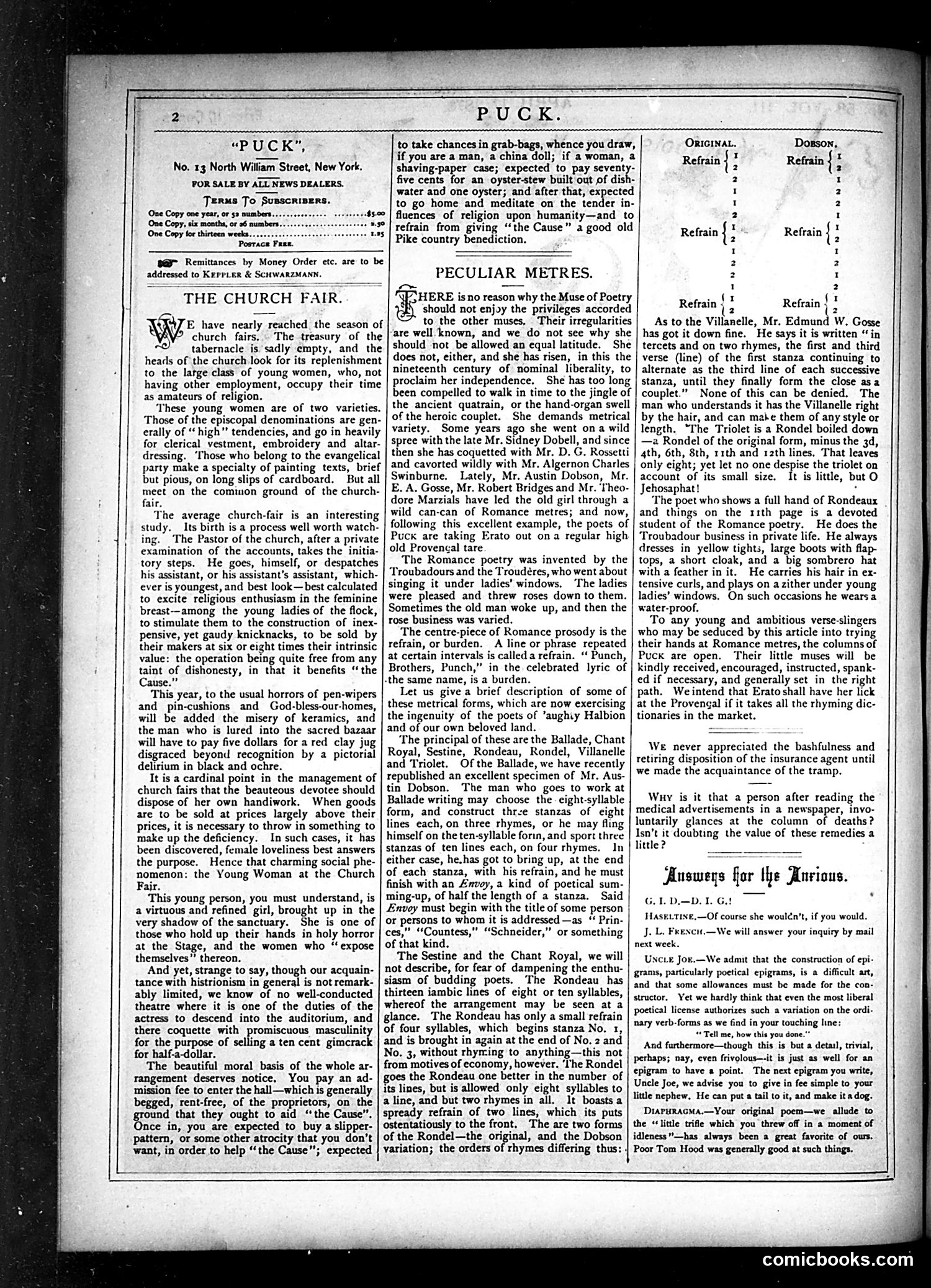
This page primarily contains **editorial content rather than political cartoons**. The main article, "The Church Fair," is a humorous essay about women organizing church fundraising events. It satirizes the social phenomenon of church ladies using fairs as occasions for elaborate dress, socializing, and mild mischief—framing their religious devotion as secondary to the social spectacle. The "Peculiar Metres" section discusses poetry forms used in Romance languages, offering literary criticism rather than satire. The bottom section, "Answers for the Inquisitive," is an advice column addressing reader questions about practical matters. This page represents **Puck's lighter content**—social satire and humor rather than hard political commentary. The church fair piece gently mocks Victorian-era female social behavior through gentle irony.
📄 Transcribed text from this page (OCR, searchable)
Machine-transcribed from the original scan — historical spelling and the odd misread are preserved.
PUCK. “PUCK”, No. 13 North William Street, New York. POR SALE BY ALL NEWS DEALERS. Tzrus To Suascripers. Bae Remittances by Money Order etc, are to be addressed to Kerrier & SCHWARZMANN. THE CHURCH FAIR. E have nearly reached. the season of church fairs, . The treasury of the tabernacle is sadly empty, and the heads of the church look for its replenishment to the latge class of young women, who, not having other employment, occupy their time as amateurs of religion. ‘These young women are of two varieties. ‘Those of the episcopal denominations are gen- erally of “high” tendencies, and go in heavily for clerical vestment, embroidery and altar- dressing. ‘hose who belong to the evangelical party make a specialty of painting texts, brief but pious, on long slips of cardboard. But all meet on the common ground of the church- fair. The average church-fair is an interesting study. Its birth is a process well worth watch- ing. The Pastor of the church, after a private examination of the accounts, takes the tory steps. He goes, himself, or despatches his assistant, or his assistant’s assistant, which- ever is youngest, and best look—best calculated to excite religious enthusiasm in the feminine breast—among the young ladies of the flock, to stimulate them to the construction of inex- pensive, yet gaudy knicknacks, to be sold by their makers at six or eight times their intrinsic value: the operation being quite free from any taint of dishonesty, in that it benefits “the Cause.” This year, to the usual horrors of pen-wipers and pin-cushions and God-bless-our-homes, will be added the misery of keramics, and the man who is lured into the sacred bazaar will have to pay five dollars fora red clay jug disgraced beyond recognition by a pictorial delirium in black and ochre. It is a cardinal point in the management of church fairs that the beauteous devotee should dispose of her own handiwork. When goods are to be sold at prices largely above their prices, it is necessary to throw in something to make up the deficiency. In such cases, it has been discovered, female loveliness best answers the purpose. Hence that charming social phe- nomenon: the Young Woman at the Church Fair. This young person, you must understand, is a virtuous and refined girl, brought up in the very shadow of the sanctuary. She is one of those who hold up their hands in holy horror at the Stage, and the women who “ expose themselves” thereon. And yet, strange to say, though our acquain- tance with histrionism in general is not remark- ably limited, we know of no well-conducted theatre where it is one of the duties of the actress to descend into the auditorium, and there coquette pithy promiscuons masculinity for the purpose of selling a ten cent gimcrack for half-a-dollar. The beautiful moral basis of the whole ar- ement deserves notice, You pay an ad- mission fee to enter the hall—which is generally begged, rent-free, of the proprietors, on the ground that they ought to aid “the Cause”. nce in, you are expected to buy a slipper- pattern, or some other atrocity that you don’t want, in order to help ‘the Cause”; expected By f -the same name, is a burden. to take chances in grab-bags, whence you draw, if you are a man, a china doll; if a woman, a shaving-paper case; expected to pay seventy- five cents for an oyster-stew built out of dish- water and one oyster; and after that, expected to go home and meditate on the tender in- fluences of religion upon humanity—and to refrain from giving ‘the Cause” a good old Pike country benediction. PECULIAR METRES. =~ PSHERE isno reason why the Muse of Poetry SE) should not enjoy the privileges accorded to the other muses, Their irregularities are wellknown, and we do not see why she should not be allowed an equal latitude. She does not, either, and she has risen, in this the nineteenth century of nominal liberality, to proclaim her independence. She has too long been compelled to walk in time to the jingle of the ancient quatrain, or the hand-organ swell of the heroic couplet. She demands metrical variety. Some years ago she went ona wild spree with the late Mr. Sidney Dobell, and since then she has coquetted with Mr. D. G. Rossetti and cavorted wildly with Mr. Algernon Charles Swinburne. Lately, Mr. Austin Dobson, Mr. E. A. Gosse, Mr. Robert Bridges and Mr. Theo- dore Marzials have led the old girl through a wild can-can of Romance metres; and now, following this excellent example, the poets of Puck are taking Erato out ona regular high old Provencal tare. The Romance poetry was invented by the Troubadours and the Troudéres, who went about singing it under ladies’ windows. ‘The ladies were pleased and threw roses down to them. Sometimes the old man woke up, and then the rose business was varied. The centre-piece of Romance prosody is the refrain, or burden. A line or phrase repeated at certain intervals is called a refrain. “ Punch, Brothers, Punch,” in the celebrated lyric of Let us give a brief description of some of these metrical forms, which are now exercising the ingenuity of the poets of ’aughiy Halbion and of our own beloved land. ‘The principal of these are the Ballade, Chant Royal, Sestine, Rondeau, Rondel, Villanelle and Triolet. Of the Ballade, we have recently republished an excellent specimen of Mr. Aus- tin Dobson. The man who goes to work at Ballade writing may choose the cight-syllable form, and construct three stanzas of eight lines each, on three rhymes, or he may fling himself on the ten-syllable forin, and sport three stanzas of ten lines each, on four rhymes. In either case, he.has got to bring up, at the end of each stanza, with his refrain, and he must finish with an Envoy, a kind of poetical sum- ming-up, of half the length of a stanza. Said Envoy wust begin with the title of some person or persons to whom it is addressed —as ‘ Prin- ces,” “Countess,” “Schneider,” or something of that kind. The Sestine and the Chant Royal, we will not describe, for fear of dampening the enthu- siasm of budding poets. The Rondeau has thirteen iambic lines of eight or ten syllables, whereof the arrangement may be seen at a glance. The Rondeau has only a small refrain of four syllables, which begins stanza No. 1, and is brought in again at the end of No. 2 and No. 3, without rhyming to anything—this not from motives of economy, however. ‘he Rondel goes the Rondeau one better in the number of its lines, but is allowed only eight syllables to a line, and but two rhymes in all. It boasts a spready refrain of two lines, which its puts ostentatiously to the front. The are two forms of the Rondel—the ori , and the Dobson variation; the orders of rhymes differing thus: | Onricinat. Refrain { Refrain { Refrain { 1 2 2 1 1 2 1 2 1 1 i Hee Refrain { 4 { a As to the Villanelle, Mr. Edmund W. Gosse has got it down fine. He says it is written “in tercets and on two rhymes, the first and third verse (line) of the first stanza continuing to alternate as the third line of each successive stanza, until they finally form the close asa couplet.” None of this can be denied. The man who understands it has the Villanelle right by the hair, and can make them of any style or length. “The Triolet is a Rondel boiled down —a Rondel of the original form, minus the 3d, 4th, 6th, 8th, rth and 12th lines. That leaves Refrain | only eight; yet let no one despise the triolet on account of its small size. Jehosaphat! ‘The poet who shows a full hand of Rondeaux and things on the rith page is a devoted student of the Romance poetry. He does the ‘Troubadour business in private life. He always dresses in yellow tights, large boots with flap- tops, a short cloak, and a big sombrero hat with a feather in it. He carries his hair in ex- tensive curls, and plays on azither under young ladies’ windows. On such occasions he wears a water-proof, To any young and ambitious verse-slingers who may be seduced by this article into trying their hands at Romance metres, the columns of Puck are open. Their little muses will be kindly received, encouraged, instructed, spank- ed if necessary, and generally set in the right path. Weintend that Erato shall have her lick at the Provengal if it takes all the rhyming dic- tionaries in the market. It is little, but O We never appreciated the bashfulness and retiring disposition of the insurance agent until we made the acquaintance of the tramp. Wuy is it that a person after reading the medical advertisements in a newspaper, invo- luntarily glances at the column of deaths? Isn't it doubting the value of these remedies a little ? ‘ , Answers for the Anrious. G.1. DD. 1. G.t Haseutin Of course she woulén’t, if you would. J. L. Frexcut.—We will answer your inquiry by mail next week. Uscue Jox.—We admit that the construction of epi- grams, particularly poetical epigrams, is a difficult art, and that some allowances must be made for the con- structor. Yet we hardly think that even the most liberal poetical license authorizes such a variation on the ordi- nary verb-forms as we find in your touching line: *Talme how th you dove" And furthermore—though this is but a detail, trivial, perhaps; nay, even frivolous—it is just as well for an epigram to have a point. The next epigram you write, Uncle Joe, we advise you to give in fee simple to your litle nephew. He can put a tail to it, and make it adog. Diaruracma.—Your original poem—we allude to the ‘little trifle which you threw off in a moment of idleness—has always been a great favorite of ours. Poor Tom Hood was generally good at such things. comicbooks.com