
Puck, 1877-11-14 · page 5 of 16
Puck — November 14, 1877 — page 5: what you’re looking at
What you’re looking at
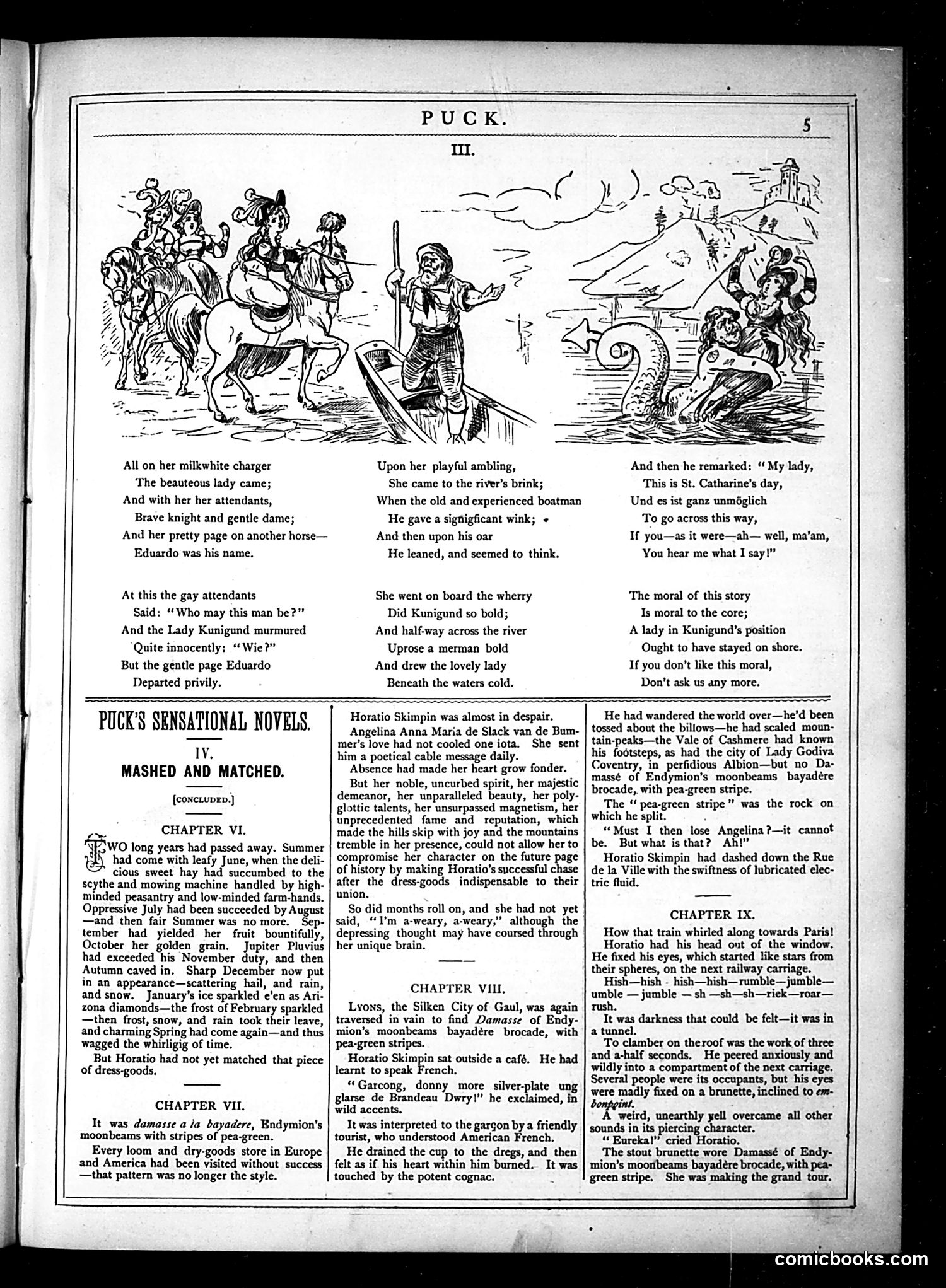
This page contains three illustrations accompanying a serialized narrative poem about a lady and a boatman, likely a romantic or comedic tale. The images depict: (1) a lady arriving on horseback with attendants; (2) the lady boarding a boat at a river; (3) the boatman making a remark to the departing lady. Below the poem, the page advertises "Puck's Sensational Novels" and begins Chapter VI of "Mashed and Matched," a serialized story. The remaining text discusses characters named Horatio Skimplin and Angelina, involving romantic complications and European travel. This appears to be entertainment/fiction content rather than political satire. The page represents Puck's dual function as both a humor magazine and publisher of serialized literature for its readers.
📄 Transcribed text from this page (OCR, searchable)
Machine-transcribed from the original scan — historical spelling and the odd misread are preserved.
All on her milkwhite charger The beauteous lady came; And with her her attendants, Brave knight and gentle dame; And her pretty page on another horse— Eduardo was his name. At this the gay attendants Said: ‘‘Who may this man be?” And the Lady Kunigund murmured Quite innocently: “Wie?” But the gentle page Eduardo Departed privily. il Upon her playful ambling, She came to the river’s brink; When the old and experienced boatman He gave a signigficant wink; « And then upon his oar He leaned, and seemed to think. She went on board the wherry Did Kunigund so bold; And half-way across the river Uprose a merman bold And drew the lovely lady Beneath the waters cold. PUCK'S SENSATIONAL NOVELS. MASHED AND MATCHED. [conctupeD.] CHAPTER VI. = WO long years had passed away. Summer & had come with leafy June, when the deli- cious sweet hay had succumbed to the scythe and mowing machine handled by high- minded peasantry and low-minded farm-hands. Oppressive July had been succeeded by August —and then fair Summer was no more. Sep- tember had yielded her fruit bountifully, October her golden grain. Jupiter Pluvius had exceeded his November duty, and then Autumn caved in. Sharp December now put in an appearance—scattering hail, and rain, and snow. January's ice sparkled e’en as Ari- zona diamonds—the frost of February sparkled —then frost, snow, and rain took their leave, and charming Spring had come again—and thus wagged the whirligig of time. But Horatio had not yet matched that piece of dress-goods, CHAPTER VII. It was damasse a la bayadere, Bndymion’s moonbeams with stripes of pea-green. Every loom and dry-goods store in Europe and America had been visited without success —that pattern was no longer the style. And then he remarked: “ My lady, ‘This is St. Catharine's day, Und es ist ganz unmdglich To go across this way, If you—as it were—ah— well, ma’am, You hear me what I say!” The moral of this story Is moral to the core; A lady in Kunigund’s position Ought to have stayed on shore. If you don’t like this moral, Don't ask us any more. Horatio Skimpin was almost in despair. Angelina Anna Maria de Slack van de Bum- mer’s love had not cooled one iota. She sent him a poetical cable message daily. Absence had made her heart grow fonder. But her noble, uncurbed spirit, her majestic demeanor, her unparalleled beauty, her poly- glottic talents, her unsurpassed magnetism, her unprecedented fame and reputation, which made the hills skip with joy and the mountains tremble in her presence, could not allow her to compromise her character on the future page of history by making Horatio’s successful chase after the dress-goods indispensable to their union, So did months roll on, and she had not yet said, “I’m a-weary, a-weary,” although the depressing thought may have coursed through her unique brain. CHAPTER VIII. Lyons, the Silken City of Gaul, was again traversed in vain to find Damasse of Endy- mion’s moonbeams bayadére brocade, with pea-green stripes. Horatio Skimpin sat outside a café. He had learnt to speak French. “Garcong, donny more silver-plate ung glarse de Brandeau Dwry!” he exclaimed, in wild accents. It was interpreted to the gargon by a friendly tourist, who understood American French. He drained the cup to the dregs, and then felt as if his heart within him burned. It was touched by the potent cognac. He had wandered the world over—he’d been tossed about the billows—he had scaled moun- tain-peaks—the Vale of Cashmere had known his footsteps, as had the city of Lady Godiva Coventry, in perfidious Albion—but no Da- massé of Endymion’s moonbeams_bayadére brocade, with pea-green stripe. The “ pea-green stripe” was the rock on which he split. ; “Must I then lose Angelina ?—it cannot be. But what is that? Ah!” Horatio Skimpin had dashed down the Rue de la Ville with the swiftness of lubricated elec- tric fluid. CHAPTER IX. How that train whirled along towards Paris! Horatio had his head out of the window. He fixed his eyes, which started like stars from their spheres, on the next railway carriage. Hish—hish - hish—hish—rumble—jumble— umble — jumble — sh —sh—sh—riek—roar— rush, It was darkness that could be felt—it was in a tunnel. To clamber on theroof was the work of three and a-half seconds. He peered anxiously and wildly into a compartment of the next carriage. Several people were its occupants, but his eyes were madly fixed on a brunette, inclined to em- Sonpeint. A weird, unearthly yell overcame all other sounds in its piercing character. “ Eureka!" cried Horatio. The stout brunette wore Damassé of Endy- mion’s mooribeams bayadére brocade, with pea- green stripe. She was making the grand tour. comicbooks.com