
Puck, 1877-11-14 · page 4 of 16
Puck — November 14, 1877 — page 4: what you’re looking at
What you’re looking at
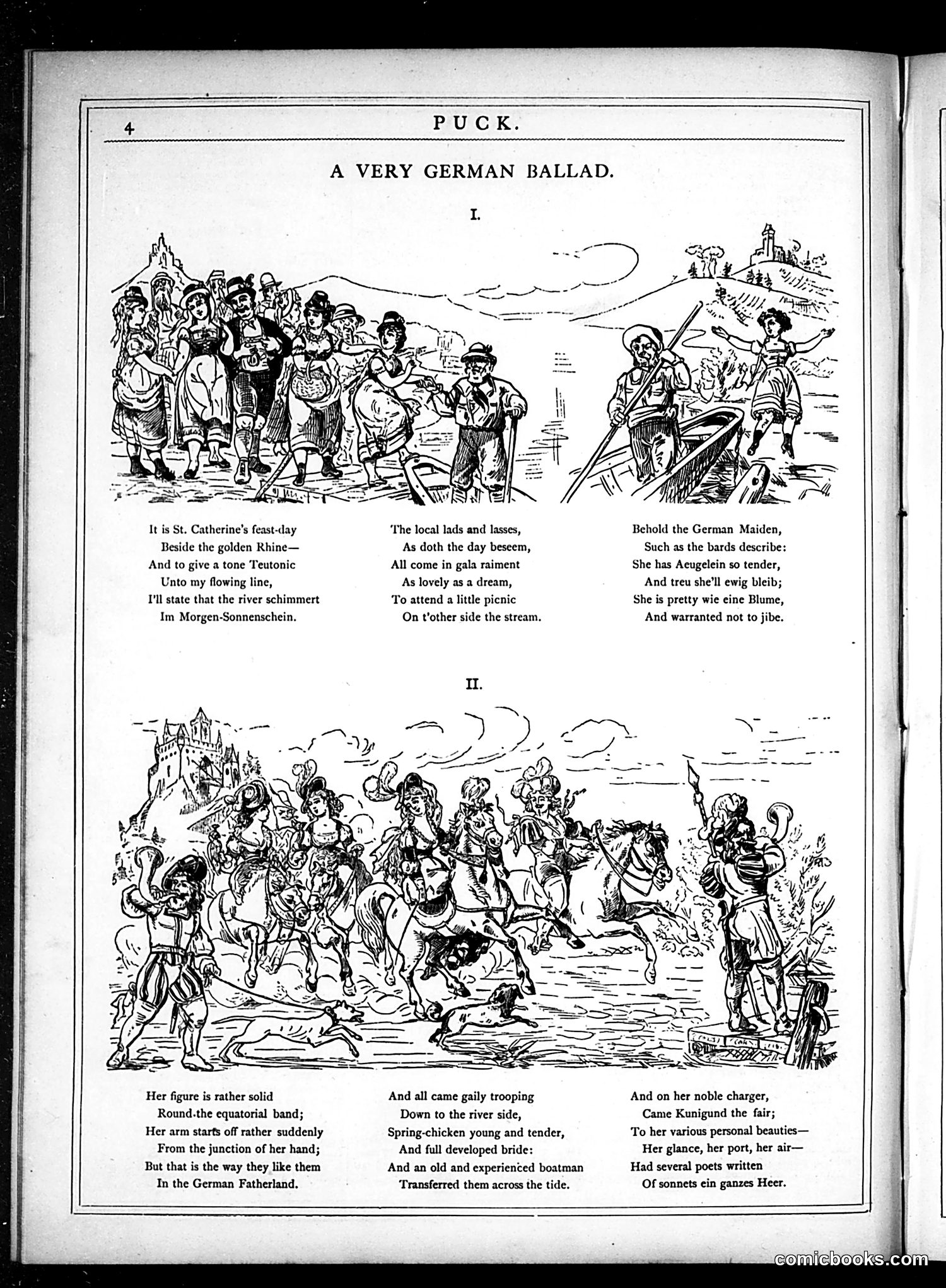
This satirical ballad mocks German culture and romanticism through exaggerated stereotypes. The narrative depicts a German maiden celebrated for her beauty—described with German characteristics like "ewig bleib" (eternally fair) and "Blume" (flower)—who attracts a procession of suitors. The two illustrated scenes show a picnic gathering and then a cavalry crossing, suggesting the absurdity of German romantic ideals clashing with military reality. The poem's rhyming couplets parody German folk ballads while poking fun at Germanic obsession with courtly love, chivalry, and aesthetic refinement. The satire likely targets late 19th-century American perceptions of German sentimentality and the contrast between German cultural pretensions and their martial militarism—a common Puck theme reflecting period tensions.
📄 Transcribed text from this page (OCR, searchable)
Machine-transcribed from the original scan — historical spelling and the odd misread are preserved.
PUCK. It is St. Catherine's feast-day Beside the golden Rhine— And to give a tone Teutonic Unto my flowing line, I'll state that the river schimmert Im Morgen-Sonnenschein, Her figure is rather solid Round.the equatorial band; Her arm starts off rather suddenly From the junction of her hand; But that is the way they like them In the German Fatherland. A VERY GERMAN BALLAD. ‘The local lads and lasses, As doth the day beseem, All come in gala raiment As lovely as a dream, To attend a little picnic On t'other side the stream. Behold the German Maiden, Such as the bards describe: She has Acugelein so tender, And treu she'll ewig bleib; She is pretty wie cine Blume, And warranted not to jibe. And all came gaily trooping Down to the river side, Spring-chicken young and tender, And full developed bride: And an old and experienced boatman Transferred them across the tide. And on her noble charger, Came Kunigund the fair; To her various personal beauties— Her glance, her port, her air— Had several poets written Of sonnets ein ganzes Heer.