
Puck, 1877-11-14 · page 3 of 16
Puck — November 14, 1877 — page 3: what you’re looking at
What you’re looking at
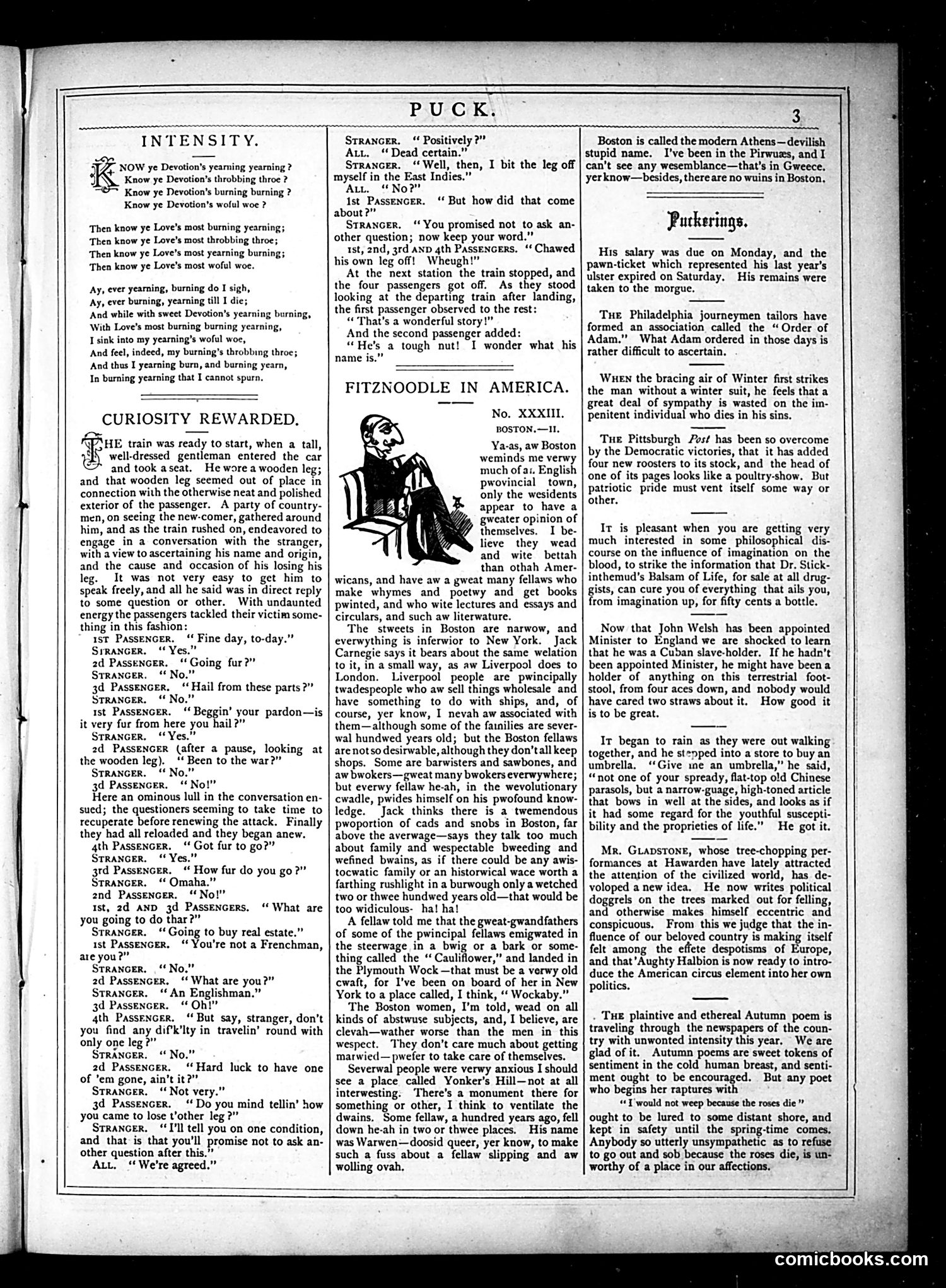
This page contains three distinct sections: a poem titled "Intensity," a brief humor piece called "Curiosity Rewarded," and a section labeled "Fitznoodle in America" featuring a cartoon of a man in a chair. The "Fitznoodle" cartoon appears to satirize Boston's pretensions and character through dialogue between a stranger and various passengers. The text mocks Boston's intellectual culture, literary aspirations, and social attitudes—contrasting Bostonians' self-regard with their actual provincial nature. References to "the Carnegie" and comparisons to Liverpool suggest commentary on American versus European cultural sophistication. The remaining prose sections are brief satirical anecdotes about conversational oddities and social behavior, typical of Puck's lighter humor. Without clearer visual detail of the cartoon's artistic style, precise identification of any specific caricatured figures remains uncertain.
📄 Transcribed text from this page (OCR, searchable)
Machine-transcribed from the original scan — historical spelling and the odd misread are preserved.
INTENSITY. IG. NOW ye Devotion’s yeaming yearning ? ul Know ye Devotion’s throbbing throe ? = Know ye Devotion’s burning burning ? Know ye Devotion’s woful woe ? ‘Then know ye Love's most burning yearning; ‘Then know ye Love’s most throbbing throe; ‘Then know ye Love's most yearning burning; ‘Then know ye Love's most woful woe. Ay, ever yearning, burning do I sigh, Ay, ever burning, yearning till I die; ‘And while with sweet Devotion’s yearning burning, With Love's most burning burning yearning, I sink into my yearning’s woful woe, ‘And feel, indeed, my burning’s throbbing throe; And thus I yearning burn, and burning yearn, In burning yearning that I cannot spurn, CURIOSITY REWARDED. = NPSHE train was ready to start, when a tall, ww well-dressed gentleman entered the car and took aseat. He wore a wooden leg; and that wooden leg seemed out of place in connection with the otherwise neat and polished exterior of the passenger. A party of country- men, on seeing the new-comer, gathered around him, and as the train rushed on, endeavored to engage in a conversation with the stranger, with a view to ascertaining his name and origin, and the cause and occasion of his losing his leg. It was not very easy to get him to speak freely, and all he said was in direct reply to some question or other. With undaunted energy the passengers tackled their victim some- thing in this fashion: 1st PassenGcer. ‘ Fine day, to-day.” SrRaNGER. ‘‘ Yes.” ad Passencer. ‘Going fur?” STRANGER. ‘ No.” 3d Passencer. ‘“‘ Hail from these parts?” STRANGER. “No.” 1st PASSENGER. ‘“ Beggin your pardon—is it very fur from here you hail?” STRANGER. “Yes.” 2d PAsseNGER (after a pause, looking at the wooden leg). ‘‘ Been to the war?” STRANGER. ‘ No.” 3d Passencer. ‘ No!” Here an ominous lull in the conversation en- sued; the questioners seeming to take time to recuperate before renewing the attack. Finally they had all reloaded and they began anew. 4th Passencer. “ Got fur to go?” Srrancer. ‘ Yes.” rd Passencer. ‘ How fur do you go?” STRANGER. ‘ Omaha.” 2nd PassenceR. “No!” 1st, 2d AND 3d PASSENGERS, you going to do thar?” Strancer. ‘Going to buy real estate.” ist PasseNGER. ‘“‘ You're not a Frenchman, are you?” Strancer. ‘ No.” 2d PASSENGER. “ What are you?” Strancer. ‘An Englishman.” 3d Passencer. ‘ Oh!” 4th Passencer. “But say, stranger, don’t you find any difk’lty in travelin’ round with only one leg 2” STRANGER. ‘ No.” 2d Passencer. ‘Hard luck to have one of "em gone, ain’t it?” STRANGER. ‘Not very.” 3d Passencer. ‘Do you mind tellin’ how you came to lose t’other leg ?” STRANGER. “I'll tell you on one condition, and that is that you'll promise not to ask an- other question after this.”” Att, ‘“ We're agreed.” “What are PUCK. STRANGER. ‘“ Positively?” ALL. “ Dead certai Srrancer. ‘Well, then, I bit the leg off myself in the East Indies.” Att. “No?” Ist PASSENGER. about ?” Strancer. ‘ You promised not to ask an- other question; now keep your word.” 1st, 2nd, 3rd AND 4th Passencers. ‘“ Chawed his own leg off! Wheugh!” At the next station the train stopped, and the four passengers got off. As they stood looking at the departing train after landing, the first passenger observed to the rest: “That's a wonderful story!” And the second passenger added: “He's a tough nut! I wonder what his name is.” “But how did that come FITZNOODLE IN AMERICA. No. XXXIII, BOSTON,—II, Ya-as, aw Boston weminds me verwy much of ai. English pwovincial town, only the wesidents appear to have a gweater opinion of themselves. I be- lieve they wead and wite bettah than othah Amer- wicans, and have aw a gweat many fellaws who make whymes and poetwy and get books pwinted, and who wite lectures and essays and circulars, and such aw literwature. The stweets in Boston are narwow, and everwything is inferwior to New York. | Jack Carnegie says it bears about the same welation to it, in a small way, as aw Liverpool does to London. Liverpool people are pwincipally twadespeople who aw sell things wholesale and have something to do with ships, and, of course, yer know, I nevah aw associated with them—although some of the fainilies are sever- wal hundwed years old; but the Boston fellaws are notso desirwable, although they don’tall keep shops. Some are barwisters and sawbones, and aw bwokers—gweat many bwokers everwywhere; but everwy fellaw he-ah, in the wevolutionary cwadle, pwides himself on his pwofound know- ledge. Jack thinks there is a twemendous pwoportion of cads and snobs in Boston, far above the averwage—says they talk too much about family and wespectable bweeding and wefined bwains, as if there could be any awis- tocwatic family or an historwical wace worth a farthing rushlight in a burwough only a wetched two or thwee hundwed years old—that would be too widiculous- ha! ha! A fellaw told me that the gweat-gwandfathers of some of the pwincipal fellaws emigwated in the steerwage in a bwig or a bark or some- thing called the “Cauliflower,” and landed in the Plymouth Wock —that must be a verwy old cwaft, for I've been on board of her in'New York to a place called, I think, ‘‘ Wockaby.” The Boston women, I’m told, wead on all kinds of abstwuse subjects, and, I believe, are clevah—wather worse than the men in this wespect. They don’t care much about getting marwied—pwefer to take care of themselves. Severwal people were verwy anxious I should see a place called Yonker’s Hill—not at all interwesting. ‘There's a monument there for something or other, I think to ventilate the dwains, Some fellaw, a hundred years ago, fell down he-ah in two or thwee places. His name was Warwen—doosid queer, yer know, to make such a fuss about a fellaw slipping and aw wolling ovah, Boston is called the modern Athens —devilish stupid name. I’ve been in the Pirwuzs, and I can’t see any wesemblance—that’s in Gweece. yerknow—besides, there are no wuins in Boston, Purkerings, His salary was due on Monday, and the pawn-ticket which represented his last year’s ulster expired on Saturday. His remains were taken to the morgue. Tue Philadelphia journeymen tailors have formed an association called the “ Order of Adam." What Adam ordered in those days is rather difficult to ascertain, Wuen the bracing air of Winter first strikes the man without a winter suit, he feels that a great deal of sympathy is wasted on the im- penitent individual who dies in his sins. Tue Pittsburgh Fost has been so overcome by the Democratic victories, that it has added four new roosters to its stock, and the head of one of its pages looks like a poultry-show. But patriotic pride must vent itself some way or other, It is pleasant when you are getting very much interested in some philosophical dis- course on the influence of imagination on the blood, to strike the information that Dr. Stick- inthemud’s Balsam of Life, for sale at all drug- gists, can cure you of everything that ails you, from imagination up, for fifty cents a bottle. Now that John Welsh has been appointed Minister to England we are shocked to learn that he was a Cuban slave-holder. If he hadn't been appointed Minister, he might have been a holder of anything on this terrestrial foot- stool, from four aces down, and nobody would have cared two straws about it. How good it is to be great. It began to rain as they were out walking together, and he stepped into a store to buy an umbrella. ‘Give ine an umbrella,” he said, “not one of your spready, flat-top old Chinese parasols, but a narrow-guage, high-toned article that bows in well at the sides, and looks as if it had some regard for the youthful suscepti- bility and the proprieties of life.” He got it. Mr. Giapstone, whose tree-chopping per- formances at Hawarden have lately attracted the attention of the civilized world, has de- voloped a new idea. He now writes political doggrels on the trees marked out for felling, and otherwise makes himself eccentric and conspicuous. From this we judge that the in- fluence of our beloved country is making itself felt among the effete despotisms of Europe, and that 'Aughty Halbion is now ready to intro- duce the American circus element into her own politics. . Tue plaintive and ethereal Autumn poem is traveling through the newspapers of the coun- try with unwonted intensity this year, We are glad of it. Autumn poems are sweet tokens of sentiment in the cold human breast, and senti- ment ought to be encouraged. But any poet who begins her raptures with « T'would not weep because the roses die” ought to be lured to some distant shore, and kept in safety until the spring-time comes, Anybody so utterly unsympathetic as to refuse to go out and sob because the roses die, is un- worthy of a place in our affections. omicbooks.com