
Puck, 1877-11-14 · page 2 of 16
Puck — November 14, 1877 — page 2: what you’re looking at
What you’re looking at
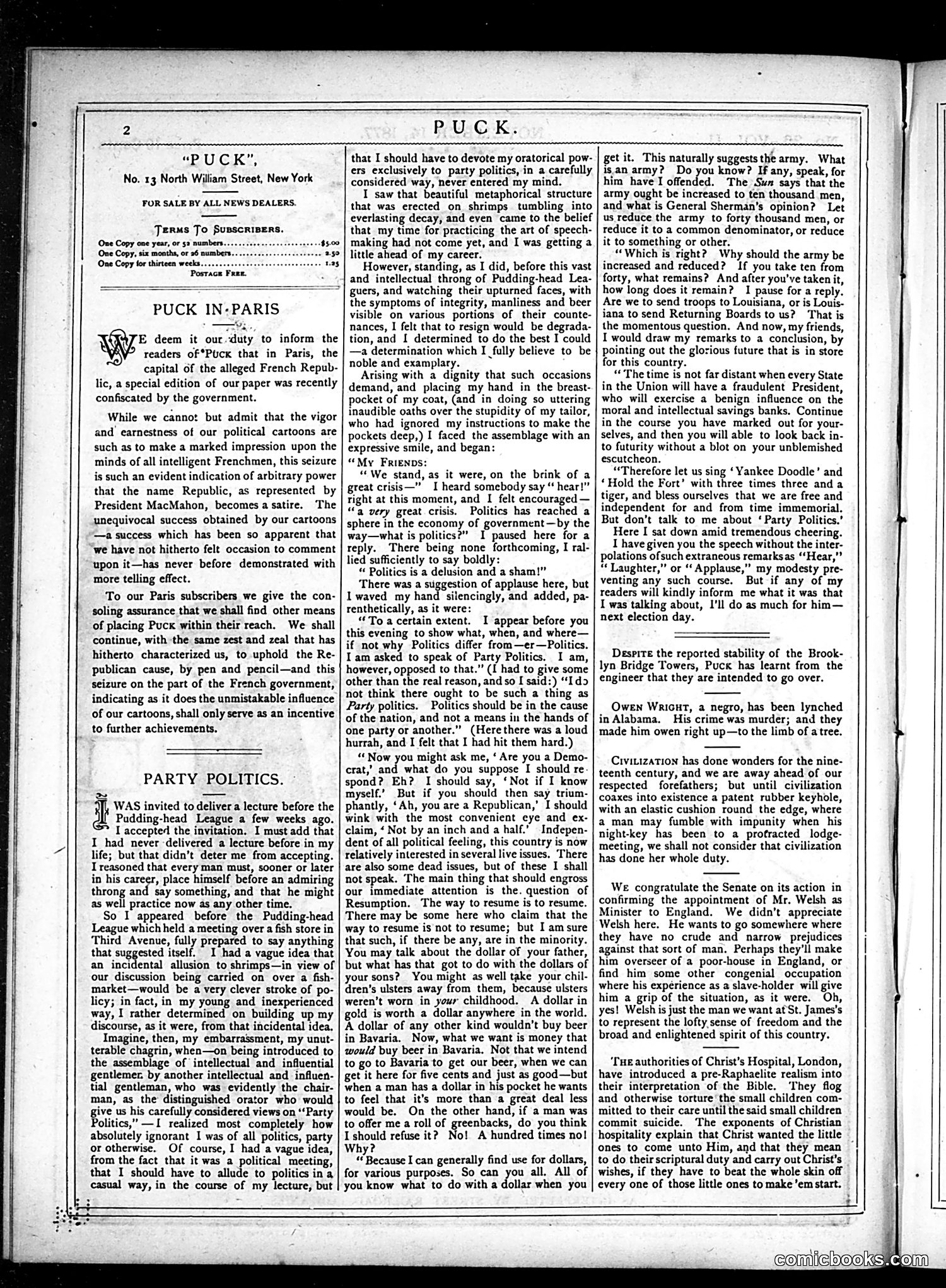
This page contains the "Party Politics" column by the editor, discussing a lecture invitation. The author describes being asked to speak before the Pudding-head League but declining, as he'd never delivered political lectures before. The piece satirizes partisan politics by depicting the author's refusal to choose between Democratic and Republican positions. He argues that politicians reduce complex issues to party loyalty rather than addressing substantive questions—using the army's future as an example. The satire mocks how both parties demand ideological conformity while the author advocates for independent thinking on policy matters. The column criticizes what it sees as the absurdity of rigid party politics, where citizens are expected to adopt pre-packaged positions rather than reasoning through issues individually. This reflects broader Progressive-era critiques of machine politics and party bosses.
📄 Transcribed text from this page (OCR, searchable)
Machine-transcribed from the original scan — historical spelling and the odd misread are preserved.
PUCK. — “PUCK”, No. 13 North William Street, New York FOR SALE BY ALL NEWS DEALERS. Terms To Susscripers. One Copy one year, or 52 numbers. One Copy, six months, or 26 numbers. Postrace Free. PUCK IN-PARIS E deem it our. duty to inform the readers of ‘Puck that in Paris, the capital of the alleged French Repub- lic, a special edition of our paper was recently confiscated by the government. While we cannot but admit that the vigor and’ earnestness of our political cartoons are such as to make a marked impression upon the minds of all intelligent Frenchmen, this seizure is such an evident indication of arbitrary power that the name Republic, as represented by President MacMahon, becomes a satire. The unequivocal success obtained by our cartoons —a success which has been so apparent that we have not hitherto felt occasion to comment upon it—has never before demonstrated with more telling effect. To our Paris subscribers we give the con- soling assurance that we shall find other means of placing Puck within their reach. We shall continue, with the same zest and zeal that has hitherto characterized us, to uphold the Re- publican cause, by pen and pencil—and this seizure on the part of the French government, indicating as it does the unmistakable influence of our cartoons, shall only serve as an incentive to further achievements. PARTY POLITICS. WAS invited to deliver a lecture before the Pudding-head League a few weeks ago. lL accepted the invitation. I must add that I had never -delivered a lecture before in my life; but that didn’t deter me from accepting. Treasoned that every man must, sooner or later in his career, place himself before an admiring throng and say something, and that he might as well practice now as any other time. So I appeared before the Pudding-head League which held a meeting over a fish store in Third Avenue, fully prepared to say anything that suggested itself. I had a vague idea that an incidental allusion to shrimps—in view of our discussion being carried on over a fish- market—would be a very clever stroke of po- licy; in fact, in my young and inexperienced way, I rather determined on building up my discourse, as it were, from that incidental idea. Imagine, then, my embarrassment, my unut- terable chagrin, when—on being introduced to the assemblage of intellectual and influential gentlemer. by another intellectual and influen- tial gentleman, who was evidently the chair- man, as the distinguished orator who would jive us his carefully considered views on ‘‘Party ‘olitics,””" —I realized most completely how absolutely ignorant I was of all politics, party or otherwise. Of course, I had a vague idea, from the fact that it was a political meeting, that I should have to allude to politics ina casual way, in the course of my lecture, but ~| guers, and watching their upturne that I should have to devote my oratorical pow- ers exclusively to party politics, in a carefully considered way, never entered my mind. I saw that beautiful metaphorical structure that was erected on shrimps tumbling into everlasting decay, and eyen came to the belief that my time for practicing the art of speech- making had not come yet, and I was getting a little ahead of my career. However, standing, as I did, before this vast and intellectual throng of Pudding-head Lea- faces, with the symptoms of integrity, manliness and beer visible on various portions of their counte- nances, I felt that to resign would be degrada- tion, and I determined to do the best I could —a determination which I fully believe to be noble and examplary. Arising with a dignity that such occasions demand, and placing my hand in the breast- ocket of my coat, (and in doing so uttering inaudible oaths over the stupidity of my tailor, who had ignored my instructions to make the pockets deep,) I faced the assemblage with an expressive smile, and began: “My Frienps: “We stand, as it were, on the brink of a great crisis—” I heard somebody say “ hear!” right at this moment, and I felt encouraged — “a very great crisis. Politics has reached a sphere in the economy of government—by the way—what is politics?” I paused here for a reply. There being none forthcoming, I ral- lied sufficiently to say boldly: * Politics is a delusion and a sham!” ‘There was a suggestion of applause here, but I waved my hand silencingly, and added, pa- renthetically, as it were: “To a certain extent. I appear before you this evening to show what, when, and where— if not why Politics differ from—er—Politics. I am asked to speak of Party Politics. I am, however, opposed to that.” (I had to give some other than the real reason, andso I said:) “Ido not think there ought to be such a thing as Party politics. Politics should be in the cause of the nation, and not a means in the hands of one party or another.” (Here there was a loud hurrah, and I felt that I had hit them hard.) ““ Now you might ask me, ‘ Are you a Demo- crat,’ and what do you suppose I should re spond? Eh? I should say, ‘Not if I know myself.’ But if you should then say trium- phantly, ‘Ah, you are a Republican,’ I should wink with the most convenient eye and ex- claim, ‘Not by an inch and a half.’ _Indepen- dent of all political feeling, this country is now relatively interested in several live issues. There are also some dead issues, but of these I shall not speak. ‘The main thing that should engross our immediate attention is the. question of Resumption. The way to resume is to resume. There may be some here who claim that the way to resume is not to resume; but I am sure that such, if there be any, are in the minority. You may talk about the dollar of your father, but what has that got to do with the dollars of your sons? You might as well take your chil- dren's ulsters away from them, because ulsters weren’t worn in your childhood. A dollar in gold is worth a dollar anywhere in the world. A dollar of any other kind wouldn’t buy beer in Bavaria. Now, what we want is money that would buy beer in Bavaria. Not that we intend to go to Bavaria to get our beer, when we can get it here for five cents and just as good—but when a man has a dollar in his pocket he wants to feel that it’s more than a great deal less would be. On the other hand, if a man was to offer me a roll of greenbacks, do you think I should refuse it? No! A hundred times no! Why? “Because I can generally find use for dollars, for various purposes. So can you all, All of you know what to do with a dollar when you get it. This naturally suggests the army. What isan army? Do you know? If any, speak, for him have I offended. The Sun says that the army ought be increased to ten thousand men, and what is General Sherman's opinion? Let us.reduce the army to forty thousand men, or reduce it to a common denominator, or reduce it to something or other. “Which is right? Why should the army be increased and reduced? If you take ten from forty, what remains? And after you've taken it, how long does it remain? 1 pause for a reply. Are we to send troops to Louisiana, or is Louis- iana to send Returning Boards to us? That is the momentous question. And now, my friends, I would draw my remarks to a conclusion, by pointing out the glorious future that is in store for this country. “ The time is not far distant when every State in the Union will have a fraudulent President, who will exercise a benign influence on the moral and intellectual savings banks. Continue in the course you have marked out for your- selves, and then you will able to look back in- to futurity without a blot on your unblemished escutcheon, “Therefore let us sing ‘Yankee Doodle’ and ‘Hold the Fort’ with three times three and a tiger, and bless ourselves that we are free and independent for and from time immemorial. But don’t talk to me about ‘Party Politics.’ Here I sat down amid tremendous cheering. I have given you the speech without the inter- polations ofsuch extraneous remarksas “Hear,” “ Laughter,” or “ Applause,” my modesty pre- venting any such course. But if any of my readers will kindly inform me what it was that I was talking about, I'll do as much for him— next election day. Despite the reported stability of the Brook- lyn Bridge Towers, Puck has learnt from the engineer that they are intended to go over. Owen Wricut, a negro, has been lynched in Alabama. His crime was murder; and they made him owen right up—to the limb of atree. Civitization has done wonders for the nine- teenth century, and we are away ahead of our respected forefathers; but until civilization coaxes into existence a patent rubber keyhole, with an elastic cushion round the edge, where a man may fumble with impunity when his night-key has been to a protracted lodge- meeting, we shall not consider that civilization has done her whole duty. We congratulate the Senate on its action in confirming the appointment of Mr. Welsh as Minister to England. We didn’t appreciate Welsh here. He wants to go somewhere where they have no crude and narrow prejudices against that sort of man. Perhaps they'll make him overseer of a poor-house in England, or find him some other congenial occupation where his expérience as a slave-holder will give him a grip of the situation, as it were. Oh, yes! Welsh is just the man we want af St. James's to represent the lofty sense of freedom and the broad and enlightened spirit of this country, ‘Tue authorities of Christ's Hospital, London, have introduced a pre-Raphaelite realism into their interpretation of the Bible. They flog and otherwise torture’ the small children com- mitted to their care until the said small children commit suicide. The exponents of Christian hospitality explain that Christ wanted the little _ ones to come unto Him, and that they mean to do their scriptural duty and carry out Christ's wishes, if they have to beat the whole skin off every one of those little ones to make ’em start.