
Puck, 1877-11-14 · page 12 of 16
Puck — November 14, 1877 — page 12: what you’re looking at
What you’re looking at
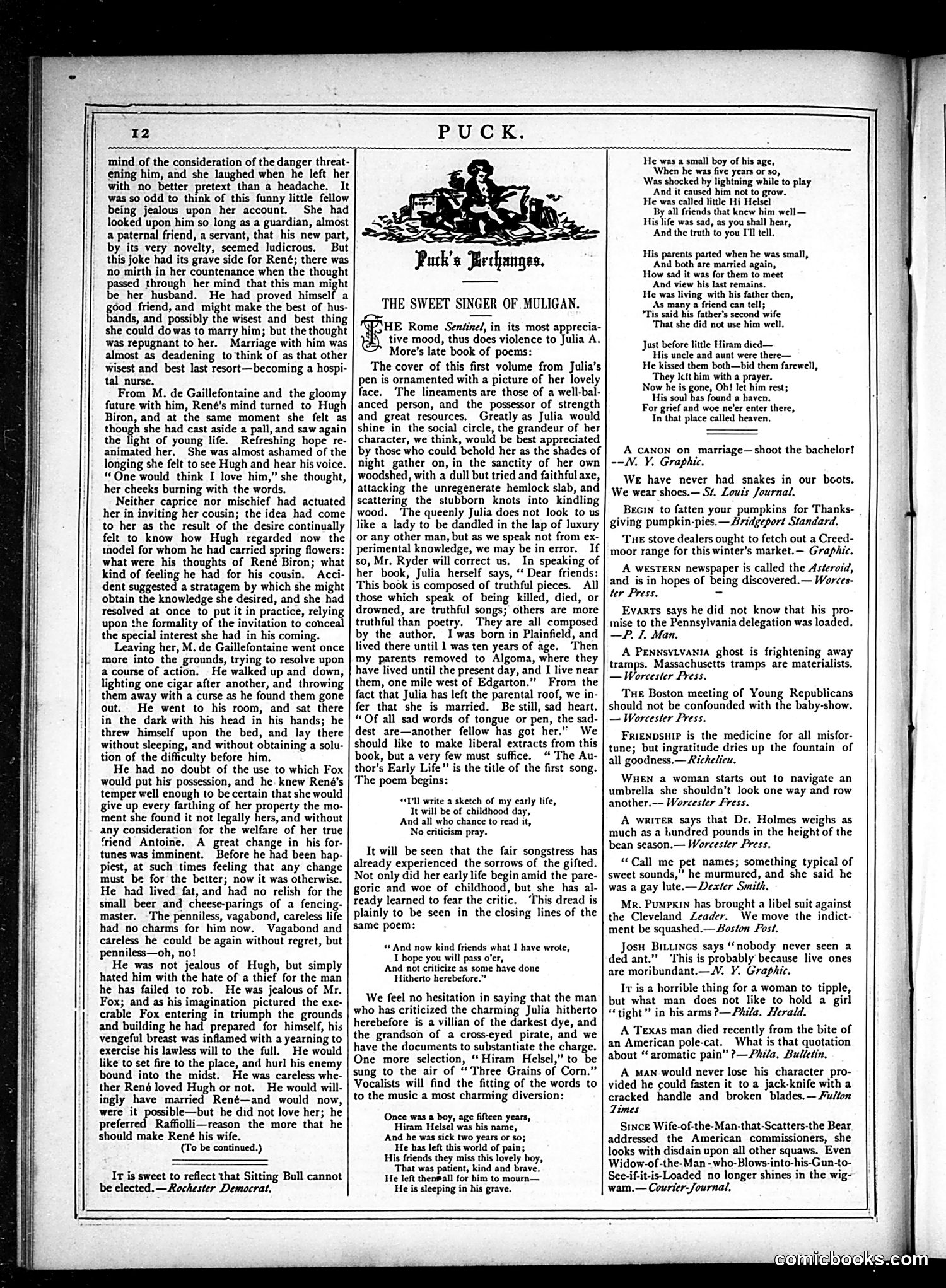
This page contains **literary criticism and humor essays** rather than political cartoons. The main feature, "Puck's Pertinages," discusses Julia A. More's poetry collection, praising her work while offering gentle mockery of contemporary literary taste. The page includes several **short humorous items** satirizing various topics: bachelor life, political delegations, newspaper sensationalism, and social pretensions. References mention Pennsylvania delegates, a "baby-show" exhibition, and Dr. Holmes' weight—typical targets of Puck's satirical commentary on American society and culture. The small illustration at top appears to show a dramatic scene, likely relating to one of the literary or humorous pieces discussed below it.
📄 Transcribed text from this page (OCR, searchable)
Machine-transcribed from the original scan — historical spelling and the odd misread are preserved.
mind of the consideration of the danger threat- ening him, and she laughed when he left her with no better pretext than a headache. It was so odd to think of this funny little fellow being jealous upon her account. She had looked upon him so long as a guardian, almost a paternal friend, a servant, that his new part, by its very novelty, seemed ludicrous. But this joke had its grave side for René; there was no mirth in her countenance when the thought feed through her mind that this man might her husband. He had proved himself a good friend, and might make the best of hus- ds, and possibly the wisest and best thing she could dowas to marry him; but the thought was repugnant to her. Marriage with him was almost as deadening to think of as that other wisest and best last resort—becoming a hospi- tal_nurse. From M. de Gaillefontaine and the gloom: future with him, René’s mind turned to Hug] Biron, and at the same moment she felt as though she had cast aside a pall, and saw again the light of young life. Refreshing hope re- animated her. She was almost ashamed of the longing she felt to see Hugh and hear his voice. “One would think I love him,” she thought, her cheeks burning with the words. Neither caprice nor mischief had actuated her in inviting her cousin; the idea had come to her as the result of the desire continually felt to know how Hugh regarded now the inodel for whom he had carried spring flowers: what were his thoughts of René Biron; what kind of feeling he had for his cousin. Acci- dent suggested a stratagem by which she might obtain the knowledge she desired, and she had resolved at once to put it in practice, relying upon the formality of the invitation to conceal the special interest she had in his coming. Leaving her, M. de Gaillefontaine went once more into the grounds, trying to resolve upon a course of action. He walked up and down, lighting one cigar after another, and throwing them away with a curse as he found them gone out. He went to his room, and sat there in the dark with his head in his hands; he threw himself upon the bed, and lay there without sleeping, and without obtaining a solu- tion of the difficulty before him. He had no doubt of the use to which Fox would put his possession, and he. knew René’s temper well enough to be certain that she would give up every farthing of her property the mo- ment she found it not legally hers, and without any consideration for the welfare of her true friend Antoine. A great change in his for- tunes was imminent. Before he had been hap- piest, at such times feeling that any change must be for the better; now it was otherwise. He had lived fat, and had no relish for the small beer and cheese-parings of a fencing- master. The penniless, vagabond, careless life had no charms for him now. Vagabond and careless he could be again without regret, but penniless—oh, no! He was not jealous of Hugh, but simply hated him with the hate of a thief for the man he has failed to rob. He was jealous of Mr. Fox; and as his imagination pictured the exe- crable Fox entering in triumph the grounds and building he had prepared for himself, his vengeful breast was inflamed with a yearning to exercise his lawless will to the full. He would like to set fire to the place, and hurl his enemy bound into the midst. He was careless whe- ther René loved Hugh or not. He would will- ingly have married René—and would now, were it ible—but he did not love her; he preferred Ratffiolli—reason the more that he should make René his wife. (To be continued. Ir is sweet to reflect that Sitting Bull cannot be elected.—Rochester Democrat, THE SWEET SINGER OF. MULIGAN. HE Rome Sentine/, in its most apprecia- tive mood, thus does violence to Julia A. More's late book of poems: The cover of this first volume from Julia’s pen is ornamented with a picture of her lovely face. The lineaments are those of a well-bal- anced person, and the or of strength and great resources. Greatly as Julia would shine in the social circle, the grandeur of her character, we think, would be best appreciated by those who could behold her as the shades of night gather on, in the sanctity of her own woodshed, with a dull but tried and faithful axe, attacking the unregenerate hemlock slab, and scattering the stubborn knots into kindling wood. ‘The queenly Julia does not look to us like a lady to be dandled in the lap of luxury or any other man, but as we speak not from ex- perimental knowledge, we may be in error. If so, Mr. Ryder will correct us. In speaking of her book, Julia herself says, “ Dear friends: This book is composed of truthful pieces. All those which speak of being killed, died, or drowned, are truthful songs; others are more truthful than poetry. They are all composed by the author. I was born in Plainfield, and lived there until 1 was ten years of age. Then my parents removed to Algoma, where they have lived until the present day, and I live near them, one mile west of Edgarton.” From the fact that Julia has left the parental roof, we in- fer that she is married. Be still, sad heart. “Of all sad words of tongue or pen, the sad- dest are—another fellow has got her.” We should like to make liberal extracts from this book, but a very few must suffice. “ The Au- thor’s Early Life” is the title of the first song. The poem begins: “P11 write a sketch of my early life, It will be of childhood day, And all who chance to read it, No criticism pray. It will be seen that the fair songstress has already experienced the sorrows of the gifted. Not only did her early life begin amid the pare- goric and woe of childhood, but she has al- ready learned to fear the critic. ‘This dread is plainly to be seen in the closing lines of the same poem: « And now kind friends what I have wrote, I hope you will pass o'er, And not criticize as some have done Hitherto herebefore.” We feel no hesitation in saying that the man who has criticized the charming Julia hitherto herebefore is a villian of the darkest dye, and the grandson of a cross-eyed pirate, and we have the documents to substantiate the charge. One more selection, ‘Hiram Helsel,” to sung to the air of “Three Grains of Corn.” Vocalists will find the fitting of the words to to the music a most charming diversion: Once was a boy, age fifteen years, Hiram Helsel was his name, ‘And he was sick two years or $0; He has left this world of pain; His friends they miss this lovely boy, That was patient, kind and brave. He left thenpall for him to mourn— He is sleeping in his grave. He was a small boy of his age, ‘When he was five years or so, Was shocked by lightning while to play And it caused him not to grow. He was called little Hi Helsel By all friends that knew him well— His life was sad, as you shall hear, ‘And the truth to you I'll tell. His parents parted when he was small, ‘And both are married again, How sad it was for them to meet And view his last remains. He was living with his father then, many a friend can tell; "Tis said his father's second wife That she did not use him well. Just before little Hiram died— His uncle and aunt were there— He kissed them both—bid them farewell, They lett him with a prayer. Now he is gone, Oh! let him rest; His soul has found a haven, For grief and woe ne'er enter there, In that place called heaven. A CANON on marriage—shoot the bachelor! --N. Y. Graphic. We have never had snakes in our bcots. We wear shoes.— St. Louis Journal. Becin to fatten your pumpkins for Thanks- giving pumpkin-pies.— Bridgeport Standard. Tue stove dealers ought to fetch out a Creed- moor range for this winter’s market.— Graphic. A WESTERN newspaper is called the Asteroid, and is in hopes of being discovered.— Worces- ter Press. = Evarts says he did not know that his pro- mise to the Pennsylvania delegation was loaded. —P. 1. Man. A PENNsYLVANIA ghost is frightening away tramps. Massachusetts tramps are materialists. — Worcester Press. Tue Boston meeting of Young Republicans should not be confounded with the baby-show. — Worcester Press. FRIENDSHIP is the medicine for all misfor- tune; but ingratitude dries up the fountain of all goodness.— Richelieu. Wuen a woman starts out to navigate an umbrella she shouldn't look one way and row another.— Worcester Fress. ‘A water says that Dr. Holmes weighs as much as a hundred pounds in the height of the bean season.— Worcester Press. “Call me pet names; something typical of sweet sounds,” he murmured, and she said he was a gay lute.—Dezxter Smith. Mr. Pumpkin has brought a libel suit against the Cleveland Leader. We move the indict- ment be squashed.— Boston Post. Jos Bitincs says ‘nobody never seen a ded ant.” ‘This is probably because live ones are moribundant.—/. Y. Graphic. Ir is a horrible thing for a woman to tipple, but what man does not like to hold a girl “tight” in his arms ?—Phila. Herald. A Texas man died recently from the bite of an American pole-cat. What is that quotation about “aromatic pain” ?—/hila, Bulletin, A Man would never lose his character pro- vided he could fasten it to a jack-knife with a cracked handle and broken blades,— Fulton Times Since Wife-of-the-Man-that-Scatters-the Bear. addressed the American commissioners, she looks with disdain upon all other squaws. Even Widow-of-the-Man - who-Blows-into-his-Gun-to- See-if-it-isLoaded no longer shines in the wig- wam.— Courier-Journal,