
Puck, 1877-11-14 · page 11 of 16
Puck — November 14, 1877 — page 11: what you’re looking at
What you’re looking at
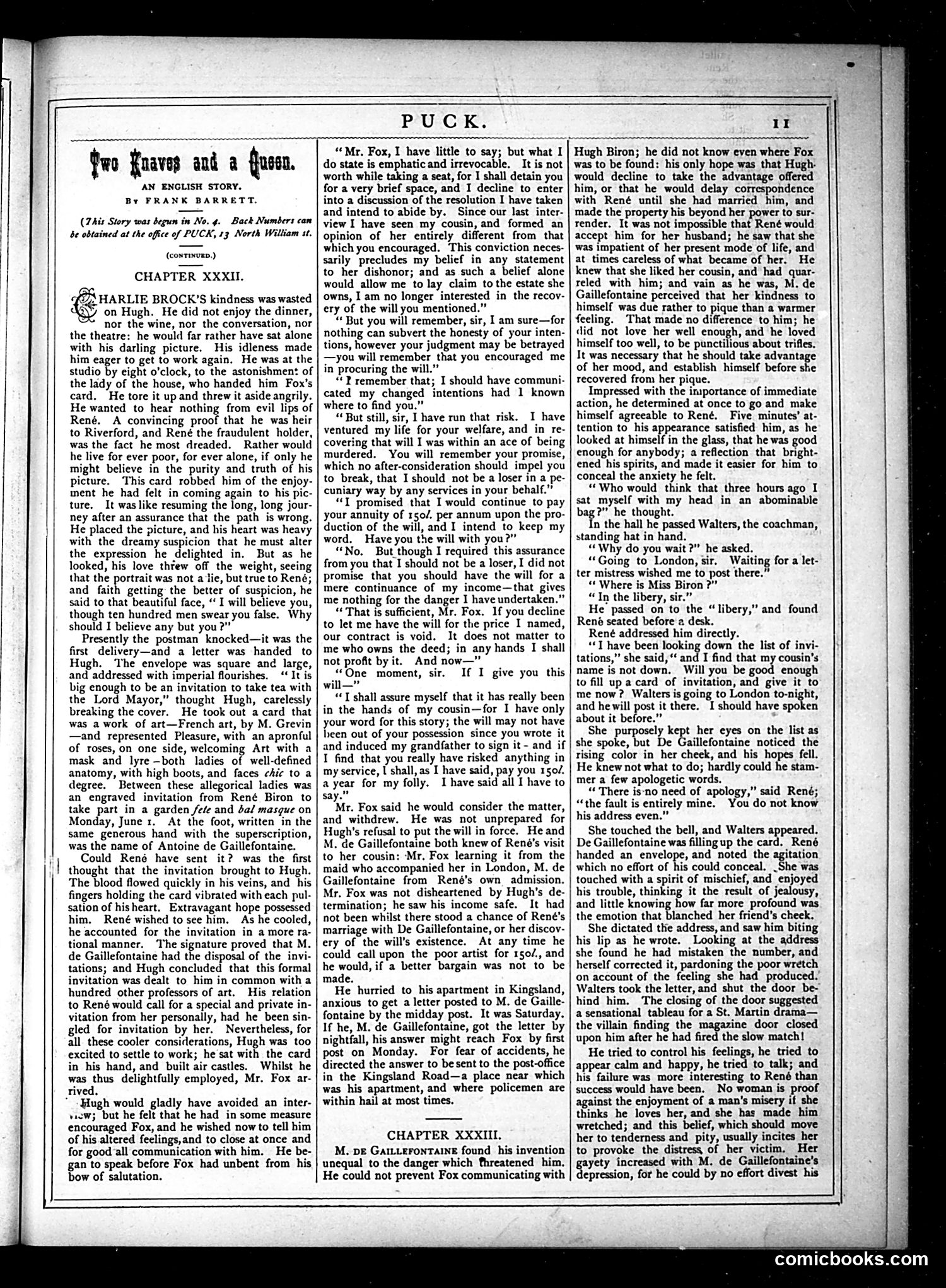
This page contains serialized fiction ("Two Knaves and a Queen: An English Story" by Frank Barrett, Chapter XXXII-XXXIII), not political satire or editorial cartoons. The narrative focuses on a domestic drama involving characters named Hugh, Fox, René, and de Gaillefontaine. The plot concerns inheritance disputes, a contested will, and romantic entanglements among English gentry. References include London locations and legal/property matters typical of Victorian-era melodrama. While Puck was primarily known for political satire and humor illustrations, this particular page demonstrates the magazine also published serialized fiction to fill its pages—a common practice for publications of this era. The content is social drama rather than satirical commentary on current events or public figures.
📄 Transcribed text from this page (OCR, searchable)
Machine-transcribed from the original scan — historical spelling and the odd misread are preserved.
PUCK. $wo fuaves and a Queen. AN ENGLISH STORY. Br FRANK BARRETT. (This Story was begun in No. 4. Back Numbers can be obtained at the office of PUCK, 13 North William st. (conrimue.) CHAPTER XXXII. HARLIE BROCK’S kindness was wasted on Hugh. He did not enjoy the dinner, nor the wine, nor the conversation, nor the theatre: he would far rather have sat alone with his darling picture. His idleness made him eager to get to work again. He was at the studio by eight o'clock, to the astonishment of the lady of the house, who handed him Fox’s card. ‘He tore it up and threw it aside angrily. He wanted to hear nothing from evil lips of René. A convincing proof that he was heir to Riverford, and René the fraudulent holder, was the fact he most dreaded. Rather would he live for ever poor, for ever alone, if only he might believe in the purity and truth of his picture. This card robbed him of the enjoy- ment he had felt in coming again to his pic- ture. It was like resuming the long, long jour- ney after an assurance that the path is wrong. He placed the picture, and his heart was heavy with the dreamy suspicion that he must alter the expression he delighted in. But as he looked, his love threw off the weight, seeing that the portrait was not a lie, but true to René; and faith getting the better of suspicion, he said to that beautiful face, “I will believe you, though ten hundred men swear you false. Why should I believe any but you ?” Presently the postman knocked—it was the first delivery—and a letter was handed to Hugh. The envelope was square and large, and addressed with imperial flourishes. ‘‘ It is big enough to be an invitation to take tea with the Lord Mayor,” thought Hugh, carelessly breaking the cover. He took out a card that was a work of art—French art, by M. Grevin —and represented Pleasure, with an apronful of roses, on one side, welcoming Art with a mask and lyre —both ladies of well-defined anatomy, with high boots, and faces chic to a degree. Between these allegorical ladies was an engraved invitation from René Biron to take part in a garden fe/e and ba/ masque on Monday, June 1. At the foot, written in the same generous hand with the superscription, was the name of Antoine de Gaillefontaine. Could René have sent it? was the first thought that the invitation brought to Hugh. The blood flowed quickly in his veins, and his fingers holding the card vibrated with each pul- sation of hisheart, Extravagant hope possessed him. René wished to see him. As he cooled, he accounted for the invitation in a more ra- tional manner. The signature proved that M. de Gaillefontaine had the disposal of the invi- tations; and Hugh concluded that this formal invitation was dealt to him in common with a hundred other professors of art. His relation to René would call for a special and private in- vitation from her personally, had he been sin- gled for invitation by her. Nevertheless, for all these cooler considerations, Hugh was too excited to settle to work; he'sat with the card in his hand, and built air castles. Whilst he was thus delightfully employed, Mr. Fox ar- rived. “Hugh would gladly have avoided an inter- vicw3 but he felt that he had in some measure encouraged Fox, and he wished now to tell him of his altered feelings,and to close at once and for good all communication with him. He be- gan to speak before Fox had unbent from his bow of salutation. “Mr. Fox, I have little to say; but what I do state is emphaticand irrevocable. It is not worth while taking a seat, for I shall detain you for a very brief space, and I decline to enter into a discussion of the resolution I have taken and intend to abide by. Since our last inter- view I have seen my cousin, and formed an opinion of her entirely different from that which you encouraged. This conviction neces- sarily precludes my belief in any statement to her dishonor; and as such a belief alone would allow me to lay claim to the estate she owns, I am no longer interested in the recov- ery of the will you mentioned.” “« But you will remember, sir, 1 am sure—for nothing can subvert the honesty of your inten- tions, however your judgment may be betrayed —you will remember that you encouraged me in procuring the will.” “‘? remember that; I should have communi- cated my changed intentions had 1 known where to find you.” “But still, sir, I have run that risk. I have ventured my life for your welfare, and in re- covering that will I was within an ace of being murdered. You will remember your promise, which no after-consideration should impel you to break, that I should not be a loser in a pe- cuniary way by any services in your behalf.” “1 promised that I would continue to pay your annuity of 150/. per annum upon the pro- duction of the will, and I intend to keep my word. Have you the will with you?” “No. But though I required this assurance from you that I should not be a loser, I did not promise that you should have the will for a mere continuance of my income—that gives me nothing for the danger I have undertaken.” “That is sufficient, Mr. Fox. If you decline to let me have the will for the price I named, our contract is void. It does not matter to me who owns the deed; in any hands I shall not profit by it. And now—” “One moment, sir. If I give you this will—” “J shall assure myself that it has really been in the hands of my cousin—for I have only your word for this story; the will may not have been out of your possession since you wrote it and induced my grandfather to sign it - and if I find that you really have risked anything in my service, | shall, as I have said, pay you 150/. a year for my folly. 1 have said ail I have to say.” ‘Mr. Fox said he would consider the matter, and withdrew. He was not unprepared for Hugh's refusal to put the will in force. He and M., de Gaillefontaine both knew of René’s visit to her cousin: ‘Mr. Fox learning it from the maid who accompanied her in London, M, de Gaillefontaine from René’s own admission. Mr. Fox was not disheartened by Hugh's de- termination; he saw his income safe. It had not been whilst there stood a chance of René’s marriage with De Gaillefontaine, or her discov- ery of the will’s existence. At any time he could call upon the poor artist for 1s0/., and he would, if a better bargain was not to be made. He hurried to his apartment in Kingsland, anxious to get a letter posted to M. de Gaille- fontaine by the midday post. It was Saturday. If he, M. de Gaillefontaine, got the letter by nightfall, his answer might reach Fox by first post on Monday. For fear of accidents, he directed the answer to be sent to the post-office in the Kingsland Road—a place near which was his apartment, and where policemen are within hail at most times. CHAPTER XXXII. M. DE GaILLeronTainE found his invention unequal to the danger which fhreatened him. He could not prevent Fox communicating with Hugh Biron; he did not know even where Fox was to be found: his only hope was that Hugh would decline to take the advantage offered him, or that he would delay correspondence with René until she had married him, and made the property his beyond her power to sur- render. It was not impossible that René would accept him for her husband; he saw that she was impatient of her present mode of life, and at times careless of what became of her. He knew that she liked her cousin, and had quar- reled with him; and vain as he was, M. de Gaillefontaine perceived that her kindness to himself was due rather to pique than a warmer feeling. That made no difference to him; he did not love her well enough, and he loved himself too well, to be punctilious about trifles. It was necessary that he should take advantage of her mood, and establish himself before she recovered from her pique. Impressed with the importance of immediate action, he determined at once to go and make himself agreeable to René. Five minutes’ at- tention to his appearance satisfied him, as he looked at himself in the glass, that he was good enough for anybody; a reflection that bright- ened his spirits, and made it easier for him to conceal the anxiety he felt. “‘Who would think that three hours ago I sat myself with my head in an abominable bag?” he thought. n the hall he passed Walters, the coachman, standing hat in hand. “Why do you wait ?” he asked. “Going to London, sir. Waiting for a let- ter mistress wished me to post there.” “« Where is Miss Biron ?” “In the libery, sir.” He’ passed on to the “libery,” and found René seated before a desk. René addressed him directly. “T have been looking down the list of invi- tations,” she said, “ and I find that my cousin’s name is not down. Will you be good enough to fill up a card of invitation, and give it to me now? Walters is going to London to-night, and hewill post it there. I should have Soke about it before.” . She purposely kept her eyes on the list as she spoke, but De Gaillefontaine noticed the rising color in her cheek, and his hopes fell. He knew not what to do; hardly could he stam- mer a few apologetic words. ‘There is-no need of apology,” said René; “the fault is entirely mine. You do not know his address even.” She touched the bell, and Walters appeared. De Gaillefontaine was filling up the card. René handed an envelope, and noted the agitation which no effort of his could conceal. _She was touched with a spirit of mischief, and enjoyed his trouble, thinking it the result of jealousy, and little knowing how far more profound was. the emotion that Blanched her friend's cheek. She dictated the address, and saw him biting his lip as he wrote. Looking at the address she found he had mistaken the number, and herself corrected it, pardoning the poor wretch on account of the feeling she had produced.’ Walters took the letter, and shut the door be- hind him. The closing of the door suggested a sensational tableau for a St. Martin drama— the villain finding the magazine door closed upon him after he had fired the slow match! He tried to control his feelings, he tried to appear calm and happy, he tried to talk; and his failure was more interesting to René than success would have been, No woman is proof against the enjoyment of a man's misery if she thinks he loves her, and she has made him wretched; and this belief, which should move her to tenderness and pity, usually incites her to provoke the distress of her victim. Her yety increased with M. de Gaillefontaine’s lepression, for he could by no effort divest his comicbooks. i i com