
Puck, 1877-11-14 · page 10 of 16
Puck — November 14, 1877 — page 10: what you’re looking at
What you’re looking at
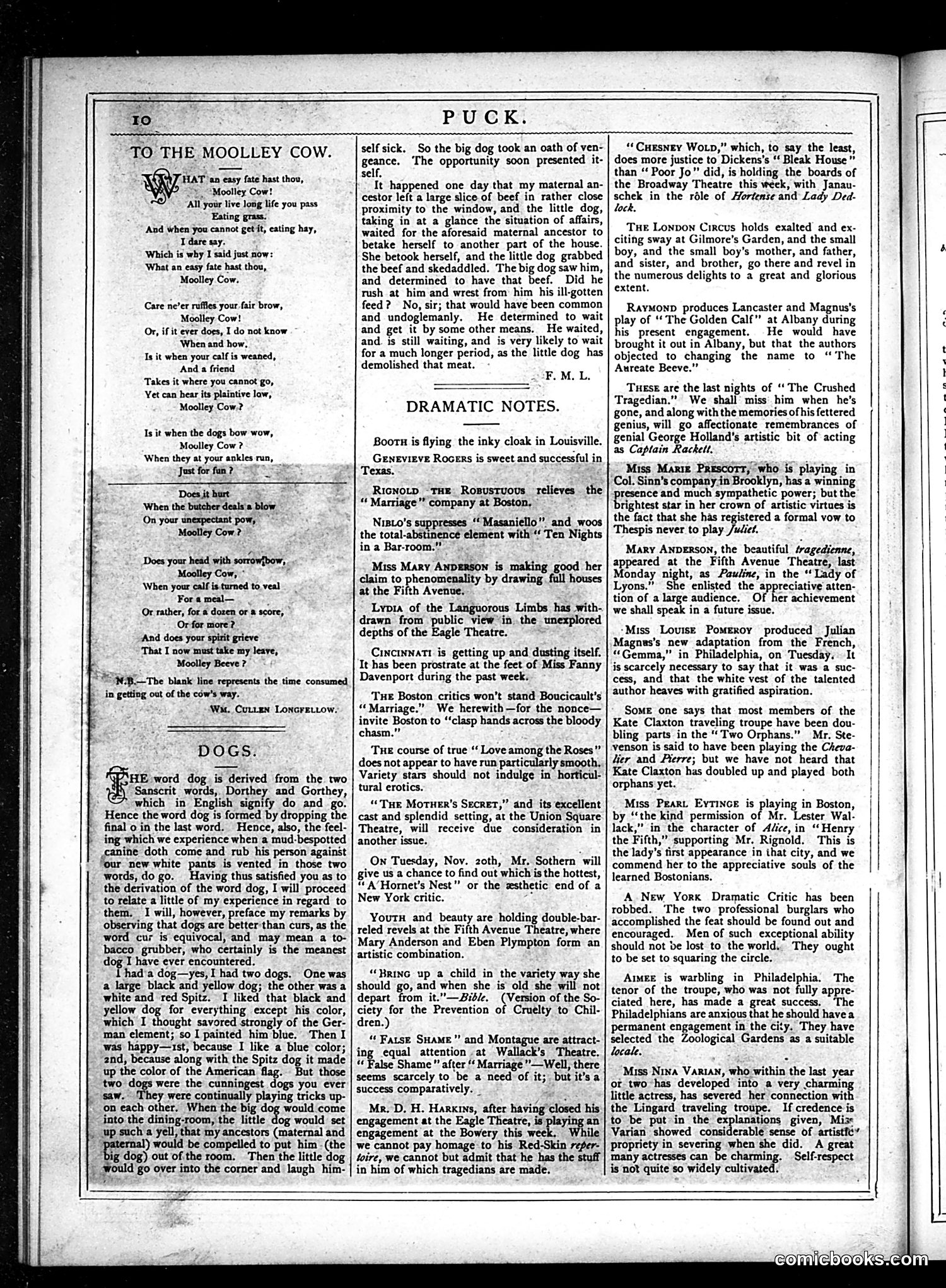
This page contains **three distinct pieces**: a poem titled "To the Moolley Cow," a section called "Dramatic Notes" reviewing theatrical performances, and an article titled "Dogs" discussing the etymology and characteristics of dogs. The "Dramatic Notes" section appears to be **theater criticism** rather than political satire, reviewing contemporary stage productions and actors of the period. References include Miss Mary Anderson, Booth, and various theatrical companies. The "Dogs" article is a **humorous etymological essay** about the word "dog" and dog behavior, with personal anecdotes about the author's experiences with dogs. **No political cartoons are visible** on this page. This appears to be a content page from Puck magazine featuring literary/cultural commentary rather than visual satire or caricature.
📄 Transcribed text from this page (OCR, searchable)
Machine-transcribed from the original scan — historical spelling and the odd misread are preserved.
PUCK. TO THE MOOLLEY Cow. FIAT an easy fate hast thou, 2y_“Moolley Cow! ‘All your live lonig life you pass Eating grass. ‘And when you cannot getit, eating hay, Tare say. ‘Which is why I said just now: What an easy fate hast thou, Moolley Cow. Care ne’er ruffles your fair brow, Moolley Cow! Or, if it ever dogs, I do not know ‘When and how, Is it when your calf is weaned, And a friend Takes it where you cannot go, Yet can hear its plaintive low, Moolley Cow? Is it when the dogs bow wow, Moolley Cow ? When they at your ankles run, Jost for fan? . Does it hurt ‘When the butcher deals'a blow. ‘On your unexpectant pow, Moolley Cow ? Does your head with sorrowfbow, Moolley Cow, * ‘When your calf is. turned to veal For a meal— Z Or rather, for @ dozen or a score, Or for more? ‘And does your spirit grieve That I now must take my leave, Moolley Beeve ? *SSFEB The blank line represents the time consumed in getting out of the cow's way. Wx. Cutten Loncretiow. DOGS. ‘HE word dog is derived from the two Sanscrit words, Dorthey and Gorthey, which in English signify do and go. Hence the word dog is formed by dropping the final o in the last word. Hence, also, the feel- ing which we experience when a mud-bespotted canine doth come and rub his yn against Your new white pants is vented in those two words, do go. Having thus satisfied you as to "the derivation of the word dog, I will proceed to relate a little of my experience in regard to them. I will, however, preface my remarks by observing that dogs are better than curs, as the word cur is equivocal, and may mean a to- bacco grubber, who certainly is the meanest dog. T have ever encountered. had'a dog—yes, I had two dogs. One was a large black and yellow dog; the other was a white and red Spitz. I liked that black and yellow dog for everything except his color, which I thought savored strongly of the Ger- man element; so I painted him blue. Then I was happy—rst, because I like a blue color; 2nd, because along with the Spitz dog it made up the color of the American flag. But those two dogs were the cunningest dogs you ever _ saw. were continually playing tricks up- ‘on each other. When the big dog would come into the dining-room, the little dog would set up such’a yell, that my ancestors (maternal and poems) would be compelled to put him -(the “big dog) out ofthe room. Then the little dog ) Would’ go over into the corner and laugh him- self sick. So the big dog took an oath of ven- geance. The opportunity soon presented it- self, It happened one day that my maternal an- cestor left a large slice of beef in rather close proximity to the window, and the little dog, taking in at a glance the situation of affairs, waited for the aforesaid maternal ancestor to betake herself to another part of the house. She betook herself, and the little dog grabbed the beef and skedaddled. The big dog saw him, and determined to have that beef. Did he tush at him and wrest from him his ill-gotten feed? No, sir; that would have been common and undoglemanly. He determined to wait and get it by some other means. He waited, and. is still waiting, and is very likely to wait for a much longer period, as the little dog has demolished that meat. F. M. L. DRAMATIC NOTES. Boorn is flying the inky cloak in Louisville. Genevieve Rocers is sweet and successful in Texas. RicNotp -THE: Rosustvovs relieves. the “ Marriage” company at Boston, Nisio’s suppresses ‘Masaniello”. and woos the total-abstinencé element with'‘‘ Ten Nights in a Bar-room.” Miss Mary ANDERSON is making good her claim to phenomenality by drawing full houses at the Fifth Avenue, Lypia of the Languorous Limbs has with- drawn from public view’in the unexplored depths of the Eagle Theatre. Cincinnati is getting up and dusting itself. Tt has Been’ prostrate at the feet of Miss Fanny Davenport during the past week. ‘Tue Boston critics won’t stand Boucicault’s “Marriage.” We herewith —for the nonce— invite Boston to ‘‘clasp hands across the bloody chasm.” ‘Tue course of true “ Love among the Roses” does not appear to have run particularly smooth, Variety stars should not indulge in horticul- tural erotics. ““THe MotHer's SECRET,” and its excellent cast and splendid setting, at the Union Square Theatre, will receive due consideration in another issue. On Tuesday, Nov. 2oth, Mr. Sothern will give us a chance to find out which is the hottest, “ A’Hornet’s Nest” or the zsthetic end of a New York critic. r Youtn and beauty are holding double-bar- reled revels at the Fifth Avenue Theatre, where Mary Anderson and Eben Plympton form an artistic combination. “Brinc up a child in the variety way she should go, and when she is old she will not depart from it.”—Bid/e, (veign of the So- oe the Prevention of Cruelty to Chil- ren. “ Fatse SHaMe”’ and Montague are attract- ing equal attention at Wallack’s Theatre. “ False Shame" after ‘ Marriage "—Well, there seems scarcely to be a need of it;. but it’s a success comparatively. _ Mr. D. H. Harkins, after having’closed his engagement at the Eagle Theatre, is Playing an engagement at the Bowery this weel hile we cannot pay homage to his Red-Skin reper- éoire, we cannot but admit that he has the stuff in him of which tragedians are made. “«Cuesney Wotp,” which, to say the least, does more justice to Dickens's ‘‘ Bleak House” than ‘ Poor Jo” did, is holding the boards of the Broadway Theatre this week, with Janau- schek in the réle of Hortense and Lady Ded- lock. Tue Lonpon Circus holds exalted and ex- citing sway at Gilmore’s Garden, and the small boy, and the small boy's mother, and father, and sister, and brother, go there and revel in the numerous delights to a great and glorious extent. RayMmonp produces Lancaster and Magnus's play of “The Golden Calf” at Albany during his present engagement. He would have brought it out in Albany, but that the authors objected to changing the name to “ The Aureate Beeve.”” Tuess are the last nights of ‘‘ The Crushed Tragedian.” We shall miss him when he's gone, and along with the memories ofhis fettered genius, will go affectionate remembrances of genial George Holland's artistic bit of acting as Captain Rackelt. Miss Marie Prescotr, “who is playing in Col. Sinn’s company.in Brooklyn, has a winning erence and much sympathetic power; but the rightest star in her crown of artistic virtues is the fact that she has registered a formal vow to Thespis never to play /udiet. Mary ANDERSON, the beautiful sragedienne, appeared at the Fifth Avenue Theatre, last Monday night, as Pauéine, in the “Lady of Lyons.” She enlisted the appreciative’ atten- tion of a large audience. of! her achievement we shall speak in a future issue. ‘Miss Louise Pomeroy produced Julian Magnes’s new adaptation from the French, “Gemma,” in Philadelphia, on Tuesday. It is scarcely necessary to say that it was a suc- cess, and that the white vest of the talented author heaves with gratified aspiration. Some one says that most members of the Kate Claxton traveling troupe have been dou- bling parts in the “Two Orphans.” Mr. Ste- venson is said to have been playing the Cheva- tier and Pierre; but we have not heard that Kate Claxton has doubled up and played both orphans yet. Miss Peart Eytince is playing in Boston, by ‘the kind permission of Mr. Lester Wal- lack,” in the character of Adice, in ‘Henry the Fifth,” supporting Mr. Rignold. This is the lady’s first appearance in that city, and we commend her to the appreciative souls of the learned Bostonians. A New York Dramatic Critic has been robbed. The two professional burglars who accomplished the feat should be found out and encouraged. Men of such exceptional ability should not ve lost to the world. They ought to be set to squaring the circle. Armee is warbling in Philadelphia. The tenor of the troupe, who was not fully appre- ciated here, has made a great success. The Philadelphians are anxious that he should havea permanent engagement in the city. They have selected the Zoological Gardens as a suitable locale. Miss Nina Varian, who within the last year or two has developed into a very charmi little actress, has severed her ‘connection wit! the Lingard traveling troupe. If credence is to be put in the explanations given, Mix Varian showed considerable sense of artistic’ propriety in severing when she did. A great many actresses can be charming. Self-respect is not quite so widely cultivated: