
Puck, 1877-09-19 · page 5 of 16
Puck — September 19, 1877 — page 5: what you’re looking at
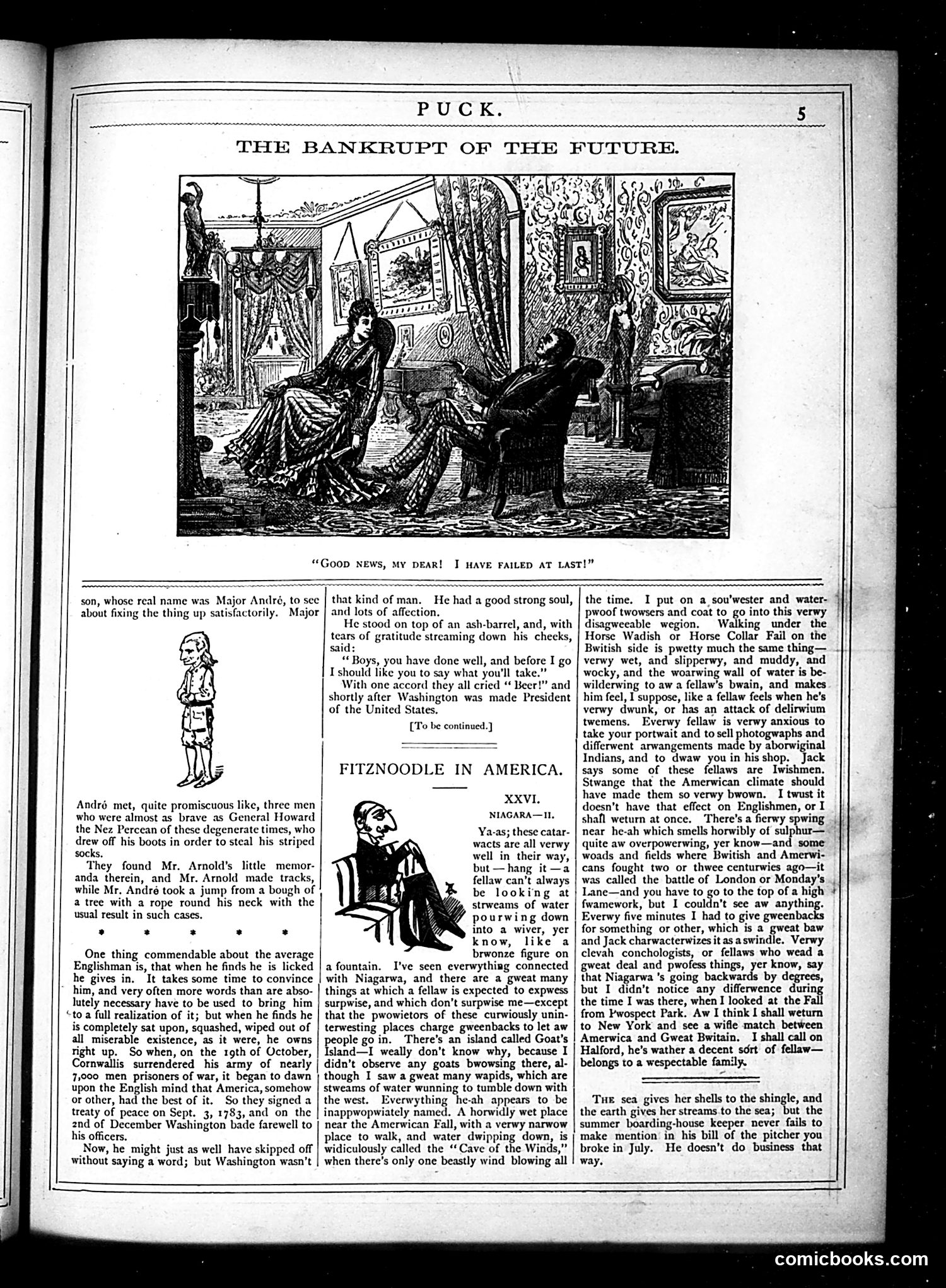
What you’re looking at
This cartoon satirizes an unnamed wealthy man (identified only as "Major André") who appears to be facing financial ruin. The illustration shows him in an ornate, lavishly decorated interior, conversing with what appears to be a creditor or financial advisor. The satire targets excessive wealth and poor financial management among the elite. The caption—"Good news, my dear! I have failed at last!"—ironically suggests relief at bankruptcy, perhaps mocking how wealthy individuals escape consequences through legal financial maneuvering that ordinary citizens cannot access. The accompanying text discusses various American travels and observations, including references to Niagara Falls and the "Cave of the Winds," suggesting this may critique American materialism and financial excess during the Gilded Age period when such satirical commentary was common in Puck magazine.
📄 Transcribed text from this page (OCR, searchable)
Machine-transcribed from the original scan — historical spelling and the odd misread are preserved.
ER “Goop NEws, MY DEAR! PUCK. THE BANKRUPT OF THE FUTURE. I HAVE FAILED AT Last!” son, whose real name was Major André, to see about fixing the thing up satisfactorily. | Major André met, quite promiscuous like, three men who were almost as brave as General Howard the Nez Percean of these degenerate times, who drew off his boots in order to steal his striped socks. They found Mr. Arnold's little memor- anda therein, and Mr. Arnold made tracks, while Mr, André took a jump from a bough of a tree with a rope round his neck with the usual result in such cases, * * * * * One thing commendable about the average Englishman is, that when he finds he is licked he gives in. It takes some time to convince ~ him, and very often more words than are abso- lutely necessary have to be used to bring him “to a full realization of it; but when he finds he is completely sat upon, squashed, wiped out of all miserable existence, as it were, he owns right up. So when, on the rgth of October, Cornwallis surrendered his army of nearly 7,000 men prisoners of war, it began to dawn upon the English mind that America, somehow or other, had the best of it. So they signed a treaty of peace on Sept. 3, 1783, and on the 2nd of December Washington bade farewell to his officers. Now, he might just as well have skipped off without saying a word; but Washington wasn’t that kind of man. He had a good strong soul, and lots of affection. He stood on top of an ash-barrel, and, with tests of gratitude streaming down his checks, said: « Boys, you have done well, and before I go I should like you to say what you'll take.” With one accord they all cried ‘¢ Beer!” and shortly after Washington was made President of the United States. [To be continued.] FITZNOODLE IN AMERICA. XXVI. NIAGARA—I1, Ya-as; these catar- wacts are all verwy well in their way, but — hang it —a fellaw can’t always be looking at strweams of water pourwing down into a wiver, yer know, like a brwonze figure on a fountain. I’ve seen everwythiag connected with Niagarwa, and there are a gweat many things at which a fellaw is expected to expwess surpwise, and which don’t surpwise me—except that the pwowietors of these curwiously unin- terwesting places charge gweenbacks to let aw people goin. There's an island called Goat's island—I weally don’t know why, because I didn’t observe any goats bwowsing there, al- though I saw a gweat many wapids, which are stweams of water wunning to tumble down with the west. Everwything he-ah appears to be inappwopwiately named. A horwidly wet place near the Amerwican Fall, with a verwy narwow place to walk, and water dwipping down, is widiculously called the ‘Cave of the Winds,” when there's only one beastly wind blowing all the time. I put on a_sou'wester and water- pwoof twowsers and coat to go into this verwy disagweeable wegion. Walking under the Horse Wadish or Horse Collar Fail on the Bwitish side is pwetty much the same thing— }. verwy wet, and slipperwy, and muddy, and wocky, and the woarwing wall of water is be- wilderwing to aw a fellaw’s bwain, and makes him feel, I suppose, like a fellaw feels when he’s verwy dwunk, or has an attack of delirwium twemens. Everwy fellaw is verwy anxious to take your portwait and to sell photogwaphs and differwent arwangements nade by aborwiginal Indians, and to dwaw you in his shop. Jack says some of these fellaws are Iwishmen. Stwange that the Amerwican climate should have made them so verwy bwown. I twust it doesn’t have that effect on Englishmen, or I shafl weturn at once. near he-ah which smells horwibly of sulphur— quite aw overpowerwing, yer know—and some woads and fields where Bwitish and Amerwi- cans fought two or thwee centurwies ago—it was called the battle of London or Monday's Lane—and you have to go to the top of a high fwamework, but I couldn't see aw anything. Everwy five minutes I had to give gweenbacks for something or other, which is a gweat baw and Jack charwacterwizes it as aswindle, Verwy clevah conchologists, or fellaws who wead a gweat deal and pwofess things, yer know, say that Niagarwa 's going backwards by degrees, but I didn’t notice any differwence coring the time I was there, when I looked at the Fi from Pwospect Park. Aw I think I shall weturn to New York and see a wifle match between Amerwica and Gweat Bwitain. I shall call on Halford, he’s wather a decent sort of fellaw— belongs to a wespectable family. Tue sea gives her shells to the shingle, and the earth gives her streams.to the sea; but the summer boarding-house keeper never fails to make mention in his bill of the pitcher you broke in July. He doesn’t do business that way, comicbooks.com } i There's a fierwy spwing