
Puck, 1877-09-19 · page 4 of 16
Puck — September 19, 1877 — page 4: what you’re looking at
What you’re looking at
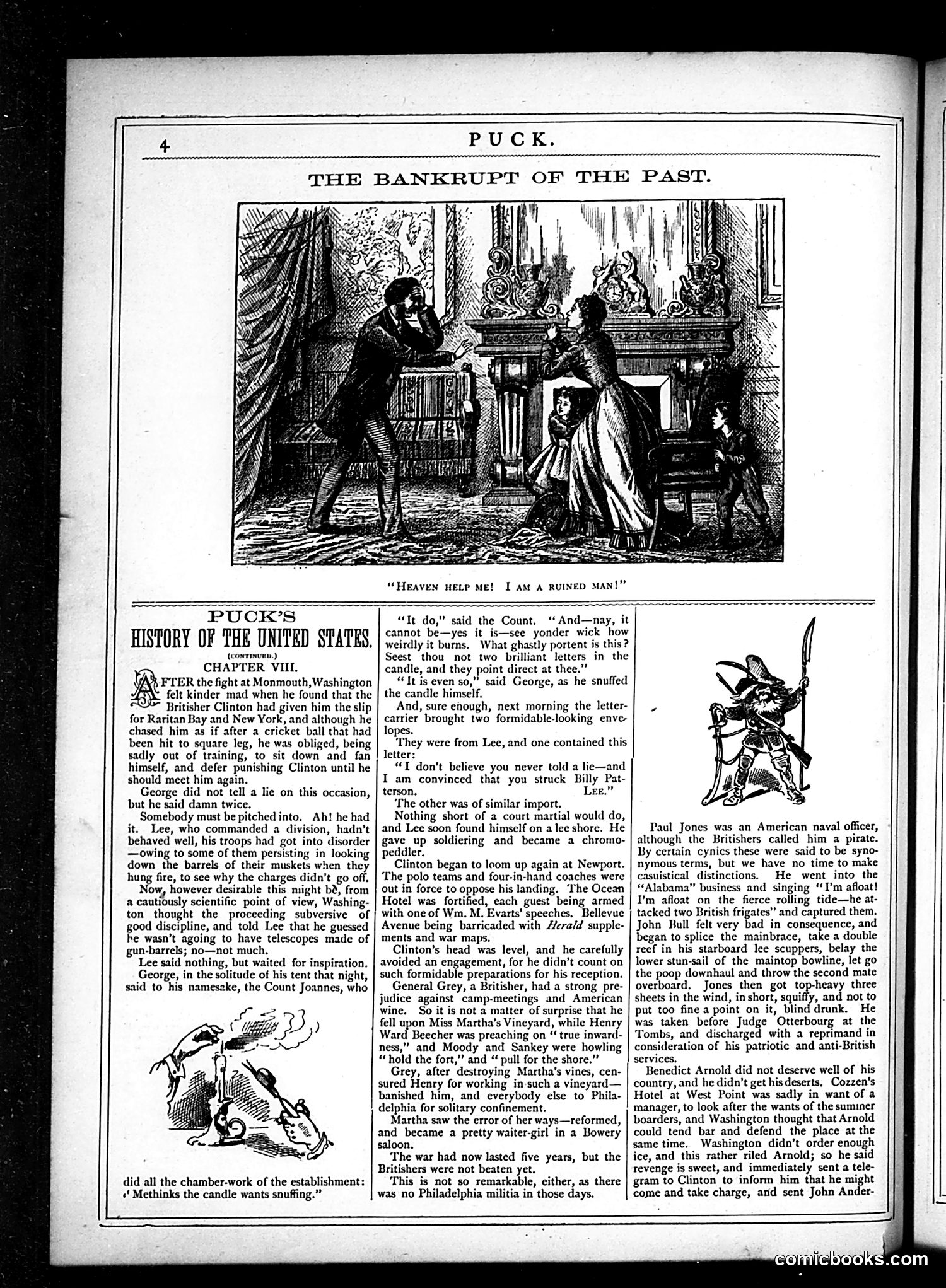
This satirical illustration depicts a financial crisis scene, likely from the late 19th century. A distressed man (center) cries "Heaven help me! I am a ruined man!" while creditors or officials surround him in an elegant interior. The accompanying text references American Revolutionary War figures—General Lee, Paul Jones, and others—in what appears to be a historical narrative about financial mismanagement and military conduct. The satire seems to critique either failed financial ventures or the legacy of historical figures whose reputations or fortunes have collapsed. The cartoon's title "The Bankrupt of the Past" suggests Puck is mocking someone whose former prestige or power has evaporated, using historical allusions to heighten the irony of their current ruin.
📄 Transcribed text from this page (OCR, searchable)
Machine-transcribed from the original scan — historical spelling and the odd misread are preserved.
PUCK. THE BANKRUPT OF THE PAST. “HEAVEN HELP ME! I aM A RUINED MANI”” PUCK’ HISTORY OF THE UNITED STATES. (comrimurn.) CHAPTER VIII. FTER the fight at Monmouth, Washington felt kinder mad when he found that the Britisher Clinton had given him the slip for Raritan Bay and New York, and although he chased him as if after a cricket ball that had been hit to square leg, he was obliged, being sadly out of training, to sit down and fan himself, and defer punishing Clinton until he should meet him again. George did not tell a lie on this occasion, but he said damn twice. Somebody must be pitched into. Ah! he had it. Lee, who commanded a division, hadn’t behaved well, his troops had got into disorder —owing to some of them persisting in looking down the barrels of their muskets when they hung fire, to see why the charges didn’t go off. Now, however desirable this might b%, from a cautiously scientific point of view, Washing- ton thought the _proceenDg. subversive of good discipline, and told Lee that he guessed he wasn’t agoing to have telescopes made of gun-barrels; no—not much. Lee said nothing, but waited for inspiration. George, in the solitude of his tent that night, said to his nameszke, the Count Joannes, who “It do,” said the Count. ‘And—nay, it cannot be—yes it is—see yonder wick how weirdly it burns. What ghastly portent is this? Seest thou not two brilliant letters in the candle, and they point direct at thee.” “It is even so,” said George, as he snuffed the candle himself. And, sure enough, next morning the letter- carrier brought two formidable-looking enve- lopes. ‘They were from Lee, and one contained this letter: “I don't believe you never told a lie—and I am convinced that you struck Billy Pat- terson, Lee.” ‘The other was of similar import. Nothing short of a court martial would do, and Lee soon found himself on a lee shore. He gave up soldiering and became a chromo- peddler. Clinton began to loom up again at Newport. The polo teams and four-in-hand coaches were out in force to oppose his landing. ‘The Ocean Hotel was fortified, each guest being armed with one of Wm. M. Evarts’ speeches. Bellevue Avenue being barricaded with Hera/d supple- ments and war maps. Clinton’s head was level, and he carefully avoided an engagement, for he didn’t count on such formidable preparations for his reception. General Grey, a Britisher, had a strong pre- judice against camp-meetings and American wine. So it is not a matter of surprise that he fell upon Miss Martha’s Vineyard, while Henry Ward Beecher was preaching on “ true inward- ness,” and Moody and Sankey were howling “hold the fort,” and “ pull for the shore.”” Grey, after destroying Martha's vines, cen- sured Henry for working in-such a vineyard— banished him, and everybody else to Phila- delphia for solitary confinement. Martha saw the error of her ways—reformed, and became a pretty waiter-girl in a Bowery saloon, ‘The war had now lasted five years, but the Britishers were not beaten yet. This is not so remarkable, cither, as there was no Philadelphia militia in those days. Paul Jones was an American naval officer, although the Britishers called him a pirate. By certain cynics these were said to be syno- nymous terms, but we have no time to make casuistical distinctions. He went into the “Alabama” business and singing “I’m afloat! I'm afloat on the fierce rolling tide—he at- tacked two British frigates” and captured them. John Bull felt very bad in consequence, and began to splice the mainbrace, take a double reef in his starboard lee scuppers, belay the lower stun-sail of the maintop bowline, let go the poop downhaul and throw the second mate overboard. Jones then got top-heavy three sheets in the wind, in short, squiffy, and not to put too fine a point on it, blind drunk. He was taken before Judge Otterbourg at the ‘Tombs, and ducharged with a reprimand in consideration of his patriotic and anti-British services. Benedict Arnold did not deserve well of his country, and he didn’t get his deserts, Cozzen’s Hotel at West Point was sadly in want of a manager, to look after the wants of the suminer boarders, and Washington thought that Arnold could tend bar and defend the place at the same time. Washington didn’t order enough ice, and this rather riled Arnold; so he said revenge is sweet, and immediately sent a tele- gram to Clinton to inform him that he might come and take charge, and sent John Ander-