
Puck, 1877-09-19 · page 6 of 16
Puck — September 19, 1877 — page 6: what you’re looking at
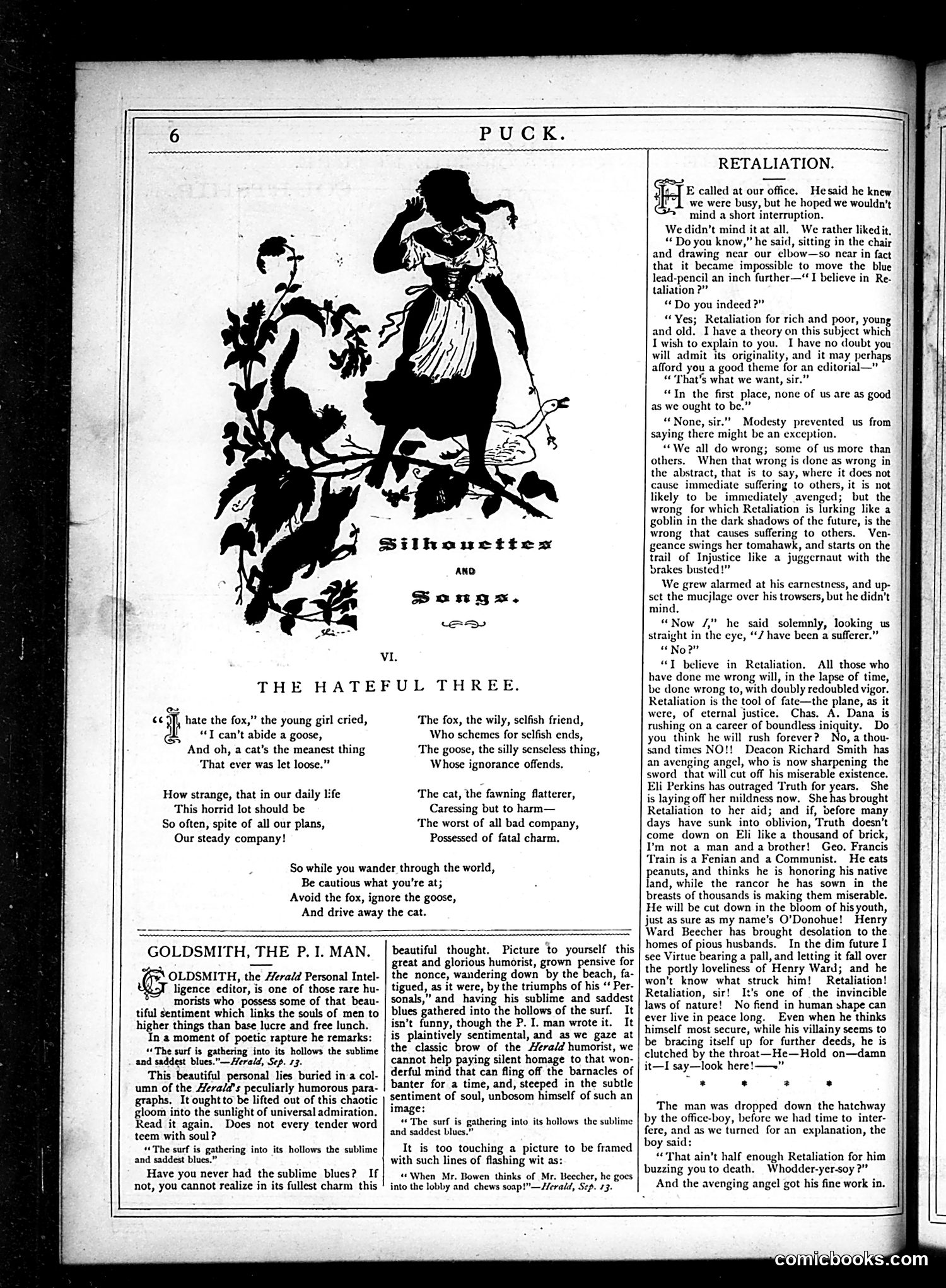
What you’re looking at
The silhouette illustration depicts a woman striking a man with a broom or stick while he cowers, labeled "Silhouettes and Songs." The accompanying article "Retaliation" presents a philosophical debate about revenge. The writer argues against retaliatory violence, using vivid metaphors: retaliation is "a goblin in the dark shadows" and "like a juggernaut with the brakes busted." The piece references specific contemporary figures—Eli Perkins, Deacon Richard Smith, and Ward Beecher—apparently involved in recent scandals or wrongs. The poem "The Hateful Three" satirizes destructive character types: the fox (selfish schemer), the goose (foolish person), and the cat (deceitful flatterer). Below, "Goldsmith, the P.I. Man" celebrates humorist Joel Chandler Harris, praising his gentle satire and "sublime blues" captured in his Herald work. Overall, the page explores themes of justice, revenge, and human character through literature and social commentary.
📄 Transcribed text from this page (OCR, searchable)
Machine-transcribed from the original scan — historical spelling and the odd misread are preserved.
Sithouecttexs AND Santygs. ea VI. THE HATEFUL THREE. hate the fox,” the young girl cried, “T can't abide a goose, And oh, a cat’s the meanest thing That ever was let loose.” ee a = How strange, that in our daily life This horrid lot should be So often, spite of all our plans, Our steady company! The fox, the wily, sclfish friend, Who schemes for selfish ends, The goose, the silly senscless thing, Whose ignorance offends. The cat, the fawning flatterer, Caressing but to harm— ‘The worst of all bad company, Possessed of fatal charm. So while you wander through the world, Be cautious what you're at; Avoid the fox, ignore the goose, And drive away the cat. GOLDSMITH, THE P. 1. MAN. % OLDSMITH, the Hera/d Personal Intel- ligence editor, is one of those rare hu- morists who possess some of that beau- tiful sentiment which links the souls of men to higher things than base lucre and free lunch. In a moment of poetic rapture he remarks: “The surf is gathering into its hollows the sublime and saddest blues."—Herald, Sep. 13. This beautiful personal lies buried in a col- umn of the Hera/d's peculiarly humorous para- graphs. It oughtto be lifted out of this chaotic gloom into the sunlight of universal admiration. Read it again. Does not every tender word teem with soul? “The surf is gathering into its hollows the sublime and saddest blues.” Have you never had the sublime blues? If not, you cannot realize in its fullest charm this beautiful thought. Picture to yourself this great and glorious humorist, grown pensive for the nonce, wandering down by the beach, fa- tigued, as it were, by the triumphs of his “ Per- sonals,” and having his sublime and saddest blues gathered into the hollows of the surf. It isn’t funny, though the P. I. man wrote it. It is plaintively sentimental, and as we gaze at the classic brow of the Herald humorist, we cannot help paying silent homage to that won- derful mind that can fling off the barnacles of banter for a time, and, steeped in the subtle sentiment of soul, unbosom himself of such an image: “The surf is gathering into its hollows the sublime and saddest blues.” It is too touching a picture to be framed with such lines of flashing wit as: “When Mr, Bowen thinks of Mr. Beecher, he gocs into the lobby and chews soap!”—Zerald, Sep. 13. RETALIATION. A E called at our office. Hesaid he knew ee we were busy, but he hoped we wouldn't mind a short interruption. We didn’t mind it at all. We rather liked it, “Do you know,” he said, sitting in the chair and drawing near our elbow—so near in fact that it became impossible to move the blue lead-pencil an inch further—‘ I believe in Re- taliation ?” “Do you indeed ?” “Yes; Retaliation for rich and poor, young and old. I have a theory on this subject which I wish to explain to you. I have no doubt you will admit its originality, and it may perhaps afford youa good theme for an editorial—” “That's what we want, sir.” “In the first place, none of us are as good as we ought to be.” “None, sir.” Modesty prevented us from saying there might be an exception. “‘We all do wrong; some of us more than others. When that wrong is done as wrong in the abstract, that is to say, where it does not cause immediate suffering to others, it is not likely to be immediately avenged; but the wrong for which Retaliation is lurking like a goblin in the dark shadows of the future, is the wrong that causes suffering to others. Ven- geance swings her tomahawk, and starts on the trail of Injustice like a juggernaut with the brakes busted!” We grew alarmed at his earnestness, and up- sct the mucjlage over his trowsers, but he didn’t mind. “Now /,” he said solemnly, looking us straight in the eye, “7 have been a sufferer.” “No?” “JT believe in Retaliation, All those who have done me wrong will, in the lapse of time, be done wrong to, with doubly redoubled vigor. Retaliation is the tool of fate—the plane, as it were, of eternal justice. Chas. A. Dana is rushing on a career of boundless i iniquity. Do you think he will rush forever? No, a thou- sand times NO!!_ Deacon Richard Smith has an avenging angel, who is now sharpening the sword that will cut off his miserable existence. Eli Perkins has outraged Truth for years. She is laying off her mildness now. She has brought Retaliation to her aid; and if, before many days have sunk into oblivion, Truth doesn’t come down on Eli like a thousand of brick, I’m not a man anda brother! Geo. Francis Train is a Fenian and a Communist. He eats peanuts, and thinks he is honoring his native land, while the rancor he has sown in the breasts of thousands is making them miserable. He will be cut down in the bloom of hisyouth, just as sure as my name’s O’Donohue! Henry Ward Beecher has brought desolation to the homes of pious husbands. In the dim future I see Virtue bearing a pall, and letting it fall over the portly loveliness of Henry Ward; and he won't know what struck him! Retaliation! Retaliation, sir! It’s one of the invincible laws of nature! No fiend in human shape can ever live in peace long. Even when he thinks himself most secure, while his villainy seems to be bracing itself up for further deeds, he is clutched by the throat—He—Hold on—damn it—I say—look here! —~” * * Fy . The man was dropped down the hatchway by the office-boy, before we had time to inter- fere, and as we turned for an explanation, the boy said: “That ain’t half enough Retaliation for him buzzing you to death. Whodder-yer-soy 2” And the avenging angel got his fine work in.