
Puck, 1877-09-19 · page 3 of 16
Puck — September 19, 1877 — page 3: what you’re looking at
What you’re looking at
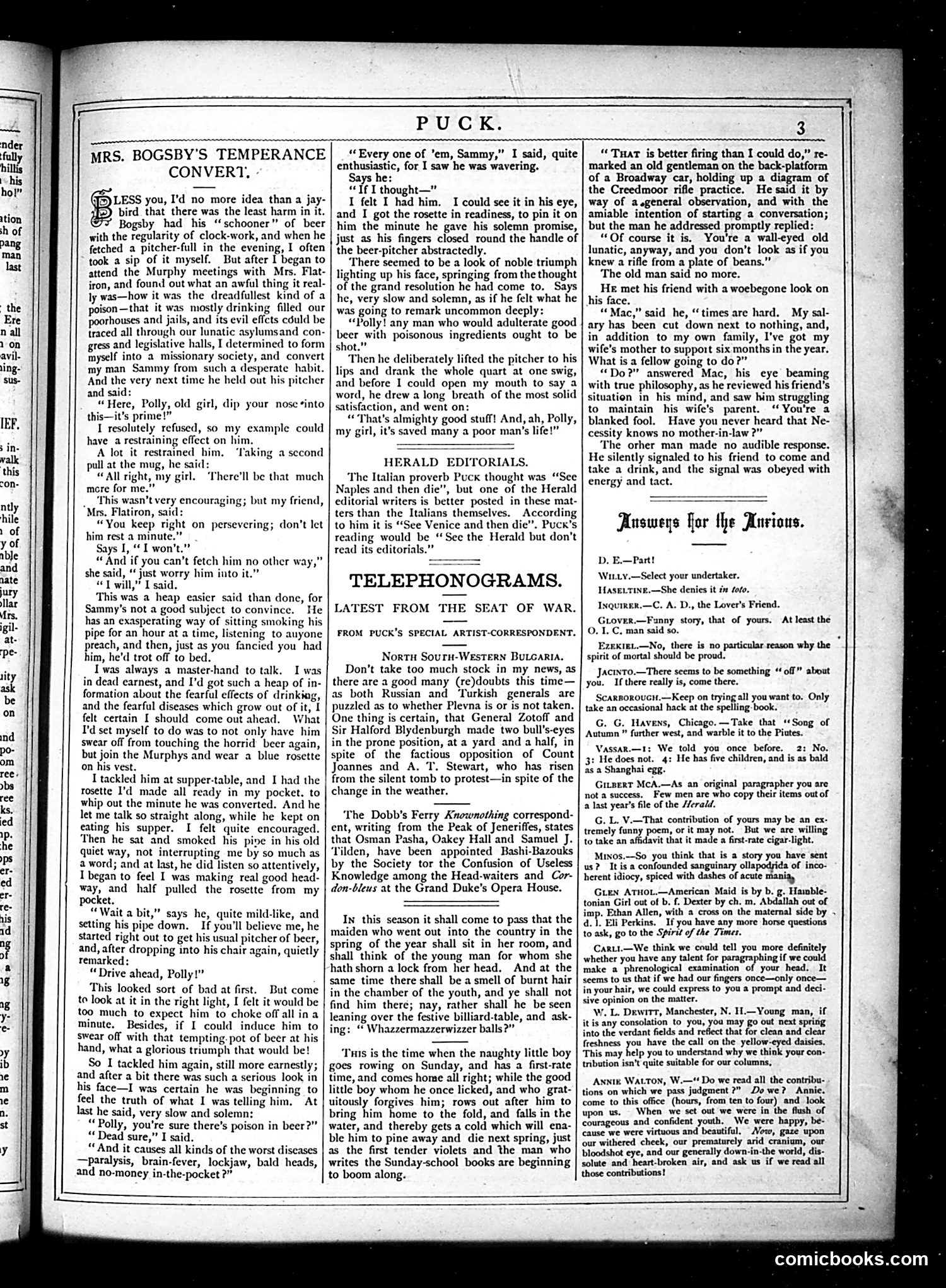
This page contains three distinct sections: 1. **"Mrs. Bogsby's Temperance Convert"** - A narrative story (not a cartoon) about a woman who converts her heavy-drinking husband to temperance through clever manipulation, eventually getting him to join a temperance society. 2. **"Herald Editorials"** - Brief editorial commentary, including a joke about an Italian proverb ("See Venice and then die") being confused with Herald editorials. 3. **"Telephonograms" and "Answers for the Anxious"** - A advice/letters column addressing reader questions on various personal matters. The page is primarily text-based rather than illustrated. It reflects Puck's satirical approach to American social issues, particularly temperance reform, which was a significant political and moral debate of the period.
📄 Transcribed text from this page (OCR, searchable)
Machine-transcribed from the original scan — historical spelling and the odd misread are preserved.
PUCK. 3 MRS. BOGSBY’S TEMPERANCE CONVERT, LESS you, I'd no more idea than a jay- bird that there was the least harm in it. Bogsby had his “schooner” of beer with the regularity of clock-work, and when he fetched a pitcher-full in the evening, I often took a sip of it myself. But after 1 began to attend the Murphy meetings with Mrs. Flat- iron, and found out what an awful thing it real- ly was—how it was the dreadfullest kind of a poison—that it was mostly drinking filled our houses and jails, and its evil effcts could be traced all through our lunatic asylumsand con- gress and legislative halls, I determined to form myself into a missionary society, and convert my man Sammy from such a desperate habit. And the very next time he held out his pitcher and said: “Here, Polly, old girl, dip your nose into this—it’s prime!” I resolutely refused, so my example could have a restraining effect on hin A lot it restrained him. ‘laking a second pull at the mug, he said: “All right, my girl. ‘There'll be that much more for me.” ___ This wasn’t very encouraging; but my friend, Mrs. Flatiron, said: “You keep right on persevering; don’t let him rest a minute.” Says I, “I won't.” “And if you can’t fetch him no other way,” she said, “just worry him into it.” “Twill,” I said. ‘This was a heap easicr said than done, for Sammy's not a good subject to convince. He has an exasperating way of sitting smoking his pipe for an hour at a time, listening to auyone preach, and then, just as you fancied you had him, he'd trot off to bed. Iwas always a master-hand to talk. I was in dead carnest, and I’d got such a heap of in- formation about the fearful effects of drinking, and the fearful diseases which grow out of it, I felt certain I should come out ahead. What I'd set myself to do was to not only have him swear off from touching the horrid beer again, but join the Murphys and wear a blue rosette on his vest. I tackled him at supper-table, and I had the rosette I'd made all ready in my pocket. to whip out the minute he was converted. And he let me talk so straight along, while he kept on eating his supper. I felt quite encouraged. Then he sat and smoked his pipe in his old quiet way, not interrupting me by so much as a word; and at last, he did listen so attentively, I began to feel I was making real good head: way, and half pulled the rosette from my pocket, “Wait a bit,” says he, quite mild-like, and setting his pipe down. If you'll believe me, he started right out to get his usual pitcher of beer, and, after dropping into his chair again, quietly remarked: “Drive ahead, Polly!” This looked sort of bad at first. But come to look at it in the right light, I felt it would be too much to expect him to choke off all ina minute. Besides, if I could induce him to swear off with that tempting. pot of beer at his hand, what a glorious triumph that would be! So I tackled him again, still more earnestly; and after a bit there was such a serious look in his face—I was certain he was beginning to feel the truth of what I was telling him, At he said, very slow and solemn: “Polly, you're sure there’s poison in beer?” “Dead sure,” I said. “And it causes all kinds of the worst diseases —Paralysis, brain-fever, lockjaw, bald heads, “Every one of ’em, Sammy,” I said, quite enthusiastic, for I saw he was wavering. Says he: “TET thought—” I felt I had him. I could see it in his eye, and I got the rosette in readiness, to pin it on him the minute he gave his solemn promise, just as his fingers closed round the handle of the beer-pitcher abstractedly. ‘There seemed to be a look of noble triumph lighting up his face, springing from the thought of the grand resolution he had come to. Says he, very slow and solemn, as if he felt what he was going to remark uncommon deeply: “Polly! any man who would adulterate good beer with poisonous ingredients ought to be shot.” Then he deliberately lifted the pitcher to his lips and drank the whole quart at one swig, and before I could open my mouth to say a word, he drew a long breath of the most solid satisfaction, and went on: “That’s almighty good stuff! And, ah, Polly, my girl, it’s saved many a poor man’s life!” HERALD EDITORIALS. ‘The Italian proverb Puck thought was “Sce Naples and then die”, but one of the Herald editorial writers is better posted in these mat- ters than the Italians themselves. According to him it is See Venice and then die”. Puck’s reading would be ‘Sec the Herald but don’t read its editorials.” TELEPHONOGRAMS. LATEST FROM THE SEAT OF WAR. FROM PUCK’S SPECIAL ARTIST-CORRESPONDENT. Nort Sourn-WesTeRN BuLcaria, Don’t take too much stock in my news, as there are a good many (re)doubts this time— as both Russian and ‘Turkish generals are puzzled as to whether Plevna is or is not taken. One thing is certain, that General Zotoff and Sir Halford Blydenburgh made two bull's-eyes in the prone position, at a yard and a half, in spite of the factious opposition of Count Joannes and A. T. Stewart, who has risen from the silent tomb to protest—in spite of the change in the weather. ‘The Dobb's Ferry Knownothing correspond- ent, writing from the Peak of Jeneriffes, states that Osman Pasha, Oakey Hall and Samuel J. ‘Tilden, have been appointed Bashi-Bazouks by the Society tor the Confusion of Useless Knowledge among the Head-waiters and Cor- don-bleus at the Grand Duke’s Opera House. In this season it shall come to pass that the maiden who went out into the country in the spring of the year shall sit in her room, and shall think of the young man for whom she hath shorn a lock from her head. And at the same time there shall be a smell of burnt hair in the chamber of the youth, and ye shall not find him there; nay, rather shall he be seen leaning over the festive billiard-table, and ask- ing: ‘ Whazzermazzerwizzer balls?” ‘Tus is the time when the naughty little boy goes rowing on Sunday, and has a first-rate time, and comes home all right; while the good little boy whom he once licked, and who_grat- uitously forgives him; rows out after him to bring him home to the fold, and falls in the water, and thereby gets a cold which wil ble him to pine away and die next spring, just as the first tender violets and the man who writes the Sunday-school books are beginning to boom along. “‘Tuar is better firing than I could do,” re- marked an old gentleman on the back-platform of a Broadway car, holding up a diagram of the Creedmoor rifle practice. He said it by way of a.general observation, and with the amiable intention of starting a conversation; but the man he addressed promptly replied: “Of course it is. You're a wall-eyed old lunatic, anyway, and you don’t look as if you knew a rifle from a plate of beans.”” The old man said no more. He met his friend with a woebegone look on his face. “Mac,” said he, “times are hard. My sal- ary has been cut down next to nothing, and, in addition to my own family, I've got my wife’s mother to support six months in the year. What is a fellow going to do?” “Do?” answered Mac, his eye beaming with true philosophy, as he reviewed his friend’s situation in his mind, and saw him struggling to maintain his wife's parent. ‘You're a blanked fool. Have you never heard that Ne- cessity knows no mother-in-law ?”” ‘The orher man made no audible response. He silently signaled to his friend to come and take a drink, and the signal was obeyed with energy and tact. Answeys for the Anricus. D, E.—Part! Wuiy.—Select your undertaker. Haseutine.—She denies it in fofo. Inquirer.—C. A. D., the Lover's Friend. Grover.—Funny story, that of yours. 1. C, man said so. -ZEKIEL.—No, there is no particular reason why the spirit of mortal should be proud. JactnTo.—There scems to be something “off” about you. If there really is, come there. Scarnoroucit.—Keep on trying all you want to. Only take an occasional hack at the spelling-book. G. G. Havens, Chicago.—Take that ‘Song of Autumn ” further west, and warble it to the Pintes. Vassar.—t: We told you once before. 2: No. 3: He does not. 4: He has five children, and is as bald as a Shanghai egg. Guaert McA.—As an original paragrapher you are not a success, Few men are who copy their items out of a last year’s file of the /erald. G. L. V.—That contribution of yours may be an ex- tremely fanny poem, or it may not, But we are willing to take an afidavit that it made a first-rate cigar-light. —So you think that is a story you have sent ‘a confounded sanguinary ollapodyida of inco- herent idiocy, spiced with dashes of acute mania, Guten AtHoL.—American Maid is by b. g. Hainble- tonian Girl out of b. f, Dexter by ch. m. Abdallah out of imp. Ethan Allen, with a cross on the maternal side by ai. you have any more horse questions to ask, goto the Spirit of the Times. Cartt.—We think we could tell you more definitely whether you have any talent for paragraphing if we could make a phrenological examination of your head. It seems to us that if we had our fingers once—only once— in your hair, we could express to you a prompt and deci- sive opinion on the matter. LL, DEwItt, Manchester, N. H.—Young man, if s any consolation to you, you may go out next spring 0 the verdant fields and reflect that for clean and clear freshness you have the call on the yellow-eyed daisies. This may help you to understand why we think your con- tnbution isn’t quite suitable for our columns, At least the Annie, WALTON, W.—'" Do we read all the contribu- tions on which we pass judgment 2” Do we? Annie. come to this office (hours, from ten to four) and look upon us. When we set out we were in the flush of courageous and confident youth. We were happy, be- cause we were virtuous and beautiful. Now, gaze upon ‘our withered cheek, our prematurely arid cranium, our Bloodshot eye, and our generally down-in-the world, dis- solute and heart-broken air, and ask us if we read all those contributions! and no-money in-the-pocket ?” comicbooks.com