
Puck, 1877-05 · page 6 of 16
Puck — May 1877 — page 6: what you’re looking at
What you’re looking at
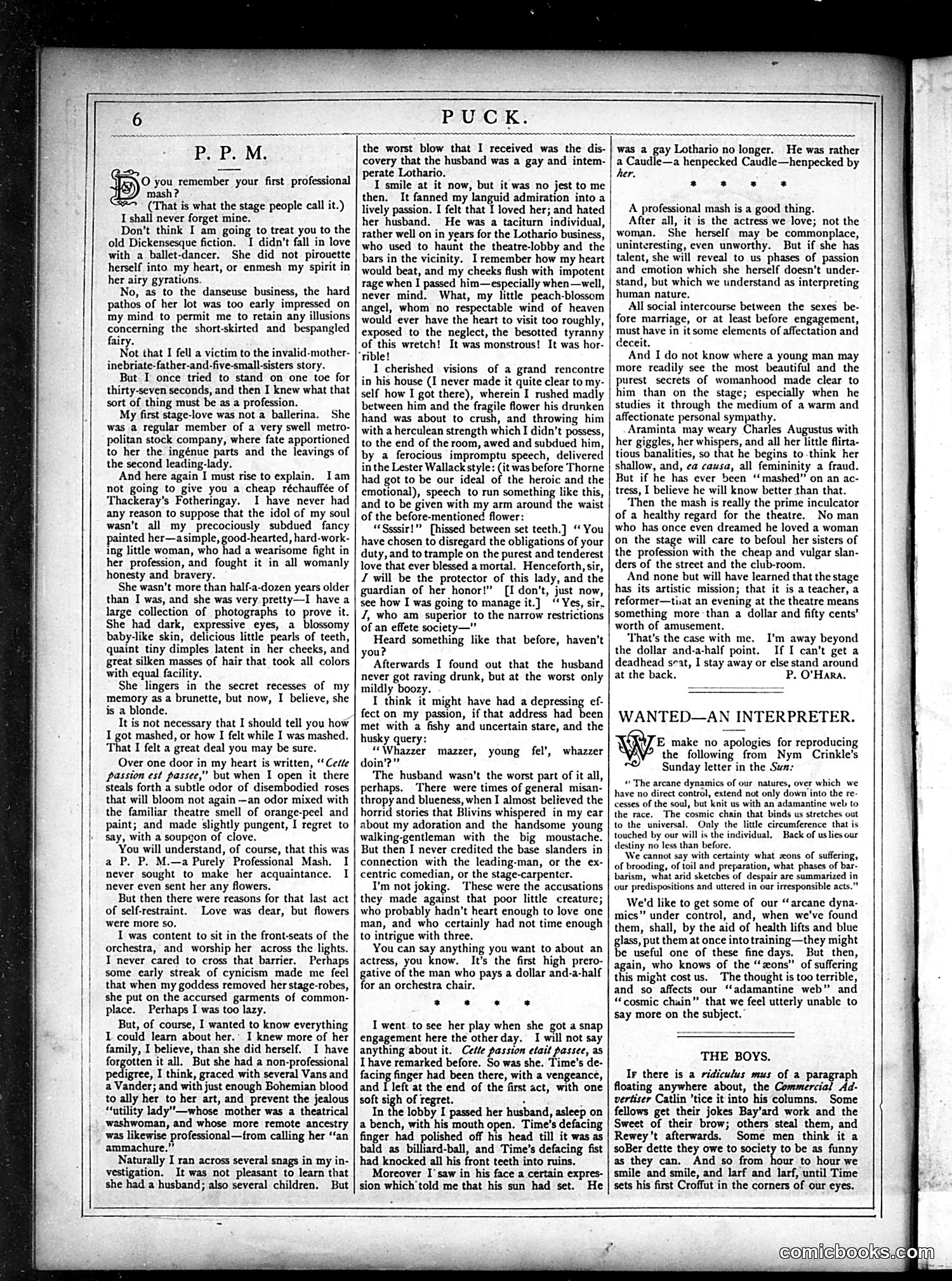
This page consists primarily of **text articles rather than cartoons**. The main content includes: 1. **"P.P.M."** - A personal essay about the author's experiences in theater, discussing her professional work as an actress and various romantic entanglements with theatrical figures, including references to a "Lothario" and conflicts with other performers. 2. **"WANTED—AN INTERPRETER"** - Commentary on Nym Crinkle's theater criticism, discussing the challenges of theatrical production and artistic interpretation. 3. **"THE BOYS"** - A brief note about theatrical humor and comedy routines. The page functions as **satirical commentary on theater life and personalities** rather than visual political satire. It reflects Puck's use of humor to critique theatrical society, professional conduct, and artistic pretension of the era.
📄 Transcribed text from this page (OCR, searchable)
Machine-transcribed from the original scan — historical spelling and the odd misread are preserved.
P. P. M. O you remember your first professional mash? (That is what the stage people call it.) I shall never forget mine. Don’t think I am going to treat you to the old Dickensesque fiction. I didn’t fall in love with a ballet-dancer. She did not pirouette herself into. my heart, or enmesh my spirit in her airy gyrations. No, as to the danseuse business, the hard pathos of her lot was too early impressed on my mind to permit me to retain any illusions concerning the short-skirted and bespangled fairy. Not that I fell a victim to the invalid-mother- inebriate-father-and-five-small-sisters story. But. I once tried to stand on one toe for thirty-seven seconds, and then I knew what that sort of thing must be as a profession. My first stage-love was not a ballerina. She was a regular member of a very swell metro- politan stock company, where fate apportioned to her the ingénue parts and the leavings of the second leading-lady. And here again I must rise to explain. Iam not going to give you a cheap réchauffée of ‘Thackeray's Fotheringay. I have never had any reason to suppose that the idol of my soul wasn’t all my precociously subdued fancy inted her—a simple, good-hearted, hard-work- ing little woman, who had a wearisome fight in her profession, and fought it in all womanly honesty and bravery. She wasn’t more than half-a-dozen years older than I was, and she was very pretty—I have a large collection of photographs to prove it. She had dark, expressive eyes, a blossomy baby-like skin, delicious little pearls of teeth, quaint tiny dimples latent in her cheeks, and great silken masses of hair that took all colors with equal facility. She lingers in the secret recesses of my memory as a brunette, but now, I believe, she is a blonde. It is not necessary that I should tell you how I got mashed, or how I felt while I was mashed. That I felt a great deal you may be sure. Over one door in my heart is written, “Cefle passion est passee,” but when I open it there steals forth a subtle odor of disembodied roses that will bloom not again —an odor mixed with the familiar theatre smell of orange-peel and paint; and made slightly pungent, I regret to say, with a soupgon of clove. You will understand, of course, that this was a P. P. M.—a Purely Professional Mash. I never sought to make her acquaintance. I never even sent her any flowers. But then there were reasons for that last act of self-restraint. Love was dear, but flowers were more so. I was content to sit in the front-seats of the orchestra, and worship her across the lights. I never cared to cross that barrier. Perhaps some early streak of cynicism made me feel that when my goddess removed her stage-robes, she put on the accursed garments of common- place. Perhaps I was too lazy. But, of course, I wanted to know everything 1 could learn about her.’ I knew more of her family, I believe, than she did herself. I have forgotten it all. But she had a non-professional pedigree, I think, graced with several Vans and a Vander; and with just enough Bohemian blood to ally her to her art, and prevent the jealous “atility lady"—whose mother was a theatrical washwoman, and whose more remote ancestry was likewise Professional—from calling her ‘an ammachure.’ Naturally I ran across several snags in my in- vestigation. It was not pleasant to learn that she had a husband; also several children. But PUCK. the worst blow that I received was the dis- covery that the husband was a gay and intem- perate Lothario. I smile at it now, but it was no jest to me then. It fanned my languid admiration into a lively passion. I felt that I loved her; and hated her husband. rather well on in years for the Lothario business, who used to haunt the theatre-lobby and the bars in the vicinity. I remember how my heart would beat, and my cheeks flush with impotent | rage when I passed him—especially when—well, never mind. What, my little peach-blossom angel, whom no respectable wind of heaven would ever have the heart to visit too roughly, exposed to the neglect, the besotted tyranny of this wretch! It was monstrous! It was hor- “rible! I cherished visions of a grand rencontre | in his house (I never made it quite clear to my- self how I got there), wherein I rushed madly between him and the fragile flower his drunken hand was about to crush, and throwing him with a herculean strength which I didn’t possess, to the end of the room, awed and subdued him, by a ferocious impromptu speech, delivered in the Lester Wallack style: (it was before Thorne had got to be our ideal of the heroic and the emotional), speech to run something like this, and to be given with my arm around the waist of the before-mentioned flower: “‘Ssssir!"” [hissed between set teeth.] ‘You have chosen to disregard the obligations of your duty, and to trample on the purest and tenderest love that ever blessed a mortal. Henceforth, sir, Z will be the protector of this lady, and the guardian of her honor!” [I don’t, just now, see how I was going to manage it.] ‘‘ Yes, sir. 7, who am superior to the narrow restrictions of an effete society—" Heard something like that before, haven’t you? Afterwards I found out that the husband never got raving drunk, but at the worst only mildly boozy. I think it might have had a depressing ef- fect on my passion, if that address had been met with a fishy and uncertain stare, and the husky query “Whazzer mazzer, doin?” The husband wasn’t the worst part of it all, perhaps. There were times of general misan- thropy and blueness, when I almost believed the horrid stories that Blivins whispered in my car about my adoration and the handsome young walking-gentleman with the big moustache. But then I never credited the base slanders in connection with the leading-man, or the ex- centric comedian, or the stage-carpenter. I'm not joking. ‘These were the accusations they made against that poor little creature; who probably hadn't heart enough to love one man, and who certainly had not time enough to intrigue with three. You can say anything you want to about an actress, you know. It’s the first high prero- gative of the man who pays a dollar and-a-half for an orchestra chair. * 8 © 28 young fel’, whazzer I went to see her play when she got a snap engagement here the otherday. I will not say anything about it. Celle passion etait passe, as Ihave remarked before. So was she. Time's de- facin finger had been there, with a vengeance, left at the cad) of the first act, with one wt Pe ne I her hi ‘band, asl ¢ lol passed er hus! leep on a peach with his mouth open. Time’s defacing finger had polished off his head till it was as bald as billiard-ball, and Time's defacing fist had knocked all his front teeth into ruins. Moreover I’ saw in his face a certain expres- sion which'told me that his sun had set. He He was a taciturn individual, | | woman. was a gay Lothario no longer. He was rather a Caudl fea henpecked Caudle—henpecked by er. Sere see A professional mash is a good thing. After all, it is the actress we love; not the She herself may be commonplace, uninteresting, even unworthy. But if she has talent, she will reveal to us phases of passion and emotion which she herself doesn’t under- stand, but which we understand as interpreting human nature. All social intercourse between the sexes be- fore marriage, or at least before engagement, must have in itsome elements of affectation and ceceit. And I do not know where a young man may more readily see the most beautiful and the purest secrets of womanhood made clear to him than on the stage; especially when he studies it through the medium of a warm and affectionate personal sympathy. Araminta may weary Charles Augustus with her giggles, her whispers, and all her little flirta- tious banalities, so that he begins to-think her shallow, and, ¢a causa, all femininity a fraud. But if he has ever been “mashed” on an ac- tress, I believe he will know better than that. ‘Then the mash is really the prime inculcator of a healthy regard for the theatre. No man who has once even dreamed he loved a woman on the stage will care to befoul her sisters of the profession with the cheap and vulgar slan- ders of the street and the club-room. And none but will have learned that the stage has its artistic mission; that it is a teacher, a reformer—tiat an evening at the theatre means something more than a dollar and fifty cents’ worth of amusement. ‘That's the case with me. I’m away beyond the dollar and-a-half point. If I can’t get a deadhead seat, I stay away or else stand around at the back. P. O'Hara. WANTED—AN INTERPRETER. E make no apologies for reproducing the following from Nym Crinkle’s Sunday letter in the Sun: «The arcane dynamics of our natures, over which we have no direct control, extend not only down into the re- cesses of the soul, but knit us with an adamantine web to the race. The cosmic chain that binds us stretches out to the universal. Only the little circumference that is touched by our will is the individual, Back of uslies our destiny no less than before. ‘We cannot say with certainty what ons of suffering, of brooding, of toil and preparation, what phases of bar: barism, what arid sketches of despair are summarized in our predispositions and uttered in our irresponsible acts.” We'd like to get some of our “arcane dyna- mics” under control, and, when we've found them, shall, by the aid of health lifts and blue glass, put them at once into training—they might be useful one of these fine days. But then, again, who knows of the “‘zons” of suffering this might cost us. The thought is too terrible, and so affects our ‘‘adamantine web” and “cosmic chain” that we feel utterly unable to say more on the subject.” THE BOYS. Ir there is a ridicudus mus of a paragraph floating anywhere about, the Commercial Ad- vertiser Catlin 'tice it into his columns. Some fellows get their jokes Bay’ard work and the Sweet of their brow; others steal them, and Rewey't afterwards. Some men think it a soBer dette they owe to pociely to be as funny as they can. And so from hour to hour we smile and smile, and larf and larf, until Time sets his first Croffut in the corners of our eyes.